おける 共同学習とディープラーニング促進へ向け た取り組み
著者 Kodate Azusa
雑誌名 神田外語大学紀要
号 30
ページ 415‑434
発行年 2018‑03
URL http://id.nii.ac.jp/1092/00001489/
Reconstructing a Peer Tutorial Programme:
Towards Cooperative, Deep Learning in Japanese Tertiary Education
Azusa Kodate
Across many tertiary institutions and academic programmes, there is a widely held feeling that:
‘Whereas lectures and tutorials might have worked in the good old days(…), they may not work so well today.’
(Biggs & Tang, 2011, p.27)
and this feeling has prompted wide ranging educational reforms and innovations in recent years. The reformation of the national curricula and university entrance exams and the promotion of “active learning” (MEXT, 2016) are examples in Japanese context.
The peer tutorial programme at the Academic Success Center (ASC) at Kanda University of International Studies (KUIS) can also be seen as a response to the challenge of finding appropriate ways of promoting effective learning in a tertiary context.
However, the results of observations and surveys conducted with participants in the programme to date, suggest that this is work in progress and that improvements need to be made, especially with regard to cooperative learning and the development of metacognitive skills among students.
In this paper, suggestions for revision to the peer tutorial programme will be given based on theories and practices in field of cooperative learning, as well as frameworks
that help embed systematic development of linguistic ability and understanding in the programme design processes. Practical applications and insights will also be discussed.
1. History and definition of peer tutoring
The explicit or implicit aim of much higher education is the development of students’
cognitive abilities, and active, co-operative peer learning is no exception to this principle.
(Falchikov, 2001, p.86)
According to Falchikov (2001), peer tutoring is a very old practice, traceable back at least as far as the ancient Greeks. Ancient definitions of peer tutoring perceived the peer tutor as a teacher substitute, whose role was to transmit knowledge to tutees in a linear model. Later, it was realised that peer tutoring interaction was qualitatively different from that of teacher-student. As a result of conceptual development and research from different disciplines over the decades, one current definition of peer tutoring suggests something broader and more complex: people from similar social groupings who are not professional teachers helping each other to learn and learning themselves by teaching (Topping, 2005, p.631)
Jean Piaget (1971) questioned the “knowledge-copy” style as the dominant inspiration for many educational methods and suggested that it could even be an impediment to nurturing cognitive abilities. Piaget believed that cooperation between peers encourages exchange of thought and discussion at a deeper level and help them develop their cognitive skills.
Piagetian cognitive developmental theory has gained expression in educational practice and McCormick and Pressley (1997), suggest the following ways to translate the belief into actual practice:
Diagnose students’ current developmental stages so that developmentally appropriate assignments and instruction can be given.
Design instructions so that students are active participants in their own learning.
Construct learning environments conducive to exploration by students.
Make students aware of conflicts between their approaches to problems and the features of the problems. Probing questions should be asked. Present counterexamples, and point out inconsistencies that may lead to disequilibration.
Reduce adult power as much as possible. Foster collaboration with peers who have mutual interests.
Encourage children to think in their own ways. Analyse students’ errors to gain a better understanding of their thought processes.
McCormick and Pressley (1997, pp.160-161)
Piagetian theory is useful to understand situations characterised by cognitive conflict and focuses on the social interactions around which this occurs.
Vygotskian cognitive developmental theory is also useful to understand the intersect between cognition and social context. Vygotsky suggests that learning takes place as individuals interact with others and come to understand concepts and ideas beyond their capacity as individual agents. He describes this zone of proximal development (ZPD) as:
The distance between the actual developmental level as determined by independent problem solving and the level of potential development as determined through problem solving under adult guidance, or in collaboration with more capable peers.
(Vygotsky, 1978, p.86) Doolittle (1995) elucidated the application of Vygotskian theory in cooperative learning
Creating classroom exercises that require social interaction with peers, parents, teachers or professionals
Providing opportunities for verbal interactions
Constructing activities that are designed to stimulate both behavioural change and cognitive/metacognitive change
Doolittle (1995, pp.20-23)
Both Piagetian constructivism and Vygotskian social constructivist theories consider cooperative peer learning to have important roles in fostering cognitive development.
These educational principles and beliefs are reflected in the practices of the peer tutorial programme at the ASC at KUIS in the belief that learners derive advantage from this.
2. Advantages of peer tutoring
Beyond the purely theoretical aspects, a number of scholars highlight concrete benefits deriving from cooperation between peers in the learning process.
Biggs and Tang (2011) suggests that cooperative learning can eliminate uncertainty by extensive examinations of learning contents initiated by students; develop awareness of interpretations of others; and activate metacognitive skills.
According to Biggs and Tang (2011), small group peer tutorials are one of the most common styles of cooperative learning today. Peer learning that takes place in small group is said to maximise the effectiveness of peer learning (Johnson and Johnson 1989;
Johnson, Johnson and Holubec, 1998) mainly due to the requirement for individual contribution and amount of input students can get from peers.
Goodlad and Hirst (1990) and Topping (2005) also point to affective advantages, as peer tutors can be more approachable, sympathetic and empathetic towards tutees than professional teachers, making students feel more at ease. They additionally suggest that
peer tutoring can impose a strong sense of social responsibility among tutors because they tend to fear loss of face to their peers. Thus their degree of commitment tends to be higher than that of tutees’. This in turn can help promote learning.
In considering benefits for tutors, peer tutoring is often promoted on the grounds that teaching is to learn twice (Topping & Ehly, 2009). To give an example, Annis (1983) conducted a study on the effectiveness of peer tutoring, which suggested that students who were required to read and teach about a topic learned more than those tasked with reading alone, and those who read and prepared to teach, but did not carry out the act of teaching.
Greenwood, Carta, and Kamps (1990) and Topping (1996) also emphasised benefits for tutees. According to their studies, peer tutoring can help promote an active attitude and enhance interactive, participative learning. Their findings also suggested that the immediate feedback tutees can receive from peers in spontaneous interaction may lower tutees’ anxiety and increase their motivation and confidence.
Akita (2007, p.139) called peer tutoring “co-beneficial learning (sokei gakushu)”, also highlighting benefits for both tutors and tutees. Akita proposed that tutors conceptualise and reconceptualise their abstract understanding through critically evaluating their own knowledge. Simultaneously tutees receive timely advice from peers, and refine their understandings through the observation of their peers.
Other reports on the positive influence on tutees by the National Center for Supplemental Instruction (1994), Topping (1996), and Chalmers and Kelly (1997) all reported increases in academic achievement by students who participated in peer tutoring programmes as tutees.
3. The Peer Tutorial Programme at the Academic Success Center at KUIS
In its current format, the Peer Tutorial Programme at KUIS aims to boost students’
achievement in areas of academic, language communication, and language examinations.
In order to achieve this, the programme aims to promote, among students, a firm understanding of English grammar and vocabulary; to nurture skills and attitude towards deep learning; to help them develop cognitive and metacognitive skills; and to critically and effectively act to direct their own learning.
In semester 1 of 2017, 38 tutors and 141 tutees were enrolled in the programme. The table below shows the number of tutorial groups formed and the breakdown of these groups according to their study concentration.
Number of tutorial groups (i.e. Cumulative number of tutors)
Stream
19 Basic English
21 TOEFL 8 TOEIC
Logistics
At the ASC, peer group tutorials are carried out in small groups with a maximum of four participants in each group.
Each group meets on a weekly basis. Through repeated group activities, trust and friendly culture can develop (Yasunaga, 2015), and collaboration and co-operation can thrive among group members. Such a friendly atmosphere is said to enhance creative attitude and achievement in learning, stimulating intrinsic motivation for learning(Deci
& Ryan, 1985).
As Kelly (2001) observes, Japanese people tend to consider a group not just simply a gathering of individuals who work on the same task, but they tend to associate a group to their identity and loyalty developing from the value placed on interdependence among group members, and this drives Japanese people’s motivation to give priority to the accomplishment of group goals. This is highly congruent to the principle idea of
“cooperative learning” where emphasis is placed on its effectiveness in enhancing learning outcomes as a result of individuals seeking outcomes that are beneficial to themselves and beneficial to all other group members. Through such instructional use of small groups, cooperative learning is now widely believed to maximise students’ learning at any educational levels (Biggs & Tang, 2011).
Issues and challenges
The large number of participants in the programme suggested a real demand among students for opportunities to learn basic English, and the programme seemed to meet their needs at the outset. However, it did not take long for issues and challenges to become apparent and observations and data acquired from the programme evaluation surveys conducted at the end of semester with both tutors and tutees strongly suggested a need for modifications to aspects of the programme.
In the first instance, through session observations and comments received from tutors, it became evident that many of the Basic English tutors were struggling with actual operation of their tutorial sessions. Many commented that it was not clear what the programme was aiming for whereas the TOEFL and TOEIC programmes were straightforward in terms of their purpose (to improve student test scores). Some tutors reported that attempts to get information from their tutees about what they might want to study in the sessions, typically elicited response such as ‘I am not good at grammar so I
want to improve my grammar’. This was not helpful to tutors a diagnostic for setting learning goals.
In order to interpret and understand this situation more thoroughly and to improve the programme, an evaluation survey was carried out with all the tutors at the end of semester. The survey consisted of 21 items asking about tutors’ perception of the effectiveness of the programme operation and their own tutoring skills and experiences.
While tutors identified a broad range of issues, the discussion below focuses on four issues that were identified by a significant percentage of the Basic English tutors, namely
‘Getting tutees to talk’, ‘Getting tutees to think’, ‘Selecting the right learning materials for tutees’ and ‘Dealing with a topic I didn’t know the answer of’ (Figure 1).
Figure: 1 Main difficulties identified by tutors in the Basic English stream
0 15 30 45 60
Getting tutees to talk
Getting tutees to think
Selecting right learning materials for tutees
Dealing with a topic I didn't know the answer of
%
‘Getting tutees to talk and think’
The first issue that Basic English Tutors identified, was the difficulty that they faced in encouraging tutees to actively participate and contribute in tutorial sessions. Among the 19 tutors in the Basic English programme, 53% of tutors answered they experienced difficulties in getting tutees to talk and elaborate their thoughts and 32% of tutors answered that they experienced difficulties in getting tutees to think by themselves (Figure 1). The results indicate that a total of over 85% tutors of the Basic English stream had difficulties in facilitating co-operative group learning.
This issue was also observed in both formal (i.e. recorded sessions for training purposes) and informal observations conducted in semester 1, 2017.
‘Selecting the right learning materials for tutees’
A second issue identified by tutors and illustrated in Figure 1, was difficulty on the part of tutors in selecting the right learning resources for tutees. From informal observation, too, the centre staff also discovered that a few tutors were using textbooks that did not seem to match well with the needs of tutees, in the Basic English stream, either because of inappropriate levels of difficulty or unsuitable content.
By contrast, the process of selecting learning materials for TOEFL and TOEIC programmes where materials focus on the achievement of discrete goals (“TOEIC 990 in 30 days” “Mastering TOEIC Part 7”), makes it less complex for tutors to help students marry their learning goals with suitable learning resources.
It is clearly more complex for tutors to find learning materials for students when learning targets and goals are less well defined.
This implies that students need appropriate guidance and support in order to gain the skills necessary for understanding and developing their language learning skills and
by implication, that tutors need to develop their capacity to choose materials and provide relevant guidance on how to use them.
‘Dealing with a topic I didn’t know the answer to’
Despite the fact that the centre strongly and repeatedly emphasises the value of co- operative learning and that tutors do not have to be perfectly knowledgeable about the topics they are covering, 32% of tutors answered that they had difficulty with dealing with a topic that they did not know about (Figure 1).
As discussed earlier on, tutors tend to work hard as they fear loss of face to tutees, and they tend to achieve more in learning as a consequence (Goodlad & Hirst, 1990;
Topping, 1996). Conversely, however, they tend to feel they should have control over learning, which often leads to tutor-centred lectures, and at the same time it can potentially create undesirable perception among tutees that the tutor is superior and supplier of all the knowledge and information they want. Both tutor and tutee perceptions and conception of cooperative learning have to be developed and reinforced constantly.
This issue highlights a further difficulty of operationalising cooperative peer learning in this particular learning context.
In order to address these specific problems the centre developed and implemented an in-house materials development project for the Basic English stream with the goal of lessening difficulties for the tutoring team and promoting more effective participation by group members.
4. Implementation of materials development
Building Students’ Cooperative learning skills
For tutors to be the dominant agent in tutorial sessions diminishes the meaning and effectiveness of cooperative group learning. Through both formal and informal
observations however, it was found to be extremely common for tutors to dominate sessions by talking excessively.
Johnson and Johnson (1999, p.74) identify this as one factor that can be a potential barrier to group effectiveness, stemming from fear of losing control, fear of silence, impatience, lack of facilitation skills, time pressure, lack of tutees’ initiative/willingness to give their opinion or simply lack of tutees’ cognitive abilities regarding a subject matter.
As a means of eliminating this problem, clear instructions were included in new activities to ensure that everyone in group would have an opportunity to share their ideas in turn. Sections where both tutees and tutors are asked to give their ideas are often followed by a section to select, refine, and summarise those ideas, providing all participants with opportunities to constructively evaluate their ways of thinking.
While tutors hold some of the responsibility for the interaction however, the role of tutees cannot be overlooked. Johnson and Johnson (1999) for example, suggest that when there are a multiple people in a group working together to achieve something, individuals have a tendency to reserve their labour whereas in an individual or small group work, they tend to work harder. On the other hand however, if one group member answers, the task gets completed without requiring effort of the rest of the group members.
In order to tackle this problem, sets of instructions for tutors were designed and developed in ways that ensure various types of interaction (namely solo, pair, and group activities) are utilised in order to achieve a main task. These solo, pair and group sub tasks were designed to ease the risk felt by students and eliminate free riding. Solo activities were inserted before group activities and instructions were designed so individual students can have sufficient time to develop and clarify their answers before moving onto the group activity. Also, to encourage tutees’ participation and sense of
responsibility in learning, the beginning of each activity was designed to ensure that each group member will have assigned responsibilities such as note-taker or timekeeper.
In this way, a scaffold has been developed to ensure that the right conditions can prevail to afford opportunities for real cooperative learning.
Metacognitive learning skills
The second issue highlighted in the analysis of the survey results, relating to student’s metacognitive skills, was also addressed by the materials development project.
Metacognitive knowledge includes having an understanding of one’s own capabilities (personal knowledge), what one needs to learn (task knowledge), and how to learn it (strategy knowledge). Metacognitive regulation encompasses aspects such as self- monitoring, assessment, and adjustment in learning processes.
These were areas that students were shown to be lacking in and one of the root causes of students’ inability to appropriately set goals, select study materials, and adjust their study practices when necessary. The materials development project sought to address this problem by providing necessary signposts and guidance for students.
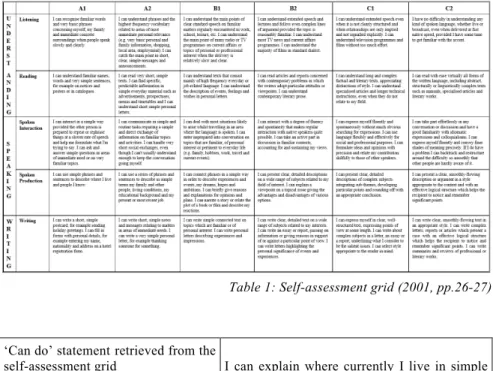
The first step in this process was to help learners clearly articulate their learning goals. As this is not a simple task, the decision was made to adopt the CEFR (Common European Framework of Reference for Languages) self-assessment grid (Council of Europe, 2001). It describes in a comprehensive way what language learners have to learn to do in order to use a language for communication and what knowledge and skills they have to develop so as to be able to learn effectively. The self-assessment grid was supplemented by ‘can do’ statements, which describe to learners specific language acts.
The materials developed for the ASC peer tutoring programme ‘can do’ statements were presented in Japanese, to actively involve students in goal-setting phase.
Additionally, these ‘can do’ statements are presented in question form so as to foster students’ active engagement (Table 2).
Table 1: Self-assessment grid (2001, pp.26-27)
Table 2: Different ways to present a ‘can do’ statement
Learners are asked to assess their ability to complete the language act as a diagnostic of their own ability. A self declared inability to carry out a language act, therefore suggests
‘Can do’ statementretrieved from the self-assessment grid
(Written in the target language)
I can explain where currently I live in simple English.
‘Can do’ statement modified for the purpose of the tutorial programme (Written in non-target language in question form)
これ、英語で自信を持って正しく言える?
「現在、私は千葉の幕張に住んでいます。」
a focus for study. At the end of each phase of study, the same ‘can do’ statement can be presented once again as a focal point for self-assessment and reflective practice.
Built into this procedure, each activity has a section called ‘Finding learning resources’. This requires students to think about what they have learned so far in the activity. It also requires them to refine their understanding of the linguistic elements necessary to achieve the learning goal represented in the ‘can do’ statement. The activity also asks students to look at the learning resource they selected and discuss how they want to use it in group learning. In this way, each group still has discretion and opportunities to explore a variety of learning resources and approaches to achieve a given learning task or goal. Thus, learning processes remain organic to a certain degree and not dominated by the supporting materials.
Through practice and training, students are expected to learn how to set a learning goal; how they can select appropriate learning resources aligned with their learning goals;
and how they can assess their ability without relying purely on a test; and actually become able to do so.
More broadly speaking, the adoption of the Common European Framework of Reference as a linguistic framework and the incorporation of ‘can do’ statements has also allowed for the ASC to make first steps toward defining levels of proficiency that will allow learners’ progress to be measured at each stage of their learning.
‘Dealing with a topic I didn’t know the answer to’
The third issue that the materials development project has sought to address is the misplaced notion that the tutors have a responsibility to be far more knowledgeable than, and able to answer all questions from tutees.
Democratizing the learning process and moving tutors away from the idea that they should be infallible sources of knowledge has also been built into the materials
development process.
Biggs and Tang (2011) propose a taxonomy of learning (Figure 2) that seeks to move students along a continuum that begins with a stage where they perhaps miss the point of learning altogether, through to a phase where they are able to generalise ideas and deal with abstractions. In addition to the linguistic framework that the CEFR provides therefore, this taxonomy informs the materials development process as a structural framework to progressively deepen students’ understanding.
Figure 2: A hierarchy of verbs that may be used to form intended learning outcomes (Biggs & Tang, 2011, p.91)
The taxonomy is also a useful tool to clarify what it means to “understand” at each stage of learning. It does not leave interpretation to individuals. Having a clearly identified activity and expectation at each learning stage also helps students be on task and provides
the tutor with some confidence to involve tutees in thinking processes. It also allows them to have peace of mind about the need not to be the dominant brain in the group.
The verbs provided in the image above were used to design each phase of a language activity and an example of how this is actually applied is given in Table 3:
Phase of SOLO
taxonomy Activity example
Unistructural - Identifying language mistakes in a given sample which is deliberately mispresented
- Identifying all the grammatical items required to correctly express the language
Multistructural - Listing some of the key grammar items to be studied as a group - Listing suitable learning resources useful for studying the selected grammar items
- Doing grammar exercises
Relational - Applying what is studied in actual communication - Analysing one’s and each other’s achievements
- Relating and explaining the success/insuccess to the cause - Applying the grammar use to a wider context beyond the language task given in the activity
Extended abstract - Theorising the grammar understanding to teach others
- Hypothesising similarities and differences between the grammar studied in the activity and related grammar
- Reflecting on one’s ability in regard to the activity objective Table 3: Example of the activity contents aligned to SOLO taxonomy
In order to help tutors get tutees to think and talk more, and challenge their understanding, a counterexample is presented in each activity. They are asked to point out inconsistencies and errors in the example and give counterproposals to correct the language. By providing opportunities for students to critically analyse the language, ask each other probing questions, the activities aim to promote a “deep approach” to learning
(Marten & Säljö, 1997). This allows students to deepen their understanding as it makes them critical about the learning topic. In turn, they are able to look at the details in attempt to understand the big picture (Biggs & Tang, 2011). This is highly congruent with the aim of the Basic English programme, which emphasises the necessity of developing students’ understanding of the basics of English.
5. Conclusion and implication
While the process of developing and honing the tutor programme is still at a relatively early stage, the issues and challenges needed to be addressed immediately to support both tutors and tutees and lessen confusion and dissatisfaction. The Basic English stream was launched with students’ needs in mind, but the result of the survey indicated an urgent need for more educational support and guidance. When universities consider implementing peer tutoring, they have to ask themselves whether they are really able to provide students with the necessary educational support. A situation where all they are doing is simply putting students together and just hoping for the best outcome needs to be avoided. Skills for facilitating cooperative learning and cultivating metacognitive learning skills do not magically grow in tutors. Providing learning materials in an attempt to promote these aspects is only a first step in tackling such challenges. The next question is how do you support tutors and provide training so they are not over-reliant on the materials provided. The importance of training and day-to-day support for tutors cannot be overstated.
References
Akita, K. (ed.). (2007). Jugyō kenkyū to danwa bunseki. Tokyo, Japan: Hōsō daigaku kyōiku shinkō kai.
Annis, F. (1983). The processes and effects of peer tutoring. Human Learning, 2, 39-47.
Biggs, J. and Tang, C. (2011). Teaching for Quality Learning at University (4th ed.).
Glasgow, UK: McGraw-Hill Education.
Chalmers, D. and Kelly, B. (1997). Peer assisted study sessions (PASS). Brisbane, Australia: Teaching and Educational Development Institute, University of Queensland.
Council of Europe. (2001). Common European Framework of Reference for Languages:
Learning, teaching, assessment. Cambridge, UK: Cambridge University Press.
Deci, E. and Ryan, R. (1985). Intrinsic Motivation and self-determination in human behavior. New York, US: Springer Science + Business Media New York.
Doolitle, E. (1995). Understanding cooperative learning through Vygotsky’s zone of proximal development. Paper presented at the Lilly National Conference on Excellence in College Teaching, Columbia, South Carolina, June 2-4, Retrieved July 29, 2017, from http://files.eric.ed.gov/fulltext/ED384575.pdf
Falchikov, N. (2001). Learning together: Peer tutoring in higher education. Oxford, UK:
Routledge Falmer.
Goodlad, S. and Hirst, B. (eds.). (1990). Exploration in peer tutoring. Oxford, UK:
Blackwell.
Greenwood, R., Carta, J. and Kamps, D. (1990). Teacher-mediated versus peer-mediated instruction: A review of educational advantages and disadvantages. In Foot, C., Morgan, J. and Shute, H. (eds.). Children helping children. London. UK: John Wiley.
Johnson, D. and Johnson, R. (1989). Cooperation and competition: Theory and research.
Minnesota, US: Interaction Book Company.
Johnson, D., Johnson, R. and Holubec, J. (1998). Cooperative learning in the classroom.
Michigan, US: Association for Supervision and Curriculum Development.
Johnson, D. and Johnson, R. (1999). Learning together and alone: Cooperative, competitive, and individualistic learning (5th ed.). Boston, US: Allyn & Bacon.
Kelly, V. (2001). Peer culture and interaction: How Japanese children express their internalization of the cultural norms of group life (shudan seikatsu). In Shimizu. H., and Levine. R. (eds.). Japanese frames of mind: Cultural perspectives on human development. Cambridge, UK: Cambridge University Press.
Marton, F. and Säljö, R. (1976). On qualitative difference in learning: Outcome and process. British Journal of Educational Psychology, 46, 4-11.
McCormick, B. and Pressley, M. (1997). Educational Psychology: learning, instruction and assessment. New York, US: Longman.
Ministry of Education, Culture, Sports, Science and Technology. (n.d.). Kōdai setsuzoku system kaikaku kaigi “Saishū hōkoku”. Retrieved July 28, 2017, from
http://www.mext.go.jp/component/b_menu/shingi/toushin/__icsFiles/afieldfile/
2016/06/02/1369232_01_2.pdf
National Center for Supplemental Instruction. (1994). Review of research concerning the effectiveness of SI. Kansas City, US: University of Missouri at Kansas City.
Piaget, J. (1971). Science of education and the psychology of the child. London, UK:
Longman.
Topping, K. (1996). The effects pf peer tutoring in further and higher education: A typology and review of the literature. Higher Education, 32, 321-345.
Topping, K. (2005). Trends in peer tutoring. Educational Psychology, 25, 631-645.
http://www.jesexpertise.be/bibb/bijlagen/trends.pdf
Topping, K. and Ehly, S. (eds.). (2009). Peer-assisted learning. Oxford, UK: Routledge.
Yasunaga, S. (2015). Kyōdō gakushū ni yoru katsudōsei no takai jugyō zukuri: Fukai henka seichō o jikkan dekiru jugyō o mezashite. In Matsushita. K. (ed.). Deep active learning: Daigaku jugyō o shinka saseru tameni. Tokyo, Japan: Keisō Shobō.