• 検索結果がありません。

Factors Affecting Cloze Test Performance

N/A
N/A
Protected

Academic year: 2021

シェア "Factors Affecting Cloze Test Performance"

Copied!
20
0
0

読み込み中.... (全文を見る)

全文

(1)

著者名(英) Daniel Jenks journal or

publication title

神田外語大学紀要

volume 23

page range 315‑333

year 2011‑03

URL http://id.nii.ac.jp/1092/00000596/

asKUIS 著作権ポリシーを参照のこと

(2)

315

TEST PERFORMANCE

Daniel Jenks

1. INTRODUCTION

!"

#

$

  The resulting data showed that the scoring methods used had little effect on

%

&

'

2. PREVIOUS CLOZE TEST RESEARCH

2.1 The cloze test

  "

#

#(

(3)

316

)

*)

*)'+,--,./0*2 )

!4"7*

)+!8"7*)9:;;/.<:*7 #

#)":;/;.,,-*"

)=,-->.:;:*

2.2 What do cloze tests measure?

  "? @A )"7:;;,.<B0*

)9,--,.>;*#

?##

C%A)E,--:.>;>*&

believed that these skills are the same as those that language users would utilise in )"7:;;,.<B0*&

second language learners highlight the correspondence between their knowledge of )"#:;//.BF*

  +

)":;;,.,,F*=

(4)

>:/

)*

)G :;;-./,* &

? A )"

7:;;,.<B;*

  %

H )"#

:;//.B<* ?7A ?A )G :;;-./>*(#

# # )I ,--,.F/,*=@

#)*

2.3 Methods of constructing cloze tests

)"

7 :;;,.</<*

K?

# A)E:;B;.>BF*=

@ )E:;0F.FF-*

? )

*A)=,-->.:;-*=

(5)

>:0

)9:;/,.:F:*

  !

H?

A )I ,--,.F0:*" ? A)9

&:;/:.>:F*?

A)"

7:;;,.</<*

2.4 Methods of marking cloze tests

  8 !4"7 +!8"7 )+ # :;/<.,<:* L

@+!8"7?

A)E:;B;.>B-*

  ##

+!8"7

?A)E:;0-.>::*

#)"#:;//.B:*&

# M, # )9:;/,.:F:*&

!4"7+!8"7

)I,--,.F/B*H

(6)

>:;

+!8"7

#)E:;0,.BB*#

)

*

2.5 Reliability and validity of cloze tests

  " +!8"7 )9:;/,.:F:*+!8"7 )9:;;/.<,*&

%

% # )E :;;-.:,<*

# @

?A

  (

?

?)=,-->.:0;*

7 )":;/;.,,B*+!8"7 !4"7 )9 :;;/.<>*"@

#M,#)=

,-->.:0;*#?#

C#%#A)E:;;-.<0*

  The remainder of this article describes an experiment carried out using two

(7)

>,-

3. TEST METHOD

3.1 Cloze test text

  :B,

%

% # &

therefore represents a sample of the kind of writing that students at this level could L

&

# understanding the text and restoring its missing words using the limited knowledge )*

""

3.2 Cloze test construction

  &

)

*&

):,*

,F@)*

(8)

>,:

3.3 Test participants

  G L

!:::,9 %"

!!

3.4 Test procedure

  + :, ? A

!G

@)

*)

*

(9)

>,, 3.5 Marking procedure

  " # #

&#?A @ L )#

*N # ? A = # + L # L K # )*)

*

4. RESULTS

  :%

# :+!8"7

!4"7

Table 1 Mean scores for both groups in their recent term test and their cloze test Term test

(out of 50)

Cloze SEMAC (out of 25)

Cloze EXACT (out of 25) Test 1 30.67

SD = 13.71

8.63 SD = 6.44

6.37 SD = 4.82 Test 2 29.33

SD = 14.4

7.73 SD = 5.11

5.90

SD = 3.99

(10)

>,>

  & , !4"7

= answered than content items in either of the tests when using a single scoring

Table 2 Mean scores for both groups on function word items and content word items SEMAC scoring EXACT scoring

Test 1

Function items

(out of 10) 3.80 3.53

Content items

(out of 15) 4.83 2.83

Test 2

Function items

(out of 13) 3.87 3.57

Content items

(out of 12) 3.87 2.33

  7 % +!8"7 !4"7

>$

+%O#

( ,F :,=

$$8#)

*

(11)

>,<

Table 3 Correlations between SEMAC scores and EXACT scores Pearson product-moment correlation

Spearman’s All items Function

items

Content items Test 1

SEMAC : EXACT 0.98 0.99 0.91 0.98

Test 2

SEMAC : EXACT 0.98 0.98 0.89 0.95

  7 % <

= )

*

Table 4 Correlation between term test scores and cloze test scores Pearson product-moment correlation

Spearman’s All items Function

items

Content items Test 1

Term test : SEMAC 0.83 0.73 0.83 0.84

Test 1

Term test : EXACT 0.80 0.70 0.79 0.81

Test 2

Term test : SEMAC 0.66 0.55 0.68 0.58

Test 2

Term test : EXACT 0.65 0.56 0.68 0.59

(12)

>,F

  F

&) P% * +!8"7

!4"7

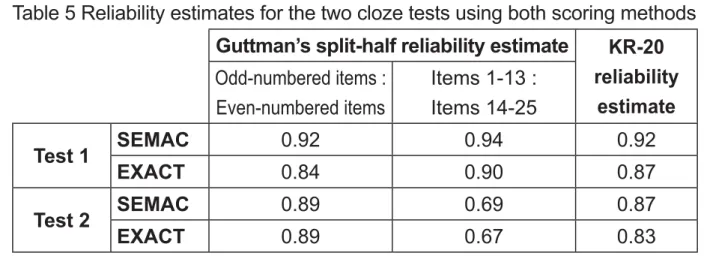
Table 5 Reliability estimates for the two cloze tests using both scoring methods Guttman’s split-half reliability estimate KR-20

reliability estimate Odd-numbered items :

Even-numbered items

Items 1-13 : Items 14-25

Test 1 SEMAC 0.92 0.94 0.92

EXACT 0.84 0.90 0.87

Test 2 SEMAC 0.89 0.69 0.87

EXACT 0.89 0.67 0.83

5. DISCUSSION

5.1 Performance on the two tests

= it is worthwhile considering the possible effects of the differences between the two

=%

:F-Q

# ),%@

*=:%

(13)

>,B

and the fact that the student who produced the text used in the test would have #

@

#

@

5.2 Validity of the two tests

  "

% ) <* : :

, )*

:%,)

@*

5.3 Reliability of the two tests

  F ) @ #* K P%

)E

(14)

>,/

:;;-.:/<* )9:;;/.<,*

P I',- @ )E:;;-.://*

I',-

5.4 Performance under the two scoring methods

  :% +!8"7 !4"7 ,

?A students’ answers to content items show greater variation; fewer of them will be

  7+!8"7!4"7

!4"7 )

*=#

+!8"7

(15)

>,0 5.5 Validity under the two scoring methods

  "+!8"7 !4"7 E $$8 +%

# "

+!8"7

%+

#+!8"7

5.6 Reliability under the two scoring methods

  )

*+!8"7)*

,#

P

6. CONCLUSIONS

  "

)*+!8"7 scoring method is the most appropriate should such tests be carried out with students

"#

?AL

(16)

>,;

)#

*

"

to a single group of students (at least without a considerable period of time between

%*

%

  " &

would be both level-appropriate for the test-takers (students at the same point in their

* @

@H#

@

#

REFERENCES

"'P77"):;;,*87 +."

&2$The Modern Language Journal/BV<<B0</;

"#IP):;//*K7 $9M$

TESOL Quarterly::V:F;B/

"G7):;/;*7 $$!H

(17)

>>-

MTESOL Quarterly:>V,,:;,,/

EMH):;0,*+7 +TESOL Quarterly :BV:B:/-

EMH):;0F*$7 H'' 2TESOL Quarterly:;V>F>FFFB

E M H ):;;-* Fundamental Considerations in Language Testing 9K$

E G ' ):;B;* H W 7 8 ' 7"Reading Research Quarterly<V>>F0>BF

E=2),---*Principles of Language Learning and Teaching)<

th

* M

EG2):;0-*'8H8+7 The Modern Language JournalB<V>>::>:/

=" ),-->* Testing for Language Teachers ),

nd

* 7 K$

G G ):;;-*" 7.( 2 7 8X TESOL Quarterly,<V:B:0>

I8),--,*7 '.!&7 +"+8 The Modern Language Journal0BV<

F/:F0B

9 G ( ):;/,* + 8 2 M 7

$ ! + M The Modern Language JournalFBV>:F::F0

9 G( & N ):;/:*" 7 ! $ TESOL QuarterlyFV<>:F>,B

9 7 ' G ( + 7 $ ):;;/* Testing 7

(18)

331

!M+KE

' G + ' ),--,* Longman Dictionary of Language

>

rd

M

+ G E # P ' ):;/<* 7 8 !

$The Modern Language JournalF0VF,>;,<:

APPENDIX A – Text used to produce cloze tests

  Hello, my name is Emiko. I come from Osaka, but now I live in Shizuoka with my family. They are my mother, my father, and my two sisters. My mother and father work in a shop. My sisters are elementary school students, but I am a junior high school student. My class is 1-6, and my teacher’s name is Mr.

Watanabe. He is an English teacher. Anna teaches English at my school too.

She is from Australia. I like English, but my favorite subject is P.E..

  I like sports very much. I play tennis and soccer at school and with my friends. I’m a member of the volleyball club, so I practice volleyball on Saturdays and Sundays. I don’t like swimming very much.

  I arrived in Shizuoka three years ago. I have lots of friends here now. I like Shizuoka because it has lots of nice mountains and beaches. It also has shops, schools and libraries, so it is an interesting place.

APPENDIX B – Cloze test 1

 Hello, my name is Emiko. I come from Osaka, but now I live in Shizuoka with my family. They are my mother, ( ) father, and my two ( ).

My mother and father ( ) in a shop. My ( ) are elementary school

(19)

>>,

students, ( ) I am a junior ( ) school student. My class ( ) 1-6, and my teacher’s ( ) is Mr. Watanabe. He ( ) an English teacher. Anna ( ) English at my school ( ). She is from Australia.

( ) like English, but my ( ) subject is P.E..

 I ( ) sports very much. I ( ) tennis and soccer at ( ) and with my friends. ( ) a member of the ( ) club, so I practice ( ) on Saturdays and Sundays. ( ) don’t like swimming very ( ).

  I arrived in Shizuoka ( ) years ago. I have ( ) of friends here now. ( ) like Shizuoka because it ( ) lots of nice mountains and beaches. It also has shops, schools and libraries, so it is an interesting place.

APPENDIX C – Cloze test 2

  Hello, my name is Emiko. I come from Osaka, but now I live in Shizuoka with my family. They ( ) my mother, my father, ( ) my two sisters.

My ( ) and father work in ( ) shop. My sisters are ( ) school students, but I ( ) a junior high school ( ). My class is 1-6, ( ) my teacher’s name is ( ) Watanabe. He is an ( ) teacher. Anna teaches English ( ) my school too. She ( ) from Australia. I like ( ), but my favorite subject ( ) P.E..

 I like sports ( ) much. I play tennis ( ) soccer at school and ( )

my friends. I’m a ( ) of the volleyball club, ( ) I practice volleyball

on ( ) and Sundays. I don’t ( ) swimming very much.

(20)

333

  I ( ) in Shizuoka three years ( ). I have lots of ( ) here now.

I like ( ) because it has lots of nice mountains and beaches. It also has

shops, schools and libraries, so it is an interesting place.

Table 1 Mean scores for both groups in their recent term test and their cloze test Term test  (out of 50) Cloze SEMAC (out of 25) Cloze EXACT (out of 25) Test 1 30.67 SD = 13.71 8.63 SD = 6.44 6.37 SD = 4.82 Test 2 29.33 SD = 14.4 7.73 SD = 5.11 5.90 SD =
Table 2 Mean scores for both groups on function word items and content word items SEMAC scoring EXACT scoring
Table 3 Correlations between SEMAC scores and EXACT scores Pearson product-moment correlation
Table 5 Reliability estimates for the two cloze tests using both scoring methods Guttman’s split-half reliability estimate KR-20

参照

関連したドキュメント

I was a business student when I did my undergraduate degree, but such a broad perspective was not really done un- til I took that International Management course. Q What would

一高 龍司 主な担当科目 現 職 税法.

I live in the dorms for Japanese students, so almost no one speaks English, which is really difficult for communication, to be honest, especially since it's my first time to

江口 文子 主な担当科目 現 職 消費者法 弁護士 現代人権論. 太田 健義

海道ノブチカ 主な担当科目 現 職 経営学 弁護士 労働法演習. 河村  学

The course aims to help students develop an interest in topics about the mental and physical development and learning process of preschoolers, elementary school children and

In addition, by longitudinal guidance intervention research, it becomes significantly higher values in all of the learning objectives in junior high school, Rules and