
• 検索結果がありません。

On The Morphological Feature of The Gill of Amphibious and Air Breathing Fishes

N/A
N/A
Protected

Academic year: 2021

シェア "On The Morphological Feature of The Gill of Amphibious and Air Breathing Fishes"

Copied!
8
0
0

読み込み中.... (全文を見る)

全文

(1)

On The Morphological Feature of The Gill of Amphibious and Air Breathing Fishes

Osamu TAMURA and Takamitsu MORIYAMA*

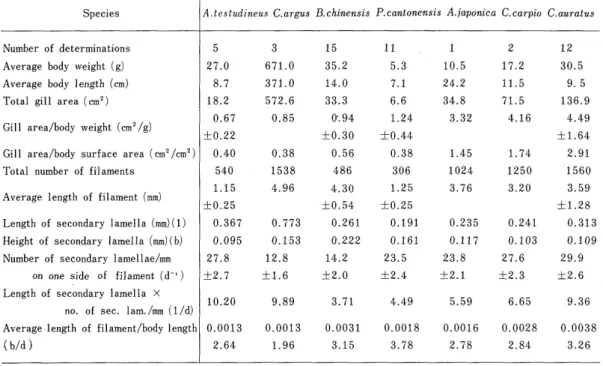
Three air-breathers, two amphibious fishes, two sluggish water-breathers and five active or intermediately active water-breathers were compared for the gill structure, and the following results were obtained so far as the used data of these species are concerned .

1) In the ratio of the gill area to body surface area ,

air-breathing and amphibious fish < sluggish fish < water-breather.

2) In the total number of filaments,

amphibious fish≒sluggish fish < air-breather < water-breather.

3) In the density of secondary lamella, sluggish fish < air-breather < water-breather.

4) As the ratio of the fourth to the first gill arch , in the length of secondary lamella and the filaments,

air-breather < amphibious fish < water-breather.

5) In the total length of filaments and the area of secondary lamella , air-breathing and amphibious fish < sluggish fish.

6) There are environmental and respiratory differences among amphibious fishes and air-breathers , and consequently, the differences of gill structure, especially in the fourth gill arch , are indicated.

Introduction

In regard to the feature of the gill of air-breathing fishes, Hughes et al. (1973) and Hughes (1974) have reported on Anabas testudin eus and Saccobranchus fossilis. They have dealt mainly with length of filament, area of secondary lamella and fourth gill arch (Anabas), but the feature of gill area and the density of secondary lamella are shown also in Gray's "sluggish fishes"

(Hughes, 1966).

Since the oxygen uptake by the gill of air-breathers or amphibious fishes in water is only a part in the total differing from that of the sluggish fishes, the former gill structure adapting to the smaller role may approach to that of the latter, when the

former activity is intermediate. Nevertheless difference can exist between these similar groups.

We compared the component parameters of gill area among the species of amphibious fishes, air-breathers, water-breathers and sluggish fishes using the data of ours, those of Gray (1954), Hughes et al. (1973) and Hughes (1974)

Materials and Methods

Amphibious fishes Periojhthalmus canto- nensis and Boleoththalmus chinensis were collected from Ariake Bay, air-breathing

Can

na argus from a river at the suberbs of Nagasaki City and Anabas testudineus was obtained from a shop of tropical fishes

* Fisheries Guidance Section of Kochi Prefecture, Murotomisaki Machi, Kochi Prefecture.

(2)

2 O. Tamura and T. Moriyama: Gill structure of amphibious and air−breathing fishes,

       17able 1. Component parameters measured in gill structure・

Species

Number of determinations Average body weight (g)

Average body l ength (cm)

Total gill area (cm2)

Gill .area/body weight (cm2/g)

Gill area/body surface area (cm?/cm2)

Total number of fi laments

Average length of filament (mm)

Length of secondary lamella (mm)(1)

Height of secondary lamella (mm)(b)

Number of secondary lamellae/mm      on one side of  filament (d一 ) Length of secondary lamella ×

       n6. of sec. Iam./mm (1/d)

Average・length of. filament/body length

(b/d ).

A.testudineus C.argus B chinensis P. cantonensis A・iaponica C).carpio C.auratus

  5

27.0   8.7 18.2   0.67

±O.22   0.40   540   1.15

±O.25   0.367   0.095

27.8

±2.7

10.20

0.OO13   2.64

 3 671.0 371.0

5 72 .一6

0.85

O.38

1538

4.96

  O.773  0.153

12.8

±1.6

  9.89

0.OO13   1.96

15 35.2 14.0 33.3

  0・.94

±O.30   0.56   486  4.30

±O.54   0.261  0.222 14.2

±2.0

  3.71

0.0031   3.15

11 ,

  5.3   7.1

  6.6   1.24

±O.44   0.38   306   1.25

±O.25   0.191   0.161 23.5

±2.4

  4.49

0.OO18   3.78

 1 10.5 24.2 34.8 3.32

  1.45

 1024  3.76

 0.235  0.117 23.8

±2.1

  5.59

0.OO16  2.78

 2 17.2 11.5 71.5 4.16

  1.74

 1250

  3.20

  0.241   0.103 27.6

±2.3

  6.65

0.0028   2.84

12 30.5

  9. 5

136.9   4.49

±1.64   2.91

 1560

  3.59

±1.28   0.313   0.109 29.9

±2.6

 −9.36

0.0038   3.26

Table 2. Body weight of the specimens and behavioral activity of each species examined or cited in this study.

Species Body weight(g) Activity Used in

Referenc6s

Fig. and Table

SαCC・6・α悔・ん・・f…読・ 1000 Intermediate 1.2 3 Hughes, 1974

Aπα6αs置2s謡碗ηεπ5 1000

U71

Active 1.2 3 Hughes e置α ,1973

Cんαηηααゲ8π5 1.2 1,3.4 Present authors

Bo 1θOPんオんα17π¢65 Cゐピηθη5ゴ5 35.2 Intermediate 1.2 1,3.4

Peγ卿ん彦んα1㎜πscα伽ηeη5ゴ8 5.3 Active 1.2 1,3.4

:r磁区09αoπ伽s 580 Intermediate 1.2 3 Gray, 1954

〃      〃 297 Intermediate 2 Hughes 1966

Sオeη伽η初5C物S・PS 253 Interm.ediate〜Active

1,2.

〃         〃 〃        〃 3 Gray 1954

1晩9記cepんα1πs 166 Active 1 3

3CO励er 8CO励γ祝8 226 Active 1.2 3 Hughes, 1966

L・吻πε飾Cα置・蜘ε 6392 .Slhggish 1 3 Gray, 19・54

ノ1γC乃05αグ8π5 ργ0占α」OCερゐα1α5 544 Intermediate〜Active 2 Hughes, 1966

OP8α雪田

305 Sluggish 2 Hhghes Gray,1972

、4ηα6αs置ε5施伽eπs 27.0 Active 1.4 Present anthors

Aη9ωゴ〃αノαpo耽α 10.5 Interrnedi ate 1.4

Cαγα∬施sαπγα施8 30.5 Intermediat e〜Active 1.4

Cyprinus carpio 17.2 Intermediate 1.4

Sarda sarda 2192 Active 3 Gray, 1%4

Brevoortia tyrannus 613 Active 3

Gymnosarda alleterata 5216 Active 3

!/ 11

(3)

the others from another shop. The pa−

rameters of gill area were measured for

several species of amphibious fishes, air−

breathers and water−breathers as shown in

Table 1・  The measurement was carried

out during several hours before the blood color faded from the isQlated filament.

   The gill area was calculated as follows:

   Total gil,1 area== 2 (Si+S2+S3十S4),

     Si= 2 Nifi2/dilibi

   In this formula, Si gill area on one gill

arch, Ni…number of filaments on one

filament series, fi…average length of fila−

ment,di ・ average distance between secondary lamellae, li ・ average length of secondary lamella, and bi…average height of secondary lamella.

   Then, 2 N i means number of filaments on two filament series, fi2/di number of

secondary lamellae of average length of

filament and 1 ib i average area of secondary lamellae on both sides.

Results

   As the calculated values in Table l are

from specimens of earlier growth stage

exept C. argus, these values can not be

compared directly with each other.

   The values for B. chinensis and P. canto−

nensis of maximum body weight are presu−

med from the regression coefficient of the value in body weight of A. testzadineus and S.ノcossilis by Hughes etα♂.(1973)and Hughes

(1974). These presumed values of maximum body weight were calculated from the percentage of the weight of used specimen

to their maximum body weight recorded up

to this time, assuming that the regression coefficient of A. testzadinens or S.fossilis may applicable to these species. The value of every gill arch is abridged in Table 1.

The data of Gray (lgs4), Hughes (1966),

Hughes & Gray (1972), Hughes et al. (1973)

and Hughes (lg74) are cited in Tables 2,

3 and Figs. 1, 2 to compare the data of the largest weight among air−breathers,

amphibious fishes, water−breathers and. sl−

uggish fishes. These references and their activity are shown in Table 2.

   Ratio of gill area to body su?Lace area

(Table 3)

   The gill areas in five air−breathers,

four active or intermediately active water−

breathers and one ,sluggish water T breather

were compared as shown in Table 3.

Table 3. Gill area per body weight and per body surface area of each species.

Species Respiration Gill area/Body wei暮ht Gill area/Body surface area Reference

(cm 2/9) (cm2/cm 2)

芸:鶴鷹鷹瓢器1ε5}

Amphibious 1.24

O.94

0.38 O.56

Present

@  ク

authors

@ 〃

SαCCO6γαηCん%s fOSS競S 0.32 0.34 Hughes, 1974.

Aηαわαs 置csJπd ηe駕5 Air・breathing 0.39 0.40 Hughes θ置α1.,1973

Cんαηηααγ9駕s 0.85 0.38 Present authors

Tα包 置08αoη蜘8 3.92 4.35 Gray, 1954

S繊0置om秘S Cんγ雪SOPS 5.06 4.78

M卿1cεPんα臨s 9.54 6.54

SCO7ηゐe?・ SCO飢6γπS Water−breathing 11.58 8.38

sα冠α3αγdα 5.95 11.55

Bγe ooγぬ吻アαππ祝5 17.73 18.28

G〃ηηosαγdαα〃e診e7α孟α 19.39 48.54

五〇両祝5P∫5Cα孟碗駕5 Sluggish 1.96 2.99

.〃

(4)

4 O. Tamura and T. Moriyama: Gill structure of amphibious and air−breathing fishes

F一E ﹂巴Φo=程︒一︑﹂o翌80の︸︒﹂︒﹄∈コZ

     S. A. C, E  P一. T. S. M. 5. L.

     fojt.iLLL!s s i i i s 一tsitE.1.y!!.s t udi一 g.1tg.1!.!g u s stt!ingn.E.Lsi nensis!st1[11gnntonett1il−Ests ptt i t u s c.ttyso p s Est lng.!.yiphalus Estg1u21zyiombrvs Ri/一isg一!EtLltt2sca torJuS

      neus

    一 air−breathing 一 一 amphibious L一一一一一>eactive or intermediately active一 esluggish一>

         Fig. 1. Number of secondary lamellae per mm on one side of filament・

       of several species.

       Vertical lines indicate standard errors. (P==O. 05)

      and amphibious fishes on one side of filament (Fig. 1)

the minimum values of gill area The species shown・ in Fig. 1 are the same

      area lower than 2.0, the as those in Table 3.. The arriphibious B.

       highest values of more chinen sis and the air−breathers Showed lower and the sluggish. fish a medium ・・,values for the nuniber of secondary lamellae

       per mm on one side of filament than the

   of secondary lamellae per mm water−breathers.

20864208642033222221111

The air−breathers

showed

/body surface water−breathers the

than 4. O value.

   ノ>itmber

切↑⊆ΦEO=畢  ︸O 

﹂Φ﹄F一⊃⊆  一.O↑Oト

0 0 8 2

000000642 222 OOOOO8 21 000 000642 1  1 

1

OOO OOOO86 000 00

﹂42

  S.      A.      C.    B.       P.        工.      ≦…_・     ・A・     ,篁L・         ≦≧9

   Fo s s il i s  Fe s tvdi一 trlgus Elh.i.npttl.E−LEs t s lptt n t o n e nsis 6−t i t u s yh![.z.Ew.E.rysops 2[tg!2E!1gobatostgmusLEombrus rvtu
         FI−Et−IJFu s … 一 sgtgt1g11!sphalus

一 air−breathing一 一amphib ious一 (一一一active or intermediately active−esluggish

      Fig. 2. Total number of filaments of several species.

       Vertical lines i ndicate standard errors. (P=O. 05)

(5)

The sluggish fish L. Piscato7 ius showed the lowest 魔≠撃浮?D The value of P. canlonensis wqS @ali?vr,oximately equal to those.of the inter−

mediately active water−breathers.

   Total number of fi/aments (Fig. 2)

   The sp ecies shown in Fig. 2 are not the same as those in Table 3 and Fig.1 Archosargus and Opsanus . are replaced in−

stead of ルiug〃 and ∠,ophizas. The total

nuinber of filaments of two amphibious

fishes showed the minimum value, but, the air−breathing species had the medium values excpt C argzas which showed the high value as that of T. oniims. The value of sluggish fish O. tau was near to the amphibious

fishes.

   Length of secondary /ame/la, n zamber of secondary /amellae Per mm ( 1/b) andaverage

伽8〃z(ゾ万伽z翻/∂oめ伽脚.

   1n the length of secondary lamella,

number of secondary lamellae per mm, the values of the amphibious f ishes were lovv and those of the air−breathers were high.

In the average length of filament/ body length, the value of B. chinensis was high,

those of the air−breathers were low.

   Fourth gill arch(Table. 4)

   The fourth gill arch of the gener.1 water−breather does not differ So mixch from the other gill arch, but that of the air−

breather and amphibious fish are remarkably different or degenerated (Suzuki, 1969;Hug−

hes et al., 19. 73). Table 4 shows parameters of the length of secondary lamella, length of filament and number of secondary lamellae per mm as the ratio to that of the first gill arch reducing the effect of body weight. ln the length of secondary lamella

Table 4. Fourth gill arch/first gM arch(9io) of several characters in each species・

Speces Respiration No. of filaments

Length of

sec. I am.

  (e/o)

  No. of Length  of

sec. I am./mm filament No. of specimens    (o/.) (a/.)

1:誕雛膿器1膿ご51 Amphibious

内篇泌 1幅  }

Air−breathing

Aη8厩〃α加。η cα

C卯吻撹5人目γ卿 V〜τater−breathing Cαγα55ピπs α膨γα置鉱s

76 126 20 40 97 90 92

ρOrD19﹁DOσrD

774000び8Qσ 104 129 119 101 101 97 104

62 62 16 42 79 108 89

−rDrO∩δ19〜9〜

1

1       

1

Table 5. Comparison between air−breathing and siuggish fish of maximum body weight.

      Species

oarameter

、4.

孟esオ㍑(1ごπe駕8     s. 〆oss読8 B. c庖πeηsゴ8P. cα窺。ηeη5どs 0、置απ

Body weight(g) 1000 1000 53.0 8.8 1000

Total gilI area(cm2) 389 321.4 50.2−545 10.5−11.5 1317

Gill area/body weight(cm2/g) 0.39 0.32 0.78−0.81 1.03−1.04 1.31

Distance between sec.1am.(mm) 0,078 0,061 0,075 0,047−0,045 0,105

Total filament Iength(mm) 5230 6172 2500−2960 495−540 8638

Average area of sec.1am.(mm2) 0.28 0.32 0.08 0.04 0.79

Total number of filaments 1316 880 500−512 315−333 一

Reference Hughes ・〜αム,1973 Hughes,1974 Authors Authors Hughes & Gray,1972

The values of Boleophthalmus andPeriophthalmusare presumed dimension from the data in Table 1 by the

regression coefficient in body weight of Anabas−Saccobranchus by Hughes (1973,1974).

(6)

  6 O. Tamura and T. Moriyama: Gill structure

and that of filament, the values of the air−breathers were low and those of the water L breathers high, and those of the

amphibious fishes the medium. ln the

number of filaments the values of the air−

breathers were low, those of the amphibious fishes higher or medium. ln the number of secondary lamellae per mm, those of B.

chinensis and A. testudinezas were high and the others were not so different.

   Comparis.:otn・ among amPhibious flsh, air−

breather and slzaggish fish (Table. 5)

   Table 5 shows characters of the gi11 of O. tau, A. testudineus and S. fossilis with the body weight of looo g, and the amphibi−

ous fishes show the presumed values of the largest body weight. As Table 5 shows,

the air−breather and the . amphibious fish differed from the sluggish fish in the follo一 wing.ch !IAgters, namely, the gill area/body

weight, the distance between secondary

lamella, the total filament length and the average area of secondary lamella. These

parameters of the air−breathing and the

amphibious fishes showed lower values than the sluggish fish. The values of the gill area/body weight were minimum in the air−

breather, and those of the average area of

secondary lamella were minimum in the

amphibious fishes. ln the distance between

secondary lamella and the total filament

lenght, the air−breather or amphibious fish showed lower values than the sluggish fish.

Discussion

   On the relation of the gill area, the density of secondary lamella, the length or the number of filaments, the fourth gill arch, the accessory respiratory organs and

the oxygen uptake by gill in the air−

breather have been reported by Suzuki (lg6g),

Hughes et al. (lg73) and Hughes (lg74).

   Dzfferen cesαf the gill a〃z ongα吻hibious fish, air−breather, sluggish water−breather and

of amphibious and air−breathing fishes

other waler−breather.

 (Gill area)

   The gill area of.amphibious gobioids decreases with terrestrial adaptation(Sch6ttle,

1931),the gill. @of air−breathers has tendency to degenerate(Carter,1957). Gill area i s proportional to the activity of fish(Hughes,

1966),its smallness indicates sluggish or ha−

bitat in high dissolved oxygen(Suzuki,1969),

the regression coefficient of gill area in body weight is small in∠L.testudineus(Hughes,

et al., 1973), the gill area of S. fossilis .is

smalIer than that of Gray s sluggish fish

(Hughes,1974). In this study, the gili brea/

body surface area of the ampibious ?奄唐??

are smaIl approaching to the air−breathers.

The gills of the amphibious fishes breathe

in water and on land, but the amount

differs with the habitat(Tamura, et al.,1976).

The oxygen uptake by the gill of the

amphibious fishes is larger in water than on land(Tamura, et al.,1976), accordingly,

the gill structure of these fishes may be

mainly related to the respiratory amount

in water. It is presumed that the small gill area of the amphibious or the air.breathing fishes are related to the smaller role in the respiration by the gill in water. As shown in Table 3,so far as the data of theused species are concerned, th・e relation of  the gill area/body surface area resulted in the order of

   amphibious fish and air−breather〈slu−

99i,h fi,h〈w。t。,.爵eath。,.

(Number of secondary lamellae per mm)

   The number.of secondary lamellae or

the density of secondary lamellae is small when the gill area small orthetotal res−

piratory water flow is large, and the oxygen consumption is proportional tb the constant relating interlamellar distance and 1/2Power of velosity 6f water flow(Hughes,1966).

The inverse number of the density of secon−

dary lamella of the amphibious fishes is

      ト

apProximately proportional to the oxygen

(7)

uptake by gill as reported by Kobayashi & Ichikawa(1970) in other fishes.

   The number of secondary lamella per mm becomes smaller with growth of fish,

and its change is small(Suzuki, lg6g). The value of P. cantonensis (Fig.1) is neq G(ly as large as that of the water−breather. Except for P. cantonensis, the relation of

    sluggish fish〈air−breather〈water−

    breather is obtained.

The large oxygen uptake by gill in water of P. cantonensis may account for the large value of the species(102ml/kg.hr=2・4XB.

chinensis 43ml/kg.hr., Tamura et al., lg76).

 (Total number of filaments)

   As the total number of filaments increa−

ses with growth, the value in relation to body weight is compared. The value・of the

amphibious fishes are minimum, but the

specimens are not largest, and these values will increase more at larger weight.Hughes

(1966) has mentioned that the value is large in active water−breather.

(Length  of secondary lamella/interlame−

   11ar distance, 1/d)

   Following the increase of the length of secondary lamella gill area becomes large

and the total water flow become smaller

(Hughes, 1966), the smaller value of 1/d indicates sluggish or habitat of high disso−

lved oxygen, and

   Time of keeping secondary lamella con−

tact with water=2(1/d)2/k, that is, 1/d should be larger to take sufficient oxygen by keeping necessary time for contact with water (Suzuki, 1969). Comparing the values of !/d in Table 1, however, the values are not aNways small in the air−breather or in the sluggish fish.

   Fourth gill arch

   C.argus is markedly degenerated in the second $eries of filaments of the fourth gill arch(Suzuki, 1969), and general w ater−

breathers have the same fourth gill arch as the other gill arch(Kobayashi & lchikawa,

1970). Anabas testzadineus hardly has th e secondary lamellae on the fourth gill arch

(Hughes, et al.,lg73). As Table 4 shows, the fourth gill arch of amphidious or air−breathing fishes remarkably differ mutually and from the water−breathers, that is, the length of secondary lamella and filament are smaller in the air−breather and the amphibious fish than in the water−breather.

   Consequently, the change of the fourth gill arch may be one of the features of air−breathers and the amphibious fishes.

    ComParison among air−breather o r

a吻励勧sfish and sluggish万s〃

   The air−breather and amphibious fish have some characters of approached values,

namely the gill area and the total length of  filaments as shown above, yet, there are difference in the presence of accessory res−

piratory organs or secondary cutaneous

respiration. S ince Hughes has pointed out the great correlation coefficient of these component parameters between gi11 area and body weight or growth, we have compared the specimens of stages of growth as large as possible for this studAy. The air−breathers and the amphibious fishes show smaller gill

area/body surface area and the area of

secondary lamella, smaller total filament length and interlamellar distance than the sluggish fish(Table. 5).

   Cazase of sPecial featzares in the gill of amPhibious and air−breathing fish

   As mentioned above, the air−breathers

and the amphibious fishes show several

differences in gill structure mutually and

the both group from the water−breathers

and also i,,from the sluggish fishes. These special features of the air−breathers and the amphibious f ishes originate in the accessory or secondary respiratory organs. The air−

breathers take oxygen by gill and also by

these organs in water. Consequently, even

though the total diffusion capacity is large

like A,, testudineus(O・2967), that by gill

(8)

  8 O. Tamura and T. Moriyama: Gill

(O・0142)is very small (4・80/o of total)(Hug−

hes el al., 1973). The structure of the fish gill is presumed to be related to the diffusion capacity of the gill in water. The total oxygen uptake of active fish P. cantonensis in water was 196 ml/kg.hr (200C), but the amount taken by gill was 520/o of total

(Tamura et al., 1967). Accordingly, the gill area of this species becomes naturally sma−

11er than that of the active water−breathers.

However, the amount of oxygen uptake by gill in air−breathers and amphibious fishes differ remarkably, and in addition, since

they have environmental difference among

species, B. chinensis, for example, may be

presumed to differ from the other air−

breathers in the number of filaments of the fourth gill arch and P. cantonensis in the density of secondary lamella.

   As to the maintenance of the sensitive delicate gill lamella in air, it may be kept by means of the prevention of the mutual contact with adjacent secondary lamellae,

or by means of the stronger stoutness of secondary lamella larger than the water−

breathers. From the former, it is presumed

that

   (1) interlamellar distance(d)>height of       secondary lamella(b).

   (2) distance between secondary lamella       on adj acent filaments is large.

structure of   amphibious and air−breathing fishes

but (1) is not true as shown in Tables 1, 5・

   From the latter. it is also considered    that

   (3) breadth of secondary lamella is       large.

   (4) area of secondary lamella is small      when the breadth is same as that       of the water−breathers.

   Among the above presumptions, (2) and

(3) are unknown, but (4) is possible.

References

   Carter, G. S.(1957). The physiology of fishes, vol.1,  Acad. Press, N.Y., 65−79.

   Gray, 1. E.(1954). Biol. Bull.107,219−225.

   Hughes, G. M.(1966) . 」. ExP. Biol. , 45, 177一 195 .

   Hughes, G. M.& Gray,1.E. (1972). Biol.

Bul/., 143, 150−161.

   Hughes, G. M., Dube, S. C. & Munshi,J.

S.D.(1973).ノ. Zool. Lond.,170,227−243.

   Hughes, G. M.(1974).」. Zool..五〇nd.,172,

215−232

   Kobayashi, H. & lchikawa, K.(1970).」.

Simonoseki Un iv..Fish., 19(1), 29−34.

   Schbttle, E. (1931). Zeitscher. f za,iss. Zoo/.,

140, 1−!14.

   Suzuki, N.(1969). Physiol. Ecol., 15,79−100.

   Tamura, S. O., Morii, H. & Yuzuriha,

M.(1976).ノ.Eゆ, Biol.,65, In Pre∬.

両生魚と空気呼吸魚、の鯉の形態的特性について

      田村  修・森山 貴光

 両生魚類又は空気呼吸魚類の鯛の形態的特性を知るために,空気呼吸魚3種,両生魚2種,水中呼吸魚5種と不 活溌(水中呼吸)魚2種について,鰻面積の媒介変数を比較した。

(1)単位体表面積当りの鯉面積に於ては,両生v魚と空気呼吸魚、<不活闘魚く水中呼吸魚

(2)全魚思弁長に於ては,両生魚≒不活溌響く空気呼吸魚く水中呼吸,魚

(3)些些片密度に隔ては,不活磯魚、<空気呼吸.魚く水中呼吸魚、

(4)第4胡弓上の鯉弁片長・川明長と第1鰍弓上の各々との比に於ては,空気呼吸魚く両生魚く水中呼吸,魚

(5)全鯉駅長と鰍弁片の面積に於ては,両生魚と空気呼吸魚、〈不活溌魚

(6)空気呼吸魚、の各種間にも環境や呼吸上の相違点があるから,その結果として,鯉構造の相違,特に第4総尼上

   の相違点が空気呼吸魚と両生魚の間に認められる6

Fig. and Table

参照

関連したドキュメント

H ernández , Positive and free boundary solutions to singular nonlinear elliptic problems with absorption; An overview and open problems, in: Proceedings of the Variational

4 because evolutionary algorithms work with a population of solutions, various optimal solutions can be obtained, or many solutions can be obtained with values close to the

If condition (2) holds then no line intersects all the segments AB, BC, DE, EA (if such line exists then it also intersects the segment CD by condition (2) which is impossible due

The performance measures- the throughput, the type A and type B message loss probabilities, the idle probability of the server, the fraction of time the server is busy with type r,

Keywords: Convex order ; Fréchet distribution ; Median ; Mittag-Leffler distribution ; Mittag- Leffler function ; Stable distribution ; Stochastic order.. AMS MSC 2010: Primary 60E05

2 Combining the lemma 5.4 with the main theorem of [SW1], we immediately obtain the following corollary.. Corollary 5.5 Let l &gt; 3 be

It is suggested by our method that most of the quadratic algebras for all St¨ ackel equivalence classes of 3D second order quantum superintegrable systems on conformally flat

Henry proposed in his book [7] a method to estimate solutions of linear integral inequality with weakly singular kernel.. His inequality plays the same role in the geometric theory