Acta Med. Nagasaki 34 : 240-245
The Prognostic Significance of Subserosal and Serosal Extent of Cancer Invasion in Gastric Cancer
Tatsuo HIRANO, Hisoyuki KUSANO, Ryoji TAKAHIRA Hironobu TOHCHIKA, Yoshikazu MINE, Keiji KAJIWARA Takayuki NAKAZAKI, Seishi HONJO, Hiroyuki YAMAGUCHI Takatoshi SHIMOYAMA, Toshio MIURA and Masao TOMITA
The First Depertment of Surgery Nagasaki University School of Medicine Received for publication, December 26, 1989
ABSTRACT : In order to determine the prognostic significance of subserosal and serosal extent of cancer invasion in gastric cancer, 78 patients were reexamined histologically. In these patients curative resection was performed and cancer invaded
the subserosal layer with growth pattern of infiltrating type i.e."ssγ"(30 patients),
or exposed outside the serosal surface i.e. "se" (48 patients). The significantly favourable prognosis was seen only in patients with ssr cancer being less than 1 cm in extent with a five-year survival rate of 92.3%, and in patients with small amount of cancer cells in the subserosal layer, having a five-year survival rate of 81.8%. In patients with se cancer the five-year survival rate was less favorable.
INTRODUCTION
It is widely recognized that the serosal factor is one of the most important factors influencing the prognosis of gastric cancer patients because the serosal invasion is direct- ly related to a subsequent peritoneal carcinosis which is the most common mode of recurrence.
The present study was undertaken to determine the influence of the serosal factor in patients with gastric cancer which involved the subser- osal wall with infiltrating fashion or was exposed outside the serosa based on the micro- scopic finding of the surgical specimens obtain- ed after curative surgical resection for gastric cancer.
MATERIALS AND METHODS
Of gastric cancer patients who underwent
curative resection at the First Department of
Surgery, Nagasaki University Hospital, in a
period between January 1973 and December
1982, 30 cases of ss r cancer and 48 cases of se
cancer were histologically reexamined. The
paraf f in-embedded specimens stained with
hematoxylin and eosin were used for this study,
and the following items were examined in rela-
tion to the patients' prognosis : the extent of
cancer in the deepest layer, mode of extension
in the subserosal layer, quantity of cancer cells,
and histologic type of cancer in the front of
cancer invasion of the deepest area. The extents
of cancer in the subserousal layer and on the
serosal surface were determined by measuring
the maximal length of the width of cancer
invasion at each layer. An shown in Fig. 1, the
modes of extension of cancer in the subserosal
layer in both ss r and se cancer patients were
divided into the following three types : (1) val-
ley type, in which cancer invasion is wider in
to the valley type, (3) box type, in which extent of cancer invasion at the shallow area of the subserosal layer is almost the same as at the deep area. The amount of cancer cells at the subserosal layer or serosal surface was determined and graded from (+) to (+ + + ).
Histologic types of cancer in the deepest area were also examined and divided either into differentiated carcinoma or into undifferentiat- ed carcinoma. The patients' prognosis was analyzed in relation to these items. Terms appearing in this paper are used according to the general rules for the gastric cancer study in surgery and pathology by Japanese Research Society for Gastric Cancer I)
The survival rates were calculated with Kaplan & Meier's method, and generalized
in the subserosal layer and on the serosal sur- face is demonstrated in Fig. 3. The cancer extent in ss r patients was 16mm on the average, ranging from 1 to 70mm ; and that in se patients was 11mm on the average, ranging from 1 to 77 mm. In the cases of ss r, the cancer extent less than 10mm was seen in 43% of the patients, 10- 19mm in 30%, and more than 20mm in 27%. In the cases of se, the cancer extent less than 10mm was seen in 65% of the patients and that of 10- 19mm in 15%, and more than 20mm in 21%. Fig.
4 shows the five-year survival curves of each group. The significantly favorable prognosis was observed in patients with ss r of extension less than 10mm (92.3%) than in those with ss r above 10mm. The patients with ss r cancer less than 10mm in extent and patients with se cancer
Fig. 2
Fig. 3
Fig. 4 a and 4 b
cancer had five-year survival rates from 57.0%
to 30.8%.
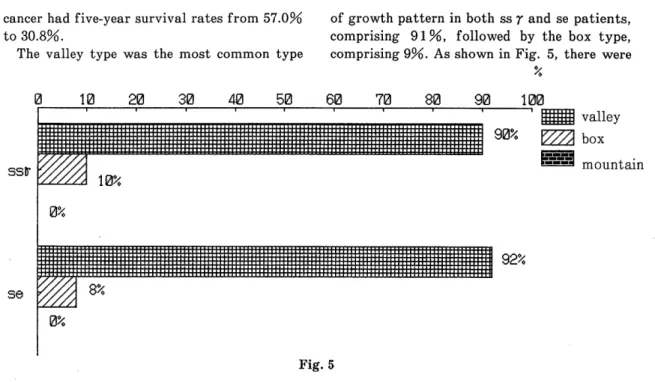
The valley type was the most common type
of growth pattern in both ss r and se patients, comprising 91 %, followed by the box type, comprising 9%. As shown in Fig. 5, there were
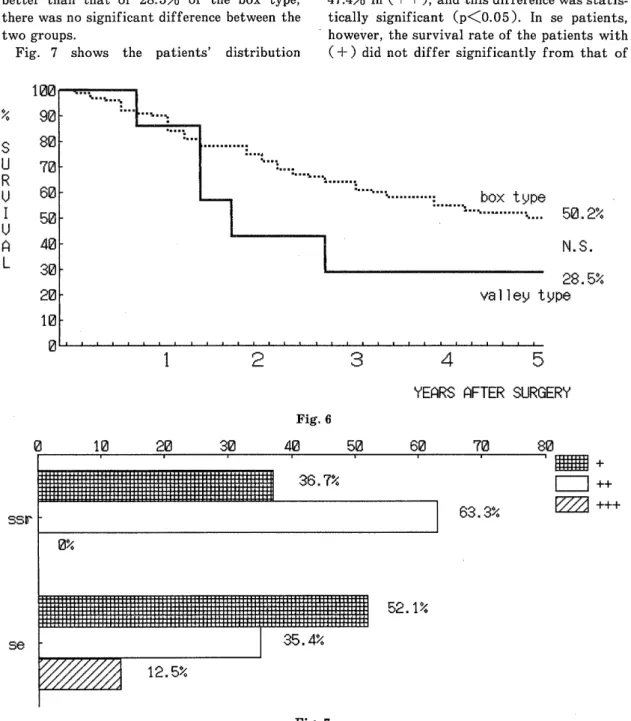
6,