Special Education Needs in Japan: Some Implications for Higher Education
Shane Doyle & Fiona Creaser
Abstract. This article focuses on special education needs (SEN) in Japan and examines the number of students in secondary compulsory education who are receiving support for learning difficulties. The percentages of students with learning difficulties is analysed and suggestions are made which imply that the actual number of students who need extra support is probably higher than the figures indicate. Moreover, the implications for higher institutions in Japan is investigated from the point of view of teaching and learning as well as future legal obligations that may be placed upon universities in Japan and faculty. Finally, it is suggested that universities in Japan take a pro-active approach to inclusion because of the intense competition to secure student numbers.
Keywords: Special Education Needs, Inclusion, Higher Education
Introduction
In the last decade efforts have been made by the Ministry of Education Culture Sports and Technology (MEXT) to address some of the issues facing children with learning disabilities in Japan. In 2007, Japan's education for children with disabilities was renamed in the School Education Law from special education to special education needs (SEN). The new name reflects a change in the way of thinking towards attaching importance to the educational requirements of the child. In other words, education of children with disabilities should be shared with ordinary classes in elementary and junior high schools. Essentially what this means is that Japan is seeking to move towards inclusion, the term used to describe the teaching of those students with educational needs and those without educational needs in the same setting.
Special Education Needs in Japan
The main issue being the recognition of the fact that students with learning difficulties
such as attention deficit hyperactivity disorder (ADHD) and high-spectrum Autism
should be brought under the umbrella of SEN. Traditionally, SEN has catered to those
students who had more easily recognizable disabilities, such as deafness, blindness or
cerebral palsy. In addition to the above, efforts are now being made to reform the
provision of SEN within mainstream schools and independent SEN providers. MEXT
has advocated greater communication and cooperation between not only these
independent institutions, but also a greater liaison within the broader community
regarding the provision of SEN. MEXT aims to insure that children with SEN are able to
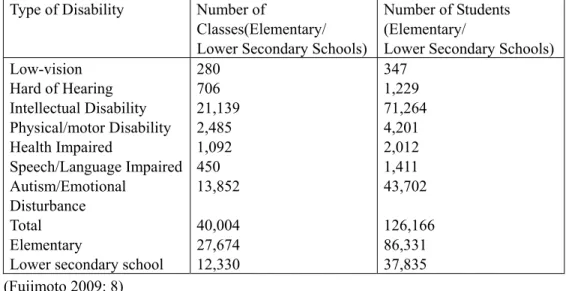
overcome or at least reduce the difficulties they face living in the community. Figures provided by the National Institute of Special Education Needs (NISE) show the breakdown of student numbers who visit the "resources room" within mainstream schools, and those numbers of students enrolled at Special Education Schools.
Some initial observations need to be mentioned in order to look at these figures in a proper light. The figures provided for elementary school and junior high school show that 126,166 students enrolled in classes for special education needs, this accounts for 1.2% of all school children in compulsory education (see table 1-1). While this figure is the official one given by MEXT I believe that it is no way a true reflection of the actual situation at the chalk face. Teachers, who have the advantage of being in the classroom and thus dealing with the children on a daily basis, could more accurately access the true number of children who have some form of special educational needs.
Table 1-1 The Number of Classes and Students in Classes for Special Needs Education (2009)
Type of Disability Number of
Classes(Elementary/
Lower Secondary Schools)
Number of Students (Elementary/
Lower Secondary Schools) Low-vision
Hard of Hearing Intellectual Disability Physical/motor Disability Health Impaired
Speech/Language Impaired Autism/Emotional
Disturbance Total Elementary
Lower secondary school
280 706 21,139 2,485 1,092 450 13,852
40,004 27,674 12,330
347 1,229 71,264 4,201 2,012 1,411 43,702
126,166 86,331 37,835 (Fujimoto 2009: 8)
For example, in the United Kingdom children with behavioural issues, also fall under the umbrella of SEN and these students can, if they wish, avail of the support services the school provides. In 2003, MEXT reported that 6.3% of children had behavioural and/or academic problems in mainstream classes in both primary and junior high schools. These children may have some form of SEN which is not been addressed or diagnosed. Furthermore, there is no mention of those children who truant from school or the numbers of futoko, those children who stop attending school and just stay at home.
These children obviously have educational needs which need to be addressed and should
come under the umbrella of SEN. If we were to factor in these various numbers I
believe that the true percentage of students needing support through SEN would rise to approximately 10%. If we were to look at comparative figures for the Britain we would see that in 2003, 14% of those students attending school were identified as having SEN, while the figure for 2005 showed an increase to 14.9%. Therefore, it would not be surprising if the actual figure for Japan was closer to these numbers than the official percentage provided.
The Implications for Universities in Japan
With figures not available to determine the number of students who may be availing of SEN support at the upper secondary level, it is impossible to actually refer to a definite number of students who may be receiving support at this level. However, with Japan's enrolment rate at upper secondary education at 94.4% (MEXT 2006: 9), it can safely be assumed that those who require support at junior high school will also need support at high school level. Furthermore, according to MEXT international comparison of entry rates to higher education, 52.3% of high school graduates go on to universities, junior colleges or colleges of technology.
The university entrance exam system has reached a critical point where all applicants will be allowed to enter. Apart from the elite universities such as Tokyo university, Keio university and Waseda university, all other smaller, private universities will probably ascribe to this mantra as competition for fewer and fewer students intensifies.
Interestingly enough while the number of students enrolled in the elementary, lower and higher secondary education continue to decline, the number of students at universities continues to grow (MEXT 2006:4). Therefore, universities, under pressure to fill their quotas for enrolment will increasingly accept any applicant who applies to their university. Although the projected number of junior high school graduates will continue to decrease, entry to higher education will also increasingly become easier. What implications does this trend have on those students with special education needs who will carry on their education to university level?
As mentioned previously, in 2003, MEXT reported that 6.3% of children had
behavioural/academic problems in mainstream classes in both primary and junior high
schools. While the cause or reasons behind these problems is not given, it is realistic to
say that they might be related to ADHD, Autism, or other Learning disorders. To try and
give us a more realistic figure of the actual number of students who should be receiving
SEN support I have taken a look at the figures provided in the UK, we see that
enrolment for upper secondary is approximately 3.3 million as of 2007 (DCFS 2007),
this figure compares with that of Japan where 3.6 million are enrolled in upper
secondary (MEXT 2006: 4), we also see that there were over 14.9% of pupils with SEN
in January 2005 (BBC News), therefore I would think that it is not unreasonable to
suggest that the actual percentage of students with SEN in Japan is a lot higher than the
1.2% reported by MEXT. With 94.4% of junior high school students going on to high school, it is only logical to assume that there will be high school graduates with SEN who wish to go on to higher education. With more university places available to choose from, universities will find themselves enrolling more students who will need educational support to succeed in their learning and fulfil their potential.
Promoting Awareness at Japanese Universities
Too often, I hear teaching professionals in Japan referring to or ridiculing students who seem to be different in some way, this may be due to the fact that the student has not developed the ability to communicate or cannot look directly at the teacher, or has poor social or organizational skills. The reason for their difficulty may very often be grounded in the fact that the student has special education needs, and that the student has come through the educational system without being referred for evaluation. With this in mind, the university should first and foremost recognize that there are students with SEN who currently attend university and that this number will increase in the future and universities should be proactive in their approach to supporting students with special education needs.
Ideally, there should be one person to coordinate within the university; this person would liaise with outside professionals, the guardians of the student and the faculty who are teaching that particular student. While not all faculty may be understanding of the particular student needs and perhaps adhere to the outdated diatribe that students with special needs should be taught separately by teachers with particular skills, it is vitally important that such faculty are trained or given opportunities to review their own teaching skills so that they can follow the individual education plan IEP, that the coordinator would produce for each SEN student. The co-ordinator would also have to try and help faculty in terms of how they may teach the student or what may be necessary to ensure that the student is not placed at a disadvantage because of their disability. This will require some administration work on the part of the faculty. Not only does this have learning and teaching ramifications, but also in the future it will have legal ramifications if faculty or the university is found to be negligible in its duty of care to any SEN students enrolled in the university.
The Legal Situation in the UK
In the UK, The Special Educational Needs and Disability Act 2001(SENDA) was
amended to the Disability Discrimination Act (DDA) 1995, which places a legal
obligation on higher education institutions making it unlawful to discriminate against
students with a disability. The Act places an obligatory duty on the university which
means that it is not good enough to wait until someone with disabilities applies to a
course or tries to use a service before thinking about what reasonable adjustments should be made.
According to the Student Support Office of Essex University, this includes teaching of classes, lectures, seminars and practical sessions. While many other examples of where this Act could be applied are given I only mention teaching and learning as it is also noted that when similar legislation was introduced in Australia in 1993, 90% of the court cases related to learning and teaching. Accordingly, DDA, provides for the right of students not to be discriminated against in education, training or any services provided wholly or mainly for students. In practise this means it will be unlawful for responsible bodies to treat a disabled person less favourably than a non-disabled person for a reason that relates to the person's disability.
The Spring 2002 issue of Directions Skill (The National Bureau for Students with Disabilities: 2) has the following example:
A partially deaf student who lip-reads is attending a law course. One of lecturers continues to lecture while simultaneously writing on the whiteboard. The student asks him to stop speaking when he turns his back to use the whiteboard so that she can follow what he is saying. The student is likely to be at a substantial disadvantage if this adjustment is not made.
The law requires responsible bodies to anticipate the requirements of a disabled people and make necessary adjustments.
The Legal Situation in Japan
The Law to Support Persons with Development Disabilities and Regulations Relative to
the Enforcement of the Law to support Persons with Development Disabilities took
effect on April 1, 2005. Within this law, section 1 article 2 defines development
disability follows; the following disabilities prescribed by the government ordinance and
whose symptoms appear in childhood: autism, Asperger's syndromes and other
pervasive developmental disorders(PDD), learning disabilities/disorders(LD)and
attention-deficit hyperactivity disorders(ADHD) and other similar cerebral dysfunctions
(Tokunaga 2006:40) The law states clearly what is covered and makes it very relevant
to universities in that should a university think that a student has any of these disabilities
there is a legal obligation to support the student. The law prescribes for universities
and technical colleges to give proper consideration in accordance with the state of
disabilities. What does proper consideration mean, in my opinion it is the provision of
whatever support is deemed necessary to ensure that the student is not placed at a
disadvantage in relation to their fellow students. In addition, The Convention on the
Rights of Persons with Disabilities took effect May 3, 2008. The UN General Assembly
adopted the 50-article convention in 2006 and Japan signed it in September of 2007. The
convention says State Parties shall prohibit all discrimination on the basis of disability
and guarantee to persons with disabilities equal and effective legal protection against discrimination on all grounds. If Japan ratifies the convention, it will have to take all appropriate measures including legislation, to modify or abolish existing laws, regulations, customs and practices that constitute discrimination against persons with disabilities (General Obligations 2006: 6). This means that the government will have to ensure an inclusive education at all levels to help people with disabilities attain the full development of their personality, talents and creativity, as well as their mental and physical abilities. The ratification of the convention would signal a clear and unequivocal move towards a more understanding and accepting society and in particular, would signal that educational institutions such as universities would have to start to proactively support those students with some form of SEN.
The convention itself predominantly deals with primary and secondary education, it does refer to lifelong learning and the point must be made that provision of SEN at secondary level will enable the high school graduates to go on to university. The law to Support Persons with Developmental Disabilities certainly sets out that the university should recognise these students and give proper consideration to them and their needs.
While Japan is seen as a country where people do not generally resort to the legal system to seek redress through lawsuits it should be noted that lawsuits are on the increase, in 1998 5.5 million were filed in Japan (Japan Times 2006), and that in the future as western ideals or western ways become increasingly viewed as the best way to settle disputes, universities may find that parents/students seek compensation for failure of universities to provide an accessible teaching/learning environment and thereby treating the SEN student unfairly. And it should be noted that parents/guardians would be perfectly within their rights to pursue such action as universities have been informed of the law and MEXT has provided guidance regarding these students.
Conclusion
In summary, it would seem that if universities were to take a proactive stance towards
the student with some form of special needs it would, in the long run, benefit both
teaching and learning in the university setting. Recognition of the issue is the first step
towards change and with MEXT advocating changes in special education which point
towards inclusion as being the way forward universities can expect to see students with
special educational needs increasing on campus. The university has a duty of care to all
students, without exception, who enrol in their programmes. By placing the issue firmly
on the agenda universities can increase awareness and provide training/advice to those
who will need it. By doing this universities will, I believe create an atmosphere of trust
in which parents and students can believe in, they will know that their educational needs
will be met in a professional and transparent fashion. While introduction of laws
regarding discrimination and disabilities are lacking compared to the West, Japan is
moving towards a fairer and more open society, albeit at a slow pace. I do think that it will eventually catch up with the West and ratification of the U.N convention on disabilities may be the catalyst needed to push the process along.
In my opinion, Japan has embarked on a path of trying to attract more students from abroad and in general, trying to make its institutes of higher education viable options for international students. One of the things which would make these universities seem to be more open and accepting would be if one of the functions of student support is to offer support to those students with special needs. The advent of all applicants entering university has arrived and with increased recognition of special needs education within educational establishments and society in general there will be an increased number of applicants with SEN and universities will be forced to confront the issue as a school wide issue. Universities should not look upon this development as a negative outcome but rather as Japanese society evolving in a more caring and understanding manner, and as such the university should strive to welcome this change in a positive manner, dealing proactively with it through increased awareness and improved teaching/learning environments.
References
BBC News, 2005, Fall in Special Needs Statements, Retrieved from www.bbc.co.uk/news DCFS, Schools and Pupils in England, 2007; http://www.education.gov.uk/rsgateway
Education Council of Japan. 2008, “Towards Constructing a University Education Curriculum”
Translated by S.Doyle.
Fujimoto H. 2009, “The Role that Special Unit Plays in Japanese Elementary and Lower Secondary Schools-addressing Educational Needs of Individual Children”, Journal of Special Education in the Asia Pacific (JSEAP).
MEXT. 2007,“Japan's Education at a Glance”, http://www.mext.go.jp/english/statist/07070310.htm.
Skill. 2002, “National Bureau of Students with Disabilities”, Directions Spring Issue.
Tokunaga, Y. 2006, “Support for Persons with Developmental Disabilities in Japan”, Journal of Special Education in the Asia Pacific (JSEAP).