Challenges and Proposals to Enhance
Japanese University Students’ English Proficiency and Learning Motivation
Sagano Duggan Sakiko Yoneda
Abstract
As globalisation becomes an increasingly important issue, developing second language acquisition (SLA) in English is also becoming a major challenge. Since the commencement of high-speed rail services, foreign tourist numbers are expected to increase in Kanazawa City, where this research participants’ school is located, and the increased opportunity for linguistic, commercial, and cultural exchange will likely require greater English ability. Based on these factors, this study investigated how this change in Kanazawa City has effects on university students’ English learning, their learning motivation, and ‘international posture.’
This study used questionnaires and Cambridge English Examinations on three occasions from 2014-2015. Questionnaires and Cambridge English Examinations conducted in February 2015 showed that the students’ English ability, motivation, and international posture scored the lowest. This indicated that English classes are the only place to enhance English ability and motivation in the current state of the course, which leads one to conclude that tasks should be tailored to students’
academic levels as well as their motivational levels. Therefore, this study proposes SLA pedagogies in English language corresponding to globalisation with particular focus in developing and stabilising university students’ English ability,
2
motivation and international posture throughout a year.
1 Introduction: Background of This Research
As globalisation is becoming important issue, developing second language acquisition (SLA) in English is also becoming a major challenge. The learning environment is considered to be an important factor in language learning. As English is a foreign language (EFL) in Japan, students are not often exposed to English outside of the classroom. Since the commencement of high-speed rail services, foreign tourist numbers are expected to increase in Kanazawa City, where our research participants’ school is located, and the increased opportunity for linguistic, commercial, and cultural exchange will likely require greater English ability, which is expected to change the environment in terms of learning English and to enhance English proficiency. At the same time, Kanazawa is a traditional city where people still have conservative customs and beliefs. High school teachers in the area as well as the parents of the participants say that parents tend to prefer their children to remain close to them and this appears to have a strong influence on the child’s future ideal self, which is not related to globalisation. Also, whilst the number of jobs requiring English is increasing (Doda, 2013), most of the openings are larger metropolitan centres like Tokyo, Nagoya and Osaka. Consequently, the participants are not very interested in working global companies using English. With these factors acting as a backdrop, this study focuses on Japanese university students in Kanazawa in terms of motivation and English proficiency. Motivation is the driving force in any situation that leads to action and is generally considered to be one of the primary causes of success and failure in second language learning (Richards & Schmidt, 2010:377; Yashima, 2009; Nakata, Kimura, Yashima, 2003; Matsuoka, n.d.). At the same time, motivation is an abstract, hypothetical concept and it should be seen as a broad umbrella term that covers a variety of meanings (Dornyei, 2001 as
motivation and international posture throughout a year.
1 Introduction: Background of This Research
As globalisation is becoming important issue, developing second language acquisition (SLA) in English is also becoming a major challenge. The learning environment is considered to be an important factor in language learning. As English is a foreign language (EFL) in Japan, students are not often exposed to English outside of the classroom. Since the commencement of high-speed rail services, foreign tourist numbers are expected to increase in Kanazawa City, where our research participants’ school is located, and the increased opportunity for linguistic, commercial, and cultural exchange will likely require greater English ability, which is expected to change the environment in terms of learning English and to enhance English proficiency. At the same time, Kanazawa is a traditional city where people still have conservative customs and beliefs. High school teachers in the area as well as the parents of the participants say that parents tend to prefer their children to remain close to them and this appears to have a strong influence on the child’s future ideal self, which is not related to globalisation. Also, whilst the number of jobs requiring English is increasing (Doda, 2013), most of the openings are larger metropolitan centres like Tokyo, Nagoya and Osaka. Consequently, the participants are not very interested in working global companies using English. With these factors acting as a backdrop, this study focuses on Japanese university students in Kanazawa in terms of motivation and English proficiency. Motivation is the driving force in any situation that leads to action and is generally considered to be one of the primary causes of success and failure in second language learning (Richards & Schmidt, 2010:377; Yashima, 2009; Nakata, Kimura, Yashima, 2003; Matsuoka, n.d.). At the same time, motivation is an abstract, hypothetical concept and it should be seen as a broad umbrella term that covers a variety of meanings (Dornyei, 2001 as
in Nakata, Kimura, Yashima, 2003). It is claimed that cultivating ‘international posture’ brings positive reinforcement in language learners (Yashima, 2009;
Matsuoka, n.d.). Yashima (2009) states that students who have “a higher level of international posture and frequency of communication tend to endorse the vision of ideal selves (p.14)”. Based on previous research, we investigate motivation, international posture, as well as English proficiency. With respect to English proficiency, students’ abilities will be evaluated by tests drawn from Cambridge English examinations, taken by over 5 million people each year in more than 130 countries (UCLES, 2015a). “English proficiency” involves general competences and communicative language competences, which requires strategic skills to complete tasks (Yoshijima, et al, 2004).
This paper will first show the results of English proficiency tests and surveys on motivation and international posture conducted on university students spanning various levels of proficiency. Based on these results, it will indicate that tasks should be tailored to match students’ academic levels as well as their motivational levels. Therefore, this study proposes SLA pedagogies in English language that correspond to globalisation with particular focus in developing and stabilising university students’ English ability, motivation and international posture throughout a year.
2 Method 2.1. Participants
The participants included 117 students from a private university in Kanazawa, Japan. Most of the students were 18-19 years old. All first year students were enrolled in compulsory general English courses for two semesters.
Their majors were either childhood education or sociology. They had a single 90- minute English class per week, 30 times throughout the school year, spanning
4
April 2014-February 2015. Their English proficiency was likely to range from Pre-A1 to A2/B1 in CEFR (Common European Framework of Reference for languages: Learning, teaching and assessment). Via placement test, participants were divided into six levels described as Upper Intermediate (UIM), Intermediate (IM), Upper Beginner (UB), Beginner A (BGA), Beginner B (BGB) and Basic (BS). UIM had 28 students, IM 26, UB 30, BGA 32, BGB 18, BS 11. Since UIM took a different exam, this research focuses on IM, UB, BGA, BGB and BS. IM was taught by a native-speaker teacher and the remaining classes were taught by Japanese teachers.
2.2. Period of Data Collection
The data were collected in April, the beginning of the school year of 2014 for the first time, the end of the first semester in July, and once more in February, 2015.
2.3. Materials
Two types of materials were used: Cambridge Young Learners (YLE) Reading and Writing Test, and an internally generated questionnaire of motivation and international posture. To evaluate language proficiency, Cambridge English Young Learners (Movers and Flyers) were used. Young Learners tests consist of three tests: reading and writing; listening; and speaking tests. Young Learners tests are designed for learners in primary and lower secondary education and are aligned with the CEFR at pre-A1, A1 and A2 levels (Cambridge English (UCLES), 2012). Four skills were supposed to be tested to grasp students’ overall abilities, but class scheduling precluded conducting the entire set of the exams.
Also, most students’ proficiency levels were lower than Main Suite, which starts from A2. Based on previous research (Yoneda & Hughes, 2011: 108) which demonstrated that reading and writing tests showed a tendency to indicate the overall abilities, reading and writing tests were chosen as the preferred testing
April 2014-February 2015. Their English proficiency was likely to range from Pre-A1 to A2/B1 in CEFR (Common European Framework of Reference for languages: Learning, teaching and assessment). Via placement test, participants were divided into six levels described as Upper Intermediate (UIM), Intermediate (IM), Upper Beginner (UB), Beginner A (BGA), Beginner B (BGB) and Basic (BS). UIM had 28 students, IM 26, UB 30, BGA 32, BGB 18, BS 11. Since UIM took a different exam, this research focuses on IM, UB, BGA, BGB and BS. IM was taught by a native-speaker teacher and the remaining classes were taught by Japanese teachers.
2.2. Period of Data Collection
The data were collected in April, the beginning of the school year of 2014 for the first time, the end of the first semester in July, and once more in February, 2015.
2.3. Materials
Two types of materials were used: Cambridge Young Learners (YLE) Reading and Writing Test, and an internally generated questionnaire of motivation and international posture. To evaluate language proficiency, Cambridge English Young Learners (Movers and Flyers) were used. Young Learners tests consist of three tests: reading and writing; listening; and speaking tests. Young Learners tests are designed for learners in primary and lower secondary education and are aligned with the CEFR at pre-A1, A1 and A2 levels (Cambridge English (UCLES), 2012). Four skills were supposed to be tested to grasp students’ overall abilities, but class scheduling precluded conducting the entire set of the exams.
Also, most students’ proficiency levels were lower than Main Suite, which starts from A2. Based on previous research (Yoneda & Hughes, 2011: 108) which demonstrated that reading and writing tests showed a tendency to indicate the overall abilities, reading and writing tests were chosen as the preferred testing
media. Among the Cambridge English Examinations, YLE was used in this research because it was the only test that evaluates Pre-A1, A1, and A2. Also if this research were to use both YLE and Main Suite, the differing format of these tests may reduce reliability1. According to the results of the placement test, IM used Flyers (CEFR A2) and the rest of the classes used Movers (CEFR A1). The Cambridge University English Exam used in this study was Flyers and Movers.
Flyers consists of seven parts. It requires students to critically define and identify the vocabularies and pictures, as well as understanding and continuing conversation dialogue and stories. Finally, it tests the students to write short messages or a story. Movers, by comparison, consists of six parts. It requires students to define and identify the vocabularies, pictures, as well as understanding and continuing conversation dialogues and stories.
To ascertain their motivation, an internally generated questionnaire of motivation with a 5-point Likert scale was used. It includes questions regarding learning motivation, communication anxiety, and international posture (Yashima, 2004; Monoi, 2009).
3 Results
3.1. English Proficiency
For ease of understanding, scores were converted in percentages: Flyers has 50 marks and Movers has 40 marks. Since Flyers’ and Movers’ testing assessment criteria differ, this study applied a simple geometric ratio to produce an output array that could be more easily compared. UCLES states that candidates with 10- 11 shields out of 15 should be ready to prepare for the next level test (UCLES, 2015a). This criterion indicates whether the candidate has achieved the
1 UIM, the highest class, took an examination from Main Suite.
6
corresponding test level only, however the Key English Test (KET), CEFR A2, has more detailed criteria: The KET scores ranging from 45-69% indicates candidates have A1 level proficiency. 70% is a pass and shows the candidate has attained level A2, and 90% indicates they have B1 level proficiency (UCLES, 2015b).
Based on the above, it seemed plausible to apply these criteria as an indicator of our students’ English abilities tested by Flyers and Movers. Using the Flyers score as the common index value, Movers scores were converted as follows:
����� ���×7 9
Where CMSi is the Comparative Mover Score of student i and MSi is the raw percentage Mover Score. For example, if the students score 90% in the Movers test, conversion to the Flyer indexed score is 90 x 7/9= 70% (Flyers score). As a result, 70% is the equivalent of CEFR A2. Table 1 shows the ratio of students who scored 90%, 85%, 70%, 45% and below 45% respectively. The table indicates very few students reached B1 and the number decreased toward the end of the year.
Table 1. Converted English test results corresponding to the CEFR level Score (%) April, 2014(n=117) July, 2014(n=114) February,
2015(n=108)
90-100 (B1) 1.7% 0.0% 0.9%
85-89 (A2+) 0.9% 2.6% 0.0%
70-84(A2) 11.1% 13.2% 11.1%
45-69(A1) 54.7% 59.6% 49.1%
0-44(Pre-A1) 34.2% 24.6% 38.9%
The results (Figure 1) indicated that IM kept the highest average score till February, and the rest of the group kept the same tendency. Most of the classes improved by three points in July, but the score in February marked the lowest of all. Almost all the classes dropped their average scores in February compared to those in April.
corresponding test level only, however the Key English Test (KET), CEFR A2, has more detailed criteria: The KET scores ranging from 45-69% indicates candidates have A1 level proficiency. 70% is a pass and shows the candidate has attained level A2, and 90% indicates they have B1 level proficiency (UCLES, 2015b).
Based on the above, it seemed plausible to apply these criteria as an indicator of our students’ English abilities tested by Flyers and Movers. Using the Flyers score as the common index value, Movers scores were converted as follows:
���� � ���×7 9
Where CMSi is the Comparative Mover Score of student i and MSi is the raw percentage Mover Score. For example, if the students score 90% in the Movers test, conversion to the Flyer indexed score is 90 x 7/9= 70% (Flyers score). As a result, 70% is the equivalent of CEFR A2. Table 1 shows the ratio of students who scored 90%, 85%, 70%, 45% and below 45% respectively. The table indicates very few students reached B1 and the number decreased toward the end of the year.
Table 1. Converted English test results corresponding to the CEFR level Score (%) April, 2014(n=117) July, 2014(n=114) February,
2015(n=108)
90-100 (B1) 1.7% 0.0% 0.9%
85-89 (A2+) 0.9% 2.6% 0.0%
70-84(A2) 11.1% 13.2% 11.1%
45-69(A1) 54.7% 59.6% 49.1%
0-44(Pre-A1) 34.2% 24.6% 38.9%
The results (Figure 1) indicated that IM kept the highest average score till February, and the rest of the group kept the same tendency. Most of the classes improved by three points in July, but the score in February marked the lowest of all. Almost all the classes dropped their average scores in February compared to those in April.
Figure 1. Cambridge English Examination results by class level
3.2. Learning Motivation and Communication Anxiety
The questionnaire results are displayed in Table 2. Questions 1, 3, 4, 5, 7, 8, 10, 12, 13, 14 were for learning motivation, Questions 2 and 9 were for communication anxiety, Questions 15-36 were for international posture consisting of four factors: intercultural friendship orientation; interest in international vocation/activities; interest in foreign affairs; and approach-avoidance tendency.
Questions 6 and 11 were deleted from the calculation because they did not belong to any factors above. The five-point Likert scale corresponds to subjective participant judgement: “I totally agree” (5); “I agree” (4); “I do not either agree or disagree” (3); “I disagree” (2); and “I totally disagree” (1).
67.6% 70.9%
66.8%
56.7% 58.1%
55.4%
48.7% 49.5%
42.6%
37.5% 41.2%
39.2%
36.2% 38.5% 34.4%
0.0%
10.0%
20.0%
30.0%
40.0%
50.0%
60.0%
70.0%
80.0%
90.0%
100.0%
April, 2014 July, 2014 February, 2015
score (%)
test month
IM UB BGA BGB BS
8
Table 2. Questions Regarding Learning Motivation, Communication Anxiety and International Posture
1. I am trying to expose myself to English besides studying at school.
2. I am nervous about speaking English in public.
3. I like studying English.
4. I don’t think English is necessary.
5. I want to study English more.
6. My reason to study English is for entrance examinations or school work.
7. I think English is useful to get a good job.
8. I frequently answer teacher’s questions in class.
9. I get nervous when called on in English class.
10. I want to have communication with foreigners via e-mail, letters, telephone, and/or conversation, etc.
11. I would like to go abroad.
12. I study English because I like English language and other cultures.
13. I hate to study English.
14. I think English taught at school is useful to communicate with people around the world.
15. Do you want to talk to people around the world if you study English?
16. Do you want to know people’s lives around the world if you study English?
17. Do you want to work with people around the world if you study English?
18. Do you want to be friends with people around the world if you study English?
19. Do you want to be friends with people around the world?
20. Are you trying to avoid talking to foreigners as much as possible?
21. Do you try to speak to friends from other countries?
22. Are you happy if a foreign friend comes to your house to stay overnight?
23. Do you want to be kind to foreign residents in your neighbourhood?
24. Are you unhappy if a foreigner moves into a house next-door?
25. Do you help foreigners who cannot speak Japanese if you see they need help in a restaurant or station?
26. Do you want to live in your town throughout your life?
27. Do you want to live overseas?
28. Do you want to work in a place where many foreigners are working?
29. Do you want to do any volunteer work?
30. Do you think foreign affairs are not related to your life?
Table 2. Questions Regarding Learning Motivation, Communication Anxiety and International Posture
1. I am trying to expose myself to English besides studying at school.
2. I am nervous about speaking English in public.
3. I like studying English.
4. I don’t think English is necessary.
5. I want to study English more.
6. My reason to study English is for entrance examinations or school work.
7. I think English is useful to get a good job.
8. I frequently answer teacher’s questions in class.
9. I get nervous when called on in English class.
10. I want to have communication with foreigners via e-mail, letters, telephone, and/or conversation, etc.
11. I would like to go abroad.
12. I study English because I like English language and other cultures.
13. I hate to study English.
14. I think English taught at school is useful to communicate with people around the world.
15. Do you want to talk to people around the world if you study English?
16. Do you want to know people’s lives around the world if you study English?
17. Do you want to work with people around the world if you study English?
18. Do you want to be friends with people around the world if you study English?
19. Do you want to be friends with people around the world?
20. Are you trying to avoid talking to foreigners as much as possible?
21. Do you try to speak to friends from other countries?
22. Are you happy if a foreign friend comes to your house to stay overnight?
23. Do you want to be kind to foreign residents in your neighbourhood?
24. Are you unhappy if a foreigner moves into a house next-door?
25. Do you help foreigners who cannot speak Japanese if you see they need help in a restaurant or station?
26. Do you want to live in your town throughout your life?
27. Do you want to live overseas?
28. Do you want to work in a place where many foreigners are working?
29. Do you want to do any volunteer work?
30. Do you think foreign affairs are not related to your life?
31. Do you dislike to obtain jobs that require frequent overseas travel?
32. Do you often watch world news on TV?
33. Do you often search about world on internet?
34. Do you often read world current events from newspapers and books?
35. Do you discuss world news with your family?
36. Do you discuss world news with your friends?
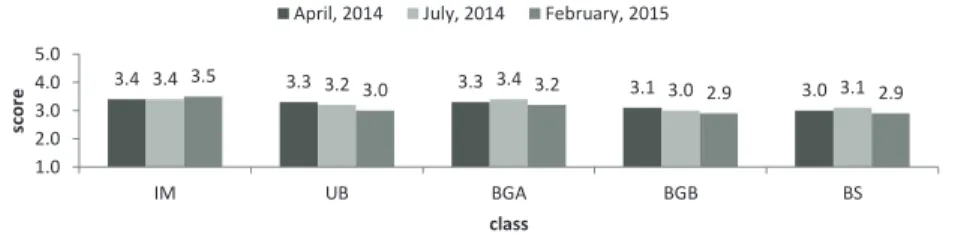
The results of learning motivation (Figure 2) showed that the scores throughout the year showed few variations. UB, and BGB dropped their scores, BGA and BS increased at the second data point but scored the lowest of three tests in February, 2015. The scores were correlated with the levels of class, id est: the higher the classes were, the higher the learning motivational scores were.
Figure 2. Results of learning motivation by class
The results of communication anxiety (Figure 3) showed that IM started out with rather high scores, the highest of which being 3.9. Many classes started with 3.6-3.7, but the scores decreased toward the end of the courses. BS, however, started out the lowest with 3.3, but increased to 3.7 in the end of first semester, then ended with 3.2, which was almost the same as the other groups. Yet, all the classes had higher scores than the midpoint of 3.0, which indicated that they tended to have communication anxiety even though it decreased toward the end.
Differences among classes were not so obvious overall.
3.4 3.4 3.5 3.3 3.2 3.0 3.3 3.4 3.2 3.1 3.0 2.9 3.0 3.1 2.9
1.0 2.0 3.0 4.0 5.0
IM UB BGA BGB BS
score
class
April, 2014 July, 2014 February, 2015
10
Figure 3. Results of communication anxiety by class
Next, international posture is considered to be an indicator that affects L2 learning (Kobayashi, 2006; Yashima, 2004). Each factor: intercultural friendship orientation; interest in international vocation/activities; interest in foreign affairs;
and approach-avoidance tendency was processed.
First, the results of intercultural friendship orientation (Figure 4) indicate that a person’s reason to study a foreign language is communication, cultural exchange, or learning another culture/language. The results showed IM had the highest score throughout the year, although it gradually decreased. BS marked the lowest and it ended with 2.6, which indicated the students potentially harbour negative attitudes and may be relatively disinclined to pursue intercultural friendships. The results did not show large differences among IM, UB, BGA and BGB compared to the results of English proficiency. Overall, upper classes tended to have higher scores in this orientation.
Figure 4. Results of intercultural friendship orientation
3.9 3.2 3.3 3.6 3.4 3.3 3.6 3.3 3.4 3.7 3.3 3.3 3.3 3.7 3.2
1.0 2.0 3.0 4.0 5.0
IM UB BGA BGB BS
score
class
April, 2014 July, 2014 February, 2015
3.5 3.4 3.4 3.6 3.3 3.1 3.6 3.5 3.4 3.5 3.1 3.1 3.0 2.9 2.6
1.0 2.0 3.0 4.0 5.0
IM UB BGA BGB BS
score
class
April, 2014 July, 2014 February, 2015
Figure 3. Results of communication anxiety by class
Next, international posture is considered to be an indicator that affects L2 learning (Kobayashi, 2006; Yashima, 2004). Each factor: intercultural friendship orientation; interest in international vocation/activities; interest in foreign affairs;
and approach-avoidance tendency was processed.
First, the results of intercultural friendship orientation (Figure 4) indicate that a person’s reason to study a foreign language is communication, cultural exchange, or learning another culture/language. The results showed IM had the highest score throughout the year, although it gradually decreased. BS marked the lowest and it ended with 2.6, which indicated the students potentially harbour negative attitudes and may be relatively disinclined to pursue intercultural friendships. The results did not show large differences among IM, UB, BGA and BGB compared to the results of English proficiency. Overall, upper classes tended to have higher scores in this orientation.
Figure 4. Results of intercultural friendship orientation
3.9 3.2 3.3 3.6 3.4 3.3 3.6 3.3 3.4 3.7 3.3 3.3 3.3 3.7 3.2
1.0 2.0 3.0 4.0 5.0
IM UB BGA BGB BS
score
class
April, 2014 July, 2014 February, 2015
3.5 3.4 3.4 3.6 3.3 3.1 3.6 3.5 3.4 3.5 3.13.1 3.02.9 2.6
1.0 2.0 3.0 4.0 5.0
IM UB BGA BGB BS
score
class
April, 2014 July, 2014 February, 2015
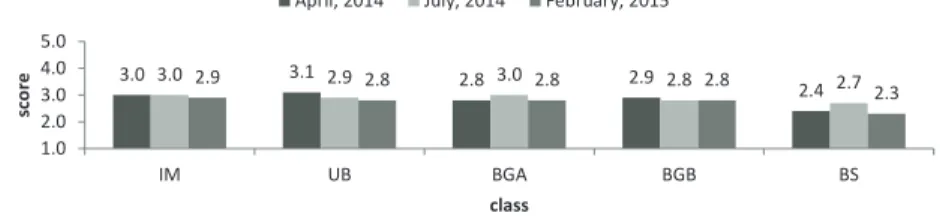
The results of interest in international vocation/activities (Figure 5) marked the second lowest of all the four factors we analysed. Compared to other groups, BS scored much lower even after accounting for an upward fluctuation in July.
Figure 5. Results of interest in international vocation/activities
The results of interest in foreign affairs marked the lowest (Figure 6). The results showed different tendencies from the other factors, which generally correlated with English proficiency: more advanced classes scored higher. The results of this factor showed all the classes marked lower than 3.0. At the same time, most of the classes increased their scores toward the end of the course.
Figure 6. Results of interest in foreign affairs
The results of approach-avoidance tendency were similar to those of intercultural friendship orientation. IM and BGA assigned judgements of 3.6-3.8 and although they decreased slightly, they generally maintained high scores. UB
3.0 3.0 2.9 3.1 2.9 2.8 2.8 3.0 2.8 2.9 2.8 2.8 2.4 2.7 2.3
1.0 2.0 3.0 4.0 5.0
IM UB BGA BGB BS
score
class
April, 2014 July, 2014 February, 2015
2.4 2.2 2.7 2.3 2.5 2.6 2.6 2.7 3.1 2.1 2.8 2.6 2.5 2.4 2.7 1.0
2.0 3.0 4.0 5.0
IM UB BGA BGB BS
score
class
April, 2014 July, 2014 February, 2015
12
started with a high score but this dropped sharply in July and stayed largely unchanged until the final data point. BGB gradually decreased its score as did BS.
Figure 7. Results of approach-avoidance tendenc
4 Discussion
4.1. English Proficiency
The Ministry of Education, Science and Technology (MEXT), (2002) set the goal for high school graduates to achieve CEFR A2/B1. To ease the understanding of the participants’ proficiency level, each level’s Can-Do’s do will be explained here. According to Council of Europe (2001), B1, Independent Users, have language ability with which they can deal with familiar matters like work, school, leisure, travelling, dreams, events, hopes, and ambitions. They can briefly give reasons and explanations for opinions and plans. A2, labelled as Basic Users, can deal with simple or routine tasks like personal information, shopping, local geography, employment, or immediate need. A1, also labelled as Basic Users, can use very basic expressions and phrases for personal details like her living places, acquaintances, and belongings. They can interact with help to carry on the conversation. The CEFR does not have Pre-A1, but the Cambridge examination does (UCLES, 2009): language users of this level have very limited ability and they can deal with isolated tasks in specific situations done in a primary school setting.
3.8 3.7 3.7 3.7 3.2 3.3 3.6 3.5 3.6 3.6 3.4 3.2 3.4 3.03.0
1.0 2.0 3.0 4.0 5.0
IM UB BGA BGB BS
score
class
April, 2014 July, 2014 February, 2015
started with a high score but this dropped sharply in July and stayed largely unchanged until the final data point. BGB gradually decreased its score as did BS.
Figure 7. Results of approach-avoidance tendenc
4 Discussion
4.1. English Proficiency
The Ministry of Education, Science and Technology (MEXT), (2002) set the goal for high school graduates to achieve CEFR A2/B1. To ease the understanding of the participants’ proficiency level, each level’s Can-Do’s do will be explained here. According to Council of Europe (2001), B1, Independent Users, have language ability with which they can deal with familiar matters like work, school, leisure, travelling, dreams, events, hopes, and ambitions. They can briefly give reasons and explanations for opinions and plans. A2, labelled as Basic Users, can deal with simple or routine tasks like personal information, shopping, local geography, employment, or immediate need. A1, also labelled as Basic Users, can use very basic expressions and phrases for personal details like her living places, acquaintances, and belongings. They can interact with help to carry on the conversation. The CEFR does not have Pre-A1, but the Cambridge examination does (UCLES, 2009): language users of this level have very limited ability and they can deal with isolated tasks in specific situations done in a primary school setting.
3.8 3.7 3.7 3.7 3.2 3.3 3.6 3.53.6 3.63.4 3.2 3.43.0 3.0
1.0 2.0 3.0 4.0 5.0
IM UB BGA BGB BS
score
class
April, 2014 July, 2014 February, 2015
The participants intimated that they struggled with the tests due to cultural differences: in Part 1, a section of definition in the tests of both Movers and Flyers, the words were everyday items that the participants had not experienced before. For example, a dentist in Japanese native speakers’ understanding is understood as a “doctor” that patients would go only when they have tooth problems, but it was defined as “a person who looks after your teeth and you should go a see him or her every six months.” As Can-Do’s shown above, these levels deal with familiar contexts, in which cultures are closely related and people’s way of thinking are reflected in language.
The results showed that the highest class, IM, almost reached A2 level on their entrance, and reached the level in July, but dropped in February 2015 even though the average scores showed both positive and negative fluctuations.
Looking into details, the ratio of students who scored 90% or higher, which could be considered as B1, was 1.7% in April, 0.0% in July, and 3.0% in February. The textbook, CEFR A2, seemed appropriate with respect to difficulty, and various kinds of activities were employed. However, the score decreased in February. UB and BGA are considered to have CEFR A1 level in general, and BGB and BS had Pre-A1 level. One of the reasons could be due to the participants’ teaching practicum overlapping with the final periods. Some students claimed that they were too busy to focus on study. Teaching practicum is something English teachers cannot do without, but overlapping with the finals should be reconsidered.
Other reasons behind falling scores can be deduced as follows: first, the test in July was the first examination for the participants so they tried hard not to fail.
In the second semester, the participants learned that this test was only 10% of the internal assessment. Concurrently students, especially those who were confident in passing the class without this 10%, were not serious about this test. Once they
passed, they would not need to study English for the rest of their college lives. The last conjecture that can be made is that if these tests had been related to the students’ future jobs such as TOEIC and BULATS, the score might have been different—the test itself could be a problem. Yet, BULATS starts from CEFR A2 (UCLES, 2015c), which is not appropriate for students below A2. Also, TOEIC was used previously, but it turned out to be too challenging for lower students. If so, the same study using the tests related to the students’ future jobs as well as covering material from Pre-A1 and up should be conducted in the future.
As for BGB and BS, their learning history before entering university should be mentioned. In BS, the teacher asked when their problem started in terms of English learning. The students stated that they could not catch up with English class in the early stage of junior high school like first year, and since then, they had hated English. Most of BS did not have native-speaker teachers in their secondary school education, and they did not have cultural exchanges with foreigners in school, especially high school. Also, these students tended to have problems not only in English but in other subjects in university like understanding class content or completing assignments like writing academic papers. This could indicate that their problem may be related to learning ability in general, which is related to “universalization of education” (Katase, 2007; Yamamoto, 2003).
Based on the presence of participants with Pre-A1, primary school level, new types of teaching principles and pedagogies may need to be implemented.
Teachers are required to change drastically, too. Classes may need to be tailored to match the participants’ academic levels and needs.
4.2. Learning Motivation and Communication Anxiety The results of learning motivation (Figure 2) showed that the scores were correlated with the levels of class, i.e. higher the classes were, the higher the
passed, they would not need to study English for the rest of their college lives. The last conjecture that can be made is that if these tests had been related to the students’ future jobs such as TOEIC and BULATS, the score might have been different—the test itself could be a problem. Yet, BULATS starts from CEFR A2 (UCLES, 2015c), which is not appropriate for students below A2. Also, TOEIC was used previously, but it turned out to be too challenging for lower students. If so, the same study using the tests related to the students’ future jobs as well as covering material from Pre-A1 and up should be conducted in the future.
As for BGB and BS, their learning history before entering university should be mentioned. In BS, the teacher asked when their problem started in terms of English learning. The students stated that they could not catch up with English class in the early stage of junior high school like first year, and since then, they had hated English. Most of BS did not have native-speaker teachers in their secondary school education, and they did not have cultural exchanges with foreigners in school, especially high school. Also, these students tended to have problems not only in English but in other subjects in university like understanding class content or completing assignments like writing academic papers. This could indicate that their problem may be related to learning ability in general, which is related to “universalization of education” (Katase, 2007; Yamamoto, 2003).
Based on the presence of participants with Pre-A1, primary school level, new types of teaching principles and pedagogies may need to be implemented.
Teachers are required to change drastically, too. Classes may need to be tailored to match the participants’ academic levels and needs.
4.2. Learning Motivation and Communication Anxiety The results of learning motivation (Figure 2) showed that the scores were correlated with the levels of class, i.e. higher the classes were, the higher the
learning motivational scores were. These results were endorsed by previous studies that claim motivation is an important factor of second language learning.
Also, as Figure 1 shows, average scores from the Cambridge English Examination increased in July 2014, but decreased in February 2015 in most classes. This could be related to the students’ learning motivation at the beginning and at the end of the research. Since the results of IM—the highest class—stayed the same level of motivation throughout the year, other factors rather than learning motivation could have effected on the test results.
The results of communication anxiety (Figure 3) showed that all classes except for BS started out with rather high scores like 3.9. The students in IM were taught by a native English speaker, and this fact was reflected in the results accordingly. However, the level of anxiety decreased by 0.7 in the IM class within three months. This can indicate that the students in IM was starting to feel comfortable speaking and learning in English. Also they were flexible in adjusting teaching and learning strategies.
As for BS, however, it started out with the lowest score, 3.3, but increased to 3.7 in the end of first semester, then ended with 3.2, which was almost the same as the other groups. This could indicate that the students in BS with CEFR Pre-A1 level were not conscious of grades as much as the other classes, but knowing the importance of good academic performance like accuracy and having a broader vocabulary made the students anxious about communication in English.
4.3. International Posture
As previously mentioned, international posture is claimed to be closely related to learning motivation. In general, the results showed that the higher the language proficiency, the higher the scores were in international posture. At the same time, the students’ interests in international vocation/activities/affairs were
scant, which would give teachers an important insight for the future.
According to the results of intercultural friendship orientation (Figure 4), upper classes marked higher compared to BS, which marked the lowest score and it ended with 2.6. This may indicate the students were likely to be negatively oriented toward having intercultural friendship. From these results, we could conclude that highly motivated students with higher language proficiency tend to be willing to have cultural exchanges with people from other cultural backgrounds. At the same time, students in BS informed their teacher that they did not have native-speaker teachers at all in high school as previously mentioned.
These cultural experiences may have had some influence on the results.
The results of interest in international vocation/activities (Figure 5) marked the second lowest of all the four factors. The results indicated that the students’
lacked interest in international vocation/activities. It can be assumed that the students answered that “English was necessary to get a good job” in the questionnaire but felt it was not closely related to their own lives. This attitude was shown in the score, 3.0. Among the five classes, BS marked the lowest here again. Infrequent exposure to foreigners or people from another culture may have had an impact on this factor as well.
The results of interest in foreign affairs marked the lowest (Figure 6), but the results were not correlated with the English proficiency in this factor. The results showed that all the students were not interested so much in foreign affairs. At the same time, most of the classes increased their scores toward the end of the course not just the class taught by a native-speaker teacher. Some reasons for these results could be their textbooks that dealt a lot of foreign affairs and teachers tried to utilize the material to gain relating knowledge using smart phones/computers. Yet the scores stayed lower than the midpoint.
scant, which would give teachers an important insight for the future.
According to the results of intercultural friendship orientation (Figure 4), upper classes marked higher compared to BS, which marked the lowest score and it ended with 2.6. This may indicate the students were likely to be negatively oriented toward having intercultural friendship. From these results, we could conclude that highly motivated students with higher language proficiency tend to be willing to have cultural exchanges with people from other cultural backgrounds. At the same time, students in BS informed their teacher that they did not have native-speaker teachers at all in high school as previously mentioned.
These cultural experiences may have had some influence on the results.
The results of interest in international vocation/activities (Figure 5) marked the second lowest of all the four factors. The results indicated that the students’
lacked interest in international vocation/activities. It can be assumed that the students answered that “English was necessary to get a good job” in the questionnaire but felt it was not closely related to their own lives. This attitude was shown in the score, 3.0. Among the five classes, BS marked the lowest here again. Infrequent exposure to foreigners or people from another culture may have had an impact on this factor as well.
The results of interest in foreign affairs marked the lowest (Figure 6), but the results were not correlated with the English proficiency in this factor. The results showed that all the students were not interested so much in foreign affairs. At the same time, most of the classes increased their scores toward the end of the course not just the class taught by a native-speaker teacher. Some reasons for these results could be their textbooks that dealt a lot of foreign affairs and teachers tried to utilize the material to gain relating knowledge using smart phones/computers. Yet the scores stayed lower than the midpoint.
The results of approach-avoidance tendency were similar to those of intercultural friendship orientation. IM and BGA marked 3.6-3.8 and they had slight drops but generally kept high scores. IM had a native-speaker teacher and that might have affected the score. The reason for the drop could be that they were excited about having a native-speaking teacher but they became used to them after a few months. BGA, being taught by a Japanese teacher, kept high scores while BGB and BS dropped or kept the scores low, which cannot be concluded as an indication of the effect of the teachers’ nationalities.
5 Suggestion on SLA Pedagogies
This section proposes some effective SLA pedagogies which may have an impact upon the university students for motivated and more advanced students (IM) as well as for those who are less motivated and have challenges in English learning (UB, BGA, BGB, and BS) based on the results discussed.
As discussed previously, upper classes tend to have higher motivation, international posture, and higher proficiency. On the other hand, lower classes have challenges in many of these factors, disinterest in English as well as little confidence, which could be a significant challenge for teachers as well. Beginning from age 18 and upwards, age appropriate activities for university students could include more difficult vocabulary and grammatical structures, but these could also make the students with Pre-A1 level more demotivated.
The results of this research indicated that extrinsic motivation like getting a good score to pass the compulsory classes is limited but necessary—this means we need to blend motivating methods with some instrumental aspects. The bottom line is that activities that motivate students at any levels should be conducted in class. Therefore, SLA pedagogical methods such as active group work, product
development, and fishbowl settings, may be effective.
One such alternative is the application of active group learning. This approach focuses on student-centred learning (also known as learner-centred education). Student-centred learning is particularly advantageous as it has been evidenced to improve critical thinking skills and problem solving whilst simultaneously developing academic independence (Saye & Brush, 2001). It eschews the practice of fact-dissemination in favour of a more open and collaborative setting that is geared towards problem-solving and task orientation;
the practice has been reported to have met with positive reception from students, which bodes well for motivation levels (Wright, 2011). In addition, it has been proven that the usage of scaffold strategies within student-centred learning, where the teacher is more a facilitator or a guide, tends to be more effective because the students understand the tasks or concepts given in class better (Saye & Brush, 2001). Consequently, this approach could be well suited to our students as it fosters class discussion, debating, presentation, and writing exercises. It also creates an atmosphere of involvement and the active participation of students in their own learning circumvents some of the motivational vagrancies of traditional lecture-based pedagogies.
Active group learning involves dividing the class into smaller work groups and assigning tasks. Depending on the level of proficiency, the assigned tasks can be tailored to different levels of complexity. At the weaker end of the spectrum, a teacher could charge the group with taking a photograph (or series of photographs) and then preparing a description of it (or them). For instance, lower level classes could be required to describe what objects they see in the frame – building on simple noun vocabulary. This could also include the colours of objects in addition to their respective sizes. Commenting on details regarding the spatial location of objects elicits responses using locational phrases (Trowbridge, 2011). Activities
development, and fishbowl settings, may be effective.
One such alternative is the application of active group learning. This approach focuses on student-centred learning (also known as learner-centred education). Student-centred learning is particularly advantageous as it has been evidenced to improve critical thinking skills and problem solving whilst simultaneously developing academic independence (Saye & Brush, 2001). It eschews the practice of fact-dissemination in favour of a more open and collaborative setting that is geared towards problem-solving and task orientation;
the practice has been reported to have met with positive reception from students, which bodes well for motivation levels (Wright, 2011). In addition, it has been proven that the usage of scaffold strategies within student-centred learning, where the teacher is more a facilitator or a guide, tends to be more effective because the students understand the tasks or concepts given in class better (Saye & Brush, 2001). Consequently, this approach could be well suited to our students as it fosters class discussion, debating, presentation, and writing exercises. It also creates an atmosphere of involvement and the active participation of students in their own learning circumvents some of the motivational vagrancies of traditional lecture-based pedagogies.
Active group learning involves dividing the class into smaller work groups and assigning tasks. Depending on the level of proficiency, the assigned tasks can be tailored to different levels of complexity. At the weaker end of the spectrum, a teacher could charge the group with taking a photograph (or series of photographs) and then preparing a description of it (or them). For instance, lower level classes could be required to describe what objects they see in the frame – building on simple noun vocabulary. This could also include the colours of objects in addition to their respective sizes. Commenting on details regarding the spatial location of objects elicits responses using locational phrases (Trowbridge, 2011). Activities
such as this are designed to develop critical language awareness and are a useful tool to increase student motivation (Tankard, 2014). Further extension could be provided by then asking the students to prepare a short presentation of the descriptions. Intermediate level classes on the other hand, could be pressed to describe what feelings the photograph invokes, what their rationale was when composing the image, and perhaps a commentary on what activities are playing out (or could be playing out) in the frame (Gunn, 2007). This exercise can be extended as far as writing a passage about each image with particular emphasis placed on the use of adjectives in conjunction with their correct order (Gunn, 2007).
A second task option that is well suited to more proficient classes is a product development exercise. Here, students are asked to develop a hypothetical product and consider all the marketing choices needed to bring the product to market. This includes pricing decisions, supply chain management, promotional strategies, and of course, the product itself. Boundaries may be set by the teacher such as restricting ideas to a particular industry or geographic region as necessary. This exercise is highly effective as it simultaneously develops not only language skills but also communication, planning, and problem solving (Brown & Eisenhardt, 1995). Both of these alternatives will require considerable time for students to prepare and thus may span several weeks or even months, depending on the level of complexity sought. This method worked very well in IM, which is reflected in the results. At the same time, the second project in the second semester did not work so well compared to the first semester. The students claimed that they were too busy to work on the project. Time constraints and topics could have affected the quality of the project as well as students’ motivation. This indicates that teachers should carefully plan so that the students can spend enough time on the project.
As for lower classes, their sentence structures are limited to very simple grammar like present tenses of be verbs, have, imperatives, there is/are.., can/can’t, etcetera. Similarly, whilst lower classes tend to struggle with using their imagination, a less structured product development exercise represents a good opportunity to develop creative skills. In this case a lack of written procedures or defined steps affords a degree of freedom which can benefit the teacher if students become stuck (Tucker, Friar, & Simpson, 2012). In terms of providing incentives to participate, bonus credit marks could be awarded for injection of ideas or as a second alternative, groups could be pitted against one another with the best idea garnering bonus marks.
‘Fishbowl learning’ is a term given to describe a second learning pedagogy.
In this case, students form two concentric rings wherein the inner ring (the fish) conducts a task and the outer ring (the bowl) observes, takes notes, and prepares questions (Gorski, 2015). The teacher assigns a task of the inner ring and discussion commences. This method is well suited for more proficient classes and is beneficial in the sense that as it provides an atmosphere of ‘being an experiment in observation’ the subject of the discussion itself is more the focus of attention rather than the students and thus can alleviate some of the angst of voicing opinions in a foreign language. Secondly, as it largely centres on discussion, observation, and listening, it is well suited to analysing current topics – such as the impact of globalisation, or perhaps the controversy surrounding whaling.
Following the completion of the inner circle’s discussion the outer circle comments on what they have observed (Facing History and Ourselves, 2015).
Roles can then be reversed, allowing each student the opportunity to be both participant and observer. As this activity can be completed within a single 90 minute session it allows for different topics to be explored each week. As for lower classes, preparation is vital. Based on the previous class, having them write their scripts and do the fishbowl may work well to improve their writing skills as