Prioritization of Factors Affecting Bank Efficiency Using Combined Data Envelopment Analysis and Hierarchical Analysis Methods
Dr. Mehdi. Fallah Jolodar (1), Sedigheh. Safari (2)
1. Professor assistant, Department of Mathematics, Firoozkooh Branch, Islamic Azad University, firoozkooh, Iran
2. Department of management, Firoozkooh Branch, Islamic Azad University, firoozkooh, Iran
[email protected], [email protected]
Abstract: Banks have a vital role in the economy of any country. They collect assets from various sources and put them in the hand of those sectors that need liquidity. Due to the limited financial and human resources and capitals and also because of the unlimited and new customers' needs and strong competition between banks and financial and credit institutions, the purpose of this study is to provide an answer to the question that which of the factors affecting performance, creating value and increasing shareholder dividends are superior to others and consequently managers should pay more attention to them. Therefore, in this study, the factors affecting performance (efficiency) in the areas of management, personnel, finance and customers were segmented and obtained results were ranked using both methods of data envelopment analysis and hierarchical analysis. In both of these methods, the leadership style in the area of management; the recruitment and resource allocation in the area of financing; the employees' satisfaction, dignity and self-actualization in the area of employees and meeting the new needs of customers got more weights.
[Mehdi. Fallah Jolodar, Sedigheh. Safari. Prioritization of Factors Affecting Bank Efficiency Using Combined Data Envelopment Analysis and Hierarchical Analysis Methods. Academ Arena 2018;10(8):71-77]. ISSN 1553- 992X (print); ISSN 2158-771X (online). http://www.sciencepub.net/academia. 6. doi:10.7537/marsaaj100818.06.
Keywords: performance (efficiency), hierarchical analysis, data envelopment analysis
1. Introduction
Basically, managers of the banks are forced to select and improve methods of providing banking services, investments, marketing, human resource management, customer management and competition with other banks and ultimately increasing the productivity and efficiency among their branches due to the economic conditions and lack of inputs, production factors and technology. Obviously, when inefficient units become efficient, one can expect that the national interests are more provided and at the same time the goals are achieved, the cost of services are reduced and wasting economic limited resources are avoided and losses due to the inefficiencies in the banks may be reduced to a minimum amount and the banking system as a whole is more efficient. Thus, given the role of banks in the development of country and also due to the existence of numerous branches, paying attention to the efficiency of banks has a special importance, so that a variety of studies have been conducted in recent years to identify the factors affecting performance (efficiency) in various areas, some of which are mentioned bellow:
In evaluating the strategic performance of the banks using FAZZY AHP method, Motameni and Javadzadeh (2010) reached the conclusion that non- financial performance is more important than financial performance and in the evaluation of financial performance, the criterion of resources share earned first place in terms of importance and the criteria of
profitability and return on assets were placed in the next position. In non-financial performance measurement, the criterion of pricing was ranked first in importance and criteria of E-banking and service quality were next in the rank. (Motameni, 2010) M.
Mirjalili (2006) conducted a study to identify and improve employees' productivity using fuzzy DEA method. According to the results of this study, bank staff motivation in immaterial dimensions (unification of job and occupations, job security, equality in the organization and education) is more important compared to the material dimensions (Salary, bonus, welfares, work physical environment, safety) (Mirjalili M,2006) Saleh Mansouri (2009) compared the DEA and AHP methods using the technique of prioritizing Key Performance Indicators (KPIS) for stock companies. The results showed no significant difference in the prioritization done by these two methods and DEA has a higher ability to prioritize the key performance indicators compared to the Analytical Hierarchy Process (AHP). (Mansoori, 2009) Jung and Jang (2006), studied the long-term profitability of banks in Taiwan and reached to this conclusion that the banking services are the most important factors for the increased profitability of banks' branches. Also, the bank employees were considered as the most important and basic factor to achieve increased profitability. (Ta-Cheng, 2006).
Timothy (2010) examined the tangible and intangible factors; and the relative importance of each of these
sources in Tanzania. Risk management, management return, services, innovation capability and the ability to measure the market performance are five important sources affecting the performance of commercial banks in Tanzania. In addition, quantitative analysis shows that the productivity of human capital, physical capital productivity, mobilization of the funds, size of the bank, interest income, and the management return have positive influences on managerial efficiency of banks. ( Timothy, 2010)
2. Theoretical fundamentation
Participants in this study are 80 people, including experts, managing directors engaged in branches management and managers of Mellat Banks in Tehran. Since the current study is related to the collection of standards and options and provides the possibility to decide on the selection and giving importance to the indicators, therefore, it is an applied research. But in terms of technique, it is descriptive- survey study because it provides the possibility of analyzing the subject and decision making through describing the criteria and decision alternatives and also because in this study a questionnaire is designed to complete the calculations. At first in this study, scientific literature related to the subject and the primary criteria for decision-making were identified using desk method and searching in the valid databases. Then, identified criteria were classified in four categories: management, investors, employees and customers and distributed as a questionnaire among experts and professionals and they were asked to provide their comments through pair comparison of the indicators.
2.1. Analytical Hierarchy Process (AHP)
Classic Analytical Hierarchy Process method conducted by T.L. Saati in 1970, is the most popular and practical methods of MADM. This method is used when there is a need for simultaneous consideration of qualitative and quantitative aspects of a decision. AHP technique using paired comparisons (one by one) and combined results, reduces the complexity of decisions, thus, not only could help decision makers to obtain the best decision, but also provides a clear justification for showing that the obtained decision is the best one.
(Rao, R.V., 2008) AHP method is the organization of decision making at different hierarchical levels where a set of options are in lower levels, a set of decision criteria and standards are at the average level and the static goals are at the top levels of decision making hierarchy. Elements of decision making usually represent a finite set of alternatives and decision- making regulations represent a set of properties that are effective for decision making. (Cakir, 2008) In order to control the outcome of this procedure, the consistency ratio is calculated for each paired
comparison and it shows how judgments are consistent and can be relied on. (Nepal, 2010)
2.2. Data Envelopment Analysis (DEA)
Data envelopment analysis is a mathematical programming method which is used to evaluate the efficiency of DMUs with multiple inputs and outputs.
Efficiency measurement has always been considered by researchers because of its importance in assessing the performance of a company or organization. In 1957, Farrell measured efficiency of a manufacturing unit using a method such as efficiency measurement in engineering issues. The case considered by Farrell to measure the efficiency included an output and an input. Charnz, Cooper and Rhodes developed farrell's viewpoint (approach) and provided a model that was able to measure the efficiency with multiple inputs and outputs. This pattern was named Data Envelopment Analysis and was used for the first time in 1976 by Karengi University in the PhD thesis (dissertation) of Edward Rhodes (supervised by Cooper), entitled "An Assessment of Educational Progress of Students in the National American Schools. (Mehregan MR, 2008)
DEA focuses on the analysis of different concepts of relative efficiency such as cost, revenue and profit efficiency, productivity of the whole components and factors of organizational units (the so-called decision-making units (DMUs)) in the use of inputs to produce output. Decomposition to the elements of efficiency is an opportunity to analyze the performance and to avoid the risk of non-profitability of banks. Cost efficiency reflects the company's ability to minimize costs given a particular level of output and income return shows whether the bank has reached the maximum level of income and productivity using a part of input and ultimately the profit efficiency seeks to minimize costs and maximize income. (Kryvko, 2011) This method is not sensitive to the measurement unit and inputs can have different units and also it does not need any specific functional form of data in order to determine the efficiency of banks. In fact it is an empirical function of the observations. DEA standard does not control optimization of multiple periods and may be at the risk of managerial decision-makings. Therefore, after identification of an efficient unit, one must again control data and outputs and to ensure their accuracy (Fethi, 2010) The use of data envelopment analysis model to relatively evaluate the units requires the two basic characteristics: "the nature of the model (input- oriented nature and the output-oriented nature) and returns to scale (CCR fixed and BCC variable). Here, the input-oriented CCR model is used by the following formula:
Where, Xo,Yo
is the vector of inputs and DMUo
outputs.
n 1,2,..., j
, 0
s 1,2,..., r
, y y
m 1,2,..., i
, x x S.t
Min
j n
1 j
ro rj j
io n
1 j
ij j
……
… (1)
Above formula is known as Envelopment Form of CCR model. 1 problem dual is known as the multiplier form of CCR model which is as follows:
m 1,2,..., i
, 0 v
s 1,2,..., r
, 0 u
n 1,2,..., j
, 0 x v y u
1 x v t . S
y u Max
i r s
1 r
m 1 i
ij i rj r m
1 i
io i s
1 r
ro r
…… . (2)…
….2.3. DEAHP method
DEA method is a useful tool for the performance evaluation of decision-making units in the management science which calculates the efficiency of each decision making unit. The main objective of DEA is to determine the efficiency of a system or a decision-making unit which produces one or more outputs using one or more inputs. On the other hand, AHP is also a useful tool in the Multi-criteria Decision Making (MCDM) to select the best option and to rank different options. Calculation of the relative weights of the elements is the main concept of the AHP method. So far, several approaches have been provided to calculate the weight from the paired comparison matrix. In 2006, Ramakrishnan Ramanathan provided a method through which the relative weight of the paired comparison matrix is obtained using DEA Model. Calculation of the exact weight of each element for the consistent matrices is one of the outstanding points of this method. In this study, the meaning of efficiency in DEA method and the meaning of relative weights in AHP method have become identical. Since the proposed method is a combination of DEA and AHP methods, Ramanathan chose the name of "DEAHP" for this method. In DEAHP method, each row of the paired comparison matrix was considered as a DMU and each of its columns was considered as an output. Therefore, in a
paired comparison matrix (n × n), there are "n"
decision-making units (DMU) and "n" outputs corresponding to each DMU. Note that each component of the paired comparison matrix is considered as an output. DEA has logically the characteristics of an output because larger number of aij is prioritized to a component with the smaller number in AHP. Therefore, the priority in AHP can be considered as identical to the output of the DEA. In DEAHP, Ramanathan used CCR models to calculate the efficiency of each DMU and that is why he considered a fixed input equal to 1 for each DMU and efficiency score of each DMU which is obtained using different models of DEA (CCR envelopment form in the input and output nature, multiplier form of CCR model in the input and output nature) was considered as the relative weight of each factor. Ramanathan proposed model for the calculation of the relative weights of elements in a paired comparison matrix using multiplier form of CCR is as follows: (Taj Din, 2010).
Max ∑nj=1 aij uj
s.t. v1= 1
∑ nj=1 ai juj- v1≤ 0, i = 1,..,n (3) v1, uj ≥ 0, j= 1,..,n
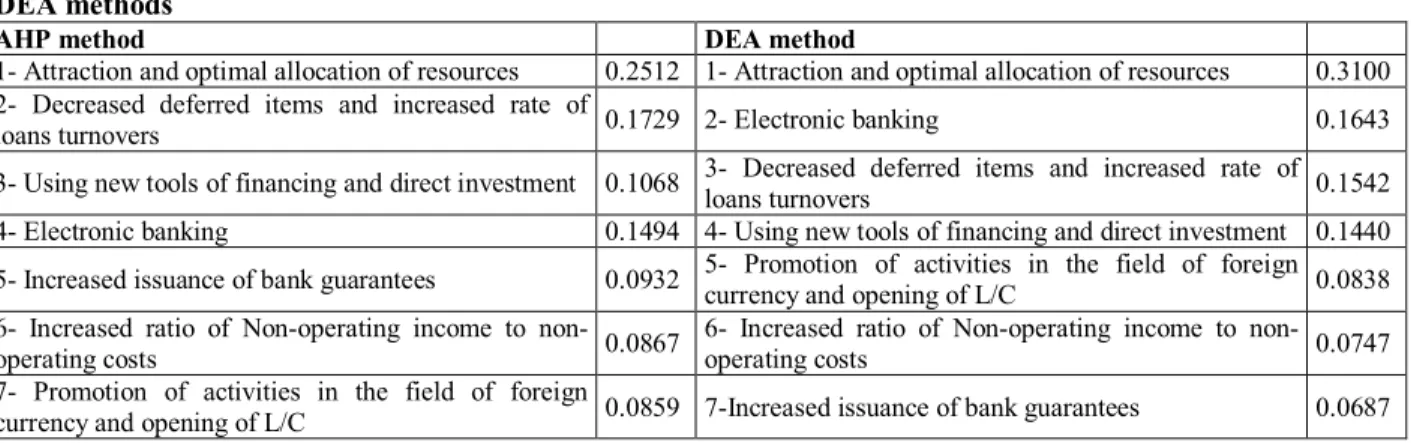
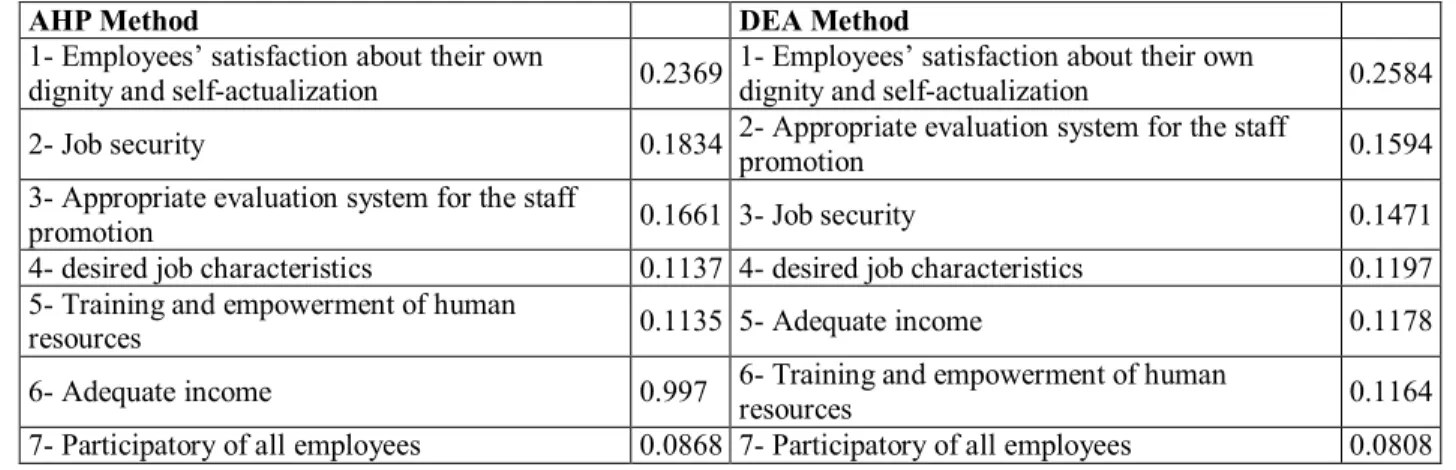
3. Prioritization of the factors affecting efficiency Given the mentioned concepts, factors affecting the efficiency were first prioritized using AHP method. In this method, prioritization of factors affecting performance (efficiency) has been considered at the first level which is the purpose of using this method and the second level is composed of 4 criteria of management, finance, staff and customers and the third level is consisted of 7 items in each field which are summarized in Table 1. Following hierarchical modeling of the decision concept, elements (indicators or options) of any level were compared to the corresponding elements in higher level (2 by 2) and 50 questionnaires were completed.
In order to combine tables of the paired comparisons of all respondents, the geometric mean was used and the relative weight was obtained from the arithmetic mean. In all four areas, the consistency ratio was less than 0.1 which represents the good consistency ratio among the comparisons. Then, in the second method, weights of options were calculated based on the model proposed by Ramanathan using gams software which is a DEA linear programming model. The results of both methods were similar to each other. The first priority is the same in all 4 areas and other indicators were ranked with a slight difference and the obtained percentages had also a small difference.
Table 1- Indicators of each criterion
Customers Staff
Financial Management
Customer orientation and providing an appropriate image
Training and empowerment of human resources
Attraction and optimal allocation of resources Management
Information Systems 1
Improvement of quality and speed of services Adequate income
Decreased deferred items and increased rate of loans turnovers Ability and
emphasis on innovation and creativity 2
Adjustment of the loans’
rate Participatory of all employees
Promotion of activities in the field of foreign currency and opening of L/C
Creating an appropriate organizational culture 3
Knowledge, expertise, personnel accountability Employees’ satisfaction about their dignity
and self-actualization Electronic Banking
Leadership style 4
To meet new needs of customers
Appropriate evaluation system for the staff promotion
Using new tools of financing and direct investment
Management of attracting key customers and relationship with them
5
Increased interest on deposits
Job security Increase in the issuance
of bank guarantees Creating an
effective and efficient internal control system 6
Suitability of the location, structure and layout of branches desired job characteristics
Increased ratio of Non- operating income to non-operating costs Risk Management
7
Table 2- Prioritization of factors affecting performance (efficiency) in the field of management using AHP and DEA methods
DEA method AHP Method
0.2262 1-Ability and emphasis on creativity
0.1891 1-Ability and emphasis on creativity
0.1746 2-Management Information Systems
0.1843 2-Management Information Systems
0.1647 3-Management of attracting key customers and relationship with them
0.1532 3-Management of attracting key customers and relationship with them
0.1239 4-Creating an effective and efficient internal control system
0.1340 4-Risk Management
0.1138 5-Creating an appropriate organizational culture
0.1317 5-Creating an appropriate organizational culture
0.1098 6-Risk Management
0.1212 6-Creating an effective and efficient internal control system
0.0867 7-Ability and emphasis on creativity
0.0865 7-Ability and emphasis on creativity
Table 3- Prioritization of factors affecting performance (efficiency) in the field of financial using AHP and DEA methods
DEA method AHP method
0.3100 1- Attraction and optimal allocation of resources
0.2512 1- Attraction and optimal allocation of resources
0.1643 2- Electronic banking
0.1729 2- Decreased deferred items and increased rate of loans turnovers
0.1542 3- Decreased deferred items and increased rate of loans turnovers
0.1068 3- Using new tools of financing and direct investment
0.1440 4- Using new tools of financing and direct investment
0.1494 4- Electronic banking
0.0838 5- Promotion of activities in the field of foreign currency and opening of L/C
0.0932 5- Increased issuance of bank guarantees
0.0747 6- Increased ratio of Non-operating income to non- operating costs
0.0867 6- Increased ratio of Non-operating income to non- operating costs
0.0687 7-Increased issuance of bank guarantees
0.0859 7- Promotion of activities in the field of foreign currency and opening of L/C
Table 4- Prioritization of factors affecting performance (efficiency) in the field of staff using AHP and DEA methods
DEA Method AHP Method
0.2584 1- Employees’ satisfaction about their own
dignity and self-actualization 0.2369
1- Employees’ satisfaction about their own dignity and self-actualization
0.1594 2- Appropriate evaluation system for the staff
promotion 0.1834
2- Job security
0.1471 3- Job security
0.1661 3- Appropriate evaluation system for the staff
promotion
0.1197 4- desired job characteristics
0.1137 4- desired job characteristics
0.1178 5- Adequate income
0.1135 5- Training and empowerment of human
resources
0.1164 6- Training and empowerment of human
resources 0.997
6- Adequate income
0.0808 7- Participatory of all employees
0.0868 7- Participatory of all employees
Table 5- Prioritization of factors affecting performance (efficiency) in the field of customers using AHP and DEA methods
DEA Method AHP Method
0.3364 1- To meet new needs of customers
0.2578 1- To meet new needs of customers
0.1615 2-Improvement of quality and speed of services
0.1683 2-Improvement of quality and speed of services
0.1284 3- Knowledge, expertise, personnel
accountability 0.1494
3-Knowledge, expertise, personnel accountability
0.1146 4- Increased interest on deposits
0.1237 4- Customer orientation and providing an
appropriate image
0.1010 5- Customer orientation and providing an
appropriate image 0.1162
5- Increased interest on deposits
0.926 6- Adjustment of the loans’ rate
0.1098 6- Adjustment of the loans’ rate
0.652 7- Suitability of the location, structure and layout of branches
0.0749 7- Suitability of the location, structure and layout
of branches
4. Analysis of the results and research suggestions:
The results of this study can be used by senior executives, managers and heads of branches and all bank experts and personnel who are involved in a way with the bank and operational plans. Due to the different types of users and uses of the results of this study, recommendations on the most important indicators that have the first priority are as follows:
4.1. First stage: resource attraction
Given that the attraction and allocation of resources have been chosen as the most important financial indicators, thus the volume and quality of resources are very important. Meanwhile, paying attention to the competitive position and the share (percentage) of the whole network resources should also be considered, therefore, the following recommendations are offered.
1- Paying attention to the attraction of resources with the lower operating costs; At first, banks should consider different types of non-cost-bearing and low-
cost-bearing deposits including interest-free current and savings deposits and then cost-bearing savings, such as short-term and long-term investments by providing high-quality services and more competitive advantage over rival banks.
2- Percentage of growth in the current resources of public institutions.
3- Percentage of growth in other Rial resources such as increase in the Rial guarantees and the opening of domestic L/Cs to receive cash deposits and advance payments of L/Cs, increase in the bank cheques and advance payments of bank loans.
4- The share of total market of resources:
Increase in the bank assets, compared with other banks, promotion of the bank’s brand, increase in the incentives of the Mellat bank's customers as their first bank.
5- Granting loans: Granting loans together with the proper authentication to gain profit margin and to cover operating and non-operating costs.
4.2. employees’ satisfaction from their dignity and self-discovery:
These personnel have a sense of purpose towards their jobs or lives than others. Employees can implement the best innovations and inventions with a sense of excitement, ownership and pride and they work with a sense of responsibility and prefer interests of the organization to their own interests.
Consequently, it is necessary to take the following measures:
1- Creating a free, dynamic and competent environment for the managers and staff.
2- Strengthening and enhancing the spirituality and preserving human values in all layers of an organization.
3- Making the commitment, loyalty, belonging to the organization, reliability, and understanding the needs of the organization.
4- To make all personnel in all levels of the business activities to be involved in the operational program activities and transition of steering committee meetings from the staff level of the bank region to the inside of bank branches.
5- Enhancing the coordination and interaction morale among personnel through cooperation and coordination between the executive directors.
6- Identifying and developing the talents, planning strength, modeling and encouraging colleagues to submit their proposals and viewpoints.
4.3. new solutions to meet the needs of new customers:
1- At first, customers should be prioritized and their needs should be identified. Then there should be tried to take their attention and to provide favorable expectations, develop a marketing culture among employees with a defined scientific approach and to arrange team talks with customers in order to meet all the needs of the customers.
2- New financing tools can include a variety of Sukuk securities, mortgage, future securities, transaction options, derivatives of stock and commodity markets and certificates of deposit and bonds and strengthening value chains of banks through insurance and leasing companies, currency exchange, funding, and other brokerages.
3- providing comprehensive financial services to corporations and institutions including equity and debt securities subscription programming, acquisitions and mergers activities, giving corporate restructuring advises, security trading and sales, granting loans and commitment services, managing receipts and payments and providing services such as risk management, liquidity management, proprietary trading.
4- Providing integrated financial and investment services and giving advice to the certain clients with
high amount of deposit in their accounts and managing their assets. Of course, all of these themes will help Mellat bank to become a bank with a variety of banking services a bank that will have a brilliant future In the field of competition through providing different banking services and implementing strategic themes and paying attention to the human resources and customers and it will be raised as a superior and valuable brand in the domestic and international banking system.
Summary and Conclusion
Measuring the performance of different organizations and comparing the efficiency of their different units are among those major issues that are discussed in today's economy. Among various organizations, banking system plays a very important role in Iran's economy, thus, given the important role of the banks in the development of our country and benefiting the opinions of bank experts and desk studies, 28 important factors affecting the performance of banks were selected and divided in 4 areas. Then, hierarchical analysis was used to prioritize these factors and weights obtained from the paired comparisons were ranked using DEAHP integration method and the results were presented.
These results can be used for operational decision- makings in the Mellat bank and other banks to allow administrators to allocate their scarce resources to these factors based on priority. One can also prioritize these factors and other internal and external factors affecting the performance (efficiency) through the use of other non-parametric methods and to compare them with the results of this study and to select the best possible options which suit the economic conditions of our country at the time of selection.
References
1. Motameni A., Javadzadeh M., Tizfahm M.,
“Evaluation of the strategic performance of banks, Strategic Management Studies, No. 1, spring 2010.
2. Mirjalili M., “Offering an integrated algorithm based on multiple analysis methods and fuzzy DEA method to identify and improve the productivity of bank employees, master, Tehran University, 2006.
3. Mansoori, S., “comparison between AHP and DEA approaches using prioritized KPI'S key performance indicators for companies listed on the Stock Exchange, master (MS degree), Imam Khomeini International University, 2009.
4. Ta-Cheng, Chang, Yung-Ho Chiu,2006, Affecting Factors on Risk-Adjusted Efficiency in Taiwan's Banking Industry, Contemporary Economic Policy, Vol. 24, Issue 4, pp. 634-648.
5. Timothy, Vedastus, A study on the determinants of commercial bank performance in Tanzania: A resource-based view, Doctoral Dissertation, Liaoning University, June 2010.
6. Rao, R. V., Davim, J. P,2008, A Decision- Making framework model for material selection using a combined attribute decision-method, Int J Adv manuf technol, 35,751.
7. Cakir, Ozan.,2008, On the order of the preference interence in fuzzy AHP, computers &
intdustrial engineering 54, 993-1005.
8. Nepal, Bimal., Yadav, Om P., Murat Alper.2010, Afuzzy-AHP approach to prioritization of CS attributers in target planning for automotive product development, Expert Systems with Applications 37, 6775-6786.
9. Mehregan MR., Advanced Operations Research, Tehran, Academic Books (Ketab-e-Daneshgahi) Publication, 2008, 4th edition.
10. Kryvko, Anna, Afsharian, Mohsen, Reichling, Peter,2011, Efficiency and Its Impact on the Performance of European Commercial Banks, Otto-von-Guericke University - Department of Banking and Finance.
11. Fethi, Meryem Duygun, Pasiouras, Fotios, 2010, Assessing bank efficiency and performance with operational research and artificial intelligence techniques.
12. Taj Din, S., ”Obtaining optimal weights from paired comparisons matrix using DEA models, Master, Islamic Azad University, Tehran, 2010.
8/25/2018