Reexamining the relationship between net foreign assets and the current account
journal or
publication title
Doshisha Shogaku (The Doshisha Business Review)
volume 64
number 6
page range 1278‑1295
year 2013‑03‑15
権利(英) Doshisha Daigaku Shogakkai
The Association of Commerce Doshisha University
URL http://doi.org/10.14988/pa.2017.0000013237
Reexamining the Relationship between Net Foreign Assets and the Current Account
Shingo Iokibe
Abstract
This paper explores the theoretical relationship between net foreign assets and the current account in the framework of a two-country, two-period model. The main finding is that an increase in the net foreign as- sets that a country initially holds shrinks the surpluses or enlarges the deficits of its current account if the period utility function has a constant elasticity of marginal utility. This effect of net foreign assets on the current account is independent of the effect of international differences in real per-capita output growth rates on the current account. This theoretical hypothesis contradicts the well-established result of existing empiri- cal literature on medium-term determinants of the current account à la Chinn and Prasad (2003), which found a statistically significant positive relationship between net foreign assets and subsequent 5-year aver- ages of the current account. Thus, the result of this paper suggests that it would be worthwhile to empiri- cally reexamine the correlation between the two variables.
Key words: Current account; Net foreign assets; Isoelastic marginal utility; Two-period models
Ⅰ Introduction
Is there any relationship between the net foreign asset position and the current account? If so, what kind of relationships is it? And what creates this relationship in the first place? These are the questions we investigate in this study.
In reality, many countries have accumulated large net external assets or debts compared to their gross domestic products (GDPs). For example, at the end of 2007, Singapore and Swit- zerland held large net foreign assets (170% and 141% of their respective GDPs), while Portu- gal and Greece had huge net external liabilities (as high as 100% of their respective
1
GDPs).
These facts suggest that we cannot ignore the effects of net foreign asset positions on the dy- namics of the current account balance.
In fact, most empirical studies that have examined the medium-term determinants of the current account balance à la Chinn and Prasad (2003) have found a statistically significant
────────────
1 These numbers have been calculated by the author, using data from the updated version of Lane and Milesi- Feretti (2005). The numbers represent the ratios of nominal net foreign assets at the end of the year to annual nominal GDP in the corresponding year, both evaluated in current US dollars.
408(1278)
positive coefficient of the initial net foreign assets per GDP ratio on the current account per GDP
2
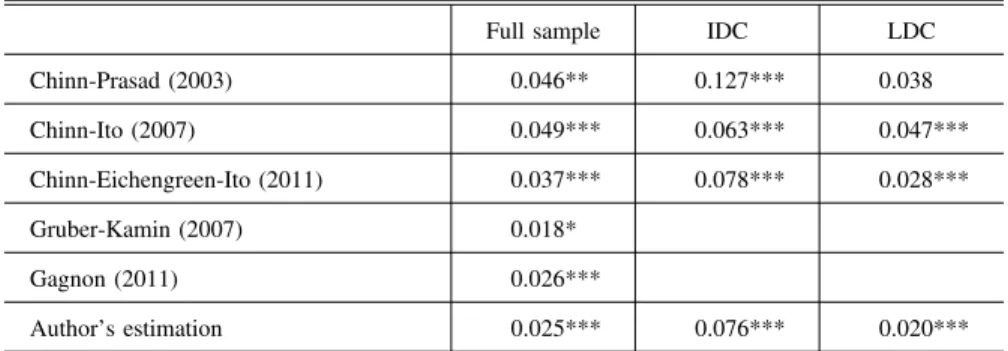
ratio. These studies regressed 5-year averages of the current account per GDP ratio on the net foreign assets to GDP ratio in the first year of the 5-year samples as well as on other macroeconomic variables, such as the fiscal balance to GDP ratio and the real per-capita GDP growth rates. Table 1 summarizes the estimated coefficients in the existing literature. The esti- mated coefficients of net foreign assets, most of which are statistically significant at the 1%
level, fall between 0.02 and 0.05.
For example, Chinn and his coauthors (Chinn-Prasad (2003), Chinn-Ito (2007), and Chinn- Eichengreen-Ito (2011)) have repeatedly detected statistically significant coefficients of net foreign assets ranging from 0.037 to 0.049 in their panel regressions for samples covering many countries and long time periods. Interestingly, they detected even larger estimates−be- tween 0.063 and 0.127−for the coefficient of the subsamples of industrial
3
countries. Gruber and Kamin (2007) and Gagnon (2011) also found a statistically significant and positive rela- tionship between net foreign assets and subsequent 5-year averages of the current account for samples smaller than those in Chinn and his coauthors’ (2003, 2007, 2011) estimations, al- though the sizes of the point estimates were slightly smaller.
How can we justify this apparently robust empirical relationship? Chinn and Prasad (2003, pp.49−50) pointed out that if the net foreign asset to GDP ratio has a steady state value, the
────────────
2 See Chinn and Prasad (2003), Chinn and Ito (2007), Gruber and Kamin (2007), Chinn, Eichengreen, and Ito (2011), and Gagnon (2011), for example.
3 We run a regression similar to that in Chinn-Eichengreen-Ito (2011), using updated data. Our estimated coeffi- cient of the net foreign asset to GDP ratio is 0.025, which is statistically significant at the 1% level. This result shows the robustness of the results of the existing literature as far as the estimation is based on the same strat- egy.
Table 1 Estimated coefficients of NFA/GDP on CA/GDP in the existing literature on medium-term determinants of the current account
Full sample IDC LDC
Chinn-Prasad (2003) 0.046** 0.127*** 0.038
Chinn-Ito (2007) 0.049*** 0.063*** 0.047***
Chinn-Eichengreen-Ito (2011) 0.037*** 0.078*** 0.028***
Gruber-Kamin (2007) 0.018*
Gagnon (2011) 0.026***
Author’s estimation 0.025*** 0.076*** 0.020***
Note: NFA and CA in the title stand for net foreign assets and the current account, respectively. IDC and LDC in the first row stand for industrial countries and less developed countries, respec- tively. ***, **, and * indicate 1%, 5%, and 10% significance, respectively.
Reexamining the Relationship between Net Foreign Assets and the Current Account(Iokibe)(1279)409
current account to GDP ratio of a growing economy equals the product of its nominal GDP growth rate and its net foreign assets to GDP ratio on the steady state growth path. In other words, for a growing economy, the net foreign asset to GDP ratio can have a positive relation- ship with the current account to GDP ratio on its long-run steady state growth equilibrium.
However, it is difficult to theoretically substantiate why an economy should have a nonzero stationary steady state value of net foreign assets to GDP ratio.
Another probable answer is that “a country’s net foreign asset position directly affects its net investment income, and therefore its current account balance.” (Gruber and Kamin (2007), p.
4
505) In other words, having a larger initial net foreign asset is identical to having a larger initial income in the current period, which brings about larger savings today. However, this reasoning is also incorrect. From the perspective of intertemporally rational behaviors of indi- viduals, the main determinant of savings is not the current income but the path of incomes over periods. Holding larger initial net foreign assets (debts) implies holding larger (smaller) income not only in the current period but also in the future. Moreover, the addition to the fu- ture income of countries with larger net foreign assets exceeds the addition to their current in- come; thus, they are inclined to borrow today in order to smooth consumption over time. We intend to stress on this point in this paper. We show how changes in the intertemporal path of income affect the current account in a framework of two-period models.
Unfortunately, most previous theoretical studies have assumed a zero net foreign asset posi- tion, either to make models mathematically tractable or to examine the effects of capital mar- ket
5
liberalization. One contribution of this paper is to bridge the gap between the abundance of empirical facts and the scarcity of theoretical explorations.
This paper is a by-product of Iokibe (2013), which examined a two-period model without initial net foreign assets and found that the sign of the current account depends on the form of period utility function as well as the international differences in real per-capita GDP growth rates. This paper clarifies that the level of initial net foreign asset position affects the current account balance independently from the factors clarified by Iokibe (2013).
The remainder of this paper is organized as follows. Section II develops a standard two- country, two-period, perfect foresight model, similar to the one in Iokibe (2013). In Section III, we analyze the effect of an increase in a country’s initial net foreign asset position on its current account by means of comparative statics and show the theoretical possibility for a negative relationship between net foreign assets and the current account. Section IV examines
────────────
4 Gagnon (2011, p.6) presents the same view.
5 Obstfeld and Rogoff (1996) assumed a zero initial net foreign asset throughout their voluminous text.
同志社商学 第64巻 第6号(2013年3月)
410(1280)
the reason for the negative relationship between the concerned variables. Section V concludes.
Ⅱ The Model
In this section, we develop a one-good, two-period, two-country, perfect foresight model in order to explain the relation between the net foreign asset position and the current account.
Ⅱ−1 Basic Settings
Let us assume a world economy that consists of country A and country B. In each country, representative households are born at the dawn of period 1, with populations NA and NB, re- spectively. These representative households live for two periods only. On birth, they realize that they are determined to receive real output of a single good yk, t at the beginning of each period, but no other economic shocks occur throughout either period.
Under the assumption of perfect foresight, representative households maximize their lifetime utilities at the beginning of period 1 by choosing their volumes of consumption in both peri- ods. Let us set the lifetime utility function in an additive form.
(1) u(ck,1)+βu(ck,2).
ck, t is real consumption for the representative household in countryk in period t(k=A, B; t
=1, 2).u(・) is the period utility function, which is assumed to satisfyu′(・)>0 andu″(・)<0 and be common to households in both countries. β is the subjective discount factor common to both countries, and we assume 0<β<1.
The international capital market is perfectly unified. Representative households in either country can lend or borrow real products without transaction costs. Further, although intra- national capital markets are perfectly unified in both countries, the homogeneous agent as- sumption prevents them from lending to and borrowing from each other in the domestic capi- tal
6
market. The intertemporal budget constraint of the representative agent can be defined as follows:
(2) bk, t=(1+rt−1)bk, t−1+yk, t−ck, t.
────────────
6 Because households in one country have identical initial assets, endowments in each period, subjective discount rates, and utility functions, they have no incentive to make an intertemporal trade with each other.
Reexamining the Relationship between Net Foreign Assets and the Current Account(Iokibe)(1281)411
bk, t denotes the net foreign assets of country k’s representative agent at the end of period t.
She or he receives (or repays) the principal and interest of the asset (or debt) at the beginning of periodt+1.
Any debt is assumed to be repaid by the end of period 2.
(3) bA,2=bB,2=0.
For expositional purposes, without of loss of generality, we express per-capita output in country B using the parameter α throughout the rest of this paper. Let us denotey as the pe- riod 1 endowment of country A’s representative household (or the per-capita GDP of country A), while αy (α>0) corresponds to the said value for country B. By denoting gk as the real per-capita GDP growth rate of countryk from period 1 to period 2, the intertemporal budget constraints for households in both countries are described as equations (4) and (5), respec- tively.
(4) cA,1+ 1 1+r1
cA,2=(1+r0)bA,0+y+1+gA
1+r1
y
and
(5) cB,1+ 1 1+r1
cB,2=−(1+r0)NA
NB
bA,0+αy+1+gB
1+r1αy.
We used the fact that net foreign assets sum to zero across the world in order to derive equa- tion (5); i.e.,NAbA, t+NBbB, t=0.
From equations (1), (4), and (5), we attain familiar first-order conditions for the utility maximization problem of representative agents.
(6) u′(cA,1)
βu′(cA,2)= u′(cB,1)
βu′(cB,2)=1+r1.
Under perfect international capital mobility, the marginal rates of the substitution of in- tertemporal consumption are equalized between countries and equal the world real interest rate, 1+r1.
The endowments are assumed to be nondurable, and they have to be consumed in the pe- riod in which they are produced. Because the assumption of positive marginal utility excludes a leftover, the sum of consumptions in both countries equals the volume of world output or
同志社商学 第64巻 第6号(2013年3月)
412(1282)
endowment in each period.
(7) NAcA,1+NBcB,1=(NA+NBα)y and
(8) NAcA,2+NBcB,2=[NA(1+gA)+NB(1+gB)α]y.
Ⅱ−2 The Equilibrium
The purpose of this paper is to investigate the effect of initial net foreign asset position on the current account or to examine the difference between propositions derived from models with nonzero and without initial net foreign assets. Let us start our exploration by describing the equilibrium conditions of the model developed above.
In the case of nonzero net external asset positions, the model becomes less tractable. By re- arranging equations (4) and (5), the consumptions in period 2 can be expressed as follows:
(9) cA,2=(1+r0)(1+r1)bA,0+(1+r1)
[
1+1+g1+rA1]
y−(1+r1)cA,1and
(10) cB,2=−(1+r0)(1+r1)NA
NB
bA,0+(1+r1)
[
1+1+g1+rB1]
αy−(1+r1)cB,1.By substituting equations (9) and (10) into equation (6) and eliminatingcB,1 from the resulting equations by using equation (7), we attain the following equations:
(11) β(1+r1)= u′(cA,1)
u′((1+r1)(1+r0)bA,0+[(1+r1)+(1+gA)]y−(1+r1)cA,1)
and
(12) β(1+r1)=
u′
(
−NNABcA,1+
[
NNAB+α]
y)
u′
(
−(1+r1)(1+r0)NNABbA,0+[
−NNAB(1+r1)+(1+gB)α]
y+(1+r1)NNABcA,1)
.Equations (11) and (12) are the general equilibrium conditions of this model. With r0, bA,0, gA,gB, α, β, NA, and NBpredetermined, the equilibrium values ofr1and cA,1 are jointly deter-
Reexamining the Relationship between Net Foreign Assets and the Current Account(Iokibe)(1283)413
mined by (11) and (12).
Moreover, by substituting the equilibrium value of cA,1into the definition of the current ac- count (below), the equilibrium value of the per-capita current account of country A in period 1 is
7
attained.
(13) caA,1=r0bA,0+y−cA,1.
Ⅱ−3 Stability and Uniqueness of the Equilibrium
It is well-known that the system summarized in equations (11) and (12) can have multiple equilibria, because changes in real interest rates have a substitution effect as well as an income effect on the consumption in period
8
1. However, if the utility function has an isoelastic mar- ginal utility, the system described in equations (11) and (12) has a unique stable equilibrium to which a comparative statics can be applied. This subsection proves this proposition.
In the rest of this paper, for descriptive purposes, let us denoteR as the gross world real in- terest rate in period 1.
(14) R≡1+r1.
This gross real interest rateR represents the relative price of the period 1 consumption to the period 2 consumption. In addition, because changes in the net world real interest rate (r1) are perfectly reflected on changes in the gross rate (R), we may use either when we examine the effects of changes in the world interest rate.
The effect of changes in the world real interest rate on the period 1 consumption of country A’s household is attained by totally differentiating equation (11) with respect tocA,1andR:
(15) dcA,1
dR=β(u′(cA,2)+Ru″(cA,2)caA,1) u″(cA,1)+βR2u″(cA,2) .
In a similar fashion, if we recall that equation (12) is identical to
(16) u′(cB,1)=Rβu′
(
R[
−(1+r0)NNABbA,0+
(
1+1+gR B)
αy−cB,1])
────────────
7 Needless to say, the per-capita current account of country B is determined as a mirror image of equation (13):
caB,1=−(NA/ NB)cA,1=−r0(NA/ NB)bA,0+αy−cB,1.
8 See Obstfeld and Rogoff (1996), pp.29−31 and Matsubayashi (2010), p.53.
同志社商学 第64巻 第6号(2013年3月)
414(1284)
and then totally differentiate equation (16) with respect tocB,1andR, we get
(17) dcB,1
dR=β(u′(cB,2)+Ru″(cB,2)caB,1) u″(cB,1)+βR2u″(cB,2) .
Next, let us consider the excess demand function for the period 1 goods, which can be ex- pressed as a function of the world real interest rate:
(18) Z(R)=NAcA,1(R)+NBcB,1(R)−(1+α)y.
Because output supplies are fixed in this model, the excess demand (Z) moves in parallel with the aggregate demand (NAcA,1+NBcB,1). The effect of changes in the world interest rate on ex- cess demands for the period 1 goods is attained by using equations (15) and (17):
(19) Z′(R)=NA
dcA,1
dR+NB
dcB,1
dR= Ψ
(u″(cA,1)+βR2u″(cA,2))(u″(cB,1)+βR2u″(cB,2)). Here,Ψis defined as follows:
(20) Ψ=βNAu′(cA,2)(u″(cB,1)+βR2u″(cB,2))+βNBu′(cB,2)(u″(cA,1)+βR2u″(cA,2))
+βRNAcaA,1u″(cA,2)u″(cB,1)
(
1−εε(c(cA,1A,2)) ε(cB,2) ε(cB,1)cA,2
cA,1
cB,1
cB,2
)
.ε(c) in equation (20) is the elasticity of marginal utility or the inverse of the elasticity of the intertemporal substitution; i.e., ε(c)≡−(u″(c)c/u′
9
(c)). The sign of the denominator on the right-hand side of equation (19) is positive, although the sign of the numerator (Ψ) is
10
ambiguous. However, if the utility function has a constant elasticity of marginal utility or if ε′(c)=0 holds, the last term on the right-hand side of equation (20) sums to zero, and thus, Ψ<0 orZ′(R)<0
11
holds.
The reason Ψ<0 always holds when ε′(c)=0 holds is that the equilibrium per-capita real consumption growth rates are equalized across countries if ε′(c)=0 holds. In order to show this proposition, let us denotegkc as the net real per-capita consumption growth rate of country
────────────
9 For proof thatε(c) can be interpreted as an inverse of the elasticity of intertemporal substitution, see Obstfeld and Rogoff (1996), p.28.
10 See Chapter 1 of Obstfeld and Rogoff (1996).
11 Besides, if both countries accidentally have a zero current account balance (caA,1=0), the last term on the right- hand side of (20) becomes zero, and thus,Z′(R)<0 holds. However, because this case rarely occurs in the real world, we have omitted it from this study.
Reexamining the Relationship between Net Foreign Assets and the Current Account(Iokibe)(1285)415
k. If gAc differs from gBc, the following inequality must hold when the utility function satisfies ε′(c)=
12
0:
(21) u′(cA,1)
u′(cA,2)= u′(cA,1)
u′((1+gAc)cA,1)= u′(cB,1)
u′((1+gAc)cB,1)≠ u′(cB,1)
u′((1+gBc)cB,1)=u′(cB,1) u′(cB,2).
In other words, the Euler equation does not hold. However, because this result contradicts with the utility maximization of the representative agents when the international capital market is perfectly unified, the relation ofgAc=gBc must hold in equilibrium. Namely, when ε′(c)=0, cA,2/cA,1must be equal to cB,2/cB,1in equilibrium and thus the last term on the right-hand side of (20) equals zero.
The above discussion proves that when ε′(c)=0, Z′(R)<0 holds for any R greater than zero. In addition, Z(0)>0 holds because ck,1=∞ must hold when
13
R=0. Applying these re- sults to the intermediate value theorem results in the following
14
proposition:
Whenr1A, aut<r1B, aut, there must exist a unique world real interest rate r1such that r1A, aut<r1
<r1B, autholds, and vice
15
versa.
In other words, the model presented above has a unique and stable equilibrium if the period utility function has an isoelastic marginal utility. We are now ready to make a comparative statics under the assumption of isoelastic marginal utility.
Ⅲ Effects of Nonzero Initial Net Foreign Assets: Comparative Statics
This subsection investigates the relation between the initial net foreign assets and the period 1 current account balances in the case of utility functions with an isoelastic marginal utility, namely in the case ofε′(c)=0.
First, let us examine the effects of changes inbA,0on the equilibrium values of R and cA,1. By totally differentiating (11) and (12) forbA,0,R, andcA,1, we get the following equation:
────────────
12 We use the fact that whenε′(c)=0,u′(ci)/ u′(aci)=u′(cj)/ u′(acj) holds for anyciandcjanda>0, in order to derive the second equality in equation (21). See Iokibe (2013) for details.
13 Equations (11) and (16) imply that whenR=1+r1=0,u′(cA,1)=u′(cB,1)=0 must hold. The conditionsu′(cA,1)=
u′(cB,1)=0 imply that the individual demands for period 1 consumption by households in both countries swell up infinitely.
14 The intermediate value theorem is described as follows: if a continuous functionf(x) that is defined within a closed interval [a, b] satisfiesf(a)>f(b), there exists x* that satisfiesa<x*<b and f(x*)=c for any real numberc that satisfiesf(a)>c>f(b). See Nishimura (1990), p.324.
15 See Nishimura (1990), p.324.
同志社商学 第64巻 第6号(2013年3月)
416(1286)
┌
│
│
│
│
└
β+βRcaA,1 u″(cA,2) u′(cA,2) β−NA
NBβRcaA,1 u″(cB,2) u′(cB,2)
−
(
u″u′(c(cA,2A,1))+βR2 u″(cA,2) u′(cA,2))
NA
NB
(
u″u′(c(cB,2B,1))+βR2 u″(cB,2) u′(cB,2))
┐
│
│
│
│
┘
┌
│
│
│
│
└ dR dbA,0
dcA,1
dbA,0
┐
│
│
│
│ (22) ┘
=
┌
│
│
│
│
└
−βR2(1+r0)u″(cA,2) u′(cA,2) NA
NBβR2(1+r0)u″(cB,2) u′(cB,2)
┐
│
│
│
│
┘ .
By solving these simultaneous equations, we attain the partial derivatives of R and cA,1 with respect tobA,0:
(23) dR dbA,0
=−R(1+r0)Φ
|A|
and
(24) dcA,1
dbA,0
=(1+r0)Ω
|A|.
Here,Φ,Ω, and |A| are defined as follows:
(25) Φ=βRNA
NB
u″(cA,2)u″(cB,1)
u′(cA,2)u′(cB,2)
[
1−u″u″(c(cA,1A,2))u″(cB,2) u″(cB,1)
]
,(26) Ω=β2R2
[
u″u′(c(cA,2A,2))+NANB
u″(cB,2) u′(cB,2)
]
<0,and
(27) |A|=β
[
u″u′(c(cA,2A,1))+NANB
u″(cB,1)
u′(cB,2)
]
+Ω+caA,1Φ.By totally differentiating equation (13) and substituting equation (24) into the resulting equa- tion, we uncover the effect of a change inbA,0on caA,1.
(28) dcaA,1
dbA,0
=(|A|−Ω)r0−Ω
|A| .
Equations (25)−(28) show that the sign ofΦ determines how an increase in initial net foreign assets affects the real interest rate, the per-capita consumption, and the per-capita current ac- count. By rearranging equation (25), we attain the following equation.
Reexamining the Relationship between Net Foreign Assets and the Current Account(Iokibe)(1287)417
(29) Φ=β2R2NA
NB
ε(cA,2)ε(cB,1)
cA,2cB,1
[
1−(
ccA,2A,1cB,1
cB,2
)
εε(c(cA,1A,2)) ε(cB,2) ε(cB,1)]
.From (29) and recalling the discussion in subsection II−3, we easily verify that Φ=0 holds if the utility function has an isoelastic marginal utility. By denoting ε−as the constant elasticity of marginal utility and by utilizing the fact that Φ=0 and substituting it into equation (27), we attain
(30) Ω=−β2R2ε− 1 1+gc
[
c1A,1+NA
NB
1 cB,1
]
<0,and
(31) |A|=−β2Rε−
[
1+1+gR c][
c1A,1+NA
NB
1 cB,1
]
<0.Finally, by substituting equations (30) and (31) into equation (28), we get the effect of changes in initial net foreign assets on the current account in period 1.
(32) dcaA,1
dbA,0
=−R−r0(1+gc) R+(1+gc) <0.
Equation (32) is the main result of this paper. Because neitherr0norgcseem to be larger than 0.2, we can assume thatr0gc!0 holds or that the sign of equation (32) is negative under plau- sible assumptions about the parameter values. In other words, as far as a period utility func- tion with an isoelastic marginal utility is concerned, the larger the initial net foreign asset of one country, the smaller its current account surplus in
16
period 1.
Moreover, it should be stressed that this result is not relevant to international differences in real per-capita output growth rates as well as to the period 1 current account balances in the pre-differentiated equilibrium. As Iokibe (2013) showed, the relative growth rate of the home country’s real per-capita output compared to that of the foreign country is the only factor that determines the sign of the current account in two-country models with isoelastic marginal utilities and without initial net foreign assets. Specifically, a faster growing economy runs a current account deficit, and vice versa, in such models. However, the abovementioned theo- retical results suggest that both international differences in per-capita real output growth rates
────────────
16 Appendix 1 calculates equation (32) in the case of log utility (a special case of isoelastic marginal utility) and shows that its sign is clearly negative.
同志社商学 第64巻 第6号(2013年3月)
418(1288)
and differences in initial net foreign asset positions do affect the determination of the current account, although their effects function independently of each other.
In short, when the period utility function has an isoelastic marginal utility, a faster growing economy tends to run a current account deficit, although the scale of its deficit is smaller when it has a net external debt obligation compared with when this obligation does not exist.
Ⅳ Why Do Larger Net External Assets Reduce Current Account Surpluses?
Why does an increase in the initial net foreign assets shrink surpluses or enlarge deficits of the current account in period 1 when the period utility function has an isoelastic marginal util- ity?
The answer can be summarized as follows: the greater the net foreign assets or debts of a country, the larger the degree of permanent income transfer from the debtor country to the creditor country. In two-period models, the size of income transfer in the second period over- whelms that in the first period, because all the principals of debts must be repaid in the sec- ond period. Therefore, the larger the net foreign assets, the higher the marginal rate of the substitution of intertemporal consumption for that country. In order to consume more goods today, the country that receives the additionally transferred income breaks down her assets (namely, runs a current account deficit) in the first period.
This argument can be clarified algebraically. Let us consider the different scenarios in which the initial net foreign assets of country A areb andb′(b′>b>0), respectively. Further, let us denotex as the equilibrium current account of country A in period 1 in the case ofbA,0
=b. Thus, in the case of bA,0=b, the equilibrium per-capita consumptions in each period are expressed as follows:
(33) cA,1=y+r0b−x,
(34) cA,2=(1+gA)y+(1+r1)(b+x),
(35) cB,1=αy−NA
NB
(r0b+x),
and
(36) cB,2=(1+gB)αy−(1+r1)NA
NB
(b+x).
Reexamining the Relationship between Net Foreign Assets and the Current Account(Iokibe)(1289)419
If we assume that the per-capita current account of country A remains at x in the case of bA,0=b′, then the per-capita consumptions must have the following values:
(37) cA,1′=y+r0b′−x,
(38) cA,2′=(1+gA)y+(1+r1)(b′+x),
(39) cB,1′=αy−NA
NB
(r0b′+x),
and
(40) cB,2′=(1+gB)αy−(1+r1)NA
NB
(b′+x).
Comparing equations (33), (35), (37), and (39), we see that in the case of b′>b, the in- come from interests, which totals NAr0(b′−b), is transferred from country B to country A in period 1. However, the income transferred in period 2 amounts toNA(1+r1)(b′−b), larger than NAr0(b′−b), as equations (34), (36), (38), and (40) show.
Using (33), (34), (37), and (38), we can show that in the case ofb′>b,
(41) u′(cA,1′)
βu′(cA,2′) > u′(cA,1) βu′(cA,2)
holds as long as the following inequality
17
holds:
(42) 1+r1−r0(1+gA)>(1+r1)(1+r0)x y.
Inequality (42) generally holds because the ratio of current account to GDP (x/y) can be re- garded as abnormally large when its absolute value exceeds 5%, and neither the real interest rate nor the per-capita GDP growth rate seem to exceed 0.2
18
regularly.
In the similar manner, from equations (35), (36), (39), and (40), we can say that in the case ofb′>b,
────────────
17 Appendix 2 presents the derivation of equations (41) and (42).
18 Freund (2005) concluded that a current account deficit tends to show a reversal after it exceeds 5% of the GDP.
See also Iokibe (2010).
同志社商学 第64巻 第6号(2013年3月)
420(1290)
(43) u′(cB,1′)
βu′(cB,2′) < u′(cB,1) βu′(cB,2)
holds as long as the following inequality
19
holds:
(44) 1+r1−r0(1+gB)>−(1+r1)(1+r0)
(
NNAB)
αxy.Inequalities (41)−(44) imply that under plausible values for interest rates, per-capita real GDP growth rate, and current account per GDP ratio, an increase in initial net foreign assets raises the marginal rate of the substitution of intertemporal consumptions if the current ac- count per GDP ratio is unchanged; thus, an increase in initial net foreign assets results in the deterioration of the current account of the concerned country.
Ⅴ Concluding Remarks
This paper showed the theoretical possibility that larger initial net foreign assets of one country may result in a larger deficit or a smaller surplus of the current account balance as a fraction of the GDP for that country.
In two-period, two-country models, the current account turns into deficit in period 1 under the often-set assumptions, such as period utility function with a constant relative risk aversion.
The main causation of this result is that an increase in the initial net foreign assets of one country produces apermanent income transfer to the concerned country from the rest of the world. Namely, the income transfer occurs in period 2 as well as in period 1. Moreover, the volume of the income transfer is larger in period 2 than in period 1, because the principals of debts have to be repaid in period 2. As far as utility functions that have an isoelastic marginal utility are considered, this receipt of permanent and growing income transfers raises the mar- ginal rate of the substitution of consumption in period 2 to that in period 1 for households in the concerned country; thus, this country increases borrowings from abroad or current account deficits.
This theoretical result contradicts the results from the existing empirical literature, which have now been accepted as the stylized facts. Most of the empirical researchers, who explored the medium-term determinants of the current account following Chinn-Prasad (2003), have found a positive relationship between the initial net foreign assets per GDP ratio and the sub-
────────────
19 Appendix 2 presents the derivation of equations (43) and (44).
Reexamining the Relationship between Net Foreign Assets and the Current Account(Iokibe)(1291)421
sequent 5-year averages of the current account per GDP ratio.
How can we interpret this contradiction between the theory and the empirical results? One possible interpretation is that this contradiction may be a representation of misspecifications of the estimation models in the preceding empirical literature. Specifically, the existing empirical studies may have missed some significant determinants of the current account that are highly correlated with net foreign asset positions. For example, because countries with households having lower subjective discount rates tend to run larger surpluses of the current account, they have accumulated larger net foreign assets than countries where households have higher sub- jective discount rates. Therefore, it may be fruitful to conduct empirical tests on the medium- term determinants of the current account, so as to add the subjective discount factor to the ex- planation variables.
Needless to say, the results of this paper may depend on the assumptions of two-periods and of the representative agent. Further study is needed to explore the effect of the net foreign asset on the current account, either in an indefinite period model or in an overlapping genera- tion model.
Acknowledgements: This paper was supported by (MEXT/JSPS) KAKENHI Grant Number 23330106 as well as by an overseas research grant from Doshisha University. This paper was accomplished during the author’s stay at the Institute of East Asian Studies, University of California at Berkeley.
References
Chinn, Manzie, and Eswar Prasad (2003) “Medium-term Determinants of Current Accounts in Industrial and De- veloping Countries: An Empirical Exploration,”Journal of International Economics,Vol.59, pp.47−76.
Chinn, Manzie and Hiro Ito (2007) “Current Account Balances, Financial Development and Institutions: Assay- ing the World ‘Saving Glut’,”Journal of International Money and Finance,Vol.26, pp.546−569.
Chinn, Manzie, Barry Eichengreen, and Hiro Ito (2011) “A Forensic Analysis of Global Imbalances,” NBER Working Paper,No.17513.
Freund, Caroline (2005) “Current Account Adjustment in Industrial Countries,”Journal of International Money and Finance,Vol.24, pp.1278−1298.
Gagnon, Mark. (2011) “Current Account Imbalances Coming Back,”Working Paper,WP 11-1, Peterson Institute for International Economics.
Gruber, Joseph W., and Steven B. Kamin (2007) “Explaining the Global Pattern of Current Account Imbal- ances,”Journal of International Money and Finance,Vol.26, pp.500−522.
Iokibe, Shingo (2010) “Patterns of Current Account Reversals: Shifted-type vs. V-shaped,” in Seiichi Fujita and Kentaro Iwtsubo eds,Economics of Global Imbalances,Yuhikaku Publishing Co., Chapter 3, pp.69−104. (in Japanese)
Iokibe, Shingo (2013) “Do Faster Growing Economies Run Current Account Deficits? A Theoretical Reappraisal of the Role of Utility Functions,”Doshisha Shogaku,Vol.65, No.5, pp.338−358.
Lane, Philip R., and Gian Maria Milesi-Ferretti (2006) “The External Wealth of Nations MarkΙΙ: Revised and Extended Estimates of Foreign Assets and Liabilities, 1970−2004,”IMF Working Paper,06/69.
同志社商学 第64巻 第6号(2013年3月)
422(1292)
Matsubayashi Yoichi (2010),Taigaifukinkou-to-Makurokeizai(External Imbalances and Macro Economy), Toyo Keizai Inc. (in Japanese)
Nishimura, Kazuo (1990),Mikuro Keizaigaku(Microeconomics),Toyo Keizai Inc. (in Japanese)
Obstfeld, Maurice, and Kenneth Rogoff (1996),Foundations of International Macroeconomics,MIT Press.
Obstfeld, Maurice, and Kenneth Rogoff (1995), “The Intertemporal Approach to the Current Account,” in Gene M. Grossman and Kenneth Rogoff eds,The Handbook of International Economics, Vol.3, North Holland, pp.1731−1799.
Appendix 1. Calculations for equation (32) in the case of log utility function
This appendix demonstrates the case of the log utility function, u(c)=logc, as a representative of the utility functions that have an isoelastic marginal utility.
In this case, we attain u″(c) / u′(c)=−c−1 and u″(ci) / u′(cj)=−cj / cj2 (for i≠j). In addition, the Euler equation β(1+r1)=c2 / c1 also holds at the pre-differentiated equilibrium. By utilizing these re- sults, we get the equilibrium values ofΦ,Ω, and |A| corresponding to equations (28)−(30) in the text:
(A 1−1) Φ=0,
(A 1−2) Ω=−β(1+r1)
[
c1A,1+NANB
1 cB,1
]
<0,and
(A 1−3) |A|=−β(1+β)(1+r1)
[
c1A,1+NANB
1 cB,1
]
<0.By substituting equations (A 1−1) and (A 1−2) into equation (22), we get the effect of an increase in in- itial net foreign assets on the current account in period 1:
(A 1−4) dcaA,1
dbA,0=−1−r0β 1+β <0.
If the initial net world real interest rater0 is less than 1, the inequality 1−r0β>0 always holds, namely dcaA,1/dbA,0<0 holds.
Appendix 2. Derivations of inequalities (41)−(44)
In this appendix, we show a proof of inequalities (41)−(44).
Let us setmas
(A 2−1) m≡c′A,1
cA,1=y+r0b′−x y+r0b−x.
Note that if we assumeb′>b, m>1 holds.
Next, let us consider the following equation:
Reexamining the Relationship between Net Foreign Assets and the Current Account(Iokibe)(1293)423
(A 2−2) (y+r0b′−x)((1+gA)y+(1+r1)(b+x))−(y+r0b−x)((1+gA)y+(1+r1)(b′+x))
=−(b′−b)
(
(1+r1)−r0(1+gA)−(1+r1)(1+r0)xy)
.If inequality (42) in the text holds, the sign on the right-hand side of (A 2−2) is negative, and thus, the following inequality holds:
(A 2−3) m((1+gA)y+(1+r1)(b+x))<(1+gA)y+(1+r1)(b′+x).
Inequality (A 2−3), in turn, implies the following relationships:
(A 2−4) u′(cA,1′)
u′(cA,1) =u′(m(y+r0b−x))
u′(y+r0b−x) =u′(m((1+gA)y+(1+r1)(b+x))) u′((1+gA)y+(1+r1)(b+x))
>u′((1+gA)y+(1+r1)(b′+x))
u′((1+gA)y+(1+r1)(b+x))=u′(cA,2′) u′(cA,2) .
To derive the first equality in (A 2−4), we use the following proposition: when ε′(c)=0, f′(c)=0 holds for the functions off(c)=u′(c) / u′(ac), where a is positive constant and differs from one. (See Iokibe (2013) for the complete proof.) Inequality in (A 2−4) holds if (A 2−3) holds. It is evident that in- equality (A 2−4) is the same as equation (41) in the text.
In a similar fashion, we can derive equation (44) in the text. Following (A 2−1), let us setn as
(A 2−5) n≡cB,1′ cB,1 =
y+r0NA
NB(b′+x) y+r0
NA
NB
(b+x) .
By using this ratio (n), we can show that if inequality (44) in the text holds, the following inequality holds:
(A 2−6) n
(
(1+gB)αy−(1+r1)NNAB(b+x))
>(1+gB)αy−(1+r1)NNAB(b′+x).In line with (A 2−4), (A 2−6) implies the following relations:
(A 2−7) u′(cB,1′) u′(cB,1) =
u′
(
n(
αy−r0NNAB(b+x)))
u′
(
αy−r0NNAB(b+x))
=
u′
(
n(
(1+gB)αy−(1+r1)NNAB(b+x)))
u′
(
(1+gB)αy−(1+r1)NNAB(b+x))
<
u′
(
(1+gB)αy−(1+r1)NNAB(b′+x))
u′
(
(1+gB)αy−(1+r1)NNAB(b+x))
=u′(cB,2′) u′(cB,2) . 同志社商学 第64巻 第6号(2013年3月)
424(1294)
We used inequality (A 2−6) to derive the inequality in the third row in (A 2−7). Inequality (A 2−7) pre- sents the same condition as equation (43) in the text.
Reexamining the Relationship between Net Foreign Assets and the Current Account(Iokibe)(1295)425