RIMS-1767
THE THEORY OF MATHEMATICAL PHYSICS IN CLASSICAL FLUID DYNAMICS
By
Shigeru MASUDA
January 2013
R ESEARCH I NSTITUTE FOR M ATHEMATICAL S CIENCES
KYOTO UNIVERSITY, Kyoto, Japan
THE THEORY OF MATHEMATICAL PHYSICS IN CLASSICAL FLUID DYNAMICS
京都大学・数理解析研究所 長期研究員 増田 茂 SHIGERU MASUDA
RESEARCH INSTITUTE FOR MATHEMATICAL SCIENCES, KYOTO UNIVERSITY
Abstract.
1. Our motivation in this paper, is to discuss introductorily how the mathematical physic theories have been deduced, comes from that we have the interest in the mathematical physics in classical fluid dynamics including the heat theory.
2. Owing to the arrival of continuum theory, many mathematical physical works are in- troduced, such as that Fourier and Poisson struggle to deduce the trigonometric series in the heat theory and heat diffusion equations. In the curent of formularizing process of the fluid dynamics, Navier, Poisson, Cauchy and Stokes struggle to deduce the wave equations and the Navier-Stokes equations. Of cource, there are many proceding researches before these topics, however, for lack of space, we must pick up at least, the essentials such as following contents :
3. At first, we introduce the heat theory and heat diffusion equations based on the oscillat- ing equations of cords, especially, we treate the theoretical contrarieties between Fourier and Lagrange, and next, between Fourier and Poisson , and then, the microscopically descriptive fluid equations, especially, we treate the theoretical contrariety between Navier and Poisson, and finally, the collaboration on the proof of describability of the trigonometric series of an arbitrary function up to the 20th Centuries.
4. Since 1811, Poisson issued many papers on the definite integral, containing transcendental, and remarked on the necessity of careful handling to the diversion from real to imaginary, especially, to Fourier explicitly.
To Euler and Laplace, Poisson owes many knowledge, and builds up his principle of integral, consulting Lagrange, Lacroix, Legendre, etc. On the other hand, Poisson feels incompatibility with Laplace’s ’passage’, on which Laplace had issued a paper in 1809, entitled : On the
’reciprocal’ passage of results between real and imaginary, after presenting the sequential papers on the occurring of ’one-way’ passage in 1782-3.
To these passages, Poisson proposes the direct, double integral in 1811,13,15 and 20.
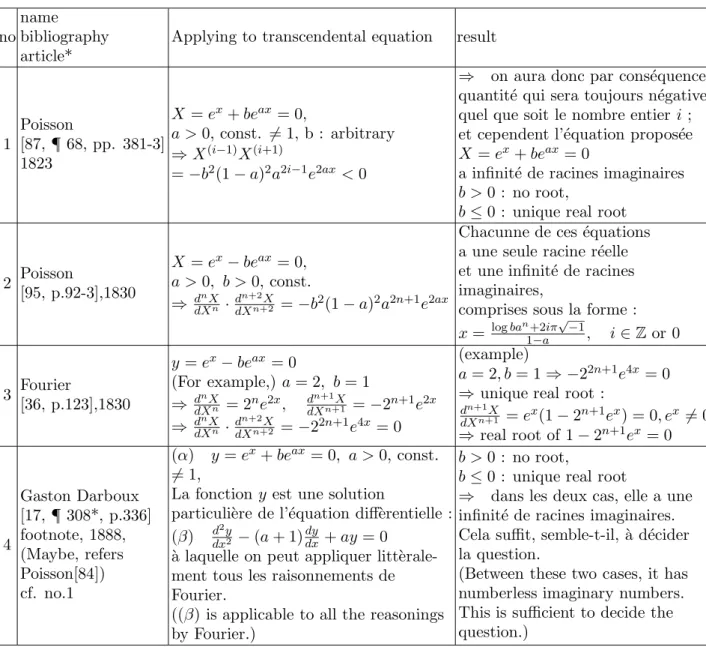
6. As a contemporary, Fourier is made a victim by Poisson. To Fourier’s main work : The analytical theory of heatin 1822, and to the relating papers, Poisson points the diversion applying the what-Poisson-called-it ’algebraic’ theorem of De Gua or the method of cascades by Roll, to transcendental equation. Moreover, about their contrarieties, Darboux, the editor of Œuvres de Fourier, evaluates on the correctness of Poisson’s reasonings in 1888. Drichlet also mentions about Fourier’s method as a sort ofsingularity of passagefrom the finite to the infinite.
7. In the last pages of a paper of fluid dynamics in 1831, Poisson remembers to put again the restriction, saying that the provings of eternity of time in the exact differential become necessarily defective, for it includes the series of transcendental.
8. About the describability of the trigonometric series of an arbitrary function, nobody succeeds in it including Fourier, himself. According to Dirichlet, Cauchy is the only person challenges it in vain. Poisson tries it from another angle. Dirichlet and Riemann step into the kernel of the question. Up tp the middle of or after the 20th Centuries, these collaborations are continued, finally in 1966, by Carleson proved inL2, and in 1968, by Hunt inLp.
Contents
1. Preliminary 4
Date: 2013/01/17.
1
2. The forewords and afterwords to the Fourier’s works 4
3. Introdiction to Forewords 4
3.1. The trigonometric series by Lagrange and Fourier 7
3.2. Recherches sur la Nature et la Propagation du Son by Lagrange [51], 1759 9 3.3. Solution de diff´erents probl`emes de calcul int´egral. Des vibrations d’une corde
tendue et chang´ee d’un nombre quelconque de poids by Lagrange [55],
1762-65 11
3.4. Poisson’s paradigm of universal truth 12
4. Poisson’s propositions on the passage from real to imaginary 12
4.1. The definite integral of an example by Euler 12
4.2. The Lacroix’s introduction of definite integral by Euler 13 4.3. M´emoire sur divers points d’analyse, by Laplace [60], 1809 14 4.4. M´emoire sur les int´egrales d´efinies, by Poisson [76], 1811 16 4.5. M´emoire sur les int´egrales d´efinies, by Poisson [77], 1813 16 4.6. Suite du M´emoire sur les int´egrales d´efinies et sur la sommation des s´eries, by
Poisson [88], 1823 19
4.6.1. Expression des Fonctions par des S´eries de Quantit´es p´eriodiques 19 5. Argument between Fourier and Poisson on applying the theorem of De Gua to
transcendental equations 23
6. Fourier’s principles on the trigonometric series, the integral and the root 23 6.1. Th´eorie analytique de la chaleur. (Deuxi´eme Edition)´ [31], 1822 24
7. Poisson’s heat theory in rivalry to Fourier 48
7.1. M´emoire sur la Distribution de la Chaleur dans les Corps solides [84], 1823 48 7.1.1. §2,Distribution de la Chaleur dans une Barre prismatique, d’une petite epaisseur´ 51 7.1.2. §3, Distribution de la Chaleur dans un Anneau homog`ene et d’un epaisseur´
constante 53
7.1.3. §5, ´Equations diff´erentielles du Mouvement de la Chaleur dans un corps solide de
forme quelconque 53
7.2. Second M´emoire sur la Distribution de la Chaleur dans les Corps solides [87], 1823 55 8. The physical structure and mathematical descriptions in the contrarieties of the
microscopically descriptive functions on the Navier-Stokes equation from the
viewpoint of mathematical history 57
8.1. Introduction 57
8.2. Separate integration of the elastic fluid equations beforeM D 58 8.3. The symbolS instead of the integral R
59 8.4. M D equations of elastic solid and fluid by sum instead of integral 59
8.5. Capillary action with ordinary description 60
8.6. The circular argument asserting consistency between physical theory and
mathematical principle 60
8.7. ”Notes and Additions” to [97], 1831 64
8.7.1. Purposes of his new theory 64
8.7.2. Essential constitution of corps, and particularly of fluid ; nature of the molecular
forces 64
8.7.3. Reducibility from sum into integral on a function made with attraction and/or
repulsion 66
8.7.4. Reducible examples of sum transformable into integral 67 8.7.5. Irreducible examples of sum intransformable into integral 69
8.8. Conclusions by Poisson 69
8.9. Conclusions of fluid dynamics 70
9. Poisson’s elastic mechanism : M´emoire sur l’Equilibre et le Mouvement des Corps´
´
elastiques [92], 1829 71
10. Poisson’s refutation to Fourier’s defect 73
2
10.1. Note sur les racines desequations transcendantes´ [95], 1830 73 10.2. M´emoire sur les ´equations g´en´erales de l’´equilibre et du mouvement des corps
solideselastiques et des fluides´ [96], 1831 75
11. Fourier’s defense and enhansement of his theory 76
11.1. M´emoire sur la distinction des racines imaginaires, et sur l’application des th´eor`emes d’analyse alg´ebrique aux equations transcendantes qui´
d´ependendent de la th´eorie de la chaleur [34], 1827 76 11.2. M´emoire sur la th´eorie analytique de la chaleur [35], 1829 76 11.3. Remarques g´en´erales sur l’application des principes de l’analyse alg´ebrique aux
´
equations transcendantes [36], 1831 83
12. G. Darboux’s comments in [17, 18], 1888, 1890 88
12.1. The critical remarks by Poisson seem to be in reason 88
12.2. Numerical calculus by Budan de-Bois Laurent 88
13. Introduction to Afterwords - Describablity of trigonometric series of arbitrary
function 90
14. Gauss and Bessel 90
15. A.Cauchy, M´emoire sur l’int´egration des ´equations lin´eaires aux diff´erences
partielles et `a coefficiences constans [8], 1823 91
16. G. Dirichlet’s works 93
16.1. Sur la convergence des s´eries trigonom´etriques qui servent `a repr´esenter une
fonction arbitraire entre des limits donn´ees [21], 1829 93 16.2. Solution d’une question relative `a le th´eorie math´ematiques de la chaleur [22],
1830 94
16.3. U¨ber die darstellung ganz willk¨urlicher functionen durch sinus- und cosinusreihen (On the describablity of a completely arbitrary function by a series with sine
and cosine ) [23], 1837 96
17. J. Liouville, Sur le developpement des fonctions ou parties de fonctions en s´eries de
sinus et de cosinus [61], 1836 104
18. B.Riemann, Ueber die Darstellbarkeit einer Function durch eine trigonometrische Reihe
(On the describablity of a function by a trigonometric series) [108], 1867 104 18.1. Geschichte der Frage uber die Darstellbarkeit einer willk¨¨ uhrlich gegebenen
Function durch eine trigonometrische Reihe (History of problem on the
describablity of an arbitrarily given function by a trigonometric series) 104 18.2. Ueber den Begriff eines bestimmten Integrals und den Umfang seiner G¨ultigkeit
(On the meaning of definite integral and the range of suitability) 105 18.3. Untersuchung der Darstellbarkeit einer Function durch eine trigonometrische
Reihe ohne besondere Voraussetzungen uber die Natur der Function¨ (Study of describablity of a function by a trigonometric series without special
preconditions on the nature of function) 106
19. Paul du Bois-Raymond [25], 1876 113
19.1. The new aspect by Paul du Bois-Raymond 114
19.2. Wever’s memorial paper to Paul du Bois-Raymond [113], 1889 114 20. R.Fujisawa, Ueber die Darstellbarkeit willk¨urlicher Functionen durch Reihen, die
nach den Wurzeln einer transcendenten Gleichungen fortschreiten
(On the describablity of arbitrary function by the series, progressing with the power
of a transcendental equation) [39], 1888 115
20.1. Heine’s trick of Fl¨ache E [46], 1880 120
21. Conclusion 120
References 121
Acknowledgments 126
3
1. Preliminary
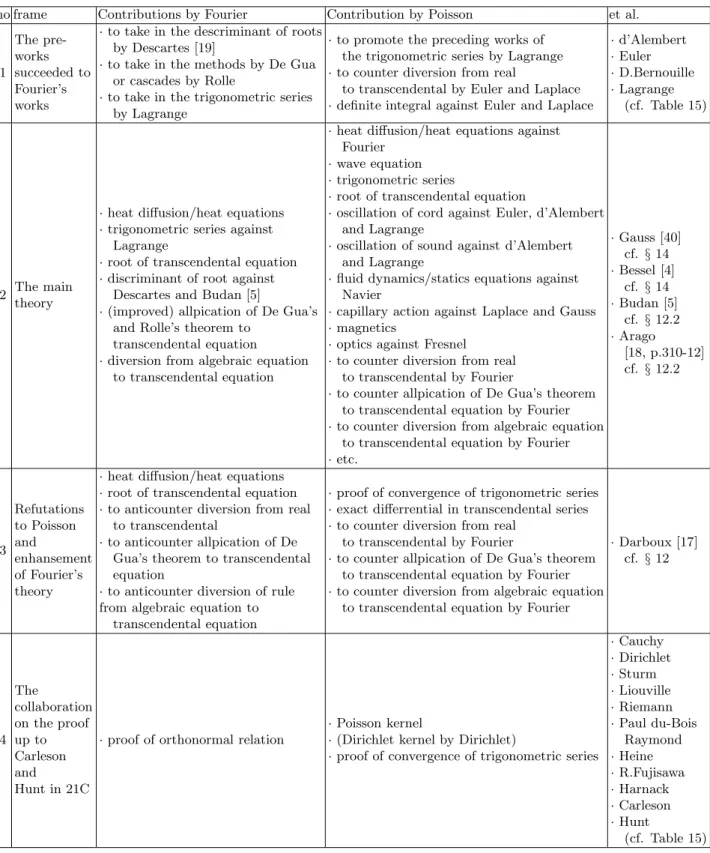
1, 2, 3, 4, 5, 6 The forewords or afterwords are generally to be written not by the author but by other. From our point of view, we would like to talk about Fourier’s works as the following four frames :
(1) The preworks of Fourier’s
(2) The main theory including the manuscript, or the first version in 1807 : Sur la propaga- tion de la chaleurand the second version in 1822 : Th´eorie analytique de la chaleur (3) Refutations to Poisson and enhansement of Fourier’s theory
(4) The collaboration on the proof of describability of the trigonometric series of an arbitrary function up to the 20th Centuries
We talk about (1)-(3) in the forwords and treate the rest in the afterwords. cf. Table 1.
2. The forewords and afterwords to the Fourier’s works 3. Introdiction to Forewords
As Riemann[108, p.5] says, d’Alembert is the progenitor of the problem of the vibrating cord. For gaining a general solution of the differential equation, he proposes the series by trigonometric fonction, d’Alembert, Euler, D. Bernoulli and Lagrange extend each solution of the same problem. d’Alembert concludes after his observations inRecherches sur les vibrations des Cordes sonores [16, pp.1-64,65-73], priding the superiority to both Euler and Bernoulli, as follows :
De toutes ces r´efl´exions je crois ˆetre en droit de conclure ;
(1) que la solution que j’ai donn´ee la premier du Probleme des cordes vibrantes, n’est nullement renferm´ee dans la fonction de M. Taylor, s’´etend beaucoup plus loin, & est aussi g´en´erale que la nature de la question le permet ; (2) que l’extension que M. Euler y a voulu donner, est capable d’conduire en
error;
(3) que sa construction est contraire `a ce qui avance lui-mˆeme en termes formels sur l’identit´e& l’imparit´edes fonctions ϕ(x+t) &ψ(x−t) ;
(4) que cette construction ne satisfait point `a l’´equation ddt22y = ddx2y2 ;
(5) que dans l’´equationy=ϕ(x+t) +ψ(x−t), les fonctions doivent demontrer toujours de la mˆeme forme, comme M. Euler l’a tacitement suppos´e lui-mˆeme
;
(6) que si on se permettoit7 de faire varier la forme de ces fonctions, il faudroit renverser la principe de toutes les constructions & fonctions analytiques, &
des d´emonstrations les plus g´en´eralement avou´ees ;
(7) qu’en faisant varier cette forme, le Problˆeme n’auroit plus de solution pos- sible, & resteroit ind´etermin´e ;
1Basically, we treat the exponential / trigonometric / logarithmic /π/ et al. / functions as the transcendental functions.
2Translation from Latin/French/German into English/Japanese mine.
3We use the symbols§: chapter,¶: article of the original.
4The Japanese sentences are not mine, but our translation from the original. Our assertions are only in English.
5The left equation numbers with the subindex of initial in a line are that of original, and the right numbers in a line are by the author.
6To establish a time line of these contributor, we list for easy reference the year of their birth and death:
Daniel Bernoulli(1700-82), Euler(1707-83), d’Alembert(1717-83), Lagrange(1736-1813), Laplace(1749-1827), Fourier(1768-1830), Gauss(1777-1855), Poisson(1781-1840), Bessel(1784-1846), Navier(1785-1836), Cauchy(1789- 1857), Dirichlet(1805-59), Stokes(1819-1903), Riemann(1826-66).
7sic., As today’s usage, ’permettrions’. In bellow, as the same, faudroit(⇒fallˆut), auroit(⇒aurions), etc.
4
Table 1. The contributions in four frames before, through and after Fourier’s works
no frame Contributions by Fourier Contribution by Poisson et al.
1
The pre- works succeeded to Fourier’s works
·to take in the descriminant of roots by Descartes [19]
·to take in the methods by De Gua or cascades by Rolle
·to take in the trigonometric series by Lagrange
·to promote the preceding works of the trigonometric series by Lagrange
·to counter diversion from real
to transcendental by Euler and Laplace
·definite integral against Euler and Laplace
·d’Alembert
·Euler
·D.Bernouille
·Lagrange (cf. Table 15)
2 The main theory
·heat diffusion/heat equations
·trigonometric series against Lagrange
·root of transcendental equation
·discriminant of root against Descartes and Budan [5]
·(improved) allpication of De Gua’s and Rolle’s theorem to
transcendental equation
·diversion from algebraic equation to transcendental equation
·heat diffusion/heat equations against Fourier
·wave equation
·trigonometric series
·root of transcendental equation
·oscillation of cord against Euler, d’Alembert and Lagrange
·oscillation of sound against d’Alembert and Lagrange
·fluid dynamics/statics equations against Navier
·capillary action against Laplace and Gauss
·magnetics
·optics against Fresnel
·to counter diversion from real to transcendental by Fourier
·to counter allpication of De Gua’s theorem to transcendental equation by Fourier
·to counter diversion from algebraic equation to transcendental equation by Fourier
·etc.
·Gauss [40]
cf. §14
·Bessel [4]
cf. §14
·Budan [5]
cf. §12.2
·Arago [18, p.310-12]
cf. §12.2
3
Refutations to Poisson and
enhansement of Fourier’s theory
·heat diffusion/heat equations
·root of transcendental equation
·to anticounter diversion from real to transcendental
·to anticounter allpication of De Gua’s theorem to transcendental equation
·to anticounter diversion of rule from algebraic equation to
transcendental equation
·proof of convergence of trigonometric series
·exact differrential in transcendental series
·to counter diversion from real to transcendental by Fourier
·to counter allpication of De Gua’s theorem to transcendental equation by Fourier
·to counter diversion from algebraic equation to transcendental equation by Fourier
·Darboux [17]
cf. §12
4 The
collaboration on the proof up to Carleson and
Hunt in 21C
·proof of orthonormal relation
·Poisson kernel
·(Dirichlet kernel by Dirichlet)
·proof of convergence of trigonometric series
·Cauchy
·Dirichlet
·Sturm
·Liouville
·Riemann
·Paul du-Bois Raymond
·Heine
·R.Fujisawa
·Harnack
·Carleson
·Hunt
(cf. Table 15)
(8) que cette solution ne represente pas mieux que la mienne , la vrai mouvement de la corde ;
5
(9) enfin que la solution de M. Daniel Bernoulli, quelqu’ing´enieuse qu’elle puisse ˆetre, est trop limit´ee, & n’ajoute absolument `a la mienne aucune sim- plification ; qu’en un mot, le calcul analytique de Problˆeme, & l’exemen synth´etique que M. Bernoullim’accuse`a tort de n’avoir point fait, sont l’un
& l’autre, ce me semble, `a l’avantage de ma m´ethode.
[16, pp.63-64]
Fourier’s works are summerized by Dirichlet, a disciple of Fourier, as follows :
• a sort ofsingularity of passage from the finite to the infinite
• to offer a new example of theprolificity of the analytic process
The first is our topics which Fourier and Poisson point this problem in life and the other is, in other words, the sowing seeds to be solved from then on. Dirichlet says in the following contents, Fourier (1768-1830) couldn’t solve in life the question in relation to the mathematical theory of heat, inSolution d’une question relative a le th´eorie math´ematiques de la chaleur (The solution of a question relative to the mathematical theory of heat) [22] :
La question qui va nous occuper et qui a pour objet de determiner l’ ´etats successifs d’une barre primitivement ´echauff´ee d’une mani`ere quelconque et dont les deux extr´emit´es sont entretenues `a des temp´eratures donn´ees en fonction de temps, a d`ej`a ´et´e r´esolue par M. Fourier dans un M´emoire ins´er´e dans le Vol. VIII de la collection de l’Acad´emie Royale des Sciences de Paris. La m´ethode dont cet illustre g´eom`etre a fait usage dans cette recherche est une esp`ece singuli`ere de passage du fini a l’infini, et offre un nouvel exemple de la f´econdit´e de ce proc´ed´e analytique qui avait d´ej`a conduit l’auteur `a tant de r´esultats remarquables dans son grand ouvrage sur la th´eorie de la chaleur. J’ai trait´e la mˆeme question par une analyse dont la marche differe beaucoup de celle de Fourier et qui donne lieu
`
a l’emploi de quelques artifices de calcul, qui paraisent pouvoir ˆetre utiles dans d’autres recherches. [22, p.161] ( Italics mine. )
The question which we would occupy with and consider as the object to deter- mine the continuous state of the bar originally heated of any method and of which both edges are keeped with the temperature given by the function of time, was given by Fourier, then solved by him, which is in the archives of M´emoire (Vol.
VIII) of l’Acad´emie Royale des Sciences de Paris.8 This method what this gifted mathematician has made use in this research is a sort of singularity transferring from the finite to the infinite, and would offer a new example of the prolificity of the analytic process, which urged the author on the many remarkable results in the great works on the heat theory. I had discussed the same question by an analysis, whose method is very different with that of Fourier, and he gives many skillfull techniques, however, these are likely to be utilized for the other researches. ( Translation mine. )
This is the originality of the method due to the what we calledDirichlet condition, which gives the constant boundary condition by any method.
After his professor Fourier’s death, Dirichlet [23] says in ¨Uber die darstellung ganz willkurlicher¨ functionen durch sinus- und cosinusreihen (On the describablity of all the arbitrary functions with the series by sine and cosine) :
Die merkw¨urdigen Reihen, welch in einen bestimmten Intervalle Functionen darstellen, welch ganz gesetzlos sind order in verschiedenen Theilen dieses In- tervalls ganz verschiedenen Gesetzen folgen, haben seit der Begrundung der mathematischen W¨armelehre durch Fourier so zahlreiche Anwendungen in der analytischen Behandlung physikalischer Probleme gefunden, daß es zweckm¨aßig
8Fourier, [35], cf. Chapter 11.2.
6
erscheint, die f¨ur die folgenden B¨ande dieses Werkes bestemmten Ausz¨uge aus den neuesten Arbeiten ¨uber einige Theile der mathematischen Physik durch die Entwickelung einiger der wichtigsten dieser Reihen einzuleiten. [23, p.135]
This remarkable series, which describe in an arbitrary interval, the function, which is independent at all, or of various parts of interval, don’t follow all the laws, the mathematical heat theory by Fourier, are much applicable to physical problems, that have many purposes, which are introduced in the following vol- umes of works. To deduce these series, we introduce an extract of the newest works on a part of mathematical physics, by the development of one of the most important.
In 1867, Riemann [108] says inUeber die Darstellbarkeit einer Function durch eine trigonometrische Reihe ( On the describabiblty of a function by a trigonometric series ) :
Der folgende Aufsatz ¨uber die trigonometrischen Reihen besteht aus zwei we- sentrich verschidenen Theilen. Der erste Theil enth¨alt eine Geschichte der Unter- suchungen und Ansichten ¨uber die willk¨uhrlichen (graphisch gegenbenen) Func- tionen und ihre Darstellbarkeit durch trigonometrischen metrischen Reihen. Bei ihrer Zusammenstellung war es mir verg¨onnt, einige Winke des ber¨uhmten Math- ematikers zu benutzen, whelch man die erste gr¨uundliche Arbeit ¨uber die Darstell- barkeit einer Function durch eine trigonometrische Reihe eine Untersuchung, whelche auch die bis jetzt noch unerledigten F¨alle umfaßt. Es war n¨otig, ihr einen kurzen Aufsatz ¨uber den Begriff eines bestimmten Integrales und den Um- fang seiner G¨ultigekeit voraufzuschcken. [108, p.3]
3.1. The trigonometric series by Lagrange and Fourier. Riemann studies the history of research on Fourier series up to then (Geschichte der Frage uber die Darstellbarkeit einer¨ willk¨uhrlich gegebenen Function durch eine trigonometrische Reihe, [108, pp.4-17].)
We cite one paragraph of his interesting description from the view of mathematical history as follows :
Als Fourier in einer seiner ersten Arbeiten ¨uber die W¨arme, welche er der franz¨osischen Akademie vorlegtet 9, (21. Dec. 1807) zuerst den Satz aussprach,
daß eine ganz willk¨uhrlich ( graphisch ) gegebene Function sich durch eine trigonometrische Reihe ausdr¨ucken laße, war diese Behauptung dem greisen Lagrange’s unerwartet,
daß er ihr auf das Entschiedenste entgegentrat. Es soll10sich hier¨uber noch ein Schriftstr¨uck in Archiv der Pariser Akademie befinden. Dessenungeachtet ver- weist11Poisson ¨uberall, wo er sich der trigonometrischen Reihen zur Darstellung willk¨urlicher Functionen bedient, auf eine Stelle in Lagrange’s Arbeiten ¨uber die schwingenden Saiten, wo sich diese Darstellungensweise finden soll. Um diese Ba- hauptung, die sich nur aus der bekannten Rivalit¨at zwischen Fourier und Poisson erkl¨aren laßt 12, zuwiderlegen, sehen wir uns gen¨othigt, noch einmal auf die Ab- handlung Lagrange’s zur¨uchzukommen ; denn ¨uber jeden ¨uber jenen Vorgang in der Akademie findet sich nichts ver¨offentlicht. [108, p.10]
● Fourierが熱に関する最初の論文(21, Dec., 1807)を提出した時、ある全く任意の(グ ラフによる具象的な)既知関数を三角関数の級数展開で表現させようとするものであり、
最初は流石の白髪のLagrange13もこの論文にかなり当惑したが、きっぱりと拒否した。●
9sic. Bulletin des sciences p. la soc. philomatique Tome I. p.112 10sic. Nach einer m¨undlichen Mittheilung des Herr Professor Dirichlet.
11sic. Unter Andern in den verbreiteten Trait´e de m´ecanique Nro. 323. p. 638.
12sic. Der Bericht in bulletin des sciences ¨uber die von Fourier der Akademie vorgelegte Abhandlung ist von Poisson.
13Lagrange was then seventy-one years old.
7
その論文は今もフランス国立文書館に収納されているという。(注2。Dirichlet博士の 口頭報告による)● それがため、Poissonは全体を注意深く熟読し、即座に、Lagrange の振動する弦に関する論文の一節に、ある任意の関数の記述のために三角関数の級数展開 を使用している個所があるが、そこでこの記述方法を発見したに違いないと異議申し立て
た。● FourierとPoissonの知られた対抗関係を如実に物語るこの申立ての誤りを論駁
するため急いで方向転換して、Lagrangeの論文にもう一度立ち返りたい ; そうすれば 何一つ明らかになっていないアカデミーの中の、こうした出来事に行き着ける。
Riemann cites exactly the French original which we show in (10) as follows : Man findet inder That an der von Poisson citirten Stelle die Formel:
y = 2 Z
Y sinXπdX sinxπ+ 2 Z
Ysin 2XπdX sin 2xπ+ 2 Z
Ysin 3XπdX sin 3xπ+· · ·
+ 2
Z
Y sinnXπdX sinnxπ, (1)
de sort que, lorsque x = X, on aura y = Y, Y ´etant l’ordonn´e qui r´epond `a l’abscisseX. Diese Formel sieht nun allerdinga ganz so aus wie die Fourier’sche Reihe ; so daßbei fl¨uchtigerAnsicht eine Verwerwechselung leicht m¨oglich ist ; aber dieser Schein r¨uhrt bloss daher, weil Lagrange das ZeichenR
dX anwendte, wo er heute das Zeichen P
∆X angewandt haben w¨urde. · · · Wenn man aber seine Abhandlung durchliest, so sieht man, daßer weit davon entfernt ist zu glauben, eine ganz willk¨uhrliche Function laße sich wirklich durch eine unendliche Sinusreihe darstellen. [108, pp.10-11]
● 事実、Poissonにより引用された一節は(1)である事が分かる。 従って、x = Xと
すれば、y = Yとなり、Yは横軸Xに対応する縦軸である。● この形式は確かにフーリ
エ級数とは全く違う ; 一見して、ある取り違えの可能性が充分にある ; しかし、そ れは単なる外見でしかない。何故ならLagrangeが積分記法 ∫dX を使っている事が(誤 解される原因)だ。今日ならΣΔXの記法を使っていただろう。● 彼の論文を通読する と、彼がある全く任意の関数をある無限個のsineによる級数展開で任意に記述しようとし たとは信じるにはほど遠い事がわかる。
A.Freeman,The analytical theory of heat by Joseph Fourier, (Translated in English, with Notes) [37, p.185, footnote], comments Lagrange’s statement as follows :
y = 2“X∞
r=1
YrsinXrπ∆X”
sinxπ+ 2“X∞
r=1
Yrsin 2Xrπ∆X”
sin 2xπ+ 2“X∞
r=1
Yrsin 3Xrπ∆X”
sin 3xπ+· · · + 2“X∞
r=1
YrsiniXrπ∆X”
sinixπ, (2)
however, (2) is commented by Freeman [37, p.185, footnote] in 1878 with the replacement of R dX in (1) with P
∆X in compliance with the statement by Riemann in 1867. Poisson says more straight than Riemenn says as follows :
Lagrange, dans les anciens M´emoires de Turin, et M. Fourier, dans ses Recherches sur la th´eorie de la chaleur, avaient d´ej`a fait usage de sembles expressions ; [84,
¶28, p.46]
The corresponding of the Fourier’s trigonometric series in the 2nd version is as follows : (D)F
π
2ϕ(x)= sinx Z
sinxϕ(x)dx+ sin 2x Z
sin 2xϕ(x)dx+ sin 3x Z
sin 3xϕ(x)dx+· · · + sinix
Z
sinixϕ(x)dx+· · ·; (3)
[17,¶219, p.208]
By the way, Fourier’s trigonometric series in the first version are as follows : π
2ϕx= sinx S(ϕxsin.xdx) + sin 2x S(ϕxsin.2xdx) +· · ·+ sinix S(ϕxsin.ixdx)· · · ; (4)
8
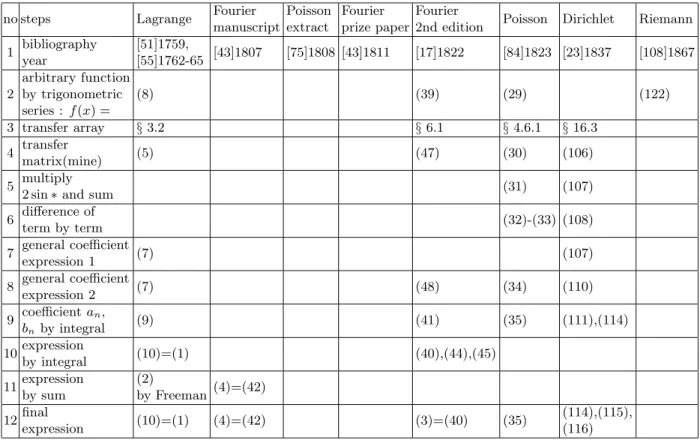
Table 2. The expressions of deductive steps into trigonometric series in our paper
no steps Lagrange Fourier
manuscript
Poisson extract
Fourier prize paper
Fourier
2nd edition Poisson Dirichlet Riemann 1 bibliography
year
[51]1759,
[55]1762-65 [43]1807 [75]1808 [43]1811 [17]1822 [84]1823 [23]1837 [108]1867 2
arbitrary function by trigonometric series : f(x) =
(8) (39) (29) (122)
3 transfer array §3.2 §6.1 §4.6.1 §16.3
4 transfer
matrix(mine) (5) (47) (30) (106)
5 multiply
2 sin∗and sum (31) (107)
6 difference of
term by term (32)-(33) (108)
7 general coefficient
expression 1 (7) (107)
8 general coefficient
expression 2 (7) (48) (34) (110)
9 coefficientan,
bn by integral (9) (41) (35) (111),(114)
10expression
by integral (10)=(1) (40),(44),(45)
11expression by sum
(2)
by Freeman (4)=(42) 12final
expression (10)=(1) (4)=(42) (3)=(40) (35) (114),(115),
(116)
[43, p.217]
By Grattan-Guinness, S means that :
Having used “S” as a summation symbol forfinite trigonometric series in his n- body-model analysis. 14 Fourier now began to employ it as an integration sign to denote specially significant integrals, such as the coefficients for the trigonometric series. [43, p.211, footnote 10]
We discuss this remark in the below chapter 8.3. cf Grattan-Guinness [43, pp.241-9].
3.2. Recherches sur la Nature et la Propagation du Son by Lagrange [51], 1759.
Lagrange explains the motion of sound diffusing along with time tby the trigonometric series of the original sample which the after ages, such as Fourier, Poisson, Dirichlet, et al. refer to it.
Here,̟=π.
¶ 23. (pp.79-81).
Pν ≡Y1sin ̟
2m +Y2sin2̟
2m+Y3sin3̟
2m +· · ·+Ym−1sin(m−1)̟
2m Qν ≡V1sin ̟
2m +V2sin2̟
2m +V3sin3̟
2m +· · ·+Vm−1sin(m−1)̟
2m y1sin ̟
2m +y2sin2̟
2m +y3sin3̟
2m +· · ·+ynsin(m−1)̟
2m
= Pνcos 2t√
esinν̟
4m +
Qνsin 2t√
esinν̟4m 2√
eν̟4m ≡Sν
14cf. §3.3.
9
3.2. Transfer array by Lagrange.
y1sin ̟
2m +y2sin2̟
2m +y3sin3̟
2m +· · ·+ym−1sin(m−1)̟
2m =S1 y1sin2̟
2m +y2sin4̟
2m +y3sin6̟
2m +· · ·+ym−1sin2(m−1)̟
2m =S2
y1sin3̟
2m +y2sin6̟
2m +y3sin9̟
2m +· · ·+ym−1sin3(m−1)̟
2m =S3
· · · · y1sin(m−1)̟
2m +y2sin2(m−1)̟
2m +y3sin3(m−1)̟
2m +· · ·+ym−1sin(m−1)2̟
2m =Sm−1
Here, we can show with a today’s style of (m−1)×(m−1) transform matrix :15
S1 S2 S3 ... Sm−1
=
sin2m̟ sin2̟2m sin3̟2m · · · sin (m−2m1)̟
sin2m2̟ sin4̟2m sin6̟2m · · · sin 2(m2m−1)̟
sin2m3̟ sin6̟2m sin9̟2m · · · sin 3(m2m−1)̟
· · ·
sin(m−2m1)̟ sin2(m2m−1)̟ sin3(m2m−1)̟ · · · sin (m−2m1)2̟
y1 y2 y3 ... ym−1
(5)
¶ 24. (pp.81-82). We assumeD1= 1.
y1h
D1sin ̟
2m+D2sin2̟
2m +D3sin3̟
2m +· · ·+Dm−1sin(m−1)̟
2m i + y2h
D1sin2̟
2m+D2sin4̟
2m +D3sin6̟
2m +· · ·+Dm−1sin2(m−1)̟
2m i + y3
h
D1sin3̟
2m+D2sin6̟
2m +D3sin9̟
2m +· · ·+Dm−1sin3(m−1)̟
2m i + · · · ·
+ ym−1h
D1sin(m−1)̟
2m +D2sin2(m−1)̟
2m +D3sin3(m−1)̟
2m +· · ·+Dm−1sin(m−1)2̟ 2m
i
= D1S1+D2S2+D3S3+· · ·+Dm−1Sm−1 In general, we may state as follows :
yµ
h
D1sinµ̟
2m +D2sin2µ̟
2m +D3sin3µ̟
2m +· · ·+Dm−1sin(m−1)µ̟
2m i
= D1S1+D2S2+D3S3+· · ·+Dm−1Sm−1, (6) Generally speaking,
D1sinλ̟
2m +D2sin2λ̟
2m +D3sin3λ̟
2m +· · ·+Dm−1sin (m−1)λ̟
2m = 0, for∀λ≥0, λ∈Z
¶ 25. (pp.82-87).
sin(m−s)µ̟
2m = sinµ̟
2 − sµ̟
2m
=±sinsµ̟
2m , m, s, µ∈Z where,
(+ mod (µ,2) = 1,
− mod (µ,2) = 0
15Lagrange didn’t use the transform-matrix symbol, but mine. cf. Poisson’s expression (30) and Dirichlet’s expression (106)
10
AssumingL : const,
Ds =± L 2m−2
sinsµ̟sin sinµ̟2m
¶26. (pp.87-89.) yµh
D1sinµ̟
2m +D2sin2µ̟
2m +D3sin3µ̟
2m +· · ·+Dm−1sin(m−1)µ̟
2m i
= ± L
2m−2sinµ̟2m
hS1sinµ̟
2m +S2sin2µ̟
2m +S3sin3µ̟
2m +· · ·+Sm−1sin(m−1)µ̟
2m i
D1sinλ̟
2m +D2sin2λ̟
2m +D3sin3λ̟
2m +· · ·+Dm−1sin (m−1)λ̟
2m =± L
2m−1 m
sinµ̟2m
±yµ Lm
2m−1 =± L 2m−2
hS1sinµ̟
2m +S2sin2µ̟
2m +S3sin3µ̟
2m +· · ·+Sm−1sin (m−1)µ̟
2m i
16Finally, Lagrange gets the coefficient yµ: yµ= 2
m
hS1sinµ̟
2m +S2sin2µ̟
2m +S3sin3µ̟
2m +· · ·+Sm−1sin(m−1)µ̟
2m
i (7) [51, ¶23-26, pp.79-89]
Lagrange states the next steps of deduction of integral in the next section 3.3.
3.3. Solution de diff´erents probl`emes de calcul int´egral. Des vibrations d’une corde tendue et chang´ee d’un nombre quelconque de poids by Lagrange [55], 1762-65.
We can see Miscellanea Taurinensia, III, which Poisson and Riemann cite as the alledged
’original’ trigonometric series (1), that is, (10).
¶40. ( The n-body model of the sonic cord. )
Supposons pr´esentement que le nombrendes corps soit tr`es grand, et que, par cons´equent, la distance a d’un corps `a l’autre soit tr`es-petit, la longeur de toute la corde ´etant ´egale `a 1 ; il est clair que les diff´erences ∆2Y, ∆4Y, · · · deviendront tr`es-petite du second ordre, du quatri`eme, · · · ; donc, puisque k =
qnc2 a = ac,
`
a cause den = 1a, les quantit´es k∆2Y, k∆4Y, k2∆6Y, · · · seront tr`es-petite du second ordre, du quatri`eme,· · · ; et par cons´equent les quantit´esP etQpourront ˆetre regard´ees et trait´ees comme nulles sans erreur sensible.
Ainsi, dans cette hypoth`ese, on aura `a tr`es-peu pr`es le mouvement de la corde, en faisant passer par les sommets des ordonn´ees tr`es-prochesY′, Y′′, Y′′′, · · · , lesquelles repr´esentent la figure initial du polygone vibrant, une courbe dont l’´equation sont
y=αsinπx+βsin 2πx+γsin 3πx+· · ·+ωsinnπx, (8) et que j’appellerai g´en´eratrice, et prenant ensuit pour l’ordonn´ee du polygone
vibrant, qui r´epond `a une abscisse quelconque n+1s =x, la demi-somme de deux ordonn´ees de cette courbe, desquelle l’une r´eponde `a l’abscisse s+ktn+1 =x+ct, et l’autrer ´eponde `a l’abscisse sn+1−kt =x−ct ; et cette d´etermination sera toujours d’autant plus exacte que le nombrensera plus grand. Or il est ´evident que plus le nombre des poids est grand, plus le polygone initial doit s’approcher de la courbe circonscrite ; d’o`u il s’ensuit qu’en supposant le nombre des poids infini, ce qui est le cas de la corde vibrante, on pourra regarder la figure initiale mˆeme de la corde comme une branche de la courbe g´en´eratrice, et qu’ainsi pour avoir cette courbe il n’y aura qu’`a transporter la coubre initial alternativement au-desus et
16Dirichlet also uses the same style of expression (107) with (7).
11
au-dessus de l’axe `a l’infini ( num´ero pr´ec´edent ). [55, ¶40, p.551-2]
¶41. ( Deduction of trigonometric series and its coefficients. )
Pour confirmer ce que je viens de dire, je vais faire voir comment on peut trouver une infinit´e de telles courbes, qui coincident avec une courbe donn´ee en un nombre quelconque de poids aussi pr`es les uns des autres qu’on voudra. Pour cela je prends l’´equation
y= 2Y1
n+ 1sinxπ+ 2Y2
n+ 1sin 2xπ+ 2Y3
n+ 1sin 3xπ+· · ·+ 2Yn
n+ 1sinnxπ et, par ce que j’ai d´emontr´e dans le no 39, j’aurai, lorsquex= n+1s ,y=Y(′).
Soient maintenant n+ 1 = dX1 , n+1s =X, on aura ym =
Z
Y sinmXπ = (n+ 1) Z
Y sinmXπdX, (9)
cette int´egral ´etant prise depuisX= 0 jusqu’`a X= 1 ; par cons´equent y = 2
Z
Y sinXπdX sinxπ+ 2 Z
Y sin 2XπdX sin 2xπ+ 2 Z
Y sin 3xπsin 3xπ+· · · + 2
Z
Y sinnXπdX sinnxπ (10)
de sorte que, lorsque x = X, on aura y = Y, Y ´etant l’ordonn´e qui r´espond `a l’sbscisseX.
[55, ¶41, p.553]
Lagrange’s (5), (7) and (10) corresponds with Poisson’s (30), (34) and (35), and Dirichlet’s (106), (110) and (114)-(115)-(116) respectively. We can observe each sequential steps to deduce the trigonometric series by the Table 2, which tells each meticulousness.
3.4. Poisson’s paradigm of universal truth.
Poisson attacks the definite integral by Euler and Laplace, and Fourier’s analytical theory of heat, and manages to construct universal truth in the paradigms.
One of the paradigms is made by Euler and Laplace. The formulae (12) deduced by Euler, are the target of criticism by Poisson. Laplace succeeds to Euler and states the passage from real to imaginary or reciprocal passage between two, which we mention in below.
The other is Fourier’s application of Du Gua. The diversion from (91) to (90) is Fourier’s essential tool for the analytical theory of heat.
Dirichlet calls these passages a sort ofsingularity of passagefrom the finite to the infinite. cf.
Chapter 1. We think that Poisson’s strategy is to destruct both paradigms and make his own paradigm to establish the univarsal truth between mathematics and physics. We would like to show it from this point of view in our paper.
4. Poisson’s propositions on the passage from real to imaginary 4.1. The definite integral of an example by Euler.
Euler states the definite integral in Supplement V to Leonhardi Euleri Opera Omnia Ser.I, XI, Sectio Prima, Caput VIII, [28] in 1781, as follows :
4) On the definite integral of the interval of variable limit fromx= 0 to x=∞.
§124.
In the following forms, the interval fromx= 0 tox=∞, the most simple case is on the circle, R ∂x
(1+x)2, whose value is π2, where, assuming the diameter = 1,
12
then the length of circumference is π.
Next, by the method, which is known as only one absolutely, Z xm−1∂x
(1 +x)n hx=0
x=∞
i= π
nsinmπn , namely,
Z ∞
0
xm−1∂x
(1 +x)n = π nsinmπn Next, our integral of problem will be R
xλ∂x·e−x =λxλ−1∂x·e−x, with the help of the formula : R∞
0 ∂x·e−x = 1, the values of sequential integrals are deduced as follows :
Z
x∂x·e−x = 1, Z
x2∂x·e−x = 1·2, Z
x3∂x·e−x = 1·2·3, Z
x4∂x·e−x = 1·2·3·4, ( omitted. )
§133.
If we assumep=fcos θ, q=fsin θ, ⇒ (p+q√
−1)n=fn(cos nθ+√
−1 sin nθ), (p−q√
−1)n=fn(cos nθ−√
−1 sin nθ) (11) where,θ= qp, f =p
p2+q2, ∆ =R
xn−1∂x·e−x. Then, our integral expres- sion turns into :
∆ p+q√
−1 = ∆
fn(cos nθ+√
−1 sin nθ)
§134.
従って積分公式(11)を辺々加えるならば、
Z
yn−1∂y·e−pycos qy= ∆ cos nθ
fn . しかし もし、積分公式(11)を辺々引き、2√
−1で割ると、
Z
yn−1∂y·e−pysin qy=∆ sin nθ fn . これらの2つの積分公式は最も長期間に亘り、 これまで完全に任意のpとqの数としたま ま放置して来たが、それは、考察したが、pに対しては負の数でないもので甘んじて来た。
従って、挑戦する価値があるのは、これらの後述する対を為す定理の2つの積分公式に ついて理解することである。∆ = 1·2·3·4· · ·(n−1)と置く、pとqに正の任意の数を与 え、p
(p2+q2) =f と置く。これで出来る角度をθとする、 即ち、θ=pq である。
この注目すべき積分は以下の値となる。
公式I : Z ∞
0
xn−1∂x·e−pxcos qx= ∆ cos nθ
fn , 公式II : Z ∞
0
xn−1∂x·e−pxsin qx=∆ sin nθ fn (12) [28, p.337-343]
Poisson talks about Euler’s integral method as follows :
These formulas owe to Euler, which however, he have discovered by a sort of induction based on diversion from real to imaginary ; although the induction is allowed as the discovering method, however, we must verify the result with the direct and strict method. [77,
¶
1, p.219], cf. Chapter 4.5.4.2. The Lacroix’s introduction of definite integral by Euler.
(1079) Puisque la formule R
xm−1dx(1−xn)np peut toujours se ramener `a une autre dans laquelle l’exposant de x, hors de la parenth`ese, soit moindre que n, et celui de la parenth`ese un fraction n´agative, il suffit de consid´erer les transcen- dantes contenues dans l’expression
Z
xm−1dx(1−xn)pn−1,
en y supposantm−1< netp < n, les nombresm, netp´etant d’ailleurs entiers et positifs. Si l’on fait d’abord 1−xn=yn, on aura
xm = (1−yn)mn, mxm−1dx=−myn−1dy(1−yn)mn−n,
13
d’o´u il r´esultera Z
xm−1dx(1−xn)p−nn =− Z
yp−1dy(1−yn)m−nn
mais, en observant que les limites x = 0 et x = 1, r´epondent `a y = 1 et y = 0, on changera le signe de la seconde int´egrale en changeant l’ordre de ses limites, et l’on en conclura que
Z
xm−1dx(1−xn)p−nn = Z
yp−1dy(1−yn)m−nn “
⇒ Z 1
0
xm−1dx(1−xn)p−nn = Z 0
1
yp−1dy(1−yn)m−nn ”
lorsqu’on prend l’une et l’autre int´egrale entre les limites 0 et 1. Rien n’empˆechant qu’on n’´ecrive dans la seconde membre x `a la place de y, on voit par l`a que l’int´egrale
Z
xm−1dx(1−x)p−nn, prise entre les limites 0 et 1, conserve la mˆeme valeur lorsque l’on y permute les exposantsm etp ; si donc on fait pour abr´ege,
Z
xm−1dx(1−xn)p−nn =ϕ(m, p), Z
xp−1dx(1−xn)m−nn =ϕ(p, m), on aura cette ´equation remarquable
(1)L ϕ(m, p) =ϕ(p, m) [50, p.398]
Lacroix [50] states Euler’s integral method of this formula :
(1083) Pour obtenir par des s´eries convergentes la valeur d l’int´egraleR xn−1dx (1−xn)n−np, Euler la partage en deux parties, l’une prise entre les limitesx= 0 et xn= 12, et l’autre entrexn= 12 et x= 1 ; nommantM la premi`e, P la seconde, et formant la s´erie par la developpement de 1
(1−xn)n−np, suivant les puissances ascendantes de x, il trouve
P= 1 2mn
n1
m+n−p 2n · 1
n+m+n−p
2n ·2n−p
4n · 1
2n+m+n−p
2n ·2n−p
4n ·3n−p
6n · 1
3n+m+· · ·o , (13) r´esultat dont chaque terme est moindre que la moiti´e de celui qui le pr´ec`ede.
Faisant ensuit 1−xn=yn, il change la formule propos´ee en−R
pp−1dy(1−y)m−nn (no.1079), qu’il faut prendre entre les limites y= 12 etyn= 0 ; et l’ordre de ces limites ´etant renvers´e, il vientP =R
yp−1dy(1−yn)m−nn, ou P = 1
2pn n1
p+n−m 2n · 1
n+p+n−m
2n · 2n−m
4n · 1
2n+p+n−m
2n ·2n−m
4n ·3n−m
6n · 1
3n+p+· · ·o ,(14) puis enfin ϕ(m, p) =M+P. [50, p.410]
It is remarkable that (13) and (14) are made with the permutation ofp ⇔ m.
4.3. M´emoire sur divers points d’analyse, by Laplace [60], 1809.
In 1809, Laplace states M´emoire sur divers points d’analyse, in which he introduces the tech- niques of integral.
Sur les int´egrales d´efinies des Equations´ a` diff´erences partielles.
J’ai donn´e, dans les M´emoires d´ej`a cit´es de l’Acad´emie des sciences de l’ann´ee 1779, une m´ethode pour int´egrer dans un grand nombre de cas, les ´equations lin´eares aux diff´erences partielles finies ou infiniment petites, au moyen d’int´egrales d´efines, lorsque l’int´egration n’est pas possible en termes finies. Plusierurs g´eom`etres se sont occup´es depuis du mˆeme objet, mais sans s’assujettir `a la condition que l’expression en int´egrales d´efinies, devienne l’int´egrale en termes finis, lorsqu’elle est possible. [60, p.235]
14

![Table 4. The comparative article number of theories of heat, source : Grattan- Grattan-Guiness [43]](https://thumb-ap.123doks.com/thumbv2/123deta/5796727.1529924/27.892.106.791.175.687/table-comparative-article-number-theories-grattan-grattan-guiness.webp)
![Table 5. The problems of roots described in Fourier’s Th´ eorie analytique de la chaleur, [17], Remark ; article* : we cite this article in our paper, cf : in this paper, R : transcendental, H : heat](https://thumb-ap.123doks.com/thumbv2/123deta/5796727.1529924/28.892.108.818.199.849/problems-described-fourier-analytique-chaleur-remark-article-transcendental.webp)
![Table 6. The problems objected by G.Darboux in Fourier’s Th´ eorie analytique de la chaleur [17]](https://thumb-ap.123doks.com/thumbv2/123deta/5796727.1529924/37.892.113.779.168.672/table-problems-objected-darboux-fourier-eorie-analytique-chaleur.webp)