MOL
approximations
for
delay
differential equations
遅延微分方程式に対する$\mathrm{M}0\mathrm{L}$近似解法Toshiyuki Koto (小藤俊幸)
The University of Electro-Communications
1
Introduction
Let us consider initial value problems for delay differential equations (DDEs) of the
form
(1.1) $\frac{dx}{dt}=f(t, X(t),$$X(t-\tau))$, $t\geq 0$,
(1.2) $x(t)=\varphi(t)$, $-\mathcal{T}\leq t\leq 0$,
where $\tau>0$ is a constant delay, $x(t)\in lR^{d},$ alld $\varphi\in(^{\gamma}([-\tau, 0], lR^{d})$. For simplicity,
we assume that $f$ is a continuous function defined on the whole space $[0, \infty)\cross lR^{d}\cross$
$JR^{d}$ and satisfies a global Lipschitz condition, i.e. there is a constant
$\gamma$ such that
(1.3) $|f(t, x, y)-f(t,\hat{x}, y)\wedge|\leq\gamma(|x-\hat{X}|+|y-y\wedge|)$
for all $t\geq 0$ and $x,$$y,\hat{x},$ $y\wedge\in lR^{d}$. Here, $|$ $|$ denotes the Euclidean norm on $R^{d}$.
Under this assumption, the problem $(1.1)-(1.\underline{9})$ has a unique solution $x(t)$ which is
defined for all $t\geq-\mathcal{T}$. Moreover, if $\varphi(t)\in C^{1}([-\tau, 0], R^{d})$ and
(1.4) $\varphi’(0)=f(0, \varphi(0),$$\varphi(-\tau))$,
the solution $x(t)$ belongs to $C^{1},([-\mathcal{T}, \infty),$$R^{d})$.
When $x(t)\in C^{1}([-\tau, \infty),$$Rd)$, the function $u(t, \theta)$ given by
(1.5) $u(t, \theta)=x(t+\theta)$, $t\geq 0$, $-\mathcal{T}\leq\theta\leq 0$,
satisfies the initial-boundary value problem for the convection equation
(1.6) $\frac{\partial u}{\partial t}=\frac{\partial u}{\partial\theta}$ , $t\geq 0$, $-\tau\leq\theta\leq 0$,
(1.7) $u(0, \theta)=\varphi(\theta)$, $-\tau\leq\theta\leq 0$,
(1.8) $\frac{\partial u}{\partial t}(t, 0)=f(t, u(t, 0), u(t, -\tau))$, $t\geq 0$.
Moreover, since every $C^{1}$-function which satisfies (1.6) is represented in the form
(1.5), the function $u(t, \theta)$ defined by (1.5) with the solution to $(1.1)-(1.\underline{9})$ gives
a unique solution to $(1.6)-(1.8)$. Therefore, for an initial function which satisfies
(1.4), we can obtain an approximate solution to the problem $(1.1)-(1.2)$ by solving
the initial-boundary value problem $(1.6)-(1.8)$ with a suitable numerical method.
Such approach for solving DDEs, called semigroup method in some literatures,
has been studied by many authors [1, 2, 3, 4, 5, 13, 20, 21], especially with the
inten-sion of constructing numerical methods which preserve some mathematical
Guglielmi [8] (see also [22]) have clarified that an asymptotic property of DDEs is
not preserved by the usual methods. To overcome the defect, Bellen and Maset
[3, 20, 21] have introduced a semigroup method and shown some results which
sug-gest the efficiency of the method in this direction.
In this paper, we try to make a frameworkfor advancing their approach.
Specifi-cally, we consider afamily of method of lines (MOL) approximations to the problem
$(1.6)-(1.8)$, which is derived from RK methods, and study their convergence as solutions to DDEs.
We may regard (1.6) as an ordinary differential equation (ODE) with the
inde-pendent variable$\theta$ on afunction space. Hence, applying an RK method to (1.6) with
respect to $\theta$, we can get an MOL approximation of arbitrary high order in the sence
ofconsistency. However, as is suggested by the Trotter-Kato theorem $[25, 15, 16](\mathrm{s}\mathrm{e}\mathrm{e}$,
also $[14, 26])$, a kind of stability condition is needed for convergence of the MOL
approximation. The main purpose of this paper is to show that $A$-stability of RK
methods plays such a role, that is, $A$-stability guarantees convergence of the MOL
approximation.
2
Method
of
lines
approximations
2.1
Space
discretization by RK metllods
We denote the parameters of an $s$-stage RK method by
$A=[a_{ij}]_{1\leq i,j\leq s}$, $b=[b_{1}, b_{\underline{?}}, \ldots , b_{s}]^{T}$,
and assume that $0\leq c_{i}\leq 1,$ $i=1,2$,
...
,$s$, for $c_{i}= \sum_{j=1}^{s}aij$. Moreover, let usconsider a mesh of the form
$-\tau=\theta_{N}<$
...
$<\theta_{n}<$...
$<\theta_{1}<\theta_{0}=0$, $\theta_{n}=-nh$, $h=\tau/N$.Applying the RK method to (1.6) with respect to $\theta$, we obtain a system of ODEs,
(2.1) $U_{n+1}(t)=1 \otimes u_{n}(t)-h(A\otimes I_{d})\frac{dU_{n+1}}{dt}$ ,
(2.2) $u_{n+1}(t)=u_{n}(t)-h(bT \otimes I_{d})\frac{dU_{n+1}}{dt}$ ,
for $7?=0,1,$ $\ldots,$ $N-1$. Here, $u_{n}(t)$ is an approximate value of $u(t, \theta_{n})$,
$U_{n}(t)=[U_{n,1}(t)^{\tau}, U_{n,2}(t)^{T}, ... , U_{n,s}(t)^{T}]^{\tau}\in(R^{d})^{s}$
are intermediate variables, $1=[1,1, \ldots, 1]^{T}\in JR^{s},$ $\mathrm{a}\mathrm{n}\mathrm{d}\otimes \mathrm{d}\mathrm{e}\mathrm{n}\mathrm{o}\mathrm{t}\mathrm{e}\mathrm{S}$ the Kronecker
product. Note that $u_{n}(t),$ $n=0,1,$ $\ldots$
,
$N$, are aligned in the minus direction withrespect to $\theta$. This order is, in a sense, natural since the convection equation (1.6)
represents a movement in the
direction.
$\cdot$ We also replace the boundary condition(1.8) with
In general, the total system $(2.1)-(2.3)\mathrm{b}\mathrm{e}\mathrm{c}\mathrm{o}\mathrm{n}\mathrm{l}\mathrm{e}\mathrm{s}$ a differential-algebraicequation
(asingularsystemofODEs), which causes some difficultyin theanalysisoftheMOL
approximations. We assume thefollowingconditions $(\mathrm{C}_{1})$ and $(\mathrm{C}_{2})$, or$(\mathrm{C}_{1})$ and $(\hat{\mathrm{C}}_{2})$
to consider cases where the system $(2.1)-(2.3)$ contains no algebraic canstraint.
$(\mathrm{C}_{1})$ $a_{sj}=b_{j}$, for$j=1,\underline{9},$ $\ldots$
,
$s$.$(\mathrm{C}_{2})$ The matrix $A$ is invertible.
$(\hat{\mathrm{C}}_{2})$ $a_{1j}=0$, for $j=1,2,$
$\ldots$ , $s$, and the matrix $\hat{A}=[a_{ij}]_{2\leq i,j\leq s}$ is invertible.
The condition $(\mathrm{C}_{1})$ implies that $u_{n}(t)=U_{n,s}(t)$ for $n=1,\underline{9},$
$\ldots,$$N$, and the last
row of (2.1) coincides with (2.2). We put $U_{0,S}(t)=u_{0}(t)$ for consistency.
In the case of $(\mathrm{C}_{2})$, the system $(2.1)-(2.3)$ is rewritten as
(2.4) $\frac{du_{0}}{dt}=f(t, u_{0}(t),$$U_{N_{S}},(t))$,
(2.5) $\frac{dU_{n+1}}{dt}=\frac{1}{l_{l}}(A^{-1}\otimes I_{d})[1\otimes U_{n,s}(t)-U_{n+1}(t)]$.
In the case of $(\hat{\mathrm{C}}_{2})$, it follows from
$a_{1j}=0$ that $U_{n+1,1}(t)=u_{n}(t)$, and hence
$U_{n+1,1}(t)=U_{n,s}(t)$. The equation (2.1) is rewritten in the form
$\frac{d\hat{U}_{n+1}}{dt}=\frac{1}{h}(\hat{A}^{-1}\otimes I_{d})[1\wedge\otimes U_{n,s}(t)-\hat{U}_{n+1}(t)-h(a @ I_{d})\frac{dU_{n,s}}{dt}]$,
where
$\hat{U}_{n+1}(t)=[U_{n+1,2}(t)\tau,$ $[T_{n+1},3(t)^{\tau}, ... , U_{n+1,s}(t)^{T}]^{\tau}\in(lR^{d})^{s-1}$,
$\wedge 1=[1,1, ... , 1]^{T}\in R^{s-1}$, $a=[a_{21}, a_{31}, ... , a_{s1}]^{T}\in ffl^{s-1}$.
Hence, each $d\hat{U}_{n}/dt$ is represented by a function of $u_{0}(t),\hat{U}_{1}(t),$
$\ldots$
,
$\hat{U}_{n}(t)$ and
$U_{N,s}(t)$.
In both cases, a vector-valued function
$u_{N}=[u_{0}^{T}, U_{1}^{T}, U_{2}^{T}, \ldots , U_{N}^{T}]^{T}$ : $[0, \infty)arrow X_{N}$,
$X_{N}=R^{d} \mathrm{X}\prod_{n=1}^{N}X_{n}$, $X_{n}\simeq(R^{d})^{S}$,
is determined from a given initial condition corresponding to (1.7), for example,
(2.6) $u_{0}(0)=\varphi(0)$, $U_{n,i}(0)=\varphi(\theta_{n}-c_{i}h)$.
2.2
Convergence
Some numerical experiments suggest a kind of stability condition is necessary for
convergece ofthe MOL approximations (Sect. 3). We consider the following
$(\mathrm{C}_{3})$ There exists a symmetric matrix $Q\geq 0$ such that
$\mathcal{M}^{\mathrm{d}\mathrm{e}\mathrm{f}}=QA+A^{T}Q-bb^{T}\geq 0$, $Q1=b$.
Here, the $\mathrm{s}\mathrm{y}\mathrm{n}\mathrm{l}\mathrm{b}_{\mathrm{o}1}"\geq 0$” denotes that a symmetric matrix is nonnegative definite.
We also use $”>0$” to indicate that a symmetric matrix is positive definite.
This condition is
kn\={o}wn
as an algebraic characterization of$A$-stability. Analge-braically stable method (see, e.g. [11]) satisfies $(\mathrm{C}_{3})$ with $Q=\mathrm{d}\mathrm{i}\mathrm{a}\mathrm{g}[b_{1}, b_{2}, \ldots , b_{s}]$ .
By the same computation as is used for proving algebraic stability implies
B-stability, it is verified that $(\mathrm{C}_{3})$ is sufficient for the method to be $A$-stable, i.e.
the stability function
(2.7) $r(z)=1+\approx b\tau(I_{s}-zA)-11$
satisfies
(2.8) $|r(Z)|\leq 1$ for ${\rm Re} z\leq 0$.
Moreover, Scherer and Mitller [23] has proved that in a wide class of RK methods the
condition $(\mathrm{C}_{3})$ is also necessary for $A$-stability (see also $[1\overline{(}]$ on examples of $Q$). For
example, under the assumption that $\det[A]\neq 0$and the numerator$\det[I_{s}-\approx A+\approx 1bT]$
and the denominator $\det[I_{s}-\approx_{A}4]$ of $r(\approx)$ haveno common zero, $(\mathrm{C}_{3})$ is a necessary
and sufficient condition for $A$-stability. The Radau IIA and Lobatto IIIC methods
satisfy $(\mathrm{C}_{1}),$ $(\mathrm{C}_{2})$, (C3). The Lobatto IIIA methods satisfy $(\mathrm{C}_{1}),$ $(\hat{\mathrm{C}}_{2}),$ $(\mathrm{C}_{3})$ (see [24]
on the condition $(\mathrm{C}_{3})$ for the methods).
Using the matrix $Q$ in the condition $(\mathrm{C}_{3})$, we define a symmetric (nonnegative
definite) bilinear form on $X_{N}$ by
(2.9) $\langle u_{N}, v_{N}\rangle_{N}=u_{0^{v}0}^{T}+h\sum_{n=1}^{N}\mathrm{L}\Gamma_{n}^{T}(Q\Theta I_{d})Vn$
’ $u_{N},$ $v_{N}\in X_{N}$.
We also write the corresponding seminorm as $||u_{N}||_{N}=\sqrt{\langle u_{N},u_{N}\rangle_{N}}$. Recall that
the Cauchy-Schwarz inequality is still valid for a nonnegative definite bilinear form.
Let $p$ be the order of consistency of the RK method, and assume that
(2.10) $\sum_{j=1}^{s}a_{ij}Cjk-1=\frac{c_{i}^{k}}{k^{\wedge}}$, $k\leq q$,
i.e. the stage order is $q$. In the remainder of this section, we assume that the
exact solution $x(t)$ to the problem $(1.1)-(1^{\underline{\eta}}.)$ belongs to $C^{p+1}([-\mathcal{T}, T],$$ffl^{d}\mathrm{I}$ forsome
constant $T>0$. If $\varphi\in C_{\text{ノ}}([-\tau, 0], lR^{d})$ and $.f$ is sufficiently smooth, the solution
$x(t)$ is $C^{k+1}$ on $t\geq k\tau$. Hence, the assumption is not necessarily impractical, for
example, in the case where the study of
the.
asymptotic behavior of the solution isthe main purpose of the numerical computation.
Put
and define $\beta_{i}^{(k)},$ $1\leq i\leq s$, inductively by
(2.12) $\beta_{i}(q+1)=\alpha_{i}(q+1)$,
$\beta_{i}^{(k)}=\alpha_{i}(k)+,\cdot\sum_{=1}^{s}a_{i_{J}}\cdot\beta_{j}\mathrm{t}k-1)$, $q+2\leq k\leq p$.
Using these $\beta_{i}^{(k)}$ we define the function
$\xi_{n+1}(t)$ by
(2.13) $\xi_{n+1,i}(t)=x(t+\theta_{n}-c_{i}h)+k=q\sum_{+1}^{p}\beta ix^{(}(t(k)k)+\theta_{n})(-h)^{k}$,
(2.14) $\xi_{n+1}(t)=[\xi_{n+1,1}(t)^{\tau}, \xi_{n+1,2}(t)^{\tau}, \ldots , \xi_{n+1,s}(t)\tau]^{T}$,
and put
$e_{n}(t)=’.r(t+\theta_{n})-u_{n}(t)$, $E_{n}(t)=\xi n(t)-U_{n}(t)$,
$e_{N}(t)=[e_{0}(t)^{T}, E_{1}(t)^{T}, E_{2}(t)^{T}, ... , E_{N}(t\mathrm{I}^{\tau}]^{T}$.
Under the notation above we have the following theoren] [18]. For the initial
condition (2.6), the MOL approximation converges at a rate of $O(h^{\Pi}\dot{\mathrm{u}}\mathrm{n}\{q+1,p\})$. By
replacing the second condition of (2.6) with
(2.15) $[ \mathrm{r}_{n.i(0)}=\varphi(\theta_{n}-cih)+\sum_{k=q+1}^{p}\beta_{i\varphi^{\mathrm{t}}()}^{\{k)}k)\theta_{n}(-h*)^{k}$ , $q+1\leq p_{*}\leq p$,
the rate is raised up to $O(h^{\min}\{p_{*}+1,p\})$.
Theorem 2.1 Assume that $(\mathrm{C}_{1}),$ $(\mathrm{C}_{2}),$ $(\mathrm{C}_{3})$, or $(\mathrm{C}_{1}),$ $(\hat{\mathrm{C}}_{2}),$ $(\mathrm{C}_{3})a\uparrow’ esati_{S}fi\epsilon d$. In
addition, assume that the exact solution $x(t)$ belongs to $C_{\text{ノ}^{}p+}1([-\tau, T], Rd)$
for
$T>0$.Then, there is a constant $C$ depending on $T$ such that
(2.16) $0\leq t\leq T\mathrm{m}\mathrm{a}\wedge \mathrm{x}||e_{N}(t)||_{N}\leq C(||e_{N(0)}||_{N}+h^{P})$
holds
for
any $N\geq 1$.3
Numerical
examples
We present numerical results which confirm the results of Sect. 2. All experiments
were carried out by an 80-bit long double floating-point arithmetic (the number of
bits in the mantissa is 64). We used the (4-stage 4th-order) classical RK method
with a constant stepsize for time integration of the MOL approximations, which
seem stiff ODE systems. In fact, rather small stepsizes, determined experimentally,
are used to avoid numerical instability with respect to the timeintegration. Since the
aim of this experiment was to test the MOL approximations, we used the classical
RK method which is easy to implement. For practical applications, however, the
use of a suitable integrator for stiff equations should be investigated.
We first show numerical results which suggest necessity of $A$-stability for
The 2-stage method (3.1)
is of order 2 and has the stability function
(3.2) $r( \sim\sim)=\frac{1+_{\tilde{F}}}{1-\approx^{2}/2}$.
The nlethod is $I$-stable but not 14-stable; $r(z)$ has a pole at $z=-\sqrt{\underline{)}}$.
The 3-stage method
(3.3)
is the adjoint method of the well-known third-order method
(3.4)
by W. Kutta. The stability function is
(3.5) $r( \mathcal{Z})=\frac{1}{1-z+z^{2}/2-z^{3}/6}$,
which has no pole in $\mathrm{t}T_{-}$, but the method is not $I$-stable; $|r(\mathrm{i}y)|>1$ holds for
$0<|y|<\sqrt{3}$.
$\mathrm{W}^{7}\mathrm{e}$ consider MOL appoximations by these methods to the following problem,
whose exact solution is given by $x(t)=\cos[(\pi/2)t]$.
Problem 1 : $\frac{dx}{dt}=-(.\frac{\pi}{2})x(t-1)$, $t\geq 0$, $x(t)= \cos(\frac{\pi}{\underline{9}}t)$, $-1\leq t\leq 0$.
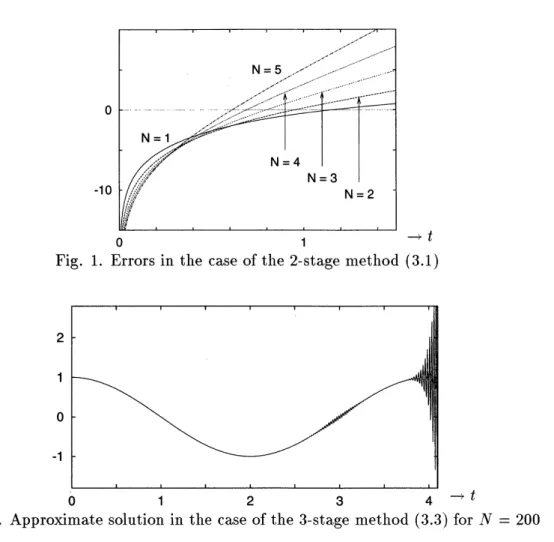
Fig. 1 shows the functions
(3.6) $\log_{2}|u_{0}(t)-x(t)|$
in the case of the $\underline{9}$-stage method (3.1), which were obtained by solving the ODE
system (2.4), (2.5) with the initial condition (2.6) and the stepsize $\triangle t=10^{-3}$. The
Fig. 2. $\mathrm{A}\mathrm{p}\mathrm{p}_{\mathrm{l}\mathrm{u}\mathrm{X}1}111\mathrm{d}\iota \mathrm{e}\mathrm{b}\mathrm{u}\mathrm{l}\mathrm{U}\iota 1\mathrm{u}\iota\iota 1\mathrm{A}\iota 1\iota \mathrm{e}\mathrm{t}\mathrm{e}\iota \mathrm{b}\mathrm{c}\mathrm{u}1\iota 11\mathrm{C}$ Q-b
$\iota C\iota \mathrm{g}\mathrm{e}$ Ille$\iota\downarrow 1\mathrm{U}\mathrm{U}(D.\mathrm{Q})1\mathrm{u}\iota\wedge(1^{\Gamma}=200$
Fig. 2 shows the approximate solution $u_{0}(t)$ in the case of the 3-stage method
(3.3) for$N=200$. Similar high-frequency oscillations appear for larger $N$, and $u_{0}(t)$
does not approach $x(t)$ even if a lager $N$ is taken.
Put
(3.7) $\varphi(t)=\exp[^{\underline{9}}+\cos(2t)]$,
and consider a problem whose exact solution is $x(t)=\varphi(t)$.
Problem 2: $\frac{dx}{dt}=-x(t-1)[1+x(t)^{2}]+\varphi(t-1)[1+\varphi(t)^{2}]+\varphi’(t)$, $0\leq t\leq 2$,
$x(t)=\varphi(t)$, $-1\leq t\leq 0$.
Tables 1, 2, 3 list observed accuracy of various methods for Problem 2. Each
number in a column for $‘ {}^{\mathrm{t}}\mathrm{d}\mathrm{i}\mathrm{g}.$
”
denotes the value
(3.8) $- \log_{2}(\max_{0\leq t\leq 2}|u_{0}(t)-\varphi(t\mathrm{I}|)$,
the number of correct bits of the approximate solution $u_{0}(t)$ for the partition
nume-ber $N$, and “diff.” stands for the difference between the bit nulnber for $N$ and that
Convergence rates of $O(h^{\min\{1,p}q+\})$ are observed for the 1-stage and 2-stage
Radau IIA methods, the 2-stage Lobatto IIIC method, and the 2-stage and 3-stage
Lobatto IIIA methods. For the other methods the rates seem a little higher.
Table 1. Numerical results by the Radau IIA methods
$s=1$ $s=2$ $s=3$
$N$ dig. diff. dig. diff. dig. diff.
2 $-0.45$ –2.96 –6.80 40.24 0.705.682.72 10.78 3.98 8 1.03 0.79 8.60 2.92 15.00 4.22 16 1.86 0.83 11.56 2.95 19.24 4.23 32 2.66 0.81 14.54 2.98 23.50 4.26 64 3.56 0.90 17.52 2.98 27.87 4.37 128 4.51 0.95 20.51 2.99 32.40 4.53
Table 2. Numerical results bythe Lobatto IIIC methods
$s=2$ $s=3$ $s=4$
$N$ dig. diff. dig. diff. dig. diff.
20..33 –4.82 –6.79 4 1.74 1.41 8.19 3.38 11.00 4.21 8 3.69 1.96 11.97 3.78 15.32 4.31 16 5.53 1.83 15.80 3.83 19.64 4.33 32 7.46 1.93 19.12 3.32 24.05 4.41 64 9.43 1.97 22.45 3.34 28.74 4.69 128 11.42 1.99 25.89 3.44 33.49 4.75
Table 3. Numerical results by the Lobatto IIIA methods
$s=2$ $s=3$ $s=4$
$N$ dig. diff. dig. diff. dig. diff.
2 0.73 – 4.81 – 8.61 42.88 2.158.653.83 13.24 4.63 8 4.90 2.02 12.71 4.07 18.28 5.04 16 6.89 2.00 16.68 3.97 23.32 5.04 32 8.89 1.99 20.70 4.03 28.23 4.91 64 10.89 2.00 24.70 4.00 33.65 5.42 128 12.89 2.00 28.71 4.01 39.34 5.68
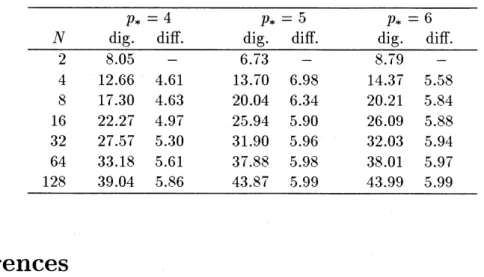
Table 4 shows results by the 4-stage Lobatto IIIC method, obtained by replacing
the second condition of (2.6) with
(3.9) $[T_{n,i}(0)= \varphi(\theta-c_{i}h)n+\sum_{4k=}^{p*}\beta i\varphi^{\{}(k)\theta_{n})(k)(-h)k$.
The use of these initial conditions indeed reduces the error in the MOL
Table 4. Numerical results by the 4-stage Lobatto IIIC method.
$p_{*}=4$ $p_{*}=5$ $p_{*}=6$
$N$ dig. diff. dig. diff. dig. diff.
2 8.05 – 6.73 – 8.79 4 12.66 4.61 13.70 6.98 14.37 5.58 8 17.30 4.63 20.04 6.34 20.21 5.84 16 22.27 4.97 25.94 5.90 26.09 5.88 32 27.57 5..30 31.90 5.96 32.03 5.94 64 33.18 5.61 37.88 5.98 38.01 5.97 128 39.04 5.86 43.87 5.99 43.99 5.99
References
[1] Banks, H. T., Burns, J. (1978): Hereditary control problelns: numerical method
based on averaging approximations. SIAM J. Control Optim. 16, 169-208
[2] Banks, H. T., Kappel, F. (1979): Spline approximations for functional differential
equations. J. Diffferential Equations 34, 496-522
[3] Bellen, A., Maset, S. (2000): Numerical solution of constant coefficient linear delav
differential equations as abstract Cauchy problems. Numer. Math. 84, 351-357
[4] Gedeon, T., Mischaikow, K. (1995): Structure ofthe global attractor of cyclic
feed-back systems. J. Dynamics DifferentiaJ Equations 7, 141-190
[5] Gedeon, T., Hines, G. (1999): Uppersemicontinuity of Morse sets ofa discretization
ofa delay-differetial equation. J. Differential Equations 151, 36-78
[6] Guglielmi, N. (1997): On the asymptotic stability of Runge-Kutta methods for delay
differential equations. Numer. Math. 77, 467-485
[7] Guglielmi, N. (1998): Delay dependent stability regions $\mathrm{o}\mathrm{f}\ominus$-methods for delay
dif-ferentialequations. IMA J. Numer. Anal. 18, 399-418
[8] Guglielmi, N. (2000): Asymptoticstabilitybarriers for natural Runge-Kutta processes
for delay equations. Preprint
[9] Guglielmi, N., Hairer, E. (1999): Orderstars and stabilityfor delay differential
equa-tions. Numer. Math. 83, 371-383
[10] Guglielmi, N., Hairer, E. (2000): Geometric proofs of numerical stability for delay
equations. To appear in IMA J. Numer. Anal.
[11] Hairer E., $\mathrm{w}_{\mathrm{a}\mathrm{n}}^{7}\mathrm{n}\mathrm{e}\mathrm{r}$, G. (1996): Solving Ordinary Differential Equations II (2nd rev. ed.). Springer, Berlin Heidelberg New York
[12] in ’t Hout, K. J. (1994): The stability of$\theta$-methods for systems of delay differential
[13] Ito, K., Teglas, R. (1986): Legendre-tau approximations for functional differential
equations. SIAM J. Control Optim. 25, 737-759
[14] Ito, K., Kappel, F. (1998): The Trotter-Kato theorem and approximation of PDEs. Math. Comp. 67, 21-44
[15] Kato, T. (1959): Remarks on pseudo-resolvents and infinitesimal generators of
semi-groups. Proc. Japan Acad. 35, $467^{-}468$
[16] Kato, T. (1966): Perturbation Theory for Linear Operators. Springer-Verlarg, New York
[17] Koto, T. (1998): A criterion for $P$-stability properties of Runge-Kutta methods. BIT
38, 737-750
[18] Koto, T. (2000): Method of lines approximations of delay differential equations,
Report CSIM 00-03, Department of Computer Science, The University of Electro-Communications
[19] Lasiecka, I., Manitius, A. (1988): Differentialbility and convergence rates of
approx-imating semi-groups for retarded functional differential equations. SIAM J. Numer.
Anal. 25, 883-907
[20] Maset, S. (1999): Asymptotic stability in the numerical solution of linear pure delay
differential equations as abstract Cauchy problems. J. Comput. Appl. Math. 111,
163-172
[21] Maset, S. (1999): Numerical solution of DDEs as abstract Cauchy problems. In-ternational Conference on Scientific Computation and Differential Equations, Fraser
Island, Queensland Australia
[22] Maset, S. (2000): Stability ofRunge-Kutta methodsfor linear delay differential
equa-tions. Numer. Math. 87, 355-371
[23] Scherer, R., M\"uller, M. (1992): Algebraic conditions for $A$-stable Runge-Kutta
meth-ods. in J. R. Cash and I. Gradwell (ed.), “Computational Ordinary Differential Equa-tions”, 1-7, Clarendon Press, Oxford
[24] Scherer, R., Wendler, W. (1994): Complete algebraic characterization of A-stable
Runge-Kutta methods. SIAM J. Numer. Anal. 31, 540-551.
[25] Trotter, H. F. (1958): Approximations of semi-groups of operators. Pacific J. Math.
8, 887-919
[26] Ushijima, T. (1975): Approximation theory for semi-groups of linear operators and