Introduction
In recent years, research on issues involving nonnative English speaking teachers (NNEST) has examined various aspects, including the self-perceptions and personal histories of NNESTs, students perceptions of NNESTs, administrative issues, the native/nonnative distinction in applied linguistics, and NNESTs’
socio-cultural and socio-political concerns (e.g., Braine, 2010; Cook, 1999; Davies, 2003; Kubota, 2002; Liu, 1999, 2004; Medgyes, 1994).
Braine (2010), for example, comprehensively depicts the history of the nonnative speaker movement in English teaching, and the extrinsic and intrinsic challenges faced by NNESTs, claiming that there is a bias in favor of native English speaking teachers (NESTs) in the teaching profession. Medyges’ seminal study (1994), relying on data obtained from questionnaire surveys, strongly suggests that native/nonnative differences are primarily due to linguistic factors. In terms of student perceptions of NESTs and NNESTs, Mahboob
(2004) concludes that ESL students do not have a clear preference for either native or nonnative English teachers, accepting the strengths and unique attributes of both types of teachers.
The majority of the studies on student perceptions of NESTs and NNESTs have been conducted in the “Inner Circle” countries (Kachru, 1985), including the United States and Canada (ESL contexts), while the perception in
“Expanding Circle” countries such as China, Japan, and South Korea (EFL contexts) has yet to be systematically investigated.
Thus, the purpose of the present study is to explore Japanese college students’ perceptions of both NESTs and NNESTs, and investigate the factors influencing such perceptions.
The Study
This study examines Japanese college students’ perceptions of NESTs and NNESTs in the context of English as a foreign language (EFL) teaching, based on Mahboob’s qualitative study (2004) conducted in an ESL setting (the
《論 文》
大学生のネイティブ・ノンネイティブ英語教師に 対する見方について
齊 藤 隆 春
Exploring Japanese College Students’ Perceptions of Native and Nonnative Speaker English Teachers
TAKAHARU SAITO キーワード
Native English speaking teachers (NEST), Nonnative English speaking teachers (NNEST), Student perceptions
United States). Instead of using traditional questionnaires in surveying students, Mahboob employed a discourse-analytic technique, asking ESL students to provide written responses to cues seeking their opinions on NESTs and NNESTs; after which the comments were coded by four readers and categorized into linguistic factors, teaching styles, and personal factors.
The cardinal importance of Mahboob’s use of a discourse-analytic technique lies in the fact that, in coding the essay comments, he allowed the categories to evolve out of the data obtained from the subjects, instead of categorizing the data based on a priori or predefined categories, such as are typically employed in questionnaires.
H e p o i n t s o u t t h a t s u c h p r e d e f i n e d categorization may force research subjects to respond along lines already defined by researchers, and thus prevent the subjects from fully expressing their own opinion. In this sense, Mahboob’s study based the analysis of data on grounded theory (Glaser and Strauss, 1967) emphasizing the importance of drawing categories out of data, rather than employing predefined categories. Furthermore, the development of data-based categories can lead to exploratory analysis capable of opening up new areas for future research. Thus, the present study has adopted the discourse-analytic technique in investigating Japanese college students’ perceptions of NESTs and NNESTs.
Participants
The author, as a NNEST, taught five required English classes at a middle-scale private university located in the Kanto region of Japan, in Fall 2012. At the end of the semester, the 96 students enrolled in the author’s English classes were invited to write comments on a given topic. Of the five classes,
three, called English E, prepared second-year students for the TOEIC Bridge test (55students in total); one, called English E Reregistration, was taken by second-through fourth-year students who had failed in the previous semester (17 students in total); and one, called English D Reregistration, a course in basic English conversation, was also taken by second- through fourth-year students who had failed in the previous semester (24 students in total).
Of the 72 students who had enrolled in the English E and English E Reregistration courses, 60 took the TOEIC Bridge test in December 2012, and their average score was 102.2 (highest 132 / lowest 64). In light of these results and the author’s own experience of teaching them, the English language proficiency of these students was evaluated at a beginner level, with low motivation in general. Therefore, the 96 students were asked to write their comments about NEST/NNEST issues in their first language, Japanese, as this enabled them to express their thoughts about the issues more freely and smoothly than if forced to use their limited English. Biographical information was not collected, in order to maintain confidentiality.
Procedure
Following Mahboob’s study (2004)( 1 ), research participants were given the stimulus topic below and asked to write their responses:
Some students think that only native speakers can be good English teachers.
Other students think that Japanese English teachers can also be good English teachers.
What is your opinion about this issue?
Please feel free to provide details including your own experiences and examples.
Note that as the topic was presented in Japanese( 2 ), and respondents were asked to answer in their first language, the students were free to express their own experiences and thoughts regarding the issue, in the 10-15 minutes provided for writing their comments.
Of the 96 comments collected, 19 were disqualified, with some students only expressing their preference for NESTs or NNESTS without detailed exploration of the issue, and others answering off topic or submitting blank comments. Therefore, a total of 77 comments from Japanese college students were analyzed in the study.
Following Mahboob (2004), a discourse- analytic technique was employed in analyzing the student responses to the cue, with the researcher first carefully reading the student comments several times, and then sorting them into four types: (1) positive or (2) negative comments about NESTs, and (3) positive or (4) negative comments about NNESTs. Next, the researcher coded the comments using different highlighting, and generated a pertinent list of categories, which were then labeled and sorted into major groups. The total number of comments in each category was counted.
Thus, rather than using a priori categories for the analysis of the students comments, the categories emerged through the process of data analysis, anticipating that students’ true
perceptions would be best observed in the uncategorized dynamics of the data itself.
Findings and Discussion
Three major groups of categories, including nine individual categories, emerged from the analysis of the student comments. The first group, ‘Linguistic Factors,’ included ‘Oral Skills,’
‘Grammar,’ ‘Vocabulary,’ and ‘Literacy Skills.’
The second group, ‘Teaching Skills,’ included
‘Ability to Receive and Answer Questions,’ and
‘Teaching Methods.’ The third group,
‘Empathy Factors,’ included ‘Experience as an FL Learner,’ ‘Understanding,’ and ‘Passion.’ As the student comments were written in Japanese, the passages cited in this study have been translated into English by the author.
Linguistic Factors
As aforementioned, linguistic factors comprise the four categories of oral skills, grammar, vocabulary, and literacy skills. Table 1 shows the distribution of student comments, with 76 comments distributed over the four linguistic factor categories: 47 positive and 2 negative comments about NESTs, and 20 positive and 7 negative comments about NNESTs. Details of the results for each linguistic category are discussed below.
TABLE 1. Distribution of Linguistic Factor Comments Linguistic Factors
NESTs NNESTs
Positive Comments
(N)
Negative Comments
(N)
Positive Comments
(N)
Negative Comments
(N)
Oral Skills 47 0 2 7
Grammar 0 2 11 0
Vocabulary 0 0 5 0
Literacy skills 0 0 2 0
Total 47 2 20 7
Oral Skills: The oral skills category included student comments on the teaching of listening, speaking, pronunciation, and conversational and practical skills in English, with a total of 56 comments recorded in this category; 47 were positive regarding the oral skills teaching of NESTs, while 2 positive and 7 negative comments were recorded for NNESTs.
The teaching of oral skills was considered NESTs’ strongest asset. In general, the 47 comments indicated that NESTs can provide a genuine, optimal, and practical model of English pronunciation as it is spoken by its native speakers. The following four examples from the comments are representative of student perceptions about NEST oral skills teaching:
・NESTs are useful for learning English pronunciation and conversation. (Student 1)
・NESTs’ pronunciation is clear, without a Japanese accent, which will certainly help me improve my English. (Student 21)
・NESTs’ natural pronunciation and accent are helpful for learning English. (Student 46)
・We can learn practical English and proper pronunciation. (Student 48)
These four comments demonstrate that NESTs were preferred for the teaching of oral skills because, as one student noted “we can learn practical English and proper pronunciation.”
These results would appear to support Benke and Medgyes (2005), whose study of Hungarian student perceptions found that NNESTs were criticized for their poor pronunciation and outdated language-use, while NESTs were preferred due to their ability to teach conversation and to function as an optimal model for imitation.
A total of 9 comments were made about NNEST oral skills teaching, with 2 positive and 7 negative. The positive comments valued
highly NNESTs’ good and precise English pronunciation:
・I’ve seen many Japanese English teachers with good pronunciation. (Student 59)
・I think Japanese English teachers’ pronunciation is also precise. (Student 61)
However, they were only two such comments, and neither elaborated on the actual teaching of English pronunciation, as for example in Mahboob (2004), where attention is drawn to NNESTs’
ability to identify exact problems with learners’
pronunciation and teach how to correct them.
On the other hand, the negative comments focused primarily on NNESTs’ non-standard, nonnative-like pronunciation; and were typified by the following:
・Japanese English teachers are themselves nonnatives. (Student 46)
・It is not good to get used to English pronunciation peculiar to Japanese English teachers. Since English circles continue to expand globally, we must get used to natural standard pronunciation. (Student 76)
These comments suggest that NNESTs are perceived as not as good at teaching oral skills due to their problematic nonnative-like pronunciation. Though not focusing on student perceptions per se, Arva and Medgyes (2000) report that some NNEST EFL teachers feel they have a faulty command of oral skills teaching because their own English, as a learnt language, lacks spontaneity. The comment of Student 76 would appear to relate to Phillipson (1992), which describes the global spread of English that divides core English speaking countries from peripheral countries where English is spoken as a second or foreign
language, and insists that linguistic imperialism holds sway by maintaining six native speaker fallacies, one of which is the relative ineffectiveness of nonnative English speaking teachers.
Grammar: Teaching grammar was regarded as the forte of NNESTs in the linguistic factor category, where 13 comments were recorded; 11 positive comments noted NNESTs’ strength in the teaching of English grammar, and 2 negative comments remarked on NESTs’ weakness in this respect, with the following illustrating NNESTs’ perceived advantage in this respect:
・In terms of grammar instruction, Japanese English teachers are better teachers than native English speakers. They are also better in the instruction regarding the Practical English Proficiency Test and TOEIC test.
(Student 12)
・Japanese English teachers can teach the basic structure of English carefully. (Student 32)
Since a majority of NNESTs (here Japanese English teachers) are familiar with standardized English tests, they are unusually well equipped to help students prepare for such tests; and with the use of their local language (here Japanese) they can carefully explain the structure of English. These results supports Mahboob’s study (2004), which found that ESL students perceived NNESTs’ knowledge of grammar to be a strength in their teaching of English. Arva and Medgyes (2000) cited NESTs’ acknowledgement of weakness in teaching grammar:
As one of them (NESTs) lamented, “This is wrong and this is the correct way you should say it, I know, but I can’t explain why it’s wrong or right.” A fellow NEST
remarked that “Most native teachers I know never really came across grammar until they started teaching it. So you have to learn it as you go along.”(p.361)
These remarks reflect NESTs’ ability to use English intuitively but not to explain the relevant grammar explicitly; and this weakness is reflected in the following student’s remark from the present study:
・It is difficult to learn the grammatical structure of English from native English speaking teachers. (Student 33)
Thus, it is of great interest that both NESTs and their Japanese students recognize this NEST weakness in teaching the grammatical structure of English.
Vocabulary: In this category, five comments suggested that NNESTs are good teachers of English vocabulary. No negative comments were recorded in the category. The following are representative of the positive comments.
・For those students who are not good at English, Japanese English teachers are better at teaching vocabulary and the basic structure of English.
(Student 13)
・Japanese English teachers can carefully teach the basic structure of English, vocabulary, and how to write in English. (Student 32)
Since the subjects of the study were at a beginner level in English, they may have wished to receive instruction in basic English vocabulary through the use of the local language, Japanese, from NNESTs. Mahboob (2004) indicated that both NESTs and NNESTs were considered effective teachers of vocabulary. However, since the instructional
setting of Mahboob’s study was ESL in the United States, students may have been better able to learn an advanced level of vocabulary, such as slang words and vocabulary useful in daily conversation, from both types of teachers.
Literacy skills: Literacy skills included reading and writing. In this category, only two comments were recorded, both of them positive and describing NNESTs, with the following as an example.
・Japanese English teachers are better at teaching grammar and how to read and comprehend English. (Student 15)
This comment draws attention to the intrinsic difference between oral and literacy skills acquisition, as both NESTs and NNESTs must be schooled in reading and writing skills, and this continues throughout their lifetime. Thus, the absence of any positive or negative comments about NESTs here may represent doubt concerning NESTs’ ability to manage the complex process of learning literacy skills, while the positive comments on NNESTs may suggest that the perception that they can teach complex literacy skills with the help of Japanese.
Teaching Skills
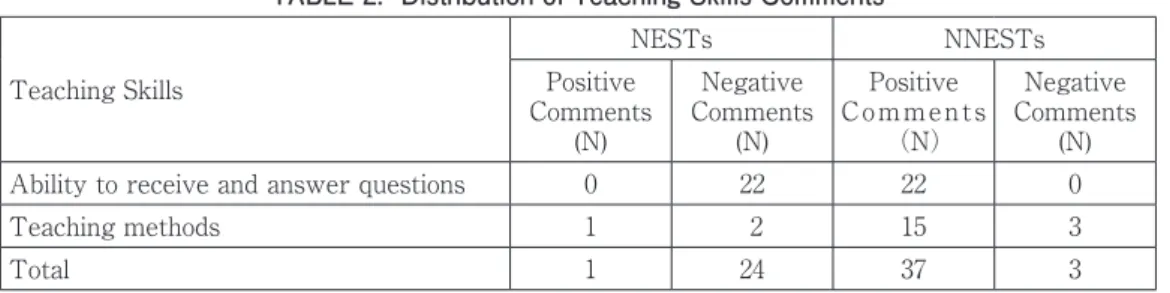
Teaching skills included two categories, ability to receive and answer questions, and teaching methods. Table 2 shows the distribution of student comments, with 65 comments distributed over the two categories: 1 positive and 24 negative comments about NESTs, and 37 positive and 3 negative comments about NNESTs. More details about the results of each category are discussed in this section.
Ability to receive and answer questions: This category reflected students’ satisfaction with
teachers’ ability to receive and answer questions in class, and 44 comments were recorded. It was of great interest that all 22 negative comments concerned NESTs, while all 22 positive comments concerned NNESTs. The following are representative of the former:
・When I was a middle school student, I received instruction in English from a native English speaking teacher. But the teacher spoke so fast that I was not able to understand what the teacher was talking about. I had to ask questions several times because the teacher spoke too fast. I had difficulty in preparing for the English examination because I was not able to communicate with the teacher about the examination in Japanese.
(Student 5)
・Native English speaking teachers sometimes misinterpret my questions. So it is difficult to communicate with them. (Student 39)
・Native English speaking teachers speak English so fast that I sometimes cannot understand what they are talking about. I know the importance of pronunciation, but I think understanding the meaning of English is more important than learning pronunciation.
(Student 54)
The following are typical of the latter.
・Since Japanese English teachers can explain the difficult part of English in Japanese, I can learn English more easily. (Student 27)
・Since Japanese English teachers have a good command of both English and Japanese, to deal with different classroom situations, I can have the pleasure of understanding English.
(Student 29)
These comments would appear to suggest
that NNESTs possess a markedly greater capacity to provide sufficient answers and explanations to address students’ needs.
Teaching methods: In this category, NNESTs received 15 positive and 3 negative comments from the students, with the following being representative of the positive comments:
・Japanese English teachers can understand the way their students feel in class and can teach English according to ability. (Student 9)
・I am not good at English and I think Japanese English teachers can teach English according to my progress. (Student 62)
・Japanese English teachers know how to teach English in an effective way. (Student 21)
and the following being typical of the negative comments:
・Japanese English teachers tend to focus on the form of English, and on memorization, like asking us to repeatedly read English sentences. (Student 30)
On the other hand, the following is a typical positive comment about NEST teaching methods.
・We need only native English speaking teachers because we live in the international era. Native English speaking teachers can teach English in a different way from the nonnative English teachers. (Student 66)
The following statement summarizes the negative perception of NESTs’ teaching methods.
・I’ve seen many native English speaking teachers who do not know how to teach English, though their English pronunciation is correct. (Student 45)
A possible explanation for the dramatic contrast between the negative comments about NESTs and the positive comments about NNESTs in this group is that NNESTs (here Japanese English teachers) possess deeper sensitivity which can “estimate the learners’
potential, read their students’ minds, and predict their difficulty” (Reves and Medgyes 1994, p.361).
This sensitivity stems from the linguistic, cultural, and educational experiences shared by NNESTs and their students. NNESTs’ use of the local language (here Japanese), in particular, functioned as an effective means to reduce the beginner-level students’ anxiety about learning English, and enhance their motivation for learning the language.
That the linguistic, cultural, and educational background shared by NNESTs and their students provides teaching strength to the former is supported by several studies (e.g., Ellis, 2002; Samimy & Brutt-Griffler, 1999), while Arva and Medgyes (2000) cite one NEST who acknowledged the negative effect of her lack of the local language:
TABLE 2. Distribution of Teaching Skills Comments Teaching Skills
NESTs NNESTs
Positive Comments
(N)
Negative Comments
(N)
Positive Comments
(N)
Negative Comments
(N)
Ability to receive and answer questions 0 22 22 0
Teaching methods 1 2 15 3
Total 1 24 37 3
“I can’t explain fully, especially with beginners, and it can be frustrating.” (p.362)
Empathy Factors
Empathy factors include three categories, experience as an FL (foreign language) learner, understanding, and passion. Table 3 shows the distribution of student comments with 15 comments distributed over the three categories, and a total of 1 negative comment about NESTs and 14 positive comments about NNESTs.
More details about the results of each category are discussed in this section.
Experience as an FL learner: This category received eight positive comments about NNESTs, noting that NNESTs are better teachers because they have themselves had the experience of learning English as a foreign language. The following comments are indicative:
・Japanese English teachers can give us meaningful instruction in English based on their own overseas experiences of learning English. (Student 7)
・Japanese English teachers can teach English based on the knowledge they acquired in school. (Student 18)
・Japanese English teachers’ instruction is easy to understand, because they can teach English through their own experience of learning English. (Student 45)
Mahboob (2004) points out that NNESTs’
experience of learning English as a second language results in their ESL students being more aware of the problems they may face, and his study is equally applicable to the EFL setting of this study. In terms of the relative strength of NNESTs in comparison to NESTs in this respect, Reves and Medgyes (1994) note the former’s “deeper insights into the English language,” remarking:
While in the course of their own structured language learning process, non-NESTs acquired a wealth of knowledge about the English language and presumably developed metacognition about the ways of language learning, NESTs are not aware of the internal mechanisms operating in the acquisition and use of the language, since informal language acquisition is largely unconscious. (p.361)
Thus, it may go without saying that NNESTs’
deeper insight into the English language, obtained through their own learning experiences, aids in their effort to help students study English.
Understanding: This category received one negative comment about NESTs and four positive comments about NNESTs, and is clearly related to the aforementioned linguistic, cultural, and educational background shared by NNESTs and their students, as well as to TABLE 3. Distribution of Empathy Factor Comments
Empathy Factors
NESTs NNESTs
Positive Comments
(N)
Negative Comments
(N)
Positive Comments
(N)
Negative Comments
(N)
Experience as an FL learner 0 0 8 0
Understanding 0 1 4 0
Passion 0 0 2 0
Total 0 1 14 0
the former’s experience as FL learners.
According to Mahboob (2004) “Some students felt that NNESTs could empathize with them and provide them emotional support because they had gone through the process themselves and knew how it felt” (p.137). The related negative perception of NESTs in this respect is typified by the following student comment:
・Native English speaking teachers cannot fully understand the feelings of those students who are not good at English because their first language is English. (Student 2)
The student’s comment reflects the perception that NESTs, who have acquired English unconsciously without going through the struggle of learning it, often cannot understand their students’ difficulty in learning the language. In support of this, Arva and Medgyes (2000) remarked:
The NEST’s inability to speak the local language may also have been conducive to a low level of empathy, an assumption framed by a NEST like this: “Being a native speaker, it is difficult for you to appreciate what the students are going through when they’re learning English.” (p.362)
In contrast to the negative statement about NESTs, some students expressed positive comments about NNESTs, of which the following are typical:
・Japanese English teachers can teach English from the learner’s point of view. (Student 30)
・Learning takes place not only in learning the subject matter itself, but in human interactions between the teacher and the student, like talking with each other in casual words. In this
sense, I prefer Japanese English teachers to native English speaking teachers. (Student 49)
These students felt that NNESTs could empathize with them, teaching the language from the learner’s point of view, because NNESTs had themselves traveled the same road as their students; thereby setting a high value on the empathetic human interaction between teacher and student, which can enhance students’ learning.
Passion: This category is closely akin to the former category of understanding; however, the following comment highlights the perception of NNESTs’ passion for the teaching of English:
・When I was in middle school, my English teacher passionately taught me how to write English in script based on his own experience of learning it. It is a Japanese English teacher who can really sympathize with me. (Student 64)
Thus, NNESTs’ passion for and deeper insight into English, based on their own learning experience, heightens their credibility as teaching professionals.
Summary of Findings and Discussion
The findings of this study are briefly summarized in Table 4.
Supporting the findings of Mahboob (2004), the comment distributed in Table 4 demonstrates that the respective perceived strengths of NESTs and NNESTs complement one another, with NESTs being seen as good at teaching oral skills, and NNESTs perceived as good at teaching grammar, vocabulary, and literacy skills. The table also indicates that NNESTs’
ability to receive and answer questions, teaching methods, and experience as FL learners is
perceived as comparative strengths; and these stem from the linguistic, cultural, and educational background, and the language learning experience, which they share with their students.
In particular, use of the shared local language (here Japanese) in the EFL setting benefited the students immensely, as the striking difference in the comments regarding the comparative abilities of NESTs and NNESTs to receive and answer questions revealed. In this vein, Reves and Medgyes noted:
In favor of non-NESTs, by far the most frequently mentioned argument was their ability to estimate the learners’ potential, read their minds and predict their difficulties.
The sensitivity was due to the linguistic, cultural and educational heritage they shared with their students. Since L1 was considered to be an effective tool for the clarification of structures, non-NESTs (or, for that matter, NESTs mastering L1) were more successful
in teaching grammar. (pp. 361-362)
This remark also relates to the group of empathy factors. The students in the present study perceived NNESTs to be more empathetic because of the abovementioned shared experiences. As a result of this, NNESTs’
teaching methods were better suited to their students’ expectations. The benefit of a shared mother tongue was not supported, however, by Mahboob’s study (2004), likely because this study was conducted in an ESL setting (in the United Sates) where students with multiple mother tongues were participating in the same course.
The results of the present study also support a number of studies on the negative perception of NNESTs’ oral skills teaching in ESL and EFL settings, in which the research subjects preferred native varieties of English to local models (e.g., Chiba, Matsuura, and Yamamoto, 1995; Forde, 1996; Dalton-Puffer et al, 1997; Lippi-Green, 1994).
Here the students’ preference for NESTs’ oral skills teaching was reflected in related TABLE 4. Distribution of Positive and Negative Comments Regarding NESTs and NNESTs Categories
NESTs NNESTs
Positive Comments
(N)
Negative Comments
(N)
Positive Comments
(N)
Negative Comments
(N) 1 Linguistic Factors
Oral Skills 47 0 2 7
Grammar 0 2 11 0
Vocabulary 0 0 5 0
Literacy skills 0 0 2 0
2 Teaching Skills
Ability to receive and answer questions 0 22 22 0
Teaching methods 1 2 15 3
3 Empathy Factors
Experience as an FL learner 0 0 8 0
Understanding 0 1 4 0
Passion 0 0 2 0
Total 48 27 71 10
expressions, such as “clear pronunciation,” “real pronunciation,” “genuine pronunciation,”
“practical pronunciation,” “proper pronunciation,”
“correct pronunciation,” and “beautiful pronunciation without a Japanese accent.” Thus, the results indicate that NESTs are perceived by the students as ideal “language models”
(Medgyes, 2001, p. 436).
Though the notion of NESTs as ideal language models seems prevalent in the English teaching prefession, the ample linguistic evidence that adult language learners cannot acquire native- like pronunciation should not be ignored. In addition, Dalton-Puffer et al. (1997) notes that the prominence of native speakers in language education may create an unattainable goal for language learners.
Given the complementary nature of the results of this study, both NESTs and NNESTS should work collaboratively for the construction of a better environment for language learners, as Mahboob (2004) suggests; and the following student comment clearly illustrates this point:
・I think both native English speaking teachers and Japanese English teachers are needed.
Native English speaking teachers can teach some skills of English that Japanese English teachers cannot teach. At the same time, since the majority of students are Japanese, Japanese English teachers are needed to support those students. Both English teachers should complement each other to provide better teaching of English. (Student 77)
Conclusion
The results of the study demonstrate that Japanese college students in the EFL setting do not have a clear preference for either
NESTs or NNESTs. As the comments show, both types of English teachers are perceived to have their own strengths, weaknesses, and unique attributes. NESTs are perceived to be best at teaching oral skills, while NNESTs are perceived to be good at teaching grammar, vocabulary, and literacy skills. The dramatic contrast in the ‘Teaching Skills’ category, between the negative comments about NESTs and positive comments about NNESTs, is due to the linguistic, cultural, and educational background that NNESTs share with their students. In this context, use of the shared mother tongue in class played an especially crucial role in satisfying student needs in the learning of English.
NNESTs’ perceived strengths were also apparent in the category of ‘Empathy Factors’, including their experience as learners of English as a foreign language, understanding, and passion. On the other hand, NNESTs were perceived as being weaker in teaching oral communication skills; and this perceived weakness stemmed from the students’ deeply ingrained notion of NESTs’ status as ideal language models. Given the complementary nature of the results, Phillipson’s (1992) concept of “native speaker fallacy” that only native speakers can be good language teachers should be taken very seriously.
Both NESTs and NNESTs should work collaboratively in order to provide an optimal learning environment for students. Rather than making some simplistic division in the roles played by NESTs and NNESTs, their respective strengths as teaching professionals should be highlighted and integrated. To this end, a future related study should include a broader range of research participants, from beginner- to advanced-level students. Such a study, enhanced by the resultant broader and
more nuanced range of student perceptions, will contribute to the construction of an optimal collaborative model for the teaching of English as a second or foreign language.
Notes
( 1 ) The following is the stimulus topic used in Mahboob’s study (2004):
“Some think students that only native speakers can be good language teachers. Others think that nonnatives can also be efficient teachers. What is your opinion about this issue? Please feel free to provide details and examples.”
( 2 ) The following is the Japanese translation of the stimulus topic, used in the present study.
「ある学生はネイティブ・スピーカーの英語の先生 だけが,よい先生だと思っています。また他の学 生は,日本人の英語の先生もよい先生だと思って います。この問題について,あなたはどう思いま すか。あなた自身の経験や実例も含めて,くわし く述べてくだい。」
References
Arva, V. & Medgyes, P. (2000). Native and non-native teachers in the classroom. System, 28, 355-372.
Benke, E. & Medgyes, P. (2005). Differences in teaching behavior between native and nonnative speaker teachers: As seen by the learners. In E. Llurda (Ed.), Nonnative language teachers: Perceptions, challenges and contributions to the profession (pp.
195-215). New York: Springer.
Braine, G. (2010). Nonnative Speaker English Teachers:
Research, Pedagogy, and Professional Growth.
New York: Routledge.
Chiba, R., Matsuura, H., & Yamamoto, A. (1995). Japanese attitudes toward English accents. World Englishes, 14, 77-86.
Cook, V. (1999). Going beyond the native speaker in language teaching. TESOL Quarterly, 33 (2), 185-209.
Dalton-Puffer, C., Kaltenboeck, G., & Smit, U. (1997).
Learner attitudes and L2 pronunciation in Austria.
World Englishes, 16 (1), 115-128.
Davies, A. (2003). The Native Speaker: Myth and Reality.
Clevedon: Multilingual Matters.
Ellis, E. (2002). Teaching from experience: A new perspective on the non-native teacher in adult ESL.
Australian Review of Applied Linguistics, 25, 71-107 Forde, K. (1996). A study of learner attitudes toward
accents of English. Hong Kong Polytechnic University Working Papers in ELT and Applied Linguistics, 1 (2), 59-76.
Glaser, B. G. & Strauss, A. L. (1967). The Discovery of Grounded Theory: Strategies for Qualitative Research.
Chicago: Aldine Publishing Company.
Kachru, B. B. (1985). Standards, codification, and sociolinguistic realism: The English language in the outer circle. In R. Quirk & H. Widdowson (Eds.), English in the world: Teaching and learning the language and literatures (pp.11-30). Cambridge:
Cambridge University Press.
Kubota, R. (2002). Marginality as an asset: Toward a counter-hegemonic pedagogy for diversity. In L.
Vargas (Ed.), Women faculty of color in the white classroom (pp.293-307). New York: Peter Lang.
Lippi-Green, R. (1994). Accent, standard language ideology, and discriminatory pretext in the courts. Language in Society, 23, 163-198.
Liu, J. (1999). Nonnative-English-speaking professionals in TESOL. TESOL Quarterly, 33 (1), 85-102.
Liu, J. (2004). Confessions of a nonnative English-speaking professional. In L. D. Kamhi-Stein (Ed.), Learning and Teaching from Experience (pp.25-39). Ann Arbor: University of Michigan Press.
Mahboob, A. (2004). Native or nonnative: What do students enrolled in an intensive English program think? In L. D. Kamhi-Stein (Ed.), Learning and Teaching from Experience (pp.121-147). Ann Arbor: University of Michigan Press.
Medgyes, P. (1994). The non-native teacher. London:
Macmillan Publishers.
Medgyes, P. (2001). When the teacher is a non-native speaker. In M. Celce-Murcia (Ed.), Teaching English as a second or foreign language (pp.429-442). Boston:
Heinle & Heinle.
Phillipson, R. (1992). Linguistic imperialism. Oxford:
Oxford University Press.
Reves, T. & Medgyes, P. (1994). The non-native English speaking EFL/ESL teacher’s self-image: An international survey. System, 22 (3), 353-367.
Samimy, K. & Brutt-Griffler, J. (1999). To be a native or nonnative speaker: Perceptions of nonnative speaking students in a graduate TESOL program. In G. Braine (Ed.), Non-native educators in English language teaching (pp. 127-144). Mahwah, NJ: Lawrence Erlbaum.