1. Introduction
Numerous applied linguists have widely discussed, in the TESOL literature, whether NESTs or NNESTs are better English teachers.
Abundant research has clearly demonstrated that NESTs have an advantage in teaching oral skills, due to their native speaker competence, and play the role of reliable informants in English language teaching (e.g., Hall and Cook, 2013; Ma, 2012; Medgyes, 1994; Saito, 2014;
Widdowson, 1992). As Hall and Cook (2013)
note, NESTs’ dominant position appears to be justified by the assumption, supported by ELT theorists, that English should be taught and learned monolingually in the classroom, without reference to the learners’ own language. Thus, NESTs are often preferred as instructors, taking on a special status as ideal linguistic models with their greater English proficiency and ease.
However, Shaw (1979) points out that NESTs may lack deeper and necessary insights into the English language, making lesson preparation and
execution less effective. For instance, NESTs have native intuition of what is grammatically correct, but may lack the metalinguistic knowledge required to effectively explain English grammatical rules to learners.
In contrast, several studies have shown that NNESTs, through their experience of learning English as an additional language, have distinctive positive traits for ELT. NNESTs, for example, can play the role of good learner models, teach language learning strategies more effectively, develop language awareness through their formal knowledge of English, provide appropriate linguistic information about the language to learners, be especially sensitive to learning problems, anticipate difficulties in learning, be more empathetic to learners’
needs, and set more realistic learning goals;
while their cultural affinity with students in EFL contexts can make them more preferred instructors (e.g., Boyle, 1997; Cook, 2005;
Lipovsky & Mahboob, 2010; Medgyes, 1994).
Above all, Hall and Cook (2013) insist that the use of the learners’ own language in EFL
《論 文》
大学生のネイティブ・ノンネイティブ英語教員に対する意識について
―再履修クラスの学生の場合―
齊 藤 隆 春
Investigating Japanese College Student Preferences for Native and Nonnative Speaker English Teachers: The Case of Repeaters
TAKAHARU SAITO キーワード
Native English speaking teachers (NESTs), Nonnative English speaking teachers (NNESTs), English as a foreign language (EFL), English as a second language (ESL), English language teaching (ELT), Teachers of English to Speakers of Other Languages (TESOL)
(255)
contexts plays an important role in explaining difficult concepts in the English language, and in developing rapport and a good classroom atmosphere; and they note, further, that own language use is more appropriate with lower- than higher-level learners.
In light of this, NNESTs would appear to have an advantage, because they share the same first language with their students in EFL contexts.
Despite this, however, NNESTs are sometimes treated as less proficient English teachers than NESTs, and tend to be less preferred by learners (Medgyes, 1994). However, empirical studies investigating student perception of NESTs and NNESTs have shown that student participants often appreciate the value of both types of teacher, and accept the strengths, weaknesses, and unique characteristics of both in certain classroom tasks in ESL settings (e.g., Mahboob, 2004; Moussu, 2002) as well as in EFL settings (e.g., Benke and Medgyes, 2005;
Lasagabaster and Sierra, 2005; Ma 2012; Saito, 2014).
Examining student perceptions of both teacher types is of great importance, because students’
views, as consumers, are valuable for improving the theoretical and pedagogical effectiveness of ELT. To further investigate these perceptions, the present study investigated Japanese college repeater preferences for NESTs or NNESTs, and identified key factors influencing such preferences. To this end, it addressed the following questions.
1 .Which do college repeaters prefer, NESTs or NNESTs, in an EFL context in Japan?
2 .What are the key factors that influence their preferences?
2. The study
The study assessed Japanese college repeater
preferences for NESTs or NNESTs, in an EFL context in Japan. In the study, NESTs were English teachers, mainly from the United States or England, who spoke English as their first language. NNESTs were Japanese English teachers, who shared the local language, Japanese, with their students. The study employed a mixed methods approach, with both a closed question (quantitative method) and an open question (qualitative method), to examine student preferences for NESTs or NNESTs, and the key factors influencing these preferences.
The student preferences were quantitatively assessed using a traditional Likert scale for the closed question, which asked the students to determine the strength of their preference for one teacher type or the other. Then an open question asked the students to freely describe the reason(s) why they made the choice they did, in answer to the closed question, in order to qualitatively assess their in-depth thoughts about these preferences.
2.1 Participants
The participants were 80 college repeaters:
students who took reregistration classes because they had failed in the previous year, for reasons such as obtaining bad grades on mid-term or final exams, and/or long absences from school. Such students tended to have low English proficiency, with low motivation in general, and to suffer from a sense of inferiority in learning English. Due to the decreasing number of school-age children in Japan, most Japanese colleges have recently faced serious enrollment problems, resulting in the acceptance of applicants with less motivation and/or academic proficiency. In light of this, it is highly important to investigate such students’ preferences for NESTs or NNESTs, in order to critically assist in the design of
(257) optimal English education for such students.
As the author had an opportunity to teach repeater English classes at a middle-scale private college in Japan in the fall of 2014, 80 students enrolled in repeater English classes were invited to complete a questionnaire on the given topic. The students were taking a course either in basic English conversation
(called English D) or in preparation for the TOEIC bridge test (called English E). Though they were third- or fourth-year students, they were asked to complete the closed and open question in their first language, Japanese, as the use of their own language enabled them to express their thoughts more freely, smoothly, and adroitly. The administration of the questionnaire was performed in class, at the end of the fall semester, in November and December of 2014.
2.2 Questionnaire
The data were collected through closed and open questions (for the Japanese version of the questionnaire, see Appendix A). First, students were asked to answer the following five-point Likert-scale closed question:
Question 1: Which do you prefer, native (NEST)
or nonnative (NNEST) English speaking teachers? Please circle one of the following sentence numbers.
1. I prefer NESTs.
2. I somewhat prefer NESTs.
3. It’s hard to say, either way.
4. I somewhat prefer NNESTs (Japanese).
5. I prefer NNESTs (Japanese).
After this closed question, the students were asked an open question concerning their choice in Question 1:
Question 2: What was the reason(s) for your choice in Question 1? Please feel free to describe your reason(s) in detail.
Note that the above questions were presented in Japanese, and respondents were asked to answer in Japanese, so that they could most freely relate their own experiences and thoughts regarding their preferences. Approximately 15 minutes were provided for completing the questionnaire.
2.3 Procedure
The administration of the questionnaire was conducted in class at the end of the fall semester, in October and November of 2014.
Of the 80 questionnaires collected, 20 were disqualified, with some students merely expressing their preference for NESTs or NNESTs without exploring their opinions in detail, and others answering off-topic with regard to the reason(s) for their choice in the Likert-scale answer. Thus, a total of 60 questionnaires from Japanese college students were analyzed in the study.
In the case of the open question (Question 2), content data analysis was conducted, in order to identify, in the written responses, noteworthy attitudes and themes regarding student preferences. The researcher first carefully read the student comments several times, and then coded them using different highlighting, to generate a pertinent list of categories regarding their preferences.
3. Findings and discussion
The following sections summarize and discuss the results of the analysis of the questionnaire data. As the student responses were written in Japanese, the author has translated the cited passages from the open question into English.
(258) 3.1 Findings regarding the closed question
(Question 1)
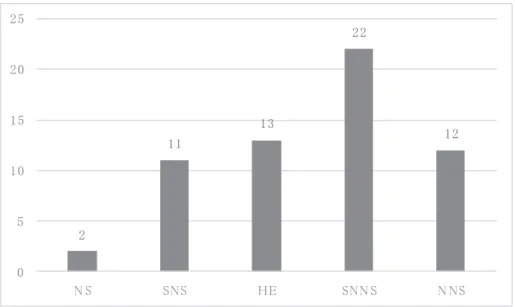
Regarding Question 1, of the 60 respondents, 2 (or 3%) chose Number 1 (‘I prefer NESTs.’);
11 (18%) chose Number 2 (‘I somewhat prefer NESTs.’); 13 (22%) chose Number 3 (‘It’s hard to say, either way.’); 22 (37%) chose Number 4
(‘I somewhat prefer NNESTs.’); and 12 (20%)
chose Number 5 (‘I prefer NNESTs.’). The mean score for the five-point Likert-scale question was 3.52. The fact that 34 students
(57%) chose either Number 4 or 5 suggests that, of the students who expressed a preference at all, most would at least somewhat prefer NNESTs (Japanese English teachers), while 13 students (22%) expressed no decided preference, leaving only 13 students (22%) at least somewhat preferring NESTs.
The following bar-chart (Figure 1) shows the distribution of student preferences for either NESTs (native English speaking teachers) or NNESTs (Japanese nonnative English teachers).
The chart suggests that, in general, Japanese
college repeater students at least somewhat prefer NNESTs over NESTs. The following section explores the factors influencing their preferences, through analysis of their free answers.
3.2 Findings regarding the open question
(Question 2)
In Question 2, students were asked to freely explain why they made the choice they did in Question 1. In this section, students’ written comments regarding each of the five preference statements are examined.
3.2.1 Regarding the choice of Number 1 (‘I prefer NESTs.’)
Of the 60 respondents, two showed a decided preference for NESTs (native English speaking teachers), explaining:
・I can learn how English is used actually through NESTs’ real English. (Student #21)
・I can psych myself up in NESTs’ lessons, and NESTs’ English-only lessons can
Figure 1. Distribution of student preferences for either NESTs or NNESTs (NS, SNS, HE, SNNS, or NNS:
number of students choosing Number 1, 2, 3, 4, or 5, respectively)
7
2
11
13
22
12
0 5 10 15 20 25
N S SNS H E SNN S N NS
Figure 1. Distribution of student preferences for either NESTs or NNESTs (NS, SNS, HE, SNNS, or NNS: number of students choosing Number 1, 2, 3, 4, or 5, respectively)
The chart suggests that, in general, Japanese college repeater students at least somewhat prefer NNESTs over NESTs. The following section explores the factors influencing their preferences, through analysis of their free answers.
3.2 Findings regarding the open question (Question 2)
In Question 2, students were asked to freely explain why they made the choice they did in Question 1. In this section, students’ written comments regarding each of the five preference statements are examined.
3.2.1 Regarding the choice of Number 1 (‘I prefer NESTs.’)
Of the 60 respondents, two showed a decided preference for NESTs (native English speaking teachers), explaining:
・ I can learn how English is used actually through NESTs’ real English.
(259) provide a lot of opportunity to think in English. (Student #41)
One student described NESTs’ English as “real”, and appreciated having an opportunity to learn NESTs’ usage of English - the way NESTs actually spoke; while the other found NESTs’
English lessons exciting, and highly valued the English-only environment in the classroom created by NESTs, where the student was given ample opportunities to practice and think in English. Thus the two students, though classified as repeaters at the time, were eager to learn practical English from NESTs with authentic English proficiency.
3.2.2 Regarding the choice of Number 2 (‘I somewhat prefer NESTs.’)
Of the 60 respondents, 11 chose this statement;
somewhat preferring NESTs, because they somewhat favored NESTs’ oral-skills teaching based on their perceived superior English proficiency (especially their accurate pronunciation), and their teaching style based on English-only lessons and less text-bound teaching. The following representative comments illustrate the students’ strong belief in NESTs’ oral-skills teaching strengths:
・NESTs’ real English had a strong impression on me. (Student #17)
・I’d like to have more opportunities to learn NESTs’ pronunciation. (Student
#19)
・Though I can learn knowledge of English from NNESTs, I somewhat prefer NESTs because I can learn practical English for communication, and get used to real English by listening to NESTs’ English. (Student
#24)
・I am shy and find it easy to communicate with NNESTs. But I somewhat prefer NESTs due to their genuine English. The
fact that NESTs learned English as a child, and still use it as English teachers, has a big impact on learners. (Student #39)
The students’ frequent use of terms like “real”,
“practical”, and “standard”, in describing NESTs’
English, appears to indicate a blind belief in the native speaker as an ideal linguistic model. The students also believed that NESTs were good at teaching oral skills such as English pronunciation.
On the other hand, NESTs’ teaching style was perceived to facilitate an authentic English- speaking environment and less text-bound teaching:
・I somewhat prefer NESTs because I am forced to communicate in English, and can learn English when being asked questions by NESTs. (Student #37)
・I somewhat prefer NESTs because NESTs can kindly explain difficult English phrases through their own storytelling, whereas NNESTs can only teach English phrases in the textbook. (Student #18)
One student considered it important to expose himself to the English-speaking environment created by NESTs, in order to improve his English communication skills. The other enjoyed the less text-bound environment created by NESTs, and showed some reluctance to accept NNESTs’ text-bound teaching, with its inclination toward a rote-learning approach. Like those of the students in the previous section, their responses showed their positive attitude toward learning ‘practical’ English through NEST instruction.
3.2.3 Regarding the choice of Number 3 (‘It’s hard to say, either way.’)
Of the 60 respondents, 13 chose this statement, and their neutral position toward both types of teacher was explained as follows:
・I could not say either way, because both
teacher types have their own advantages and disadvantages. I have not had enough experience to talk with NESTs. (Student
#1)
・I could not say either way, because both are good teachers. I can learn beautiful pronunciation from NESTs. When I have difficulties in learning, I can ask NNESTs in Japanese. (Student #4)
・I am sure I can learn proper pronunciation from NESTs, but I am not sure whether such NESTs are good teachers. NNESTs are better equipped to address difficulties that learners may face in learning English, because they went through the same process as learners. (Student #36)
These responses show that the students appreciated the unique characteristics of both types of English teacher. They perceived NESTs as having good English proficiency, in pronunciation for example, and as being good at teaching oral skills. At the same time, they suggested that NNESTs were also good teachers, because they had had the experience of learning English themselves, and shared the same local language, Japanese, which enabled them to anticipate students’ learning difficulties, and meet the needs of their students with warm sensitivity. One student did not focus as much on the respective advantages of both, but rather on personal factors:
・Regardless of the differences between NESTs and NNESTs, I’d like to take English lessons from teachers with whom I feel at ease communicating. (Student #14)
Having no specific preference for either teacher type, the student simply wished to receive instruction from an English teacher who could provide him with emotional support, including ‘the human touch’, which would allow him to share his anxieties with him/her.
As Widdowson (1992) suggests, the student comments regarding this choice appear to recognize the advantages of both teacher types: NESTs’ role as reliable linguistic informants who have extensive experience as English language users, and NNESTs’ role as instructors with experience as English language learners with pertinent knowledge of the English language.
3.2.4 Regarding the choice of Number 4 (‘I somewhat prefer NNESTs.’)
Of the 60 students, 22 chose this statement, with a majority focusing on NNESTs’ ability to use their local language, which could enhance students’ understanding in lessons, and facilitate communication between NNESTs and their students. The following comments illustrate NNESTs’ most prominent merits:
・I somewhat prefer NNESTs because I sometimes cannot make myself understood in Japanese to NESTs. (Student #38)
・It is easy for me to communicate with NNESTs. NNESTs can explain the meaning of English in detail in Japanese, though I appreciate NESTs’ good pronunciation.
(Student #46)
・I somewhat prefer NNESTs because I am free to ask NNESTs questions, and I can benefit from their learning experience as a similar learner. (Student #57)
These comments evidence the students’
satisfaction with NNESTs’ appropriate use of their local language to facilitate student understanding and effective communication, and their appreciation of NNESTs’ own English learning experiences. Some students making this choice expressed their sense of inferiority in learning English:
・I’d like to take English lessons from NNESTs, because I want to learn the
(261) structure of English from NNESTs rather than taking oral-skill lessons from NESTs.
I am poor at English and have difficulty in learning English, so I prefer to have NNESTs, because I feel at ease asking them questions. (Student #5)
Such a student, with a sense of inferiority, appears to prefer to take lessons from NNESTs because he/she primarily wishes to acquire a basic knowledge of English, and feels comfortable asking NNESTs questions in Japanese, rather than focusing on oral skills in NESTs’ English- only approach. The following comments would appear to suggest a degree of student negativity toward NESTs:
・I was not able to learn English from NESTs because I had no idea what they were saying or writing on the blackboard.
(Student #8)
・NNESTs are used to teaching English in a Japanese context. I have no idea what NESTs are talking about, and I sometimes give up listening to NESTs’ speech. I have some fear of foreign English teachers.
(Student #9)
・I feel at ease asking NNESTs questions.
On the other hand, I tend to shrink in front of NESTs. (Student #25)
These college repeaters had difficulty understanding what NESTs were talking about in class, and NESTs’ English lessons, lacking appropriate use of the students’ local language, hampered the students’ motivation to learn English, and even caused emotional anxiety in dealing with them.
The students expressing this preference appreciated NNESTs’ use of the local language in teaching English, while acknowledging NESTs’ linguistic authenticity. In addition, the students highly valued NNESTs’ similar experience of the language learning process, in
the same educational system as the students themselves, which also increased their respect for NNESTs, as successful English language learners.
3.2.5 Regarding the choice of Number 5 (‘I prefer NNESTs.’)
Of the 60 respondents, 12 chose this statement, with most highlighting NNESTs’ perceived advantages, such as their ability to use the students’ local language, student ease in understanding their teaching, their understanding of students’ difficulties and needs, and the ease of communication between NNESTs and their students, as exemplified in the following student responses:
・I can understand NNESTs’ English pronunciation. NNESTs can teach the difficult structure of English in Japanese.
(Student #44)
・NNESTs can understand and teach the kind of English we need to learn in Japan.
(Student #58)
・I think NNESTs are more knowledgeable about the basic structure of English than NESTs, and NNESTs have made a great effort to master English. I prefer NNESTs because they can understand students’
weaknesses and difficulties in learning, though I respect NESTs’ native pronunciation.
(Student #10)
Similarly to those in the previous section, these comments suggest greater student ease in understanding what NNESTs are teaching in class, mainly due to NNESTs’ ability to use the local language, in addition to their previous English learning experiences in the shared education system in Japan. Such shared experiences may enable NNESTs to better meet the needs of their students, as in the case of Student #58 for example, in preparing for
examinations in Japan. In contrast, the students appeared to suffer from the serious gap between their level of English understanding and NESTs’
English-only teaching style:
・I have no idea what to do in trying to understand. NESTs keep speaking English on and on and on, like a chatterbox. (Student
#47)
Given such responses, NESTs may need to make some adjustments in their speech rate and choice of vocabulary, and use Japanese equivalents when explaining difficult concepts, in order to increase student ease and comprehension.
4. Summary of findings and discussion
The distribution of college repeater preferences in Figure 1 indicates that most students at least somewhat preferred NNESTs to NESTs in an EFL context in Japan. Supporting Widdowson’s (1992) conclusions, their written comments demonstrated that they distinguished between NESTs’ role as reliable linguistic informants with good English proficiency, and NNESTs’ role as instructors who could provide students with accurate knowledge of the English language.
Though the students’ general admiration for NESTs’ oral-skills teaching was obvious, with some students also appreciating NESTs’ ability to facilitate learning through their English-only environment and less textbook-bound teaching style, most students showed a tendency to prefer NNEST instruction, mainly due to factors such as NNESTs’ ability to use the students’
local language effectively, their understanding of students’ needs and difficulties in learning, the ease felt by students in understanding their lessons, and the effective communication between NNESTs and their students.
The use of the shared local language, in
particular, was perceived as playing a major role in effective English teaching, in order to easily explain difficult concepts, including grammar rules, to create a comfortable atmosphere for effective communication, and to enhance student ease in asking questions. This finding supports a number of previous studies conducted in EFL settings (e.g., Ma, 2012; Medgyes, 1994; Saito, 2014, 2016), but not those conducted in ESL settings (e.g., Mahboob, 2004), likely because NNESTs and their students in EFL contexts are mostly from the same linguistic background, whereas multiple mother tongues are often at play in ESL classrooms. Students’ ease in understanding and communicating with NNESTs also seemed to stem from their shared linguistic background, because the students were able to codeswitch to the local language, Japanese, if communication in English was ineffective. In addition, NNESTs’ ability to understand student difficulties and needs was associated with their shared local language and experience in going through the same language learning process in an education system similar to the students’.
Likely exacerbated by their status as repeaters with low English proficiency, most appeared to have difficulty in understanding English-only lessons delivered by NESTs. In light of this, the present study also supports one of the key findings by Hall and Cook (2013), namely, that
“own-language use is more appropriate with lower-level English language learners than higher-level students” (p. 26).
The student perception of NESTs’ English language proficiency echoes the findings of a number of previous studies (e.g., Benke and Medgyes, 2005; Ma, 2012; Mahboob, 2004;
Medgyes, 1994; Saito, 2014, 2016), suggesting a blind belief in the native speaker as an ideal linguistic model for imitation. Undoubtedly, the opportunity to practice English offered by
(263) NESTs is valuable for students in the EFL context in Japan, where English is not used for daily communication. However, given some of the repeaters’ negative comments, NESTs may need to consider making adjustments in their speech rate and choice of vocabulary, to suit their students’ level, seeking effective communication for mutual intelligibility.
5. Conclusion
The results of this study suggest that the college repeaters tended to somewhat prefer NNESTs to NESTs, mainly due to their shared linguistic background and learning experiences, while admiring NESTs’ English language proficiency. Abundant evidence suggests that both types of teacher are beneficial for effective college English education, as further illustrated by the student comments here. Research into means to assist in the design of optimal English education for such students would appear to be of great value; and further related research, including advanced, intermediate, and lower- level students is required, to enhance the English teaching skills of both teacher types.
References
Benke, E. & Medgyes, P. (2005). Differences in teaching behavior between native and nonnative speaker teachers: As seen by the learners. In E. Llurda (Ed.), Non-native Language Teachers:
Perceptions, Challenges and Contributions to the Profession (pp. 195-215). New York: Springer.
Boyle, J. (1997). Native-speaker teachers of English in Hong Kong. Language and Education, 11, 163-181.
Cook, V. (2005). Basing teaching on the L2 user. In E. Llurda (Ed.), Non-native Language Teachers:
Perceptions, Challenges and Contributions to the Profession (pp. 47-61). New York: Springer.
Hall, G. & Cook, G. (2013). Own-language use in ELT:
exploring global practices and attitudes. British Council ELT Research Papers 13-01. London: British Council.
Kelch, K. & Santana-Williamson, E. (2002). ESL students’ attitudes toward native-and nonnative- speaking instructors’ accents. The CATESOL Journal, 14, 57-72.
Lasagabaster, D. & Sierra, J.M. (2005). What do students think about the pros and cons of having a native speaker teacher? In E. Llurda (Ed.), Nonnative language teachers: Perceptions, challenges and contributions to the profession (pp.217-241).
New York: Springer.
Lipovsky, C. & Mahboob, A. (2010). Appraisal of native and non-native English speaking teachers.
In A. Mahboob (Ed.), The NNEST lens: Non- native English speakers in TESOL. (pp.154-179).
Newcastle upon Tyne, England: Cambridge Scholars.
Ma, L.P.N. (2012). Advantages and Disadvantages of Native- and Nonnative-English-speaking Teachers:
Student Perceptions in Hong Kong. TESOL Quarterly, 46 (2), 280-305.
Mahboob, A. (2004). Native or nonnative: What do students enrolled in an intensive English program think? In L.D. Kamhi-Stein (Ed.), Learning and Teaching from Experience (pp.121-147). Ann Arbor: University of Michigan Press.
Medgyes, P. (1994). The non-native teacher. London:
Macmillan Publishers.
Moussu, L. (2002). English as a second language students’
reactions to nonnative English-speaking teachers.
Master’s thesis, Brigham Young University, Provo
(ERIC Document Reproduction Service No. ED 468 879).
Saito, T. (2014). Exploring Japanese college students’
perceptions of native and nonnative speaker English teachers. The Journal of Ryutsu Keizai University, 48 (3), 43-54.
Saito, T. (2016). Investigating Japanese college student preferences for native and nonnative speaker English teachers: The case of Advanced Students. The collected papers to commemorate the 50th anniversary of the founding of Ryutsu Keizai University (pp.783-801).
Shaw, P.A. (1979). Handling a language component in a teacher-training course. Modern English Teacher, 3, 12-15.
Widdowson, H.G. (1992). ELT and EL teachers:
Matters arising. ELT Journal, 46, 333-339.
Appendix A
質問 1 . あなた自身は,ネイティブ・スピーカーの英語の先生,または日本人の英語の先生のどちら を好みますか。 1 から 5 のスコアで評価し,番号の一つに○をつけてください。
1 ― 2 ― 3 ― 4 ― 5 ネイティブの どちらかと言えば、 どちらとも言えない どちらかと言えば、 日本人の英語の 英語の先生がよい ネイティブの英語の 日本人の英語の先生 英語の先生がよい 先生がよい がよい
質問 2.上記の番号の一つを選んだ理由は何ですか。自由にくわしく書いてください。