博士論文審査結果の要旨
博士論文審査委員会
主
査 伊 藤 和 寿 審 査 委 員 川 上 幸 男 審 査 委 員 米 田 隆 志 審 査 委 員 田 中 豊 審 査 委 員 小 野 直 樹
氏 名
Pham Ngoc Pha
論文題目
Improvement of Energy and Control Performance in Water Hydraulic Transmissions
〔論文審査の要旨〕
論文審査は,5 名の学位審査委員全員の出席の下,大宮キャンパス
2
号館2401
教室に おいて2014
年6
月26
日に17:30
より19:30
まで行われた.申請者は,査読付き論文2
件(その他,第一査読通過
1
件,査読待ち1
件),査読付き国際学会発表9
件,受賞3
件を 有する博士課程在籍者である.審査では初めに申請者からの一時間程度の論文発表が行われ,次いで
40
分程度の質疑 応答が行われた.まず論文発表は,予備審査において指摘のあった事項を中心に,より深い考察を行った 結果が述べられた.具体的には,油圧システムにおける省エネルギー手法との比較,エネ ルギー評価指標の定義と物理的意味合いの解釈,実験で注目しなかったパラメータが結果 に及ぼす影響,二つの提案手法における正味の消費エネルギーの計算法等について説明が 行われた.指摘があったこれらの項目については,論文中でも修正および補足がなされて いることが審査委員により確認された.
質疑応答では,本論文の結果を将来において実用化した場合の設計コンセプトがどの程 度の広い普遍性を有するか,より具体的には各設計パラメータの意味合いと影響度につい ての質問がなされた.申請者はテーマである水圧トランスミッションの速度制御系につい て十分な精度を持つシミュレーターも構築しており,これを下に設計パラメータの感度お よび効果について説明を行ったが,その一方で省エネルギー性についてのシミュレーター にはまだ議論の余地があり,これは今後の課題とする旨のやり取りがなされた.また,今 回の研究成果では一動力源-一負荷の場合における
PMT(pump-motor transmission)シス
テムの速度制御性能と省エネルギー性における有効性が極めて高いことが示されたが,こ れが一動力源-複数負荷となったケースについては言及しておらず,実応用を考えた場合 には是非この成果が必要となるとのコメントもなされた.また,出席頂いた水圧機器メー カの設計者からは,コンポーネントレベルでの性能(仕様)が全体効率にどのように影響 するかについての質問もあり,内部漏れおよび起動トルクがシステム全体のエネルギー効 率にどの程度の感度を持つかについて議論が行われた.審査後の協議においては,審査委員会は研究に十分な価値を認めるものとし,審査を合 格とした.
論
文
要
旨
Thesis Abstract
2014
年07
月02
日※報告番号
甲
第
164
号氏 名
(Name) PHAM NGOC PHA
主論文題名 (
Title
)Improvement of Energy and Control Performance in Water Hydraulic Transmissions
内容の要旨 (
Abstract
)I. INTRODUCTION
This thesis introduces two novel systems: water hydraulic fluid switching transmission (FST) and pump motor transmission (PMT) that only use cheap ON/OFF valve for lessening the initial cost and can reduce much energy consumption beside a conventional water hydraulic servo motor system (SMS) for comparison.
II. FST SYSTEM
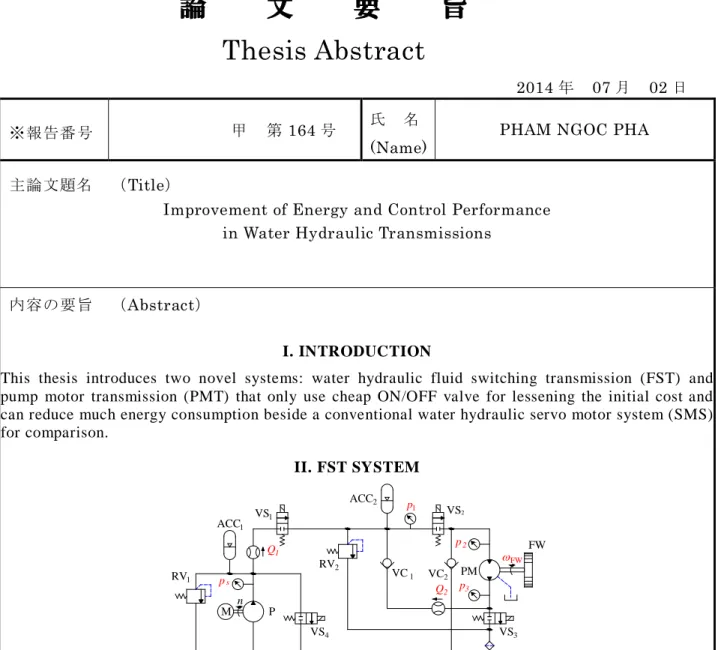
Figure 1: Schematic of water hydraulic FST system.
The system consists of following main elements as shown in Fig. 1: a fixed displacement pump (P), a fixed displacement pump/motor (PM), two accumulators (ACCi, i = 1, 2), three ON/OFF valves (VSi, i=1, 2, 3). The two accumulators ACC1 and ACC2 are used as a pressure surge absorber and energy storage, respectively. The fluid energy with pressure ps generated by the pump P is considered as the input energy, kept as 12 MPa in all experiments. The flywheel (FW) connected to PM is the rotational load and acts as the work.
III. PMT SYSTEM
A new water hydraulic pump motor transmission PMT will be introduced in this research. The PMT system is set on the basis of the FST system, only some devices were changed and the control algorithms for the ON/OFF valves and the electric motor M are different. In the PMT system, the ON/OFF valve VS
1was replaced by the check valve VC
1, the accumulator ACC
1was eliminated, and the accumulator ACC
2was used for both tasks: pressure surge absorber in acceleration and constant phases and energy storage for recovered energy in deceleration phase.
IV. SERVO MOTOR SYSTEM
A conventional servo motor was examined to evaluate the advantages of the FST and PMT systems.
Therefore, the servo motor system was set on the basis of the FST and also PMT systems, only the servo valve replaced for the ON/OFF valves to control the velocity of the flywheel FW.
※
official use only
P
ACC2
ωFW
ps PM
p1
Q2 Q1
M
FW
ACC1 VS1 VS2
VS3
VC 1 RV2
RV1 VC2
p2
p3 n
VS4
論
文
要
旨
Thesis Abstract
2014
年07
月02
日※ 報告番号
甲
第
164
号氏 名
(Name) PHAM NGOC PHA
内容の要旨
(Abstract)
V. SUMMARY
The goal of this dissertation is to improve both energy and control performance in water hydraulic transmissions. This research introduces two cheap FST and PMT systems beside the conventional servo motor system for comparison.
This study showed a whole view of the FST system, because it covered from simulation to experiment, examined the parameters which affected to control performance and energy saving, the two most important points of the system. In addition, three methods to improve the energy efficiency were introduced beside the original FST system.
The simulated results of the FST system had a good agreement with behavior of the experimental results in velocity, pressure, and flow of each part. That means the simulator has been build successfully and matched the actual.
The percentage error of the flywheel velocity could be reduced by use a quick response velocity transducer and restricting control upper and lower thresholds. The combination of both methods made the control accuracy of the FST system within ±25 min
−1, that corresponds with the velocity error below 3% for given reference speeds equal or above 800 min
−1. However, the restriction of the control upper and lower thresholds made the number of switching up; as a result, the life of the ON/OFF valves would be reduced much. A requirement is to simulate the relationship between the upper and lower thresholds and the duration of the ON/OFF valves. It is a future work of the research.
The most important target of the research is to improve the energy efficiency of the water hydraulic FST. Chapter 2 introduced the original FST system without acting on the electric motor M during working cycles and proposed three methods to reduce the energy consumption by lessening the velocity of the electric motor M and stopping it in the working and deceleration phases, respectively, and limited the working pressures p
1.i(i = 3, 4) by use an unload valve or idling stop method, and after that compared them together in both velocity and energy performances.
The steady state error in the working phase decreased drastically in the PMT system in comparison with FST system. For more detail, the steady state error downed from 1/6 to 1/18 times, it was from 1.66 to 4.10 min
−1corresponding to the percentage errors from 0.28 to 0.59%.
The more important point of the study is analysis of the energy saving performances of FST and PMT system and compares them together. Total energy consumption of FST system was much larger than PMT system that was from 2.56 to 3.85 times corresponding to the reference velocities from 600 to 1000 min
−1.
The SMS system shows much advantage in transient response with the shortest rise time and smallest overshoot while the steady state error is only slightly smaller than PMT system. The steady state error of the FST system is relative large, the percentage errors are from 5.5 to 8.1 times bigger than PMT and SMS system for the reference velocity from 600 to 1000 min
−1; however, the tendency of the error reduces for higher reference velocity. Both FST and PMT can reduce energy consumption drastically, the FST system only need from 33.2 to 47.3% of the total energy consumption of the SMS to complete a full cycle and even much reducing in PMT system with the reduction from 76.0 to 86.0%.
Moreover, both FST and PMT systems can also recover energy in the deceleration process and the saved energies stored in the accumulator ACC
2after a working cycle are from 8.2 to 11.6% and from 8.7 to 13.7% of the total energy consumption of FST and PMT system, respectively. The energy will be reused in the next working cycle for reducing the energy consumption and the rise time. The investigation on the effect of the saved energy is considered as a future work of this research.
In addition, the FST and PMT systems are much cheaper than SMS system because of using only cheap ON/OFF valves. This property will bring wider applications for water hydraulics.
※