熊本大学学位論文
新興薬剤耐性基盤メタロ-β-ラクタマーゼに対する 阻害剤・蛍光剤の開発
2006
金 万春
熊本大学学位論文
新興薬剤耐性基盤メタロ-β-ラクタマーゼに対する 阻害剤・蛍光剤の開発
2006 金 万春
Development of Inhibitions and Fluorescence Detection Agents for Metallo-β-lactamases
2006
Wanchun Jin
Development of Inhibitors and Fluorescence Detection Agents for Metallo-β-lactamases Wanchun Jin
A wide variety of β-lactam antibiotics are used in the treatment of infectious diseases.
These antibiotics block bacterial cell wall biosynthesis by inhibiting a transpeptidase.
However, bacteria have evolved several strategies for resisting the action of β-lactam antibiotics, including the production of a family of enzymes, β-lactamases. β-Lactamases catalyze the hydrolysis of β-lactam antibiotics, opening the β-lactam ring and rendering the antibiotics inactive. IMP-1 and VIM-2 are members of the metallo-β-lactamase (MBLs) subfamily of proteins. Genes that encode IMP-1 and VIM-2 are located on plasmids and can be horizontally transferred to other bacteria. No clinically available inhibitors are currently available for them at present. The search for clinically useful inhibitors and agents for the detection of MBLs remains an important objective. Therefore, the development of potent inhibitors and detecting agents requires an understanding of these enzymes at the atomic level and, particularly, of the structure and dynamics of their essential metal ion binding sites.
For the purpose of developing inhibitors and detection methods that are effective for a wide range of MBLs, three series of 2-ω-Phenylalkyl-3-mercaptopropionic acid [PhenylCnSH (n = 1-4)], N-[(7-Chloro-quinolin-4-ylamino)alkyl]-3-mercaptopropionamide [QuinolineCnSH (n = 2-6)], and N-{n-[5-(dimethylamino)naphthalene-1-sulfonamido]alkyl}-3-mercaptopropionamide [(DansylCnSH (n = 2-6)], where n denotes the alkyl chain length, were synthesized. These compounds contain a thiol group and a hydrophobic group linked by variable-length methylene chain.
The inhibition activities and fluorescence properties of these compounds for IMP-1 and VIM-2 were examined in this study. The X-ray crystal structures of VIM-2-PhenylC3SH (n = 3) and IMP-1-DansylC4SH (n = 4) complexes were also determined.
The new findings obtained in this study are summarized as follows.
1. PhenylCnSH (n = 1-4) were found to be potent inhibitors of both IMP-1 and VIM-2, suggesting that the thiol group of these inhibitors binds to Zn (II) ions of the active site of IMP-1 and VIM-2. PhenylC4SH was a potent inhibitor of both IMP-1 (IC50 = 1.2 µM) and VIM-2 (IC50 = 1.1 µM). When the number of methylene units was varied, QuinolineC4SH showed a maximum inhibitory activity against IMP-1 and VIM-2 (IC50 = 2.5 µM and 2.4 µM). The relationship between the inhibitory effect of the alkyl chain length was different for both series of inhibitors, suggesting the IMP-1 has a tighter binding site than VIM-2. QuinolineCnSH (n = 2-6), having a quinoline group as a fluorophore, did not serve as an agent for the fluorescent detection of MBLs.
2. PhenylC3SH was found to be potent inhibitor of VIM-2 with a Ki value of 220 nM but the compound was a weak inhibitor for IMP-1, with a Ki value of 1660 nM. To determine precisely the binding mode between VIM-2-PhenylC3SH, co-crystals of VIM-2-PhenylC3SH were prepared and an X-ray crystallographic analysis was performed.
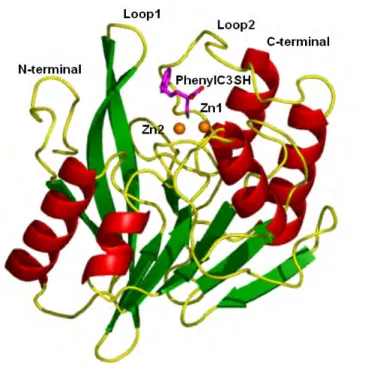
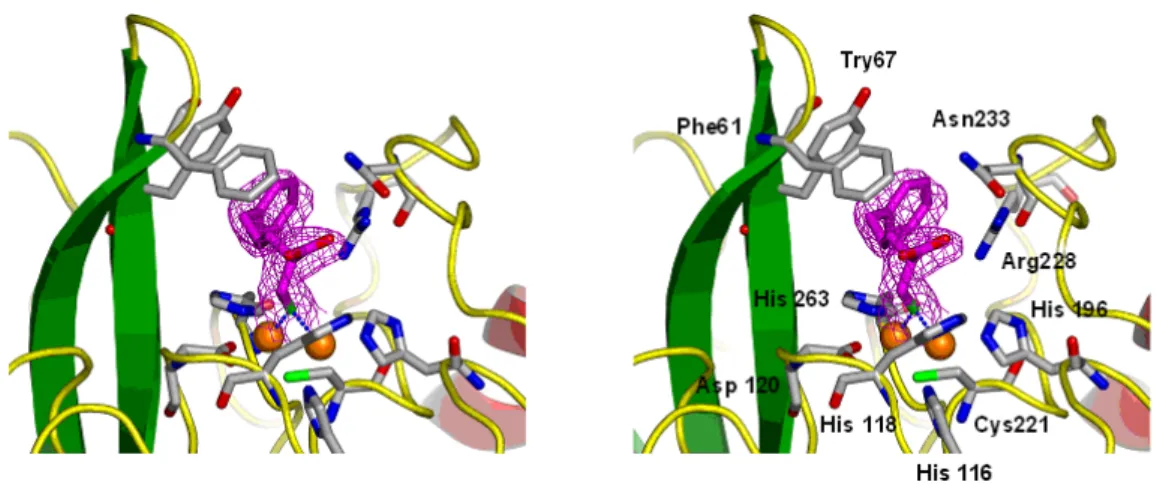
In the case of IMP-1, however, it was not possible to examine the IMP-1-PhenylC3SH complex by X-ray crystallography due to the lower quality of the crystals obtained. The X-ray crystal structure of the PhenylC3SH complex was determined at a resolution of 2.3 Å by multi absorption dispersion (MAD). The overall structure of VIM-2-PhenylC3SH adopted an αβ/αβ sandwich structure. The thiol group in PhenylC3SH formed a bridge between the two Zn(II) ions in the active site of VIM-2, whereas the phenyl group
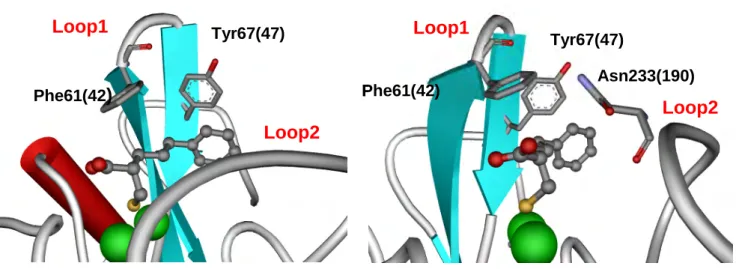
the methylene group by edge-to-face CH-π interactions. It is thought that these interactions stabilize VIM-2 complexed with PhenylC3SH. On the other hand, in IMP-1, Tyr67 and Phe61 are replaced with Val67(31) and Val61(25), respectively. These π-π and CH-π interactions might reflect the difference in inhibitory activity of PhenylC3SH between VIM-2 and IMP-1. In a comparison of native VIM-2 (PDB code: 1KO3) with the PhenylC3SH-VIM-2 complex, upon binding of an inhibitor, dynamic movements were found in Phe61(42) and Tyr67(47), located in loop1, and Arg228(185) and Asn233(190), located in loop2. These results suggest that Phe61(42) and Tyr67(47) play important roles in interactions with inhibitors or substrates.
3. As mentioned above, among the most widely recognized MBLs, IMP-1 and VIM-2 are extremely widespread. Therefore, it is very important to confirm the production of IMP-1 in infectious bacteria for effective chemotherapy in the initial stages of disease. New fluorescence probes, DansylCnSHs (n = 2-6), were designed, in which the length of the methylene chain of the linker between the dansyl and thiol groups was varied. The fluorescence properties and inhibition activities of DansylCnSHs with IMP-1 and VIM-2 were determined. The X-ray crystal structure of IMP-1 with DansylC4SH (n = 4) complex was also determined. This is one of the most sensitive fluorescent probes and an inhibitor of IMP-1, among the DansylCnSHs examined to date. From the proportional dependence of IMP-1 concentration on the fluorescence emission intensity, it can be concluded that all DansylCnSHs bind to IMP-1 forming 1:1 complex. The calculated Kd
values were in the range of 67 – 975 nM (Table 1), indicating that DansylC4SH (n = 4) binds more tightly to IMP-1 than the other DansylCnSHs (i.e. about 15-fold stronger than n
= 3). Similar to IMP-1, the fluorescence emission intensity of DansylCnSH increased with increasing concentrations of VIM-2. Their fluorescence intensities, however, increased with the number of the methylene groups in the linker (i.e. DansylC6SH showed
a maximal fluorescence enhancement, with a Kd value of 190 nM). These results suggest that Try64 in IMP-1 is an important factor in controlling the fluorescence properties of DansylCnSH with MBLs. Attempts were made to prepare co-crystals of DansylC4SH to elucidate the binding mode between IMP-1 and DansylC4SH and to carry out an X-ray crystallographic analysis. The X-ray crystal structure of the DansylC4SH–IMP-1 complex was determined at a resolution of 2.43 Å by molecular replacement. The overall structure of each molecule adopts an αβ/βα sandwich structure, as was also found in native IMP-1. A sulfur atom of the thiol group in DansylC4SH bridges to two Zn(II) ions. The naphthyl ring of DansylC4SH is stabilized by a CH-π interaction (edge-to-face) with the indole ring of the Trp64 residue, leading to a change in the conformation of Trp64.
Among the DansylCnSHs examined, DansylC4SH has an optimum length for binding to two Zn(II) ions, replacing the bridging OH2 or OH- that act as nucleophiles and the edge-to-face interaction with Trp64.
As mentioned above, these findings shed new light on the development of both inhibitors and agents for the detection of MBLs. Of importance, is the fact that the binding modes of VIM-2-PhenylC3SH and IMP-1-DansylC4SH complexes prepared in this study were determined by X-ray crystallography. These three-dimensional structures would be of help in the design of inhibitors that target not only VIM-2 and IMP-1 but also all MBLs.
Finally, it is expected that PhenylCnSH, QuinolineCnSH, and DansylCnSH investigated in this study will serve as lead compounds for the further development of detection agents and specific inhibitors with a high affinity, and which are selective for MBLs.
本論文は学術雑誌に掲載された次の論文を基礎とするものである。
(1) Comparative Study of the Inhibition of Metallo-β-lactamase (IMP-1 and VIM-2) by Thiol Compounds that Contain a Hydrophobic Group
Wanchun Jin, Yoshichika Arakawa, Hisami Yasuzawa, Tomoko Taki, Ryo Hashiguchi, Kana Mitsutani, Asumi Shoga, Yoshihiro Yamaguchi, Hiromasa Kurosaki, Naohiro Shibata, Michio Ohta, Masafumi Goto
Biol. Pharm. Bull., 27, 851-856 (2004)
(2) Probing, Inhibition, and Crystallographical Characterization of Metallo-β-lactamase (IMP-1) with Fluorescent Agents Containing Dansyl and Thiol Groups
Hiromasa Kurosaki, Yoshihiro Yamaguchi, Hisami Yasuzawa, Wanchun Jin, Yuriko Yamagata, Yoshichika Arakawa
Chem. Med. Chem., in press (2006)
目 次
第1章 緒言 ・・・・・・・・・・・・・・・・・・・・・・・・・・・・・・・・・・・・・・・・・・・・・・・・・・・・・・・・1
・・・・・・・・・・・・・・・・・・・・・・・・・・・・・・・・・・・・
・・・・・・・・・・・・・・・・・・・・・・・・・・・・・・・・・・・・・・・・・・・・・・・・・・・・・・
・・・・・・・・・・・・・・・・・・・・・・・・・・・・・・・・・・・・・・・・・・・・・・・・・・・・・・
・・
・・・・・・・・・・・・・・・・・・・・・・・
・・・・
・・・・・・・・・・・・・・・・・・・・・・・・・・・・・・・・・・・・・・・・・・・・・・・・・・・・・・
・・・・・・・・・・・・・・・・・・・・・・・・・・・・・・・・・・・・・・・・・・・・・・・・・・・・・・
・・・・・・・・・・・・・・・・・・・・・・・・・・・・・・・・・・・・・・・・・・・・・・・・・・
・・・・・・・・・・・・・・・・・・・・・・・・・・・・・・・・・・・・・・・・・・・・・・・・・・・・・・
・・・・・・・・・・・・・・・・・・・・・・・・・・・・・・・・・・・・・・・・・・・・・・・・・・・・・・
・・・・・・・・・・・・・・
・・・・・・・・・・・・・・・・・
・・・・・・・・・・・・・・・・・・・・・・・・・・・・・・・・・・・・・・・・・・・・・・・・・・・・・・
・・・・・・・・・・・・・・・・・・・・・・・・・・・・・・
第2章 PhenylCnSH (n = 1-4)と QuinolineCnSH (n = 2-6)による MBL
(IMP-1、VIM-2)阻害の検討 10
第1節 序論 10
第2節 結果 12
第1項 IMP-1とVIM-2に対する阻害剤(PhenylCnSH、DansylC2SH、
QuinolineCnSH) のIC50 (50%有効抑制濃度) と阻害定数Kiの決定 12
第2項 PhenylCnSH (n = 1-4)による阻害の検討 13
第3項 QuinolineCnSH (n = 2-6) によるIMP-1、VIM-2蛍光と阻害の 15
第3節 考察 16
第4節 小括 20
第3章 VIM-2-PhenylC3SH複合体およびVIM-2-酢酸イオン複合体のX線
結晶構造解析 21
第1節 序論 21
第2節 結果 23
第1項 VIM-2とPhenylC3SH複合体のX線結晶構造解析 23
第2項 VIM-2-酢酸イオン複合体 のX線結晶構造解析 29
第3節 考察 33
第1項 NativeとComplexの構造の比較 33
第3項 活性中心の比較 ・・・・・・・・・・・・・・・・・・・・・・・・・・・・・・・・・・・・・・・・・・・・39
・・・・・・・・・・・・・・・・・・・・・・・・・・・・・・・・・・・・・・・・・・・・・・・・・・・・・・
・・・・・・・・・・・・・・・・・・・・・・・・・・・・・・
・・・・・・・・・・・・・・・・・・・・・・・・・・・・・・・・・・・・・・・・・・・・・・・・・・・・・・
・・・・・・・・・・・・・・・・・・・・・・・・・・・・・・・・・・・・・・・・・・・・・・・・・・・・・・
・・・・・・・・・・・・・・・・・・・・・・・・・・・・・・・・・・・・・・・・・・・・・・・・・・・・・・
・・・・・・・・・・・・・・・・・・・・・・・・・・・・・・・・・・・・・・・・・・・・・・・・・・・・・・
・・・
・・・・・・・・・・・・・・・・・・・・・・・・・・・・・・・・・・・・・・・・・・・・・・・・・・・・・・
・・・・・・・・・・・・・・・・・・・・・・・・・・・・・・・・・・・・・・・・・・・・・・・・・・・・・・
・・・・・・・・・・・・・・・・・・
・・・・・・・・・・・・・・・・・・・・・・・・・
・・・・・・・・・・・・
・・・・・・・・・・・・・・・・・・
・・・・・・・・・・・・・・・・・・・・
・
・・
・・・・・・・・・・・・・・・・
・・・・・・・・
・・・・・・・・・・・
・・・・・・・・・・・・・・・・・・・・・・・・・・・・・・・・・・・・・・・・・・・・・・・・・・・・・・
・・・・・・・・・・・・・・・・・・・・・・・・・・・・・・・・・・・・・・・・・・・・・・・・・・・・・・
第4節 小括 40
第4章 Cd置換VIM-2のX線結晶構造解析 41
第1節 序論 41
第2節 結果 42
第3節 考察 50
第4節 小括 54
第5章 ダンシル基とチオール基を有する蛍光プローブによるMBLの検出 55
第1節 序論 55
第2節 結果 57
第1項 MBL (IMP-1) による蛍光剤の蛍光特性の変化 57
1、DansylCnSH (n = 2-6) 蛍光量子収率の決定 57
2、IMP-1共存下のDansylCnSH (n = 2-6)蛍光スペクトル変化 58
3、DansylCnSH (n = 2-6)とIMP-1との解離定数の決定 60
4、DansylC2SHの蛍光スペクトルに及ぼす溶媒効果 62
第2項 MBL(VIM-2) に対する蛍光剤DansylCnSH (n = 2-6) の検出能力 65 1、MBL(VIM-2) 共存下のDansylCnSH (n = 2-6) の蛍光スペクトル変化 65
2、DansylCnSH (n = 2-6) とVIM-2との解離定数の決定 67
第3項 DansylCnSH (n = 2-6) によるIMP-1、VIM-2阻害の検討 68
第4項 IMP-1とDansylC4SHとの複合体のX線結晶構造解析 69
第3節 考察 74
第4節 小括 77
第6章 総括 ・・・・・・・・・・・・・・・・・・・・・・・・・・・・・・・・・・・・・・・・・・・・・・・・・・・・・・・79
・・・・・・・・・・・・・・・・・・・・・・・・・・・・・・・・・・・・・・・・・・・・・・・・・・・・・・・・・・・・・・・
・・・・・・・・・・・・・・・・・・・・・・・・・・・・・・・・・・・・・・・・・・・・・・・・・・・・・・・・・・・・・・・・・・
・・・・・・・・・・・・・・・・・・・・・・・・・・・・・・・・・・・・・・・・・・・・・・・・・・・・・・・・・・・・・・
実験の部 84
謝辞 112
参考文献 114
第1章 緒言
1940 年代にペニシリンが臨床で感染症の治療に使用され、それ以後、多種の 抗菌剤が開発され細菌感染症の治療は著しく進歩した。近年,広域抗菌スペク トルを有する第 3 世代セフェム,セファマイシン,カルバペネム系などの新規 β-ラクタム剤が開発され、日本ではこれらの抗菌剤が感染症治療の初期段階で第 1 選択薬として使用されている1)。β-ラクタム剤は、細菌の外膜の主要な構成要 素 で あ る ペ プ チ ド グ リ カ ン の 生 合 成 に 関 与 す る ペ ニ シ リ ン 結 合 タ ン パ ク (Penicillin Binding Protein = PBP) のトランスペプチダ-ゼ機能を阻害する働き があり、極めて選択毒性に優れている2)。しかし、その一方で、細菌はこれらの 抗菌剤の進歩と共に自己を守るため耐性を獲得し、日和見感染症や院内感染の 起因菌として薬剤耐性菌は社会的にも問題となっている。
薬剤耐性菌の主な耐性機構は、(1) 細胞内への薬剤透過性の低下(膜の親水性、
疎水性、荷電状態の変化またはポリンタンパクの数、種類や透過孔の性状の変 化)3-6)、(2) 抗菌剤の標的部位の変化(PBP2’の産生など)7, 8)、(3) 修飾酵素に よる薬剤の修飾不活化(アセチル化酵素など)9)、(4) 分解酵素による薬剤不活 化(β-ラクタマーゼの産生など)10, 11)、(5) 細胞外への薬剤排出の亢進(テトラ サイクリン汲み出し蛋白など)6, 12-14)などが挙げられる(Fig. 1)。
β-ラクタマーゼはβ-ラクタム剤の基本骨格であるβ-ラクタム環のC-N結合を加 水分解する酵素であり、β-ラクタム剤の抗菌活性を消失させる(Fig. 2)10, 11)。β- ラクタマーゼは、Amblerらによってアミノ酸配列の相同性に基づき、4つのクラ ス A、B、C、D に分類されている15)。クラスA、C、Dは酵素の活性中心にセリ ン残基をもつセリン‐β‐ラクタマーゼである。クラスBは酵素の活性中心に1 個または2個のZn(II)をもつメタロ‐β‐ラクタマーゼ(MBL)である。
結合 結合で
きない
+ H2O β-lactamaseβ
Inactive Cephaloridine
HN H
N S
COO
N+
C S
O O
H H
O -
-
N H
N
O
S
COO
N+
C S
H H
O
-
+ H2O β-lactamaseβ
+ H2O ββ
Inactive Cephaloridine
-lactamase
HN H
N S
COO
N+
C S
O O
H H
O -
-
HN H
N S
COO
N+
C S
O O
H H
O -
-
N H
N
O
S
COO
N+
C S
H H
O
-
N H
N
O
S
COO
N+
C S
H H
O
-
Fig. 2. Hydrolysis of β-lactam antibiotics by β-lactamases.
染色体
DNA 標的蛋白
(抗菌薬により標的蛋 白が不活化される)
薬剤排出機構 テトラサイクリン 汲み出し蛋白など
修飾酵素 アセチル化 酵素など
標的蛋白の変化 PBP2’の産生など 膜の親水性・疎水性、荷
電状態の変化
ポリン蛋白の数・種類や 透過孔の性状の変化
分解酵素 β-ラクタマーゼ の産生など
(不活化さ れない) (β-ラクタム剤分解され不活化) 抗菌薬
染色体 DNA 染色体 DNA
結合 結合で
きない
標的蛋白 標的蛋白
(抗菌薬により標的蛋 白が不活化される)
薬剤排出機構 テトラサイクリン 汲み出し蛋白など 薬剤排出機構 テトラサイクリン 汲み出し蛋白など
修飾酵素 アセチル化 酵素など
標的蛋白の変化 PBP2’の産生など 膜の親水性・疎水性、荷
電状態の変化
ポリン蛋白の数・種類や 透過孔の性状の変化
分解酵素 β-ラクタマーゼ の産生など
(不活化さ れない) (β-ラクタム剤分解され不活化) 抗菌薬
抗菌薬
Fig. 1. Several mechanisms of bacterial resistance to antibiotics.=ー
MBLは1960年代にBacillus cereus16)から初めて発見され、その後、Bacteroides fragilis からCcrA17)、Aeromonas hydrophila からCphA18)、Serratia marcescens か らIMP-119)など現在では20種類以上の菌種で産生されることが分かっている20)。 これらのMBLは臨床において切り札的存在であるカルバペネム系(例えば、イ ミペネム、メルペネム)を含むほとんど全てのβ-ラクタム剤を加水分解する。
また、現在臨床で使われているクラブラン酸やスルバクタム等のβ-ラクタマー ゼ阻害剤に対して感受性を示さない21)。
MBLは活性中心のZnリガンドのアミノ酸配列に基づき、さらに 3 つの subclasses B1~B3に分類されている22, 23)。subclass B1はHis116-x-His118-x-Asp120 の配列を持ち、BcII(活性中心に1つZn(II)を含む)以外、活性中心に2つZn(II)を 含む23)。subclass B2はAsn116-x-His118-x-Asp120の配列を持ち、活性中心に一つ
Zn(II)を含むが、両方の結合サイトにZn(II)が配位すると、活性が低下する24)。
subclass B3 はHis116-x-His118-x-Asp120-His121 の配列を持ち、活性中心に 2 つ Zn(II)を含む25)。本論文ではアミノ酸番号付けはGalleniらが提案したクラスB β- ラクタマ-ゼについてのナンバリング方式(BBL numbering)に従い、( )の中は 熟成タンパク質のナンバリングを示す22) (His116(86)を例として、BBL numbering では116番目、熟成タンパク質では86番目のHisアミノ酸を示す)。
特にIMP familyやVIM family はsubclass B1 に分類されており、さらに発現す る遺伝子(blaIMP-1、blaVIM-2など)は伝達性プラスミド上に存在している(Fig. 3)。
そのため水平的に他の菌種を超えた伝播が可能で、日本のみならず世界的な蔓 延が進行しつつある26)。またIMP familyはIMP-1からIMP-13まで、VIM familyは
VIM-2からVIM-11a, -11bまで、アミノ酸配列に変異が入り、亜型が生じている
ことから、特に警戒されている27)。そのため、これらの酵素に対する有効な阻 害剤の開発は極めて急務とされている。
Class B metallo-β-lactamase の分類
(カルバペネムを加水分解できる)
・Subclass B1 BcII, CcrA, VIM-1, etc (染色体性) IMP family (IMP-1), (プラスミド性) VIM family (VIM-2), etc (プラスミド性)
・Subclass B2 CphA, etc (染色体性)
・Subclass B3 L1, etc (染色体性)
Fig. 3. Classification for metallo-β-lactamases (MBLs).
His 118
His 116
His 196 Cys 221
His 263 Asp 120 Zn 1
Zn 2 His 118
His 116
His 196 Cys 221
His 263 Asp 120 Zn 1
Zn 2 His 118
His 116
His 196 Cys 221
His 263 Asp 120 Zn 1
Zn 2
Fig. 4. The overall structure (left) and the active site (right) of metallo-β-lactamase (IMP-1)(PDB code: 1DDK).
IMP familyのIMP-1は1994年日本でS. marcescens (セラチア菌)から発見された MBLである19)。また、2000年にConchaらによってPseudomonas aeruginosa(緑膿 菌)由来のIMP-1のX線結晶構造が報告された28)。
IMP-1の3次元構造はαβ /βαのサンドイッチ構造を形成し、これはこれまでに
構造が明らかにされたMBLに共通している。ポリペプチド鎖は2つのドメインに 分けられ、その中心の2つのβシートはおよそ2回軸対称の関係にある。これら 2つのβシートの境界面は酵素分子の浅くて広い溝の疎水性ポケットを形成し、
その中に2個のΖn (II)が存在する活性中心が存在する(Fig. 4)。第1のΖn(II)(Zn1) には3つのヒスチジン残基(His116、His118, His196)が配位し、第2のΖn(II)(Zn2) にはヒスチジン(His263)、アスパラギン酸(Asp120)およびシステイン(Cys221)が 1つずつ配位している。また、Bacteroides fragilis 由来のCcrAのX線結晶構造で
は、2 個のΖn(II)に水分子またはヒドロキシアニオンの存在が確認されているが
29)、IMP-1の場合3.1 Åの低分解能のため確認されていない。しかし、subclass B1 のアミノ酸配列の相同性、複核Ζn (II)酵素であること、また加水分解の原動力と 考えられる求核試薬としての水またはヒドロキシアニオンの存在を考えると、
Fig. 4に明示されていないが、IMP-1においても架橋配位子として水またはヒド
ロキシアニオンが存在すると考えられる。
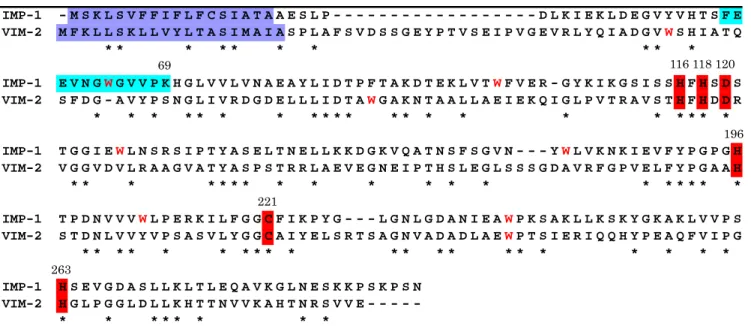
VIM familyのVIM-2は1996年ヨーロッパでP. aeruginosaから発見されIMP-1と 同様にプラスミド伝達性のMBLで30),近年日本でも臨床において単離されてい る。VIM-2とIMP-1のアミノ酸配列を比較すると(Fig. 5)、VIM-2はIMP-1と32%
のアミノ酸配列相同性を示し、活性中心のΖn (II)に配位しているアミノ酸残基は よく保存されていることが分かっている。またIMP-1はセフェム系β-ラクタム剤 をよく加水分解するが、piperacillinのような近年開発されたペニシリン系をあま り加水分解できない31-34)。しかしVIM-2はpiperacillinもよく加水分解することが 知られている33, 35)。
58 IMP-1 - M S K L S V F F I F L F C S I A T A A E S L P - - - D L K I E K L D E G V Y V H T S F E VIM-2 M F K L L S K L L V Y L T A S I M A I A S P L A F S V D S S G E Y P T V S E I P V G E V R L Y Q I A D G VW
W W
W
WL N W
W W
W
S H I A T Q
* * * * * * * * * *
IMP-1 E V N G G V V P K H G L V V L V N A E A Y L I D T P F T A K D T E K L V T F V E R - G Y K I K G S I S S H F H S D S VIM-2 S F D G - A V Y P S N G L I V R D G D E L L L I D T A G A K N T A A L L A E I E K Q I G L P V T R A V S T H F H D D R
* * * * * * * * * * * * * * * * * * * * *
IMP-1 T G G I E S R S I P T Y A S E L T N E L L K K D G K V Q A T N S F S G V N - - - Y L V K N K I E V F Y P G P G H VIM-2 V G G V D V L R A A G V A T Y A S P S T R R L A E V E G N E I P T H S L E G L S S S G D A V R F G P V E L F Y P G A A H
* * * * * * * * * * * * * * * * * * *
IMP-1 T P D N V V V L P E R K I L F G G C F I K P Y G - - - L G N L G D A N I E A P K S A K L L K S K Y G K A K L V V P S VIM-2 S T D N L V V Y V P S A S V L Y G G C A I Y E L S R T S A G N V A D A D L A E P T S I E R I Q Q H Y P E A Q F V I P G
* * * * * * * * * * * * * * * * * * * * *
IMP-1 H S E V G D A S L L K L T L E Q A V K G L N E S K K P S K P S N VIM-2 H G L P G G L D L L K H T T N V V K A H T N R S V V E - - - - -
* * * * * * * *
116 118 120 69
196
221
263
Fig. 5. Comparison of the amino acid sequences between IMP-1 and VIM-2.
Red: Conserved amino acids that are the Zn(II) ligands.
Red W: The number of Ws is six in the IMP-1 whereas three in the VIM-2.
Blue: Signal peptide.
Light blue: The 12 residues (58~69) that compose the flap in IMP-1.
この違いは、基質や阻害剤が結合する際に重要な役割を演じると考えられて いるフラップを構成するアミノ酸残基 BBL numbering 61(Phe)~67(Tyr)がIMP-1 のそれとは異なっているからと考えられる30)。
1996年から、trifluoromethyl alcohols and ketones36)、hydroxamates37)、thiols38-46)、 thioester derivatives20, 40, 47-49)、cysteinyl peptides50)、biphenyl tetrazoles51, 52)、 mercaptocarboxylates28, 41, 50)、1β-methylcarbapenem derivatives53, 54)、2,3 disubstituted succinic acid derivatives55)、tricyclic natural products56)、sulfonyl dydrazones57)、a derivative of synthetic cephamycin58) がMBLに対する阻害剤として報告されてい
しか阻害しない。個々の阻害剤は酵素が変わると阻害の強さが異なることから、
それぞれ違う酵素-阻害剤結合様式をもつと考えられる。
MBLの阻害剤を開発するためには、これらの酵素のⅰ) Ζn(II)および近隣の残 基並びに、ⅱ) 疎水性残基と阻害剤との結合様式をX線結晶構造解析等により構 造を明らかにして推察することが必要である。現在までに、B. fragilis 由来 subclass B1 であるCcrA29) と阻害剤4-morpholineethanesulfonic acid の複合体59)、 B. cereus 由来subclass B1 であるBcII60, 61)、B. fragilis 由来CfiA とtricyclic natural products の 複 合 体56)、P. aeruginosa由 来subclassB1 で あ るIMP-1 と 阻 害 剤 mercaptocarboxylate (2-[5-(1–tetrazolyl-methyl)thien-3-yl]-N-[2-(mercaptomethyl)-4- (phenylbutyrylglycine)]) の 複 合 体28)お よ び 2,3-dissubstituted succinic acid deriratives の複合体55)、Chryseobacterium meningosepticum 由来subclass B1 であ るBlaB とD-captopril の複合体62)、Setenotrophomonas maltophilia由来subclassB3 であるL125) と阻害剤biphenyl tetrazoles の複合体51)、Fluoribacter gormanii 由来 subclass B3 であるFEZ-1 またFEZ-1 とD-captopril の複合体63)について、X線結 晶構造解析が報告されている。先にも述べたように、阻害剤を開発するにあた って、酵素の特定構造、また酵素と阻害剤の結合様式と相互作用を知ることが 重要である。また、新しい阻害剤の開発はこれらのX線結晶構造解析結果に立脚
し、design することができる。
Gotoらは1997年にメルカプトカルボン酸がIMP-1に対して強い阻害剤として
働くことを報告した39)。その後、チオール基を持つ化合物が阻害剤開発のター ゲットとなった53)。その阻害機構を検討する為、3-メルカプトプロピオン酸と
コバルト(II)置換IMP-1を用いて可視吸収スペクトルを測定したところ、チオレ
ートからCo(II)への電荷移動吸収帯が観察された。この結果から、チオール化合 物の阻害作用はチオール基が活性部位のZn(II)に配位することであると考えた
39)。このことは、IMP-1 と阻害剤であるメルカプトカルボキシレート誘導体と
の複合体のX線結晶構造解析の結果からも支持された28)。
最近、KurosakiらはIMP-1の三次元構造に基づいて、初めて、IMP-1に対し非 可逆的に阻害する新規阻害剤を設計、合成し阻害活性ならびに阻害様式を速度 論的解析、MALDI-TOF MS、X線結晶構造解析により解明した64)。これらのチ オール基と良い脱離基を持つ化合物が非可逆的阻害剤開発の道を開いたと考え られる。
2003年に、KurosakiらはMBL (IMP-1) に対する新規蛍光剤として、ダンシル エ チ レ ン ジ ア ミ ン と 3-メ ル カ プ ト プ ロ ピ オ ン 酸 と を 縮 合 し たN-[2-(5 -dimethylamin-naphthalene-1-sulfonylamino)ethyl]-3-mercaptopropionamide
(DansylC2SHと略す)はIMP-1 に結合すると蛍光強度が増大し、かつ阻害するこ
とを報告した46)。
Zn(II)酵素はZn(II)の性質上、分光学的研究を行うことができない。そのため、
Co(II)置換することで、UV-Vis分光学滴定やγ線摂動角相関法(PAC)などの分光学
的研究がよく行われている。その他の方法としてMBLの一つのBcIIではCd置換 酵素の結晶構造および分光学的研究を行うことで、溶液中における金属イオン の機能などを推測している65-68)。
これらの背景の下、本論文では、耐性遺伝子がプラスミド上に存在するIMP-1、
VIM-2を対象として以下の研究を行なった。第2章では、Parkらが報告したZn(II) 含有酵素であるCarboxypeptidase A (CPA)のチオール阻害剤PhenylCnSH69)がMBL に対する阻害剤となり得ると考え、Parkらの合成法に従い合成し、IMP-1、VIM-2 との結合相互作用を活性阻害により検討した。また、蛍光剤DansylCnSH (n = 2
-6) のIMP-1、VIM-2 への阻害作用の検討を行い、そして蛍光発色団のダンシ
ル基をキノリン基に変えた、新規化合物Quinoline誘導体 [QuinolineCnSH (n = 2
の異常散乱を利用した多波長異常分散(MAD)法によって、複合体のX線結晶構造 解析に成功した。またこの構造をモデルとして分子置換法によりVIM-2 と酢酸 イオンとの複合体の構造解析を行い、VIM-2と酢酸イオンとの構造およびVIM-2 と阻害剤との結合様式を解明した。第4章では高濃度のCd(II)にVIM-2を浸すこ とで、Cd(II)に置換したVIM-2の結晶を調製し、X線結晶構造解析を行った。第 5章では、ダンシル基とチオール基間のスペーサー部位の長さを変えた新規蛍光 剤DansylCnSH (n = 2-6) を合成し、IMP-1に対しての蛍光と阻害作用の検討を 行い、IMP-1と蛍光剤 (DansylC4SH) との複合体のX線結晶構造解析に成功した。
以下に得られた知見を詳述する。
第2章 PhenylCnSH (n = 1-4)とQuinolineCnSH (n = 2-6)によるMBL(IMP-1、
VIM-2)阻害の検討
第1節 序論
MBL阻害剤の開発は、現在世界中で進んでいる。緒言でも述べたように、1996 年から、様々な阻害剤が開発されてきた。特に、Gotoらは1997年にメルカプト カルボン酸がIMP-1に対して強い阻害剤として働くことを報告して以来39)、分子 内にチオール基を有する化合物がMBL阻害剤開発のターゲットとなった53)。し かし、現在までに臨床試験に至った阻害剤はない。
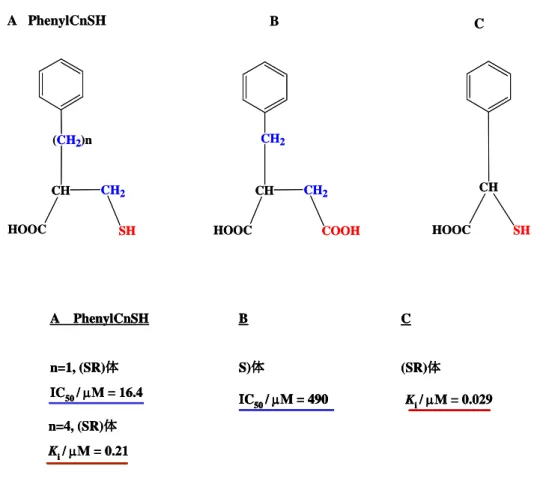
2002年、Parkらは単核Zn(II)酵素であるCarboxypeptidase A (CPA) について、分 子内にチオールとカルボキシル基を有する阻害剤PhenylCnSH (n = 1-4)の合成 とCPAに対する阻害作用について報告した69)。Table 1 からも明らかなように PhenylC1SH (n = 1)は阻害定数Ki = 0.01 µMであり、CPAについて最も強い阻害が 見られ、一方n = 3と4ではほぼ同じ阻害能を有することがわかる。
Table 1. Inhibitory constants (Ki Values) of PhenylCnSH (n = 1-4) for CPA inhibition.
CO2H R
HS
Compound R Ki (µM)
PhenylC1SH phenyl 0.010
PhenylC2SH benzyl 2.1
PhenylC3SH phenylethyl 1.35
本研究では、複核のZn(II)酵素であるIMP-1とVIM-2に対しもPhenylCnSH (n = 1-4)が阻害活性を示し、さらにメチレンの数に依存した阻害活性能を調整でき ると考えた。そこでメチル基の数に及ぼす阻害活性の相関を明らかにすることを 目的した(Fig. 6)。
CH (CH2)n
H2C SH
COOH 疎水性 Zn
相互作用
静電的 適当な長さ 相互作用
CH (CH2)n
H2C SH
COOH
Zn 疎水性 Zn
相互作用 疎水性 相互作用
静電的 相互作用 静電的 適当な長さ 相互作用
Fig. 6. Expectation of interaction between PhenylCnSH with VIM-2 and IMP-1.
2003年に、KurosakiらはIMP-1 に対する新規蛍光剤として、DansylC2SH (n = 2)
はIMP-1に結合すると蛍光強度が増大し、かつ阻害することを報告した46)。
そこで、蛍光発色団のダンシル基をキノリン基に変え、キノリン基とチオー ル基間をメチレン鎖で架橋した新規蛍光剤QuinolineCnSH (n = 2-6)を合成し、
IMP-1 および VIM-2 について蛍光スペクトルならびに阻害活性について検討を
行った。
Fig. 7. Chemical structures of inhibitors
第2節 結果
第1項 IMP-1 とVIM-2 に 対 す る 阻 害 剤(PhenylCnSH、DansylC2SH、 QuinolineCnSH)のIC50(50%有効抑制濃度)と阻害定数Kiの決定
基 質 と し て ニ ト ロ セ フ ィ ン を 用 い 、 各 阻 害 剤[PhenylCnSH (n = 1-4)、 DansylC2SH、QuinolineCnSH (n = 2-6)]存 在 下 に お け る 見 か け の 分 子 活 性 (k2/min-1 = vint/[E]t)を初速度法から求めそれを阻害剤濃度に対してプロットした。
例としてIMP-1およびVIM-2に対するPhenylC3SH (n = 3)の濃度-見かけの分子 活性k2/min-1プロットをそれぞれFig. 8左およびFig. 8右に示した。IMP-1とVIM-2 に対するIC50(酵素活性を50%阻害する濃度)は図から算出した。阻害定数Kiは(4) 式(実験項P89)の拮抗阻害を用い非線形最小二乗法により求めた。
min-1k2 /min-1k2 /
[PhenylC3SH]/µM
0 100 200 300 400 500 0
5000 20000 15000 10000 25000 30000 35000
[PhenylC3SH]/ M 5000
10000 15000 20000 25000
0 0 100 200 300 400 500 30000
min-1k2 /
[PhenylC3SH]/µM 5000
10000 15000 20000 25000
0 0 100 200 300 400 500 30000
min-1k2 /min-1k2 /
0 20 40 60 80 100 0
5000 10000 15000 20000 25000 30000 35000
IMP-1
0 20 40 60 80 100 0
5000 10000 15000 20000 25000 30000 35000
IMP-1
0 5000 10000 15000 20000 25000 30000
0 2 4 6 8 10
VIM-2
0 5000 10000 15000 20000 25000 30000
0 2 4 6 8 10
VIM-2
0 5000 10000 15000 20000 25000 30000
0 2 4 6 8 10
VIM-2
IC50
IC50
min-1k2 /min-1k2 /
[PhenylC3SH]/µM
0 100 200 300 400 500 0
5000 20000 15000 10000 25000 30000 35000
[PhenylC3SH]/ M 5000
10000 15000 20000 25000
0 0 100 200 300 400 500 30000
min-1k2 /
[PhenylC3SH]/µM 5000
10000 15000 20000 25000
0 0 100 200 300 400 500 30000
min-1k2 /min-1k2 /
0 20 40 60 80 100 0
5000 10000 15000 20000 25000 30000 35000
IMP-1
0 20 40 60 80 100 0
5000 10000 15000 20000 25000 30000 35000
IMP-1
0 5000 10000 15000 20000 25000 30000
0 2 4 6 8 10
VIM-2
0 5000 10000 15000 20000 25000 30000
0 2 4 6 8 10
VIM-2
0 5000 10000 15000 20000 25000 30000
0 2 4 6 8 10
VIM-2
min-1k2 /min-1k2 /
[PhenylC3SH]/µM
0 100 200 300 400 500 0
5000 20000 15000 10000 25000 30000 35000
min-1k2 /min-1k2 /
[PhenylC3SH]/µM
0 100 200 300 400 500 0
5000 20000 15000 10000 25000 30000 35000
[PhenylC3SH]/ M 5000
10000 15000 20000 25000
0 0 100 200 300 400 [PhenylC3SH]/ M 5000
10000 15000 20000 25000
0 0 100 200 300 400 500 30000
min-1k2 /
500 30000
min-1k2 /
[PhenylC3SH]/µM 5000
10000 15000 20000 25000
0 0 100 200 300 400 500 30000
min-1k2 /min-1k2 /
[PhenylC3SH]/µM 5000
10000 15000 20000 25000
0 0 100 200 300 400 500 30000
min-1k2 /min-1k2 /
0 20 40 60 80 100 0
5000 10000 15000 20000 25000 30000 35000
IMP-1
0 20 40 60 80 100 0
5000 10000 15000 20000 25000 30000 35000
IMP-1
0 20 40 60 80 100 0
5000 10000 15000 20000 25000 30000 35000
IMP-1
0 5000 10000 15000 20000 25000 30000
0 2 4 6 8 10
VIM-2
0 20 40 60 80 100 0
5000 10000 15000 20000 25000 30000 35000
IMP-1
0 5000 10000 15000 20000 25000 30000
0 2 4 6 8 10
VIM-2
0 5000 10000 15000 20000 25000 30000
0 2 4 6 8 10
VIM-2
0 5000 10000 15000 20000 25000 30000
0 2 4 6 8 10
VIM-2
0 5000 10000 15000 20000 25000 30000
0 2 4 6 8 10
VIM-2
0 5000 10000 15000 20000 25000 30000
0 2 4 6 8 10
VIM-2
IC50
IC50
Fig. 8. Typical plots of molar activity of IMP-1 (left) and VIM-2 (right) against the concentration of PhenylC3SH. Each point represents the mean value of three
第2項 PhenylCnSH (n = 1-4)による阻害の検討
単核Zn(II)酵素Carboxypeptidase A (CPA)のチオール阻害剤PhenylCnSH(n = 1-
4)はParkらの合成法69)に従い調製した。IMP-1とVIM-2に対する阻害能を調べた。
IMP-1とVIM-2に対するそれぞれのIC50と阻害定数KiをTable 2に示した。
IMP-1 に対するPhenylCnSHのIC50ならびに阻害定数Kiはそれぞれ 1.2 µM (PhenylC4SH)-16.4 µM (PhenylC1SH)、0.20 µM (PhenylC4SH)-2.78 µM
(PhenylC1SH)の範囲にあることがわかった。架橋しているメチレン基の数を変化
すると、その中で、PhenylC4SH (n = 4)がPhenylCnSHの中でIMP-1の活性を最も 強く阻害することがわかった。以前報告された 3-メルカプトプロピオン酸は IMP-1に対して阻害定数Ki = 1.2 µMである39)。これと比べるとPhenylC4SH (n = 4) は有効な阻害剤として働くことがわかった。
Table 2. IC50 and Ki values for PhenylCnSH (n = 1-4) and QuinolineCnSH (n = 2-6) to IMP-1 and VIM-2.
IC50 / µM Ki / nM Inhibitors
IMP-1 VIM-2 IMP-1 VIM-2
PhenylC1SH 16.4 14.3 2780 ± 210 2360 ± 240 PhenylC2SH 7.4 2.6 1320 ± 150 460 ± 79 PhenylC3SH 9.7 1.3 1660 ± 200 220 ± 23 PhenylC4SH 1.2 1.1 210 ± 25 190 ± 16 QuinolineC2SH
QuinolineC3SH QuinolineC4SH QuinolineC5SH QuinolineC6SH
14.2 6.6 2.5 6.7 3.4
6.3 6.5 2.4 7.6 4.9
2970 ± 440 1350 ± 240 440 ± 15 1310 ± 220
610 ± 80
1190 ± 200 1210 ± 58
420 ± 54 1390 ± 54
940 ± 90
一方、VIM-2 対するPhenylCnSHのIC50ならびに阻害定数Kiはそれぞれ 1.1 µM (PhenylC4SH)-14.3 µM (PhenylC1SH)、0.19 µM (PhenylC4SH)-2.36 µM
(PhenylC1SH)の範囲にあることがわかった。このことからVIM-2に対しも、IMP-1
の場合と、PhenylCnSH (n = 1-4)は有効な阻害剤として働くことがわかった。架 橋しているメチレン基の数を変化させると、PhenylCnSHの中でPhenylC3SH (n = 3)とPhenylC4SH (n = 4)はVIM-2の活性を最も強く阻害し、両者の阻害活性はほ ぼ同程度であることがわかった。
1 2 3 4
0 3000 2500 2000 1500 1000 500
PhenylCnSH Ki
VIM-2 IMP-1
/nM
1 2 3 4
0 3000 2500 2000 1500 1000 500
PhenylCnSH Ki
VIM-2 IMP-1
/nM
QuinolineCnSH 500
0 2 3 4 5 6
2500 2000 1500 1000 3000 3500
nMKi/
VIM-2 IMP-1
QuinolineCnSH 500
0 2 3 4 5 6
2500 2000 1500 1000 3000 3500
nMKi/
QuinolineCnSH 500
0 2 3 4 5 6
2500 2000 1500 1000 3000 3500
nMKi/
VIM-2 IMP-1 VIM-2 IMP-1
Fig. 9. Variation of inhibition constants of IMP-1 and VIM-2 with n, for PhenylCnSH (left) and QuinolineCnSH (right).
PhenylCnSHとIMP-1ならびにVIM-2との各々の阻害定数Kiを比較した(Fig. 9)。
Fig. 9からもわかるようにPhenylCnSH (n = 1-4)がIMP-1とVIM-2の両方に阻害 作用を示すことが明らかとなった。しかしながらメチレン基の数に対する阻害 効果はIMP-1とVIM-2では異なることがわかった。PhenylC4SHはIMP-1とVIM-2 を最も強く阻害し、一方PhenylC1SHはIMP-1 とVIM-2 を最も弱く阻害した。
VIM-2において、メチレン基の数がn = 4の時と同様にn = 2と3の場合でも、