博士学位論文(東京外国語大学)
Doctoral Thesis (Tokyo University of Foreign Studies)
氏 名 Purna Bahadur Karki 学位の種類 博士(学術)
学位記番号 博甲第227号 学位授与の日付 2017年5月24日 学位授与大学 東京外国語大学
博士学位論文題目 Post-war instability and Human Security in Nepal
Name Purna Bahadur Karki
Name of Degree Doctor of Philosophy (Humanities)
Degree Number Ko-no. 227
Date May 24, 2017
Grantor Tokyo University of Foreign Studies, JAPAN
Title of Doctoral Thesis
Post-war instability and Human Security in Nepal
POST-WAR INSTABILITY AND HUMAN SECURITY IN NEPAL
By
KARKI, Purna Bahadur Supervisor: Prof. FUJII, Takeshi
An Academic Dissertation
Submitted to the Tokyo University of Foreign Studies in Partial Fulfillment of the Requirement for the Degree
of Doctor of Philosophy
Doctoral Program of Graduate School of Global Studies Tokyo University of Foreign Studies
December 2016
1
Table of Contents
Acknowledgments ... 3
List of Abbreviations... 5
Glossary of Nepali Terms ... 8
Introduction ... 9
0.1 Background of the Study ... 9
0.2 Academic Significance of the Study ... 13
0.3 Overview of the Methodology ... 15
0.4 Theoretical Frameworks of Peace Building ... 17
0.5 Outline of the Forthcoming Chapters ... 20
Chapter 1: Country Profile of Nepal ... 23
1.1 Geographical and Administrative Divisions of Nepal ... 23
1.2 Historical Overview of Nepal and Its Conflicts ... 24
1.3 Land Ownership and People ... 30
1.4 Economic Overview of Nepal During the Insurgency ... 31
1.5 Political Development of the Post Conflict ... 35
Chapter 2: Literature Review ... 39
2.1 Introduction ... 39
2.2 Post-Conflict Situation of Nepal ... 41
2.3 Root Causes of the Conflict ... 43
2.4 Background of Nepali Political Parties ... 53
2.4.1 Political Behavior and Leadership ... 57
2.4.2 Democratization in Nepal ... 60
2.4.3 Political Parties and People ... 66
2.4.4 Development of Political Parties ... 72
2.4.5 Prospects for Nepali Politics ... 76
2.4.6 Social Structure ... 82
2.5 Conclusion ... 86
Chapter3: The Maoist Insurgency and Conflict Resolution ... 94
3.1 History of the Maoist Party ... 94
3.2 Preparation for the Maoist People’s War ... 95
3.3 The Maoist Insurgency ... 99
3.4 Stakeholder Analysis ... 110
3.5 Ongoing Conflicts in Nepal ... 118
3.6 Management of the Ongoing Conflicts in Nepal ... 122
3.7 Armed Conflict and the Peace Process in Nepal ... 125
3.8 Uniqueness of Nepal’s Peace Process ... 133
3.9 Prospective Solution for the Peace-Building Process ... 136
3.10 The Recent Political Situation (2006-2016) ... 138
3.11 Conclusion ... 143
Chapter 4: Peace Building in Nepal and Data Analysis ... 147
4.1 Peace Building in Nepal ... 147
4.2 Analysis ... 151
4.2.1 Peace Building Assistance Needs ... 151
4.2.2 Capacity Building ... 155
4.2.3 Do Ethnicity and Caste Cause Problems for Peace Building? ... 160
4.2.4 Is Nepal Trapped in Contentious Politics? ... 167
4.2.4.1 The Maoist Movement and its Relation with Indigenous Ethnic People ... 168
4.2.4.2 Identity Politics ... 172
4.2.4.3 Findings ... 176
4.3 Conclusion ... 177
2
4.4 Data Analysis ... 180
4.4.1 Introduction ... 180
4.4.2 Peace-Building Process: Need, Progress and Problems ... 180
4.4.3 Connecting Freedom With Peace Building and Human Security ... 188
4.4.4 Political Leadership Saving Democracy ... 193
4.4.5 Findings ... 196
4.4.6 Recommendations: Minimization of Conflicts and Successful Implementation of Peace Building Process ... 206
4.4.2 Conclusion ... 211
Chapter 5: Human Security in Nepal ... 212
5.1 Human Security ... 212
5.2 Human Security and Peace Building ... 217
5.3. Impacts of the Armed Conflict in Nepal ... 222
5.4 Analysis ... 226
5.5 Conclusion ... 229
Chapter 6: Conclusion of this Study ... 234
Bibliography ... 244
Appendix 1: Questionnaire ... 279
Appendix 2: Questionnaire ... 281
Appendix 3. Chronological events related to the monarchy and politics of Nepal ... 282
Appendix 4: Timeline of political instability after the massacre of the royal family ... 284
Appendix 5: Interviews with stakeholders of Nepal ... 288
Appendix 6: Maoists’40-point demands ... 378
Appendix 7: 12-point understanding reached between the Seven Political Parties and Nepal Communist Party (Maoists) ... 382
Appendix 8:No.of people killed from 1996 to August 2004 (classification by district) ... 385
Appendix 9: Number of people killed during the six years after the CPA ... 386
Appendix 10: Nepal Poverty Map ... 387
Table
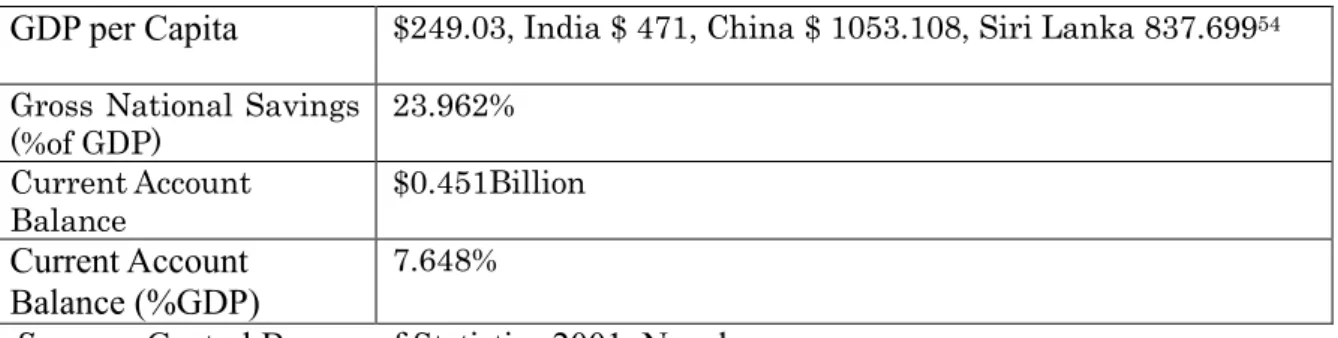
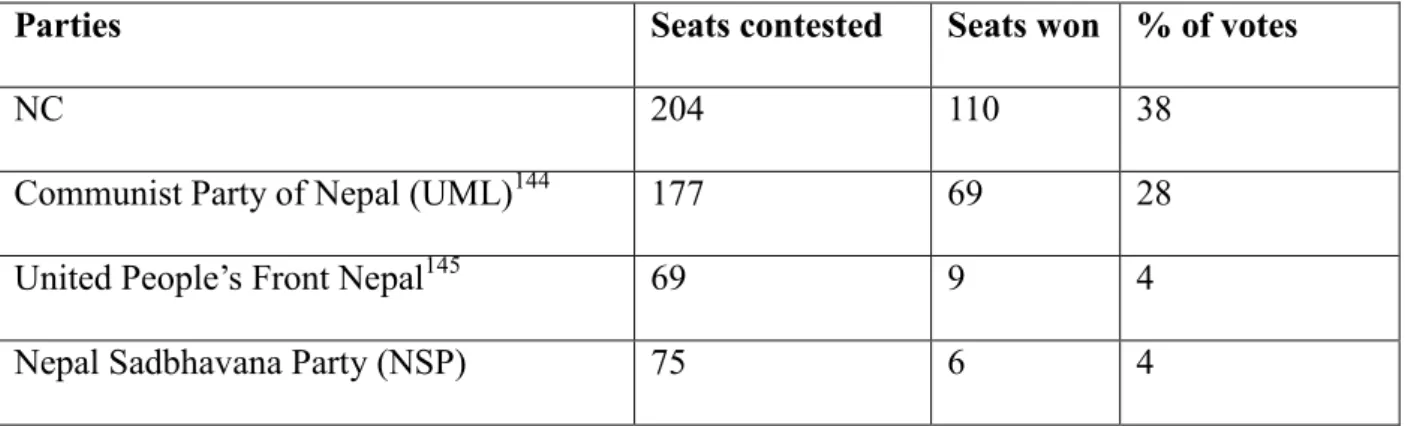
Table 1 Country Profile and Economic Overview of Nepal During the Insurgency in 2001. ... 33Table 2 Results of the 1991 General Election for 205 Seats ... 55
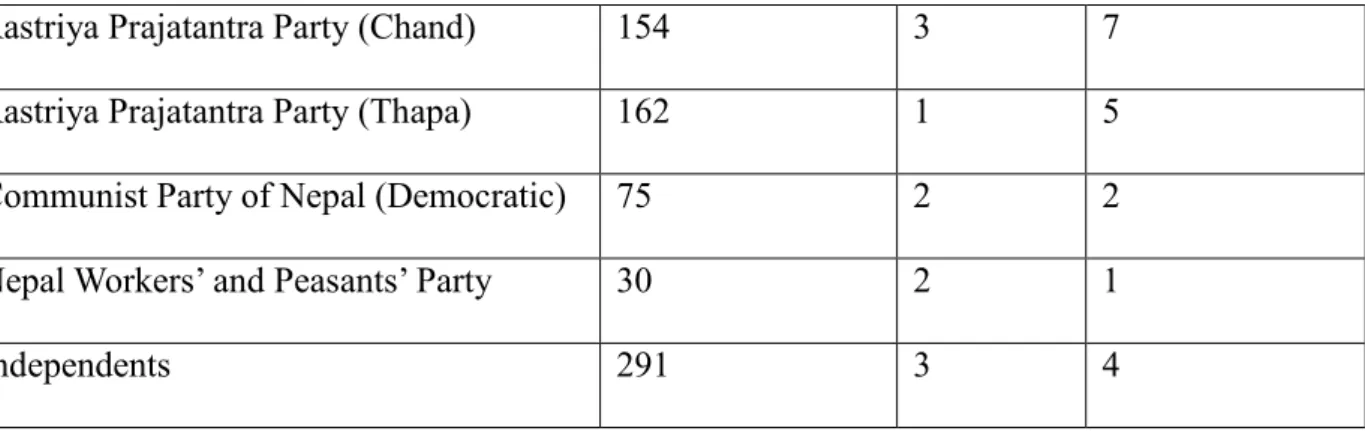
Table 3 Results of the 1994 Mid-Term Poll for 205 Seats ... 56
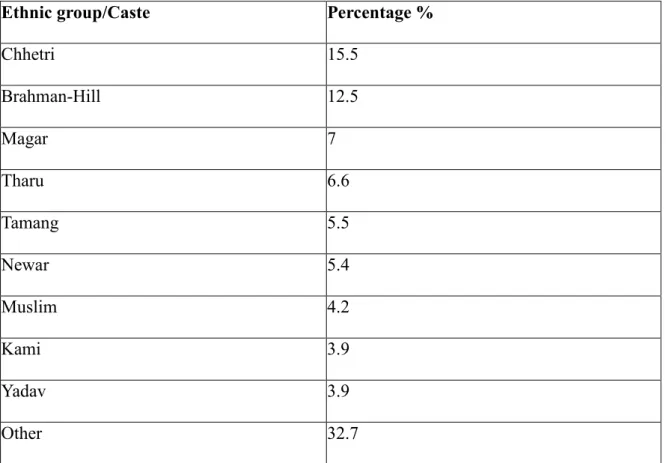
Table 4 Ethnic and Caste Proportions in the Nepali Population ... 84
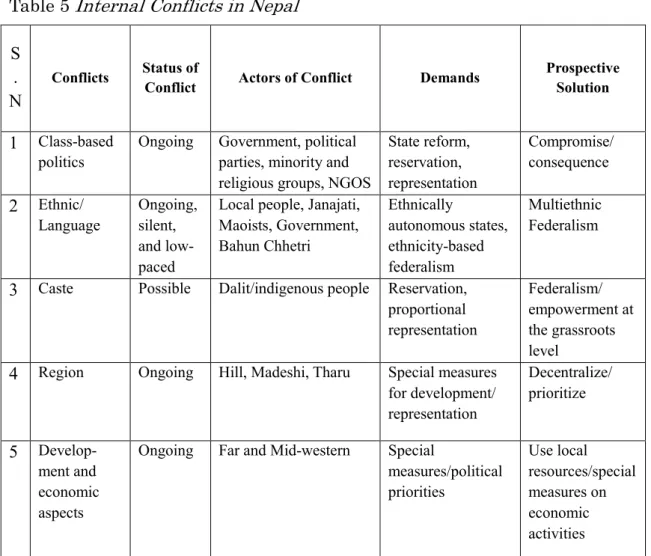
Table 5 Internal Conflicts in Nepal ... 119
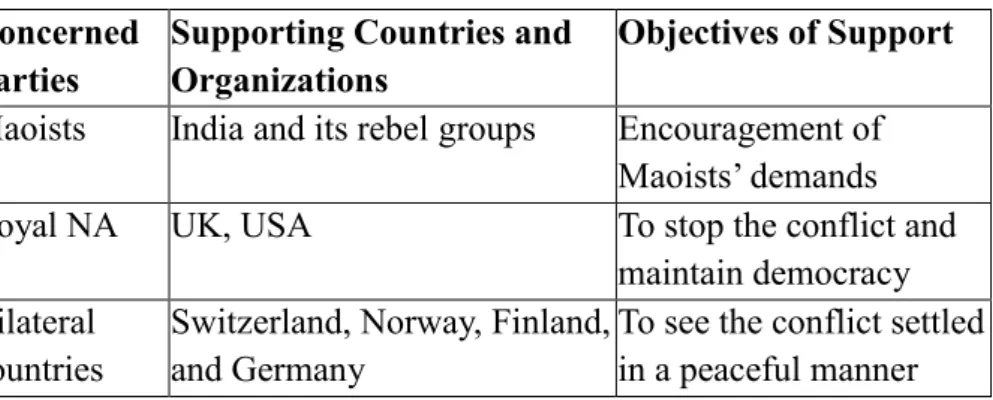
Table 6 Participants and Supporters ... 125
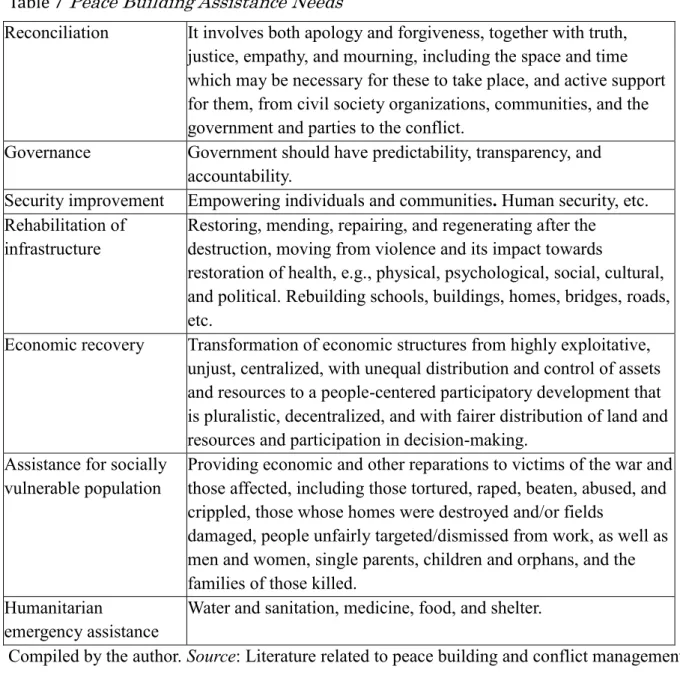
Table 7 Peace Building Assistance Needs ... 152
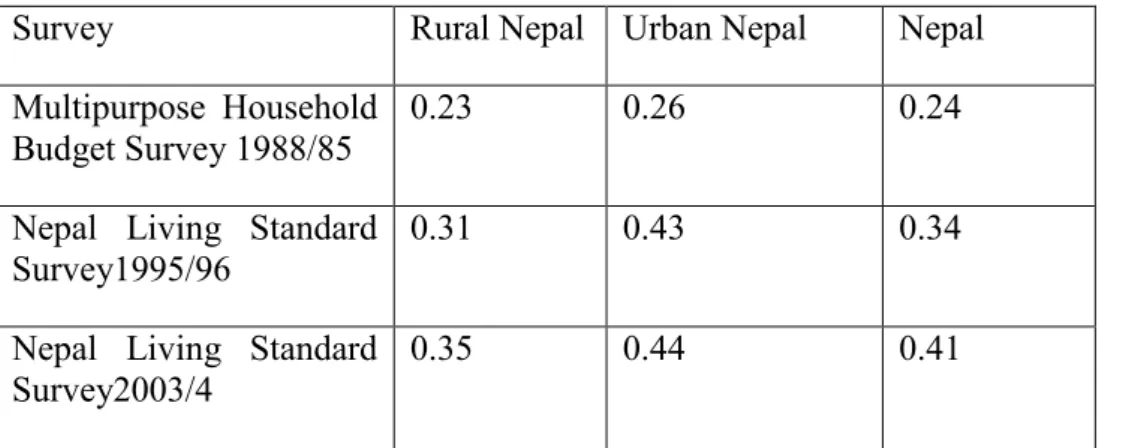
Table 8 Gini Coefficients of Income Distribution Patterns ... 158
Table 9 Ethnicity, Language, and Religion of Nepal’s Population in the 2011 Census ... 163
Table 10 Non-Maoist Violent Conflicts (Riots and Insurgencies) in Nepal, 1990-2006 ... 175
Table 11Contentious Activities of Dalits after 1990 ... 175
Table 12 Sources of Human Insecurity ... 218
Table 13 Armed Conflict Intensity Stages ... 222
Table 14 IDPs Figures Since 2003 ... 223
Figure 1 Country Map of Nepal ... 32
3
Acknowledgments
During my research and writing the present dissertation, I received a great deal of support from a number of people. I would like to express my gratitude to everyone who provided me with valuable comments and suggestions to help lay the foundation of this study.
Throughout the research, I received useful guidelines from, and had active debates with, my supervisor, Professor FUJII Takeshi. Above all, he provided me with the insight to seize the sociopolitical dynamics of the topic. Without his prompt guidance, it would have been impossible for me to achieve this study. His teaching allowed me to gain a method of social scientific analysis, to apply it to my thesis “Post-War Instability and Human Security in Nepal”
and then to conceptualize this study successfully.
I would like to express my heartfelt thanks to Professor HACHIOSHI Makoto, Professor ISHII Hiroshi and Professor Leigh Faulkner, who provided me with sufficient guidelines to complete this work. I have profited from their valuable comments and suggestions to improve my research.
I am deeply grateful to the International Training Program (ITP-AA) for providing me with the opportunity to carry out field studies at the School of Oriental and African Studies
(SOAS), University of London, where I was able to adopt a theoretical and analytical approach to this research. During my stay at SOAS, I received valuable comments and regular guidance from, and had intellectual debates with, my mentor, Dr. Lawrence Saze. His contribution has been invaluable to my research. I would also like to extend my sincere thanks to everyone who assisted me in carrying out interviews during my field research, provided valuable information for this study, and participated actively in discussion during my visit. I must thank Mr. Sanjya Dhoj Bhandari, who continuously assisted me in holding interviews during my stay in the UK.
4
I have been very fortunate to access first-hand information from the Prime Minister and senior leaders of political parties who have played a vital role in the Nepal peace process and national political discourse. I have had a great opportunity to carry out this research by using a qualitative approach. I thank Bhim Nath Regmi, Arjun Parajuli, Nilam Tiwari, Tara Bhusal, Tek Raj Prarsai, and Sanjoy Thapa for their contribution to my field studies in Nepal.
I have also benefited from my friends and the staff at TUFS who either provided active comments for my research or were supportive in other ways, and gave me necessary advice. I am deeply grateful to UMEDA Yumiko, ISHIDA Rie, Mac James, and ADACHI Kyosuke.
I would also like to thank the Rotary Yoneyama Memorial Foundation for providing me with a scholarship that gave me the opportunity to concentrate on my study without any financial hardships. Without their contribution, I could not have accomplished this study.
I appreciate the Fuji Xerox Co., Ltd Setsutaro Kobayashi Memorial Fund for providing me with the grant and generous support to this research.
Last but not least, I am grateful to my family members who have constantly supported me and encouraged me to complete my research, especially my loving sons, Anmol Bahadur Karki and Aavash Bahadur Karki, my daughter Ashima Kumari Karki, my caring wife, my sisters Sita and Rita, and my mother. Without their understanding and support, I could not have achieved this.
KARKI Purna Bahadur December 1, 2016
5
List of Abbreviations
ACCA Association of Chartered Certified Accountants ADB Agricultural Development Bank
ADB Asian Development Bank
BIPPA Bilateral Investment Promotion and Protection Agreement
CA Constituent Assembly
CBS Central Bureau of Statistics CHR Commission on Human Rights CIA Central Intelligence Agency CPA Comprehensive Peace Accord CPN Communist Party of Nepal
CPN (M) Communist Party of Nepal (Maoist) CPN (UC) Communist Party of Nepal (Unity Centre)
CPNUML Communist Party of Nepal United Marxist and Leninist CSWC Community Study and Welfare Centre
CWB Child Welfare Board
CWNCC Child Workers in Nepal Concerned Center
EC European Commission
FPP First-past-the-post
GDO German Development Organization
(Deutsche Gesellschaft für Technische Zusammenarbeit) GDP Gross Domestic Product
GNIPC Gross National Income Per Capita GNP Gross National Product
HDI Human Development Index
6
HDR Human Development Report HMG His Majesty’s Government HR House of Representatives ICG International Crisis Group
IDMC Internal Displacement Monitoring Centre IDPs Internally Displaced Persons
IIDEA The International Institute for Democracy and Electoral Assistance ILO International Labour Organization
INF International Nepal Fellowship
INGO International Non-Governmental Organization ISSC Informal Sector Service Centre
JTMM Janatantric Tarai Mukti Morcha KNF Khambhuwan National Front
ML Marxist-Leninist
MNO Mongol National Organisation MPs Members of Parliament
MPRF Madeshi People’s Rights Forum MRD Movement for Restoring Democracy
NA Nepalese Army
NC Nepali Congress
NDO Netherlands Development Organization NGO Non-Governmental Organization NMVA Nepal Maoists Victims’ Association NRN Non-Resident Nepali
NSP Nepal Sadbhavana Party
7
OHCHRUN Office of the High Commissioner for Human Rights of the United Nations PLA People’s Liberation Army
PM Prime Minster
PWG People’s War Group
RPPN Rashtriya Prajatantra Party Nepal RRN Rural Reconstruction Nepal RUPP Rural Urban Partnership Program
SC Supreme Court
SCA Save the Children Alliance
SE State of Emergency
SPA Seven Party Alliance
TMDP Terai Madhes Democratic Party TRC Truth and Reconciliation Commission ULF United Left Front
UMLP United Marxist and Leninist Party UN United Nations
UNDP United Nations Development Programme
UNESCO United Nations Educational, Scientific and Cultural Organization UNHCR United Nations High Commissioner for Refugees
UNOCHA United Nations Office for the Coordination of Humanitarian Affairs UNPFN United Nations Population Fund Nepal
UNPMN United Nations Political Mission in Nepal UPFN United People’s Front of Nepal
VDC Village Development Committee
8
Glossary of Nepali Terms
banda shutdown
Bidhaika Samsad Legislative Parliament
chaka jam blockade of vehicles/buses, etc. during strikes Jana Andolan, 1990s People’s Movement, 1990s
Jana Andolan II Popular Mass Movement II
jaljala shrine
Nepali Nepalese
Nepalko Jatiya Prashna Ethnic Question of Nepal Pratinidhi Sabha House of Representatives
Samsad Parliament
Rashtriya Sabha Upper House
Sija Sisne Peak
9
Introduction 0.1 Background of the Study
The conflict in Nepal started in 1996, when the Maoists proclaimed the so-called People’s War and launched an armed insurgency against the monarchy. The United People’s Front of Nepal (UPFN) launched a people’s war in 1996. This war was responsible for violence in the 50 districts of Nepal. The revolt by the civilians witnessed atrocities, such as mass killing, bloodshed, bombing in the country and extortion. The Maoists also attacked the Nepali Government, and many strikes were carried out nation-wide. This insurgency was ignited by such leaders as Pushpa Kamal Dahal (a.k.a. "Prachanda") and Baburam Bhattarai, and is also considered as "People's War", i.e., a self-declared Maoist insurgency.1 On February 13, the CPN (M) attacked four districts in the country and declared an armed uprising against the feudal government of Nepal, with the aim of establishing a People’s Republic of Nepal, based on Marxism, Leninism, and Maoism. Thapa and Sijapati state,
[A]t about 3.45 pm a group of people, both men and women, took possession, almost without any resistance, of the office of Small Farmer’s Development, Development Bank in Chyangli, in Gorkha district in Central Nepal… The same day in the evening three police outposts, one each in Rolpa and Rukum in western Nepal and one in Sindhuli in eastern Nepal, were seized by armed youths shouting Marxist-Leninist and Maoist slogans.2
Since its inception, the Communist Party of Nepal (Maoist) CPN (M) had vowed to aid the long-ignored and deprived people of Nepal. Therefore, the Maoist insurgency was therefore deeply rooted in the rural areas that constituted the major parts of the country. The
1 Pike, J. "Nepal Insurgency- 1996." Globalsecurity.org. 2015.
http://www.globalsecurity.org/military/world/war/nepal_insurgency-1996.htm. Accessed September 15, 2015.
2 Thapa and Sijapati, A Kingdom under Siege: Nepal’s Maoist insurgency, 1996 to 2003, 49.
10
CPN (M) forced women and children to join the party and united the isolated youth of the rural mid-western region. By November, 2001, it had captured 30 districts, and, after the breakdown of the ceasefire on 23 November, 2001, the insurgency affected the entire country.
After the declaration of a state of emergency in 2001, the military were mobilized to control the rebellion. Later, the Maoists started looting, destroying public property and killing political figures. The increasing acts of violence greatly affected the daily lives of the general populace. In the next year, 2002, the Maoists increased their level of attack on the civilians.
Their atrocities increased, culminating in the killing of 170 police and army troops, and they shut down the country when they called a two-day strike on February, 2002.This violence took the form of full warfare and, as such, invited the government's immediate attention.
Thereafter, the Maoists put forward the following three demands: (1) Nepal should be freed from the monarchy; (2) a newly formed Constituent Assembly (CA) should write a new constitution for Nepal; (3) the current government should resign so that an all-party interim government could manage the CA elections. As was expected, the government rejected all of these demands and told the Maoists to end the violence that they had practiced in Nepal. The Maoists, however, got exasperated at this demand of the government and broke the ceasefire by resuming their attacks.3 This could be observed directly in frequent boycotts of economy- driving activities. The so-called People’s War claimed the lives of more than 12,000 people (including women and children) and created thousands of casualties.4 The destruction of vital infrastructure has pushed back the development process of the country by more than a decade, and only recently has it shown signs of recovery.5 Nepal reported increasing cases of
depression, post-traumatic stress disorder and suicide which were supposed to be wholly due
3 Pike, J. "Nepal Insurgency- 1996." Globalsecurity.org. 2015.
http://www.globalsecurity.org/military/world/war/nepal_insurgency-1996.htm. Accessed September 15, 2015.
4 The Informal Sector Service Centre (INSEC), 2010, victim report.
http://www.insec.org.np/victim/reports/total.pdf. Accessed on September 20, 2011.
5 The conflict ended with the signing of the CPA on November 21, 2006, between the government and the rebels.
11
to the war. The health experts estimated an upsurge of 30% in mental health problems of Nepali people.6
Furthermore, the Nepali Government’s response to the victims was seriously inadequate.
Offenders continued to enjoy immunity from prosecution for violations of human rights. It was almost impossible for victims to seek justice. In light of the foregoing, the present research examines the human security7 inputs into Nepal that may enhance freedom through capability building. Furthermore, education, health, economic income, and social inclusion are among the other necessary aspects in the peace-building process. However, there have been few attempts to look on these aspects as factors enhancing the freedom of the people, which has been greatly hampered by the insurgency. Under such conditions, I would like to clarify the following three questions:
Why does Nepal need peace building?
(N.B. The first question will be addressed in great detail in Chapter 3.)
Who are the main actors involved in delineating the potential connection between freedom and peace building?
(N.B. The second question will be discussed extensively in Chapter 4.)
What are possible inputs from the discipline of human security that might enhance freedom?
(N.B. The third question will be dealt with in Chapter 5.)
My hypothesis is that post-war8 political instability affects human security. An analysis of the existing literature and scholarly discussions reveals that scholars believe that the political
6 "Mental Health in Nepal; A Psychiatric’s Views,." Health, Science, and Technology in Nepal. February 1, 2008. Accessed September 17, 2015.
7 Human Security: freedom from fear and freedom from wants. It includes human rights, human needs, human development, as well as security, and it should be of the individual rather than the state. Further, the essential components of human security are economic security, food security, health security, political security and community security.
8 The Nepal Maoist decade war between the Nepali Government and CPN (M) formally ended with a peace agreement in November, 2006. Thereafter, the postwar period started.
12
discourse and the democratization process in Nepal since 1991, and even post-1990s, have resulted in different outcomes for the Nepali people and for the country’s political system.
According to Dev Raj Dahal,
Nepal’s political institutions had rested on the commitment to popular sovereignty, parliamentary supremacy, and political openness. But the political process of Nepal revolves around powerful personalities rather than institutions. The familial and dynastic succession of leadership has bred a patrimonial culture.9
Poor political institutionalization has blurred the boundaries between institutions.
According to Robert A. Scalapino,
Political institutionalization is the process whereby a political structure is made operational in accordance with stipulated rules and procedures, enabling more regularized, hence predictable, patterns of political behavior, minimum trauma in power transfer, and a foundation for the effective development of policies as well as the application of justice.10
Dahal mentions, furthermore, that the government gave up policy making in favor of market forces. The withdrawal of the state from society created a vacuum of security and authority and the onset of the People's War.11 In the middle of April, 2006, mass movements against the king led to the curtailment of the power of monarchy, and Nepal became a federal democratic republic. Despite the change of regimes, however, the behavior of political parties and the functioning of the state were largely unchanged. Thus, to rebuild the state, Nepali political parties and the government needed to address the post-conflict issues and cope with
9 Dahal, National Security, Security Sector Reforms and Civil-Security Relations in Nepal, 2.
http://www.nepaldemocracy.org/civic_education/Civil-Military%20relations.pdf. Accessed on September 20, 2011.
10 Scalapino, “Legitimacy and Institutionalization,” 59.
11 Dahal, National Security, Security Sector Reforms and Civil-Security Relations in Nepal, 3.
http://www.nepaldemocracy.org/civic_education/Civil-Military%20relations.pdf Accessed on September 20, 2011.
13
the problems of society by raising the quality of leadership and curbing the irresponsibility of constitutional actors. To date, Nepal has attempted to establish a democratic system, but the concept has yet to be put into practice on account of a lack of political will. Therefore, to stabilize Nepali politics and to safeguard its economic prospects, the root causes of the country’s instability should be addressed through a holistic approach and from the angle of human security so that the nation can realize a definite change.
0.2 Academic Significance of the Study
In this dissertation, I would like to provide a practical model for peace building to help resolve the ongoing conflict in Nepal. One basic reason for the insurgency was the inadequate development of Nepal. Due to the complex geography, Nepal needed to spend a huge amount of money on the development of infrastructure so as to develop the country equally, but in fact it failed to achieve that national goal. Similarly, the caste hierarchy has been a problem.
Except for the higher caste people, the others felt dominated and the government could not address the public concern effectively. These two principal issues led the people to experience political marginalization and created economic inequality and ideological differences that were fundamentally linked to the roles played by different actors. These factors have led me to adopt a rights-based approach. Indeed, there are different models for mediating conflicts throughout the world. However, the Nepali peace process follows its own unique path, which may be applied to conflicts elsewhere in the world in the future for similar types of conflict.
Only in this respect do the findings of this study have a potential application beyond Nepal.
The focus of this approach is the management or resolution of the conflict for the
transformation of the state apparatus to achieve acomprehensive political system. Jhala Nath Khanal, President of CPNUML, has informed me that we are in the last stage of the peace process, that I am doing my thesis on this very issue, and that as long as the peace process of Nepal gets to a logical end, my thesis will definitely get completed. If my document becomes
14
a part of this peace process, it would be more logical and convincing in this regard.12
Furthermore, a well-established theory of human security can contribute to understanding the merit of linkage between human freedom and peace building. In this research, I intend to explore the relationship between peace building and the broader concept of freedom by examining the roles and actors toward Nepalese determination. There are several reports which have claimed that peace building is necessary not only in post-conflict countries but also in countries in active conflict. No systematic study has yet been undertaken to find a linkage between peace building and the perspectives of human security paradigms, especially with regard to Nepal. The present research intends to test the idea that peace building is not a final target for the Nepalese, but rather a necessary mechanism toward enhancing their freedom. Further, this research intends to shift our current understanding of peace building from a theoretical to a practical one.
This study analyzes the concrete situation of Nepal and Nepali society from a
developmental and human security perspective. Nepali society could be considered to be still in the stage of the pre-twenty-first century in its development, with people lacking the most fundamental necessities and comforts. Baburam Bhattarai accepts that
Most of the Nepali people living in rural areas practice very primitive and subsistence farming and the majority of the populace are poor, unemployed, and socially excluded.
People continue to face gender, caste, and regional discrimination.13
Without a drastic shift of Nepalese society from its old hierarchy to a new sociopolitical structure, no sustainable peace would be possible. Therefore, this study focuses on finding the root causes of past violence in Nepal and identifies a solution definitively.
In the Nepalese context, this may be the first research into establishing a relation between peace building and enhancing freedom. Herein, freedom refers to the manner in which human
12 Jhal Nath Khanal, answer to a question. See Appendix 5, 315.
13 Baburam Bhattarai, answer to a question. See Appendix 5, 317.
15
security enhances the capacity of people to develop their potential and live in dignity, free from poverty and despair. In other words, the fundamentals of human life are freedom from fear, freedom from want and freedom to live in dignity.
Geographically, Nepal lies between two large Asian countries i.e. China and India, and we must consider their own vested interests in this Himalayan country in addition to the interests of Nepali politicians and the common people. The volatile situation in Nepal will have a direct impact on the two adjoining countries. Sustainable peace in Nepal will be possible only when there is a peaceful power balance between the neighboring countries. The findings in these areas will be a great stimulus for further research. Another innovative aspect of this study is that it attempts to establish an analytical link between the people’s
determination and the role played by different actors.
0.3 Overview of the Methodology
In this research, a number of methods were used to access data and information. However, more emphasis was given to qualitative aspects, such as field surveys and deskwork, for which two major research tools – questionnaires and interviews – were used. In addition, secondary data was collected through an extensive literature review and a systematic comparison. In order to understand Nepal’s contemporary discourse and politico-economic and societal contexts, the social components were examined and then oral history was
recorded. Further, discussions were held with the relevant political actors, leaders of political parties, and leaders of civil society so as to comprehend societal views and ideas.
The questionnaires in Appendices 1 and 2 were analyzed in detail to evaluate Nepal’s peace process and political development during and after the conflict. Interviews were conducted about the current political discourse with Nepali political actors, including leaders of political parties, the Nepali Prime Minister, rebellion leaders, experts on the current conflict, the people directly involved in the peace process at the decision-making level, and
16
those more or less involved in the decade of insurgency. These interviews provided me with both a comprehensive understanding of the political situation and the tools to analyze future scenarios in political science as well as to evaluate the process of cause and effect in
particular.
Similarly, Appendices 3 and 4 evaluate the chronological events that have a strong
correlation with the current political development of Nepal. The political instability of Nepal has been evaluated by looking at the timeline from the massacre of the royal family on June 1, 2001, until the present day. Appendix 5 provides interviews with different stakeholders in Nepal, such as the Prime Minister and the other ministers and political leaders, with the aim of understanding the central policy and government views on the Maoist insurgency and the resulting political situation.
In the course of writing this dissertation, I have presented the following research papers to international academic conferences; these are also included in this dissertation.
1) “Enhancing Freedom Through Peace Building: Finding Roles, Actors, and Theories towards Nepalese Determination,”14 at Post-Conflict Peace-Building and Reconstruction in Societies Emerging from Conflict, June 17–18, 2011, Desmond Tutu Centre for War and Peace Studies, Liverpool Hope University, UK.
2) “Nepal Armed Conflict and Peace Process in the Human Rights Perspective,”15
14 This conference was devoted to post-conflict reconstruction of society and focused on peace, conflict, and peace-building issues. My paper was about the Maoist insurgency and its effect on the human and social development of Nepal, and it evaluated the stakeholders of Nepalese polity. Further, this research paper was intended to explore the relationship between peace building and the wide concept of freedoms by examining the roles and actors involved in Nepalese determination. Reports have claimed the prevalence of peace building as a necessary condition in post-conflict countries, or even countries in active conflict, but there appears to be no field study done on Nepal in this respect. The research intends to test the idea that peace building, rather than being the ultimate target for the Nepali people, is a necessary mechanism for enhancing their freedom.
15 This paper highlighted key issues such as human rights, reconciliation, justice, public policy, conflict, and enforcement. The symposium focused on conflict as a broad category, especially in the context of political conflicts, territory, identity, etc. The participants were mostly professors, lecturers, and prominent scholars. I had ample opportunity to engage in discussions with them and get their opinions.
The paper illustrates the Maoist armed conflict in Nepal that began in February, 1996. It also explores negotiation and peace talks and the conflict’s development until the date of the CA election, during which the people’s rights were undermined by both parties – the state and the rebels.
Furthermore, the paper discusses two factors of the Maoist insurgency. One is the civil history and origin of
17
at Human Rights in the Aftermath Graduate Symposium, March 8, 2012, University of California, Davis, California, USA.
3) “Kingship in Nepal: Envisioning Contemporary Perspective,”16 Third Asian
Conference on Arts & Humanities (ACAH) 2012, April 5–8, 2012, Ramada Osaka Hotel, Osaka, Japan.
4) “The Challenge and Prospect of Nepal CA,”17 South Asian Studies Association’s (SASA) Sixth Annual Conference, April 12–23, 2012, Claremont Graduate University, Claremont, California, USA.
The invaluable suggestions, comments, and remarks of many scholars and professors in my field of study, and of political scientists working in related areas, have helped make this research more academic and fruitful and have provided the cutting edge in completing this research.
0.4 Theoretical Frameworks of Peace Building
Wendy Lamoure defines peace building as “strategies designed to promote a secure and
the insurgency and the other is the possible tools for negotiating an ongoing peace process. Aside from this, the paper highlights the human rights issue during the conflict itself as well as the subsequent peace process. It goes on to propose traditional and indigenous approaches for conflict resolution strategies. Through conceptual analysis, its rights-based approach will be more suitable than others for reconciliation in a post-conflict nation, such as Nepal.
Finally, this paper finds the reason for the Communist Movement’s success under the conditions of the twentieth-century Himalayan nation: inequality of the state of the rural economy and the people’s normative understanding of democracy. The state actors failed to address the development activities involved in changing political discourse during the 1990s. Therefore, states should consider the human security perspective for the empowerment of its people.
16This was an interdisciplinary conference featuring scholars from different countries and fields. I presented a paper about the Nepali contemporary political discourse and its long-term effects. This paper is published in Sociology Study Journal, September 2012, vol. 2, no. 9, Serial no. 16, David Publishing Company, USA.
17 This conference was attended by South Asian scholars and researchers, who provided a fascinating
sociopolitical perspective. I received good comments from them and was able to build up a worldwide network of scholars studying South Asia. My paper highlights the challenges and prospects of the Nepal CA. It evaluates the members’ activities in the peace process, in which Maoist guerrillas moved “from bullet to ballot.”
Immediately after its election on April 10, 2008, the Assembly was tasked with writing a new constitution within two years, but failed to meet this deadline despite it being extended several times. Under these circumstances, people are losing patience. Given such a dilemma, informed by intra-party conflict, is the reconstruction of the state possible? Can a new constitution bring peace to Nepal? These two central questions are addressed in this paper. I also analyze the nature and actions of the Assembly itself from both legal and social perspectives. Finally, this research suggests that the CA has lost the people’s mandate, but it is still functioning due to special circumstances. The larger contexts of the 1990 constitution and the recent
development activities of the Assembly members indicate the possibility of a severe conflict in Nepal in the near future.
18
stable lasting peace in which the basic human needs of the population are met and violent conflicts do not recur.”18 Earl Conteh-Morgan proposes a constructive approach of peace building as society building.19 Rebecca Spence argues that post-conflict peace building requires an understanding of the root causes of conflicts. Conflict management and
transformation literature reveal that most approaches dealing with conflict are not based on any explicit theoretical concept. In Theories and Alternative Dispute Resolution Scimecca mentions a contradiction that “there is…no real theoretical justification for when and why to use conflict intervention techniques.”20
Since World War II, there have been 228 conflicts in 148 locations around the globe. Of these, 30 to 42 were estimated to have been armed conflicts until 2004.21 Moreover,
according to Peace Women22, in 2006, 193 countries and 46 nations were experiencing some form of conflict either internally or with the neighboring countries. About 33 percent, or 15, of these countries are in Africa.23 By the turn of the twenty-first century, any event in the world had the potential to pose a threat at local, regional, and global levels and to ultimately affect the political and economic aspects of these countries and regions.
Most of the existing literature has been based on experiences at international and national levels and is focused on conflicts over either natural resources or ethnic issues. The conflict in Nepal was driven by political and social inequality, with neglect of institutions
undermining human rights and human security. The system of highly centralized wealth and
18 Lambourne, “Post Conflict Peace Building”, 3.
19 Conteh-Morgan, “Peace Building and Human Security,” 75–6. “The task of peace building should, first and foremost, be to eliminate the mind-set that compelled people to distrust and question their socio-political and psychological environment. The emphasis should be on combating the structural and cultural sources of insecurity—harmful actions and results linked to new modes of thinking and cognition on society at large. This means engaging in resocialization in order to strengthen commonly held traditional ideas and understanding of political an[d] social life.”
20 Scimecca, “Theory and Alternative Dispute Resolution”, 211.
21 Paffenholz and Spurk, “Civil Society, Civic Engagement,” 13–4.
22 Peace Women.org is a space for peacemaker to engage, learn and be part of a global movement to advance a holistic Women, Peace and Security Agenda. Source: http://www.peacewomen.org/.
Accessed on April 12, 2013.
23 Kang, McDonald, and Bae, eds., Conflict Resolution and Peace Building, 201.
19
power, initiated by the monarchy, remains a fundamental cause of discontent and potential conflict in Nepal today.Nepal is moving gradually towards a post-conflict environment, but it does so from a structural, cultural and social foundation of deep inequities.
John Paul Lederach, one of the leading scholars in peace building, states that human capacities envision new and dynamic patterns of relationships and engagement pertaining to the concretization of that vision in the world.24 In the pursuit of wide range of social change, peace building draws primarily upon human creativity to transform the unfamiliar,
entrenched patterns of peace into the norm. Thus, peace building is a tool to prevent, reduce, transform, and help people recover from, violence in all forms, even structural violence that has not led to massive civil unrest, according to Lisa Schirch25. It has also been argued that in order to maintain long-lasting peace, the reemergence of violence should be prevented. Peace building is important and it consists of three dimensions. The first dimension addresses the social issues that create the conflict and works on building social, political and economic foundations to achieve stable peace. The second dimension of peace building focuses on relationship building, where the effects of hostility during war and conflict are reduced.
Finally, the third dimension of peace building focuses on the individual level. In the post- conflict situation in Nepal, the eminent fear of violence has subsided; however, the issues still remain unaddressed.26
To stabilize society, it is important to achieve a negotiated settlement of any violent conflict. Thus, to understand the discourse of peace, it is imperative that a conceptual framework should be employed to analyze conflict and peace building in Nepal. There are several different approaches, such as conflict management, dispute settlement, conflict resolution, conflict transformation, conflict transmutation and conflict prevention, that are widely used in peace building. In order to curtail violence and give humanitarian assistance to
24 Lederach, John Paul. The moral imagination: the art and soul of building peace, 29.
25 Schirch, L., The little Book of Strategic Peacebuilding: A vision and framework for peace with justice, 12.
26 Lederach, John Paul. Building peace: sustainable reconciliation in divided societies, 101.
20
victims, it is necessary to hold a political dialogue between the government and the rebel forces. Protection of human rights, ensuring the security of civilians, generating a congenial environment for addressing conflicts, and coordination of internal and external parties to transform the conflict into sustainable peace building are all necessary in conflict-affected regions. Conflict management seeks to prevent the escalation of conflict and reduce the negative effects of conflict in society. Conflict resolution resolves political conflict through a constructive dealing with the problems of conflict. The transformation of the socio-economic foundation of a political society into a new socio-political structure helps in preventing further conflict.
Root causes that need to be addressed can be identified by carrying out an extensive research into the subject of Nepali conflict. This will prevent further violent outbreaks and help achieve a sustainable transformation from armed conflict to peace. By examining different schools of thought on peace building and their different conceptual understandings, it is possible to identify and propose the following approaches:
To minimize further conflicts, a rights-based approach is desirable.
Empower people and civil society through capability building27.
Transform society through the building of infrastructure.
Human security approaches are best for third-world countries like Nepal, because developing countries are vulnerable in terms of social security28. States often fail to provide basic facilities to their people.
0.5 Outline of the Forthcoming Chapters
In addition to this introduction, the present dissertation comprises six more chapters, in
27 Herein, Capability Building means “the empowerment which encompasses the ability, will and skills to initiate, plan, manage, undertake, organize, monitor/supervise and evaluate project activities”. Further, at the individual level, it is "activities which strengthen the knowledge, abilities, skills and behavior of individuals and improve institutional structures and processes such that the organization can efficiently meet its mission and goals in a sustainable way.”
28 Herein, social security means social insurance like medical care, unemployment relief, and so on.
21
which the last chapter presents the conclusion of the whole study.
Chapter 1 explains about the country profile of Nepal. It includes the geographical and administrative divisions of Nepal, the historical overview of Nepal and its conflicts, and the economic and political development.
Chapter 2 focuses on the literature review concerning the main theme of the study. It includes a literature review of the post-conflict situation of Nepal, the root causes of the conflict and its features, and it also discusses the dynamics of state building and the prospects of political behavior, leadership, and democratization of the political parties and people.
Further, it elaborates on the prospects for Nepali politics, the impact of the social structure, and other issues of Nepali politics beyond nationalism.
Chapter 3 covers the Maoist revolution and conflict resolution, and provides an overview of the economy during the insurgency. In addition, it emphasizes the opinions of the
stakeholders and primary actors, and evaluates the approach of the political parties towards the problem. It also covers ongoing conflicts in Nepal and their management for sustainable peace, constitutional development, and aspects of conflict resolution. The role of UNMIN,29 which played a crucial part in Nepal’s peace process, is described.
Chapter 4 includes the peace building in Nepal and the data analysis of field researches. It analyzes the peace building in Nepal and its components, evaluating the problem and
providing the findings. Furthermore, the present study undertakes interviews as a method of qualitative research. These interviews focus on identifying the current state of people in Nepal. The present researcher has employed a thematic analysis in the study to gain a deeper understanding of the issues that are in line with the responses provided by the participants of field researches. The present study analyzes the transcripts critically in order to provide a
29 The United Nations Mission in Nepal (UNMIN) is a special political mission in support of the peace process in the country. It was established in response to a letter sent to the UN Secretary-General on August 9, 2006, in which the then SPA, Government and the CPN (M) requested UN assistance in creating a free and fair
atmosphere for the election of the CA and the entire peace process. Source:http://un.org.np/unmin- archive/?d=about&p=mandate. Accessed on April 12, 2013.
22
conclusion.
Chapter 5 elaborates on human security in Nepal in connection with capability building and empowerment issues to create prevailing peace, and it also analyzes the social and political impacts of the armed conflict.
Chapter 6 concludes the study, focusing on post-war instability and human security in Nepal.
23
Chapter 1: Country Profile of Nepal
1.1 Geographical and Administrative Divisions of Nepal
Nepal is an Asian country and is located between India and China. It has an area of 147,181 sq. km, with an average length from east to west of 885 km and an average width from south to north of 193 km, with a rectangular shape. In comparison to its neighbors, it is 22 times smaller than India and 75 times smaller than China. Nepal shares its border in the east, west, and south with India. To the north, the country is locked by the Tibetan Plateau region, and this makes it more complex due to the mountainous terrain. The nearest access to the sea lies in Indian Territory and is approximately 1,127 km away30.
The altitude of the geographical features of Nepal extend from about 100 m in the southern Terai to 8,848 m in the Himalayas in the north. Thus, Nepal’s physical landscape is sub- divided into Terai, Inner Terai, Hills, and Mountains.31 Terai is a narrow strip that extends from 15 to 40 km in a north-south direction. Terrai is also known as Nepal’s breadbasket.
Nepal has a very fertile landscape in the south, and the south of Nepal shares its border with India, which has helped them strengthen politico-economic relation and strategic links.
In addition to the above details, it is important to note the features of geographical locations of Nepal. In average, Nepal lies between 600 and 3000 m above the sea level. The Hills of Nepal is the prevailing region of the country where the main administrative center of the country is located in Kathmandu, the capital. Also, from an administrative point of view, Nepal has 75 districts, which are further sub-divided into municipalities and village
development committees. In addition to this, there are 14 zones, within which there are four
30 Richard Hodder-Williams, Sarah J. Lloyd, and Keith McLachlan, eds. Land-locked States of Africa and Asia.177.
31 Bhattarai, B. The Nature of Underdevelopment, 28.
24
to five districts; and five more development regions range from north to west, comprising two to three zones each.32 Thus, there are separate headquarters of all the districts, zones, and development regions in Nepal. There is a unique historical and political identity to the capital in that it controls every affair of Nepal and is also considered as the political center of the country.
1.2 Historical Overview of Nepal and Its Conflicts
This study intends to follow the historic conflict analysis of Nepal and its link with enhancing freedoms through peace building – finding roles, actors, and theories toward Nepalese determination. It is pertinent here to briefly review the history and political development of Nepal.
Baburam Bhattarai33 dates the formation of the Nepalese states to the eleventhcentury AD.
He points out,
[A]fter the 11thcentury, large numbers of Hindu people migrated to Nepal from Indian plains in the wake of Moslem invasions there. Their introduction of superior production technology with the attendant social division of labor long stereotyped into hierarchical class and establishment of petty kingdoms through gradual assimilation of indigenous tribal communities in most of the central and western hill regions by the fourteenth and fifteenth centuries marked a qualitative change in class society and emergence of state structure in the larger parts of the territory of Nepal.34
This process increased the detribalization of the traditional state-communities as new states were formed one after another in the different parts of Nepal. From the mid-eighteenth century, Prithvi Narayan Shah began to extend the small territorial state of Gorkha, located in
32 This is according to 1991 Constitution of Nepal but recent political changed draft new Constitution, 2015. It has federal set up and now it under reconstruction and new administration division will be established.
33 Bhattarai, B. The Nature of Underdevelopment, 36.
34 Ibid.
25
the Gandaki region. His unification campaign annexed about 60 petty principalities to form the state of Nepal. The small states of Chaubise Rajya (24 in number) in the Gandaki region, Baise Rajya (22 in number) in the Karnali region, and other states in the Kathmandu Valley and eastern Nepal all lost their independent identities and their peoples became citizens of a unified Nepal. Thapa and Sijapati state that the first stage in the formation of the Nepali nation-state was complete by 1768, when Prithvi Narayan Shah conquered the Kathmandu Valley and shifted his capital there from Gorkha.35
Over a 40-year time span following the death of Prithvi Narayan Shah in 1775, the
territory of Nepal extended all along the foothills of the Himalayas from the “Teesta in east to the Sutlej in the west,”36 an area “nearly twice the size of today’s Nepal.”37
In a two-year war with the British East India Company in 1814–1816, Nepal lost vast areas, including Teesta and Sutlej. The Sugauli Treaty signed between Nepal and the East India Company in 1816 resulted in the present boundaries, from the Mechi River in the east to the Mahakali River in the west. With the presence of a powerful colonial ruler in India, Prithvi Narayan Shah’s descendants were unable to retain firm political control, and high- ranking officials became involved in palace conspiracies that resulted in the assassination of Bahadur Shah, the youngest son of Prithvi Narayan Shah, and the suicide of Bhimsen Thapa, a Nepalese nationalist political reformer.38
In 1846, Prime Minister Fateh Jung Chautaria and General Mathabar Singh Thapa orchestrated a coup that overthrew the political system and made the latter’s nephew, Jung Bahadur Rana, the effective ruler of Nepal, and all prominent officials who opposed him were eliminated in the Kot massacre that same year. In 1847, Jung Bahadur Rana dethroned
35 Thapa and Sijapati, A Kingdom under Siege, 13.
36 Bhattarai, Baburam, The Nature of Underdevelopment, 36.
37 Thapa and Sijapati, A Kingdom under Siege, 13.
38 After his father's death, Bahadur Shah went into self-imposed exile in Bettia, India. After the death of his brother Pratap Singh Shah, he returned to Kathmandu and was killed in jail in 1794. Bhimsen Thapa committed suicide in jail in 1839.
26
King Rajendra and elevated Rajendra’s son Surendra Bikram Shah to the throne.39 Within three years, he had eliminated all his rivals and appointed his brothers and cronies to all the highest positions. Though his rule was effectively a dictatorship, he introduced innovations in the bureaucracy and the judiciary, along with other efforts to modernize Nepal. The Rana dynasty that he initiated in Nepal in 1846 remained in power until 1951.
During the Rana period, the Nepali people attempted to establish political rights and assert their sociopolitical-economic identity. The first political party, Praja Parishad, began its struggle against the Rana regime in 1936, followed by the Nepali Congress (NC) (established on January 25, 1947), the Nepal Democratic Congress (established on August 4,1948), and the Communist Party of Nepal (CPN) (Founded on September 15,1949). By 1951, the last Rana Prime Minister, Mohan Shamsher, faced revolution and entered a coalition with NC.
The revolt of the peasant leader Bhim Datta Panta in western Nepal that year, however, reflected the incomplete nature of this democratic transition. In a very short time, the regime collapsed and a new government was declared, under the premiership of Matrika Koirala.
Nepal then entered a decade-long transitional phase of chronic instability. King Tribhuvan40 had already promised the people an election for the CA. His son Mahendra, who came in power in 1955, declared the king to be the source of all power in the Constitution of the Kingdom of Nepal 1959. Even then, the political parties failed to wage a successful struggle and took part in the general election of 1959. A power struggle between the palace and the cabinet ensued until, finally, in 1961, King Mahendra established the Panchayat system, a party-less form of government that continued until 1990.
39 The Kot massacre took place on September 14, 1846, when Jung Bahadur and his brothers killed about 40 members of the palace armory (the kot) at Kathmandu; they killed other opponents in the Bhandarkhal garden in 1846; and finally in 1847 Jung Bahadur wrested all political power from the king and established a family system that lasted a century. See more: History in dates
http://historyindates.com/14-september-1846/. Accessed on March 10, 2016.
40 King Tribhuvan; (June 23, 1903-March 13, 1955) was King of Nepal from 11 December 1911 until his death. He exile November7, 1950 to February18, 1951) to India.
27
The political stalemate worsened Nepal’s economic situation, and poverty spread across Nepal, planting the seeds of conflict that emerged in 1996 as an ideological struggle initiated by the CPN (M) and affected the country for a decade. In the post-Rana period, the CPN adopted an anti-Congress position, and in the decade-long political transition, no Communist leader got an opportunity to be part of the government. The Communist leaders stated that they were progressive forces and that the leaders of the NC were stooges of the Indian government; they therefore called upon the people to form a “people’s front to fight against the NC.”41 The alliance of the CPN with anti-Congress parties emphasized its intention to prevent Indian influence in Nepal and built friendly relations with China. When the Communists divided into pro-Moscow and pro-Peking factions, which ultimately led to a split within the party.42 In 1974, the supporters of the Peking faction formed a new party, the CPN (Fourth Convention), under the leadership of Mohan Bikram Singh. In 1979, its new Secretary General, Nirmal Lama, started providing guerilla training, “proletarianizing” the party cadre, and initiating an agrarian uprising. Later, in the early 1990s, the CPN (UC) began to adopt the same policies. It changed its name to the CPN (M) in 1995 and declared a
people’s war to establish its own political system in 1996.
Nepal had entered a new political era, and efforts were made to improve the political system of the country after Janaandolan–I (People's Movement Phase I) in 1990, with a new constitution being promulgated as a document of negotiation between the royal palace, NC and ULF. However, the United National People's movement – a political forum of ultra-left groups –opposed this process. In a short period of time, Nepalese politics plunged into political instability. The major ruling party, NC, dissolved the government and declared a mid-term general election in 1994, followed by further problems, as no political party achieved a majority in the election.
41 Gupta, Politics in Nepal: 1950–60, 201.
42 Baral, Oppositional Politics in Nepal, 83.
28
The 'pseudo' democratic power failed to solve the political crisis and, in 1996, Maoists initiated their political movement in order to shatter bourgeoisie democracy. In 1996, the third general election was held and Prime Minister Krishna Prasad Bhattrai formed a High-Level- Committee under former Prime Minister Sher Bahadur Deuba to offer suggestions to solve the Maoist problem. On February 25, 2001, Maoists announced new political doctrine –
‘Prachanda Path' and, on 1 June of the same year, King Birendra and his entire family members were assassinated.
Sher Bahadur Deuba replace Girija Prasad Koirala on July 22, 2001, and held three rounds of political dialogue with the Maoists, but it failed to fulfill the demands of Maoists – for example, a republican set up and holding the election of CA. After their attack on army post for the first time in Dang, western Nepal, and Solusalleri, eastern Nepal on November 23, 2001, the government proclaimed a 'State-of-Emergency' across the country and the Maoists were designated as terrorists on November 26, 2001. The political crisis deepened, and Deuba dissolved the parliament and called an election on May 22, 2002; however, it was not possible to hold the general election. A new political crisis resulted, and on May 23, 2002, the party suspended Deuba from the party. The king acted on February 1, 2005, as a political coup polarized political groups, and in November, 2005, political dialogue between SPA and Maoists resulted in a 12-point agreement. Both sides had agreed to form a common front, with the aim of ending the king's dictatorship, holding a CA election and reinstating the dissolved parliament.
Janaandolan–II (People's Movement Phase II) began in 2006 and the people ratified the political understanding of the SPA-and-Maoists. The king was forced to hand over the political power to the political parties and restore the parliament. The political dialogue between the SPA – now the part of the government of Nepal – and the Maoists resulted in an agreement to sign a CPA in the presence UNMIN, thus ending the conflict formally. The
29
election of the CA in 2008 offered significant political spaces to women, indigenous groups, Madhesi,43 marginal class and backward class. Politically, for the first time, 33 percent women, 34 percent indigenous groups, 35 percent Madhesi and 9 percent Dalit44(untouchable community) succeeded in entering the CA in order to draft a new constitution for Nepal. In the CA election, Puspa Kamal Dahal, a rebel leader, was appointed the new Prime Minister in 2008, but the political rifts among the political parties intensified for nominating the
President. Similarly, different political problems were observed in the course of drafting the constitution, such as declaring the number of federal states and their rights, right to self- determination, electoral system, land and property rights, judiciary system, army integration and form of government.
Nepalese political parties failed to institutionalize the political achievement and end the political crisis. As in the earlier time, no government that was formed after the election of the CA in 2008 ruled for a long period. Madhav Kumar Nepal, Jhalnath Khanal and Baburam Bharttrai – another rebel leader – replaced the government one after another, which indicated the real political conflict in Nepal. During that time, the issue of the Army General,
appointment of new Nepali priests in Pashupati Nath, an intra-party rift in CPN (UML), and the UCPN (Maoist) were major problems. However, the issue of army integration,
rehabilitation of Maoist combatants and the return of seized land-property were politically addressed. The first CA, moreover, failed to promulgate a constitution by 2013, as there were contentious interests separating Nepalese political parties, regional stakeholders, such as India and China, international communities and within government. As Manmohan Bhattrai pointed out in an interview, "Mahakali Treaty was a part of conflict inside Nepal which has connection with India," and it was a conflict over seizing the resources of the country.45 After failing to fully draft and promulgate a constitution in order to settle the political crisis and
43 The Madeshi are the people of Nepal living in the plains region of Nepal, also called the Terai or Madesh.
44 Pyakurel, "Political Transition in Nepal: an Overview," 15.
45 See, Bhattrai, Manmohan, Appendix, 5,291-92.
30
guarantee human security for peace building to make the people free from fear, hunger and disease, the CA was dissolved in 2013.
1.3 Land Ownership and People
Significant events influenced the people's quest for land rights and political power. The Rana regime was dethroned in 1951, the rule of democratic government was established in 1990, the people’s war gained momentum by the CPN (M) from 1996 to 2006. SPA
supporters found democratic movement in the parliamentary political system, and finally the CPN (M) rebelled. Hence, all the above-mentioned aspects worked to curtail the feudal powers of the king, ultimately suspending the monarchy. The people of Nepal wanted to come to power and had a deep desire to gain sufficient land rights and political power, but this was not possible, as political parties in Nepal marginalized them.
It is also a well-known fact that high-caste Nepalese, particularly the Brahmins and Kshatriyas, had a considerable proportion of the land under them. Due to this, they were also able to gain political dominance to rule the people of Nepal.46 Hence, in Nepal, land is one of the key factors responsible for the current conflict. Land has widened the gap of inequalities among sects of people and the political landscape of the nation.
The modern pattern of land distribution in Nepal exhibits a miserable status of the nation, wherein numerous people have no land of their own. According to Bishnu Raj Upreti, Nepal’s land conflict is mainly related to access and control as hundreds of thousands of people are landless and even larger majorities are cultivating the land owned by other people`s land.47 In Upreti’s words, “[H]istorically, in Nepal, land was always used as a means to showcase the rising power of people. In order to maintain and expand their position, power, and social relations, Rulers, regents, state functionaries acquired large areas of land.”48
46 Upreti, BR. “Political Economy of Conflict,” 235.
47 Ibid., 7.
48 Ibid., 3.
31
The Communist Party of Nepal – Unified Marxist Leninist (CPNUML) – also supports eliminating the feudal land ownership to protect the rights of the Kamaiyas, Haliya, Haruwa, and Charuwa. Similarly, during the decade-long conflict, CPN (M) also captured land, which accounts for its interest in the CA manifesto to redistribute land to the tillers, imposing the land ceilings, and abolition the feudal structure of land ownership.49 Thus, the Nepali people have witnessed grave issues related to the unequal distribution of land. These issues have also deteriorated the living conditions of poor in Nepal, especially the ones who belong to ethnic and other minorities, backward groups, and women. In a study, Wily, Chapagain, and Sharma state that the issue pertaining to land ownership is an ongoing political agenda that is a cause of concern for the political parties of Nepal. Contrastingly, the land ownership and the
cultivation carried out on the land have benefited certain groups who are inhabitants of Nepal, and on the contrary, the people who do not have any access to their own land are subjected to social injustice.50
1.4 Economic Overview of Nepal During the Insurgency
Nepal is traditionally known as “a yam between two stones.” It is ironically also referred to as “the dynamite between two rocks51.” Geographically, it is divided into three regions:
Mountains, Hills, and Terai. There are five development regions and 75 administrative districts in Nepal. Districts are further sub-divided into smaller units, called Village
Development Committee (VDC) and municipalities (towns). When there was insurgency in Nepal, according to the June 2001 census, its population was 23,151,423. The annual average growth rate of the population during the preceding decade, that is, 1991–2001, was 2.25 percent Central Bureau of Statistics (CBS) 2002. The population census of 2011 shows
49 Ibid., 247.
50 Wily, Chapagain, and Sharma, Land Reform in Nepal, 7.
51 Nepali Times,” A dynamite between two rocks”
http://nepalitimes.com/blogs/kundadixit/2011/08/01/a-dynamite-between-two-rocks/. Accessed on March 10, 2016.