■Introduction
The mortality from surgery for non ruptured abdominal aortic aneurysm has been decreased to 2- 4%1) due to recent improvements in diagnosis, surgical technique, and postoperative management.
However, the outcomes of surgery for ruptured abdominal aortic aneurysm are still poor, and the reported operative mortality rate in patients who underwent surgery was 30-50%2,3). Various complica- tions, such as cerebrovascular disease, renal failure, and intestinal necrosis, develop after surgery for ruptured abdominal aortic aneurysm in many cases, worsening the surgical outcomes.
In this study, we examined outcomes of surgery for ruptured abdominal aortic aneurysm performed at our hospital to investigate factors involved in operative
mortality.
■Methods
Surgery for ruptured abdominal aortic aneurysm was performed in 51 patients (38 males and 13 females) between January 1979 and December 2006 at Toyama University Hospital. The mean age was 73.4 ± 9.7 years. Regarding the preoperative backgrounds of the patients, there was hypertension in 23 (45.1%), hyper- lipidemia in 7 (13.8%), diabetes mellitus in 6 (11.8%), chronic renal failure in 6 (11.8%), ischemic heart disease in 2 (3.9%), and obstructive lung disease in 2 (3.9%) (Table 1). Thirty-seven of the 51 patients (72.5%) were in shock before surgery (shock state was defined as 70 mmHg or lower systolic blood pressure). The mean diameter of abdominal aortic aneurysm
Predictors of hospital mortality in patients with ruptured abdominal aortic aneurysm
Koji SEKI, Kazuaki FUKAHARA, Akio YAMASHITA Katsunori TAKEUTI, Toshio DOI, Saori NAGURA Keiju KOTOH, Naoki YOSHIMURA, Takuro MISAKI
Abstract Purpose
Recently, the results of elective surgery for abdominal aortic aneurysms have become safety, whereas those of emergency surgery for cases of rupture remain high mortality rate. In the present study, we investigated the risk factors of surgery for a ruptured abdominal aortic aneurysm.
Methods
We studied 51 patients who underwent emergency surgery for a ruptured abdominal aneurysm from January 1979 to December 2006 at Toyama University Hospital. We analyzed preoperative and operative factors. The factors were analyzed using multivariate logistic regression analysis.
Results
Fourteen patients died (hospital mortality 27.5%). The factors were examined using stepwise logistic analysis to investigate hospital deaths in cases with a ruptured abdominal aortic aneurysm, which revealed that Postoperative organ failure (OR 32.4, p=0.004), intraoperative bleeding of 5000 ml or more (OR 6.76, p=0.039), preoperative base excess in arterial blood of −5 or lower (OR 9.30, p=0.008), and diabetes mellitus (OR 9.02, p=0.062).
Conclusion
Risk factors of death from direct surgery for ruptured abdominal aortic aneurysm were investigated by multivariate analysis, and complication by diabetes, postoperative organ failure,5000ml or more blood loss during surgery, and −5 or lower base excess in preoperative arterial blood were identified as highly associated factors.
Key words: Ruptured abdominal aortic aneurysm, postoperative organ failure, diabetes mellitus
Department of Surgery, University of Toyama
REVIEW
Toyama Medical Journal Vol. 21 No. 1 2010
measured on preoperative computed tomographic scans was 7.4 cm, and the ruptured site was located in the abdominal aorta in44patients and in the common iliac artery in 7. Only 10 patients (19.6%) had been diagnosed with abdominal aortic aneurysm before the onset of rupture. In surgery, a median incision was made, and the lesion was transperitoneally approached in all 51 patients. Y-graft replacement was performed in40, and I-graft replacement in 10. The inferior mesen- teric artery was reconstructed in 21 patients (41%).
The mean time of operation in all patients was 230.7 ± 79.7 minutes. Mean blood loss was 3551 ± 3058ml;
mean volume of blood transfusion was 3445 ± 2342 ml;
mean preoperative hemoglobin level was 8.6 ± 2.7 g/dl; mean preoperative base excess in blood gas analysis was -5.2±7.5 mmol/l; and the mean time from
initiation of surgery to aortic cross clamping was 38.2
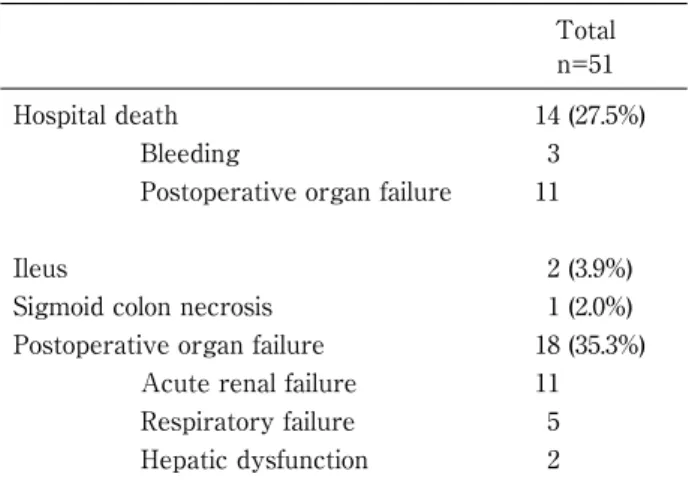
±23.2 minutes (Table 2). Regarding postoperative com- plications, acute renal failure requiring hemodialysis developed in 11 patients, respiratory failure requiring tracheotomy in 6, hemorrhage in 3, ileus in 2, liver dysfunction in 2, pneumonia in1,and necrosis of the sigmoid colon in 1. One patient died after the initiation of surgery because ventricular fibrillation occurred before aortic cross clamping, which resulted in cardiac arrest and death. Fourteen patients (27.5%) died at the hospital with the causes of death being uncontrollable bleeding followed by death immediately after surgery in 3 (21%), acute renal failure in 6 (43%), respiratory failure in 3 (21%), and disseminated intravascular co- agulation in 2 (7%). All14fatal patients were in shock before surgery (Table 3).
Statistical analysis
Results for continuous variables are presented as mean±standard deviation and categorical variables are presented as number (percent). The patients were divided into survival (Group S, n=37) and surgical death (Group D, n=14) groups. The preoperative factors analyzed were age, hemoglobin level, and Base Excess in blood gas analysis. Intraoperative factors were operation time, blood loss, volume of blood transfusion, and time from initiation of surgery to aortic cross clamping. The unpaired Student’s t test was used to compare the continuous variables and the Pearson χ2test was used to compare the categorical variables. A value of p<0.05 was regarded as significant. Surgical death risk factors for patients with ruptured abdominal aortic aneurysm were analyzed using multiple logistic regression analysis, and p<0.10 was regarded as significant.
Table 1 Patient characteristics
Total n=51
Age (yrs) 73.4±9.7
Gender, M / F 38 / 13
Diabetes mellitus 6 (11.8%)
Hypertension 23 (45.1%)
Hyperlipidemia 7 (13.8%)
Ischemic heart disease 2 (3.9%)
Chronic renal failure 6 (11.8%)
Chronic obstructive pulmonary disease 2 (3.9%) Table 2 Operative characteristics
Total n=51 Previous diagnosis of an aortic aneurysm 10 (19.6%) Location of the rupture
(abdominal aorta / iliac artery) 44/7 Diameter of an aortic aneurysm (cm) 7.4±1.2
preoperative shock 37 (72.5%)
Preoperative hemoglobin (g/dl) 8.6±2.7 Preoperative base excess in blood gas
analysis (mmol/l) -5.2±7.5
I-graft replacement 10
Y-graft replacement 40
Operative death before graft replacement 1 Reconstruction of an inferior mesenteric
artery 21 (41.2%)
Operation time (min) 230.7±79.7
Intraoperative bleeding (ml) 3551±3058
Blood transfusion (ml) 3445±2342
Time to aortic clamp (min) 38.2±23.2
Table 3 Postoperative characteristics
Total n=51
Hospital death 14 (27.5%)
Bleeding 3
Postoperative organ failure 11
Ileus 2 (3.9%)
Sigmoid colon necrosis 1 (2.0%)
Postoperative organ failure 18 (35.3%)
Acute renal failure 11
Respiratory failure 5
Hepatic dysfunction 2
■Results
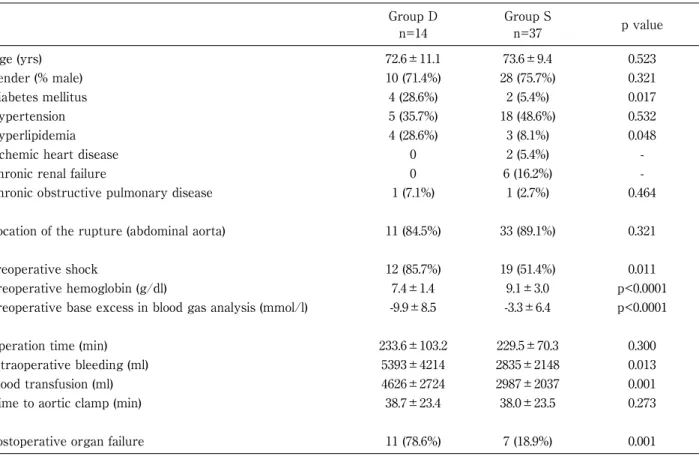
Univariable analysis between group S and group D (Table 4) The results of comparison between the survival and surgical death groups are shown in Table 4. The intraoperative bleeding was significantly greater in the surgical death group (p=0.013), and accordingly, the volume of blood transfusion was also greater (p=0.001).
The preoperative hemoglobin level (p<0.0001) and base excess in blood gas analysis (p<0.0001) were also sig- nificantly lower in the surgical death group. There were no significant differences in the age, operation time, or time from initiation of surgery to aortic cross clamping between the two groups.
Multiple logistic regression analysis
The analytical factors applied in the stepwise logistic method were postoperative organ failure, -5.0 or lower base excess in preoperative blood gas analysis, 5000 ml or more blood loss during surgery, diabetes mellitus, the time from initiation of surgery to aortic cross clamping , preoperative shock state , age , and preoperative hemoglobin level. According to the results, the following risk factors for surgical death were identified: development of postoperative organ failure (odds ratio: 32.4, 95%CI: 3.0-347.6, p=0.004), 5000 ml or more blood loss during surgery (odds ratio: 6.76, 95%CI: 1.1-41.5, p=0.039), -5.0 or lower base excess in preoperative blood gas analysis (odds ratio: 9.30, 95%
CI: 1.8-48.9, p=0.008), and diabetes mellitus (odds ratio:
Table 4 Comparison of patient characteristics in the study groups
Group D n=14
Group S
n=37 p value
Age (yrs) 72.6±11.1 73.6±9.4 0.523
Gender (% male) 10 (71.4%) 28 (75.7%) 0.321
Diabetes mellitus 4 (28.6%) 2 (5.4%) 0.017
Hypertension 5 (35.7%) 18 (48.6%) 0.532
Hyperlipidemia 4 (28.6%) 3 (8.1%) 0.048
Ischemic heart disease 0 2 (5.4%) -
Chronic renal failure 0 6 (16.2%) -
Chronic obstructive pulmonary disease 1 (7.1%) 1 (2.7%) 0.464
Location of the rupture (abdominal aorta) 11 (84.5%) 33 (89.1%) 0.321
preoperative shock 12 (85.7%) 19 (51.4%) 0.011
Preoperative hemoglobin (g/dl) 7.4±1.4 9.1±3.0 p<0.0001
Preoperative base excess in blood gas analysis (mmol/l) -9.9±8.5 -3.3±6.4 p<0.0001
Operation time (min) 233.6±103.2 229.5±70.3 0.300
Intraoperative bleeding (ml) 5393±4214 2835±2148 0.013
Blood transfusion (ml) 4626±2724 2987±2037 0.001
Time to aortic clamp (min) 38.7±23.4 38.0±23.5 0.273
Postoperative organ failure 11 (78.6%) 7 (18.9%) 0.001
Table 5 Multivariate analysis of hospital death
Odds Ratio 95%CI p value
Postoperative organ failure 32.4 3.0-347.6 0.004
Preoperative base excess in blood gas analysis was lower -5.0 9.30 1.8-48.9 0.008
Intraoperative bleeding was more than 5000 ml 6.76 1.1-41.5 0.039
Diabetes mellitus 9.02 0.9-90.8 0.062
Time to aortic clamp 1.02 0.9-1.1 0.224
preoperative shock 12.9 1.4-115.8 0.338
age 2.65 0.3-24.5 0.390
Preoperative hemoglobin 0.38 0.02-6.1 0.493
9.02, 95%CI: 0.9-90.8, p=0.062) (Table 5). Risk factors of postoperative organ failure were also analyzed, and preoperative shock state (odds ratio: 6.12, 95%CI: 1.2- 32.0, p=0.032) and diabetes mellitus (odds ratio: 16.3, 95%CI: 1.4-194.4, p=0.027) were identified to be risk factors (Table 6).
■Discussion
The surgical outcome of ruptured abdominal aortic aneurysm is poor, and it has been reported to be 30- 50%2,3). Recent meta-analysis found no improvement of the operative mortality in patients with ruptured abdominal aortic aneurysm, and frequent causes of death were shock associated with aneurysm rupture, intraoperative hemorrhage, and multiorgan failure.
Several reports4〜11)that addressed ways to predict postoperative prognosis by scoring preoperative conditions of aortic aneurysm rupture have been published.
Risk factors of operative mortality of ruptured abdominal aortic aneurysm should be divided into patient background, preoperative conditions, surgical factor, and newly generated factors after surgery. In previous reports6,10〜13), age, gender, past history of myocardial infarction, hypertension, and obstructive pulmonary disease were reported as patient back- ground factors. Also reported6,9,10,12)to be preopera- tive condition factors after onset of rupture are consciousness disturbance, depression of hemoglobin, cardiac arrest, shock, and time of surgery after admission. As intraoperative factors10〜14), massive hemorrhage, aortic cross clamping on the supra-renal abdominal aorta, ligation of the left renal vein, skill and specialty of surgeon, and re-operation within 48 hours.
As postoperative factors10,12,14), renal failure, cardiac dysfunction, coagulation dysfunction, and intestinal ischemia were reported. In this study, diabetes mellitus, -5 or lower base excess in preoperative blood gas analysis, 5000 ml or more blood loss during
surgery, and postoperative organ failure were identified as risk factors. It was suggested that a marked decrease of base excess in preoperative blood gas analysis reflects peripheral circulatory failure induced by hypotension.
In surgery for ruptured abdominal aortic aneurysm, it is generally considered that rapid surgery and prevention of hypotension by aortic cross clamping are important. However, the time from initiation of surgery to aortic cross clamping was not identified as a factor of operative mortality in this study. Further- more, there was no apparent association between the time of aortic cross clamping and total intraoperative blood loss.
Recently endovascular repair has been attempted to treat ruptured abdominal aortic aneurysm, and the operative mortality rate was reported to be 0-45%15). Although comparison between the results of direct surgery and the results of endovascular repair is not possible because of limited indication of endovascular repair, it may be one method to improve the prognosis of patients with ruptured abdominal aortic aneurysm.
■Conclusion
Risk factors of death from direct surgery for ruptured abdominal aortic aneurysm were investi- gated by multivariate analysis, and complication by diabetes mellitus, postoperative organ failure, 5000 ml or more blood loss during surgery, and -5 or lower base excess in preoperative arterial blood were identified as highly associated factors.
Reference
1)Young EL, Holt PJ, Poloniecki JD, et al.: Meta-analysis and systematic review of the relationship between surgeon annual caseload and mortality for elective open abdominal aortic aneurysm repairs. J Vasc Surg.
46: 1287―1294, 2007.
2)Bown MJ, Sutton AJ, Bell PR, et al.: A meta-analysis of Table 6 Multivariate analysis of postoperative organ failure
Odds Ratio 95%CI p value
Diabetes mellitus 16.3 1.4-194.4 0.027
preoperative shock 6.12 1.2-32.0 0.032
Intraoperative bleeding was more than 5000 ml 2.21 0.4-11.1 0.332
Time to aortic clamp 1.01 1.0-1.1 0.409
age 1.71 0.3-8.9 0.525
Preoperative base excess in blood gas analysis was lower -5.0 1.52 0.3-8.0 0.619
Preoperative hemoglobin 1.16 0.2-8.6 0.885
50years of ruptured abdominal aortic aneurysm repair.
Br J Surg.89: 714―730, 2002.
3) Hoornweg LL, Storm-Versloot MN, Ubbink DT, et al.:
Meta analysis on mortality of ruptured abdominal aortic aneurysms. Eur J Vasc Endovasc Surg.35: 558―
570, 2008.
4) Samy AK, Murray G, MacBain G, et al.: Glasgow aneurysm score. Cardiovasc Surg.2: 41―44, 1994.
5) Korhonen SJ, Ylonen K, Biancari F, et al.: Glasgow Aneurysm Score as a predictor of immediate outcome after surgery for ruptured abdominal aortic aneurysm.
Br J Surg.91: 1449―1452, 2004.
6) Hardman DT, Fisher CM, Patel MI, et al.: Ruptured abdominal aortic aneurysms: who should be offered surgery? J Vasc Surg.23: 123―129, 1996.
7) Prance SE, Wilson YG, Cosgrove CM, et al.: Ruptured abdominal aortic aneurysms: selecting patients for surgery. Eur J Vasc Endovasc Surg.17: 129―132, 1999.
8) Neary WD, Crow P, Foy C, et al.: Comparison of POSSUM scoring and the Hardman Index in selection of patients for repair of ruptured abdominal aortic aneurysm. Br J Surg.90: 421―425, 2003.
9) Leo E, Biancari F, Nesi F, et al.: Risk-scoring methods in predicting the immediate outcome after emergency open repair of ruptured abdominal aortic aneurysm.
Am J Surg.192: 19―23, 2006.
10)Chen JC, Hildebrand HD, Salvian AJ, et al.: Predictors of death in nonruptured and ruptured abdominal aortic aneurysms. J Vasc Surg.24: 614―620, 1996.
11)Dueck AD, Kucey DS, Johnston KW, et al.: Survival after ruptured abdominal aortic aneurysm: effect of patient, surgeon, and hospital factors. J Vasc Surg.39:
1253―1260, 2004.
12)Alonso-Perez M, Segura RJ, Sanchez J, et al.: Factors increasing the mortality rate for patients with ruptured abdominal aortic aneurysms. Ann Vasc Surg.
15: 601―607, 2001.
13)Dardik A, Burleyson GP, Bowman H, et al.: Surgical repair of ruptured abdominal aortic aneurysms in the state of Maryland: factors influencing outcome among 527recent cases. J Vasc Surg.28: 413―420, 1998.
14)Laukontaus SJ, Lepantalo M, Hynninen M, et al.:
Prediction of survival after48-h of intensive care following open surgical repair of ruptured abdominal aortic aneurysm. Eur J Vasc Endovasc Surg. 30: 509―
515, 2005.
15)Mastracci TM, Garrido-Olivares L, Cina CS, et al.:
Endovascular repair of ruptured abdominal aortic aneurysms: a systematic review and meta-analysis. J Vasc Surg.47: 214―221, 2008.