45
■ 症 例
日血外会誌 10:627ミ629,
2001
A Case of Acute Complete Thrombosis
of Abdominal Aortic Aneurysm
Shinji Matsushima,1 Hideki Yamamoto,1 Kaku Egami,1 and Shigeo Tanaka2
Summary: This report describes a successful case and verified the effectiveness of surgical inter-vention adopted for this patient. The patient was a 65-year-old woman with a 16-year history of non-insulin-dependent diabetes mellitus. Sudden complete thrombosis of an abdominal aortic aneurysm occurred when bedridden and under treatment for a myocardial infarction two and a half months previously. During the operation, an aneurysm of 6 cm in diameter was completely thrombosed and replaced with a bifurcated artificial graft. In conclusion, we had satisfactory results, and the early precise diagnosis and proper surgical treatment seem to be factors in the successful outcome. (J. Vasc. Surg., 10: 627ミ629, 2001)
Key words: Abdominal aortic aneurysm, Thrombosis, Complete occlusion
Introduction
Among the usual complications of an infra-abdominal an-eurysm, rupture with subsequent hemorrhage has been well documented, however, sudden complete thrombosis of an aneurysm of the abdominal aorta is uncommon. While acute complete occlusion associated with an abdominal aortic an-eurysm is very rare, the mortality is also very high, as is the rate of rupture of the aortic aneurysm. We present here a very rare case which combined acute complete thrombotic occlu-sion in an abdominal aortic aneurysm associated with ASO.
Case
A 65-year-old woman, with non-insulin-dependent diabe-tes mellitus from the age of 49, had received regular medical treatment since 1994. The patient sometimes had complained of pain in inferior limbs when walking. She had been
hospi-1 Department of Surgery, Tama-Nagayama Hospital, Nippon Medi-cal School
1-7-1 Nagayama, Tama City, Tokyo 206-8512, Japan 2 Second Department of Surgery, Nippon Medical School Received March 9, 2001; revision accepted August 1, 2001.
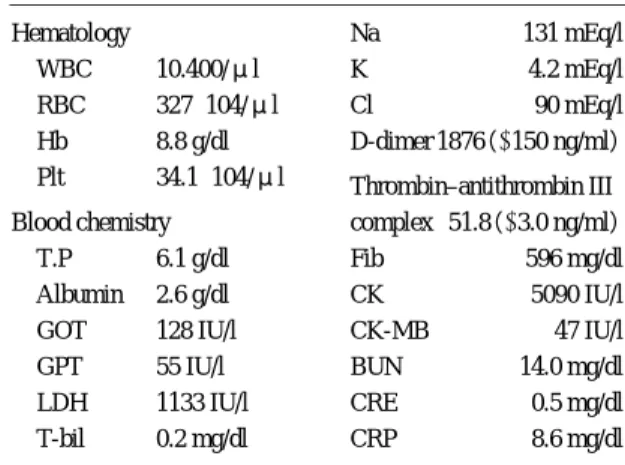
talized for the treatment of low grade fever in February 1998. In March, she had a sudden attack of acute myocardial inf-arction(inferior wall). Severe arrhythmia, such as ventricu-lar fibrillation and heart arrest also occurred temporarily, and cardiopulmonary resuscitation was performed, however, her bedridden condition continued with a level 100 grade of consciousness. The general condition and hemodynamics of the patient gradually stabilized, however, a mottled-gray cy-anosis and a cold sensation suddenly occurred from the thigh to the region below the knee on both sides after about 10 weeks of acute myocardial infarction. On physical examina-tions, the pulses of the femoral, popliteal and dorsalis pedis arteries of both sides were completely absent. The findings of an MRA are shown in Fig. 1. The upper part of the rysm was enhanced and complete occlusion below the aneu-rysm was seen. Anticoagulant therapy was started immedi-ately, but the ischemia of the lower extremities of both sides did not improve, and in addition, cyanosis had deteriorated further. Table 1 shows the laboratory examination findings before the operation. The hemostatic molecular markers, in-cluding D-dimer and TAT level, revealed a hypercoagulabil-ity which might have induced the growth of the thrombus.
日血外会誌 10巻 6 号
46
628
The total urine volume in one day decreased from 1,200 ml to 600 ml with general pyrexia, and this condition continued for several days. An emergency operation was done for the purpose of aneurysmectomy and reconstruction 8 hours after being transferred to the surgical ward. The blood flow was interrupted by filling of the aneurysm with atherosclerotic plaque and fresh thrombus. The aneurysm was replaced with a bifurcated artificial graft which was inserted from the aorta to the right common iliac artery and the left common femoral artery. Fig. 2 shows the changes in the serum CK level after the operation. The postoperative MRA finding is shown in Fig. 3. After the patientユs general condition stabilized, she transferred to the medical ward.
Discussion
Though the rupture of an abdominal aortic aneurysm is not rare, acute thrombotic complete occlusion is very uncom-mon. There is a report of 2 cases among 254 abdominal aortic aneurysm operations below the renal artery by Olcott et al.,1) and also a report of 7 cases among 275 operations by
Johnson et al.2) The frequency is very low (0.8-2.5%), but
the mortality is very high (50-59%).3, 4) Jannetta and Roberts5)
reported the first successful case of operation in 1961. In this paper, we also describe a successful case of acute thrombotic complete occlusion of an abdominal aneurysm. The charac-teristic symptoms of the disease are lower abdominal pain, ischemic signs in both legs and motor nerve disorder.2, 6)
Some causes for the thrombotic complete occlusion of the aortic aneurysm are thrombi in the aortic aneurysm,
transfer-Table 1 Laboratory data before operation
Hematology Na 131 mEq/l
WBC 10.400/μl K 4.2 mEq/l
RBC 327×104/μl Cl 90 mEq/l
Hb 8.8 g/dl D-dimer 1876(<150 ng/ml)
Plt 34.1×10⁴/μl Thrombin–antithrombin III
Blood chemistry complex 51.8(<3.0 ng/ml)
T.P 6.1 g/dl Fib 596 mg/dl
Albumin 2.6 g/dl CK 5090 IU/l
GOT 128 IU/l CK-MB 47 IU/l
GPT 55 IU/l BUN 14.0 mg/dl
LDH 1133 IU/l CRE 0.5 mg/dl
T-bil 0.2 mg/dl CRP 8.6 mg/dl
Fig. 1 MRA revealing complete occlusion of the abdominal aortic aneurysm
Fig. 2 Changes of the serum CK level after operation
Fig. 3 The postoperative MRA showing complete exclusion of the aneurysm and good flow through the graft
2001年10月
47
Matsushima, et al,: Acute Complete Thrombosis of AAA 629
ring mural thrombosis, injury, retrograde thrombi of distant artery embolism, dehydration, hypercoagulability, operative procedures, and atrial fibrillation.3, 6) In the present case, the
patient had a predisposition to dehydration due to general pyrexia and water restriction after the myocardial infarction. It is considered that this causes hypercoagulability by an increase of D-dimer and TAT-complex values which might have induced the acute thrombosis. Enomoto et al.7) reported
a case of acute thrombotic occlusion in the mycotic abdomi-nal aneurysm and indicated the cause of occlusion to be mu-ral thrombosis in the aneurysm. Yamamoto et al.8)
demon-strated by two-dimensional echography that the rapid growth of a thrombus in an abdominal aortic aneurysm can be in-duced by atherosclerotic ulceration, laceration of the throm-bus or swirling blood flow. With regard to the aneurysmal size, it was recorded in 22 patients in the literature. The diameter of the aneurysm in 13(59%) of these cases was 6 cm or smaller, which is small for aortic aneurysms.2, 3, 6, 7, 9)
There was also a report associated with severe ASO2 which
recommended that even small aneurysms could be resected if there were concomitant occlusive atherosclerosis. As for the surgical procedures, aneurysmectomy and reconstruc-tion are fundamentally the best treatment when the operative risk is not high. On the other hand, extra-anatomical bypass is also acceptable if the general condition of the patient is poor.6) Patel et al.6) reported four successful cases of the
operation, and indicated that the appropriate operative method and diagnosis leads to successful treatment. In the present case, we also had satisfactory results, and in conclusion, early precise diagnosis and proper surgical treatment seem to be factors in the successful outcome.
References
1) Olcott, IV. C,, Holcroft, J. W., Stoney, R. J., et al.: Unusual problems of abdominal aortic aneurysms. Am. J. Surg., 135: 426-431, 1978.
2) Johnson, J. M., Gaspar, M. R., Movius, H. J., et al.: Sudden complete thrombosis of aortic and iliac aneurysms. Arch. Surg., 108: 792-794, 1974.
3) Cervantes. J., Martinez, R., and Perez-Garcia, D.: Acute thrombosis of abdominal aortic aneurysm. J. Cardiovasc. Surg., 26: 598-601, 1985.
4) Corson, J. D., Brewster, D. C., and Darling, R. C.: The surgical management of infrarenal aortic occlusion. Surg. Gynecol. Obstet., 155: 369-372, 1982.
5) Jannetta, P. J. and Roberts, B.: Sudden complete thrombo-sis of an aneurysm of the abdominal aorta. N. Engl. J. Med., 264: 434-436, 1961.
6) Patel, H., Krishnamoorthy, M., Dorazio, R. A., et al.: Thrombosis of abdominal aortic aneurysms. Am. Surgeon., 60: 801-803, 1994.
7) Enomoto, S., Horita, K., Naitoh, K., et al.: Mycotic ab-dominal aneurysm requiring emergency operation due to sudden thrombotic obstruction: A case report. J. Jpn. Surg. Soc., 90: 1274-1277, 1988.
8) Yamamoto, K., Ikeda, U., Ikeda, Y., et al.: Rapidly grow-ing mural thrombus in an abdominal aortic aneurysm. Heart Vessels, 8: 166-169, 1993.
9) Perdue, G. D.: Thrombosis of aneurysms of the abdominal aorta. J. Med. Assoc. Ga., 52: 201-202, 1963.