Investigations on the Preparation of Highly
Efficient Ti-, Mo-, and Cr-Oxide Based
Photocatalysts and Their Photocatalytic
Reactivities
著者
Kim Tae-Ho
内容記述
学位授与大学: Osaka Prefecture University(大阪
府立大学), 学位の種類: 博士(工学), 学位記番号:
論工第1253号, 学位授与年月日: 2010-03-31, 指導
教員: 安保正一.
Investigations on the Preparation of Highly Efficient Ti-, Mo-, and
Cr-Oxide Based Photocatalysts and Their Photocatalytic Reactivities
(高効率な Ti-, Mo-, Cr- 酸化物系光触媒の調製と
光触媒反応性に関する研究)
Tae-Ho KIM
金 兌鎬
February 2010
Contents
Chapter 1. General Introduction …1
Chapter 2. Preparation of Visible Light-Responsive TiO2 Thin Films by an RF Magnetron Sputtering Deposition Method and Their Photocatalytic Reactivity 2.1 Introduction …14
2.2 Experimental Section …15
2.3 Results and Discussions …16
2.4 Conclusions …24
2.5 References …25
Chapter 3. Photocatalytic Activity of Photoelectrochemical Circuit System Consisting of a Rod-Type TiO2 Electrode and Silicon Solar Cell 3.1 Photocatalytic Decomposition of Ethanethiol on a Photoelectrochemical Circuit System Consisting of a Rod-Type TiO2 Electrode and Silicon Solar Cell 3.1.1 Introduction …28
3.1.2 Experimental Section …29
3.1.3 Results and Discussions …30
3.1.4 Conclusions …43
3.2 Effect of Various Calcination Treatments on the Photocatalytic Activity of the Rod-Type TiO2 Electrode
3.2.1 Introduction …45
3.2.2 Experimental Section …45
3.2.3 Results and Discussions …46
3.2.4 Conclusions …56
3.2.5 References …56
Chapter 4. Effect of Surface Modification by Fluoride Ions for the selective Photocatalytic Oxidation of Benzyl Alcohol into Benzaldehyde by O2 on TiO2 under Visible Light
4.1 Introduction …59
4.2 Experimental Section …60
4.3 Results and Discussions …61
4.4 Conclusions …72
4.5 References …72
Chapter 5. Preparation and Characterization of Single-Site Heterogeneous Catalysts and Their Photocatalytic Reactivities
5.1 Preparation and Characterization of Ti-, V-, Cr-Oxide Containing Zeolite and Their Photocatalytic Reactivity
5.1.1 Introduction …75
5.1.3 Results and Discussions …77
5.1.4 Conclusions …110
5.1.5 References …111
5.2 Preparation and Characterization of Unique Inorganic-Organic Hybrid Mesoporous Materials Incorporating Arene Metal Carbonyl Complexes
5.2.1 Introduction …115
5.2.2 Experimental Section …115
5.2.3 Results and Discussions …117
5.2.4 Conclusions …129
5.2.5 References …130
Chapter 6. General Conclusions …132
ACKNOLEDGEMENTS …137
Chapter 1
In recent years, global environmental pollution and the lack of natural energy resources have become urgent problems which hinder sustainable development and amenable living space for future generations. The development of industries and cont emporary lifestyles have all led to accelerated energy consumption and the discharge of toxic agents into the air and water, leading to averse effects such as pollution-related diseases and global warming. In this regard, the design of new catalysts and catalytic processes are the focus of much attention as promising and effective chemical technologies that are totally clean, safe and efficient, and thus, environmentally-harmonious. Among such new advances and materials, the utilization of photocatalysis in many chemical processes is of special interest since it can be applied for the removal of toxic agents in air and water using clean and abundant solar energy so that photocatalytic technologies are now considered especially promising [1-5].
Since the photosplitting of water into H2 and O2 using an electrochemical cell
consisting of a Pt electrode and TiO2 electrode was first reported by Honda and
Fujishima in 1972 [6], a large number of applications using various semiconductor materials in photocatalytic technology have been investigated for their potential in the conversion of light energy into useful chemical energy [7-13]. Under UV light irradiation, electrons can be excited from the valence band of the semiconductor catalysts to the conduction band, leaving photo-generated holes in the valence band, as shown in Fig. 1.1. These photo-generated electrons and holes play an important role in the photocatalytic degradation of pollutants. Photocatalytic reactions proceed under mild conditions at room temperature, normal atmospheric pressure and under light irradiation, making photocatalysis a much-desired ecologically clean chemical process for the removal of pollutants in our environment.
non-toxicity, are cost-efficient and environmentally-harmonious. In fact, TiO2
photocatalysts are presently the most actively and widely investigated for applications that can effectively address environmental pollution [14-18]. However, TiO2
photocatalysts operate only under UV light of wavelengths shorter than 400 nm which means only 3–5 % of the solar light that reaches the earth can be utilized. Recently, many studies have been devoted to the modification of TiO2 photocatalysts by the
substitutional doping of metals or nonmetals in order to extend their absorption edge into the visible light region and to improve their photocatalytic activity [19-24]. Although metal ions chemically doped into TiO2 can induce visible light response,
most of these catalysts do not show long-term stability nor have sufficiently high reactivity for a wide range of applications. When metal ions or oxides are incorporated into the TiO2 by a chemical doping method, impurity energy levels in the
band gap of TiO2 are formed and may cause an increase in the recombination between
the photogenerated electrons and holes [20].
C.B.
V.B.
OH
-O
2O
2-Eg
hv
OH•
h
+e
-0
+1.0
+2.0
+3.0
O
2/H
2O
V vs NHE
H
+/H
2C.B.
V.B.
OH
-O
2O
2-Eg
hv
OH•
h
+e
-C.B.
V.B.
OH
-O
2O
2-Eg
hv
OH•
h
+e
-0
+1.0
+2.0
+3.0
O
2/H
2O
V vs NHE
H
+/H
2Figure 1.1. Processes of photocatalysis on semiconductor particles.
This thesis deals with the application of a radio frequency magnetron sputtering (RF-MS) deposition method for the development of visible light-responsive TiO2 thin
film photocatalysts [25-28]. Various spectroscopic analyses have revealed that a decrease in the O/Ti ratio from the surface (O/Ti = 2.00) to the bottom (O/Ti = 1.93)
may play a significant role in the modification of the electronic properties of these TiO2
thin films, enabling them to absorb and operate under visible light irradiation [29]. In addition to the development of visible light-responsive TiO2 photocatalysts, a
unique photoelectrochemical circuit system (TE-SSC-PE) consisting of a rod-type TiO2
electrode (TE), Pt counter electrode (PE) and silicon solar cell (SSC) was constructed. The effect of the external bias on the photocatalytic activity of this TE-SSC-PE system has been investigated in detail in order to achieve an efficient photocatalytic system for the oxidation of various kinds of toxic or odorous organic compounds.
Single-Site Photocatalysts
It has been reported that single-site photocatalysts constructed within zeolites or mesoporous silica materials show fascinating photocatalytic activity with high selectivity which cannot be realized on bulk semiconducting photocatalysts. In these catalytic systems, transition metal oxides (titanium oxide, vanadium oxide and chromium oxide) are considered to be highly dispersed at the atomic level as well-defined catalysts which exist in the specific structure of the zeolite or mesoporous silica framework [30-46]. Single-site photocatalysts can initiate the direct decomposition of NOx (NO, N2O) into N2 and O2 [43,44], CO2 reduction with H2O into methanol [40,42]
and the partial oxidation of hydrocarbons [40,46] with high efficiency and high selectivity. These unique reactivities are attributed to the ligand to metal charge transfer excited state of the isolated metal oxide species under UV-light irradiation (Fig. 1.2) [30]. The high reactivity of these ligand to metal charge transfer excited states or electron-hole pair states, which are localized in close proximity as compared to those in semiconductors, enables various photocatalytic reactions with a high efficiency that is not possible on bulk semiconductor photocatalysts. This thesis deals with the development of highly active and selective single-site photocatalysis using transition
has been focused on the differences in the reaction dynamics as well as the reactivity between single-site photocatalysts and semi-conducting bulk photocatalysts in their photoexcited states. Ti4+ h
ν
’ hν
O 2-O O O Ti3+ O -O O O Excitation and radiative decay process fromthe charge transfer excited triplet state
Zeolite framework Mesoporous silica Ti4+ h
ν
’ hν
O 2-O O O Ti3+ O -O O O Excitation and radiative decay process fromthe charge transfer excited triplet state
Zeolite framework Mesoporous silica
Figure 1.2. Single-site Ti-oxide photocatalysts
In addition to these transition metal oxide single-site photocatalysts, inorganic-organic hybrid mesoporous materials (HMM) incorporating organometalcarbonyl complexes within their silica frameworks have been developed. A simple chemical vapor deposition (CVD) treatment with various metal carbonyls (M(CO)6 (M =
Cr,Mo,W)) of phenylene-bridged hybrid mesoporous materials (HMM-ph) enabled the efficient incorporation of phM(CO)3 complexes within their silica frameworks
(HMM-phM(CO)3). This work also deals with the thermal stability of HMM-phM(CO)3 as
well as their unique photocatalytic activity for the metathesis reaction of propylene to yield ethylene and butadiene [47].
Outline
This thesis details the research devoted to the preparation of highly active visible-light responsive semiconducting TiO2 photocatalysts by a RF magnetron sputtering
deposition method. The photocatalytic reactivity of these TiO2 photocatalysts has been
investigated by the oxidation of various organic compounds into CO2 under UV and
visible light irradiation. Furthermore, the unique photocatalytic oxidation of benzyl alcohol into benzaldehyde with high conversion and selectivity on TiO2 photocatalysts
under visible light irradiation is also discussed. To achieve an enhancement in the photocatalytic activity of these TiO2 photocatalysts, photoelectrochemical circuit
systems consisting of a rod-type TiO2 electrode, Pt electrode and silicon solar cells have
also been constructed and their activity for the decomposition of ethanethiol in water has been investigated.
The preparation of highly active zeolites and mesoporous materials containing highly dispersed isolated transition metal oxides species (Ti, Mo, Cr) or organometal carbonyl complexes as single-site photocatalysts by various preparation methods such as ion-exchange, hydrothermal synthesis, or CVD method is also introduced here. The application of these photocatalysts for highly selective reactions has been discussed. Special attention has been focused on the effect of the local structure of the active sites on the photocatalytic reactivity as well as on a clarification of the reaction mechanisms. Moreover, detailed and comprehensive characterizations of these photocatalysts have been undertaken by such spectroscopic techniques as UV-vis, XAFS, XRD, XPS, SEM, TPD, FT-IR, and photoluminescence analyses.
This thesis contains 6 chapters, the first being an overall introduction of the research objectives with outlines of the succeeding chapters summarized as follows:
the development of visible light-responsive TiO2 thin films and their photocatalytic
reactivity has been investigated. The visible light-responsive TiO2 thin film and
nanoparticles of Pt were deposited on the non-woven fabric of a Ti-metal substrate (Pt-Vis-TiO2/N-Titanystar) by a radio-frequency magnetron sputtering deposition method.
Pt-Vis-TiO2/N-Titanystar was shown to oxidize various organic compounds into CO2
as well as decompose ammonia gas into N2 in the presence of O2 even under visible
light (λ > 420 nm) at 293 K. It was also found that methanol vapor was photocatalytically oxidized into CO2 on Pt-Vis-TiO2/N-Titanystar even under a flow
system, while the oxidation rate of the methanol vapor into CO2 varies greatly
depending on the UV light intensity from the LED lamp (λ = 375 nm).
Chapter 3
In this chapter, a unique photoelectrochemical circuit system was constructed and its photocatalytic activity for the decomposition of ethanethiol in water was investigated. Chapter 3.1 focuses on the effect of the external bias as well as the calcination temperature of a rod-type TiO2 electrode on the oxidation rate of ethanethiol. The
rod-type TiO2 electrodes were prepared by the calcination of a metal Ti rod at various
temperatures. Spectroscopic investigations have revealed that a dense and thick stoichiometric TiO2 layer was formed at 1073 K which shows the highest activity for
the decomposition of ethanethiol. Photoelectrochemical circuit systems were constructed by connecting the rod-type TiO2 electrode and rod-type Pt electrode through
a silicon solar cell. The photoelectrochemical circuit system efficiently oxidized the ethanethiol in water into CO2, while the reaction rate strongly depended on the
calcination temperature of the rod-type TiO2 electrode. Furthermore, it was found that
a negative bias applied to the rod-type TiO2 electrode by a silicon solar cell enhances
the oxidation rate of the ethanethiol in water. Chapter 3.2 focuses on the effect of the various treatments of the rod-type TiO2 electrode, such as calcination in NH3 or in
the rod-type electrode was particularly effective in increasing the photoelectrochemical performance and photocatalytic activity of the photoelectrochemical circuit system.
Chapter 4
In this chapter, the effects of the calcination temperature and HF treatment of TiO2
on the reaction rate of the selective photocatalytic oxidation of benzylalchol were investigated. The selective photocatalytic oxidation of benzyl alcohol into benzaldehyde proceeded at high conversion and selectivity on a TiO2 photocatalyst
suspended in acetonitrile solution in the presence of O2 under visible light irradiation.
It was found that the photocatalytic activity for the formation of benzaldehyde decreases when the number of surface OH groups of TiO2 decrease by calcination treatment at
high temperature. It was also confirmed that the interaction of benzyl alcohol with both the coordinately unsaturated Ti sites and surface OH groups gives the unique surface complex, which shows an absorption band in the visible region. Visible light irradiation of the absorption band was found to induce a charge separation of the holes and electrons and initiate the selective photocatalytic reaction of benzyl alcohol into benzaldehyde.
Chapter 5
In this chapter, various zeolites or silicious mesoporous materials containing transition metal ions have been prepared by using various preparation methods and applied for highly selective photocatalytic reactions. Chapter 5.1 deals with the incorporation of transition metal oxides (Ti, Mo, Cr) within the framework of the zeolites and their high and unique photocatalytic reactivity as single-site heterogeneous catalysts for significant reactions such as the decomposition of NOx (NO, N2O) and
and FT-IR revealed that the photo-excited states of the transition metal oxides play a vital role in realizing the photocatalytic reactions. The high photocatalytic efficiency and selectivity of these single-site catalysts for the reactions, which could not be observed with semiconducting bulk photocatalysts, were found to depend strongly on the unique reactivity of the photo-excited state of the single-site transition metal oxide species. Chapter 5.2 discusses the preparation of HMM-ph incorporating arenetricarbonyl complexes (HMM-phM(CO)3 (M=Cr, Mo, W)) by CVD treatment of
HMM-ph with M(CO)6. Various spectroscopic investigations have elucidated that the
phM(CO)3 complexes within HMM-ph are thermally stable even under thermovacuum
treatment at 473 K. The catalytic activity of HMM-phM(CO)3 for the metathesis
reaction of propylene was also investigated in a gas phase reaction. It was found that UV light irradiation of HMM-phM(CO)3 in the presence of propylene induces the
methathesis reaction of propylene to form ethane and butane even at 293 K.
Chapter 6
The results and conclusions obtained in the various investigations covered in this thesis have been summarized in this final chapter.
References
[1] M. Anpo, Catal. Surveys. Jpn., 1, 169 (1997).
[2] M. Anpo (Ed.), Surface Photochemistry, Wiley, London (1995).
[3] M. Anpo, H. Yamashita, In: M. Schiavello (Ed.), Heterogeneous Photocatalysis, Wiley, London (1997).
[4] M. Anpo, In: I. Okura, M. Kaneko (Eds.), Photocatalysis, Kodanshya Scientific Publishers, Tokyo (2002).
[5] M. Anpo, In: P. Tundo, P. Anatase (Eds.), Green Chemistry, Oxford University Press,
[6] K. Honda, A. Fujishima, Nature, 286, 37 (1972) ; Bull. Chem. Soc. Jpn., 44, 1148 (1971).
[7] T. Inoue, A. Fujishima, S. Konishi, K. Honda, Nature, 277, 637 (1979). [8] T. Kawai, T. Sakata, Nature, 286, 31 (1980).
[9] S. Sato, J.M. White, J. Am. Chem. Soc., 102, 7206 (1980).
[10] A. Heller, A.A. Shalom, W.A. Bonner, B. Miller, J. Am. Chem. Soc., 104, 1688 (1982).
[11] M.A. Fox, Acc. Chem. Res., 16, 314 (1983).
[12] M.A. Fox, M.T. Dulay, Chem. Rev., 93, 341 (1993).
[13] M. Anpo, M. Takeuchi, H. Yamashita, S. Kishiguchi, In: V. Ramamurthy, K.S. Schanze (Ed.), Molecular and Supramolecular Photochemistry: Semiconductor
Photochemistry and Photophysics, Dekker, New York, 10, 283 (2003).
[14] M. R. Hoffmann, S. T. Martin, W. Choi, D. W. Bahnemann, Chem. Rev. 95, 69 (1995).
[15] A. Heller, Acc. Chem. Res., 14, 154 (1981).
[16] Y. Kubokawa, M. Anpo, K. Honda, K. Ito, in Hikari-shokubai (Photocatalysis), Eds., Y. Kubokawa, K. Honda, Y. Saito, Asakura-shoten, Tokyo (1988).
[17] M. Anpo, Y. Kubokawa, Res. Chem. Intermed., 8, 105 (1987).
[18] A. Fujishima, T. N. Rao, D. A. Tryk, J. Photochem. Photobiol. C: Photochem. Rev.,
1, 1 (2000).
[19] E. Borgarello, J. Kiwi, M. Grätzel, E. Pelizzetti, M. Visca, J. Am. Chem. Soc., 104, 2996 (1982).
[20] W.Y. Choi, A. Termin, M. R. Hoffmann, J. Phys. Chem., 98, 13669 (1994). [21] R. Asahi, T. Morikawa, T. Ohwaki, A. Aoki, Y. Taga, Science, 293, 269 (2001). [22] T. Umebayashi, T. Yamaki, H. Ito, K. Asai, Appl. Phys. Lett., 81, 454 (2002). [23] H. Irie, Y. Watanabe, K. Hashimoto, Chem. Lett., 32, 772 (2003).
[25] M. Takeuchi, M. Anpo, T. Hirao, N. Itoh, N. Iwamoto, Surf. Sci. Jpn., 22, 561 (2001).
[26] M. Kitano, M. Takeuchi, M. Matsuoka, J.M. Thomas, M. Anpo, Chem. Lett., 34, 616 (2005).
[27] M. Matsuoka, M. Kitano, M. Takeuchi, M. Anpo, J.M. Thomas, Top. Catal., 35, 305 (2005).
[28] H. Kikuchi, M. Kitano, M. Takeuchi, M. Matsuoka, M. Anpo, P.V. Kamat, J. Phys.
Chem. B, 110, 5537 (2006).
[29] M. Matsuoka, M. Kitano, M. Takeuchi, M. Anpo, J.M. Thomas, Top. Catal., 35, 305 (2005).
[30] M. Anpo, M. Che. Adv. Catal. 44, 119 (1999).
[31] M. Anpo, J.M. Thomas. Chem. Commun., 3273 (2006).
[32] H. Yamashita, M. Anpo, Curr. Opin. Solid State Mater. Sci., 7, 471 (2004).
[33] H. Yamashita, Y. Miura, K. Mori, S. Shironita, Y. Masui, N. Miura, T. Ohmichi, T. Sakata, H. Mori, Pure Appl. Chem., 79, 11, 2095 (2007).
[34] H. Yamashita, K. Mori, Chem. Lett., 36, 348 (2007).
[35] M. Anpo, M. Kondo, Y. Kubokawa, C. Louis, M. Che, J. Chem. Soc. Faraday
Trans., 84, 2771 (1988).
[36] M. Anpo, M. Kondo, S. Coluccia, C. Louis, M. Che, J. Am. Chem. Soc., 111, 8791 (1989).
[37] M. Anpo, I. Tanahashi, Y. Kubokawa, J. Phys. Chem., 84, 3440 (1980).
[38] A.M. Gritscov, V.A. Shvets, V.B. Kazansky, Chem. Phys. Lett., 35, 511 (1975). [39] J.M. Thomas, G. Sanker, Acc. Chem. Res., 34, 571 (2001).
[40] K. Ikeue, H. Yamashita, M. Anpo, T. Takewaki, J. Phys. Chem. B, 105, 8250 (2001). [41] Y. Hu, S. Higashimoto, S. Takenaka, Y. Nagai, Catal. Lett., 100, 35 (2005).
[42] H. Yamashita, Y. Fujii, Y. Ichihashi, S.G. Zhang, K. Ikeue, D.R. Park, K. Koyama, T. Tatsumi, M. Anpo, Catal. Today, 45, 221 (1998).
[43] H. Yamashita, Y. Ichihashi, M. Anpo, M. Hashimoto, C. Louis, M. Che, J. Phys.
Chem., 100, 16041 (1996).
[44] J. Zhang, M. Minagawa, T. Ayusawa, S. Natarajan, H. Yamashita, M. Matsuoka, M. Anpo, J. Phys. Chem. B, 104, 11501 (2000).
[45] A. Corma, Chem. Rev., 97, 2373 (1997).
[46] F. Amano, T. Yamaguchi, T. Tanaka, J. Phys. Chem. B, 110, 281 (2006). [47] A. Korda, R. Giezynski, S. Krycinski, J. Mol Catal., 9, 51 (1980).
Chapter 2
Preparation of Visible Light-Responsive TiO
2Thin Films by
an RF Magnetron Sputtering Deposition Method
and Their Photocatalytic Reactivity
2.1. Introduction
Recently, various TiO2 photocatalysts have been applied for various reactions such
as the purification of water, air and soil polluted with organic compounds [1,2,4] as well as the photocatalytic decomposition of water into H2 and O2 [3]. However, TiO2
photocatalysts operate only under UV light irradiation of wavelengths shorter than 400 nm and utilize only 3-4 % of solar beams that reach the earth. It is, therefore, necessary to develop a photocatalytic system which can work even under visible light irradiation [5]. Many studies have been devoted to the modification of TiO2
photocatalysts by the substitutional doping of metals or nonmetals in order to extend their absorption edge into the visible light region and improve their photocatalytic efficiency [6-8]. We have previously reported that a radio-frequency magnetron sputtering (RF-MS) deposition method in pure Ar gas atmosphere using a TiO2 target
enables the preparation of a visible light-responsive TiO2 (Vis-TiO2) thin film by precise
control of the substrate temperature during the deposition process [9-11].
In the present work, Vis-TiO2 thin film have been deposited on two different kinds
of anodized Ti-metal substrates, i. e., plate-type Titanystar (P-Titanystar) or non-woven fabric Titanystar (N-Titanystar), by a RF-MS deposition method. These two kinds of Vis-TiO2 thin film photocatalysts (Vis-TiO2/P-Titanystar and Vis-TiO2/N-Titanystar)
were then applied for the oxidation of various organic compounds in the gas phase or in water under UV or visible light irradiation. Special attention was focused on how the photocatalytic activity of the Vis-TiO2 thin film photocatalysts is affected by the kinds
of substrates as well as the Pt deposition. Moreover, we have evaluated the photocatalytic activity of Pt-loaded Vis-TiO2/N-Titanystar (Pt-Vis-TiO2/N-Titanystar)
for the oxidation of methanol gas in a flow system under UV light irradiation from a LED lamp (80 W).
2.2. Experimental
Two kinds of Titanystar (Yield CO., Kyoto, Japan) were prepared by the anodization treatment (100 V for 1500 s) of a plate-type Ti-metal (P-Ti) in an electrolyte containing an mixture of organic acids and the non-woven fabric of Ti-metal (N-Ti) in an electrolyte containing an mixture of organic acids followed by calcination at 773 K for 1 h in air, and these were denoted as P-Titanystar and N-Titanystar, respectively.
After anodization and calcination treatment, the top surfaces of P-Ti and N-Ti were oxidized into TiO2. The TiO2 thin films were then deposited on various substrates by a
radio-frequency magnetron sputtering (RF-MS) deposition method using a TiO2 plate
(High Purity Chemicals Lab., Corp., Grade: 99.99 %) as the source material and Ar gas (99.995 %) as the sputtering gas. Prior to the introduction of Ar gas, the chamber was evacuated to less than 5.0 x 10⁻⁴ Pa, followed by the introduction of Ar at 2.0 Pa. Visible light-responsive TiO2 (Vis-TiO2) thin films were then deposited on three kinds
of substrates (P-Titanystar, N-Titanystar, N-Ti; 50 x 50 mm2) by inducing a radio-frequency power of 300 W with the substrate temperature (Ts) held at 873 K. The Vis-TiO2 thin film photocatalysts were denoted as Vis-TiO2/P-Titanystar, Vis-TiO2
/N-Titanystar and Vis-TiO2/N-Ti. Nanoparticles of Pt were deposited on Vis-TiO2
/N-Titanystar by a RF-MS method using a Pt plate as the source material with an RF power of 70 W at Ts = 298 K and this thin film photocatalyst was denoted as Pt-Vis-TiO2
/N-Titanystar. The crystal structures of the Vis-TiO2 thin film photocatalysts were
determined by X-ray diffraction (XRD: Shimadzu, XRD-6100) analysis using a CuKα line (λ = 1.5406 Å). The photocatalytic activities of the Vis-TiO2 thin film
photocatalysts were investigated by the oxidation of 2-propanol in water under UV light irradiation at 293 K. The concentration of an aqueous solution of 2-propanol was adjusted to 6.5 x 10⁻³ mol/L. The various Vis-TiO2 thin film photocatalysts were
placed in a quartz glass cell with an aqueous solution of 2-propanol (10 ml). UV irradiation was carried out with a full arc from a 500 W high pressure Hg lamp. The
reaction products were analyzed by a gas chromatograph (GC-14A, Shimazu).
The flow reactor for the photocatalytic oxidation of methanol vapor was constructed by an aluminium frame (150 mm(W) X 200 mm(D) X 5 mm(H)) equipped with a quartz glass window (150 mm(W) X 200 mm(D), 2 mm thickness) where 12 sheets of Pt-Vis-TiO2/N-Titanystar were placed. He-balanced methanol (CH3OH
(1000 ppm)/He) was used for the reactant gas. The photocatalytic oxidation reactions of methanol vapor was performed by using a flow reactor under light irradiation from a LED lamp (80 W, 375 nm) at 298 K with various light intensities (5, 10, 20 mW/cm2). The light intensity was varied by changing the distance between the LED lamp and flow reactor. The flow rates of He-balanced methanol (CH3OH (1000 ppm)/He) and O2
(99.99 %) introduced into the reactor were adjusted to 25 and 5 ml/min, respectively. The reaction products were analyzed by gas chromatography (Shimadzu GC-14B) with a Porapak-Q packed column. Photocatalytic oxidation reactions of various organic compounds in the gas phase with O2 were carried out in a closed system using a quartz
reactor under visible light irradiation (λ > 420 nm) at 293 K. The gas pressure of the reactant gas and O2 were both adjusted to 1013.25 Pa. The reaction products were
analyzed by gas chromatography (Shimadzu GC-7A) with a Porapak-Q packed column.
2.3. Results and Discussion
Figure 2.1 shows the activities of the various Vis-TiO2 thin film photocatalysts for
the oxidation of 2-propanol in water under UV light irradiation at 293 K. First, the photocatalytic activity was compared for these three kinds of Vis-TiO2 thin film
photocatalysts (Vis-TiO2/P-Titanystar, Vis-TiO2/N-Ti and Vis-TiO2/N-Titanystar).
Degradati
o
n
of 2-pro
p
ano
l /
%
·h
-10
5
10
15
20
(a)
(b)
(c)
(d)
(e)
Degradati
o
n
of 2-pro
p
ano
l /
%
·h
-10
5
10
15
20
(a)
(b)
(c)
(d)
(e)
Figure 2.1. Photocatalytic oxidation of 2-propanol in water under UV light irradiation
on: (a) Vis-TiO2/P-Titanystar, (b) Vis-TiO2/N-Ti, (c) Vis-TiO2/N-Titanystar, (d)
The high activity of Vis-TiO2/N-Titanystar can be attributed to the higher active
surface area of N-Titanystar (non-woven fabric type) than that of P-Titanystar (plate type), showing the advantage of N-Titanystar as the substrate against P-Titanystar. Furthermore, Vis-TiO2/N-Titanystar showed higher photocatalytic activity than
Vis-TiO2/N-Ti, indicating that the anodization of N-Ti (non-woven fabric of Ti-metal) to
produce the surface TiO2 layer is indispensable in realizing Vis-TiO2 thin film
photocatalysts with high activity and performance. It should be noted that N-Titanystar as a substrate (without the deposition of the Vis-TiO2 thin film) shows lower
activity than Vis-TiO2/N-Titanystar, showing that the deposition of Vis-TiO2 on
N-Titanystar is essential in preparing a highly active photocatalyst. It was also found that the photocatalytic activity of Vis-TiO2/N-Titanystar was remarkably enhanced by
the deposition of Pt on the surface of Vis-TiO2/N-Titanystar (Pt-Vis-TiO2/N-Titanystar).
This enhancement of the photocatalytic activity was considered to be caused by the increase in the efficiency of the charge-separation resulting from the electron transfer from the Vis-TiO2 thin film to the deposited Pt particles [12]. These results clearly
indicate that deposition of both Pt particles and Vis-TiO2 on N-Titanystar by the RF-MS
deposition method is an effective way to prepare highly active TiO2 photocatalysts.
Figure 2.2 shows the XRD patterns of N-Titanystar and Pt-Vis-TiO2/N-Titanystar
prepared by the RF-MS method. N-Titanystar shows typical diffraction peaks due to the Ti metal substrate (2θ = 35.0, 38.7, 40.2, 53.0) while exhibiting no diffraction peaks due to the TiO2 phase, showing that the TiO2 layer formed on the top surface of N-Ti
(non-woven fabric of Ti-metal) by anodization treatment is too thin to be detected by XRD measurement. On the other hand, Pt-Vis-TiO2/N-Titanystar exhibited diffraction
peaks due to the rutile phase of TiO2 (2θ = 27.4, 44.3, 54.4, 56.9), while the intensities
of the diffraction peaks due to the Ti metal substrate were remarkably decreased. These results clearly suggest that the surface of N-Titanystar is covered by a Vis-TiO2
20
30
40
50
60
Intensit
y / a. u.
2 theta / degree
(a)
(b)
Ti
Ti
Ti
Ti
Rutile
20
30
40
50
60
Intensit
y / a. u.
2 theta / degree
(a)
(b)
Ti
Ti
Ti
Ti
Rutile
The photoctalytic oxidation of methanol vapor was then investigated on Pt-Vis-TiO2/N-Titanystar using a flow reactor, as shown in Fig. 2.3. The flow reactor was
constructed by an aluminium frame equipped with a quartz glass window where 12 sheets of Pt-Vis-TiO2/N-Titanystar were placed. A mixture of He-balanced methanol
(CH3OH/He) and O2 was introduced from one side of the flow reactor at atmospheric
pressure, while the outlet of the reactor on the other side was connected to a gas chromatographer where the outlet concentrations of methanol and CO2 were monitored.
Figure 2.4 shows the effect of the light intensity on the reaction time profiles of the photocatalytic oxidation of methanol on Pt-Vis-TiO2/N-Titanystar. Independent of the
light intensity, the concentration of methanol vapor decreased to around 1/4 – 1/2 of its initial concentration under UV light irradiation, while the concentration gradually increased to its initial level after UV light was discontinued. These results suggest that Pt-Vis-TiO2/N-Titanystar is an effective photocatalyst in reducing the vapor pressure of
methanol under LED light irradiation even under flow conditions. In the case of a UV light intensity of 20 mW/cm2, CO2 evolution as a reaction product can be observed
immediately after UV light is turned on and its evolution was continuously observed under UV light irradiation. These results clearly show that methanol vapor is photocatalytically oxidized into CO2. However, the concentration of the CO2 evolved
under UV irradiation decreases with a decrease in the UV light intensity and CO2
evolution was not observed in the gas phase in the case of a UV light intensity of 5 mW/cm2. These results suggest that partially oxidized products of methanol such as formaldehyde and formic acid were accumulated on the surface of Pt-Vis-TiO2
/N-Titanystar under the reaction conditions of low UV light intensity.
Finally, the visible light response of Pt-Vis-TiO2/N-Titanystar was investigated by
the oxidation reaction of organic compounds in the gas phase under visible light irradiation (λ > 420 nm) at 293 K. Figure 2.5 shows the CO2 yields in the
Pt-Vis-TiO2/N-Titanystar Gas inlet
Gas outlet LED lamp (80W : 375 nm) Pt-Vis-TiO2/N-Titanystar
Gas inlet
Gas outlet LED lamp (80W : 375 nm) Figure 2.3. Flow reactor for the photocatalytic oxidation of methanol vapor on
0 200 400 600 800 1000 CH 3 OH, CO 2 / pp m 0 50 100 150 200 Time / min CH3OH CO2 UV ON UV OFF (a) 0 200 400 600 800 1000 CH 3 OH, CO 2 / pp m 0 50 100 150 200 Time / min CH3OH CO2 UV ON UV OFF (a) 0 200 400 600 800 1000 CH 3 OH , C O2 / pp m 0 50 100 150 200 Time / min UV ON UV OFF CH3OH CO2 (b) 0 200 400 600 800 1000 CH 3 OH , C O2 / pp m 0 50 100 150 200 Time / min UV ON UV OFF CH3OH CO2 (b) UV ON UV OFF CH 3OH CO2 0 50 100 150 200 0 200 400 600 800 1000 CH 3 OH , C O2 / pp m Time / min (c) UV ON UV OFF CH 3OH CO2 0 50 100 150 200 0 200 400 600 800 1000 CH 3 OH , C O2 / pp m Time / min (c)
Figure 2.4. Effect of the light intensity on the reaction time profiles of the
photocatalytic oxidation of methanol vapor on Pt -Vis-TiO2/N-Titanystar under UV light
irradiation.
Light source: LED lamp (80 W, 375 nm)
Acetone 2-butanone Buthanol Cycro hexanone Methyl pentanone 1 2 7 8 6 9 5 3 4 0 Yield of CO 2 and N 2 / µ m o l Methanol Ethanol Methane CO Ammonia
(a)
(b)
N2 Acetone 2-butanone Buthanol Cycro hexanone Methyl pentanone 1 2 7 8 6 9 5 3 4 0 Yield of CO 2 and N 2 / µ m o l Methanol Ethanol Methane CO Ammonia(a)
(b)
N2Figure 2.5. (a) Yields of CO2 in the oxidation of various organic compounds in the
gas phase, and (b) yield of N2 in the oxidation of ammonia in the gas phase on
Pt-Vis-TiO2/N-Titanystar (1 cm x 1 cm) under visible light irradiation (λ > 420 nm,
80mW/cm2).
Reaction time: 12 hrs
Light source: Xenon lamp with L-420 cut filter (HOYA) Reactant: 1013.25 Pa, O2: 1013.25 Pa
All of the organic compounds in the gas phase could be oxidized into CO2 and the
highest CO2 formation rate was observed with acetone. The yields of CO2 greatly
depended on the kinds of organic compounds while it is clear that Pt-Vis-TiO2
/N-Titanystar can oxidize various organic compounds into CO2 even under visible light
irradiation (λ > 420 nm) at 293 K. Moreover, ammonia was found to oxidize to yield N2 as a reaction product on Pt-Vis-TiO2/N-Titanystar even under visible light irradiation
(λ > 420 nm). The main origins of the visible light activity of the Vis-TiO2 thin film
photocatalysts can be ascribed to the Vis-TiO2 deposited onto the various substrates
since the O/Ti ratio of the Vis-TiO2 thin films gradually decrease from the top surface
(O/Ti ratio of 2.00) to the inside bulk (O/Ti ratio of 1.93). Such an anisotropic morphology of the Vis-TiO2 thin film may modify the electronic properties of the thin
films, leading to changes in the band gap energy [13-18]. Thus, it was elucidated that Pt-Vis-TiO2/N-Titanystar can be applied for the elimination of harmful organic
compounds in the gas phase even under visible light irradiation (λ > 420 nm) at 293 K.
2.4. Conclusions
Vis-TiO2 thin film photocatalyst were deposited on various kinds of substrates
(P-Titanystar, Ti-N and N-Titanystar) by a RF magnetron sputtering deposition method at a substrate temperature of 873 K and their photocatalytic activity was investigated. The Vis-TiO2 thin film photocatalyst deposited on various substrates were observed to
efficiently oxidize 2-propanol in water under UV light irradiation while the highest activity was observed for Vis-TiO2/N-Titanystar. It was also found that Pt-Vis-TiO2
/N-Titanystar shows higher activity for the oxidation of 2-propanol in water than Vis-TiO2/N-Titanystar. The photoctalytic oxidation of methanol vapor was then
investigated on Pt-Vis-TiO2/N-Titanystar using a flow reactor. Results show that
greatly depending on the UV light intensity from the LED lamp (375 nm). Finally, it was elucidated that Pt-Vis-TiO2/N-Titanystar can oxidize various organic compounds
into CO2 as well as decompose ammonia gas into N2 in the presence of O2 even under
visible light irradiation (λ > 420 nm) at 293 K.
2.5. References
[1] I. Sopyan, M. Watanabe, S. Murasawa, K. Hashimoto, A. Fujishima, J. Photochem.
Photobiol. A: Chem., 98, 79 (1996)
[2] A. Fujishima, T.N. Rao, D.A. Tryk, J. Photochem. Photobiol. C: Photochem. Rev., 1, 1 (2000).
[3] S.C. Moon, Y. Matsumura, M. Kitano, M. Matsuoka, M. Anpo, Res. Chem.
Intermed., 29, 233 (2003).
[4] M. Anpo, H. Yamashita, in M. Schiavello (Ed.), Heterogeneous Catalysis, Wiley, London (1997).
[5] M. Anpo, Bull. Chem. Soc. Jpn., 77, 1427 (2004).
[6] E. Borgarello, J. Kiwi, M. Gratzel, E. Pelizzetti, Visca M., J. Am. Chem. Soc., 104, 2996 (1982).
[7] W. Choi, A. Termin, M. R. Hoffmann, J. Phys. Chem., 98, 13669 (1994). [8] T. Ohno, T. Tsubota, M. Toyofuku, R. Inaba, Catal. Lett., 98, 255 (2004).
[9] M. Takeuchi, M. Anpo, T. Hirao, N. Itoh, N. Iwamoto, Surf. Sci. Jpn., 22, 561 (2001). [10] M. Kitano, M. Takeuchi, M. Matsuoka, J. M. Thomas, M. Anpo, Chem. Lett., 34, 616 (2005).
[11] M. Matsuoka, M. Kitano, M. Takeuchi, M. Anpo, J. M. Thomas, Top. Catal., 35, 305 (2005).
[12] A. L. Linsebigler, G.. Lu, J. T. Yates, Chem. Rev., 95, 735 (1995).
[13] M. Kitano, M. Matsuoka, M. Ueshima, M. Anpo, Appl. Catal. A: General, 325, 1 (2007)
[14] M. Matsuoka, M. Kitano, S. Fukumoto, K. Iyatani, M. Takeuchi, M. Anpo, Catal.
Today, 132, 159 (2008)
[15] M. Kitano, K. Tsujimaru, M. Anpo, Appl. Catal. A: General, 314, 179 (2006) [16] M. Kitano, M. Takeuchi, M. Matsuoka, J. M. Thomas, M. Anpo, Catal. Today, 120, 133 (2007)
[17] H. Chen, M. Matsuoka, J. Zhang, M. Anpo, J. Catal., 228, 75 (2004)
[18] M. Matsuoka, M. Kitano, M. Takeuchi, K. Tsujimaru, M. Anpo, J. M. Thomas,
Chapter 3
Photocatalytic Activity of a Photoelectrochemical Circuit System
Consisting of a Rod-type TiO
2Electrode and Silicon Solar Cell
3.1. Photocatalytic Decomposition of Ethanethiol on a Photoelectrochemical Circuit System Consisting of a Rod-Type TiO2 Electrode and Silicon Solar Cell
3.1.1. Introduction
The TiO2 photocatalyst is a fascinating photo-functional material which enables
various useful reactions at ambient temperature such as the complete mineralization of toxic organic compounds [1], elimination of NOx in air [2] or hydrogen evolution from biomass [3]. These photocatalytic activities are based on the strong oxidation and reduction ability of the photo-formed holes and electrons, respectively. In addition to powdered TiO2 photocatalysts, the photoelectrochemical properties of TiO2 electrodes
have been widely investigated. So far, it has been shown that the photocatalytic reaction rates as well as reaction dynamics of the photo-formed electrons and holes are significantly affected by the external electric bias applied to the TiO2 electrodes. In
our recent work, a unique photoelectrochemical circuit system consisting of a rod-type TiO2 electrode and silicon solar cell has been constructed [4]. This
photoelectrochemical circuit system can effectively oxidize lactic acid in water into CO2,
while the reaction rate is enhanced by the negative bias applied to the rod-type TiO2
electrode by a silicon solar cell [4]. These results suggest that the photoelectrochemical circuit system can be utilized for the elimination of various undesirable toxic or odorous organic compounds. It is well known that methanethiol, which exists in the human buccal or oral cavity, is the cause of breath odor. Furthermore, it has been shown that ethanethiol is an important intermediate in the formation of methanethiol in the metabolic decomposition of sulfur-containing protein [5]. In the present work, the application of TiO2 photocatalysts for dental care or
buccal protection, especially for the prevention of bad breath, has been carried out with a the photoelectrochemical circuit system for the oxidation of ethanethiol in water.
type TiO2 electrode on the oxidation rate of ethanethiol has been investigated.
3.1.2. Experimental
Rod-type TiO2 electrodes were prepared by the calcination of a metal Ti rod (3 mm
× 78 mm) at various temperatures, i.e., without calcination, at 473 K, 673 K, 873 K, and 1073 K, for 3 min in air and denoted as TE273, TE473, TE673, TE873 and TE1073,
respectively. The photoelectrochemical circuit systems were constructed by connecting the rod-type TiO2 electrode and rod-type Pt electrode (denoted as PE: 3 mm
× 78 mm) through a silicon solar cell (SSC: 2.4 V, 6 μA at 200 lx). Two different types of photoelectrochemical circuit systems (TE-SSC-PE) were constructed, i.e., TE-+SSC- -PE and TE--SSC+-PE, as shown in Fig. 3.1.1(A). Here, TE is connected to the positive electrode of SSC for the former system (TE-+SSC--PE), while TE is connected to the negative electrode of SSC for the latter (TE--SSC+-PE). As shown in Fig. 3.1.2, the TE--SSC+-PE system has been practically applied for the electric circuit of a toothbrush (Soladey 3; Shiken Corp.). In addition to the TE-SSC-PE system, three kinds of circuit systems (TE-PE, TE-TE, PE-PE) were constructed by directly connecting TE and PE. The photocatalytic decomposition reaction of ethanethiol (C2H5SH) was
performed by using a closed reaction cell (Fig. 3.1.1(B)) under light irradiation from various light sources such as a black light lamp (6 W) or fluorescent lamp (6 W) at 298 K. The concentration of ethanethiol aqueous solution (18 ml) was adjusted to 0.08 mol/l and K2SO4 was added (0.30 mol/l) as the electrolyte. The amount of evolved
CO2 in the gas phase was analyzed by gas chromatography (Shimadzu, GC-7A). The
crystal structure and surface morphologies of the rod-type TiO2 electrodes were
investigated by XRD (Shimadzu, XRD-6100) and scanning electron microscopy (SEM, Hitachi, S-4500). The XPS spectra were recorded under vacuum at 298 K (Shimadzu, ESCA3000). The photoelectrochemical properties of the rod-type TiO2 electrodes
electrode, Pt electrode and saturated calomel electrode (SCE) were set as the working, counter and reference electrodes, respectively. For the photoelectrochemical measurements, the working electrode was immersed in 0.25 M K2SO4/10 vol %
methanol aqueous solution and irradiated with a 500 W Xenon lamp through a water filter.
3.1.3. Results and Discussion
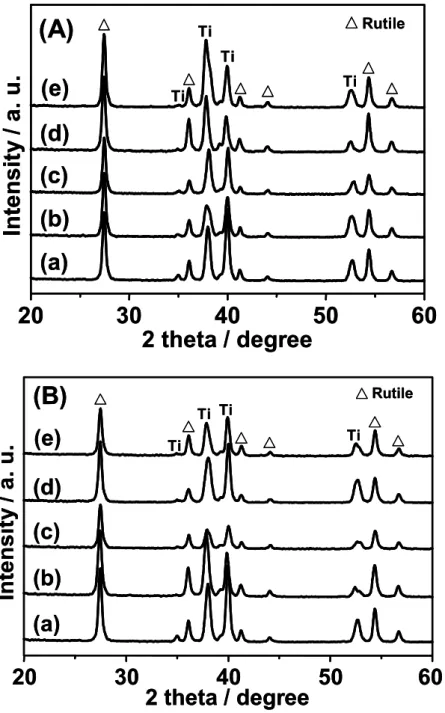
Figure 3.1.3 shows the effect of the calcination temperature on the XRD pattern of the rod-type TiO2 electrode (TE). Typical diffraction peaks of the Ti metal substrate
(2θ = 38.5, 40.2) can mainly be observed when the calcination temperature is below 673 K, while diffraction peaks due to the rutile phase of TiO2 (2θ = 27.5, 54.3) can be
observed above 873 K. TE1073 shows the most intense diffraction peaks due to the
rutile phase of TiO2, while the intensity of the diffraction peaks due to the Ti metal
substrate was remarkably decreased. These results clearly suggest that the surface of TE is covered by a rutile TiO2 layer after calcination treatment above 873 K, while the
thickness of the rutile TiO2 layer increases with an increase in the calcination
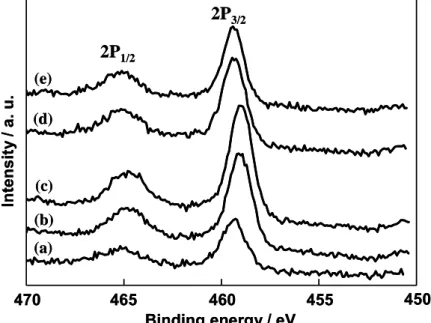
temperature. Figure 3.1.4 shows the effect of the calcination temperature on the Ti 2p XPS spectrum of the rod-type TiO2 electrode. Typical Ti 2p1/2 and Ti 2p3/2 peaks due
to the Ti4+ species were observed at around 465.1 and 459.4 eV, respectively, regardless of the calcination temperature [6,7]. These results show that the surface of the rod-type TiO2 electrode is covered by a stoichiometric TiO2 layer regardless of the
A A - + SSC Ethanethiol aq. GC analysis Lam p Septum Air Stir bar PE TE Lamp TE--SSC+-PE TE-SSC-PE systems SSC
-
+
+
SSC-TE-+SSC--PE TE PE TE PE (A) (B)
Figure 3.1.1. Schematic diagram of: (A) TE-SSC-PE systems and (B) reaction cell for
the photocatalytic oxidation of ethanethiol
Human body
Metal counter electrode Silicon solar cell
Rod-type TiO2 electrode
Human body
Metal counter electrode Silicon solar cell
Rod-type TiO2 electrode
Figure 3.1.2. Schematic diagram of the electric circuit of a commercially produced
Rutile Ti Ti (a) (b) (c) (d) (e) Ti 20 30 40 50 60 2 theta / degree Intensity / a. u. Rutile Rutile Ti Ti (a) (b) (c) (d) (e) Ti 20 30 40 50 60 2 theta / degree Intensity / a. u.
Figure 3.1.3. Effect of the calcination temperature on the XRD pattern of the rod-type
TiO2 electrode.
Calcination temperature (K): (a) Before calcination, (b) 473, (c) 673, (d) 873, (e) 1073.
(a) (b) (c) (d) (e) 2P1/2 2P3/2 470 465 460 455 450 Binding energy / eV Intensit y / a. u. (a) (b) (c) (d) (e) 2P1/2 2P3/2 470 465 460 455 450 Binding energy / eV Intensit y / a. u.
Figure 3.1.4. Effect of the calcination temperature on the XPS spectra of the Ti 2p3/2
and 2p1/2 peaks for the rod-type TiO2 electrode.
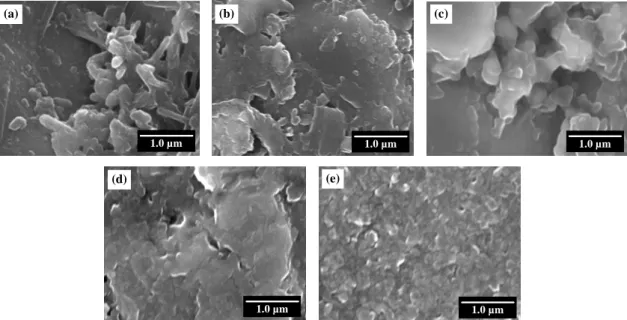
The rod-type TiO2 electrode prepared at calcination temperatures of less than 873
K exhibited a rough surface morphology, while TE1073 showed a rather smooth and flat
surface, as shown in Fig. 3.1.5. These results indicate that calcination at 1037 K is a suitable pretreatment to develop a dense and thick rutile TiO2 layer on the rod-type TiO2
electrode.
Photoelectrochemical measurements of the rod-type TiO2 electrodes were
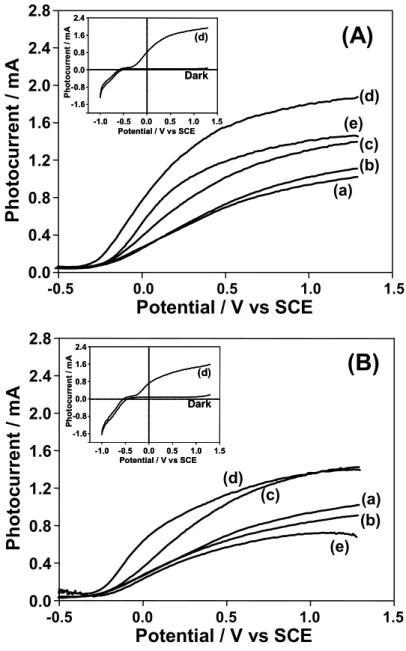
performed in a 10 vol % methanol aqueous solution using a standard three-electrode system. Figure 3.1.6 shows the effect of the calcination temperature on the current-potential curves of the rod-type TiO2 electrodes measured in 10 vol % methanol
aqueous solution under UV irradiation. For all of the electrodes, the cathodic photocurrent dramatically increases under an applied negative bias of -1.0V (SCE: pH = 6), showing that the hydrogen evolution reaction can proceed on the electrode (2H+ + 2e- → H2 ). On the other hand, an anodic photocurrent was observed to proceed under
an applied potential of –0.5 V and increased with an increase in the applied positive bias. These results suggest that the anodic oxidation of methanol by photo-formed holes occurs on these electrodes under UV irradiation of TE (λ > 300nm). Moreover, significant increases in the anodic photocurrent were observed with an increase in the calcination temperature, especially above 873 K. These results are in good agreement with XRD results showing that a dense and thick rutile TiO2 layer can be developed on
the TE after calcination treatment above 873 K. Figure 3.1.7 shows the photocurrent observed for the rod-type TiO2 electrode (TE) calcined at various temperatures as a
function of the incident light. Here, the wavelengths of the incident light were controlled by various cut-off filters. The observed photocurrent increased with an increase in the calcination temperature and the highest photocurrent was observed for TE1073. Furthermore, the photoelectrochemical threshold onsets locate at around 400
nm independent of the calcination temperature, suggesting that the observed photocurrent is derived from the photoexcitation of the stoichiometric TiO2 layers.
(b) 1.0 µm (a) (d) 1.0 µm (e) 1.0 µm (c) 1.0 µm 1.0 µm (b) 1.0 µm (b) 1.0 µm (a) (d) 1.0 µm (d) 1.0 µm (e) 1.0 µm (e) 1.0 µm 1.0 µm (c) 1.0 µm (c) 1.0 µm 1.0 µm 1.0 µm 1.0 µm
Figure 3.1.5. Effect of the calcination temperature on the SEM images of the
rod-type TiO2 electrode.
λ≥300nm (a) (b) (c) (d) (e) 0.35 0.30 0.25 0.20 0.15 0.10 0.05 0.00 P h o toc ur re nt / mA -0.05 -0.10 -0.15 -1.5 -1.0 -0.5 0.0 0.5 1.0 1.5 Potential / V vs SCE
Figure 3.1.6. Effect of the calcination temperature on the current–potential curves of
the rod-type TiO2 electrodes measured in 10 vol % methanol aqueous solution under
UV irradiation (λ > 300 nm).
Calcination temperature (K): (a) Before calcination, (b) 473, (c) 673, (d) 873, (e) 1073. Light source: 500 W Xenon lamp.
(a)
(e)
0.35
0.30
0.25
0.20
0.15
0.10
0.05
0.00
300
350
400
450
500
550
600
Wavelength of cut-off filter / nm
Photocurrent /
mA
(a)
(e)
0.35
0.30
0.25
0.20
0.15
0.10
0.05
0.00
300
350
400
450
500
550
600
Wavelength of cut-off filter / nm
Photocurrent /
mA
Figure 3.1.7. Relative photocurrent as a function of the cutoff wavelength of the
incident light for the rod-type TiO2 electrodes measured in 10 vol % methanol aqueous
solution.
(Potential: +1.0 V vs SCE)
Calcination temperature (K): (a) Before calcination, (b) 473, (c) 673, (d) 873, (e) 1073. Light source: 500 W Xenon lamp.
The decomposition reaction of ethanethiol (C2H5SH) was investigated under light
irradiation with a black light lamp (BL: 6 W) in a closed reaction cell at 298 K, as shown in Fig. 3.1.1. Figure 3.1.8 shows the yields of CO2 in the photocatalytic
decomposition of ethanethiol on various photoelectrochemical circuit systems and the irradiated parts of the photoelectrochemical circuit system are denoted in parenthesis. For example, TE-[+SSC-]-PE indicates that only SSC was irradiated, while [TE-+SSC- -PE] indicates that all parts of TE-+SSC--PE were irradiated. Only a negligible formation of CO2 and negligible current was observed on TE-SSC-PE under dark
conditions, showing that the decomposition of ethanethiol does not proceed in the dark (data not shown). Moreover, CO2 formation was not observed under light irradiation
of the ethanethiol aqueous solution when the photoelectrochemical circuit system was not immersed in the solution (data not shown).
The decomposition of ethanethiol was investigated on three photoelectrochemical circuit systems (TE-[+SSC-]-PE, TE-[-SSC+]-PE, PE-[+SSC-]-PE) where only SSC was irradiated. CO2 formations were observed for all three systems, showing that
ethanethiol can be oxidized into CO2 by electrolysis. It was also found that the circuit
current observed for PE-[+SSC-]-PE (210 μA) was not affected by the presence of
ethanethiol in the aqueous solution, showing that the observed circuit current is mainly ascribed to water electrolysis under an applied voltage by SSC. A higher circuit current was observed for TE-[+SSC-]-PE than TE-[-SSC+]-PE, which can be explained
by the rectification effect due to the Schottky barrier at the interface between the TiO2
layer and metal Ti. Next, the decomposition of ethanethiol was performed on three other kinds of photoelectrochemical circuit systems ([TE-PE], [TE-TE], [PE-PE]) where all of the electrodes were irradiated by a black light lamp. CO2 formation was
observed for [TE-TE] while only a negligible formation of CO2 was observed for
[PE-PE], showing that ethanethiol is photocatalytically decomposed into CO2 on TE.
[TE-TE]. This enhancement of the photocatalytic activity can be ascribed to a decrease in the charge recombination rate due to the efficient transfer of the photo-formed electrons from TE to PE [8-11]. The decomposition of ethanethiol was performed on [TE--SSC+-PE] and [TE-+SSC--PE] where all parts of the photoelectrochemical circuit system were irradiated by a black light lamp. Light irradiation of both systems led to the efficient formation of CO2, confirming that
ethanethiol can be decomposed with these systems. The CO2 yield on both systems
was much higher than the sum of the CO2 yield on TE-[-SSC+]-PE (0.3 μmol) and
[TE-PE] (0.7 μmol). Moreover, [TE--SSC+-PE] showed higher activity for the complete oxidation of ethanethiol than [TE-+SSC--PE]. Since a higher circuit current was observed for [TE--SSC+-PE] (270 μA) than [TE-+SSC--PE] (220 μA), the activity of both systems was compared under the same circuit current. Here, the proper resistance was serially connected in the [TE--SSC+-PE] circuit system and the circuit current was adjusted at 220 μA. This reaction condition was denoted as “[TE--SSC+-PE] (current adjusted)”. As shown in Fig. 3.1.8, [TE--SSC+-PE] shows higher activity than
[TE-+SSC--PE] even under the same circuit current conditions (220 μA), showing that an
applied negative bias on TE by SSC is more effective in enhancing ethanethiol decomposition than an applied positive bias. These results suggest that applying a negative bias on TE promoted the reduction of oxygen to form an O2- species on the
surface of TE, leading to the efficient oxidation of ethanethiol into CO2. Figure 3.1.8
shows the time dependences of the yields of CO2 in the decomposition of ethanethiol on
[TE--SSC+-PE]. It can clearly be seen that light irradiation of the TE--SSC+-PE system led to the formation of CO2 with a good linearity against the light irradiation time,
[TE--SSC+-PE] b 0 1.8 1.6 1.4 1.2 1.0 0.8 0.6 0.4 0.2 2.0 20 30 40 50 60 10 0 0 1.8 1.5 1.2 0.9 0.6 0.3 2.1 2.2 270 µAa
Yi
e
ld
of CO
2/ µ
m
ol
20 30 40 50 60 10 0 Time / hr 0 1.8 1.5 1.2 0.9 0.6 0.3 2.1 220 µA 2.9 µA 0.2 µA 110 µA 210 µA 210 µA 0.2 µA 220 µA Y iel d of C O2 / µm ol [TE--SSC+-PE] [TE-+SSC--PE] [TE--SSC+-PE] (current adjusted) [TE-PE] [TE-TE] [PE-PE] TE-[-SSC+]-PE TE-[+SSC-]-PE PE-[SSC]-PE [TE--SSC+-PE] b 0 1.8 1.6 1.4 1.2 1.0 0.8 0.6 0.4 0.2 2.0 20 30 40 50 60 10 0 0 1.8 1.5 1.2 0.9 0.6 0.3 2.1 2.2 270 µAaYi
e
ld
of CO
2/ µ
m
ol
20 30 40 50 60 10 0 Time / hr 0 1.8 1.5 1.2 0.9 0.6 0.3 2.1 220 µA 2.9 µA 0.2 µA 110 µA 210 µA 210 µA 0.2 µA 220 µA Y iel d of C O2 / µm ol [TE--SSC+-PE] [TE-+SSC--PE] [TE--SSC+-PE] (current adjusted) [TE-PE] [TE-TE] [PE-PE] TE-[-SSC+]-PE TE-[+SSC-]-PE PE-[SSC]-PEFigure 3.1.8. Yields of CO2 in the decomposition of ethanethiol on various
photoelectrochemical circuit systems.
Inset: Time profile of the CO2 yield on [TE--SSC+-PE].
aThe absolute values of the observed short circuit current between two electrodes are
shown on each bar.
bIrradiated parts of the photoelectrochemical circuit system are denoted in parentheses.
Light source: Black light lamp (6 W) Irradiation time: 60 hrs
Figure 3.1.9 shows the effect of the calcination temperature of TE on the yield of CO2 in the decomposition of ethanethiol on the [TE--SSC+-PE] circuit system. It was
clearly observed that the increase in the calcination temperature led to a marked increase in the CO2 yields while TE1073 shows the highest activity for the complete
oxidation of ethanethiol. These results show good agreement with the results of the current-potential curve measurements (Fig. 3.1.6), indicating that the dense and thick TiO2 layer formed on TE1073 acted as the most efficient photocatalyst for the
decomposition of ethanethiol. Finally, the decomposition reactions of ethanethiol were performed on various photoelectrochemical circuit systems under light irradiation from a fluorescent lamp (6 W). The CO2 yield on [TE--SSC+-PE] was almost the same as
the sum of the CO2 yields on [TE-PE] and TE-[-SSC+]-PE. Thus, no marked or
dramatic synergy effect could be observed when combining the TE-PE system and SSC, in contrast to the case under black light irradiation (Fig. 3.1.8). However, these results clearly show that [TE--SSC+-PE] can be practically applied for the clean and safe removal of ethanethiol in human buccal under light irradiation from a fluorescent lamp.
Yi el d of CO 2 / µm o l 0 0.2 0.4 0.6 0.8 1.0 1.2 1.4 1.6 1.8 (a) (b) (c) (d) (e) 70 µAa 2.0 80 µA 120 µA 190 µA 270 µA Yi el d of CO 2 / µm o l 0 0.2 0.4 0.6 0.8 1.0 1.2 1.4 1.6 1.8 (a) (b) (c) (d) (e) 70 µAa 2.0 80 µA 120 µA 190 µA 270 µA
Figure 3.1.9. Effect of the calcination temperature of TE on the yield of CO2 in the
decomposition of ethanethiol on the [TE--SSC+-PE] circuit system.
aThe absolute values of the observed short circuit current between the two electrodes
are shown on each bar.
Light source: Black light lamp (6 W) Reaction time: 60 hrs
0 0.10 0.05 0.15 0.20 0.25 0.30 0.35 0.40 0.45 Yi el d o f CO 2 / µ m ol 150 µAa 0 µA 120 µA
[TE--SSC+-PE] [TE-PE] TE-[-SSC+]-PE
0 0.10 0.05 0.15 0.20 0.25 0.30 0.35 0.40 0.45 Yi el d o f CO 2 / µ m ol 150 µAa 0 µA 120 µA
[TE--SSC+-PE] [TE-PE] TE-[-SSC+]-PE
Figure 3.1.10. Yields of CO2 in the decomposition of ethanethiol on various
photoelectrochemical circuit systems. Light source: Fluorescent lamp (6 W) Reaction time: 60 hrs
3.1.4. Conclusions
It was found that the [TE--SSC+-PE] system can efficiently oxidize ethanethiol in water into CO2. The activity of [TE--SSC+-PE] for the decomposition of ethanethiol
was greatly affected by the calcination temperature of TE and TE1073 was observed to
exhibit the highest activity for the oxidation of ethanethiol. Spectroscopic investigations have revealed that a dense and thick stoichiometric TiO2 layer was
formed on TE1073 whichshows the highest activity for the decomposition of ethanethiol.
A negative bias applied on TE by SSC was also found to markedly enhance the reaction rate, showing a remarkable synergy effect when combining the TE-PE system and SSC for the oxidation of ethanethiol. Finally, it was shown that [TE--SSC+-PE] can be applied for the removal of ethanethiol in water even under light irradiation from a fluorescent lamp (6 W).
3.1.5. References
[1] D.F. Ollis, H. AlEkabi, Photocatalytic Purification and Treatment of Water an
d Air, Elsevier, Amsterdam (1993).
[2] M. Anpo, in: P. Tundo, P. Anastas (Eds.), Green Chemistry, Oxford Universit y Press, 1 (2000).
[3] S. Fukumoto, M. Kitano, M. Takeuchi, M. Matsuoka, M. Anpo, Catal. Lett.,
127, 39 (2009).
[4] M. Matsuoka, T. Kamegawa, D. Rakhmawaty, M. Kitano, K. Wada, M. Anpo,
Topics Catal., 47, 162 (2008).
[5] K. Masatake, Dental Magazine, 105, 32 (2002).
[6] B. Erdem, R.A. Hunsicker, G.W. Simmons, E.D. Sudol, V.L. Dimonie, M.S. El-Aasser, Langmuir, 17, 2664 (2001).
[7] M. Kitano, K. Funatsu, M. Matsuoka, M. Ueshima, M. Anpo, J. Phys. Chem.
[8] J. Sa, M. Fernandez-Garcia, J.A. Anderson, Catal. Commun., 9, 1991 (2008). [9] M. Anpo, N. Aikawa, Y. Kubokawa, J. Phys. Chem., 88, 3998 (1984). [10] M. Kitano, K. Tsujimaru, M. Anpo, Appl. Catal. A: Gen., 314, 179 (2006). [11] M. Kitano, K. Iyatani, K. Tsujimaru, M. Matsuoka, M. Takeuchi, M. Ueshima, J.M. Thomas, M. Anpo, Top. Catal., 49, 24 (2008).
3.2. Effect of Various Calcination Treatments on the Photocatalytic Activity of the Rod-Type TiO2 Electrode
3.2.1. Introduction
Titanium dioxide (TiO2) photocatalysts have attracted much attention due to their
high photocatalytic activity and chemical stability. TiO2 photocatalysts have many
advantages for practical applications in such areas as the purification of toxic compounds in polluted water and air [1,2], elimination of NOx in air [3], and the photocatalytic decomposition of toxic agents in water [4] as well as for the development of self-cleaning materials [5]. Photoelectrochemical investigations have revealed that the photocatalytic reaction rates as well as reaction dynamics of the photo-formed electrons and holes are significantly affected by the external electric bias applied in the TiO2 electrode [6,7]. Recently, we have reported on the construction of a unique
photoelectrochemical circuit system consisting of a rod-type TiO2 electrode and silicon
solar cell [6,7]. This photoelectrochemical circuit system can efficiently oxidize lactic acid and ethanethiol in water into CO2, while the reaction rate is enhanced by the
negative bias applied on the rod-type TiO2 electrode by a silicon solar cell [6,7].
However, the effect of various treatments of the rod-type TiO2 electrode, such as
calcination in NH3 or under vacuum, on the decomposition rate of ethanethiol for the
photoelectrochemical circuit system has not been fully investigated.
In the present work, enhancement of the photocatalytic activity of the photoelectrochemical circuit system has been undertaken by investigations into the effect of various treatments of the rod-type TiO2 electrode, such as post-calcination in
NH3 or under vacuum, on the performance of this system for the oxidation of
ethanethiol in water.
3.2.2. Experimental