水面に拘束されたバブルの運動の数値シミュレーション
Numerical
simulation of
motion
of
a
bubble
restrained
to water
surface
金沢大学 自然科学研究科山崎崇史 (YAMAZAKI, TAKASHI)
Graduate School of Natural Science and Technology,
Kanazawa University
金沢大学 自然科学研究科小俣正朗 (OMATA, SEIRO)
Graduate School of Natural Science and Technology,
Kanazawa University
金沢大学 自然科学研究科長山雅晴 (NAGAYAMA, MASAHARU)
Graduate School of Natural Science and Technology,
Kanazawa University
Abstract. The aim of this paper is to develop the numerical method for solving
the hyperbolic free-boundary problem under the volume conservation $\mathrm{c}\mathrm{o}\mathrm{n}\mathrm{s}\mathrm{t}\mathrm{r}\mathrm{a}\dot{\mathrm{i}}\mathrm{t}$
.
Theequation treated in this paper has
a
degenerate hyperbolic operator and non-localterm (Lagrange multiplier) coming from volume constraint. The typical phenomena
described by this equation
are
the motion of bubbleon water
surface and oil dropletmotion
on a
plane. Wetryto realize them numcricaly. It is themethod
called discreteMorse
flow
$(DMF)$of
hyperbolic type that playsan
important role in the numericalsimulation or the stage of construction ofan approximateweak solution. The DMF is
based
on
the variational method using time-semidiscretized functional and is suitableto treat
a
volume constraint condition.1
Introduction
In this paper,
we
treat numericallythe motionof a bubble whichmoves
on a
water surfaceor an
oil dropleton a
flat plane. Thereare some common
features in these phenomena. Thefirst common
feature
is that the volume doesnot
changealong theirmotion. The second
common
feature of these phenomena is that thearea
where thebubble
or
oil droplet exist is localized. We call the set of points where the bubble touches the water surfaceor
where the surface of oil droplet touches the plane $fi\epsilon e-$boundary. In this section
we
explain the model equation that rules the motion ofthebubble. However, the model ofthe bubble
can
be applied also to the motionof the oildroplet because ofthese two
common
properties.We use the graph of
a
scalar function $u$ to describe the shape ofthe bubble. Thezero
level set of$u$coincideswith thewatersurface. Theset ofpoints wherethe bubbletouchcs the water surface is called free-boundary. In order to simplify the model,
we
assume
that the water layer isso
thin that its flowor
movement does not influencetensor
density ofthe
bubble and watersurface
to be homogeneous and isotropic.We
alsoassume
that the volume of air which issurrounded
by the bubble is pre-served atany
time, i.e., $\int_{\Omega}udx=M=\mathrm{c}\mathrm{o}\mathrm{n}\mathrm{s}\mathrm{t}.$,
that is, the bubble movementcan
bedescribed by
wave
equation with volume constraint. The following equation describesthe phenomenawcll:
$\chi_{u>0}u_{tt}=\Delta u-R^{2}\chi_{\epsilon}’(u)+\lambda\chi_{u>0}$ $(x\in\Omega, 0<t<\tau)$
.
(1.1)Here $\Omega$ is
a
bounded domain in $\mathrm{R}^{m}$ (in the following, to simplify the notation, $\Omega_{\tau}=$$\Omega\cross(0,\tau)\subset \mathrm{R}^{m+1}$ is used), and $\chi_{u>0}$ is the characteristic
function of
theset
$\{u>0\}$and
$\chi_{\epsilon}\in C^{2}(\mathrm{R})$ isa
smoothing of$\chi$ satisfying$\chi_{\epsilon}(s)=\{$
$0$, $s\leq 0$
1, $\epsilon\leq s$
with interpolating in $0<s<\epsilon$ in such
a
way thatI
$\chi_{\epsilon}’(s)|\leq C/\epsilon$.
Theterm
$R^{2}\chi_{\epsilon}’(u)$describes the net adhesive force.
It
is due to this rcstriction force that the generation of thenew
surfaceor movement
offree-boundaryare
obstructed. The specificity ofequation (1.1) lies in the coefficient $\chi_{u>0}$
on
the left-hand side.Bccause
of thisco-efficient, non-negativity of the solution is guaranteed.
Function
$\lambda$, which appears inthe last term of (1.1) is
a
Lagrange multiplier originating in the volume preservationcondition. The explicit formof the Lagrange multiplier A is obtained
as
follows:
$\lambda=\frac{1}{M}\int_{\Omega}[uu_{\ell t}\chi_{u>0}+|\nabla u|^{2}+R^{2}u\chi_{e}’(u)]dx$ (1.2)
by formal calculation with
volume
constraint under the assumption thatA
does notdepend
on space
variables. The integral representation of Lagrange multiplier makestheproblem
more
difficult.
However,we
can
calculatean
approximatesolution to (1.1)by
use
ofa
time-semidiscretized functional which is called the discre$te$Morse
flow
of
hyperbolic type (see [7]).
2
Minimizing
method
for the bubble
problem
Like in [8], we introduce another approximation problem to (1.1). Here, we give
thevolume constraint in the admissible space for finding
a
minimizer ofa
discretized functional correspondingto the Lagrangian.Problem
2.1.
Let $\Omega$ be a bounded domain in $\mathrm{R}^{m}$.
For $n=2,3,$$\ldots$
,
find
minimizer $u_{n}$of
the follouringfunctional:
$J_{n}(u):= \int_{\Omega}\frac{|u-2u_{n-1}+u_{n-2}|^{2}}{2h^{2}}dx+\frac{1}{2}\int_{\Omega}|\nabla u|^{2}dx+\int_{\Omega}R^{2}\chi_{e}(u)dx$, (2.1)
in the
function
setFunctions$u_{0},$ $u_{1}\in \mathcal{K}_{M}$ with $u_{1}=u_{0}+hv_{0}$ are given and the sequence $\{u_{n}\}$ is to be
de-$te$rmined inductively. Moreover, by use
of
these minimizers,construct
an approximateweak solution to (1.1).
Let us
use
test function $(u+ \delta\zeta)/\int_{\Omega}(u+\delta\zeta)\chi_{u+\delta\zeta>0}dx,$ $\zeta\in C_{0}^{\infty}(\Omega\cap\{u>0\})$and take the first variation of$\sqrt:n$
$\int_{\Omega}(\frac{u-2u_{n-1}+u_{n-2}}{h^{2}}\zeta+\nabla u\nabla\zeta+R^{2}\chi_{\epsilon}’(u)\zeta)dx=\int_{\Omega}(\lambda_{n}dx$
$\forall_{\zeta}\in C_{0}^{\infty}(\Omega\cap\{u>0\})$ , (2.2)
$\int_{\Omega}\nabla u\nabla\zeta dx=0$ $\forall_{\zeta}\in C_{0}^{\infty}(\Omega\cap\{u\leq 0\}^{\mathrm{o}})$ . (2.3)
Here,
$\mathrm{A}_{n}=\int_{\Omega}(\frac{u-2u_{m-1}+u_{m-2}}{h^{2}}u+|\nabla u|^{2}+R^{2}\chi_{e}’(u)u)dx$
is the Lagrange multiplier coming from thevolume constraint. From the second
iden-tity,
we can
conclude that $u\equiv 0$ outside the set $\{u>0\}$.
3
Interpolation
in
time
and approximate solution
In this section,
we
carry out interpolationintimeof minimizers $\{u_{n}\}$ and introducethe approximateweak solution. First
we
state the definitionof
weak solution.Definition 3.1. We call$u$ a weaksolution to (1.1),
if
$u$satisfies
the following: $\int_{0}^{\tau}\int_{\Omega}(-\mathrm{u}_{t}\zeta_{t}+\nabla u\nabla\zeta+R^{2}\chi_{\epsilon}’(u)\zeta)dxdt-\int_{\Omega}v_{0}\zeta(x, \mathrm{O})dx=\int_{0}^{\tau}\int_{\Omega}\lambda\zeta dxdt$$\forall(\in C_{0}^{\infty}(\Omega \mathrm{x}[0,\tau)\cap\{u>0\})$, (3.1)
$\mathrm{u}\equiv 0$ outside
of
$\{u>0\}$ (3.2)and$u(\mathrm{O})=u_{0}$ in the sense
of
traces.Now,
we
consider the approximate solutions. We define $\overline{u}^{h}$ and $u^{h}$on
$\Omega \mathrm{x}(0, \infty)$by
$\overline{u}^{h}(x, t)=u_{n}(x)$,
$u^{h}(x, t)= \frac{t-(n-1)h}{h}u_{n}(x)+\frac{nh-t}{h}u_{n-1}(x)$,
$\overline{\lambda}^{h}(t)=\lambda_{n}$,
for
$(x, t)\in\Omega\cross((n-1)h,nh],$ $n\in N$.We can construct
theapproximateweaksolution to the bubbleproblem in terms of$\overline{u}^{h}$ and $u^{h}$.
Definition 3.2 (Approximate solution).
Let
$\{u_{n}\}\subset \mathcal{K}_{M}$ and let $\overline{u}^{h}$and $u^{h}$ be
defined
as
above.If
the following conditions$\int_{h}^{\tau}\int_{\Omega}(\frac{u_{t}^{h}(t)-u_{t}^{h}(t-h)}{h}\zeta+\nabla\overline{u}^{h}\nabla\zeta+R^{2}\chi_{e}’(u^{h})()dxdt=\int_{h}^{\tau}\int_{\Omega}\overline{\lambda}^{h}\zeta dx$ ,
$\forall_{\zeta\in C_{0}^{\infty}}(\Omega\cross[0, \tau)\cap\{u^{h}>0\})$ , $u^{h}\equiv 0$ in $\Omega \mathrm{x}(h,\tau)\backslash \{u^{h}>0\}$
and the initial conditions $u^{h}(0)=u_{0},$ $u^{h}(h)=u_{0}+hv_{0}$
are
satisfied, thenwe
call$\overline{u}^{h}$and$u^{h}$ approximate solutions to the bubble problem.
If
one can
pass to the limitas
$harrow \mathrm{O}$, then the above approximatesolutions
are
expected to
converge
to the solution of $(3.1)-(3.2)$. Weexpectthata
goodregularityofminimizers $\{u_{n}\}$shouldimplythatthelimit of$\overline{\lambda}^{h}$
agrees
with the Lagrangemultiplier $\lambda$of(1.1). Bynow,
we
eould notgetany resultconcerning theconvergence ofapproximatesolutions. However,
we can
still carry out numerical computations usinga
minimizingmethod.
4
Numerical method
Here
we
present the numerical method and experimentalresults. We applya
finite
element method with minimizing algorithm and find minimizer of the approximate
functional $J_{n}(u)$ defined above via steepest descent method for
a
fixed
time step $n$.
Thetime step $h$ and diameter ofeachfinite element
are chosen
smallenough relatedtothe approximation parameter 6. However, the
functional
(2.1) does not correspondto
the
case
when two ormore
bubbles exist. In that case,we
should detect each bubbleand find minimizer for each bubble.
After
detection of each bubble, the basiccourse
of
our
minimizing algorithm is the following:1.
$u_{0},$$u_{1}(=u_{0}+hv_{0})\in \mathcal{K}_{M}$ isan
initial value2. for $n=1,2,$$\ldots,$$N$, determine$u_{n+1}$ by the followingprocedure $\mathrm{a}$
.
$v^{1}=u_{n}$$\mathrm{b}$
.
for $k=1,2,$$\ldots$ ,$K_{n}$
($K_{n}$ is made
so
largethata
certainerror
estimator becomes small enough)$\mathrm{i}$
.
$p^{k}=\nabla_{u}J_{n}(v^{k})$
as retrieval
direction$\mathrm{i}\mathrm{i}$
.
search the minimizer$\hat{v}^{*+1}$ in the $\mathrm{d}\mathrm{i}\mathrm{r}\mathrm{e}\mathrm{c}\mathrm{t}\mathrm{i}\mathrm{o}\mathrm{n}-p^{k}$(steepest descent $\mathrm{m}\mathrm{e}\mathrm{t}\mathrm{h}\mathrm{o}\mathrm{d}+\mathrm{b}\mathrm{i}\mathrm{s}\mathrm{e}\mathrm{c}\mathrm{t}\mathrm{i}\mathrm{o}\mathrm{n}$ method)
$\mathrm{i}\mathrm{i}\mathrm{i}.\hat{v}^{k+1}=\max\{v^{k+1},0\sim\}$
$\mathrm{i}\mathrm{v}$
.
projectiononto thevolume-constraint
plane:$v^{k+1}=P(\hat{v}^{k+1})$
By executing tasks
a.
$-\mathrm{c}.$,we
get an approximate minimizer for a fixed time step $n$.
In the following simulations, we use equation with a damping term $\gamma u_{t}$, i.e.
$\chi_{u>0}u_{u}+\gamma u_{t}=\Delta u-R^{2}\chi_{\epsilon}’(u)-\lambda\chi_{u>0}$
.
We choose the parameters
as
follows: $h=5\cross 10^{-3},$ $\epsilon=0.1,$ $\gamma=0.5$.4.1
Neumann
condition
The first example
uses
Neumann boundary condition and $R^{2}=0.35$.
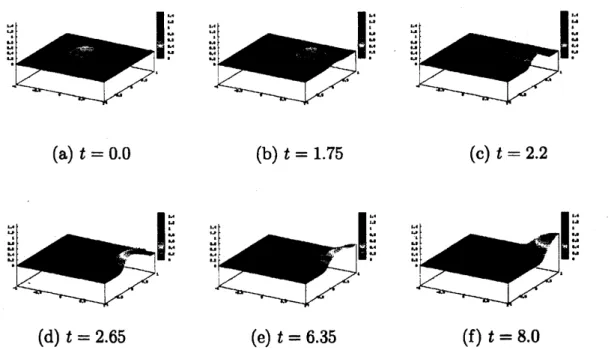
An initialvelocity is imparted to the bubble. In this case, it approaches the boundary of $\Omega$.
After touching the boundary, the bubble
moves
along the boundary. Themore
thebubble leans against the boundary, the smaller the
area
ofthe surface of the bubblebecomes. Thebubble stops and keeps the smallestsurfacewhen reachingthe corner of
$\Omega$.
(a) $t=0.\mathrm{O}$ (b) $t=1.75$ (c) $t=2.2$
(d) $t=2.65$ (e) $t=6.35$ (f) $t=8.0$
Figure 1: Neumann boundary condition. The bubble which has
an
initial velocitychosen in such away that it
moves
diagonally,moves
toward the boundary. After4.2
Collision of
two
bubbles
The second example treats a collision oftwo bubbleswith the same volume.
After
the collision, thebubbles
merge
and keepthe smallest surfacenear
the center of initialposition oftwo bubbles.
$(\mathrm{a})t=0.\mathrm{O}$ $(\mathrm{b})t=0.8$ $(\mathrm{c})t=0.9$
(d) $t=1.1$ (e) $t=1.2$ (f) $t=1.5$
Figure 2: collision of
two
bubbles. Two bubbles separated initially merge into eachother.
4.3
Division
of
oil
droplet
In the third example, the motion of oildrople on the
flat
planeon
which thereisa
nonuniform distribution of$\mathrm{s}\mathrm{u}\mathrm{r}\mathrm{f}\mathrm{a}\mathrm{c}\triangleright \mathrm{a}\mathrm{c}\mathrm{t}\mathrm{i}\mathrm{v}\mathrm{e}$
agent is considered.
Thecontact anglebetween the oildropletandtheplaneisprescribed by the affinity
ofthe material of the water surface to the oil droplet surface. Therefore, if there is
a
nonuniform distribution of surface-active agent,we
can observe that the oil dropletmoves on
the plane driven by the force ofnon-uniformity of the contact angle. Thefree-boundary condition
$|\nabla u|^{2}-(u_{t})^{2}=R^{2}$
on
$\partial\{v>0\}$ , (4.1)which is
obtained
by passingto
thelimit
as
$\mathit{6}arrow 0$ in (1.1) tellsus
thatwe
can
rulethe contact angle of the oil droplet and the plane by defining the coefficient $R$. The
(a) $t=0.0$ (b) $t=0.85$ (c) $t=1.0$
(d) $t=1.15$ (e) $t=1.2$ (f) $t=1.5$
Figure 3: Division of bubble (case 2).
aiming at the part of$\Omega$ withsmaller $R^{2}$. We set
$R^{2}=\{$
0.35
$(x_{1}x_{2}(x_{1}^{2}-x_{2}^{2})\leq 0)$
3.5
otherwise.4.4
Combination
with
reaction-diffusion equation
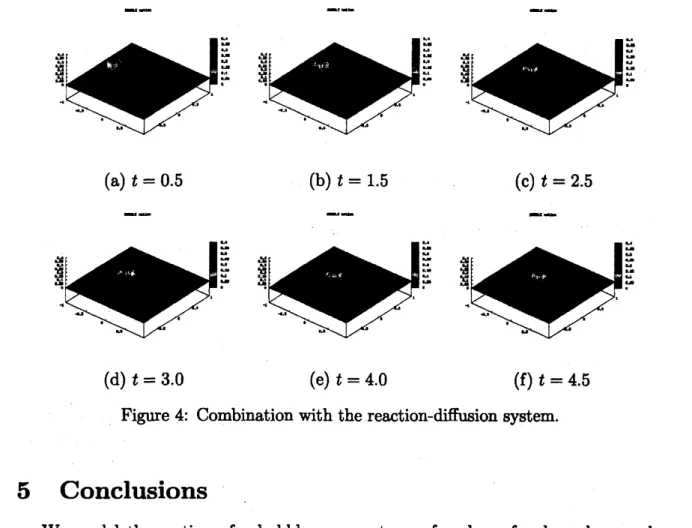
In [11] it is reportedthat
an
oildropleton
theglass planeimmersedinsurface-activeagentsolutionimmediately
moves
accordingtothegradient ofthe concentrationofthesurface-active agent. We
are
trying to realize the motion of the oil droplet numericallyby applying the model of the bubble (1.1) to this phenomenon and combiming it with
reaction-diffusion
equation which shows the time development ofthe concentration ofsurface-aetiveagent. Let$v$be the concentrationof surface-activeagent, thenour model
equation of$v$ is
as
follows:$R^{2}=( \frac{Q}{T})^{2}+\frac{\gamma_{w}(v)-\gamma_{b}}{T}$,
$v_{t}=\kappa\Delta v+\mu(v_{0}-v)v\chi_{u\leq 0}-\nu v\chi_{u>0}$,
$\gamma_{w}=\frac{\gamma_{0}}{1+\alpha v^{\beta}}$
.
Here$T$is the tensionof the oil droplet surface, $\gamma_{w}$ is thetension of glass plane surface
surface have
come
in contact, $Q>0$ is adhesion between the oil and the surfaceof plane. In the numerical experiment
we
seta
$=1,$ $\beta=2$ and impose Neumannboundary condition. We choose
the
uniform distributionas
the initial conditionfor
$v$.We
use
the explicit method to solvethis equation. It is observed that the oil dropletput
near
the boundarystarts
moving aiming at thearea
where the concentration ofthe surface-active agent is high. However, the droplet slows down and stops before
reaching the center of the domain, although it should keep moving
as
the experimentshows. We think that it is nec\’esary to improve the model,
e.g.
by considering theinternal energy of the oil in addition to thesurface energy.
$(\mathrm{a})t=0.5$ $(\mathrm{b})t=1.5$ $(\mathrm{c})t=2.5$
(d) $t=3.0$ (e) $t=4.0$ (f) $t=4.5$
Figure
4:
Combination with thereaction-diffusion
system.5
Conclusions
We model the motion of
a
bubbleon
a water
surface bya
free-boundaryprob-lem with volume conservation constraint and
we
have establisheda
numerical method for its solution. The bubblemoves
on
thewater
surfaee
while changing its shapebut preserving its volume. The model equation becomes free-boundary problem of
degenerate hyperbolic type which is difficult to
treat.
We have introduced the time.semidiscretized variational method to solve this problem and it gives good numerical
results. Thismodel
can
alsobe appliedto themotionof oilon the bottom of wateror to
thiswork hasmanyapplications and is significant for thefuture studying ofhyperbolic
free-boundary problems.
References
[1] H.
W.
Alt- L.A.
Caffarelli, “Existence and $regula7^{\cdot}ity$for
a minimum prvblemwith
free
boundary“, J. Reine Angew. Math., 325 (1981),105-144.
[2] H. Berestycki - L. A.
Cafafrelli
- L. Nirenberg,“Uniform
estimatesfor
regular-ization
of
ffoe
boundaryproblems“, in Analysis and Partial Differential Equation,Marcel Dekker, NewYork,
1990.
[3] M. Giaquinta, “Multiple integmb in the calculus
of
variations and nonlinearel-liptic systems”, Princeton University Press,
1983.
[4] H. Imai - K. Kikuchi - K. Nakane - S. Omata- T. Tachxikawa, $‘ {}^{t}A$ numerical
approach to the asymptotic behavior
of
solutionsof
a
one-dimensional hyperbolicffee
$bounda\eta$ prvblem“,JJIAM
18 No.1(2001),43-58.
[5] K. Kikuchi-S. Omata, $u_{Affee}$ boundary problem
for
aone
dimensional$h_{\Psi}erbolic$equation”, Adv. Math.
Sci.
Appl. 9 No.2 (1999),775-786.
[6]
O.
Ladyzhenskaya- N. Uraltseva, ttLinear and Quasilinear Elliptic Equations”,Academic
Press, New York and London, 1968.[7] T. Nagasawa-K. Nakane-
S.
Omata, “Nume$r\dot{\tau}cal$ Computationsfor
motionof
vortioes govemed by
a
Hyperbolic Ginzburg-Landau System”, Nonlinear Anal. 51(2002) No.1
Ser
A: Theory Methods,67-77.
[8]
S.
Omata, $‘ {}^{t}A$ Numericaltreatment
of
film
motion utthffee
boundary“,Adv. Math.Sci. Appl., 14, (2004),
129-137.
[9] T. Yamazaki - S. Omata- H. Yoshiuchi - K. Ohara, $‘ {}^{t}Bubble$ motion
on
watersurface”, Gakuto Intern. Ser. Math.
Sci.
Appl. 23 (2005),209-216.
[10] T. Yamazaki-S. Omata-K. Svadlcnka-K. Ohara, “Construction
of
approxi-mate solution to ahyperbolic
ffee
boundary prvblem utthvolume constraintand itsnume
rical computation“,Intem.
Ser. Math. Sci.
Appl.23
(2005),209-216.
Adv. Math.Sci.
Appl. 16 No.1 (2006),57-67.
[11] Y. Sumino-N. Magome-T. Hamada-K. Yoshikawa, “Self-Running $\mathrm{D}\mathrm{r}\mathrm{o}\mathrm{p}\mathrm{l}\mathrm{e}\mathrm{t}+$
Emergence ofRegular Motion fromNonequilibrium Noise”, Phys. Rev. Lett., 94,