より効率的なフィルタリング型ブースティング技法
An Efficient Smooth Boosting
by
Filtering
畑町晃平
\daggerKohei
Hatano
九州大学システム情報科学研究院情報理学部門
DepartmentofInformatics, KyushuUniversity
Abstract
Boosting is ageneral method to construct a highly accurate classifier by combining “weakly”
ac-curate ones. Smooth boosting algorithmsarevariants ofboostingmethods which handleonlysmooth
distributions onthe data. They are proved tobe noise-tolerant and canbe used in the “boosting by
filtering” scheme, which is suitable for learning over huge data. However, current smooth boosting
algorithms have rooms for improvements: A non-smooth boosting algorithm, InfoBoost canperform
moreefficiently thantypicalboosting algorithmns byusinganinformation-theoretic criterion for choosing
hypotheses. In this paper, we propose anewsmooth boosting algorithm withan information-theoretic
criterion andweshow thatitinheritsthe advantages of twoapproaches,smooth boosting andInfoBoost.
1
Introduction
Inrecentyears, huge data havebecome available
due tothe developmentof computers and the
Inter-net. In knowledgediscovery and machine learning
tasks, size of such huge data
can
reach hundredsofgigabytes or
more.
So it is important to makeknowledge discoveryormachine learning algorithms
scalable. Sanipling is one ofeffective techniques to
dealwith large data. Thatis, instead of usingwhole
the data, wecan obtain asumniaryofthedata by
sampling randomly from it. There
are
manyre-sults on sampling techniques (see,
e.g.,
[4]) andapplicationsto data mining tasks such
as
decisiontree learning [6], support vector machine [2], and
boosting $[4, 5]$
.
Especially, boosting is simple andefficient
learn-ing method
among
machine learning algorithms.The basic idea of boosting is combining many
slightly accuratehypotheses(which we call “weak”
hypotheses) into
a
highly accurateone.
Originally,boosting
was
invented underthe boosting byfilter-ing framework, where the booster
can
sampleex-amplesrandomly from
the whole
data [16, $\eta$.
Themain advantage of the filtering
framework
isthat
2Email: [email protected] jp
the learnerneedto store lessexamples. Ingeneral,
the learner have to store manyexample enough in
ordertoevaluate its finalhypothesis. On the other
hand, in boosting by framework, the booster does
not have to store all sampled examples, but have
to keep examples only for learning weak hypothe
ses, which is much smaller than those forthe final
hypotheses. Sothe boostingbyfilteringfiiamework
seems
tofitlearningtasksover
huge data. However,early boosting algorithms [16, $\eta$ which workinthe
filtering
framework
were
not practical because theywere
not adaptive, i.e., they need thepriorknowl-edge
on
theaccuracy of
weak hypotheses.Madaboost,
a
modification of$\mathrm{A}\mathrm{d}\mathrm{a}\mathrm{B}\mathrm{o}\mathrm{o}\mathrm{s}\mathrm{t}[8]$,is thefirstadaptive boosting algorithmwhich worksinthe
filtering framework [5]. Combining with adaptive
sampling methods [4], Madaboost is shown to be
more
efficient than$\mathrm{A}\mathrm{d}\mathrm{a}\mathrm{B}\mathrm{o}\mathrm{o}\mathrm{e}\mathrm{t}$over
huge data,whilekeeping the prediction accuracy. By its nature of
updating scheme, MadaBoost is categorized
as one
of(ismooth” boosting algorithms $[18, 9]$, where the
name, smooth boosting,
comes
from the fact thatthese
boosting algorithms only deal withsmooth
distributions
over
data (In contrast, for example,dis-tributions
over
data). Smoothness of distributionsenables boosting algorithms to sample data
effi-ciently. Also,smoothboostingalgorithms have
the-oretical guarantees for noise tolerance in the
vari-ousnoisy learning settings,such
as
statisticalquerymodel [5], malicious noise model [18] and agnostic
boosting [9].
However
itseems
that there is stillroom
forim-provements
on smooth
boosting. A non-smoothboosting algorithm,
InfoBoost
[1] (which isa
spe-cial form of real $\mathrm{A}\mathrm{d}\mathrm{a}\mathrm{B}\mathrm{o}\mathrm{o}\mathrm{s}\mathrm{t}[17])$, performsmore
efficiently than other boosting algorithms in the
boosting by subsampling framework, where only a
bunch of data isgiven in advance. Moreprecisely,
givenhypotheseswith
error
1/2-7/2$(0<\gamma<1)$,typical boostingalgorithmstake$O(1/\gamma^{2})$ iterations
to learn sufficiently accurate hypothesis. On the
other hand, InfoBoost learns in from $O(1/\gamma)$ to
$O(1/\gamma^{2})$ iterationsbytaking advantage
of
thesitu-ationwhen weak hypotheses have low
false
positiveerror
$[10, 11]$. So InfoBoostcan
bemore
efficientat most by$O(1/\gamma)$ times.
The main differencebetweenInfoBoost andother
boosting algorithms such as $\mathrm{A}\mathrm{d}\mathrm{a}\mathrm{B}\mathrm{o}\mathrm{o}\mathrm{e}\mathrm{t}$ or Mad-$\mathrm{a}\mathrm{B}\mathrm{o}\mathrm{o}\mathrm{s}\mathrm{t}$ is the criterion for
choosing weakhypothe
ses.
Typical boosting algorithmsare
designed tochoose hypotheseswhose errors are nnnimumwith
respect to given distributions. In contrast,
In-$\mathrm{f}\mathrm{o}\mathrm{B}\mathrm{o}\mathrm{o}\mathrm{s}\mathrm{t}$
uses an
information-theoretic criterion tochoose weak hypotheses. The criterion was
previ-ously proposed by Kearns and
Mansour
[12], andalso applied to boosting algorithms using decision
trees[12] andbranching
programs
[14]. But, sofar,no
smooth algorithmis known to have such the nicepropertyofInfoBoost.
In this paper, we modify
one
of smooth boost-ing algorithms, $\mathrm{A}\mathrm{d}\mathrm{a}\mathrm{F}\mathrm{l}\mathrm{a}\mathrm{t}[9]$, as
it is quite similarto
MadaBoost
and yet simple to analyze.Our
modification is derived in a similar way that
In-$\mathrm{f}\mathrm{o}\mathrm{B}\mathrm{o}\mathrm{o}\mathrm{s}\mathrm{t}$ is given. As a result,
we
propose anew
smooth boostimg algorithm with yet another information-theoretic criterion. Our preliminaryexperiments show that
our
modification, whichwe
call
MadaFlat
(Modificationof
$\mathrm{A}\mathrm{d}\mathrm{a}\mathrm{F}\mathrm{l}\mathrm{a}\mathrm{t}$),outper-forms MadaBoostinthe filtering framework.
2 Preliminaries
2.1 Learning Model
We adapt the
PAC
learning model [19]. Let $\mathcal{X}$be
an
instance space andlet$\mathcal{Y}=\{-1, +1\}$beasetoflabels. We
assume
an
unknown targetfunction
$f$: $\mathcal{X}arrow \mathcal{Y}$
.
Furtherweassume
that $f$is contained ina
knownclass
$F$offunctions
from$\mathcal{X}$to
$\mathcal{Y}$
.
Let$D$bean unknown
distribution
over
$\mathcal{X}$.
The learner hasan access
to the example oracle $\mathrm{E}\mathrm{X}(f, D)$.
Whengiven
a
call from
the learner, $\mathrm{E}\mathrm{X}(f, D)$ returnsan
example$(x, f(x))$ where each$x$is drawnrandomly
according to $D$
.
Let $\mathcal{H}$ bea
hypothesis space,or
a set of functions from X to $\mathcal{Y}$.
Weassume
that $\mathcal{H}\supset \mathcal{F}$
.
For any distribution $D$over
X,er-ror
ofhypothesis $h\in \mathcal{H}$ is defined as $\mathrm{e}\mathrm{r}\mathrm{r}_{D}(h)\mathrm{d}\mathrm{e}\mathrm{f}=$$\mathrm{P}\mathrm{r}_{D}\{h(x)\neq f(x)\}$
.
Let $S$ be a sample, a set ofexamples $((x_{1}, f(x_{1}),$
$\ldots,$$(x_{m}, f(x_{m})))$
.
For anysample $S$, training
error of
hypothesis $h\in \mathcal{H}$ isdefined
as
$\overline{\mathrm{e}\mathrm{r}\mathrm{r}}_{S}(h)\mathrm{d}\mathrm{e}\mathrm{f}=|\{(x_{i}, f(x_{i})\in S|h(x_{t})\neq$$f(x_{i})\}|/|S|$
.
Now
we define PAC
learnabilityas
follows.Deflnition 1 (Strong learning). A learning
al-gorithm $A$ is
a
strong leamerfor $F$ if and only if,for any $f\in F$ and any distribution $D$, given $\vee c$, $\delta$
$(0<\epsilon, \delta<1)$,
a
hypothesis space$\mathcal{H}$, andaccess
tothe example oracle$\mathrm{E}\mathrm{X}(f, D)$ asinputs,$A$outputsa
hypothesis $h\in \mathcal{H}$ such that$\mathrm{e}\mathrm{r}\mathrm{r}_{D}(h)=\mathrm{P}\mathrm{r}_{D}\{h(x)\neq$
$f(x)\}\leq\epsilon$ with probabilityat least 1–6.
On the otherhand,
an
apparentlyweakernotionof learningwasproposed [16].
Deflnition2 (Weak learning). Alearning
algo-rithm$A$is
a
weak leanerfor$\mathcal{F}$ifand only if, forany$f\in F$, given a hypothesis space $\mathcal{H}$, and
access
tothe example oracle $\mathrm{E}\mathrm{X}(f.D)$ as inputs, $A$ outputs
a
hypothesis $h\in \mathcal{H}$ such thaterr
$D(h)\leq 1/2-\gamma/2$for a fixed7 $(0<\gamma<1)$
.
2.2 $\mathrm{B}o$ostingApproai
Schapireprovedthatstrongandweak
PAC
learn-ability
are
equivalent to each other for thefirst
a strong learner by using a weak learner is called
“boosting”. Basic idea of boosting is the
follow-ing: First, the booster trains a weak learner with
respect to different distributions $D_{1},$ $\ldots$,$D_{T}$
over
the domain $\mathcal{X}$, and gets different “weak“
hypothe-ses
$h_{1},$$\ldots$,$h_{T}$ such thaterr$D_{f}(h_{t})\leq 1/2-\gamma_{t}/2$ for
each$t=1,$$\ldots,$$T$
.
Then the booster combines weakhypotheses$h_{1},$
$\ldots,$$h_{T}$into
a
final hypotheses $h_{final}$satisfying
err
$D(h_{fina\iota})\leq\epsilon$.
Definition 3. Let and be any distributions
over
$\mathcal{X}$.
Wesay that $D’$ is $\lambda$-smooth with respectto $D$ if$\sup_{X\in \mathcal{X}}D’(x)/D(x)\leq\lambda$.
The smoothness parameter A has crucial roles in robustness of boosting algorithms [5, 18, 9]. Also,
it affects the efficiency of sampling methods. For
example, byrejection sampling,
we
use
$1/\lambda$callsof
$EX(f, D)$
on
averagetosimulate
a
call of$\mathrm{E}\mathrm{X}(f, D’)$for
a
distribution$D’$ that isA-smooth$\mathrm{w}$.
$\mathrm{r}$.
$\mathrm{t}$.
$D$.
Subsampling
versus
Filtering We considertwo
frameworks
of boosting, boosting bysubsam-pling and boosting by filtering. In the
subsam-pling framework, the booster is given
a
sample$S=((x_{1}, f(x_{1}),$$\ldots,$$(x_{m}, f(x_{m})))$ in advance. The
booster constructs thefinal hypothesis whose
train-ing $\overline{\mathrm{e}\mathrm{r}\mathrm{r}}s(h_{f\dot{*}nal})\leq\epsilon$ by training the weak learner
over
the given sample $S$.
Then thegeneraliza-tion
error
is estimatedby using argumentson
VC-dimensions
or
margin (E.g.,see
[15]). Forexam-ple, for typical boosting algorithms,$\mathrm{e}\mathrm{r}\mathrm{r}_{D}(h_{f:na1})\leq$
$\overline{\mathrm{e}\mathrm{r}\mathrm{r}}s(h_{f1na\mathrm{t}})+\tilde{O}(\sqrt{T\log|W|}/m)$ 1 with high
prob-ability, where$T$ is the size ofthe final hypotheses,
i.e., the number of weak hypotheses combined in
$h_{f_{t\hslash a\iota}}$
.
In the filtering framework, on the other hand,
the booster deal with the whole instance space $\mathcal{X}$
through $\mathrm{E}\mathrm{X}(f, D)$
.
By using statistics obtainedfrom calls of $\mathrm{E}\mathrm{X}(f, D)$, the booster tries to mini-mizes
err
$D(h_{fina\iota})$ directly. Thereare
twoadvan-tages of the boostingbyfilteringover the boosting
by subsampling.
First of
all, thespace
complexityis reduced. Roughly speaking, the booster needs
tostore$\tilde{O}(T\log|W|)$ examples in the subsampling
framework,whereas,the boosteronly needtostore
$\tilde{O}(\log|\dagger V|)$ examples in the filtering framework.
Second,thebooster does not havetodeterminethe
size of sample $S$ a priori. There advantages are
preferablefor learning
over
huge data.Smooth Boosting Smooth boosting algorithms only deal such
distributions
$D_{1},$$\ldots,$$D_{t}$ that
are
“smooth” with respect to the original
distribution
$D$
.
Wedefine
the followingmeasure
ofsmoothness.1Inthe$\overline{O}(.q(n))$ notation,weneglectpoly$(1\mathrm{o}g(n))$terms.
Our Assumption and Technical Goal In the
rest of the paper,
we
assume
the weak hypothesisassumption
on
$W$as
follows: The learner isgivena
finite set $W$ ofhypothesessuchthat for any
distri-bution$D’$ over X, there existsahypothesis$h\in W$
satisfying$\mathrm{e}\mathrm{r}\mathrm{r}_{D’}(h)\leq 1/2-\gamma/2(0<\gamma<1)$
.
Now our technicalgoalisto construct
an
efficientsmooth boostingalgorithmwhich worksinboth the
subsamplingand
the
filteringframework.
3 $\mathrm{B}o$ostingby Subsampling
In this section, we propose a modification of
$\mathrm{A}\mathrm{d}\mathrm{a}\mathrm{F}\mathrm{l}\mathrm{a}\mathrm{t}$ inthe subsampling framework. Let
$\ell(x)=\{$
1, $x\geq 0$
$x-10,$’
$x\leq-1-1<x.<0$
The description of
our
modification is given inFigure 3 Given
a
sample $S=((x_{1}, f(x_{1}))$,..
.
,$(x_{m}, f(x_{m})))$, and
a
combined hypothesis $H_{t}=$$\sum_{j=1}^{t}\alpha_{j}[h_{j}(x)]h_{j}(x)$ at iteration$t$, pseudo gain of hypothesis $h$is given as
follows:
$\Delta_{t}(h)$ $=$ $\frac{m_{h,+}}{m}\mu_{h,t},[+1]^{2}\gamma_{h,t}[+1]^{2}$ $+ \frac{m_{h,-}}{m}\mu_{h,t}[-1]^{2}\gamma_{h,t}[-1]^{2}$
.
where
$\mu_{h,t}[\pm 1]=\frac{1}{m_{h,\pm}}.\sum_{:h(x_{:})=\pm 1}\ell(-f(x:)H_{t}(x.))$,
$\gamma_{h.\ell}[\pm 1]=\frac{\sum_{:.h(X.)=\pm 1}f(x.)h(x:)D_{\mathrm{t}}(i)}{\sum_{i\cdot h(l_{l})=\pm 1}D_{f}(i)}$,
$D,(x_{i})= \frac{\ell(-f(x_{i})H_{t}(x_{i}))}{\sum_{i=1}^{m}\ell(-f(x_{*})H_{t}(x.))}$,
and $m_{h,\pm}=|\{i : h(x_{i})=\pm 1\}|$ (In
the
case
when $m_{h,\pm}$ is zero,
we
assume
that $\mu_{h.t}[\pm 1]=$$\gamma_{h.t}[\pm 1]=0)$
.
At each iteration $t$,our
algorithm MadaFlat chooses hypothesis $h$thatmaximizes its$\mathrm{M}\mathrm{a}\mathrm{d}\mathrm{a}\mathrm{F}\mathrm{l}\mathrm{a}\mathrm{t}_{filt}(\epsilon, \delta, \mathrm{E}\mathrm{X}(f, D))$
begin
l.Let $H_{1}(x)=0;tarrow 1;\delta_{1}arrow\delta/4$;
2. while
Pt
$\geq\frac{4\ }{5}$ doa) $(h_{t}, S_{t})arrow \mathrm{H}\mathrm{S}\mathrm{e}\mathrm{l}\mathrm{e}\mathrm{c}\mathrm{t}(1/2,\delta_{t})$;
b) $(\hat{\mu}_{t},\hat{\mu}_{t}[+1],\hat{\mu}_{f}[-1], \gamma_{\ell}[’+1],\hat{\gamma}_{\ell}[-1])$
$arrow \mathrm{e}\mathrm{m}\mathrm{p}\mathrm{i}\mathrm{r}\mathrm{i}\mathrm{c}\mathrm{a}\mathrm{l}$ estimatesover $S_{t}$;
c) at$[+1]arrow\mu_{t}’[+1]’\gamma_{\mathrm{t}}[+1];\alpha_{\mathrm{t}}[-1]arrow\hat{\mu}_{t}[-1]\hat{\gamma}_{\mathrm{t}}[-1]$;
d) $H_{+1},(x)arrow H_{t}(x)+\alpha_{t}[h_{\mathrm{t}}(x)]h_{t}(x)_{1}$
e) $tarrow t+1;\delta_{t}arrow\delta/(2t(t+1))$;
end-while
3.Output the final hypothesisdefinedby
$h_{jinal(X)}=s\mathrm{i}\mathrm{g}\mathrm{n}(H_{T+1}(x))$;
end.
Figure 1: MadaFlat
pseudo gain $\Delta_{t}(h)$
.
For simplicity,we
denote $\Delta_{t}=$$\Delta_{t}(h_{t}),$ $\mu_{t}[\pm 1]=\mu_{h_{\mathrm{t}},t}[\pm 1]$ and
$\gamma_{t}=\gamma_{h_{\ell},t}$. Further, let
us
define $\mu_{t}=\sum_{i=1}^{m}\ell(-f(x_{i})H_{t}(x_{t}))/m$.
Foreach$h_{t}$, let $\gamma\iota=\sum_{i=1}^{m}f(x_{i})h_{t}(x_{i})D_{t}(i)$. Note that
$\mathrm{e}\mathrm{r}\mathrm{r}_{D},$$(h_{t})=1/2-\gamma_{\ell}/2$
.
First,
we
show that the smoothness ofdistribu-tions$D_{t}$
.
Proposition1. Duringthe execution ofMadaFlat,
each distribution $D_{t}(t\geq 1)$ is $1/\epsilon$-smooth with
respect to$D_{1}$, the uniform distribution over$S$
.
Next,
we
provethe
time complexity ofMadaFlat.Theorem 2.
Assume
theweak hypothesisassump-tion
on
$W$.
Then, MadaFlat outputs a finalhy-pothesis $h_{final}$ satisfying $\overline{\mathrm{e}\mathrm{r}\mathrm{r}}_{S}(h_{fina\mathrm{t}})\leq\epsilon$ within
$T=O(1/\epsilon^{2}\gamma^{2})$ iterations.
4 Boosting by Filtering
In this section, we propose $\mathrm{M}\mathrm{a}\mathrm{d}\mathrm{a}\mathrm{F}\mathrm{l}\mathrm{a}\mathrm{t}_{f;\iota\iota}$in the
filteringframework. Let
$D_{\mathrm{t}}(x)= \frac{D(x)\ell(-f(x)H,(x))}{\sum_{X\in x^{D(x)\ell(-f(x)H_{t}(x))}}}$.
We define $\Delta_{t}(h)=p_{h}\mu_{h,t}[+1]^{2}\gamma_{h,t}[+1]^{2}+(1$
-$p_{h})\mu_{h,t}[-1]^{2}\gamma_{h,t}[-1]^{2}$, where $p_{h}=\mathrm{P}\mathrm{r}_{D}\{h(x)$ $=$
$+1\}$,
$\mu_{h,t}[\pm 1]=\frac{\sum_{l\cdot h(l)=\pm 1}D(x)\ell(-f(x)H_{t}(x))}{\sum_{Xh(X\rangle=\pm 1}D(x)}$,
$\frac{\mathrm{H}\mathrm{S}\mathrm{e}1\mathrm{e}\mathrm{c}\mathrm{t}(\epsilon,\delta)}{\mathrm{b}\mathrm{e}\mathrm{g}\mathrm{i}\mathrm{n}}$
$marrow 0;Sarrow\emptyset;iarrow 1;\Delta_{g}arrow 1;\delta’arrow\delta/(2|W|)$;
repeat
$(x, j(x))arrow \mathrm{E}\mathrm{X}(f, D)_{j}$
$Sarrow S\cup(x, f(x));marrow m+1$;
if$m= \mathrm{r}.\frac{r_{1}\ln\# b}{\Delta_{g}}]$ then
if$\exists h\in W,\hat{\Delta}(h, S)\geq\Delta_{g}$then return $h$and $S$;
elseAg $arrow\Delta_{\mathit{9}}/2;iarrow i+1;\deltaarrow\delta/(i(i+1)|W|)$;
end-if
end-repeat
end.
Figure 2: $\mathrm{M}\mathrm{a}\mathrm{d}\mathrm{a}\mathrm{F}\mathrm{l}\mathrm{a}\mathrm{t}_{f1lt}$
and
$\gamma_{h,t}[\pm 1]=\frac{\sum_{x:h(X\rangle=\pm 1}-f(x)h(x)D(x)\ell(-f(x)H_{t}(x))}{\sum_{X.h(l)=\pm 1}D(x)\ell(-f(x)H_{t}(x))}$,
respectively.
Also let
$\mu_{t}=\sum_{x\in x}D(x)\ell(-f(x)H_{t}(x))$
and$\gamma_{h,t}=p_{h}\gamma_{h,t}[+1]+(1-p_{h})\gamma_{h,t}[-1]$
. As
intheprevious section,we use thesimilarnotation: $\Delta_{t}=$
$\Delta_{t}(h_{t}),$$p_{l}=p_{h_{\mathrm{t}}}$, and$\gamma_{t}[\pm 1]=\gamma_{h,t}[\pm 1]$
.
We denote\^a
as
theempiricalestimate of theparameter$a$givena sample $S_{t}$
.
The description of $\mathrm{M}\mathrm{a}\mathrm{d}\mathrm{a}\mathrm{F}\mathrm{l}\mathrm{a}\mathrm{t}_{fut}$ isgiven inFigure 2.
First,we prove thefollowing lemma.
Lemma 1.
Let
$\hat{\Delta}_{t}=\hat{p}_{\ell}\hat{\mu}_{t}[+1]^{2}\hat{\gamma}_{\ell}[+1]^{2}+(1$ -$\hat{p}_{t})\hat{\mu}_{t}[-1]^{2}\hat{\gamma}_{t}[-1]^{2}$ be the empirical estimate of $\Delta_{t}$given $S_{t}$
.
Then itholds for
any $\epsilon(0<\epsilon<1)$that $D^{m}\mathrm{P}\mathrm{r}\{\hat{\Delta}_{t}\geq(1+\epsilon)\Delta_{t}\}\leq b_{1}e^{-\frac{2_{\Delta m}}{\mathrm{c}_{1}}}$.
(1)$D^{m}\mathrm{P}\mathrm{r}\{\hat{\Delta}_{t}\leq(1-\epsilon \mathrm{i})\Delta_{t}\}\leq b_{1}e$ (2 (2)
$-\underline{c^{2}}\Delta m$
where$b_{1}\leq 8,$ $c_{1}\leq 600$, and$c_{2}\leq 64$ ,
Thenwe$s$how the propertyof HSelect.
Lemma 2. Fix any step $t$ in MadaFlat. Let
$\Delta_{*}=\max_{h\in w}\Delta_{t}(h)$. Then, the following
state-ments hold. (i) With probability at least 1 $-\mathit{6}_{!}$
$\mathrm{H}\mathrm{S}\mathrm{e}\mathrm{l}\mathrm{e}\mathrm{c}\mathrm{t}(\epsilon, \delta)$outputs
a
hypothesis$h\in W$such that$\Delta_{t}(h)>(1-\epsilon)\Delta_{*}$
.
(ii)The number of $\mathrm{c}\mathrm{a}\mathrm{U}s$ of$EX(f,D)$ is
$O( \frac{\log\frac{1}{\delta}+\log|W|+\log\log\frac{1}{\Delta}}{\epsilon^{2}\Delta_{l}}$
.
$)$.
Finally
we
obtainthe followingtheorem.Theorem 3. Withprobability at least $1-\delta$,
(i) $\mathrm{M}\mathrm{a}\mathrm{d}\mathrm{a}\mathrm{F}\mathrm{l}\mathrm{a}\mathrm{t}_{fi1t}$ output$s$ the final hypothesis
$h_{fina1}$ such that $\mathrm{e}\mathrm{r}\mathrm{r}_{D}(h_{final})\leq\epsilon$,
(ii)
MadaFlat
filt terminates in $T=O(1/\epsilon^{2}\gamma^{2})$it-erations, and
(iii) the number of callsof$\mathrm{E}\mathrm{X}(f, D)$ is
$O( \frac{\log\frac{1}{\delta}+\log\frac{1}{\epsilon\gamma}+\log|W|+\log\log\frac{1}{\epsilon\gamma}}{\vee--2\gamma 4})$
.
5 Experimental Results
In this section, we show
some
experimentalre-sults
on
both artificial and real datasets. Ourex-perimentsconsists
of
two parts.In
the
first part, we compare MadaFlat,Ad-$\mathrm{a}\mathrm{B}\mathrm{o}\mathrm{o}\mathrm{s}\mathrm{t},$ InfoBoost, and MadaBoost. in the
sub-samplingframework.
For realdata,we use
some
datasets from UCIma-chine learning repository [3]. Also, we prepare
arti-ficialdatain order to examine behavior of boosting
algorithms in details. To do so weuse r-of-k
func-tion
as
the targetinction. An
r-of-k function $f$over boolean domain $\{-1, +1\}^{N}$ consists of$k$
rele-vant variablesand $f(x)=+1$ if at least $r$ ofthe $k$
relevant variables
$\mathrm{t}\mathrm{a}\mathrm{k}\mathrm{e}\mathrm{s}+1$, otherwise
$f(x)=-1$.
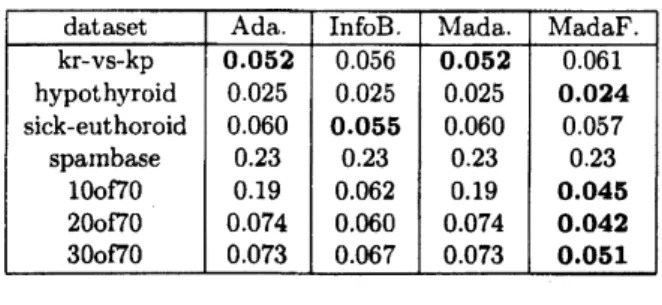
Table
1:
Testerrors
of boosting algorithms inthesubsamplingframework.
Notethat l-of-k function andk/2-of-kfunction
cor-respond to $k$-disjunction and $k$-majority,
respec-tively. In [11], it isshown that InfoBoost
can
learnr-of-k functions in$O(rk)$ steps whereas $\mathrm{A}\mathrm{d}\mathrm{a}\mathrm{B}\mathrm{o}\mathrm{o}\mathrm{s}\mathrm{t}$
needs $O(k^{2})$ stepswhen boolean literals
are
usedas
weak hypotheses. For $r=1,3,5$and$k=10$,
we
fixa r-of-k function
over 100
boolean variablesas
thetarget function,and
we
generate10,000
randomex-amples labeled by each r-of-k function, where the
random examples
are
drawn so that positive andnegative examples are equally likely. The size of
data
we use
varies$\mathrm{h}\mathrm{o}\mathrm{m}$about 3,000to 10,000.For eachdataset, we prepare decisionstumps and the constant hypothesis +1 (i.e. the hypothesis
that always
answers
+1)as
weak hypotheses. Ineachdataset, each record have nruneric attributes
orbinaryattributes. Foreachnumericattribute,
we
construct
a
decisionstump witha
threshold,which$\mathrm{p}\mathrm{r}\text{\’{e}} \mathrm{i}\mathrm{c}\mathrm{t}\mathrm{s}+1$ or-l depending
on
whether thevalueof the attribute is
below
thethreshold
or
not. The threshold is chosenso
that thetrainingerror
of thedecision stump is minimized. For
each
binaryat-tribute,
we
prepare the decision stump whichan-swers
thevalue of theattribute.We evaluate theboostingalgorithms by
cross
val-idation. We split each data randomly
10
times,whereeach example is put into a training set with
probability
0.7
anda
test set with with probability0.3.
Foreachtraining set,we
run
theboostingalgo-rithms in100stepsand evaluatetheir final
hypothe-ses on
thetest
data. The resultsare
summarized inAs shown in Table5, performance of MadaFlat-appearsto becomparabletothoseof others
on
realdatasets. Also, MadaFlat is significantlybetter on
artificial datasets, as well
as
InfoBoost.In the secondpart,
we
compare MadaBoost andMadaFlatin the filteringframework. Basic settings
of our experiments in the filtering framework are
the
same as
those in the subsampling framework,except the following: First ofall, in order to
ob-tainlarge datasets,
as
is done in [4],we inflate
thedatasets by preparing
100
copies of each record inthe dataand changing their orderrandomly.
Con-sequently, the size of the inflated data varies ffom
300, 000 to 1, 000,000. Second, instead of running
each algorithm in
100
steps,we
run
them untiltheysample 10,0000examples. Moreprecisely, we
run
MadaFlatwith HSelect$(\epsilon, \delta)$, where parameter$\epsilon=0.5$ and $\delta=0.1$
are
fixed. Also, werun
Mad-$\mathrm{a}\mathrm{B}\mathrm{o}\mathrm{o}\mathrm{s}\mathrm{t}$with
geometric$\mathrm{A}\mathrm{d}\mathrm{a}\mathrm{S}\mathrm{e}\mathrm{l}\mathrm{e}\mathrm{c}\mathrm{t}$whoseparameters
are
$s=2,$ $\epsilon=0.5$and $\delta=0.1$.
Third, note that
we use
heuristics for Lemma 1.Although
Lemma
1 givesa
theoretical guaranteeto approximatethepseudo gainaccurately enough,
it is too rough to
use
in practice. By using the central limittheorem, it isnot hard to show that Aisasymptoticallydistributed from$N(\Delta, \sigma^{2})$, where
$\sigma\leq 5\Delta/m$
.
This analysis implies that it is safe toreplacethe condition
on
$m$ inHSelect with$m= \lceil\frac{10(\ln\pi_{\delta’}^{1}--\frac{1}{2}\ln\ln_{\sqrt{8\delta’}^{1)}}}{\Delta_{g}}\rceil$
.
Inthefollowing experiments,
we
usethis improvedheuristics.
Finally, in addition,
we
apply MadaBoost andMadaFlatfor
text categorization taskson
a
collec-tion ofReuters news (Reuters-215782). We use the modified Apte$(” \mathrm{M}\mathrm{o}\mathrm{d}\mathrm{A}\mathrm{p}\mathrm{t}\mathrm{e}")$ split which
con-tains about 10,000news
documents labeled withtopics. Wechoose twomajor topics(“$\mathrm{e}\mathrm{a}\mathrm{m}\mathrm{i}\mathrm{n}\mathrm{g}\mathrm{s}$” and
“acquisitions”) and for each of two topics, we let
boosting algorithms classify whether
a news
doc-ument belongs to the topic
or
not. As weakhy-potheses,we prepare about 30,000decision stumps
correspondingto words. This experiment is donein
the
same
settingofprevious ones, exceptthatwedo2http:$//\mathrm{w}\mathrm{w}\mathrm{w}$.daviddlewis.$\mathrm{c}\mathrm{o}\mathrm{m}/\mathrm{r}\mathrm{o}\mathrm{e}\mathrm{o}\mathrm{u}\mathrm{r}\mathrm{c}\mathrm{e}\mathrm{s}/\mathrm{t}\mathrm{e}\epsilon \mathrm{t}\mathrm{c}\mathrm{o}\mathrm{l}\mathrm{l}\mathrm{e}\mathrm{c}\mathrm{t}\mathrm{i}\mathrm{o}\mathrm{n}\mathrm{s}$ $/\mathrm{r}\mathrm{e}\mathrm{u}\mathrm{t}\mathrm{e}\mathrm{r}\mathrm{s}21578$.
Table 2:
Test
errors
of boosting algorithms in the filteringframework.
notinflatethisdataset. Theresults
are
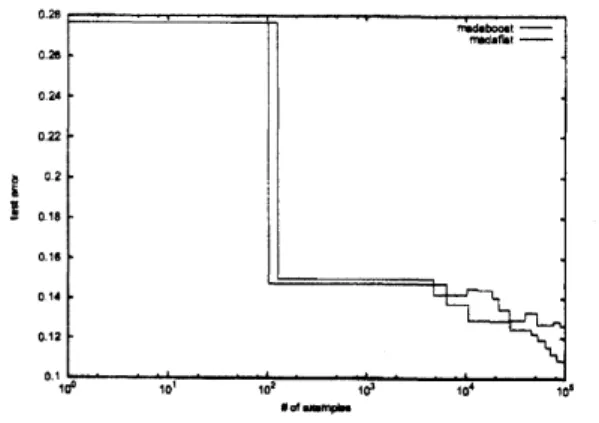
summarized inTable 5.As
indicated in Table 5 and Figure 3, MadaFlatoften outperforms MadaBoost.6 Summary and Rture Work
In this paper, we propose a modification of
$\mathrm{A}\mathrm{d}\mathrm{a}\mathrm{F}\mathrm{l}\mathrm{a}\mathrm{t}$ that
uses an information-theoretic
crite-rion for choosing hypotheses.
Our
preliminaryex-periments show that
our
modification appears tooutperform MadaBoost in the filtering
framework.
As future work, advantages and noise torelance of MadaFlat
are
yet to be investigated theoretically.Also,
we
plan to conduct experimentsover
muchlarger data.
Acknowledgments
Thiswork is supported inpart by the $2\mathrm{l}\mathrm{s}\mathrm{t}$
cen-tury
COE
program at Graduate School ofInforma-tion Science and Electrical Engineeringin Kyushu University.
References
[1] J. A. Aslam. Improvingalgorithnts for
boost-ing. InProc. 13thAnnu.
Confere
nce
onCom-put. Leaming Theory,pages 200-207,
2000.
[2] Jose L. Balcazar, Yang Dai, and
Osamu
Watanabe. Provably fast training algorithms
boosting and applicationto agnosticlearning.
Joumal
of
Machine Learning Research,2003.
Figure
3:
Test error of boosinting algorithms forReuters-21578
data. The testerrors are
averagedover
topics. The lower line correspondstothe testerror
ofh4adaF1at.IEEE International
Conference
on Data ${\rm Min}-$ing (ICDM’Ol), pages43-50, 2001.
[3] C.L. Blake D.J. Newman, S. Hettich and C.J. Merz. UCI repository of machine learning
databases, 1998.
[4] C. Domingo, R.
Gavald\‘a,
andO.
Watanabe. Adaptive sampling methods for scaling upknowledge discovery algorithms. Data Mining
and Knowledge Discovery,$6(2):131-152$,
2002.
[5] C. Domingo and O. Watanabe. MadaBoost:
A modification of AdaBoost. In Proceedings
of
13th AnnualConference
on
ComputationalLearning Theory, pages180-189,
2000.
[6] P. Domingos and G. Hulten. Mining
high-speeddata streams. In Prvceedings
of
the SixthACM Intemational
Conference
on KnowledgeDiscovery and Data Mining, pages 71-80, 2000.
[7] Y. Freund. Boosting
a
weaklearning algorithmby majority.
Information
and Computation,$121(2):256-285$,
1995.
[8] Y. Freund and R. E. Schapire:. A
decision-theoreticgeneralization
of
on-line learningandan
application to boosting. Joumalof
Com-puter and System Sciences, $55(1):119-139$,
1997.
[10] K. Hatanoand M. K. Warmuth. Boosting
ver-sus
covering. In Advances in NeuralInforma-tion Processing Systems 16, 2003.
[11] K. Hatano and O. Watanabe. Learning r-of-k
functions by boosting. In Prvceedings
of
the 15th IntemationalConference
on
AlgorithmicLeaming Theory,
pages
114-126,2004.
[12] M. Kearns and Y. Mansour.
On
theboost-ing ability oftop-down decision tree learning
algorithms. Joumal
of
Computerand SystemSciences, 58(1): 109-128, 1999.
[13] Michael J. Kearns, Robert E. Schapire, and
Linda Sellie. Towa.rd efficient agnostic
learn-ing. In COLT, pages 341-352,
1992.
[14] Yishay Mansour and David A. McAUaeter.
Boosting using branching programs. Joumal
of
Computerand System Sciences, $64(1):103-$112,
2002.
[15] R. Meir and G. Rdtsch. An introduction to
boosting andleveraging. In Advanced lectures
on
machine leaming,pages 118-183.
Springer-VerlagNew York, Inc,
2003.
[16] Robert E. Schapire. The strength of weak
learnability. Machine Leaming, $5(2):197-227$,
1990.
[17] Robert E. Schapire and Yoram Singer.
Im-proved boosting algorithms using
confidence-rated predictions. Machine Leaming,
$37(3):297-336$,
1999.
[18] R. A. Servedio. Smoothboostingandlearning
withmalicious noise. In
14th
AnnualConfer-enceon Computational Leaming Theory, pages
473-489,
2001.
[19] L. G. Valiant. A theoryof the learnable.
Com-munications