Verified
eigenvalue
evaluation
for Laplace
operator
on
arbitrary
polygonal
domain
早稲田大学理工学術院/CREST,JST 劉 雪峰 (Xuefeng Liu) 大石 進一 (Shin’ichi Oishi)
Faculty ofScience and Engineering, Waseda University
Abstract
For eigenvalue problem of Laplace operator over polygonal domain $\Omega(\subset R^{2})$
of arbitrary shape, we proposed an algorithm based on finite element method
to bound the leading eigenvalues with indices guaranteed. The algorithm is
developed by welluseof max-min and min-max principles and newly constructed
a priori error estimation for FEM solution. The efficiency of the algorithm is
demonstratedby several computation examples.
1
Introduction
The eigenvalue problem of Laplacian has been well investigated in history from
various viewpoints. Here, we pay attention to giving accurate bounds for eigenvalues
with indices guaranteed. For such a purpose, Lehmann-Goerisch method is wellknown
as
a
effective way to give sharp bounds for eigenvaluesonce a
quantity $\nu$ satisfying$\lambda_{k}<\nu\leq\lambda_{k+1}$ is available, where $\lambda_{k}$ denotes the eigenvalues with increasing order
on
magnitude. To find such a $\nu$is not an easy work. In [8], M. Plum developed homotopy
method basedon operator comparison theorem to give acomputable lノ.As base problem
with explicit eigenvalues is necessary when we apply the homotopy method, domain
mapping is used to construct the base problem, which brings difficulties to solving
problems over general domain.
Inthis paper, startingfrom
an
earlyworkof Birkhoff, deBoor, Swartz andWendroff[2], we propose a
new
method to give guaranteed estimation for leadingk-th eigenvalueon arbitrary polygonal domain, where the finiteelement method(FEM) is used to give
approximate eigenvalues with computable error bounds. The estimate of $\lambda_{k}$ obtained
by using sparse domain triangulation will be relatively rough, but it can work
as
agood candidate of ノ mentioned above $Thus$, if$needed$, the bounds can be sharpened
by further applying Lehmann-Goerisch method. The method proposed here can deal
with three types homogeneous boundary conditions associated with function space:
Dirichlet, Neumann and mixed
one.
To explain the method in a concise way, we onlyshowdetails for theDirichlet case. Also, it is possible toextend themethod for general
elliptic problem.
At the end of this paper, we show computation results on triangle and L-shaped
domain.
2
Preliminaries
$Let_{\mathfrak{l}}\zeta]$ be polygonal domain with arbitrary shape,
convex
ornon-convex.
Wein-troduce function space $V=H_{0}^{1}(\Omega)=\{v\in H^{1}(\Omega)|v=0 on \partial\Omega\}$. The notation $\Vert v\Vert_{L_{2}}$
$\mathcal{T}^{h}$ be
one
triangularization of $\Omega$, whichhas
polygon boundary. The variational formof eigenvalue problem is defined
as
below:Find $\lambda\in R$ and $u\in V$ s.t. $(\nabla u.\nabla v)=\lambda(u, v)$, $\forall v\in V$. (1)
The classical continuous piecewise linear finite element(FE) space $V_{h}\subset V$ will be
used
as
approximation space. The Ritz method is to solve the variational problem in$V_{h}$,
Find $\lambda^{h}\in R$ and $u_{h}\in V_{h}$ s.t. $(\nabla u_{h}, \nabla v_{h})=\lambda^{h}(u_{h}, v_{h})$ . $\forall v_{h}\in V_{h}$ . (2)
Supposing the bases of $V_{h}$ to be $\{\phi_{i}\}_{i=1}^{n}$, the problem of (2) is in fact a generalized
matrix eigenvalue problem:
$A^{h}x=\lambda^{h}B^{h}$, where $A_{i,j}^{h}=(\nabla\phi_{i}, \nabla\phi_{j})_{L_{2}},$$B_{i,j}^{h}=(\phi_{i}, \phi_{j})_{L_{2}}$ . (3)
The eigenvalues $\lambda_{k}^{h}$
can
be evaluated accurately by applyingverifiedcomputations, c.f.,[1, 7, 9]. Denote by $\{\lambda_{i}, u_{i}\}$ (resp. $\{\lambda_{i}^{h},$$u_{i}^{h}\}$ ) the eigenpairs of (1) (resp. (2)) with
eigenfunction being orthogonallynormalized under $L_{2}$-norln. These eigenpairs
are
justthe stationary values and critical points of Rayleigh quotient on space $V$ (resp. $V_{h}$):
$R(u)$ $:=(\nabla u, \nabla u)/(u.u)$ . (4)
Since
an
upperbound for $\lambda_{i}$as
$\lambda_{i}\leq\lambda_{i}^{h}$ is easytoobtain from min-maxprinciple, wewill pay attention to find satisfactory lower boundsfor eigenvalues. The eigenfunction
estimation will not be discussed here.
Let’s introduce two constants $C_{i,h}(i=0,1)$ to be used later, which are related to
function interpolations $\pi_{i}(i=0,1)$ over triangle element $K$. For $u\in L_{2}(K),$ $\pi_{0}u$ is
constant function s.t.
$\pi_{0}u\equiv\int_{K}u(x)dx/\int_{K}1dx$ , (5)
and for $u\in H^{2}(K),$ $\pi_{1}u$ is linear function s.t.
$(\pi_{1}u)(x)=u(x)$ on each vertex of K. (6)
Global interpolations$\pi_{0,h}$ and $\pi_{1,h}$
are
just the extension of $\pi_{0}$ and $\pi_{1}$. Define $h$ by themesh size and $C_{0,h}$ and $C_{1,h}$ the constants
over
triangulation $\mathcal{T}_{h}$,$C_{i,h}$ $:= \max C_{i}(K)/h$ $(i=0,1)$ , (7)
$K\in \mathcal{T}^{h}$
where
$C_{0}(K):= \sup_{v\in H^{1}(K)\backslash \{0\}}|\pi_{0}u-u|_{L_{2}}/|u|_{H^{1}}$. $C_{1}(K):= \sup_{v\in H^{2}(K)\backslash \{0\}}|\pi_{1}u-u|_{H^{1}}/|u|_{H^{2}}$ .
3
Lower bound of eigenvalues
by
adopting
min-max
and
max-min
principle
In this section, we will introduce two methods to give lower bound for eigenvalues, all
of them adopting computable a priori estimate of Ritz-Galerkin solution of Poisson‘s
problem. Let $u\in H_{0}^{1}(\Omega)$ be the solution of following variation problem,
The solution $u\in H_{0}^{1}(\Omega)$, in meaning of distribution,
satisfies
the partialdifferential
$equation-\triangle u=f$. Whether$u$ belongs to $H^{2}(\Omega)$
or
notdependson
the domain shape.Let $P_{h}$ be the orthogonal projection of $u\in V$ into
$V_{h}$,
$(\nabla u-\nabla P_{h}u, \nabla v_{h})=0$ $\forall v_{h}\in V_{h}$ . (9)
We will deduce a computable a apriori error estimate in the form as below,
$|u-P_{h}u|_{H^{1}}\leq M\Vert f\Vert_{L_{2}},$ $\Vert u-P_{h}u\Vert_{L_{2}}\leq M|u-P_{h}u|_{H^{1}}\leq\Lambda I^{2}\Vert f\Vert_{L_{2}}$ , (10)
where $M$ is quantity to be evaluated in Section 4. In the following, we will introduce
two methods to bound eigenvalues based onthis apriori error estimation.
3.1
Birkhoff
$s$method:
application of
Min-Max
principle
Birkhoff, de Boor,
Swartz
and Wendroff [2] considered eigenvalue problem in form ofRayleigh quotient $R(u)$ $:=N(u)/D(u)$ , where $N(u)$ and $D(u)$ are quadratic forms of
$u\in V$ and $D(u)>0$ for $u\neq 0$. Suppose $\{\lambda_{k}, u_{k}\}$ (resp. $\{\lambda_{h}^{k},$$u_{k}^{h}\}$) the stationary
values and critical points of $R(u)$ on space $V$ (resp. $V_{h}$), with increasing order on $\lambda_{k}$
(resp. $\lambda_{h}^{k}$). Birkhoff et al
deduced an
estimate for$\lambda_{k}^{h}$ by applying Min-Max principle:
Theorem 1. Given any $v_{1}^{h},$$v_{2}^{h},$
$\cdots,$$v_{k}^{h}\in V_{h}(\subset V)$ satisfying $\sum_{i=1}^{k}D(v_{i}^{h}-u_{i})<1$, we
have,
for
$k\geq 1$,$\lambda_{k}\leq\lambda_{h}^{k}\leq\lambda_{k}+(\sum_{i=1}^{k}N(v_{i}^{h}-u_{i}))/(1-(\sum_{i=1}^{k}D(v_{i}^{h}-u_{i}))^{1/2})^{2}$ (11)
For model problem of Laplacian in (1), $N(u)=(\nabla u, \nabla u)$ and $D(u)=(u, u)$. It
is natural to select $v_{i}^{h}=P_{h}u_{i}(i=1, \cdots, k)$ for each eigenfunction $u_{i}$, and apply the
error
estimate of (10):$|u_{i}-P_{h}u_{i}|_{H^{1}}\leq M\Vert\triangle u_{i}\Vert_{L_{2}}=M\lambda_{i}\Vert u_{i}\Vert_{L_{2}}=M\lambda_{i}$ .
1
$u_{i}-P_{h}u_{i}\Vert_{L_{2}}\leq M|u_{i}-P_{h}u_{i}|_{H^{1}}\leq M^{2}\lambda_{i}$.Thus, we obtain an a priori estimate for $\lambda_{k}^{h}$.
Theorem 2. Let $\lambda_{k}$ and$\lambda_{k}^{h}$ be the
ones
defined
inSeetion 2.If
$1-l \downarrow I^{2}(\sum_{i=1}^{k}\lambda_{i}^{2})^{1/2}>0$,we have
$\lambda_{k}^{h}\leq\lambda_{k}+M^{2}\sum_{i=1}^{k}\lambda_{i}^{2}/(1-M^{2}(\sum_{i=1}^{k}\lambda_{i}^{2})^{1/2})^{2}$ (12)
Define function $\phi_{1}$ on variable $t_{k}$ with parameters $\{t_{1}, \cdots, t_{k-1}\}$
as
below,$\phi_{1}(t_{k};t_{1}, \cdots, t_{k-1}):=t_{k}+M^{2}\sum_{i=1}^{k}t_{i}^{2}/(1-\lrcorner\iota I^{2}(\sum_{i=1}^{k}t_{i}^{2})^{1/2})^{2}$ (13)
Noticing that $\phi_{1}$ is increasing
as
varible $t_{k}$ increases, $\phi_{1}(t_{k})$ has increasing inversefunction. Therefore, $\phi_{1}^{-1}(\lambda_{k}^{h};\lambda_{1}, \cdots , \lambda_{k-1})\leq\lambda_{k}$ . As $\lambda_{i}\leq\lambda_{i}^{h}$ for $i\geq 1$, we can further
see
Remark
3.1. In practical computation, insteadof
verifying $1- \lrcorner lI^{2}(\sum_{i=1}^{k}\lambda_{i}^{2})^{1/2}>0$,we
will check astronger
condition
$1- \lrcorner\iota I^{2}(\sum_{i=1}^{k}\lambda_{i}^{h^{2}})^{1/2}>0$ since $\lambda_{i}^{h}(\geq\lambda_{i})s$are
computableones.
Remark 3.2. Birkhoff, de Boor, Swartz and
Wendroff
$[2J$ obtained the estimationof
form
(11) with $V_{h}$ the space constructed by splinefunctions.
By applying the errorestimate
for
spline interpolation, quantitative estimatefor
eigenvalue problemof
lDSturm-Liouville system is successfully done. However, it $\iota s$
difficult
to apply theirmethod to solve problem on general $2D$ domain. As a companson, our estimation in
Theorem 2 and 3can deal with eigenvalue problem with domain
of
general shape, whichinhents advantages
from
thefinite
element method.3.2
Bounding
eigenvalues
by
adopting
Max-Min
principle
Theorem3 (Liu). Let$v_{1}^{h},$$\cdots,v_{k-1}^{h}$ be arbitrary
functions of
$V_{h}$ and$V_{k-1}$ $:=span\{v_{1}^{h}, \cdots, v_{k-1}^{h}\}$.Define
$\tilde{\lambda}_{k}$by Rayleigh quotient on $V_{h}\cap V_{k-1}^{\perp}$ ($V_{k-1}^{\perp}$ : complement space
of
$V_{k-1}$ in $V$)$\tilde{\lambda}_{k}=\min_{v_{h}\in V_{h}\cap V_{k-1}^{\perp}}\frac{(\nabla v_{h},\nabla v_{h})}{(v_{h},v_{h})}$.
Then, an a posteriori estimate
for
$\tilde{\lambda}_{k}\iota s$ available,$\tilde{\lambda}_{k}-\lambda_{k}\leq(l\mathfrak{l}I\tilde{\lambda}_{k})^{2}/(1+M^{2}\tilde{\lambda}_{k})$ (14)
where $M$ is the one in (10).
Proof.
FromMax-Min
principle,we
have$\lambda_{k}=\max W\subset V,\dim(W)\leq k-1$
$\min_{v\in W^{\perp}}\frac{(\nabla v,\nabla v)}{(v,v)}$ .
Thus, for specified $V_{k-1}$ $:=$ span$\{v_{1}^{h}, \cdots, v_{k-1}^{h}\}$, alower bound for $\lambda_{k}$ is given as
$\lambda_{k}\geq\min_{v\in V_{k-1}^{\perp}}\frac{(\nabla v,\nabla v)}{(v,v)}$. (15)
For any $v\in V_{k-1}^{\perp},$ $P_{h}v\in V_{h}$. Let $w_{h}$ be arbitrary
one
in $V_{k-1}(\subset V_{h})$. Then$(\nabla v, \nabla w_{h})=0$. Thus $(\nabla P_{h}v, \nabla w_{h})=(\nabla v, \nabla w_{h})=0$, which implies that $P_{h}v\in$
$V_{h}\cap V_{k-1}^{\perp}$. Considering (10) and the definition of
$\tilde{\lambda}_{k}$
,
$\Vert v\Vert_{L_{2}}\leq\Vert P_{h}v\Vert_{L_{2}}+\Vert v-P_{h}v\Vert_{L_{2}}\leq\tilde{\lambda}_{k}^{-1/2}\Vert\nabla P_{h}v\Vert_{L_{2}}+\Lambda I\Vert\nabla(v-P_{h}v)\Vert_{L_{2}}$ .
$\Vert v\Vert_{L_{2}}^{2}\leq(\overline{\lambda}_{k}^{-1}+1\downarrow I^{2})(\Vert\nabla P_{h}v\Vert_{L_{2}}^{2}+\Vert\nabla(v-P_{h}v)\Vert_{L_{2}}^{2})=(\tilde{\lambda}_{k}^{-1}+1\mathfrak{l}I^{2})\Vert\nabla v\Vert_{L_{2}}^{2}$ .
Hence,
$\Vert\nabla v\Vert_{L_{2}}^{2}/\Vert v\Vert_{L_{2}}^{2}\geq\tilde{\lambda}_{k}/(1+\lrcorner \mathfrak{h}I^{2}\tilde{\lambda}_{k})$ for any $v\in V_{k-1}^{\perp}$ .
The equation (15) tells us,
$\lambda_{k}\geq\tilde{\lambda}_{k}/(1+1|I^{2}\tilde{\lambda}_{k})$ (16)
Remark 3.3. The subspace $V_{k-1}$ in Theorem 3
can
be taken as theone
spanned byfirst
$k-1$ eigenfunctionof
(2). In this case, $\tilde{\lambda}_{k}=\lambda_{k}^{h}$ and lower boundof
$\lambda_{k}$ is given$as$;
$\lambda_{k}^{h}/(1+l|I^{2}\lambda_{k}^{h})\leq\lambda_{k}\leq\lambda_{k}^{h}$ . (17)
It is obvious that the above estimate based on Max-Minprinciple gives better estimate
than the one
of
(11).4
A
prioiri
error
estimate
for Ritz-Galerkin
solu-tion
of
Poisson’s
problem
The following section will be devoted to evaluating $M$ appearing in a priori error
estimate (10) for projection $P_{h}$. The discussion will be divided into two parts, the
one with regular solution on convex domain and the one with singular solution on
non-convex
domain.4.1
Convex
domain
First, we quote a well known result on a priori estimation for Laplacian.
Lemma 4. [4]Assume $\Omega$ is bounded convexpolygonal domain in $R^{2}$. For$u\in H^{2}(\Omega)\cap$
$H_{0}^{1}(\Omega)$ or$u\in H^{2}(\Omega)$ and$\partial u/\partial n=0$ on $\partial\Omega$, let $f$ $:=-\triangle u$. Then, we have
$|u|_{H^{2}}\leq\Vert\triangle u\Vert_{L_{2}}=\Vert f\Vert_{L_{2}}$ .
Theorem 5. Let$\Omega$ be convexpolygonal domain and
$u$ be the solution
of
(8). The errorestimate
for
$(u-P_{h}u)$ is given as$|u-P_{h}u|_{H^{1}}\leq C_{1,h}h\Vert f\Vert_{L_{2}}$, $\Vert u-P_{h}u\Vert_{L_{2}}\leq C_{1,h}h|u-P_{h}u|_{H^{1}}\leq C_{1,h}^{2}h^{2}\Vert f\Vert_{L_{2}}$ .
Thus, we can take $M:=C_{1,h}h$ under current assumptions.
Proof.
Under the given assumptions, the solution $u$ belongs to $H^{2}(\Omega)$. By usinginter-polation error estimate for $\pi_{1,h}$ and the Lemma 4, wehave,
$|u-P_{h}u|_{H^{1}}\leq|u-\pi_{1,h}u|_{H^{1}}\leq C_{1,h}h|u|_{H^{2}}\leq C_{1,h}h\Vert f\Vert_{L_{2}}$ , (18)
where the constant $C_{1,h}$ is the
one
defined
in (7).The
$L_{2}$-norm error
estimationcan
be easily done by adopting Aubin-Nitsue’s technique.
$\square$
4.2
Non-convex domain
To deal with problem on
non-convex
domain, which has singular solution notbelong-ing to $H^{2}(\Omega)$, we adopt the hypercircle equation to deduce
a
computablea
priorierror
estimate. Let $W^{h}$ be the lowest order Raviart-Thomas FEM space over domain
trian-gulation $\mathcal{T}^{h}$ and $\lrcorner lI^{h}$ the space ofpiecewise constant. Also, define subspace of $W_{h}$ for
$f_{h}$ in $M^{h},$ $W_{f_{h}}^{h}$ $:=\{p_{h}\in W^{h}|divp_{h}=f_{h}\}$. Recall the definition of
$\pi_{0,h}$ : $L_{2}(\Omega)arrow\Lambda I^{h}$
in Section 2,
From
the
definition,we
have $\Vert u\Vert_{L^{2}}^{2}=\Vert\pi_{0,h}u\Vert_{L^{2}}^{2}+\Vert u-\pi_{0,h}u\Vert_{L^{2}}^{2}$and$\Vert u-\pi_{0,h}u\Vert_{L^{2}}\leq C_{0,h}h|u|_{H^{1}}$ if $u\in H^{1}$.
where $C_{0,h}$ is the constant defined in (7).
Let’s introduce acomputable quantity $\kappa$
over
finite dimensional spaces:$\kappa:=\max_{hf\in\Lambda I^{h}\backslash \{0\}}$ $\min_{v_{h}\in V_{h}}\min_{p_{h}\in W_{f_{h}}^{h}}\Vert p_{h}-\nabla v_{h}\Vert_{L_{2}}/\Vert f_{h}\Vert_{L_{2}}$ (19)
Lemma 6. Given $f_{h}\in M^{h}$, let $\tilde{u}\in H^{1}$ and $\tilde{u}_{h}\in V_{h}(\subset V)$ be the solutions
of
$var\iota a-$tionalproblems,
$(\nabla\tilde{u}, \nabla v)=(f_{h}, v)$, $\forall v\in V$ . $(\nabla\tilde{u}_{h}, \nabla v_{h})=(f_{h}, v_{h})$, $\forall v_{h}\in V_{h}$ , (20)
respectively. Then we have a computable error estimate as below:
$|\tilde{u}-\tilde{u}_{h}|_{H^{1}}\leq\kappa\Vert f_{h}\Vert_{L_{2}}$ . (21)
Proof.
From Prager-Synge’stheorem, wehave, for$\tilde{u}$in (20) and any $v_{h}\in V_{h},$$p_{h}\in W_{f_{h}}^{h}$,such a hypercircle equation holds,
$\Vert\nabla\tilde{u}-\nabla v_{h}\Vert_{L_{2}}^{2}+\Vert\nabla\tilde{u}-p_{h}\Vert_{L_{2}}^{2}=\Vert p_{h}-\nabla v_{h}\Vert_{L_{2}}^{2}$. (22)
Thus,
$\Vert\nabla\tilde{u}-\nabla v_{h}\Vert_{L_{2}}\leq\Vert\nabla v_{h}-p_{h}\Vert_{L_{2}}$, $\forall v_{h}\in V_{h},$ $\forall p_{h}\in W_{f_{h}}^{h}$ . (23)
From minimization principle and the definition of$\kappa$, we obtain
$\Vert\nabla\tilde{u}-\nabla\tilde{u}_{h}\Vert_{L_{2}}\leq\min_{v_{h}\in V_{h}}\min_{p_{h}\in W_{f_{h}}^{h}}\Vert p_{h}-\nabla v_{h}\Vert_{L_{2}}\leq\kappa\Vert f_{h}\Vert_{L_{2}}$ . (24)
$\square$
Theorem 7. For any $f\in L_{2}(\Omega)$, let $u\in V$ and $u_{h}\in V_{h}$ be solution
of
$var\cdot lational$problems
$(\nabla u, \nabla v)=(f, v)$, $\forall v\in V$, $(\nabla u_{h}, \nabla v_{h})=(f, v_{h})$, $\forall v_{h}\in V_{h}$ . (25)
respectively. Introduce quantity $M:=\sqrt{C_{0h}^{2}h^{2}+\kappa^{2}}$, where $C_{0,h}$ is the constant
defined
in (7). Then, we have,
$|u-u_{h}|_{H^{1}}\leq M\Vert f\Vert_{L_{2}}$, $\Vert u-u_{h}\Vert_{L_{2}}\leq l\mathfrak{l}I^{2}\Vert f\Vert_{L_{2}}$ . (26)
Remark 4.1. The quantity $\Lambda I$, independent
of
$f$, will $dec\uparrow ease$ when mesh $is\uparrow efined$.By theoretical analysis, we can show that $\Lambda I$ tends to $0$ in the
same
orderas
theerror
of
linear conforming $FEM$solution solution.Proof.
We follow analogous framework with $I\backslash$’ikuchi and Saito [6] to finish the proof.Let $\tilde{u}$ and $\tilde{u}_{h}$ be the
ones
defined in Theorem 6 with $f_{h}=\pi_{0,h}f$. The minimizationprinciple leads to $|u-u_{h}|_{H^{1}}\leq|u-\tilde{u}_{h}|_{H^{1}}$ . Decomposing $u-\tilde{u}_{h}$ by $(u-\tilde{u})+(\tilde{u}-\tilde{u}_{h})$,
we have
From
the
definitions
of$u$ and $\tilde{u}$,we
have, for any $v\in V$$(\nabla(u-\tilde{u}), \nabla v)=(f-\pi_{0,h}f, v)=((I-\pi_{0,h})f, (I-\pi_{0,h})v)$ .
Taking $v$ to be $u-\tilde{u}$ and applying the
error
estimate of interpolation$(I-\pi_{0,h})v$,
$|u-\tilde{u}|_{H^{1}}\leq C_{0,h}h\Vert(I-\pi_{0,h})f\Vert_{L_{2}}$ . (28)
Substitute (21) and (28) into (27),
$|u-u_{h}|_{H^{1}}\leq C_{0,h}h\Vert(I-\pi_{0,h})f\Vert_{L_{2}}+\kappa\Vert\pi_{0,h}$
fli
$L_{2}\leq\sqrt{C_{0h}^{2}h^{2}+\kappa^{2}}\Vert f\Vert_{L_{2}}$ .The estimate for $\Vert u-u_{h}\Vert_{L_{2}}$
can
be easily done by applyingAubin-Nitsche’s
method.$\square$
5
Computation
The computation of quantity $\kappa$ turns to solving eigenvalue problem of matrix, for
which weomit thedetails but point out that evaluationof$\kappa$
consumes
most ofthe totalcomputationtime. To obtain accurate numerical result, weadopt interval computation
arithmetic to do the floating-point computation. The total framework is
as
below1$)$ Tlriangulate the domain $\Omega$ andconstruct finite element space
$V_{h}$.
2$)$ Solve eigenvalues problem $A^{h}x=\lambda^{h}B^{h}x$ under the bases of
$V_{h}$.
3$)$ Evaluate quantity $M$ for the mesh and domain.
4$)$ Calculate the lower and upper bounds of
$\lambda_{k}$ by using (12) or (17).
In the following we display computation examples on several domains.
5.1
Triangle domain
In
case
of unit isosoceles right triangle domain, due to thesymmetryofspecified triangledomain,
we can
apply reflecting techniques, $e.g.,[5]$, toobtain the explicit eigenpairsas
below:
$\{\lambda=m^{2}+n^{2}, u=\sin m\pi x\sin 7?\pi y-\sin\uparrow?\pi x\sin m\pi y\}_{m>n\geq 1}$.
To compare the efficiency of the methods basing
on
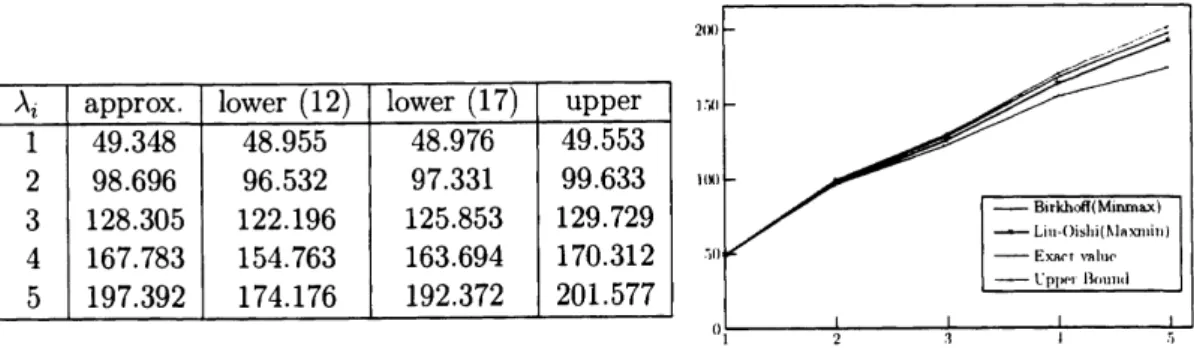
Max-min principle and theMin-max principle, we display the estimates of (12) and (17) in Table 1.
5.2
Computation
Results
on
L-shaped domain
Thedomain is taken
as
$\Omega=[0,2]\cross[0.2]\backslash [1,2]\cross[1,2]$. As amodel problem, it hasbeenwell explored by many people, e.g., L. Fox, P. Henrici and C. Moler [3]. However, to
the author$s$ knowledge, most of the results are given only in the senseof approximate
computation. Although our method gives a relatively rough evaluation, it can easily
deal with more general domain and the result works as mathematically correct with
Table 1: Estimates by Min-max(12) and Max-min (17) principle. $(h=1/32)$
Table 2: Eigenvalue estimates for Laplacian ontriangle domain (Dirichlet b.d.$c.$)
In Table 4,
we
list the first 5 eigenvalues given by [3] and the verifiedbounds
byour
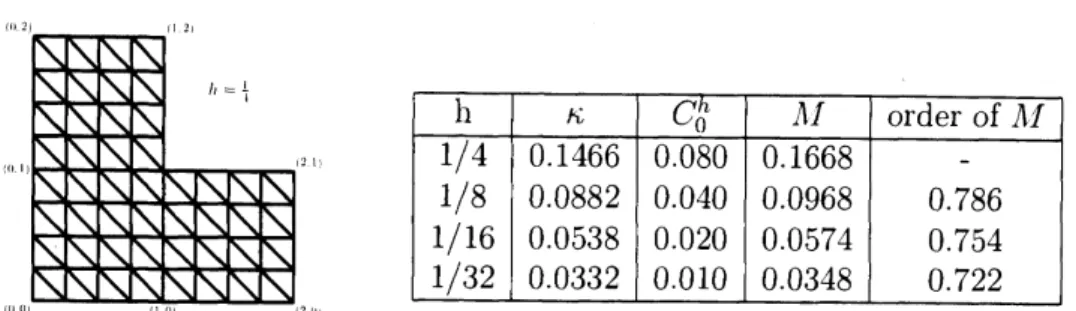
proposed method. The values of $\kappa,$ $C_{0}^{h}$ and $M$, whichare
only dependingon
themesh, are displayed in Table 3. We can see $M$ tends to zero in order less than 1. Once
lower bound for $\lambda_{5}$ is available,wecanfurther apply the Lehmann-Goerischmethod to
obtain more precise bound for $\lambda_{1},$
$\cdots,$$\lambda_{4}$. Such
a
computation, although not verified,has been reported by Yuan and He [10] with very sharp bounds, while thelower bound
for $\lambda_{5}$ is obtained in
a
different way.6
Conclusion
For the classical eigenvalue problems of Laplace operator over 2-dimensional
do-main, we have proposed a novel and robust method to give accurate lower and upper
bounds for eigenvalues. The method can deal with both
convex
andnon-convex
do-mains with general shape. To apply the Lehmann-Goerischmethod for purposeof high
precision,
we
still need pay effortson
constructingbase functionsover
general domain.Acknowledgement
The authors would like show great appreciation to Prof. M. Plum and Prof. K.
$|(|$ $|1(|$
Table 3: Uniform mesh of L-shaped domain and $\kappa$ values
Table 4: Eigenvalue evaluation for L-shaped domain $(h=1/32)$
References
[1] H. Behnke. The calculation of guaranteed bounds foreigenvaluesusingcomplementary variational
principles. Springer-Verlag, 47(1): 11-27, 1991.
[2] G. Birkhoff, C. De Boor, B. Swartz, and B. Wendroff. Rayleigh-ritz approximation by piecewise
cubic polynomials. SIAM JoumalonNumerical Analysis, pages 188-203, 1966.
[3] L.Fox, P.Henrici,andC.Moler. Approximations and bounds for eigenvalues ofelliptic operators.
SIAM Joumal on NumericalAnalysis, $4(1):89-102$, 1967.
[4] P. Grisvard. Elliptic problems in nonsmooth domains. Pitman, 1985.
[5] F. Kikuchi and X. Liu. Determination of the Babu\v{s}ka-Aziz constant for the linear triangular
finite element. JapanJoumal ofIndustnal andApplied Mathematics, 23.75-82, 2006.
[6] F. Kikuchi and H. Saito. Remarks on aposteriori errorestimation for finite element solutions.
Journal ofComputational and Applied Mathematics, 199.329-336,2007.
[7] K.Maruyama, T. Ogita,Y. Nakaya, andS. Oishi. Numericalinclusionmethod for all eigenvalues
of real symmetric definite generalized eigenvalue problem. IEICE Trans, J97-A(8):1111-1119,
2004.
[8] M. Plum. Bounds for eigenvalues ofsecond-order elliptic differential operators. The Joumal of Applied Mathematics andPhysics(ZAMP), 42(6) 848-863, 1991.
[9] N. Yamamoto. A simple method for errorbounds ofeigenvalues of symmetric matrices. Linear Algebra and its Applications,$324(1-3).227-234$ , 2001.
[10] Q. Yuan and Z. He. Bounds to eigenvalues of the laplacian on L-shaped domain byvariational methods. JoumalofComputational and AppliedMathematics, $233(4):1083-1090$ , 2009.