1
Title: Increased urine production due to leg fluid displacement reduces hours of undisturbed sleep
Keisuke Kiba1, kiba_uma@ yahoo.co.jp
Akihide Hirayama1, [email protected] Motokiyo Yoshikawa1, [email protected] Yutaka Yamamoto1, [email protected]
Kazumasa Torimoto3, [email protected] Nobutaka Shimizu2, [email protected]
Nobumichi Tanaka3, [email protected] Kiyohide Fujimoto3, [email protected] Hirotsugu Uemura2, [email protected]
1. Department of Urology, Kindai University Nara Hospital, 1248-1 Otoda-cho, Ikoma-city, Nara, Japan
2. Department of Urology, Kindai University Faculty of Medicine, 377-2 Onohigashi, Sayama-city, Osaka, Japan
3. Department of Urology, Nara Medical University, 840 Shijo-cho, Kashihara-city, Nara, Japan
2 Corresponding author: Akihide Hirayama TEL +81-743-77-0880, FAX +81-743-77-0890
Running title: Leg edema reduces hours of undisturbed sleep
Abstract
Objectives: To investigate whether or not the leg fluid displacement observed when moving from the standing to recumbent position at bedtime reduces the hours of undisturbed sleep (HUS).
Methods: We investigated men aged 50 or older who were hospitalized for urological diseases. We performed body water evaluation 3 times with a bioelectric impedance analysis, 1) 17:00, 2) 30 min after (short-term), 3) waking up (long-term). A frequency volume chart was used to evaluate the status of nocturnal urine production, and the factors affecting HUS were investigated.
Results: A total of 50 patients (Mean age: 68 years) were enrolled. Short-term changes in extracellular fluid (ECF in the legs showed a significant positive correlation with urine production per unit of time at the first nocturnal voiding (UFN/HUS) (r=0.45, p=0.01). In the comparison between patients who had <3 HUS vs. those who had ≥ 3 HUS, the <3 HUS group showed significantly greater short-term changes in leg fluid volume, nighttime water intake (17:00 to 06:00), and UFN/HUS. Multivariate analysis
3
to assess the risk factors for <3 HUS indicated UFN/HUS as a risk factor in the overall model, and short-term changes in leg ECF and nighttime water intake as risk factors in the model that only considered factors before sleep.
Conclusions: Nocturnal leg fluid displacement may increase urine production leading up to first voiding after going to bed, and consequently, induce early awakening after falling asleep.
Key Word: nocturia, bioelectric impedance analysis, hours of undisturbed sleep, body position changing, leg edema
Introduction
Nocturia is defined by the International Continence Society (ICS) as waking up at least once during the night to urinate, and is the most prevalent lower urinary tract symptom 1). Nocturia also induces chronic sleep deprivation due to sleep fragmentation, decreasing quality of life (QOL) 2).
Recently, the frequency and timing of nocturia have both been identified as factors that affect sleep quality. Decreased slow wave sleep (SWS), which appears during the first 3-4 h after falling asleep, is known to induce other diseases, such as cognitive
4
disorders, diabetes, hypertension, and infection 3)-7). Fewer hours of undisturbed sleep (HUS) caused by nocturia leads to decreased SWS, increasing the likelihood of
developing sleep disorders and onset of these other complications.
Nocturnal polyuria is considered to be one of the causes of decreased HUS. While nocturnal polyuria can be triggered by more serious systemic conditions, such as heart failure, liver dysfunction, kidney dysfunction and respiratory disorders 8), it can also be caused by everyday activities, such as drinking excessive quantities of fluids during the daytime, and leg edema 9)-11).
We previously investigated the relationship between nocturnal polyuria and leg edema and reported that increased leg fluid in the evening positively correlates with nocturnal urine volume 10),11). Extracellular fluid (ECF) in the legs typically shifts to the trunk and arms over time, although mostly within 30 to 60 min 12). It is thus possible that a diuretic effect emerges soon after falling asleep in patients with a greater change in leg ECF due to a change in body position, which increases urine production and, consequently, decreases HUS; however, no studies have investigated this concept to date. We therefore examined how the change in leg ECF due to changing body position affects nocturnal urine production. Furthermore, we
investigated the risk factors for <3 HUS, which is known to trigger other diseases.
Methods
5
The study included male patients aged 50 or older, who were hospitalized for urological diseases. This study was approved by the Institutional Review Board of Kindai University Nara Hospital, and written informed consent for the clinical study was obtained from all patients prior to starting this study. Exclusion criteria were:
patients who were <50 years old, those with kidney dysfunction (S. Creatinine (S. Cr)
>1.5 mg/dl), impaired glucose tolerance (fasting blood sugar [FBS] >200 mg/dl), cardiac dysfunction, liver dysfunction, sleep apnea syndrome (presence/absence of snoring), post-void residual urine (urine volume >100 ml), or urinary tract infection, patients who were determined by the attending physician as being unsuitable for participation in the study, and patients who did not give verbal or written consent for participation in the study. Patients ate hospital meals that included approximately 1500 ml of water and ≤10 g of salt at 07:00, 12:00, and 16:00. They drank water or Japanese tea if they were thirsty. They went to bed at 21:30 and woke up at 06:00.
For biochemical analyses, routine peripheral blood biochemistry tests, brain natriuretic peptide (BNP) measurement, urinalysis, and urine osmolarity
measurement were performed at awakening. Serum osmolarity was calculated using the following equation: 2 × Na (mEq/L) + blood sugar (mg/dL) / 18 + blood urea nitrogen (mg/dL) / 2.8. Residual urine volume was determined using transabdominal ultrasonography.
6
Body water was measured using the body composition analyzer, Inbody S10 (InBody Co. Ltd., S. Korea), which is based on a previously reported method10). The accuracy of bioelectric impedance analysis (BIA) has been demonstrated in previous studies13)-14). Patients were instructed to keep the stomach and bladder empty, avoid exercise, recline for at least 5 minutes before BIA and lie quietly during BIA to make the measurement more precise. Since greater changes in leg fluids were observed in the evening in a previous study 10), body water was measured at 17:00 on the day of admission in all patients. Subsequently, patients were asked to rest in the recumbent position with their legs elevated to approximately 15° for 30 min, and body water was measured again. On the following day, body water was measured again within 30 min of waking up. The latter two measurements were subtracted from the first
measurement taken at 17:00 on the day of admission to calculate short-term and long-term changes in body water, respectively.
A frequency volume chart was recorded from 08:00 on the day of body water measurement until 08:00 the following day, and 24-h void volume, nocturnal urine volume, first nocturnal voiding volume, urine production per unit of time at first nocturnal voiding (first nocturnal voiding volume/HUS; UFN/HUS), urine production per unit of time after first nocturnal voiding (nocturnal urine volume-first nocturnal voiding volume)/(total hours of sleep-HUS), urine production per total hours of sleep (total nocturnal urinary volume/total hours of sleep; TNV/HS), 24-h water intake,
7
daytime water intake (from 06:00 to 17:00), and nighttime water intake (from 17:00 to 06:00) were measured.
Patients were divided into 2 groups (<3 HUS and ≥ 3 HUS groups) based on the number of undisturbed hours of sleep before waking up to void. In order to ascertain the risk factors of <3 HUS, the factors assessed were categorized into before sleep and after sleep factors. Before sleep factors included: age, body mass index (BMI),
uroflowmetry (Qmax, residual urine volume), 24-h water intake, daytime water intake (before 17:00), nighttime water intake (after 17:00), hemoglobin (Hb), serum sodium (Na), potassium (K), blood urea nitrogen (BUN), S. Cr, total protein (TP), blood sugar (BS), brain natriuretic peptide (BNP), serum osmolarity, ECF by body part, short-term changes in ECF by body part, history of calcium (Ca) channel blocker usage, and background factors. After sleep factors included urine osmolarity at awakening, UNa/Ucre, first nocturnal voiding volume, UFN/HUS, and long-term changes in ECF volume by body part.
The above values were compared between patients with <3 and those with ≥ 3 HUS.
Spearman’s rank correlation coefficient was used to determine the correlation between the 2 groups, and Mann-Whitney’s test and Chi-squared test were used to analyze the differences between the 2 groups. Logistic regression was used to perform multivariate analysis of the risk factors for <3 HUS with a P value of < 0.05 in univariate analysis.
8
All the factors were used in model 1, while model 2 only included before sleep factors.
All analyses were performed using SPSS ver. 23.
Results:
Of the 50 patients initially enrolled in this study, those who were unable to maintain a voiding diary (n=4) and those whose changes in body water could not be accurately measured due to body movements (n=5) were excluded. Hence, 41 patients were ultimately analyzed. The patients’ characteristics are shown in Table 1.
The mean decreases in leg ECF due to changes in body position were 0.11 L (2.2%) over the short-term and 0.22 L (4.5%) over the long-term period.
Nocturia (at least once) was observed in 31 patients. In these patients, urine production per unit of time was 139±82 mL/hr at the first nocturnal voiding and 69±36 mL/hr after the first nocturnal voiding, indicating a significantly larger urine production per unit of time at the first nocturnal voiding (p<0.001).
A significant and positive correlation was observed between short-term changes in leg ECF and UFN/HUS (r=0.45, p=0.01; Fig. 1), and a correlation was observed between long-term changes in leg ECF and TNV/HS (r=0.32, p=0.044).
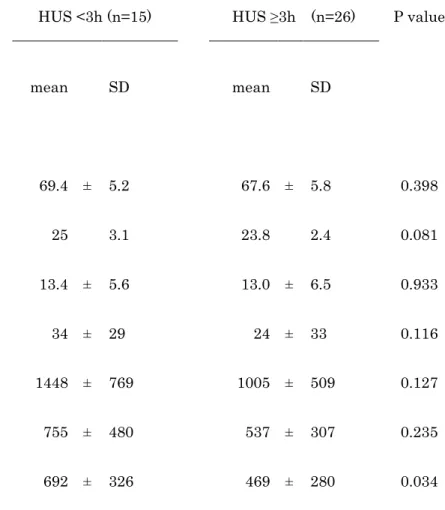
Next, in the comparison of factors before sleep between <3 HUS and ≥3 HUS groups, short-term changes in leg ECF and nighttime water intake were significantly greater in the <3 HUS group (p=0.034 and p=0.012, respectively). For factors after sleep,
9
UFN/HUS was significantly greater in the <3 HUS group (p<0.001). UFN/HUS was also a risk factor in multivariate analysis using all factors (model 1), and short-term changes in leg ECF and nighttime water intake were risk factors in the model that only included factors before sleep (model 2) (Table 2).
To assess the factors affecting short-term changes in leg ECF, correlations with factors listed in Table 3 were examined. The results showed that serum osmolarity and blood sugar had negative correlations with short-term changes in leg ECF (r=-0.36, p=0.021 and r=-0.43, p=0.005, respectively; Table 3).
Discussion
No reports conducted to date have shown that leg fluid displacement soon after going to bed decreases HUS. Our study showed that a diuretic effect emerges soon after falling asleep due to changes in body position, which may result in fewer HUS in patients with large changes in leg ECF.
In the present study, we set the threshold for comparison of the two groups at 3 hours. This was done because it has been reported that SWS appears in the first 3-4 hours after going to sleep 15), and that SWS impairment affects QOL and induces other diseases. Although there are a variety of reasons for nocturnal awakening, including pain, dyspnea, nocturnal voiding, chills, noise, and thirst, Ohayon et al. reported that
10
nocturnal voiding was the cause of nocturnal awakening in 77.1% of the ≥65-year-old individuals evaluated 16).
The current study indicated the possibility that leg ECF shifts soon after changing body position, thereby increasing urine production. A 0.22 L (4.5%) decrease in leg ECF was observed approximately 8 hours (long-term) after changing body position, and approximately 50% (0.11 L (2.2%)) of this shift occurred within the first 30 min (short-term). Moreover, when comparing urine production per unit of time in patients with at least one nocturnal voiding, we found that urine production per unit of time was significantly greater at the first nocturnal voiding than after the first nocturnal voiding. We also observed that short-term changes in leg ECF showed a significant and positive correlation with UFN/HUS. These findings are consistent with a previous report 12), suggesting that body water displacement occurs soon after adopting the recumbent position and is associated with the generation of a diuretic effect. Increased urine volume due to a change in body position is thought to occur through the following mechanism: decreased hydrostatic pressure in leg fluid, primarily ECF, resulting from adoption of the recumbent position, causes displacement of water from the
intercellular space to the circulatory system, and the resulting increase in circulatory volume due to fluid displacement causes hemodilution, which suppresses antidiuretic hormone (ADH) secretion, thereby increasing urine volume 11).
11
In this study, comparison of background factors between the <3 HUS and ≥3 HUS groups indicated that nighttime water intake, short-term changes in leg ECF, and UFN/HUS were significantly different between the two groups. Although BNP is known to increase with greater circulating plasma volume 17), it was not significantly different between the <3 HUS and ≥3 HUS groups. While use of Ca channel blockers can cause peripheral edema 18), there was no significant difference in Ca channel blocker usage between the two groups in this study. We conducted multivariate analysis using factors that were significantly different as independent variables, and found that UFN/HUS was a risk factor in the overall model, while nighttime water intake and short-term changes in leg ECF were risk factors in the model that only used factors before sleep. In other words, the diuretic effect that emerges soon after falling asleep is a factor that reduces HUS; further, nighttime water intake and short-term changes in leg ECF before sleep are thought to influence the diuretic effect in the early hours of sleep, because the short-term changes in leg ECF show a positive correlation with UFN/HUS, and because nighttime water intake is considered to exert a diuretic effect.
In this study, we investigated the factors that affect changes in leg ECF and found that serum osmolarity and blood glucose have negative correlations with leg ECF.
There are several factors that contribute to the formation of edema, including increased hydrostatic pressure, reduced oncotic pressure within blood vessels,
12
augmented blood vessel permeability due to inflammation and lymphatic obstruction, and changes in water retention properties of the tissues themselves 19). In our study, the increase in leg fluid displacement may have been due to a decrease in oncotic pressure within blood vessels.
In addition to serum sodium concentration, blood glucose and urea nitrogen affect serum osmolarity; however, of these two factors, only blood sugar showed a negative correlation with the changes in leg ECF in the present study.
Considering that displacement of leg ECF induces an increase in voided volume in the early stages after falling asleep, resulting in a decrease in HUS in older individuals, reducing leg ECF in older individuals may be an effective way to treat nocturia
resulting from nocturnal polyuria. In clinical practice, treatments for the underlying diseases that increase leg ECF, such as heart failure, liver failure, kidney failure, and venous dysfunction, as well as discontinuation of drugs such as Ca channel blockers are performed first, followed by treatments to decrease the amount of ECF by creating a negative sodium balance through sodium absorption restriction or by increasing the excretion of sodium. Additionally, optimizing water intake is also important. Since nighttime caffeine, alcohol and water intake decreases ADH production and increases urine volume, restricting water intake in the evening hours is generally recommended
20). However, Tani et al. claim that restriction of daytime water intake is also important
9). Yumino et al. showed that nocturnal changes in leg fluids correlate with
13
transcutaneous PCO2 in heart failure patients with obstructive sleep apnea 21), and that daytime activity, time spent sitting, and the degree of edema affect the changes in leg fluid volume 22). Their findings indicate that behavior therapy, such as exercise, may perhaps be effective for older individuals with nocturia caused by nocturnal polyuria.
As drug therapy to treat nocturnal polyuria, DDAVP has been shown to have a high level of efficacy 23)-25). It has also been shown to reduce nocturnal voiding frequency and to extend the HUS in patients with nocturia caused by nocturnal polyuria, thereby improving their QOL. However, reportedly, 7.6% of patients on DDAVP therapy develop hyponatremia 26), and a serious grade 5 water intoxication could also
potentially develop 27). The risk of hyponatremia is especially great in patients who are 65 years or older 28). Since the older men in the previous study showed increased circulating plasma volume and, consequently, increased nocturnal urinary volume due to leg fluid displacement, extreme caution is necessary when using DDAVP in such patients11). In particular, considering that conditions such as hyponatremia (<140 mEq/l) decrease serum osmolarity and tend to cause leg fluid displacement, it may be more effective to use medications that reduce ECF, such as diuretics, rather than DDAVP to treat nocturnal polyuria.
There are several limitations to this study. The first limitation is that the short-term changes in body water were measured after elevating the legs, which is different from
14
the body position during normal sleep. Also, most body water shifts from the legs to the upper body in 30 to 60 min. In the present study, this phenomenon may have been magnified due to leg elevation. The second limitation is that this investigation was limited to inpatients, and it is therefore unknown whether or not the findings are applicable to people performing normal everyday activities. The third limitation is that the hormones that maintain the homeostasis of body water, such as aldosterone and epinephrine, were not assessed.
Conclusions
In older individuals, nocturnal leg fluid displacement may increase urine production until first voiding after going to bed, thereby reducing HUS, which can be extended by treating leg edema.
Disclosure
The authors declare no conflict of interest.
References
1) Irwin DE, Milsom I, Hunskaar S et al. Population-based survey of urinary incontinence, overactive bladder, and other lower urinary tract symptoms in five countries: results of the EPIC study. Eur Urol 2006; 50: 1306-15.
15
2) Nakagawa H, Niu K, Hozawa A et al. Impact of nocturia on bone fracture and mortality in older individuals: a Japanese longitudinal cohort study. J Urol 2010; 184:
1413-8.
3) Diekelmann S and Born J. The memory function of sleep. Nat Rev Neurosci 2010;
11: 114–26.
4) Blackwell T, Yaffe K, Ancoli-Israel S et al. Poor sleep is associated with impaired cognitive function in older women: the study of osteoporotic fractures. J Gerontol A Biol Sci Med Sci 2006; 61: 405–10.
5) Cappuccio FP, D'Elia L, Strazzullo P, Miller MA. Quantity and quality of sleep and incidence of type 2 diabetes: a systematic review and meta-analysis. Diabetes Care 2010; 33: 414–20.
6) Sayk F, Teckentrup C, Becker C et al. Effects of selective slow-wave sleep deprivation on nocturnal blood pressure dipping and daytime blood pressure regulation. Am J Physiol Regul Integr Comp Physiol 2010; 298: R191–7.
7) Cohen S, Doyle WJ, Alper CM, Janicki-Deverts D, Turner RB. Sleep habits and susceptibility to the common cold. Arch Intern Med 2009; 169: 62–67.
8) van Kerrebroeck P, Abrams P, Chaikin D et al. The standardisation of terminology in nocturia: report from the Standardisation Sub-committee of the International
Continence Society. Neurourol Urodyn 2001; 21: 179-83.
16
9) Tani M, Hirayama A, Torimoto K, Matsushita C, Yamada A, Fujimoto K. Guidance on water intake effectively improves urinary frequency in patients with nocturia. Int J Urol 2014; 21: 595-600.
10) Torimoto K, Hirayama A, Samma S, Yoshida K, Fujimoto K, Hirao Y. The
relationship between nocturnal polyuria and the distribution of body fluid: assessment by bioelectric impedance analysis. J Urol 2009; 181: 219-24
11) Hirayama A, Torimoto K, Yamada A et al. Relationship Between Nocturnal Urine Volume, Leg Edema, and Urinary Antidiuretic Hormone in Older Men. Urology 2010;
77: 1426-31.
12) Berg HE, Tedner B, Tesch PA. Changes in lower limb muscle crosssectional area and tissue fluid volume after transition from standing to supine. Acta Physiol Scand 1993; 148: 379–85.
13) Bedogni G, Malavolti M, Severi S et al. Accuracy of an eight-point tactileelectrode impedance method in the assessment of total body water. Eur J Clin Nutr 2002; 56:
1143.
14) Cha K, Chertow GM, Gonzalez J, Lazarus JM, Wilmore DW: Multifrequency bioelectrical impedance estimates the distribution of body water. J Appl Physiol 1995;
79: 1316.
15) Diekelmann S, Born J. The memory function of sleep. Nat Rev Neurosci 2010; 11:
114–26.
17
16) Ohayon MM. Nocturnal awakenings and comorbid disorders in the American general population. J Psychiatr Res 2008; 43: 48–54.
17) Weiss JP, Blaivas JG. Nocturia. J Urol 2000; 163: 5-12.
18) Kraemer M. A new model for the determination of fluid status and body composition frombioimpedance measurements. Physiol Meas 2006; 27: 901-19.
19) Cho S, Atwood JE. Peripheral edema. Am J Med 2002; 113: 580-6.
20) Appall RA, Sand PK. Nocturia: etiology, diagnosis, and treatment.
Neurourol.Urodyn 2008; 27: 34–9.
21) Yumino D, Redolfi S, Ruttanaumpawan P et al. Nocturnal rostral fluid shift: a unifying concept for the pathogenesis of obstructive and central sleep apnea in men with heart failure. Circulation 2010; 121: 1598-605.
22) Redolfi S, Yumino D, Ruttanaumpawan P et al. Relationship between overnight rostral fluid shift and Obstructive Sleep Apnea in nonobese men. Am J Respir Crit Care Med 2009; 179: 241-6.
23) van Kerrebroeck P, Rezapour M, Cortesse A, Thüroff J, Riis A, Nørgaard JP.
Desmopressin in the treatment of nocturia: A double-blind, placebo-controlled study.
Eur Urol 2007; 52: 221-9.
24) Mattiasson A, Abrams P, Van Kerrebroeck P, Walter S, Weiss J. Efficacy of
desmopressin in the treatment of nocturia: A double-blind placebo-controlled study in men. BJU Int 2002; 89: 855-62.
18
25) Lose G, Lalos O, Freeman RM, van Kerrebroeck P. Efficacy of desmopressin (Minirin) in the treatment of nocturia: A double-blind placebo-controlled study in women. Am J Obstet Gynecol 2003; 189: 1106-13.
26) Weatherall M. The risk of hyponatremia in older adults using desmopressin for nocturia: A systematic review and meta-analysis. Neurourol Urodyn 2004; 23: 302-5.
27) Shindel A, Tobin G, Klutke C. Hyponatremia associated with desmopressin for the treatment of nocturnal polyuria. Urology 2002; 60: 344i-344iii.
28) Rembratt A, Riis A, Norgaard JP. Desmopressin treatment in nocturia; an analysis of risk factors for hyponatremia. Neurourol Urodyn 2006; 25: 105-9.
19
Table 1. Characteristics of patients in this study and comparison of each parameter between <3 hours of undisturbed sleep (HUS) and
≧3 HUS groups
HUS <3h (n=15) HUS ≥3h (n=26) P value
mean SD mean SD
Factors before sleep
Age (y.o.) 69.4 ± 5.2 67.6 ± 5.8 0.398
Body mass index (kg/m2) 25 3.1 23.8 2.4 0.081
Qmax (mL/s) 13.4 ± 5.6 13.0 ± 6.5 0.933
PVR (mL) 34 ± 29 24 ± 33 0.116
Fluid consumption in 24 h (mL) 1448 ± 769 1005 ± 509 0.127
Daytime fluid intake (mL) 755 ± 480 537 ± 307 0.235
Nighttime fluid intake (mL) 692 ± 326 469 ± 280 0.034
20
Hb (g/dL) 14.4 ± 2.1 15.2 ± 1.3 0.332
Na (mEq/L) 139.2 ± 1.1 139.7 ± 1.6 0.525
K (mEq/L) 4.2 ± 0.2 4.3 ± 0.2 0.100
BUN (mg/dL) 14.1 ± 4.1 13.8 ± 3.1 0.868
Cr (mg/dL) 0.9 ± 0.2 0.9 ± 0.2 0.804
TP (mg/dL) 6.8 ± 0.5 6.8 ± 0.4 0.679
BS (mg/dL) 104 ± 25.5 103.2 ± 13.1 0.305
BNP (pg/dL) 21.4 ± 13.3 21.4 ± 20.6 0.489
Plasma osmolarity (mOs/kg·H2O ) 289 ± 3 290 ± 3 0.543
Segmental ECF (L)
Arms 1.6 ± 0.2 1.6 ± 0.2 0.478
Trunk 6.5 ± 0.7 6.7 ± 0.7 0.314
21
Legs 4.8 ± 0.3 4.9 ± 0.5 0.383
Δ Segmental ECF (L) after leg elevation for 30 min
Arms 0.01 ± 0.03 0.00 ± 0.02 0.253
Trunk 0.05 ± 0.09 0.02 ± 0.08 0.355
Legs 0.14 ± 0.05 0.10 ± 0.05 0.012
Use of a Ca channel blocker (number) 7 9 0.446
Disease
Suspected prostate cancer 9 15 0.979
Prostate cancer 0 2
Benign prostatic hyperplasia 5 7
Others 1 2
Factors after sleep
22
Urine osmolarity (mOs/kg·H2O ) 427 ± 127 497 ± 149 0.222
UNa/Ucre 27.0 ± 15.2 25.2 ± 11.9 0.804
Urine volume at first nocturnal voiding (mL) 265 ± 63 293 ± 106 0.429
Urine production per unit of time at first nocturnal voiding (mL/h) 204 ± 61 64 ± 39 <0.001
Δ Segmental ECF (L) during sleep
Arms -0.01 ± 0.05 -0.03 ± 0.05 0.201
Trunk 0.04 ± 0.14 -0.05 ± 0.13 0.063
Legs 0.26 ± 0.12 0.20 ± 0.12 0.121
Hb, hemoglobin; Na, sodium; K, potassium; BUN, blood urea nitrogen; Cre, creatinine; TP, total protein; BNP, brain natriuretic peptide;
ECF, extracellular fluid; UNa, urinary sodium; Ucre, urinary creatinine; Δ Segmental ECF, change in segmental ECF volume.
Δ Segmental ECF after leg elevation for 30 minutes = (Segmental ECF at 17:00) - (Segmental ECF after leg elevation for 30 minutes). Δ Segmental ECF during sleep = (Segmental ECF at 17:00) - (Segmental ECF within 30 min of waking up).
23
Table 2. Univariate and multivariate analysis of variables associated with <3 hours of undisturbed sleep (HUS). Model 1: Factors before and after sleep, Model 2: Factors before sleep
Univariate analysis Multivariate analysis
Model 1 Model 2
OR 95%CI p value OR 95%CI p value OR 95%CI p value
Nighttime water intake (*100 mL) 1.288 ( 0.998 - 1.663 ) 0.052 2.068 ( 0.649 - 6.587 ) 0.219 1.374 ( 1.056 - 2.055 ) 0.023
Change in ECF in the legs after leg
elevation for 30 min (*10 mL)
1.226 ( 1.038 - 1.448 ) 0.016 1.464 ( 0.744 - 2.881 ) 0.270 1.291 ( 1.021 - 1.649 ) 0.033
Urine production per unit of time at
first nocturnal voiding (mL/h)
1.049 ( 1.018 - 1.081 ) 0.002 1.061 ( 1.002 - 1.124 ) 0.041
24
Table 3. Correlation between before sleep and after sleep factors and changes in extracellular fluid volume (Δ ECF) in the legs after leg
elevation for 30 min
r p value
Age -0.06 0.720
Body mass index -0.16 0.326
24-h water intake -0.10 0.558
Daytime water intake -0.18 0.314
Nighttime water intake -0.05 0.780
Hb -0.14 0.401
Na -0.21 0.184
BUN -0.06 0.726
Cr -0.09 0.578
25
TP -0.22 0.166
Blood sugar -0.43 0.005
BNP 0.13 0.440
Plasma osmolarity -0.36 0.021
ICF -0.06 0.712
ECF -0.04 0.791
Body water -0.06 0.707
Fat mass -0.19 0.246
Soft lean mass -0.06 0.727
Soft lean mass in legs 0.05 0.767
Segmental water in legs 0.07 0.665
Segmental ICF in legs 0.02 0.898
26
Segmental ECF in legs 0.08 0.611
ICF, intracellular fluid
Fig. 1. Changes in extracellular fluid (ECF) volume in the legs after leg elevation for 30 min had a significant positive correlation with urine production per unit of time at first nocturnal voiding (r=0.45, p=0.01).
Fig. 1