• 検索結果がありません。

,宮本雅之

N/A
N/A
Protected

Academic year: 2021

シェア ",宮本雅之"

Copied!
21
0
0

読み込み中.... (全文を見る)

全文

(1)

持続陽圧呼吸療法中の閉塞性睡眠時無呼吸症候群における一次性頭痛の合併頻 度とその治療効果

渡邉悠児

1)

,鈴木圭輔

1)

,宮本雅之

2)

,宮本智之

3)

,平田幸一

1)

5

1) 獨協医科大学内科学(神経)

2)獨協医科大学看護学部看護医科学(病態治療)

3) 獨協医科大学越谷病院 神経内科

*Corresponding author:

10

鈴木 圭輔

獨協医科大学内科学(神経)

〒321-0293 栃木県下都賀郡壬生町北小林 880 TEL:0282-86-1111 (内 2721)

FAX:0282-86-5884

15

e-mail: [email protected]

文字数 要約 495 字,英文要旨字 239, 本文字 5,799 ,参考文献 27 ,図 3 ,表 2 Key words: obstructive sleep apnea syndrome, primary headache, continuous positive airway pressure, migraine, tension-type headache

20

欄外見出し: OSAS に伴う頭痛に対する CPAP の効果

(2)

要約

閉塞性睡眠時無呼吸症候群( obstructive sleep apnea syndrome, OSAS )に慢性頭痛 は高率に合併する.我々は OSAS における一次性頭痛の合併頻度と持続陽圧呼

25

吸 (continuous positive airway pressure, CPAP) 療法の効果について検討した.

CPAP 療法中の OSAS 患者 235 例(男性 190 例, 女性 45 例; 平均 54.8±11.6 歳)

を対象とした.一次性頭痛の診断は質問紙を参考に,面接法により国際頭痛分 類第 2 版 (International Classification of Headache Disorders, 2nd edition, ICHD-II) に基づいて行い,睡眠時無呼吸性頭痛の診断は ICHD-3beta を用いた. OSAS 235

30

例中 105 例 (44.7%) に慢性頭痛があり,片頭痛 18 例 (7.7%) ,緊張型頭痛 55 例 (23.4%),群発頭痛 1 例 (0.4%), その他の頭痛 31 例 (13.0%)であった.頭痛のあ る群では,睡眠障害,日中の眠気,抑うつ症状が有意に認められた.慢性頭痛

105 例中 39 例 (37.1%) に睡眠時無呼吸性頭痛を認めた. CPAP 治療の効果があ

った片頭痛 12 例および緊張型頭痛 33 例のうち睡眠時無呼吸性頭痛の共存例は

35

それぞれ 8 例 (66.7%),16 例 (48.5%) であった.頭痛のある OSAS 患者のうち 睡眠時無呼吸性頭痛を除外した 66 例の中で,頭痛に対して CPAP の効果があっ

た群 (n=36) では,頭痛に対して CPAP の効果がなかった群 (n=30) よりも一日の

CPAP 使用時間が有意に長かった.今回の検討では OSAS に慢性頭痛を高頻度に 合併したが,睡眠時無呼吸性頭痛の診断基準を満たさない一次性頭痛において

40

も CPAP 療法が有効な症例があることが明らかとなった.

(3)

Primary headaches in patients with obstructive sleep apnea syndrome receiving continuous positive airway pressure therapy

45

Yuji Watanabe

1)

, Keisuke Suzuki

1)

, Masayuki Miyamoto

2)

, Tomoyuki Miyamoto

3)

, Koichi Hirata

1)

1)

Department of Neurology, Dokkyo Medical University

50

2)

Department of Clinical Medicine for Nursing, Dokkyo Medical University School of Nursing

3)

Department of Neurology, Dokkyo Medical University Koshigaya hospital

Abstract

55

Chronic headache is often comorbid with obstructive sleep apnea syndrome (OSAS).

We investigated the prevalence of primary headaches and also evaluated the effect of continuous positive airway pressure (CPAP) on the primary headaches. A total of 235 patients with OSAS (190 M, 45F; mean age 54.8±11.6 years) receiving CPAP therapy were participated in this study. Primary headaches were diagnosed according to the

60

International Classification of Headache Disorders, 2nd edition (ICHD-2). Sleep apnea headache was diagnosed based on ICHD-3 beta. Of 235 OSAS patients, chronic headaches were observed in 105 (44.7%): 18 migraines (7.6%); 55 tension-type headaches (23.5%); 1 cluster headache (0.4%) and 31 unclassified headaches (13.0%).

Patients with chronic headache showed higher scores for sleep disturbances, daytime

65

sleepiness and depressive symptoms compared with patients without chronic headache.

(4)

Of 105 patients with chronic headaches, 39 (37.1%) had sleep apnea headache. CPAP treatment was effective in reducing headaches in 12 patients with migraine (8 with comorbid sleep apnea headache, 66.7%) and in 33 patients with tension-type headache (16 with comorbid sleep apnea headache, 48.5%). Among OSAS patients with chronic

70

headaches after exclusion of patients with sleep apnea headache (n=66), CPAP-responsive headache group (n=36) had a significant longer daily CPAP use compared to CPAP-non responsive headache group (n=30). In patients with OSAS, chronic headache was frequently observed. Our study results showed that in patients with OSAS CPAP therapy can ameliorate concomitant primary headaches not fulfilling

75

the diagnostic criteria of sleep apnea headache.

(5)

はじめに

睡眠障害と頭痛はしばしば合併し,睡眠の分断や不眠が頭痛の原因となる一方

80

で,睡眠により頭痛が改善する場合もあることから,睡眠と頭痛の相互の密接 な関連性は以前より知られている

1)

.慢性頭痛は閉塞性睡眠時無呼吸症候群 (obstructive sleep apnea syndrome, OSAS) 患者の 15-50%に合併すると報告されて いる

2)

. また起床時頭痛は OSAS の随伴症状として, 18-60% の OSAS 患者でみ られる

3-6)

.そのうち,両側・圧迫性に生じ,持続時間が 30 分以内で OSAS の

85

適切な治療により消退する起床時頭痛は睡眠時無呼吸性頭痛として定義されて いる ( 国際頭痛分類第 2 版 , International Classification of Headache Disorders

(ICHD), second edition)

7)

.しかし,睡眠時無呼吸性頭痛では緊張型頭痛様の性質

の他,片頭痛様の性質を呈する場合もある

3)

. その後発刊された ICHD-3 beta 版の睡眠時無呼吸性頭痛の診断基準では持続時間が 30 分から 4 時間まで延長さ

90

れた

8)

.我々は持続陽圧呼吸療法中の OSAS 患者 235 例を対象に起床時頭痛を調 査し,睡眠時無呼吸性頭痛の ICHD-2 と ICHD 3-beta 版を用いて睡眠時無呼吸性 頭痛の頻度を調査した.その結果,起床時頭痛は全体の 20.4% にみられた.起床 時頭痛の 60.4% が ICHD-2 で, 81.3% が ICHD-3 beta で睡眠時無呼吸性頭痛と診断 され,ICHD-3beta の有用性が示された

7)

.しかし本邦において OSAS 患者におけ

95

る一次性頭痛の合併頻度や持続陽圧呼吸 (continuous positive airway pressure,

CPAP) の頭痛に対する効果は明らかにされていない.

(6)

本研究では CPAP 療法中の OSAS 患者における一次性頭痛の合併頻度を 調査し,CPAP 療法の頭痛に対する効果について検討した.

100

対象と方法

1. 対象

当院神経内科外来に通院している CPAP 療法中の OSAS 患者で,他の原発性睡

105

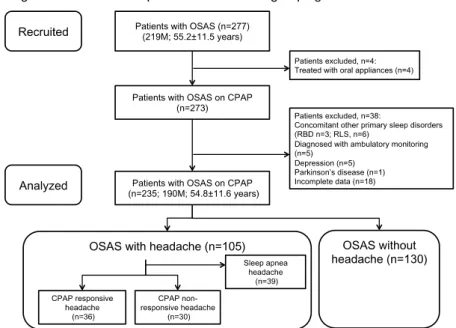
眠障害や神経・精神疾患などを除外した 235 例 (男性 190 例, 女性 45 例; 平均 54.8±11.6 歳 ) を対象に調査した (Fig.1) .

2. 方法

110

CPAP 療法中の OSAS 235 例 (男性 190 例, 女性 45 例; 平均 54.8±11.6 歳) を対象 に,頭痛と睡眠に関する質問紙を用いた横断調査を施行した. OSAS の診断は臨 床的に面接と診察の後に,睡眠ポリグラフ検査を施行して睡眠障害国際分類第 2 版に基づいて診断した

9)

. 呼 吸 イ ベ ン ト の 判 定 は American Academy

of Sleep Medicine の シ カ ゴ 基 準を用いて

10)

,睡眠時無呼吸低呼吸指数

115

(apnea hypopnea index, AHI), 3% 動脈血酸素飽和度低 下 指 数 (3% oxygen

desaturation index, 3%ODI) を含めた睡眠関連呼吸障害指標を解析した.覚醒反応

指数(arousal index)の判定は American Sleep Disorders Association の基準を用い

11)
,睡眠構築の判定には Rechtschaffen と Kales の基準を用いた

12)

.全患者のう ち 225 例(95.7%)は AHI≧20/時であった.CPAP 療法開始後の CPAP 使用状況

120

(7)

と AHI 変化に関しては CPAP memory card より 2 か月以上の連続データから解析 した.CPAP 導入から頭痛調査日までの CPAP 使用期間,CPAP 使用率 (観察期 間の実使用日数/観察期間の日数×100), 1 日あたりの平均の CPAP 使用時間,平 均 residual AHI を解析した.

一次性頭痛の診断は,質問紙を参考に面接法によって国際頭痛分類第 2

125

版 (ICHD-2) に基づいて診断した

7)

.睡眠障害に関しては自己記入式の 18 質問 項目からなるピッツバーグ睡眠質問票 (Pittsburgh Sleep Quality Index, PSQI) を 用いて評価した

13)

. PSQI 総得点の他,下位項目として C1 睡眠の質; C2 入眠 時間;C3 睡眠時間; C4 睡眠効率; C5 睡眠困難; C6 眠剤の使用; C7 日中覚醒困 難も評価した.日中の眠気は日本語版エプワース眠気尺度 (Japanese version of

130

Epworth sleepiness scale, JESS) にて評価を行った

14)

.抑うつ症状はベック抑うつ 尺度-II (Beck Depression Inventory-II, BDI-II) を用いて評価した

15)

.睡眠時無呼吸 性頭痛に関しては,睡眠障害国際分類第 3 版 beta 版 (ICHD-3beta) に従って,カ ルテも参考にして問診を行い,睡眠時無呼吸が改善もしくは消失するのと並行 して有意に改善したか消失した起床時頭痛を睡眠時無呼吸性頭痛と診断した

)

135

それぞれの頭痛に対する CPAP 療法の効果を問診およびカルテを参照に後方視 的に検討した.慢性頭痛に対する CPAP 療法の効果に関して,CPAP 療法開始後 に頭痛の頻度や重症度が CPAP 治療前に比べて半分以下に改善した場合を CPAP 療法の効果ありとみなした.睡眠時無呼吸性頭痛以外の頭痛に対する CPAP 療法 の効果に関連する背景因子の違いをみるために睡眠時無呼吸性頭痛を除外した

140

検討も行った.

(8)

統計解析に関して, 2 群間の連続変数の比較には Mann-Whitney U 検定も しくは対応のない t 検定を用い,比率の比較にはχ二乗検定を使用した.連続数 については平均値±標準偏差で示した.統計解析結果は p<0.05 を統計学的有意 差ありとみなした.

145

本研究は獨協医科大学病院生命倫理委員会の承認を得て,患者からのイ ンフォームドコンセントのもとで施行された.

結果

150

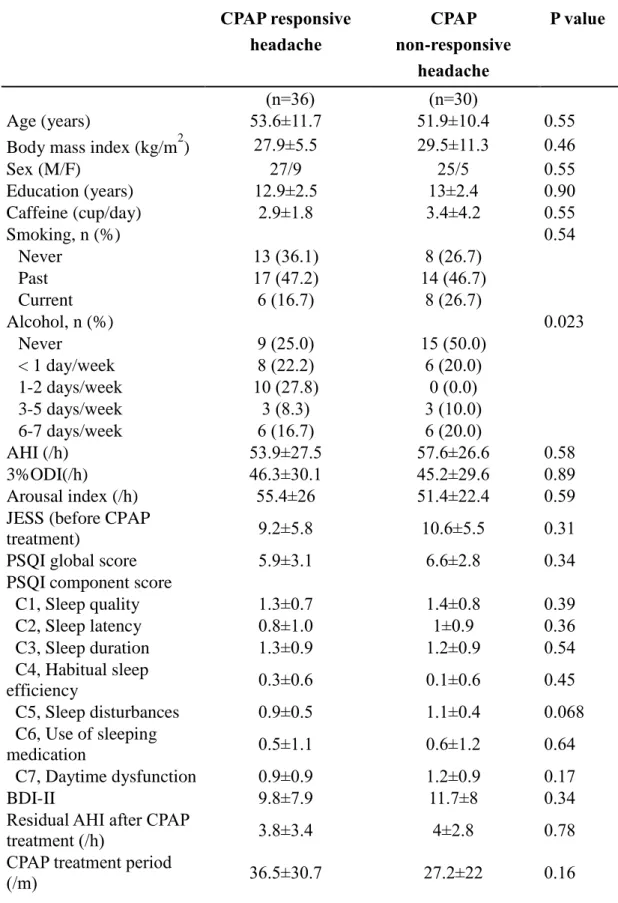
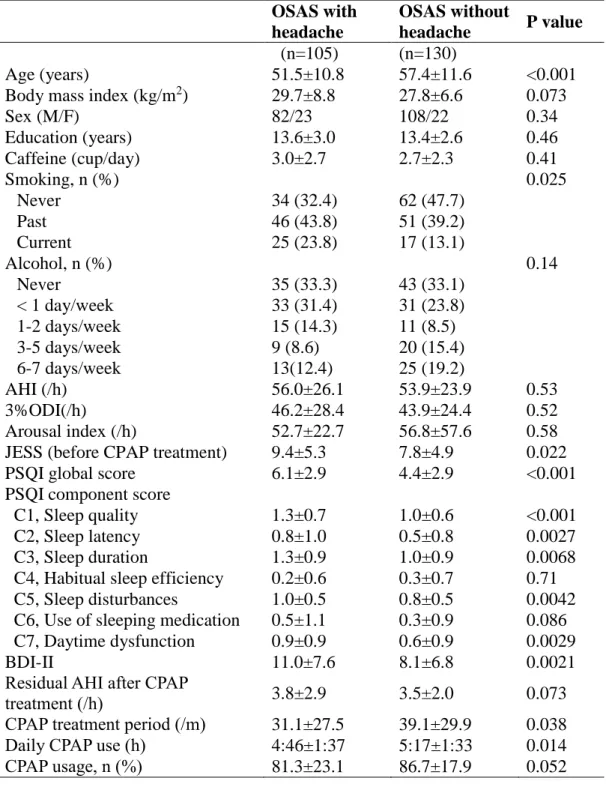
CPAP 療法中の OSAS 患者 235 例中 105 例 (44.7%) に慢性頭痛があり (Fig.1) , その内訳は片頭痛 18 例 (7.7%), 緊張型頭痛 55 例 (23.4%), 群発頭痛 1 例 (0.4%), その他の頭痛 31 例 (13.0%) であった (Fig.2) . Table 1 に頭痛のある群 (105 例 )

とない群 (130 例 ) における頭痛の背景因子を示す.頭痛のある群はない群と比

して若年であり,PSQI 総得点,ESS, BDI-II 得点が高かった.PSQI 下位項目に

155

おいては C1 睡眠の質,C2 入眠時間,C3 睡眠時間,C5 睡眠困難,C7 日中覚醒 困難が頭痛のある群でない群よりも有意に高かった. OSAS 診断のために施行し

た PSG で AHI および 3% ODI は頭痛のある OSAS 群と頭痛のない OSAS 群間で

明らかな差は認めなかった.患者全体 (n=235) における CPAP 使用後の residual AHI 3.6 ± 2.5/ 時, CPAP 使用期間 35.5 ± 29.1( 月 ) , CPAP 使用時間 5:03 ± 1:36 (時

160

間) ,CPAP 使用率 84.3±20.5%であった.頭痛のある OSAS 群では頭痛のない

OSAS 群と比べて,CPAP の使用時間は短く,CPAP 使用率は低い傾向がみられ

(9)

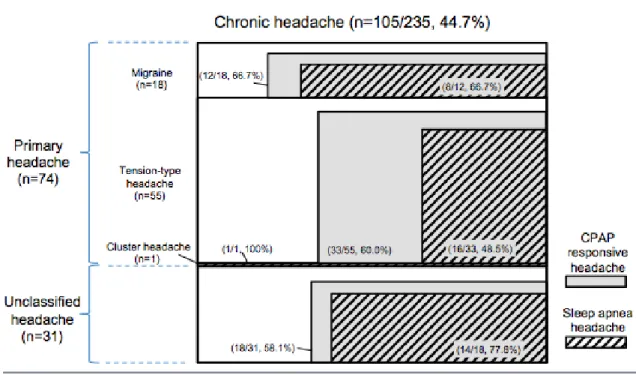
た. 慢性頭痛患者 105 例中 39 例 (37.1%) に睡眠時無呼吸性頭痛を認めた. CPAP による頭痛に対する効果は頭痛全体 105 例中 73 例 (69.5%),一次性頭痛 74 例中 46 例 (62.2%) にみられ,その 50%に睡眠時無呼吸性頭痛の合併がみられた. Fig.

165

3 に頭痛のある OSAS 患者に対する CPAP の効果を示す.それぞれの頭痛別にみ ると, CPAP の頭痛への効果は片頭痛 18 例中 12 例 (66.7%) に,緊張型頭痛 55 例中 33 例 (60.0%) に,群発頭痛 1 例中 1 例 (100%),その他の頭痛 31 例中 18 例 (58.1%) にみられた.さらに,CPAP の効果のあった頭痛のある OSAS 群の 中で,片頭痛の 66.7%, 緊張型頭痛の 48.5% ,群発頭痛の 100% ,その他の頭痛

170

の 77.8%に睡眠時無呼吸性頭痛の合併がみられた.頭痛のある OSAS 患者

(n=105) の中で睡眠時無呼吸性頭痛を除外した 66 例に関して,頭痛に対して

CPAP の効果があった群 (n=36) と頭痛に対して CPAP の効果がみられなかった 群 (n=30) の背景因子を比較した.その結果,頭痛に対して CPAP の効果があっ た群では一日の CPAP 使用時間が有意に長かった (Table 2).

175

考察

本邦における 15 歳以上の一般人口 4029 例を対象にした頭痛の疫学調査では慢性 頭痛および片頭痛の有病率はそれぞれ 55.6%, 8.4% であった

16)

.この結果と比較 すると本研究ではOSASにおける慢性頭痛 (44.5%)と片頭痛 (7.6%) の合併頻度

180

は一般人口の有病率と差がなかった. また,これらの慢性頭痛のあるOSAS患者

では日中の眠気,睡眠障害,抑うつ症状が頭痛のない患者に比べて有意に多く

みられた.しかしこの両群間ではOSASの重症度 (AHI, ODI) に差はなかった.

(10)

これらの結果から, OSAS 患者における慢性頭痛の存在は, OSAS の重症度にか かわらず睡眠および気分の障害に影響を及ぼすことが明らかとなった.3323例

185

の男性を対象にした疫学調査では,自覚的ないびきの存在は交絡因子の補正後 も頭痛の存在と有意な関連がみられたと報告されている

17)

. 習慣性いびき268例 の調査では,起床時頭痛の予測因子として,交絡因子の補正後,片頭痛 (オッズ 比6.3),不眠 (オッズ比4.2),精神的ストレス (オッズ比3.9),OSAS (オッズ比

2.6) であった

18)

.従って,OSASのみならず習慣性いびき患者への治療介入が

190

起床時および片頭痛の改善につながる可能性がある.

本検討では,慢性頭痛患者105例のうち37.1%(39例)に睡眠時無呼吸性 頭痛の合併を認め,睡眠時無呼吸性頭痛 39例のうち一次性頭痛の合併は,片頭 痛 20.5% (8 例 ) ,緊張型頭痛 41% (16 例 ) ,群発頭痛 2.6% (1 例 ) であった.典型 的には睡眠時無呼吸性頭痛は緊張型頭痛のような圧迫性の性状が多いとされる.

195

Albertiら

3)

の検討では睡眠時無呼吸性頭痛は前兆のない片頭痛 (5.3%), 頻発反

復性緊張型頭痛 (42.1%),慢性緊張型頭痛 (15.8%) に類似した性状を認めた . 宮本ら

19)

は,頭痛薬の非服用時には 5-6 時間持続する前兆のない片頭痛様の起床 時頭痛を呈した重症OSAS患者において,CPAPが奏効したことを報告している.

睡眠時無呼吸性頭痛はOSASに関連した起床時頭痛であり,OSASの適切な治療

200

により改善する.その病態は明らかではないが,夜間低酸素血症,高炭酸ガス

血症に伴う脳血管拡張,繰り返す夜間の呼吸イベントによる睡眠の分断化など

のOSASに関連した病態が考えられている.さらに,本検討で特記すべき結果と

しては,一次性頭痛 74 例の 62.2% が CPAP 治療で改善し,その半数は睡眠時無呼

(11)

吸性頭痛の併存がなかったことであり, CPAP 治療の頭痛に対する効果が睡眠時

205

無呼吸性頭痛を含む起床時頭痛のみならず日中の一次性頭痛にもみられたこと である.

睡眠と慢性頭痛の関連に関して, Jennumら

1)は以下について述べている

.睡 眠時間により誘発されやすいのは緊張型頭痛あるいは片頭痛,睡眠段階に関連 して生じるものは片頭痛や群発頭痛,夢に関連する頭痛は片頭痛,睡眠をとる

210

ことによって改善するものは片頭痛である.したがって,本検討においてCPAP 療法によってOSAS患者の睡眠の状態が改善したことから,二次的に一次性頭痛 が改善した可能性は十分に考えられる.睡眠ポリグラフ検査を施行した頭痛患 者82例 (平均年齢45±13歳) を後方視的に解析した研究では OSASは52例 (63%) にみられ, OSAS の存在は年齢の増加,女性,前兆のない片頭痛に関連していた.

215

33例 (82%) がCPAP治療を受け, 13例 (39.4%) においてCPAP治療により頭痛の

改善がみられた

20)

.また,頭痛が睡眠中に生じる,もしくはいびきのある慢性,

難治性頭痛患者 72 例に対して睡眠ポリグラフ検査を施行した研究では, 21 例が OSAS と診断された

21)

.随伴する頭痛としては薬物使用過多による頭痛や群発頭 痛が最も多かった.CPAP治療により約3分の1の症例ではOSASのみならず慢性

220

頭痛の改善がみられた.睡眠時無呼吸性頭痛以外の頭痛のあるOSAS患者で頭痛 に対して CPAP の効果があった群では,頭痛に対して CPAP の効果がなかった群よ り一日当たりのCPAP使用時間が有意に長かったことから,一次性頭痛を合併す るOSAS患者においては十分なCPAP使用時間を確保することの重要性が示唆さ れる (Table 2).

225

(12)

睡眠と痛みの関連について,動物実験における慢性的な睡眠制限下では,

痛覚過敏の発症に関連する炎症性サイトカイン (腫瘍壊死因子-αやインターロ イキン1) の上昇が報告されている

22)

.健常人を対象とした睡眠の分断実験では,

内因性痛覚抑制が低下し,自発的な痛みが有意に増加した

23)

. OSAS 患者では,

呼吸イベントに伴う間歇的低酸素血症による活性酸素の産生が酸化ストレス感

230

受性の転写因子を活性化し,遺伝子レベルでこれらのサイトカインの産生が増 加すると考えられている

24, 25)

.さらに増加したTNF-αはCPAP療法により正常化 すると報告されている

24)

.重症 OSAS 12 例を対象に指への放射熱刺激に対する

CPAP療法の効果をみた検討では, CPAP治療後に痛みに対する感受性が有意に低

下した

26)

.これらの研究結果から,本研究ではCPAP治療によりOSASによる睡眠

235

の分断や夜間の低酸素血症の改善に加え,炎症性サイトカインが減少し,頭痛 に対する感受性に変化が生じた可能性がある.さらに,いびきと中途覚醒時間 の増加や睡眠効率の低下を関連づける報告もあり

27)

,CPAP治療の適応基準を満 たさない軽症 OSAS 患者や習慣性いびきのある人においても,睡眠の分断が疼痛 閾値に影響を及ぼす可能性がある.

240

本研究のlimitationとしてOSAS患者におけるCPAP療法の頭痛に対す る効果を後方視的に解析したことが挙げられる.今後, CPAP療法の導入前後の 頭痛の性状を比較する前方視的検討が必要である.さらにOSAS患者軽症例を合 併する慢性頭痛患者に対するCPAP治療の適応基準についての調査が必要であろ う.

245

(13)

結論

本研究では OSAS は慢性頭痛を高頻度に合併し, CPAP 療法は約 6 割の頭痛に対 して有効であった.本研究により, OSAS 患者では睡眠時無呼吸性頭痛の診断基 準を満たさない一次性頭痛に対しても CPAP 療法の十分な時間の使用が有効な 場合があることが明らかとなった.

250

本論文の要旨は第 32 回日本神経治療学会 (2014 年 11 月 21 日,東京 ) で発表し た.

255 謝辞

本研究にご協力いただきました獨協医科大学内科学(神経)沼尾文香先生,作 田英樹先生,渡邉由佳先生に深謝いたします.

開示

本研究は JSPS (MEXT) 科研費 15K09358 の助成を受けた(K.H.).

(14)

260

文献

1) Jennum P, Jensen R. Sleep and headache. Sleep Med Rev 6:471-479, 2002 2) Alberti A. Headache and sleep. Sleep Med Rev 10:431-437, 2006

3) Alberti A, Mazzotta G, Gallinella E et al. Headache characteristics in obstructive sleep apnea syndrome and insomnia. Acta Neurol Scand 111:309-316, 2005

265

4) Aldrich MS, Chauncey JB. Are morning headaches part of obstructive sleep apnea syndrome? Arch Intern Med 150:1265-1267, 1990

5) Goksan B, Gunduz A, Karadeniz D et al. Morning headache in sleep apnoea:

clinical and polysomnographic evaluation and response to nasal continuous positive airway pressure. Cephalalgia 29:635-641, 2009

270

6) Loh NK, Dinner DS, Foldvary N et al. Do patients with obstructive sleep apnea wake up with headaches? Arch Intern Med 159:1765-1768, 1999

7) Suzuki K, Miyamoto M, Miyamoto T et al. Sleep apnoea headache in obstructive sleep apnoea syndrome patients presenting with morning headache:

comparison of the ICHD-2 and ICHD-3 beta criteria. J Headache Pain 16:56,

275

2015

8) Headache Classification Committee of the International Headache S. The International Classification of Headache Disorders, 3rd edition (beta version).

Cephalalgia 33:629-808, 2013

9) American Academy of Sleep Medicine: Obstructive Sleep Apnea Syndromes.

280

International Classification of Sleep Disorders: diagnostic and coding manual.

second ed. Westchester, IL, USA, 2005:51-55

10) Sleep-related breathing disorders in adults: recommendations for syndrome definition and measurement techniques in clinical research. The Report of an American Academy of Sleep Medicine Task Force. Sleep 22:667-689, 1999

285

11) EEG arousals: scoring rules and examples: a preliminary report from the Sleep Disorders Atlas Task Force of the American Sleep Disorders Association. Sleep 15:173-184, 1992

12) A manual of standardized terminology, techniques and scoring system for sleep stages of human subjects. In: Rechtschaffen A, Kales A, eds. Washington D.C. :

290

U.S. Public Health Service, U.S. Government Printing Office, 1968

13) Buysse DJ, Reynolds CF, 3rd, Monk TH et al. The Pittsburgh Sleep Quality

Index: a new instrument for psychiatric practice and research. Psychiatry Res

(15)

28:193-213, 1989

14) 福原俊一 , 竹上未紗 , 鈴鴨よしみほか . 日本語版 the Epworth Sleepiness

295

Scale(JESS): これまで使用されていた多くの「日本語版」との主な差

異と改訂. 日呼吸会誌 44:896-898, 2006

15) Beck AT, Steer RA, Brown GK. The Beck Depression Inventory Second Edition.

Boston MA: Houghton Mifflin, 1996

16) Sakai F, Igarashi H. Prevalence of migraine in Japan: a nationwide survey.

300

Cephalalgia 17:15-22, 1997

17) Jennum P, Hein HO, Suadicani P et al. Headache and cognitive dysfunctions in snorers. A cross-sectional study of 3323 men aged 54 to 74 years: the Copenhagen Male Study. Archives of neurology 51:937-942, 1994

18) Chen PK, Fuh JL, Lane HY et al. Morning headache in habitual snorers:

305

frequency, characteristics, predictors and impacts. Cephalalgia 31:829-836, 2011 19) 宮本雅之, 鈴木圭輔, 平田幸一ほか. 起床時頭痛の 51 歳男性:片頭痛と睡

眠時無呼吸性頭痛との鑑別について. 睡眠医療 6:484-488, 2012

20) Johnson KG, Ziemba AM, Garb JL. Improvement in headaches with continuous positive airway pressure for obstructive sleep apnea: a retrospective analysis.

310

Headache 53:333-343, 2013

21) Mitsikostas DD, Vikelis M, Viskos A. Refractory chronic headache associated with obstructive sleep apnoea syndrome. Cephalalgia 28:139-143, 2008

22) Zielinski MR, Kim Y, Karpova SA et al. Chronic sleep restriction elevates brain interleukin-1 beta and tumor necrosis factor-alpha and attenuates brain-derived

315

neurotrophic factor expression. Neurosci Lett 580:27-31, 2014

23) Smith MT, Edwards RR, McCann UD et al. The effects of sleep deprivation on pain inhibition and spontaneous pain in women. Sleep 30:494-505, 2007

24) Minoguchi K, Tazaki T, Yokoe T et al. Elevated production of tumor necrosis factor-alpha by monocytes in patients with obstructive sleep apnea syndrome.

320

Chest 126:1473-1479, 2004

25) Ryan S, Taylor CT, McNicholas WT. Selective activation of inflammatory pathways by intermittent hypoxia in obstructive sleep apnea syndrome.

Circulation 112:2660-2667, 2005

26) Khalid I, Roehrs TA, Hudgel DW et al. Continuous positive airway pressure in

325

severe obstructive sleep apnea reduces pain sensitivity. Sleep 34:1687-1691,

2011

(16)

27) Hoffstein V, Mateika JH, Mateika S. Snoring and sleep architecture. Am Rev Respir Dis 143:92-96, 1991

330

(17)

Table 1: Comparison of characteristics of OSAS patients with and without headache OSAS with

headache

OSAS without

headache P value (n=105) (n=130)

Age (years) 51.5±10.8 57.4±11.6 <0.001

Body mass index (kg/m

2

) 29.7±8.8 27.8±6.6 0.073

Sex (M/F) 82/23 108/22 0.34

Education (years) 13.6±3.0 13.4±2.6 0.46

Caffeine (cup/day) 3.0±2.7 2.7±2.3 0.41

Smoking, n (%) 0.025

Never 34 (32.4) 62 (47.7)

Past 46 (43.8) 51 (39.2)

Current 25 (23.8) 17 (13.1)

Alcohol, n (%) 0.14

Never 35 (33.3) 43 (33.1)

< 1 day/week 33 (31.4) 31 (23.8)

1-2 days/week 15 (14.3) 11 (8.5)

3-5 days/week 9 (8.6) 20 (15.4)

6-7 days/week 13(12.4) 25 (19.2)

AHI (/h) 56.0±26.1 53.9±23.9 0.53

3%ODI(/h) 46.2±28.4 43.9±24.4 0.52

Arousal index (/h) 52.7±22.7 56.8±57.6 0.58

JESS (before CPAP treatment) 9.4±5.3 7.8±4.9 0.022

PSQI global score 6.1±2.9 4.4±2.9 <0.001

PSQI component score

C1, Sleep quality 1.3±0.7 1.0±0.6 <0.001

C2, Sleep latency 0.8±1.0 0.5±0.8 0.0027

C3, Sleep duration 1.3±0.9 1.0±0.9 0.0068

C4, Habitual sleep efficiency 0.2±0.6 0.3±0.7 0.71 C5, Sleep disturbances 1.0±0.5 0.8±0.5 0.0042 C6, Use of sleeping medication 0.5±1.1 0.3±0.9 0.086 C7, Daytime dysfunction 0.9±0.9 0.6±0.9 0.0029

BDI-II 11.0±7.6 8.1±6.8 0.0021

Residual AHI after CPAP

treatment (/h) 3.8±2.9 3.5±2.0 0.073

CPAP treatment period (/m) 31.1±27.5 39.1±29.9 0.038

Daily CPAP use (h) 4:46±1:37 5:17±1:33 0.014

CPAP usage, n (%) 81.3±23.1 86.7±17.9 0.052

AHI=apnea hypopnea index, 3%ODI=3% oxygen desaturation index, JESS=Japanese version of Epworth Sleepiness Scale, PSQI=Pittsburgh Sleep Quality Index,

335

BDI-II=Beck Depression Inventory-II, CPAP=continuous positive airway pressure

(18)

Table 2: Comparison of characteristics of CPAP responsive headache and non-responsive headache groups after exclusion of patients with sleep apnea headache

CPAP responsive headache

CPAP non-responsive

headache

P value

(n=36) (n=30)

Age (years) 53.6±11.7 51.9±10.4 0.55

Body mass index (kg/m

2

) 27.9±5.5 29.5±11.3 0.46

Sex (M/F) 27/9 25/5 0.55

Education (years) 12.9±2.5 13±2.4 0.90

Caffeine (cup/day) 2.9±1.8 3.4±4.2 0.55

Smoking, n (%) 0.54

Never 13 (36.1) 8 (26.7)

Past 17 (47.2) 14 (46.7)

Current 6 (16.7) 8 (26.7)

Alcohol, n (%) 0.023

Never 9 (25.0) 15 (50.0)

< 1 day/week 8 (22.2) 6 (20.0)

1-2 days/week 10 (27.8) 0 (0.0)

3-5 days/week 3 (8.3) 3 (10.0)

6-7 days/week 6 (16.7) 6 (20.0)

AHI (/h) 53.9±27.5 57.6±26.6 0.58

3%ODI(/h) 46.3±30.1 45.2±29.6 0.89

Arousal index (/h) 55.4±26 51.4±22.4 0.59

JESS (before CPAP

treatment) 9.2±5.8 10.6±5.5 0.31

PSQI global score 5.9±3.1 6.6±2.8 0.34

PSQI component score

C1, Sleep quality 1.3±0.7 1.4±0.8 0.39

C2, Sleep latency 0.8±1.0 1±0.9 0.36

C3, Sleep duration 1.3±0.9 1.2±0.9 0.54

C4, Habitual sleep

efficiency 0.3±0.6 0.1±0.6 0.45

C5, Sleep disturbances 0.9±0.5 1.1±0.4 0.068

C6, Use of sleeping

medication 0.5±1.1 0.6±1.2 0.64

C7, Daytime dysfunction 0.9±0.9 1.2±0.9 0.17

BDI-II 9.8±7.9 11.7±8 0.34

Residual AHI after CPAP

treatment (/h) 3.8±3.4 4±2.8 0.78

CPAP treatment period

(/m) 36.5±30.7 27.2±22 0.16

(19)

Daily CPAP use (h) 5:10±1:35 4:20±1:39 0.041

CPAP usage, n (%) 83.6±23.1 74.2±27.1 0.14

AHI=apnea hypopnea index, 3%ODI=3% oxygen desaturation index, JESS=Japanese

340

version of Epworth Sleepiness Scale, PSQI=Pittsburgh Sleep Quality Index, BDI-II=Beck Depression Inventory-II, CPAP=continuous positive airway pressure

345

350

355

360

(20)

Fig. 1: Flow chart of the patient selection and grouping

RBD=rapid eye movement sleep behavior disorder, RLS=restless legs syndrome

365

Fig. 2: Frequency of chronic headache in patients with OSAS receiving CPAP therapy

OSAS=obstructive sleep apnea syndrome; CPAP=continuous positive airway pressure

(21)

Fig. 3: CPAP effects on different types of headache

370

CPAP=continuous positive airway pressure

When looking at CPAP effects on the different type of headaches, CPAP-responsive headache is observed in 66.7 % of 18 migraine patients, 60.0% of 55 tension-type headache, 100% of one cluster headache patient and 58.1% of 31 unclassified headache, respectively.In addition, among OSAS patients with CPAP-responsive headache, sleep

375

apnea headache is observed in 66.7% of migraine patients, 48.5% of tension-type

headache patients, 100% of one cluster headache patient and 77.8% of unclassified

headache patients, respectively.

Table 1: Comparison of characteristics of OSAS patients with and without headache    OSAS with  headache    OSAS without headache    P value    (n=105)  (n=130)  Age (years)    51.5±10.8  57.4±11.6  &lt;0.001
Table  2:  Comparison  of  characteristics  of  CPAP  responsive  headache  and  non-responsive headache groups after exclusion of patients with sleep apnea headache
Fig. 1: Flow chart of the patient selection and grouping
Fig. 3: CPAP effects on different types of headache

参照

関連したドキュメント

FIGURE 1: The poly-T region in intron 8 of the cystic fibrosis transmembrane conductance regulator (CFTR) gene amplified by polymerase chain reaction and analysed by a direct

Conclusions: Past reported cases of situs inversus and cystic kidney diseases were divided into three groups, i.e., gestational lethal renal dysplasia group, infantile or

Methods: IgG and IgM anti-cardiolipin antibodies (aCL), IgG anti-cardiolipin-β 2 glycoprotein I complex antibody (aCL/β 2 GPI), and IgG anti-phosphatidylserine-prothrombin complex

The other is to find an associated lesion in patients with typical IgG4-related disease, such as autoimmune pancreatitis or IgG4-related chronic sclerosing dacryoadenitis and

We measured blood levels of adiponectin in SeP knockout mice fed a high sucrose, high fat diet to examine whether SeP was related to the development of hypoadiponectinemia induced

10) Takaya Y, et al : Impact of cardiac rehabilitation on renal function in patients with and without chronic kidney disease after acute myocardial infarction. Circ J 78 :

Projection of Differential Algebras and Elimination As was indicated in 5.23, Proposition 5.22 ensures that if we know how to resolve simple basic objects, then a sequence of

[r]