1. Introduction
High explosives destroy and accelerate the materials surrounding the explosive material when they explode, and the accelerated material can impact and injure people or damage buildings. The damage caused by the accelerated materials can be extremely serious, thus making investigating the flight velocity of accelerated materials important. The velocity typically depends on a variety of factors that include the weight, cross section, density, shape of the material, degree to which the case seals in the explosive material, and the standoff distance between the explosive materials to the material accelerated.
The initial velocity of fragments from a warhead shell has been extensively studied in ensuring the most effective damage to the target. For example, the Gurney method
1)is rather wellknown. More recently, Zhang
2)proposed a theoretical computation method and compared it with experimental data on initial fragment velocity. The authors
3)carried out explosion tests using a steel container filled with TNT in thereby determining the flight velocity of the fragments. In an explosion of a 1 kg container filled with 1 kg of TNT the highest fragment
velocity was determined to be 1700 50 m·s
−1at a distance of 11.56 0.01 m from the point of explosion. The effect of air resistance was also discussed.
Warheads are generally encased within a shell that the explosive comes in contact with. In addition, the explosive is completely covered by the shell. Part of the explosive energy is consumed in fragmentation of the shell, wherein the expansion of the explosion gases is confined by the fragments, and the fragments thus effectively accelerated.
However, in industrial accidents any material, which did not cover the explosive material but was in contact with the explosive material or near the explosive materials, can result in damage. The explosion gases can freely expand in this situation, and hence the acceleration of the scattering material should differ from the case of warheads. The flight velocity of such scattering material is therefore fundamental data that can be used to suppress any damage to the surroundings, thus making examination of the velocity indispensable.
The authors
4)measured the velocity of a stainless steel disk accelerated by an explosion. The disk, with a diameter of 100 mm and a thickness of 20 mm was set in contact with 20 kg of composition C4 explosive. The disk
Velocity of metal disks accelerated by explosions
Tomotaka Homae
*†, Kunihiko Wakabayashi
**, Tomoharu Matsumura
**, and Yoshio Nakayama
***
Toyama National College of Technology, 12 Ebieneriya, Imizu, Toyama 9330293, JAPAN TEL : +81766865100
†
Corresponding address : homae@nctoyama.ac.jp
**
National Institute of Advanced Industrial Science and Technology (AIST), Central 5, 111 Higashi, Tsukuba, Ibaraki 3058565, JAPAN
Received : July 25, 2011 Accepted : December 20, 2011
Abstract
Explosives accelerate a surrounding layer of metal or other material by their detonation. In this study, stainless steel disks were accelerated by exploding composition C4, weighing 40 g, in determining the flight velocity. The intention here was to identify the relationship between the ratio of the thickness of the disk to diameter (" ! ! ), the standoff distance from the explosive material to the disk, and the flight velocity of the disk. The (" ! ! ) was set to be 0.1, 0.2, 0.5, and 1.0. The same weight disks, being approximately 2.5 g, were used. The velocity increased with the cross sectional area of the disk.
The velocity is substantially described by the momentum per unit cross section. The velocity decreased with standoff distance in the range from 0 mm to 38 mm. The velocity was basically constant within the range of 38 mm to 189 mm.
Keywords : explosive, fragment, velocity, metal disks, standoff distance.
Research paper
3
8
4
75
50
9
34 2
Detonator
Steel Plate PVC Tube Standoff distance
PMMA tube with or without holes Disk
WoodenBar Thread
Cross section Disk
PVC Tube Composition C-4 Explosive simulated material that was in contact with but did not
completely cover the explosive material. The experiment was carried out twice, with the average velocity of the disk, which flew 14.8 m, being 1213 m·s
−1and 1233 m·s
−1. Hamashima
5)has also reported upon the velocity of stainless steel disks accelerated by exploding composition C4. The weight of the composition C4 used was 40 g and with a similar configuration to the above experiment.
The standoff distance, described later, was set to be 0 mm, 10 mm, 20 mm, 30 mm, 40 mm, and 50 mm. The results were compared with numerical simulations using LS
DYNA. The velocity of the disk was approximately 1200 m·s
−1in the case of a standoff distance of 0 mm. The maximum standoff distance was limited to 50 mm and the shape of the disk fixed.
In this study, stainless steel disks were accelerated by the explosion of composition C4 weighing 40 g in thereby determining their flight velocity. The intention was to identify the relationship between the ratio of the thickness of the disk to diameter (" ! ! ), standoff distance from the explosive material to the disk, and the flight velocity of the disk.
2. Experimental 2.1 Test explosives
Composition C4 explosive (Nippon Koki Co., Ltd.) was stuffed into Polymethyl methacrylate (PMMA) tubes of an internal diameter, thickness, and length of 34.0 mm, 2.0 mm, and 31.5 mm, respectively. 40 g of the explosive was used and the density adjusted to 1400 kg·m
−3. Exploding
bridgewire (EBW) detonators (RP501, Teledyne RISI, Inc.) were utilized. A digital delay and pulse generator (DG 535, Stanford Research Systems, Inc.) was used to send the precise appropriate delay pulses to the firing system (FS
43, Teledyne RISI, Inc.).
2.2 Disks
The disks, made of stainless steel (SUS304, a Japanese Industrial Standard), were prepared to simulate the scattered materials. The ratio of the thickness of the disk to the diameter (" ! ! ) was set to be 0.1, 0.2, 0.5, and 1.0. The diameter and thickness of the four kinds of disks differed but the disks were all the same weight of approximately 2.5 g. The diameters were 16.4 mm, 12.6 mm, 9.3 mm, and 7.4 mm. The thicknesses were 1.5 mm, 2.5 mm, 4.6 mm, and 7.4 mm.
2.3 Standoff distance
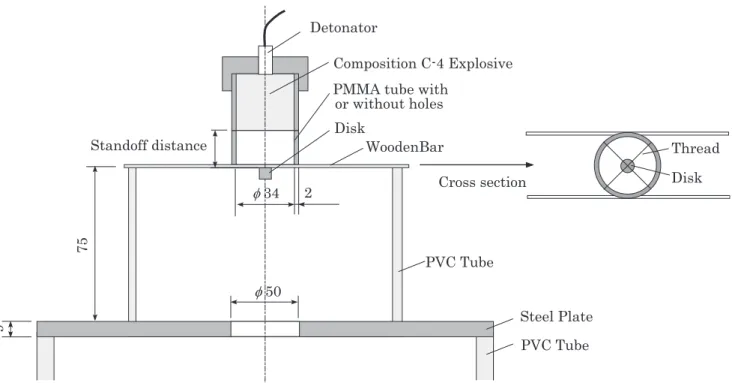
Figure 1 shows the configuration of the explosive in the PMMA tubes and the disks. The standoff distance was defined to be from the face of the explosive to the face of the disk. The standoff distance was set to be 0 mm, 12.7 mm, 38.0 mm, 88.2 mm, and 189.1 mm. In the 0 mm case the disk was in close contact with the explosive. The corresponding Hopkinson scaled distance
6)was 0 m·kg
−1/3, 0.037 m·kg
−1/3, 0.111 m·kg
−1/3, 0.258 m·kg
−1/3, and 0.553 m·
kg
−1/3, respectively. A PMMA tube of an internal diameter and thickness of 34.0 mm and 2.0 mm, respectively, was used to set the standoff distance. This tube will hereinafter be referred to as the spacer tube. A spacer tube suits being used to set the accurate standoff distance, but it confines the air blast and can thus affect the velocity of the disk. As many holes as possible were therefore drilled in the tube to suppress the confinement. This spacer tube will be hereinafter referred to as the spacer tube with holes. The diameter of the holes was either 9 mm or 11 mm. The ratio of the overall area of the holes to the lateral area of the spacer tube is tabulated in Table 1. In addition, PMMA tubes without holes were also tested as spacer tubes in thereby evaluating the effect of the tubes on the flight velocity.
Thread was stretched at the opposite side of the spacer
Figure1 Configuration of explosive and metal disks used in this study.
75
䠄
1200
䠅 䠄500
䠅 䠄250
䠅Clay 9
75 2
(50)
PVC tube Aluminum plate
120㼻
䠄㻌㻌㻌267䠅25
PVC ring
Recorded area of camera 120㼻
120㼻
䠄㻌㻌㻌267䠅Disk
Explosive
䠄㻌㻌㻌247䠅
50
Steel plate PVC ring 25
VP250 PVC tube (10) with 120 degree vent tube to the explosive. The thread was made of polyester of
a diameter of approximately 0.1 mm. The disk was bonded to the thread with epoxy resin. The end face of the disk and the explosive faced each other.
The disk was placed in the direction of the detonation in this study. Held
7−9)reported the blast impulse in this direction to be the largest. The configuration used in this study resulted in the fastest velocity of the disk.
2.4 Velocity measurement
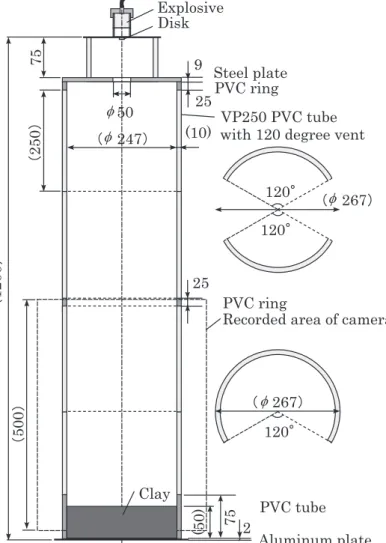
Figure 2 shows the configuration of the apparatus used to measure the flight velocity. The experiments took place at atmospheric pressure. The disks flew from top to bottom within a large polyvinyl chloride (PVC) tube of a length, internal diameter, and thickness of 1100 mm, 247 mm, and 10 mm, respectively. The tube had vents for the explosion gases and openings to record images, and is shown in Figure 2. A steel plate was fixed at the top of the PVC tube. The steel plate was used to restrain the bright explosion gases that could have obstructed the velocity being measured by the high
speed camera. The steel plate was square, with sides 267 mm long, and the thickness of the plate was 9 mm. A circular opening with a diameter of 50 mm was prepared in the center of the plate to allow passage of the disk. Preliminary advance experiments demonstrated that the opening diameter of 50 mm did not affect the velocity of the disk but was enough to restrain the bright explosion gases generated. The explosive and the disk were fixed to two thin wooden bars of a length, thickness, and width of 200 mm, 4 mm, and, 4 mm, respectively, and then placed on a PVC tube of a length, internal diameter, and thickness of 75 mm, 146 mm, and 10 mm, respectively.
The velocity of the disk was then measured using a highspeed video camera (HPV1, Shimadzu Corporation). Images were recorded during a flight of 500 mm from 630 mm from the initial position.
The time interval of the frames was 16 " s or 32 " s.
The digital delay and pulse generator, described above, sent the appropriate delay pulse to the camera to start recording. 105 mm f/2.5 or 135 mm f /2 lenses were employed. A flash (Matsushita Electric Industrial Co. Ltd PE560 MGN or Panasonic Photo & Lighting Co. Ltd PE60 SG) was used as the light source.
3. Results and discussion
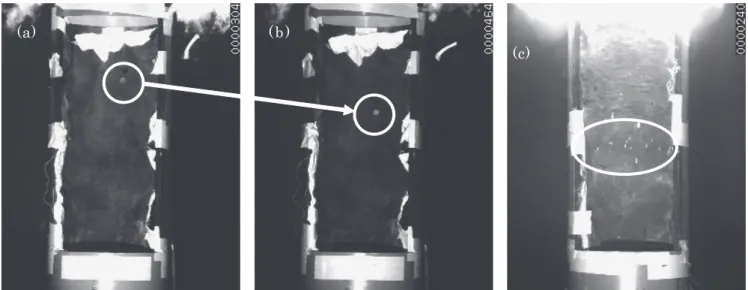
Figure 3 (a)(c) shows a typical image taken by the high
speed camera. The obtained images were clear enough to analyze the velocity in almost experiments. Some of the disks rotated as they flew. As shown in Figure 3 (c) the case of a standoff distance of 0 mm resulted in the disks being destroyed and the small fragments recorded, excluding a (& ! $ ) of 0.1, although the disk was not destroyed in the experiments in reference 4) and 5) that took place in similar conditions. In the experiments the disks were all made of the same regulated stainless steel, and hence the strength of the hardening due to work must have affected the fragmentation.
The position of the disk in each image was determined in thus obtaining the relationship between time and displacement. The velocity of the disk was then determined based on linear fitting of that relationship. The coefficient of determination was approximately 0.999.
After taking into account the air resistance the relationship between the velocity of the disk and the distance is expressed using eq. (1)
3,10).
'# $ %#'
!" $&%! "
$" # " !
" %
! " " #
# $ (1)
where '(# ) is the velocity at distance # , '
!the initial velocity, #the density of air, ! the cross section of the disk, % the mass of the disk, and "
#the drag coefficient.
Table1 Holes in PMMA tube.
Length [mm]
Diameter of Holes [mm]
Number of Holes
Areal Ratio of Holes to PMMA Pipe
[%]
189.1 11 104 41.6
88.2 11 48 41.2
38.0 9 24 32.0
12.7 9 8 31.9
Figure2 Configuration of flight velocity measurement apparatus.
3
8
4
(a) ( b )
(c)
0 20 40 60 80 100 120 140 160 180 200 0
200 400 600 800 1000 1200 1400 1600 1800
Standoff distance [mm]
0.1 0.2 0.5 1.0
Velocity [ m s
-1]
[ t /d]
To estimate the effect of the air resistance the drag coefficient of the disk and the initial velocity were presumed to be 1.2 and 1200 m·s
−1, respectively. The density of the air was 1.2 kg·m
−3. Substituting these values into eq. (1) resulted in the velocity after a flight of 500 mm, which is the length of the area recorded by the high
speed camera, being calculated to be 1179 m·s
−1. The decrease in velocity was 1.8%. The disk was therefore regarded to move at constant velocity. As in the fragmentation experiments the velocity was determined using a fragment, which can be traced on all the images, the significance of the velocity in such experiments differed from the others. The determined velocity and corresponding experimental conditions are tabulated in Table 2. The determined velocity is in accordance with the velocity in references 4) and 5).
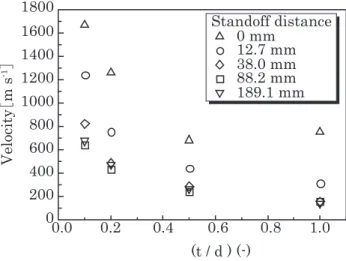
The velocity obtained with the spacer tubes with holes is represented in Figures 4 and 5. Figure 4 demonstrates the velocity to be basically constant and only dependent on (" ! ! ) when the standoff distance was more than 38 mm.
Figure 5 shows that the velocity generally decreased with (" ! ! ).
Table2 Velocity of disks and corresponding experimental conditions.
Number [" ! ! ]
Standoff distance [mm]
Scaled Standoff Distance [m kg
−1/3]
Holes on spacer
Velocity [m/s]
1 0.1 0.0 0.000 Yes 1669
2 0.1 12.7 0.037 Yes 1241
3 0.1 38.0 0.111 Yes 821
4 0.1 88.3 0.258 Yes 644
5 0.1 189.0 0.553 Yes 671
6 0.2 0.0 0.000 Yes 1259
*7 0.2 12.7 0.037 Yes 752
8 0.2 38.0 0.111 Yes 484
9 0.2 88.2 0.258 Yes 436
10 0.2 189.0 0.553 Yes 473
11 0.5 0.0 0.000 Yes 681
*12 0.5 12.7 0.037 Yes 442
13 0.5 38.0 0.111 Yes 285
14 0.5 88.2 0.258 Yes 242
15 0.5 189.1 0.553 Yes 260
16 1.0 0.0 0.000 Yes 750
*17 1.0 12.7 0.037 Yes 310
18 1.0 38.0 0.111 Yes 155
19 1.0 88.1 0.258 Yes 158
20 1.0 189.1 0.553 Yes 138
21 0.1 12.7 0.037 No 1238
22 0.1 38.0 0.111 No 824
23 0.1 88.1 0.258 No 703
24 0.1 188.8 0.552 No 713
25 0.2 12.7 0.037 No 743
26 0.2 38.0 0.111 No 501
27 0.2 88.1 0.258 No 397
28 0.2 188.9 0.552 No 475
*
The case of a standoff distance of 0 mm resulted in the disks being destroyed, excluding (" ! ! ) of 0.1. The velocity shown in this table is the representative velocity of fragments.
Figure3 Typical images taken by highspeed camera.
(a), (b) Images taken in experiment No.9. (" ! ! ) of 0.2 and standoff distance of 88.2 mm. (b) was recorded 160 " s after (a).
The white circles emphasize the movement of the disk. The disk rotated as it flew.
(c) Images taken in experiment No.6. (" ! ! ) of 0.2 and standoff distance of 0 mm. Fragments can be observed within the white ellipse.
Figure4 Relationship between standoff distance and velocity.
0.0 0.2 0.4 0.6 0.8 1.0 0
200 400 600 800 1000 1200 1400 1600 1800
Standoff distance 0 mm
12.7 mm 38.0 mm 88.2 mm 189.1 mm
(t / d ) (-) Velocity [ m s
-1]
0 20 40 60 80 100 120 140 160 180 200 0
200 400 600 800 1000 1200 1400
Standoff distance [mm]
0.1 Hole 0.1 0.2 Hole 0.2
Velocity [ m s
-1]
[t /d ]
0 20 40 60 80 100120140160180200 0
5000 10000 15000 20000
0.1 0.2 0.5 1.0
[t /d ]
Momentum per unit cross section [ m
-1kg s
-1]
Standoff distance [mm]
The effect of the holes on the spacer tube is examined in Figure 6. The difference is not at all obvious and the effect of the holes ambiguous. The holes in the spacer tube, whose areal ratio was from 30 % to 40 %, did not affect the velocity of the disk.
The relationship between the velocity and the standoff distance, as shown in Figure 4, demonstrates the velocity to strongly depend on the (& ! # ) at the same standoff distance. The velocity of the disk should therefore be related to the impulse caused by the explosion. The impulse per unit cross section of the disk must be same at the same standoff distance. The amount of the impulse should be proportionate to the cross section of the disk.
The momentum, as described by eq. (2), should be proportionate to the impulse.
% !$' (2)
where %is the momentum of the disk, $ the mass of the disk, and 'the velocity measured in this study. The four kinds of disks used in this study had basically the same $ but different cross sections. Based on the above, therefore, the momentum per unit cross section " in eqs. (3) and (4) should not depend on the (& ! # ).
" ! %
! (3)
" ! " $'
" #
!(4)
where ! is the cross section and # the diameter of the disk. As the disk was fragmented the data from a standoff distance 0 mm was eliminated. Figure 7 shows the relationship between the standoff distance and the momentum per unit cross section. The difference due to (& ! # ) at same standoff distance was up to 20 %, which is small when compared with Figure 4. The velocity therefore can be substantially described using the momentum per unit cross section. Similar to the velocity (Figure 4) the momentum per unit cross section did not strongly depend on the standoff distance in the case of being more than 38 mm.
Held
9)reported the impulse per unit area around cylindrical explosive (TNT/HMX (30/70)) to be 0.77 kg.
The precise impulses from the figure in the paper were rather difficult to determine, but impulse per unit area at 0.28 m·kg
−1/3, 0.55 m·kg
−1/3was approximately 1.5 10
4m
−1・kg·s
−1. The momentum in this study was smaller than that of Held but comparable. Held
9)also reported that the impulse definitely decreased at 0.82 m·kg
−1/3and 1.09 m·kg
−1/3. The explosion of spherical explosives normally results in the reflected blast impulse decreasing with distance
11). The cylindrical shape of the explosive used in this study should have affected the constant momentum when larger than 38 mm, although the confinement due to the spacer tube could not be excluded.
The results demonstrate that the velocity of material accelerated by an explosion can be estimated using the standoff distance, weight, and cross section of the material.
Any dependence on shape and density of the material will be a future subject of research.
4. Conclusion
This study examined the flight velocity of metal disks accelerated by explosions. Summarized conclusions follow.
Figure5 Relationship between (& ! # ) and velocity.
Figure 7 Relationship between standoff distance and momentum per unit cross section.
Figure6 Effect of holes on PMMA tubes.
3
8
4
1. The flight velocity of a disk accelerated by an explosion depended on the cross section of the disks of the same weight and at the same standoff distance (Figure 5).
The velocity could be significantly described using the momentum per unit cross section (Figure 7).
2. The flight velocity decreased at standoff distances of 0 mm to 38.0 mm but then basically remained constant when greater than 38 mm (Figure 4).
3. A PMMA spacer tube was used make the standoff
distance more accurate. Tubes with holes and without holes had no obvious difference in velocity. The ratio of the hole to lateral area of the spacer tube was 3040 % (Figure 6).
The dependence on the kind of explosive, shape, and density of the material will be a future subject of research.
This study will be used in a technique for measuring the impulse at a very near point to the explosion.
Acknowledgement
This study was conducted as part of the commissioned project of “Technical Standards Examination for Mitigation of Damage from Explosions” by the Nuclear and Industrial Safety Agency of the Ministry of Economy, Trade and Industry of Japan in FY2008.
References
1) R.W. Gurney, Ballistic Research Laboratory Report No. 405, Aberdeen Proving Ground, Maryland (1943).
2) Q. Zhang, C. Miao, D. Lin, and C. Bai, Int. J. Impact Eng., 28, 1129 (2003).
3) K. Wakabayashi, T. Homae, K. Ishikawa, E. Kuroda, T.
Matsumura, and Y. Nakayama, Sci. Tech. Energetic Materials, 70, 94 (2009).
4) Unpublished data.
5) H. Hamashima, S. Kubota, T. Saburi, and Y. Ogata, Mat. Sci.
Forum, 673, 301 (2011).
6) W.E. Baker, “Explosions in Air”, Univ. of Texas Press, Austin, Texas (1973).
7) M. Held, Propellants, Explosives, Pyrotechnics, 24, 17 (1999).
8) M. Held, Propellants, Explosives, Pyrotechnics, 26, 290 (2001).
9) M. Held, Propellants, Explosives, Pyrotechnics, 27, 279 (2002).
10) “Manual of NATO safety principles for the storage of military ammunition and explosives AASTP1 Edition1”, II
534, NATO Group of Experts of the Safety Aspects for Transportation and Storage of Military Ammunition and Explosives (2006).
11) W.E. Baker, P.A. Cox, P.S. Westine, J.J. Kulesz, and R.A.
Strehlow, “Explosion Hazards and Evaluation”, Elsevier (1983).
爆薬の爆発により加速される金属円板の速度
保前友高
*†,若林邦彦
**,松村知治
**,中山良男
**爆発物が爆発すると,周囲に存在する物体は加速されて飛散物となる。本研究では,飛散物速度の評価を行うため,飛
散物の模擬物としてステンレス製円板を使用した実験を行った。特に,円板の厚さ・直径の比(" ! ! ),爆薬と円板の距
離(Standoff distance)と速度の関係に着目した評価を行った。(" ! ! )については,ほぼ同じ質量の円板で比較したとこ
ろ,断面積が大きいほど,速度も大きかった。速度は,おおむね,単位断面積当たりの運動量で整理できた。爆薬と円 板の距離については,爆薬がコンポジションC−4 40gの場合,0mmから38 mmまでの範囲では,距離が大きくなるに 伴い,速度が小さくなったが,38 mmから189 mmの範囲では,ほぼ一定であった。
*
富山高等専門学校 商船学科 〒9330293 富山県射水市海老江練合12 TEL : 0766865100
Corresponding address : homae@nctoyama.ac.jp
**