Integration of Financial Markets in Japan and Asia
—Financial Deepening in Asia due to Japanese Banks’ Entry— * Mitsuru Yaguchi
General Manager and Chief Economist at the Economic Research Department and Emerging Economy Research Depart- ment, Institute for International Monetary Affairs
Ayako Yamaguchi
Senior Economist at the Economic Research Department, Institute for International Monetary Affairs
Koji Sakuma
Professor of Faculty of English and Global Communication at Kyoto Tachibana University/ Visiting Researcher at the In- stitute for International Monetary Affairs
Abstract
Looking back at Japanese banks’ activities in Asia since the 1980s, we see that they have steadily expanded credit provision and other business operations amid the growing sophisti- cation of needs while Euro-Area banks have restrained their activities in the region, particu- larly since the global economic and financial crisis in 2007-2008. Above all, in the ASEAN (Association of Southeast Asian Nations) region, Japanese banks have actively pursued the acquisition of capital or business alliances with local banks since around 2012 in order to capture the increasingly sophisticated and diverse needs of the region.
As a result, in the field of financial services for retail and corporate customers, there have been spillovers of financial technology from Japanese banks to the local banks which they have acquired or with which they have formed alliances. In the retail sector in particu- lar, financial techniques have been transferred from financially developed countries to finan- cially underdeveloped countries through the international networks of local banks which Japanese banks have acquired or with which they have formed alliances.
Moreover, when local banks are acquired by Japanese banks, the level of know-how concerning the business administration as broadly defined, including adaptation to global fi- nancial regulations and national legislative framework, is immediately raised to a level equivalent to the Japanese level. We may also point out the possibility that as those local banks’ activities serve as best practices, their effects may spread throughout the relevant countries through the financial supervisory authorities.
As described above, in a sense, Japanese banks’ entry into Asia contributes to the re- gion’s financial deepening. This may be taken as evidence that the integration of financial markets in Japan and Asia is gradually proceeding at the financial institution level.
*
In preparing this article, the authors were greatly stimulated by the exchange of opinions with the staff in charge of Asian
business at the headquarters and overseas offices of the Bank of Tokyo-Mitsubishi UFJ (current MUFG Bank). The authors
would like to express heartfelt thanks to them. The opinions in the article are solely of the authors and do not represent the offi-
cial views of the institutions they belong to.
I. Introduction
In the past decade or so, the Asian business of the Japanese private financial institutions advanced greatly, contributing to the mutual development of the Asian financial market. In this article, in making the main theme the integration of financial markets in Japan and Asia, the authors try to analyze the current situation of the market integration and consider the fu- ture challenges, not from an aspect of international capital movement or financial regulation, but from the aspect of activities of private financial institutions. What the authors give their special attention to is the possible contribution of Japanese banks, in their accelerated entry into Asia, to the deepening of finance in Asia, through transfers of their relatively advanced financial and managerial technology to the local banks in the region.
The precedent studies on Japanese banks’ entry into Asia are very few, with recent ones limited only to Watanabe (2014) who discussed the global strategies of Japanese me- ga-banks, or Yamagami (2017) who dealt with their ways of retail finances and securitiza- tion. Building on their studies, the authors intend to discuss, from a new perspective of spill- over effects of the Japanese financial technology to the local banks in Asia, the dynamism of the Asian financial markets which have become increasingly sophisticated through the inte- gration led, not by the government orientations, but by the private business initiatives.
In Chapter II, the authors look back at the history of business expansion to Asia of Japa- nese companies (non-financial institutions) as far back as the 1980s with special focus on their direct investment, and overview the situations where Japanese banks have expanded their Asian business to support the advancement of those non-financial institutions. Further, we confirm that after the global economic and financial crisis of 2008-2009 (hereafter re- ferred to as “Global Crisis”), Japanese banks have substantially expanded their credits to Asia, including local claims denominated in local currency.
In Chapter III, the core of this article, after confirming that the middle class in the Asian countries has increased in line with the rise of income levels, we will show, focusing on the ASEAN countries where Japanese banks have aggressively expanded their business, that there have been increased and sophisticated needs for financial services and Japanese banks have taken steps to acquire or form alliances with local banks to take advantage of these needs. Then, we will discuss in what ways the financial technology has spilt over to the lo- cal banks as a result of accelerated entry of Japanese banks.
Finally in Chapter Ⅳ, we will wrap up our analyses for this article with some additional remarks on the challenges for the Asian finance toward further deepening.
Keywords: Asia, overseas business expansion, spillover effects, banks, financial technol- ogy, ASEAN, acquisition, alliance
JEL Classification: G15, G21, O16
II. History of Japanese Banks’ Business Expansion into Asia
II-1. Growth of the Japanese Economy and Support to Business Advancement of Japanese Companies into Asia
In the 1980s, the Japanese economy, overcoming recessions after two oil shocks, achieved a relatively stable growth and low unemployment rate as compared to the U.S. and European countries. In that process, the manufacturing industry expanded its exports, espe- cially in automobiles and electric machineries, and set in place a surplus trend for the Japa- nese current account balance. Especially in the first half of the decade a higher dollar trend that continued under the Reaganomics policies in the U.S. contributed to the export-led growth of the Japanese economy. The real GDP grew at an annual average of a bit below 4% in 1980-85, to which net exports contributed by more than 1 percentage point. The ex- pansion of the current account surplus triggered a trade friction with the U.S. and European countries. The harmful effect of the excessive appreciation of the U.S. dollar became appar- ent internationally, which led to the correction of the high U.S. dollar through the Plaza Agreement in 1985.
The progress of appreciation of the yen that followed the Plaza Agreement led to a de- cline in export competitiveness of Japanese companies. In response to trade frictions and progress of a rising yen, Japanese manufacturing companies increased their direct invest- ment in the U.S. and European countries (local production in the region of consumption), while at the same time they increasingly shifted their production bases to Asia where labor costs were still low. The destination of investment spread from the initially targeted Asian NIEs (Korea, Hong Kong, Taiwan, and Singapore), to China and ASEAN in response to ris- ing wages in their host economies with the development of the Asian economy. Especially Japanese large manufacturers aggressively shifted their production base overseas and fol- lowing the advancement of major finished goods makers into Asia, parts makers as well as leading medium-sized companies started to establish their production bases locally, thus broadening their activity base in Asia.
The revision of Foreign Exchange and Control Act in 1980 also pushed the globalization of the Japanese economy and Japanese companies by liberalizing in principle external trans- actions with foreign countries. On the other hand, emerging Asian countries took measures to industrialize their economy, by establishing Export Processing Zones to attract foreign companies. They also gave Japanese companies a push to expand their business to Asia.
In the 1990s, China started to actively take in foreign companies and not only Japanese
companies but also Korean and Taiwanese companies that had achieved dramatic develop-
ment accelerated their advance in China and the ASEAN countries. In this way an interna-
tional division of labor among Japan-NIEs-China-ASEAN was established covering the
whole East Asia. Japanese companies promoted to develop global supply chains in a way to
produce low value-added products in Asia while producing high value-added and technolo-
gy-intensive goods in Japan.
In response to these movements, Asia’s presence as a big export destination of Japan rapidly expanded. The share of East Asia (total of China, Asian NIEs and ASEAN) in total Japanese exports increased from 30% in 1980 to 40% in 2000 and 50% in 2016, enhancing the degree of tightness of economic relations between East Asian countries and Japan.
According to the Japanese Direct Investment Statistics, both the numbers and the amounts of direct investment abroad showed an increase since the middle of the 1980s be- fore they dropped in the aftermath of the burst of bubbles, but if limited to Asia, Japanese direct investment sustained a relatively high level centering around the manufacturing in- dustry even after the burst of bubbles (Figure II-2). It also suggests that the direct invest- ment in other regions, especially in Europe and the U.S., was rather concentrated in non-manufacturing industries (mainly in real estate) while in Asia it was driven by manufac- turing industries.
Such development of supply chains in East Asia by Japanese companies gave Japanese banks more business chances in such forms of advisory services to Japanese companies which wanted to go international, services business such as consultation on various proce- dures and provision of local information, trade-related foreign exchange businesses, dealing with their local needs for fund raising, etc. Taking advantage of these chances, Japanese banks expanded their business in Asia.
Direct investment of Japanese companies in Asia decreased largely after the Asian cur- rency and financial crisis of 1997 (hereafter referred to as “Asian Crisis”) in every category of industries including manufacturing and non-manufacturing. With a sharp deceleration of the Asian economy, Japanese companies that advanced into Asia had a worsening perfor- mance and the non-performing loan ratio rose on the external assets of Japanese banks. In addition, the domestic economy also deteriorated and suffered from the financial crisis.
Figure II -1. Japanese Exports by Trading Partners
(Source) Ministry of Finance
These factors jointly led to a decrease in the direct investment abroad of Japanese compa- nies.
The direct investment abroad on the balance of payments basis 1 since 2005 showed a sharp drop in 2009 affected by the Global Crisis, but the investment in Asia suffered a rela- tively smaller decrease and remained on a solid base thereafter (Figure II-3). The level of investment in Asia seems to have been supported by the fact that Asia began to draw more attention as a consuming region in line with the growth of the Asian economy, encouraging the Japanese manufacturing companies to focus on Asia not only as a production site for their exports but also as a base for production and sales to the local consumers. The growth of the Asian economy expanded local consumers’ needs for various services, attracting more investment in non-manufacturing industries including not only finance but also wholesale
(Note) Data for 1975 to 1990, computed from US$
data with the exchange rate.
(Source) Ministry of Finance (Note) Data for 1975 to 1990, computed from
US$ data with the exchange rate.
(Source) Ministry of Finance
Amounts
Figure II-2. Japanese Direct Investment Abroad by Industry (on a permission base, flow) Numbers
(Source) Ministry of Finance (Source) Ministry of Finance
1
Figure II-2 is based on the notification based statistics and II-3 on the balance of payments basis. While the former refers to
the aggregated number of only outward investment, statistics on the balance of payment basis record net figures of investment
executed less withdrawals. There is a discontinuity between them because of a difference in coverage and others in addition to
the compilation method.
and retail sales, transportation, telecommunication and other services. These investments further boosted the direct investment in Asia that had been led by manufacturing industries. 2
The rapid expansion of these overseas activities since the 1980s can be confirmed by the development of numbers of branches and affiliates of Japanese banks in Asia (Figure II-4).
The number of the bank bases decreased since the latter half of the 1990s, which reflected the progress of consolidation of overseas bases following the mergers and acquisitions of the banks in Japan, especially among major city banks. Before 1990 Japanese banks aggres- sively opened their overseas bases in Hong Kong as one of the financial centers, but after the 1990s they increasingly expanded their networks in the ASEAN region. Specifically af- ter the Global Crisis, mega-banks among others successively took stakes in the local banks in Asia. 3
Figure II-3. Direct Investment Abroad by Industry (Balance of Payment basis)
(Notes) Balance of Payments basis. From 2014 and thereafter figures are compiled according to the Directional Principle -- that is, investments from an affiliated company in its parent company are recorded as withdrawals from the parent company. Thus, the figures are different from those of 2005-2013.
(Source) Ministry of Finance
2
In 2016, investment of finance and insurance in Asia recorded a large withdrawal (capital inflow to Japan), mainly due to a large withdrawal from Singapore of ¥2.4 trillion despite a positive investment in other Asian countries. Since 2014, on the bal- ance of payments statistics, investment of a subsidiary in its parent company is registered negatively as a withdrawal (formerly it was registered as investment on a gross base.) This change of methodology may have affected the figures.
3
A minor stake with no ownership is not reflected in the Figure II-4.
II-2. Growth of Asian Economy and Development of Financial Services to Non-Japanese Companies
According to Lam (2013), there were three characteristic booms in the overseas expan- sion of Japanese banks as shown below.
(1) From the 1980s to the burst of bubbles
(2) From the middle of the 1990s to the Asian Crisis (3) Resurgence after 2006
The Bank for International Settlements (BIS) banking statistics on the foreign credit of Japanese banks show that these major booms mainly reflected the expansion of credit to Asia.
The Japanese banks’ credit to Asia 4 continued to expand from the middle of the 1980s to even after the burst of bubbles, especially with a sharp increase in the middle of the 1990s until the start of the Asian Crisis. After the Asian Crisis, their credit to Asia contracted sharply due to a sharp deterioration of the local economy as well as the deterioration of their performance affected by the domestic financial crisis. It was a group of banks in the Euro Area that kept rising instead. The banks in the Euro Area had enhanced their international presence through the introduction of the euro of 1999 and the start of circulation in 2002 of the euro notes and coins. That was no exception in Asia.
The banks in the Euro Area had sharply expanded their credit to foreign countries well Figure II-4. Numbers of Japanese Banks’ Asian Branches and Affiliates
(Notes) At the end of each fiscal year. Data includes representative offices.
(Source) Japan Bankers Association
4
Unless otherwise noted, the credit to Asia represents a total of the 9 economies of Indonesia, Malaysia, the Philippines, Thai-
land, Vietnam, China, Korea, Taiwan and India. Hong Kong and Singapore are not included here due to their status as interna-
tional financial centers.
before the Global Crisis and Japanese banks also started to increase their credit to Asia since the middle of the 2000s. After the Global Crisis, all of European and U.S. banks as well as Japanese banks cut their credit to Asia. Especially the banks in the Euro Area experienced a deterioration of their performance because the Global Crisis triggered the euro sovereign crisis. As a result, they heavily reduced their external credit as a whole, with no exception to that to Asia. Japanese banks also reduced their credit to Asia, but to a lesser extent because the damage of the Global Crisis to their capital was less severe than the banks in Europe and the U.S. had experienced.
It was Japanese and British banks that expanded their credit as if to compensate the drop in the credit extended by the banks in the Euro Area. British banks largely increased their outstanding of credit by 2013, but reduced the outstanding after 2014, mainly to China. In the meantime Japanese banks steadily increased their credit outstanding, becoming only the second to British banks in the credit outstanding to Asia. As the Figure II-6 shows, the dif- ference between the total credit of major advanced countries and the world total has been widening in recent years. This seems to indicate that credit extended through such Asian fi- nancial centers as Hong Kong and Singapore has been increasing. Also the credit extended to Asia by banks in Taiwan and Korea has been increasing in recent years with their out- standing reaching $5.75 billion and $4.7 billion respectively at the end of 2016, suggesting the progress of integration of financial markets within Asia. Reflecting such a situation, the cases are emerging, though slowly, where the banks in Malaysia and Thailand have expand- ed their business in their neighboring ASEAN countries. 5
Among the recipient countries of credit extended to Asia by the European banks (located Figure II-5. Japanese Banks’ Foreign Claims Outstanding
(Notes) From 1984 to 1999 half yearly, from 2000 and afterwards on a quarterly basis. Figures for world total, data for some developed countries were added from 2000, thus the data is not consistent from the data before. Asia means Indonesia, Malaysia, Philippines, Thailand, Vietnam, China, South Korea, Taiwan and India.
(Souces) Bank for International Settlement, “Consolidated Banking Statistics,” Bank of Japan
in the U.K. and Euro Area), China accounts for around 40%, India 16%, Korea 15%, Taiwan 11%, with ASEAN 5 countries accounting for around 20%. Among the U.S. banks’ credit, China accounts for 25%, Korea 24%, India 23%, and Taiwan 13%, with ASEAN 5 account- ing for 15%. Japanese banks extend 25% of credit to Thailand, 21% to China, with ASEAN accounting for 47% including 10% to Indonesia, and 7% to Malaysia. It is noticeable that while the European and U.S. banks have focused more on China, India, Korea and Taiwan, the Japanese banks have focused more on the ASEAN countries. As a result, the share of the Japanese credit in the recipient countries represents 58% in Thailand followed by 24% in Vietnam, 23% in the Philippines, 23% in Indonesia, 15% in Malaysia and 6% in China, which indicates the increasing importance of the Japanese banks in the ASEAN countries.
According to Remolona & Shim (2015), after the Global Crisis a greater concentration of creditors developed in the international credit to the Asian countries. In most Asian coun- tries the shares of the top three creditors increased. Among all, the increase in concentration progressed more significantly in Thailand, Malaysia, Korea, Philippines and Indonesia, in which, the top 5 creditors included the U.S., the U.K., Japan, Germany, and France in 2007
Figure II-6. Advanced Countries Reporting Banks’ Foreign Claims to Asia
(Notes) From 1984 to 1999 half yearly, from 2000 and afterwards on a quarterly basis. Asia means Indonesia, Malaysia, Philippines, Thailand, Vietnam, China, South Korea, Taiwan and India.
(Source) Bank for International Settlement, “Consolidated Banking Statistics”
5
Against the background of such an expansion of international financial services within Asia, the ASEAN countries have been
promoting, albeit at a moderate pace, liberalization of intra-regional financial services under the ASEAN Banking Integration
Framework (ABIF). Specifically, members are negotiating on a bilateral basis on the introduction of a system under which the
qualified ASEAN banks (QABs) that satisfy a certain level of conditions can freely conduct financial business in other member
countries.
while in 2015 they included the U.S., the U.K., Japan, Australia and Singapore. In Indonesia and Thailand, Japan ranked the first while Singapore was the top creditor in Malaysia. This may represent the slumping activities of the European banks in Asia and a strengthened linkage in Asia and Pacific regions.
Foreign claims in the BIS statistics consist of international claims and local claims in lo- cal currency. International claims include cross-border claims and local claims in foreign currency. Figure II-7 shows the credit of Japanese banks by recipient country. In China and Taiwan, credits were mostly extended in local currency from early on, and therefore the lo- cal claims in local currency have already exceeded the international claims. In Thailand the local claims in local currency exceeded the international claims in the early 2000s, and in 2013 the outstanding local claims in local currency increased to more than double of the in- ternational claims partly because the Bank of Tokyo-Mitsubishi UFJ (current MUFG Bank) acquired the Ayudhya Bank (5 th largest in assets in Thailand) as a subsidiary. In Korea, the outstanding local claims in local currency reached about 60% of international claims. Also in Malaysia and Indonesia, the local claims in local currency have been on a steady increase.
In the Philippines, India and Vietnam, the ratio of local claims in local currency is still low, but it is seen that the ratio is steadily rising in each of them. Although the share of Asia in the total foreign claims of Japanese banks still remains below 10%, as far as the share in the local claims in local currency is concerned, Asia’s share has risen to around 20%, showing that “localization” of Japanese banks in Asia has been rapidly progressing as compared to other regions.
Remolona & Shim (2015) pointed out that, when they go international, the Asian banks including the Japanese ones tend to choose to establish branches rather than local subsidiar- ies as compared to the European and U.S. banks. In fact, looking at the share of local claims in local currency among the foreign claims of banks in advanced countries, the British banks Table II-1. Foreign Claims by Reporting Banks’ Nationality (as of June 2017, billions of dollars)
(Source) BIS, Consolidated Banking Statistics
Figure II-7. Japanese Reporting Banks’ Foreign Claims to Asia (millions of dollars)
(Notes) Half yearly data from 1983-1999, quarterly data from 2000 and after.
International claims include cross-border claims and local claims in foreign currency.
Data for Q3 2017 is by the Bank of Japan, data for Q2 2017 and before is by BIS.
(Source) BIS, Consolidated Banking Statistics,
Bank of Japan
and the U.S. banks, which had aggressively expanded their overseas business from early on, rapidly increased the share of the local claims in local currency in the 1980s, with its share reaching over 50% in the 1990s. The British banks’ share has remained at over 50% since and the U.S. banks have maintained the level of 30-40% after reducing it somewhat in the first half of the 2000s. Lagging behind the British and U.S. banks, those in the Euro Area started to expand their international business lately, and increased their share of local claims in local currency from the low level of 5-6% in the 1980s to over 40% in the 2010s before levelling off thereafter. On the other hand, the share of Japanese banks’ local claims in local currency to their total foreign claims remains at slightly over 20%, even most recently, al- though it has been on a rising trend. However, as far as Asia is concerned, its share of the Japanese banks has steadily risen to 46% most recently, reaching a level comparable to those of the European and U.S. banks. The Japanese banks conduct local lending through their overseas branches as well, but it will be a quicker route to take a stake in the local banks to expand local transactions. In that respect, the business models of the Japanese banks may have come closer to those of Western banks.
In addition, against the backdrop of the Asian Crisis and the Global Crisis, the financial authorities in the Asian countries have been more inclined to regulate the branches of for- eign banks on the same status with the foreign subsidiaries and local banks, in an effort to strengthen regulations on rapid capital flight and treat foreign banks on an equal footing with the local banks. This also may have led to an increase of local claims in local currency.
Within the recipient countries, transactions with non-Japanese companies have become an important target for Japanese banks against a background of growth of local companies in line with the economic growth of Asian countries and the broadening of international business activities of the Japanese companies. 6 Also noteworthy was the expansion of the middle class associated with the economic growth of the Asian countries (to be discussed in the next chapter in more details). Financial needs have been increasing among the middle class such as housing loans, auto loans and so on, which have given the Japanese banks new business chances. The expansion of local claims in local currency of the Japanese banks may reflect such a diversification of business opportunities. In order to expand business more geared to non-Japanese local companies (especially leading SMEs) and households, it would be an easy shortcut for the Japanese banks to broaden their customer base through acquisition of or business/capital alliance with local financial institutions which have a de- tailed knowledge of local markets. The Global Crisis also made the banks deeply realize the importance of core deposits in their funding and encouraged them to obtain a local base for stable deposits as one of their strategic objectives. 7 In fact, the Japanese banks’ ratio of local claims in local currency to local liabilities in local currency has been at almost 100% in Thailand and Vietnam, despite it often exceeding 100% in most developing countries (BOJ
6
See Yamaguchi (2018b), Development of Asian Supply Chains of Japanese Companies.
7
Remolona & Shim (2015) found that the ratio of core deposits to total funding in the overseas bases of the Japanese banks in
Asia and Pacific accounted for about 75%, almost the same level as was seen in bases in other regions and showed no large
difference with the comparable levels of banks in other countries.
data as of September 2017).
In the prolonged period of stagnant Japanese economy after the burst of bubbles and the progress of deflation, the Japanese banks, especially mega-banks, had seen a decline in do- mestic lending in the face of the balance sheet adjustment of domestic companies. In the meantime, overseas lending, especially to Asia, increased strongly, underpinning their in- come structure.
Under the Abenomics strategy, Japanese banks are expected to shift their assets from Japanese government bonds to assets with higher risks. And with a sluggish domestic growth, business expansion to Asia has been one of the important challenges for them.
III. Japanese Banks’ Acquisition and Alliance Strategies 8 and Financial Devel- opment of Asia
III-1. Rise of Income in Asia and Broadening of Local Customer Base of Banks Asia embraces countries in a variety of development stages. Based on the per capita GDP (on a purchasing power parity basis), the income level in Singapore, which has already joined the high-income country group, and oil rich Brunei has already exceeded the level of Japan. Headed by these two, Malaysia and Thailand have achieved outstanding growth in recent years and have reached the level of upper middle income group, followed by Indone- sia and the Philippines. For the latecomers of ASEAN, called CLMV, income levels have been steadily rising with Vietnam at the top followed by Myanmar, Lao PDR, and Cambo- dia. The annual growth rate of ASEAN member states in the 1980s and 90s generally ex- ceeded 5% except for the Philippines, which had a late start, revealing their steady catch- ing-up to other members.
The IMF expects in its medium-term growth forecast to 2022 that they will achieve a high growth of 5-8% except for Singapore and Thailand which had already been maturing.
With the high economic growth and the progress of urbanization, the middle class has been growing in Asia. The middle income earners in the Asian emerging and developing countries expanded from 220 million in 2000 to 940 million in 2010 (based on White Paper on International Economy and Trade 2010). 9
Kharas (2017) estimates, on a slightly different definition and coverage from the White Paper on International Economy and Trade, the world middle class population as 3 billion as of 2015 and forecasts it to rise to 5.4 billion. About 90% of the increase is expected to occur in the Asia and Pacific region. In the 2020s the middle class is forecast to account for more
8
Acquisition and alliance strategies referred to here aim at a kind of discontinuous high growth through acquisition of other companies or alliance with other companies. These strategies come to be called recently as “non-organic strategies” in the ter- minology of Japanese banks management strategies. On the other hand, the strategy that aims at high growth by utilizing exist- ing managerial resources like their own local branches is called “organic strategy.”
9
Middle class refers here to the households with disposable income of $5,000-35,000.
Table III-1. Economic Indicators of Main Asian Countries
(Notes) GDP data are available only from 1985 for Brunei Darussalam, from 1987 for Cambodia, from 1997 for Myanmar. Average growth rates are average of years for which data are available. The data after 2015 are the es- timates by the IMF.
(Source) IMF
Table III-2. Urbanization (Share of Urban Population to Total Population, %)
(Source) World Bank
Table III-3. Growing Global Middle Class, Population and Consumption Estimates
(Notes) *Middle class is defined as those with per capita consumption of US$11 to US$110 (2011 price) per day.
**Prices are Purchasing Parity, 2011 US $ basis.
(Source) Kharas (2017)
than a half of the world population. The middle class is a major player in consumption, con- tributing to a third of world consumption in 2015. By 2022, their consumption is expected to increase by $10 trillion as compared to 2015, of which China and India will account for
$3 trillion for each and other Asian countries about $2 trillion. By 2030, the total consump- tion of the middle class will increase by $30 trillion above the 2015 level, and its main play- ers will be lower middle income countries like India, Indonesia, and Vietnam, and the con- sumption will also increase in the upper middle income countries like China and Brazil, but contribution to the increase of consumption by the middle class in the high income group in Europe and the U.S. is expected to be small. By 2020 the consumption of the Chinese mid- dle class will come out on top over the U.S. By 2030, China and India will rank first and second, followed by the U.S., Indonesia, and Japan in that order. Excluding the U.S., the consumption by the middle class of the highest 5 countries will be dominated all by the Asian countries.
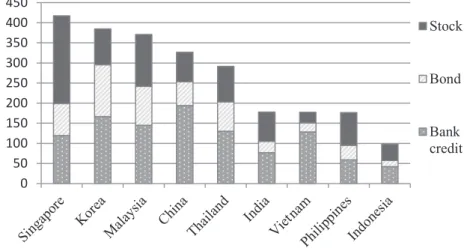
Such expansion of the middle class will lead to an increase of various financial needs. In addition to the expansion of such business as housing and auto loans and other consumer loans, needs for asset management will also increase with the rise in income, and institution- al investors such as insurance, pension, and investment trust are expected to grow accord- Figure III-1. The Size of Financial Markets of Asian Countries (as % of GDP, end of 2015)
(Note) Stock: Market capitalization
(Sources) ADB, IMF and each country’s data
Table III-4. Financial Accessibility of Asian Countries (as of 2014)
(Note)*Ratio to total poulation for 15 years old and above.
(Sources) IMF, World Bank
ingly. These are the areas where the Japanese banks can expect to diversify their business.
However, at present the Asian countries are still largely varied in their income levels and de- grees of financial market development.
Judging from the size of financial markets and degree of financial accessibility, India, Indonesia, the Philippines and Vietnam are considered to have not seen yet sufficient finan- cial deepening in their markets.
Normally, a financial market is expected to grow as the income increases. However, as Figure III-2 shows, while financial markets saw a steady development in Korea, China, Ma- laysia and India during the 15-year period from 2000 to 2015, the market in Thailand had seen only a small expansion, and the market rather shrank in Indonesia.
According to “Ease of Doing Business Index” of the World Bank, relatively low ranked countries in Asia have specific weaknesses in financial matters. 10 The development of fi- nance should have a positive impact on the attraction of foreign investment, thus accelerat- ing economic development. In this sense, the financial deepening of the local market through the involvement of local activities of Japanese banks will have a significant mean- ing in the economic development of the countries concerned.
Among the recipients of bank credit in each country, an increase in credit to households is noticeable except for India (Figure III-3). Especially in Thailand and Malaysia, lending to households has come to exceed that to companies. In Malaysia, the government had politi- cally tried to foster the bond market after the Asian Crisis amid the worsening non-perform-
Figure III-2. Income Growth and Financial Deepening
(Note) The starting point of the arrows represents year 2000 (2001 for Indonesia) and finishing point year 2015.
(Sources) IMF, BIS
10
Yamaguchi (2017).
ing loan problems of the banks, with companies raising more funds with stocks and bonds rather than relying on bank borrowings. 11 Also in Thailand stocks have amounted to a great- er weight in companies’ fund raising with relatively smaller weight for borrowing from banks. These diversifications of ways of companies’ financing may have led to the sluggish- ness in the provision of bank credit to companies. Anyway, in most countries, credit to households constitutes an important factor for an expansion of financial business. There is a great expectation on the Japanese banks for the expanded financial services in this region.
Figure III-3. Domestic Total Credit to Nonfinancial Sectors (as % of GDP)
(Source) BIS
11
Yamaguchi and Tamura (2016).
III-2. Changing Needs for Financial Services in ASEAN
In the following sections, we would like to focus our attention on the ASEAN region where Japanese banks have most actively expanded their business and where more integra- tion of the financial market with Japan can be expected. First we will confirm the extent of sophistication and diversification of financial needs of the local households (retail) and com- panies in the backdrop of a rise in income levels and associated growth of local companies.
III-2-1. Sophistication of Needs for Retail Financial Services
In the previous section III-1, we have overviewed the degree of financial advancement in the Asian countries including ASEAN, mainly using a macro statistical approach. In this section, we would like to see the more concrete situation of their financial market by picking up specific products like auto and housing loans as representative retail financial services, thus confirming their spread among the ASEAN countries as much as possible.
(1) Auto Loans
Sakamuki (2014) and Mizuho Research Institute (2013) made on-the-spot research on the use of auto loans by local residents. According to a survey made in June 2013, about 60% of the purchasers of cars simultaneously applied for an auto loan in Indonesia, and in the Philippines between 70% and 80% of purchasers used the loan. Also according to a sur- vey of September 2012, about 60% of buyers who used an auto loan in the Philippines made a direct application for a loan to a group of major local banks while the remaining 40% or so applied for a loan through automobile dealers.
As seen above, auto loans are in a stage of wider utilization in Indonesia and the Philip- pines, reaching a level where they are offered to car purchasers not only by auto dealers but also by local banks directly. In other ASEAN countries, given their income levels, it is no wonder that Malaysia and Thailand have seen a wide use of the loans, but even in Vietnam and other lower income countries auto loans seem to be approaching a stage of wider use.
(2) Housing Loans
The use of housing loans is thought to be favorably progressing basically in line with a rise of income levels. Usually the users of housing loans are thought to belong to the middle income class and “upper low income class” and this is no exception in the ASEAN coun- tries. 12 Generally a ratio of loan outstanding to GDP is recognized as an indicator to show a degree of use of housing loans, and the ratio generally has a high co-relation with per capita GDP in the emerging countries in Asia, 13 although it does not show a strong co-relation in advanced economies.
12
Kitano, Mizuno, and Kidokoro (2001).
13
Kobayashi (2013).
Table III-5 shows a ratio of housing loans outstanding to GDP in Malaysia, Thailand, In- donesia, the Philippines and Vietnam, although some of the data are a bit old. As is seen from the table, in Malaysia, of which per capita GDP (PPP basis) has already reached
$20,000, the ratio stands at 34%, reaching almost as high a level as 38% in Japan. In other countries, the ratios are mixed with a low level in single digits for countries with old data.
However, given the increase of income levels in those countries up to now, these countries are supposed to have also reached a considerably high level. In other words, it can be recog- nized that these ASEAN countries are also entering a period of popularized use of housing loans.
Although the information on the supply side of housing loans is limited, the share of commercial banks in the total housing loans amounted in 2012 to 86.4% in Malaysia 14 and 58.9% in Thailand, 15 indicating that in these countries banks have been playing a key role in offering housing loans.
(3) Other Loans
Since there already exist numerous non-bank usuries (loan sharks) in the ASEAN coun- tries, it seems there is a substantial need for consumer loans (unsecured personal loans). Ob- jective statistics are hardly available, however. Anyway, as the credit information institu- tions for individual persons are still underdeveloped in most of the ASEAN countries, 16 it is considered that the provision of unsecured loans by banks has still remained marginal.
Also it can be expected that the needs for wealth management services may have been growing 17 as the wealthy class has been emerging in some degree in the ASEAN countries
Table III-5. Ratios of Housing Loan Outstanding to GDP
(Sources) Based on Kojima (2013), Niimura (2013a), Niimura (2013b), Niimura (2015) and IMF Data
Country Housing Loan Outstanding (as % of GDP)
Observation Year
Per capita GDP in the Observation Year (PPP Basis)
Indonesia 2% 2008 US$7,637
Philippines 5% 2009 US$5,117
Vietnam 10% 2009 US$4,123
Thailand 19% 2011 US$13,514
Malaysia 34% 2011 US$21,498
Japan 38% 2011 US$35,775
14
Niimura (2013b).
15
Kobayashi (2013).
16
In Indonesia, PT Pefindo Biro Kredit (Pefindo Credit Bureau) started its full-fledged operation in March 2017 under the technical assistance of the Japanese Credit Information Center (CIC, the Designated Credit Bureau under the Installment Sales Act and Money Lending Business Act). Please refer to The Nikkei, May 18, 2017 and URL of PeFinco Biro Kredit http://www.
pefindobirokredit.com/about-us/.
along with the rise of income levels. However, since it is difficult to obtain objective statis- tics, the real picture remains obscure.
III-2-2. Sophistication and Diversification of Needs for Financial Services to the Corporate Sector
(1) Sophisticated Needs of Local Companies
With the growth of regional companies, needs for financial services geared to corpora- tions have become sophisticated to include project finance, M&A advisory, derivative trans- actions, bond issuance, and securitization of assets. 18 The needs for these transactions are generally strong in Malaysia and Thailand which have a developed financial market, while the needs for some of the transactions are not yet materialized in Indonesia, the Philippines and Vietnam.
Actually, bond issuance is possible in the legislative framework in Indonesia, the Philip- pines and Vietnam. However, it can be pointed out that the institutional investors have not been nurtured enough in these countries, and in many cases funding cost through bond issu- ance (cost of interest payments to investors) exceeds the cost of bank borrowing (interest payments to banks).
On the other hand, before we discuss any needs for securitization, improvement of the legislative framework for securitization should be taken account of. Shimizu (2014) found that the framework had been well established in Malaysia and the government of Thailand recognized it had been improved, while in Indonesia they had a long way to go. In Malaysia and Thailand, it had been supposed that the needs for securitization had been weak since the Global Crisis, yet Yamagami (2017) points out that in Thailand financial institutions have found in recent years the needs for securitizing their loan assets made to individuals (retail loan assets) as well as small and medium-sized financial institutions.
(2) Sophisticated and Diversified Needs of Japanese Companies A. Intermediation of tie-ups with local companies
Amidst the expansion of local sales of Japanese companies in the ASEAN countries, there is a growing need for intermediation of tie-ups by introducing local companies to these Japanese companies. First, there is a need for “business matching” to introduce potential lo- cal sales companies to Japanese companies. In the past, Japanese companies used to position ASEAN as a production base in the “China+1 strategy,” but more recently, with the increase of income level in the region, they have been increasingly seeking to acquire local custom- ers by developing domestic (internal) sales channels in the ASEAN countries. 19 They find a need to tie up with local companies that have sales capacities in the region.
17
Kataoka (2015) points out that local banks are making efforts to offer wealth management services, trying to designate a specialized person in charge of customers with financial assets above a certain level. He also points out, however, that they have a problem of lack of established know-how for development of human resources.
18
Akiyama (2015), Kitano (2015).
19
Watanabe (2014).
Secondly, there is a need for introducing partners to the Japanese companies who are trying to improve their local distribution networks to increase their sales. Due to local regu- lations, it is hard for the Japanese companies to construct their distribution channels by their own efforts. One of the difficulties is related to the restriction of real estate acquisition, which prohibits the foreign companies from acquiring 100% ownership of land. When a Japanese company builds a factory, it can obtain the land by itself either by establishing it in a deregulated export processing zone or by utilizing a long-term real estate lease. However, when it tries to acquire land suitable for establishing a local distribution network, such alter- natives are not available, and therefore it becomes necessary for it, for instance, to set up a joint-venture with a local company.
On the other hand, there is a growing need also on the side of local companies for an al- liance with companies of advanced economies including Japan. This is because major local companies with improved competitiveness have started to aspire for international expansion of their business and seek partners for it.
B. Support of distribution channel finance
Also Japanese firms have diversified their needs on banks and come to seek “distribution channel finance” in the local countries.
The “distribution channel finance” represents here two aspects of (i) financing to local sellers and suppliers 20 and (ii) guarantees against sales risks Japanese companies may face locally. These are needs that have grown with the increase of local domestic sales of Japa- nese companies. In the past, as their local domestic sales were rather limited, Japanese com- panies supported the finance of sellers and suppliers by themselves in regard to (i) above and they accepted risks by themselves in regard to (ii). However, as their capacity to do it comes to face a limit, they have increasingly come to seek support from banks. 21
III-3. Spillover of Financial Technology to Local Banks Acquired by or Having Formed Alliances with Japanese Banks
III-3-1. Acquisition of or Alliance with Local Banks by Japanese Banks
As noted above, the needs for financial services to the retail sector and corporate sector in the ASEAN countries have generally been sophisticated and diversified, despite differenc- es in degrees by products and among countries. Needs for auto loans and housing loans have been increasing in the retail sector, while in the corporate sector needs for project finance and M&A advisory services are increasing. Needs are also growing for intermediation of tie-ups and support for distribution finance.
20
The Nikkei, November 12, 2013.
21
The Asia Pacific Institute of Research (APIR) (2014) has the impression that the Japanese companies targeting the local do-
mestic markets have had not a few transactions with local banks in addition to the local offices of the Japanese banks, in order
to secure not only working capital but also sales finance. This suggests they have been seeking support from local banks in re-
gard to (i) in the text.
In the meantime, the local branches of Japanese banks had hardy dealt with these finan- cial services to retailers while most of their local transactions were conducted with local large companies. The former reflects a limited number of branches and the latter is account- ed for mainly by the fact that Japanese banks have had difficulty in securing the collection of loans because of insufficient availability of corporate credit information. 22 So it was the reality of Japanese banks that they were not in a position to meet satisfactorily these new lo- cal needs only by their local branches.
Under these circumstances, and taking into account the time to build from scratch a ca- pacity to respond to these needs, Japanese banks, especially mega-banks, started from around 2012 to build such a capacity quickly by acquiring or forming alliances with local banks. Specifically, they utilized three types of affiliation, namely (i) acquisition (subsid- iarization with subscription (taking a stake) of more than half of capital), (ii) capital alliance (business alliance with minor subscription of capital), and (iii) business alliance without subscription of capital (Table III-6). And as a by-product of the business expansion of Japa- nese banks, there was an increased spillover of financial technology to local banks. 23
III-3-2. Spillover of Technology on Retail Financial Services (1) Japanese Banks’ Co-development of Retail Products with Local Banks
As described above, Japanese banks had seldom dealt with retail finance services at their local branches, but in response to the expansion of the needs for such services, they have started to make efforts since around 2012 to take in these needs by acquiring local banks or forming alliances with them.
In these cases, the know-how on retail finance of local banks, which the Japanese banks acquired or formed alliances with, is often utilized, 24 but there are also cases for Japanese banks to co-develop with local banks financial products and services that are geared to indi- vidual customers. For instance, the Vietnam Export Import Commercial Joint Stock (Viet- nam Exim Bank), after developing medium- to long-term strategies for their retail financial business under the support of Sumitomo Mitsui Banking Corporation (SMBC) with which it has a capital alliance, accepted the dispatch from SMBC of staff in charge of retail business and started to develop a card business and auto loans 25 while customizing the housing loan products to meet the needs of local clients. 26 Further, the Bank Tabungan Pensiunan Nasion- al (BTPN), a national pension and savings bank of Indonesia, developed in August 2016 a
22
The Asia Pacific Institute of Research (APIR) (2014).
23
World Bank (2017) analyzes that when the banks in advanced economies enter into developing countries, the performance of the local banks generally improve through two transmission routes of (i) improved efficiency following an increased compe- tition among banks in these countries (especially in the case with no acquisition of or no alliance with local banks) or (ii) spill- over of financial technology to local banks (especially in the case accompanied by acquisition or alliance). It is the route (ii) that we have given special attention in this article. In the past, more attention had been paid to the route (i), but Lehner and Schnitzer (2008) suggested the possible existence of a route (ii) separate from the route (i), and Zhu (2012) verified the case of the route (ii) in Eastern Europe and Latin America.
24
For instance, Yamaguchi (2012) introduces examples when banks in advanced countries including Japan try to expand their retail financial business in Thailand, they utilize the know-how of local banks rather than of those in their homeland.
25
Eximbank (2013).
26
Oriental Economy Online (2015a).
Table III-6. Acquisition of and Affiliation with ASEN Local banks by Japanese Mega Banks
(Source) Based on each company’s home page and IR information.
Country Local banks Japanese Mega Banks or
their Subsidiaries Style Brief Outline
Malaysia CIMB Group Bank of Tokyo-Mitsubishi UFJ (Current MUFG Bank)
Business alliance only
In October 2006 BTMU obtained about 4% of CIMB stakes. In September 2017, Mitsubishi UFJ Financial Group launched the sale of all its holdings (about 5%, or equivalent of about ¥68 billion).
Maybank Mizuho Corporate Bank
(Current Mizuho Bank) Business
alliance only In December 2010, they formed a business alliance.
Thailand Bank of Ayudhya Bank of Tokyo-Mitsubishi
(Current MUFG Bank) UFJ Acquisition
In December 2013 BTMU acquired 72.01% stake of Bank of Ayudhya for about ¥536 billion. In January 2015, the Bank of Ayudhya integrated its business oper- ations with the Bangkok branch of BTMU, which in- creased the stakes of BTMU to 76.88%.
Siam Commercial Bank
PCL Mizuho Bank Business
alliance only In November 2014, they concluded a business alliance agreement.
Indonesia
Bank Nusantara Parahyangan (BNP)
Bank of Tokyo-Mitsubishi (Current MUFG Bank) UFJ
Capital alliance
In December 2007, BTMU took a 20% stake of BNP (ACOM also took a 55.4% stake). Since May 2013, the investment ratio remains at 9.35% (ACOM 66.15%).
Bank Negara Indonesia Mizuho Corporate Bank
(Current Mizuho Bank) Business
alliance only They formed a business alliance in February 2013.
Bank Tabungan Pensiunan
Nasional (BTPN) Sumitomo Mitsui Banking
Corporation Capital alliance
In May 2013, SMBC took a 24.26% stake of BTPN, with an additional stake in March 2014 to take a total 40% stake of it (appro. ¥150 billion).
Bank Danamon Indonesia Bank of Tokyo-Mitsubishi (Current MUFG Bank) UFJ
Acquisition (planned)
In December 2017, BTMU took a 19.9% stake (¥133.4billion), with a plan to take an additional stake up to 40% by the middle of 2018. Upon the permission by the authorities BTMU plans to acquire more than 73.8% of the stake of Bank Danamon.
Philippines
Bank of the Philippine
Islands Mizuho Corporate Bank
(Current Mizuho Bank) Business
alliance only In December 2012, they formed a business alliance.
Security Bank Bank of Tokyo-Mitsubishi (Current MUFG Bank) UFJ
Capital
alliance In April 2016, BTMU took a 20% stake of Security Bank (about ¥91 billion).
Vietnam
Vietnam Export Import Commercial Joint Stock Bank (Vietnam Eximbank)
Sumitomo Mitsui Banking
Corporation Capital
alliance In May 2008, SMBC took 15% of the capital of the bank (about ¥23 billion).
Vietcombank Mizuho Bank Capital
alliance In September 2011, Mizuho Bank took 15% of the capi- tal of the bank (about ¥43 billion).
VietinBank Bank of Tokyo-Mitsubishi (Current MUFG Bank) UFJ
Capital
alliance In May 2013, BTMU took a 19.73% stake of the Viet- combank (about ¥63 billion).
Cambodia
Canadia Bank Plc.
Bank of Tokyo-Mitsubishi (Current MUFG Bank) UFJ
Business
alliance only In February 2013, they formed a business alliance.
Mizuho Bank Business
alliance only Iin September 2013, they formed a business alliance.
Maybank (Cambodia) Plc. Mizuho Bank Business
alliance only In September 2013, they formed a business alliance.
ACLEDA Bank PLC Sumitomo Mitsui Banking
Corporation Capital alliance
In September 2014, SMBC took a 12.25% stake of the bank with an additional investment in August 2015 for a total stake of 18.25% (with about ¥20 billion).
Hattha Kaksekar Limited (Micro finance institution)
Bank of Ayudhya (subsidiary of Bank of
Tokyo-Mitsubishi UFJ) Acquisition In September 2016, Bank of Ayudhya took a 100% stake of the institution (about ¥15 billion).
Myanmar
Kanbawza Bank Sumitomo Mitsui Banking
Corporation Business
alliance only In May 2012, they formed a business alliance.
Co-operative Bank (CB Bank)
Bank of Tokyo-Mitsubishi (Current MUFG Bank) UFJ
Business
alliance only In December 2014, they formed a business alliance.
Lao P.D.R. BCEL Mizuho Corporate Bank
(Current Mizuho Bank) Business
alliance only In December 2012, they formed a business alliance.
smartphone application for money transfer in cooperation with SMBC with which it has a capital alliance. The application is considered to be used in the local banks in Vietnam, Cambodia and Myanmar with which SMBC has a capital/business alliance. 27 In addition, Security Bank in the Philippines has been provided with know-how on personal loans by the Bank of Tokyo-Mitsubishi UFJ (BTMU, current MUFG Bank), its capital alliance partner, by sending its employees in charge of retail finance to the branch offices of BTMU for re- ceiving training. 28
These cases suggest that the financial technology on retail finance has spilt over to local banks in the ASEAN countries through Japanese banks.
(2) Cooperation among the Local Banks Acquired by or Having Formed Alliances with Jap- anese Banks
The technology transfer of retail financial services has been made not only by the route of “from Japanese banks to local banks” as noted above but also among the local banks that Japanese banks have acquired or have formed alliances with, from banks with more ad- vanced financial technology to banks with less advanced technology. This may reflect the fact that there is a higher compatibility of know-how of other ASEAN countries than that nurtured in Japan. 29 It may reflect the background of closer national characteristics among the ASEAN countries than between any ASEAN country and Japan.
One specific example can be found in the case of Bank of Ayudhya PCL in Thailand that BTMU acquired in 2013. Bank of Ayudhya was a local bank with strong competitiveness in retail financial services, but its international expansion had been rather limited. However, nowadays it has cooperation with Vietinbank in Vietnam, a capital alliance partner of BTMU, on the provision of auto loans, consumer loans and microfinance. 30 The bank has also started to collaborate with Security Bank in the Philippines, another capital tie-up part- ner of BTMU, and invites the staff in charge of retail sector finance to Thailand and educates them on the know-how on credit examination and small-business loans/microfinance. 31
Separately, Bank of Ayudhya opened a representative office in Myanmar in April 2015, and announced its intention to provide auto loans and consumer loans in cooperation with the Yangon Branch of BTMU. 32 As BTMU has already a business alliance with Cooperative Bank, a local bank in Myanmar, there is a possibility to utilize this route in the future.
(3) Characteristics of Spillover of Financial Technology Associated with Japanese Banks’
Entry
According to Grubel (1977) who provided a leading study on the theoretical framework
27
The Nikkei, September 17, 2016.
28
The Nikkei, June 14, 2017.
29
For example, Mr. Alfonso L. Salcedo, President of Security Bank, comments that the Philippine market has much in com- mon with the Thai market. (The Nikkei, June 14, 2017).
30
Bank of Ayudhya (2017).
31
The Nikkei, June 14, 2017.
32
Bank of Ayudhya (2017).
of overseas expansion of banks, the overseas expansion of banks is classified into three cate- gories of Multinational Retail Banking (currently Global Retail Banking), Multinational Service Banking (currently Global Corporation Banking) and Multinational Wholesale Banking (currently Global Markets Banking).
The moves of Japanese banks described in sections (1) and (2) above can be classified as Multinational Retail Banking in this classification. However, what Grubel (1977) assumed was that the banks would use at an extraordinarily low cost in the countries they had entered their managerial technologies and marketing know-how they had developed in their home countries. As will be discussed later, typical examples were seen in the international expan- sion of retail financial services by Citibank and HSBC. In this regard, in the case of Japa- nese banks’ entry into the ASEAN countries, managerial technologies and marketing know- how have been transferred not only from their mother market (Japan), but also from
“financially developed country” to “financially underdeveloped country” among the local banks which Japanese banks had acquired or formed alliances with. In other words, it is a characteristic of the Japanese banks’ business expansion that a spillover of financial technol- ogy has been realized within the international network of the Japanese banks.
(4) Situations of Western Banks and Local Banks
Such a spillover of financial technology within the international network of Japanese banks associated with their entry into ASEAN had not been seen in the cases of the past en- try of Western banks into the ASEAN countries. The Western banks which have provided retail financial services in the ASEAN regions include HSBC and Citibank, and they had basically developed global or region-wide strategies for retail banking based on the financial technology developed in their motherland (headquarters). 33 Theirs were not a transfer of technology like the one achieved by Japanese banks within their networks, but rather a transfer of technology on a unipolar base from the bank headquarters.
In the meantime, the local banks in ASEAN had been in the past less aggressive in ex- panding their business cross borders. Yamanaka (2014) points it out as a reason for slower expansion of the local banks in an ASEAN country to other ASEAN countries that in many countries the government had restricted the entry of foreign banks and placed business re- strictions. Many of the ASEAN countries tended to choose, on approving the entry of for- eign banks, those with large size and high competitiveness of financial technology as well as with global networks, and in fact they had actually placed such restrictions or regulations. 34
33
According to Nagashima (2009), HSBC started in 1998 to aim at establishing a globally integrated corporate brand and the planning and proposals for retail products like asset management, insurance, credit card, etc., have been made and implement- ed in a group of countries and regions combined. Also in the past when Citibank expanded its retail business internationally, it undertook a centralized business management with its headquarters in the U.S. keeping the decision making power on devel- opment and implementation of their products and services as well as management policies. Although these characteristics were somewhat weakened by the merger of its parent company Citicorp with Travelers in 1998, it seems that they have been still maintained to some extent.
34
Yamanaka (2014) introduces a case in Indonesia, where the government set a condition that if a foreign bank establishes a
branch in the country, the bank should have an asset size equivalent to that of the world top 200 banks and this has constituted
a high hurdle for the ASEAN banks that have a relatively small asset size.
As described above, however, liberalization of intra-regional financial services has been promoted in more recent years, albeit at a cautious pace. Gomi (2015) mentioned the names of local banks, like United Overseas Bank and ODBC Bank in Singapore, May Bank and CIMB Bank in Malaysia, and Bangkok Bank in Thailand, which have been positive in cross border business expansion including opening of branch offices.
III-3-3. Spillover of Technology on Financial Services to Corporations
On financial services to corporations, as Watanabe (2014) has pointed out, many local banks that Japanese banks acquired or formed alliances with have provided local companies with fairly sophisticated financial products and services (project finance, M&A advisory, 35 derivative transactions, etc.), in cooperation with the product provision departments in the headquarters of Japanese banks. These activities have been more pronounced in an environ- ment where the banks in the Euro Area reduced their business activities in ASEAN after the Global Crisis. According to the classification of Grubel (1977), these activities fall into the categories of Multinational Service Banking and Multinational Wholesale Banking.
As is seen below, it is difficult for the local branches of Japanese banks to provide by their own efforts such fairly sophisticated financial products and services to the local medi- um- or smaller-sized companies and it can be realized only by the alliance with local banks.
Therefore, even if the financial products and services are provided from the headquarters of the Japanese banks located in Tokyo or Singapore, local banks will have a chance to be di- rectly exposed to the financial technology, and here a technology transfer emerges.
(1) Project Finance
In the case of project finance, its know-how is kept in the headquarters of Japanese banks located in Tokyo or in Singapore and these headquarters play a central role in provid- ing services, but in order to expand their business actively to a broader spectrum of local companies, it becomes necessary for them to cooperate with the local banks they have ac- quired or formed alliances with. This is because if the involvement is limited to their local branches, their access to local companies is generally restricted only to major ones. In addi- tion, they may have a problem that even if they are going to provide long-term project fi- nance, they have to shorten the period of credit due to limited information on corporate credit. In this regard, there is a significant meaning for Japanese banks in forming alliances with the local banks which have ample accumulation of information on corporate credit.
Also, it should be noted that the fund the Japanese headquarters can provide is basically denominated in U.S. dollars and it is necessary to have local banks to intermediate exchange transactions from the dollar into local currency which local companies need.
For these reasons, local banks usually participate in the project finance that Japanese banks provide through the form of joint financing. For example, Siam Commercial Bank implemented in September 2016 project finance in collaboration with Mizuho Bank with
35
In the M&A advisory, securities companies in the banking group will be involved in addition to the main unit of the bank.
which it has a partnership. 36 When Security Bank entered into a capital alliance with BTMU, project finance was one of the priority areas for collaboration. 37
(2) M&A Advisory
In the field of M&A advisory, especially if the target of an acquisition is a medium- or smaller- sized local company in the ASEAN countries, it is difficult for a Japanese bank/
company to collect sufficient corporate information unless it has the help of local banks in that country. On the other hand, local banks, as noted above, have currently been in the pro- cess of constructing external networks, and there are not so many local banks that have suf- ficient information on corporations in other ASEAN countries even if they are located in the region. Under such circumstances, there will be a great value added in the intermediation of Japanese banks that introduce a target company to a Japanese company or large global com- pany by utilizing the networks of local banks they have acquired or have formed alliances with.
Further, in the case where a local company happens to be on a buyer side of an M&A, and if it is a large company, the company may have business contact with local branches of Japanese banks. However, as for a business like M&A advisory, which requires a very close relationship between the parties, local banks with which the buyer company has a longtime relationship may have an advantage over Japanese banks.
Accordingly, there are great advantages in the cooperation between Japanese banks and local banks, and they have become actually apparent. For instance, Bank of Ayudhya in Thailand that was acquired by BTMU has been working with BTMU and a securities com- pany in its group in the M&A advisory business, and it is observed that since 2015 the bank has been participating in every large M&A case that represents Thailand. 38
(3) Derivatives Transactions
Derivatives transactions are mainly handled by the headquarters of Japanese banks lo- cated in Tokyo or Singapore and are provided to the local medium- or smaller-sized compa- nies through the local banks, tie-up partners of the Japanese banks. Actually, under the sup- port of BTMU, it is reported that Bank of Ayudhya had become enabled to provide their customers with such products as non-deliverable forwards (NDF), various foreign exchange options, and interest rate derivatives. 39
Although margin requirements for non-centrally cleared OTC derivatives 40 were intro-
36
Mizuho Bank (2016).
37
Mitsubishi UFJ Financial Group (2016).
38
The Nikkei, October 20, 2016.
39
Bank of Ayudhya (2015).
40