九州大学学術情報リポジトリ
Kyushu University Institutional Repository
国際環境協定の理論的分析 : 繰り返しゲームを用い て
高島, 伸幸
https://doi.org/10.15017/1806802
出版情報:Kyushu University, 2016, 博士(経済学), 課程博士 バージョン:
権利関係:Fulltext available.
Theoretical Analysis of International Environmental Agreements: Repeated Game Models
A Dissertation Submitted in Partial Fulfillment of the Requirements for the Degree of
Doctor of Philosophy
Department of Economic Engineering Graduate School of Economics
Kyushu University
by
Nobuyuki Takashima January, 2017
ii
Abstract
Today, the emissions of various transboundary pollutants are causing global environmental damage. Since one country’s reduction of such pollutants will benefit all other countries in a non-exclusive and non-rival manner, each country has an incentive to free ride on the abatement efforts of others, and consequently, the abatement efforts of individual countries do not reach an effective level. Therefore, coordinated action by countries is essential in reducing transboundary pollutants. As no supranational authority exists that can dictate environmental policy to nations, each country has to enter into international environmental agreements (IEAs).
This doctoral thesis provides a new theoretical framework for IEAs, using a repeated game model in which the game is repeated infinitely. In repeated game models, agreements need to specify a strategy that can enforce signatories’ cooperation. It must be in the best interest of each country to individually act in accordance with the strategy (i.e., the subgame perfection requirement). Additionally, renegotiation must be prevented in such an equilibrium agreement (i.e., the renegotiation-proofness requirement). In particular, it must be in the best interest of the punishing countries to collectively punish a non-complying country before restarting the cooperative relationship. As a result, signatories are forced to cooperate through credible threats for deviation. If these requirements are satisfied, the IEA can be sustained as a weakly renegotiation-proof (WRP) equilibrium. The thesis contains six chapters.
Chapter 1 presents the research background, motivations, and contributions of the thesis. We also explain the thesis structure.
Chapter 2 provides a literature review of IEAs in repeated game models and introduces the basic IEA models and strategies that prescribe the abatement behaviors of
iii
countries in IEAs in a repeated game.
Chapter 3 investigates an IEA where all countries participate in case that each country has impartial altruism, that is, cares about the net benefits to other countries from pollution abatement. A high degree of impartial altruism is needed for full participation in the one shot game model. Under the assumption of high altruism, however, each country tends to abate irrespective of existence of IEAs. We show the possibility of an IEA with full participation in which each country has a low degree of impartial altruism by employing the Penance-m strategy, which limits the number of countries that are permitted to punish a non-compliance in order to sustain all countries’
participation. Our conclusions are as follows. A full participation IEA with low impartial altruism is feasible if considered in a repeated game framework. Additionally, the impartial altruism decreases the lower bound of discount factor where a full participation state is sustained as WRP equilibrium. In other words, the impartial altruism facilitates the sustainability of IEA. Our results show that setting a credible threat for a deviation is the key factor in explaining the effect of impartial altruism and feasibility of IEA where all countries cooperate.
Chapter 4 shows the effect of ancillary benefits on the condition of full participation in an IEA by employing the Penance-m strategy in two cases of payoff function: linear benefit and cost functions and linear benefit and quadratic cost functions. We assume an IEA where all countries participate, as in Chapter 3, but no country has altruism. In this chapter, a new concept of additional benefit by emission abatement is considered.
Environmental protection not only generates benefits that all countries equally receive by reduction of transboundary pollutants (primary benefits), but also private benefits that only abating countries receive through the improvement of local environment
iv
(ancillary benefits). Our main results show that full participation IEA is sustained as WRP equilibrium even though ancillary benefits are taken into consideration.
Additionally, the introduction of ancillary benefits is shown to decrease the number of punishing countries with linear costs, while this number remains unchanged with convex costs.
Chapter 5 provides a new framework for IEAs, which include punishment exceptions for accidental deviation. Unlike Chapters 3 and 4, which consider that IEAs are formed globally and that the deviation is intentional, this chapter considers regional agreements in which neighboring countries participate and that deviation from an agreement can occur accidentally because of phenomena such as natural disasters. If an IEA signatory deviates accidentally, it fails to achieve its pollution abatement target.
This chapter theoretically demonstrates the rationality of integrating an exception clause into IEAs for accidental deviation by presenting a new strategy, called Regional Cooperative, which integrates punishment deductibility for accidental deviation into an IEA. Under a Regional Cooperative strategy, the neighboring countries’ punishment levels change depending on the types of deviation: intentional deviation and accidental deviation. That is, neighboring countries behave more cooperatively when an accidental deviation occurs, while the signatories from the other region completely abandon their abatement as punishment.
Our main contributions are as follows. First, no country deviates intentionally on a WRP equilibrium. Second, for accidental deviation, punishing countries tend to revoke the punishment and return to cooperation if an accidental deviator increases its abatement volume. In other words, the abatement efforts of the accidental deviator can lead to renegotiation. We conclude that our new strategy motivates the accidental
v
deviator to engage in abatement and the punishing countries to restart cooperation by renegotiation. Consequently, prevention of social welfare loss due to punishment is possible through renegotiation in cases of accidental deviation.
Chapter 6 concludes the thesis. We summarize the main findings in Chapters 2-5 and present the future scope for research.
vi
Acknowledgement
I would like to thank Prof. Toshiyuki Fujita for his teachings and discussions and for answering all my questions. He motivated me to study the theoretical analysis of international environmental agreements and repeated games. His deep insights always helped me to move in the right direction. Under his generous mentorship, I learned a lot about fundamental factors for research and education.
I am also grateful to my committee members, Prof. Isao Miura and Assoc. Prof.
Nobuaki Hori, for their helpful comments and time in reviewing and discussing my dissertation. With their deep insight and extensive knowledge, each chapter in my dissertation was substantially improved.
Much gratitude goes to Prof. Yasunori Ouchida for his kind comments and suggestions for my research and for his advice, which encouraged me to advance it. I built the foundation of my research based on his attitude towards research. I owe an equal debt to Assoc. Prof. Daisaku Goto for his important suggestions on my work.
I am grateful to the participants of the 2014 Annual Meeting of the Society for Environmental Economics and Policy Studies, the 2014 Autumn Meeting of the Japan Association for Applied Economics, the Fifth Congress of the East Asian Association of Environmental and Resource Economics, and the 2015 Autumn Meeting of the Japan Association for Applied Economics for their very helpful comments.
I would like to thank Kyushu University, Asahi Glass Scholarship Foundation, and the Society for Environmental Economics and Policy Studies for their financial support, which helped me to advance my research. Kyushu University also provided me the perfect place to conduct my research and the great opportunity to meet many precious friends.
vii
Finally, I would like to thank my father and mother, for whom I have enormous respect, for their generous support, deep understanding, and encouragement.
Nobuyuki Takashima, January 2017
viii
Contents
Abstract ... ii
Acknowledgement ... vi
Chapter 1 Introduction ... 1
1.1 Research background ... 1
1.2 Motivations ... 3
1.3 Thesis Structure ... 6
Chapter 2 Literature review... 7
2.1 Reduced-stage game models ... 7
2.2 Repeated game models ... 9
2.3 The basic strategy ... 11
2.3.1 Tit-For-Tat ... 11
2.3.2 Grim strategy ... 12
2.4 The strategy with n players ... 13
2.4.1 Getting-Even strategy with n players ... 13
2.4.2 Consensus treaty ... 15
2.4.3 The Regional Penance strategy ... 16
2.4.4 The Penance-m strategy ... 17
2.5 Summary and discussion ... 18
Chapter 3 A full participation international environmental agreement with low degree of impartial altruism ... 27
3.1 Introduction ... 27
3.2 Model and strategy ... 30
3.2.1 The model ... 30
3.2.2 The Penance-m concept ... 32
3.3 WRP equilibrium outcomes ... 33
3.3.1 Subgame perfection requirement ... 33
3.3.2 Renegotiation-proofness requirement ... 35
3.4 The effect of altruism on IEA ... 37
3.4.1 The effect of altruism on WRP condition ... 37
3.4.2 The effect of altruism on discount factor ... 40
3.5 Summary and discussion ... 42
Chapter 4 International environmental agreements with ancillary benefits ... 44
4.1 Introduction ... 44
4.2 The Penance-m concept ... 47
4.3 Models and equilibrium outcomes ... 48
ix
4.3.1 Case I: Linear benefit and cost functions ... 50
4.3.1.1 The model for Case I ... 50
4.3.1.2 Equilibrium outcome of Case I ... 51
4.3.1.3 The discount factor in Case I ... 53
4.3.2 Case II: Linear benefit and quadratic cost functions ... 54
4.3.2.1 The model for Case II ... 54
4.3.2.2 Equilibrium outcome of Case II ... 55
4.3.2.3 The discount factor in Case II ... 58
4.4 A comparison of the impact of ancillary benefits on a weakly renegotiation-proof equilibrium with respect to Case I and Case II ... 58
4.4.1 Case I ... 59
4.4.1.1 The impact of ancillary benefits on the subgame perfection requirement: Case I ... 59
4.4.1.2 The impact of ancillary benefits on the renegotiation-proofness requirement: Case I 61 4.4.2 Case II ... 62
4.4.2.1 The impact of ancillary benefits on the subgame perfection requirement: Case II ... 62
4.4.2.2 The impact of ancillary benefits on the renegotiation-proofness requirement: Case II ... 63
4.5 Summary and discussion ... 64
Chapter 5 The impact of accidental deviation by natural disaster-prone countries on renegotiation-proof agreements ... 71
5.1 Introduction ... 71
5.2 The model ... 75
5.3 Regional Cooperative strategy ... 78
5.3.1 The concept of Regional Cooperative strategy ... 79
5.3.2 Equilibrium outcomes: The case of intentional deviation ... 82
5.3.3 Equilibrium outcomes: The case of accidental deviation ... 83
5.4 Effect of the Regional Cooperative strategy ... 88
5.4.1 The positive impact of renegotiation on social welfare ... 88
5.4.2 The punishment rule of Regional Cooperative vs. no punishment rule ... 89
5.4.3 Regional Cooperative vs. other strategies ... 90
5.4.4 Contributions of the Regional Cooperative strategy ... 92
5.5 Summary and discussion ... 96
Chapter 6 Conclusions ...111
References ... 114
1
Chapter 1 Introduction
1.1 Research background
The prevention of trans-boundary environmental problems, such as global warming and ozone layer depletion, is an important global issue. Local environmental issues, such as air pollution due to automobiles and power generation, can be addressed by their respective governments; however, there is no supranational authority to resolve trans-boundary environmental problems. An abatement of such trans-boundary pollutants by a country can affect other countries because a reduction in pollution generally has characteristics of public goods. In other words, each country receives benefits depending on another country’s abatement actions. Therefore, it is essential for countries to enter into negotiations on emission reductions and conclude international environmental agreements (IEAs).
Over the years, several IEAs have been implemented. For instance, the Montreal Protocol, which took effect in 1989, regulates the use of chemicals such as chlorofluorocarbons that deplete the stratospheric ozone layer. This agreement has achieved universal ratification and participants must reduce the production and consumption of ozone-depleting substances. The Montreal Protocol has succeeded in implementing the promised emission cuts and keeping a higher number of countries ratified in the agreement. Similarly, the Helsinki Protocol adopted in 1985 established targets for emission cuts. According to the Protocol, all signatories were required to reduce emissions of sulfur oxides by at least 30 percent from the 1980 level by 1993.
However, the agreement failed to achieve full participation. The Kyoto Protocol, established at the Third Conference of the Parties (COP3) in 1997, compels
This chapter is partially based on Fujita and Takashima (2016).
2
approximately 40 developed countries (Annex I countries in the UNFCCC) to reduce greenhouse gas (GHG) emissions that cause climate change. Such agreements are referred to as global IEAs, that is, agreements that are globally formed. However, under the Kyoto Protocol, China, India, and other developing countries are not required to abate emissions. Cooperation by these countries is, therefore, a significant challenge and the negotiations surrounding the Kyoto Protocol indicate the difficulty in attaining a grand, stable coalition with efficient abatement levels.
An example of an IEA that has achieved regional cooperation is the North American Agreement on Environmental Cooperation (NAAEC), the environmental aspect of the North American Free Trade Agreement (NAFTA), which was adopted in 1993 as a main platform to raise countries’ concerns about environmental problems in liberalized trading. The NAAEC established the Commission for Environmental Cooperation (CEC) and created a new framework for broad North American environmental cooperation.1 In addition, the European Climate Change Programme was launched by the European Union (EU) in 2000 to coordinate efforts to reduce GHGs emissions and included an emission trading scheme within the EU. These types of agreements are referred to as regional IEAs, that is, agreements formed by neighboring countries. Finus (2008) surveys the literature on IEAs using game theory and indicates that multiple agreements are effective to reach the aim of global agreement; that is, multiple regional agreements can lead to more comprehensive ones. Carraro and Buchner (2005) state that if each country can freely choose which agreement to participate in, more than one agreement can be achieved.
For IEAs to achieve full participation, a new basic framework aimed at preventing
1 NAAEC called for NAFTA members to work toward countries’ cooperation on transboundary environmental impact assessment (TEIA). For more details, see Garver and Podhora (2008).
3
global warming was compiled during COP21 held in Paris, France, in 2015. The main scope of this framework is to uphold and promote regional and global cooperation to mobilize stronger and more ambitious climate actions by all parties and non-party stakeholders.2
1.2 Motivations
From the IEA examples presented in Section 1.1, we know that agreement sizes differ by IEA and not all IEAs can succeed in achieving countries’ cooperation. A significant body of literature theoretically studies the effectiveness of IEAs.3 The analytical frameworks of IEAs can be roughly divided into two groups: reduced-stage and repeated game framework.4 The key difference between both frameworks is the stability concept they employ and their assumptions for cooperation compliance.
Reduced-stage game models depict the formation of agreements as a two-stage game. In the first stage, countries decide whether to sign an IEA and in the second, the signatories jointly choose their abatement levels, while non-signatories independently decides its abatement levels (e.g., Barrett, 1994, 2001; Carraro and Siniscalco, 1993;
Finus and Rübbelke, 2013; Fujita, 2013; Karp and Simon, 2013; van der Pol et al., 2012).5 The stability concept in the reduced-stage game is referred to as self-enforcing.
Self-enforcing IEAs must have two characteristics: first, no signatory should have an incentive to deviate from the agreement (internal stability) and second, no non-signatory should have an incentive to join the agreement (external stability).
2 For more details, see data by UNFCCC (2016).
3 According to Barrett (2003, p. 39), IEAs can succeed by restructuring the game of cooperation between countries and theory can show us how to negotiate more effective IEAs.
4 Asheim et al. (2006) divide the models of cooperation for environmental protection into reduced-stage and repeated game models. In addition to these models, we consider the evolutionary game model (e.g., Arce, 2001; De Oliveira et al., 2005; McGinty, 2010; Weibull, 1995).
5 Some studies consider a three- (or more) stage game model. For example, see Barrett (1997), Fujita (2013), Kosfeld et al. (2009), Osmani and Tol (2010), and Rubio and Ulph, (2006).
4
The effectiveness of an IEA depends on the number of participating countries and the levels of public goods provisions (pollution abatement) because each country receives public benefits from the other countries’ abatement of trans-boundary pollutants. However, Barrett (1994) and Carraro and Siniscalco (1993) show that an agreement that can significantly improve global welfare is achieved if entered into by few countries. In summary, these studies indicate the difficulty in forging a global agreement with effective abatement levels and full participation within a reduced-stage game framework.
However, if the game is repeated, an equilibrium wherein every country cooperates with effective abatement levels can be achieved through the threat of punishment (e.g., Asheim et al., 2006; Asheim and Holtsmark, 2009; Barrett, 1999, 2002, 2003; Finus and Rundshagen, 1998; Froyn and Hovi, 2008; Heitzig et al., 2011; Kratzsch et al., 2012).6 In repeated game models, the agreement should be sustained as an outcome of a weakly renegotiation-proof (WRP) equilibrium.7
In repeated game models, the stability concept is referred to as WRP equilibrium and the agreement is enforced using a strategy that specifies the countries’ behavior.8 First, it must be in the best interest of each country to individually act in accordance with the strategy (i.e., the subgame perfection requirement). In a repeated game with discounting, it is required that no player can gain by a one-period deviation after some history. Second, in such an agreement, a renegotiation must be prevented (i.e., the renegotiation-proofness requirement). In particular, it must be in the best interest of the punishing countries to collectively punish a non-compliant country (i.e., a deviator from
6 Hovi et al. (2015) categorize Asheim et al. (2006), Asheim and Holtsmark (2009), Barrett (1999, 2002, 2003), and Froyn and Hovi (2008) as those that demonstrate IEA formation within the context of a repeated game framework.
7 WRP is a condition wherein there is no other equilibrium in which each player can simultaneously increase his/her benefits. See Farrell and Maskin (1989, pp.330–331).
8 For more detail, see Chapter 2 in this thesis.
5
the strategy) before a cooperative relationship is resumed. If these requirements are satisfied, the stable IEA is sustained as an outcome of WRP equilibrium. In summary, the size and abatement levels of IEAs depend on the contents of the strategy.
The theoretical analyses of IEAs that use repeated games are highlighted in this doctoral thesis. In reality, an agreement is implemented over several periods and must address the issue of deviations. However, studies examining the cooperative relationship between countries using a repeated game model are limited compared to those adopting a reduced-stage game model. We believe there is significant scope to investigate IEAs with repeated games. In addition, we consider that strategies in repeated games are widely applicable. That is, we can examine IEAs assuming several situations by modifying strategies presented in previous studies or presenting new one. Moreover, a condition of stable IEAs, obtained from the extant literature using the reduced-stage game framework, can be extended by considering it in a repeated game framework.
Using repeated game model, this thesis presents new conditions of stable IEAs using a repeated game model in three cases. First, we assume that each country cares about the net benefits to other countries from pollution abatement (impartial altruism) and investigate the effect of impartial altruism on the sustainability of a global IEA. Second, we consider that environmental protection generates not only benefits that all countries equally receive from the reduction of trans-boundary pollutants (primary benefits) but also private benefits that only cooperative (abating) countries receive from the improvement of local environments (ancillary benefits). Third, we assume that IEAs in which neighboring countries participate are formed regionally and a deviation can accidentally occur because of phenomena such as natural disasters.
6
1.3 Thesis Structure
The remainder of this doctoral thesis is structured as follows. Chapter 2 reviews the theoretical models of IEAs and introduces the basic strategies used in repeated game models. The main investigations on IEAs are presented in Chapters 3–5.
In Chapter 3, we provide a new condition for a full participation IEA in the case where each country considers impartial altruism, that is, they cares about other countries’
net benefits from the abatement of trans-boundary pollutants. We investigate the effectiveness of such altruism on IEAs. In Chapter 4, we examine the effects of the ancillary benefits of environmental protection on stable IEAs with full participation.
The main objective of this chapter is to examine the effect of ancillary benefits from the condition of full IEA participation with two types of abatement cost functions: linear and quadratic. Chapter 5 considers that a deviation from an agreement can accidentally occur, even if the agreement is sustained as a WRP equilibrium. If an IEA signatory accidentally deviates, it fails to achieve its emission abatement target. We provide a new framework for regional IEAs that include punishment exceptions for accidental deviation by presenting a new strategy, called Regional Cooperative, which integrates accidental deviations into an IEA. Finally, Chapter 6 summarizes the results obtained from Chapters 3 to 5, and presents the conclusions.
7
Chapter 2 Literature review
This chapter reviews previous research examining IEAs using the game theory. In particular, we focus on the previous literature on IEAs that uses repeated game models.
2.1 Reduced-stage game models
This section introduces analyses on IEAs that use reduced-stage games. In this game, the stable agreement is referred to as self-enforcing. As discussed in Chapter 1, self-enforcing IEAs must satisfy two conditions: internal stability, that is, no participating country has an incentive to defect from the agreement, and external stability, where no non-signatory should have an incentive to join the agreement.
We consider the following game. In the first stage, each country chooses whether to sign an IEA. In the second stage, the signatories jointly decide the abatement levels to maximize the agreement payoff and each non-signatory independently decides their abatement levels to maximize individual payoffs. The net benefit is expressed as a function of the abatement levels.
Several studies have been conducted on the formation of stable IEAs using the reduced-stage game models.9 As described in Chapter 1, Barrett (1994) and Carraro and Siniscalco (1993) show that only a small coalition of countries can significantly improve global welfare. That is, if there are many countries in an agreement, significant improvement in global welfare would not be achieved. Barrett (1997) analyzes the relationship between policies for climate control and international trade in segmental markets, and shows that the credible threat of trade sanctions can achieve a full cooperation in terms of emission reductions on the condition of a minimum
This chapter is based on Fujita and Takashima (2016).
9 As for global environmental problems, the reduced-stage game is used for international policies, such as IEAs, and domestic environmental policies. See, for instance, Ouchida and Goto (2014, 2016).
8
participation clause, which restricts the lower bound number of participating countries.
Barrett (2001) reveals that strong asymmetry among countries warrants a change in the rules of the game of global public goods provision, and that the side payment schemes can sustain superior outcome of IEA formation compared to IEA without such schemes.
Finus and Rübbelke (2013) categorize the benefits of abatement into large-scale and regional benefits. The latter are referred as ancillary benefits that can be received privately and their effect on IEA participation can be examined. They hold the pessimistic view that an agreement can be sustained if entered into by few countries and these benefits have a neutral or negative impact on the number of signatories. Osmani and Tol (2010) assume two types of asymmetric countries and demonstrate similarities between one and two self-enforcing IEAs. The result of Osmani and Tol (2010) shows that two IEAs can improve abatement levels and welfare compared to one IEA. van der Pol et al. (2012) consider two types of altruism, impartial and community altruism, in the decision to participate and show that a certain degree of altruism is sufficient to stabilize the agreement. Fujita (2013) incorporates ―matching schemes,‖ in which all signatories commit to an additional abatement, depending on other countires’ abatement decisions and shows that the existence of a self-enforcing agreement leads to an efficient and equitable outcome. Calcott and Petkov (2012) and Biancardi and Villani (2010) consider monetary transfers in an IEA formation within the context of a reduced-stage game framework.10 Rubio and Ulph (2007) study IEAs with stock pollutants using the infinite-horizon model.
10 Biancardi and Villani (2010) present an IEA formation in a static model, while Calcott and Petkov (2012) do so in the context of an infinite-horizon game model, which is an infinite-horizon case of the static IEA model.
9
2.2 Repeated game models
Reduced-stage game models assume that the signatories of an IEA are bound by the agreement. However, repeated game assumes the possibility of a deviation and the game is repeated. If the game is repeated, an equilibrium in which every country cooperates can be reached through the threat of punishment.11 Punishment in a repeated game means that the signatories cease their abatement actions. Repeated game models assume that countries participating in the IEA have to be enforced in subsequent stages using credible threats (e.g., Asheim et al., 2006; Asheim and Holtsmark, 2009; Froyn and Hovi, 2008).
Here as well, following Asheim et al. (2006), Froyn and Hovi (2008) and Takashima (2017a, b), we introduce an equilibrium concept of a WRP equilibrium.
(1) The first requirement is that the strategy profile must be subgame perfection. Within the context of a repeated game with discounting, it is required that no player can gain by a one-period deviation after any history.12 That is, each player never changes its actions specified by the strategy if subgame perfection is satisfied: the cooperating countries play cooperate and the punishing countries punish a deviator in accordance to strategy.
(2) The second requirement is that the strategy profile must be renegotiation-proof. This requirement is fulfilled if not all players strictly gain by collectively restarting cooperation at once, instead of carrying out the threatened punishment when a unilateral deviation has occurred in the previous period. Punishment here implies
11 A punishment in repeated games means that the signatories halt their abatement action. For more details, see Asheim and Holtsmark (2009) and Barrett (2003, Chapter 10).
12 From the theory of repeated games with discounting, the player cannot gain by some period deviations if he/she cannot gain by a one-period deviation (Abreu, 1988, p. 390). Hence, we need only check that no player can gain by a one-period deviation after any history.
10
that all punishing countries, but not the deviator, play defect after the deviation. This makes not only the deviator but all non-punishing countries worse off with the punishment. Therefore, renegotiation-proofness requires that the punishing countries’
benefits from punishment are at least equal to those of renegotiation.
Barrett (2002) shows that only a less ambitious agreement can attain full participation through a consensus treaty. The Regional Penance strategy proposed by Asheim et al. (2006) permits the same types of countries as the deviator to punish a deviator to sustain the agreement and shows that two regional agreements can sustain more than twice the number of participants than one agreement. Froyn and Hovi (2008) present the Penance-m strategy, which limits the number of countries that can punish a deviator, to demonstrate the feasibility of a stable agreement with full participation and efficient abatement levels. Asheim and Holtsmark (2009) also adopt the Penance-m strategy and show an efficient time lag between deviation and punishment in the case of a full participation agreement. Heitzig et al. (2011) propose an enforcement method with a dynamic strategy, which redistributes obligations for an abatement depending on each country’s past abatement levels, keeping the total abatement level constant across periods. Kratzsch et al. (2012) assume that the pollutants stock in the atmosphere over periods and show that full participation can be achieved by applying the Penance-m strategy.
11
2.3 The basic strategy
This section introduces the basic strategies in the repeated game model of IEAs, according to Barrett (2003).13 Suppose that two countries negotiate an agreement. Each country chooses to cooperate (i.e., accept abatement levels that maximize the coalition payoff) or to defect (i.e., accept abatement levels that maximize each country’s individual payoff). Player i’s payoff function is given by
𝜋𝑖 = 𝑏(𝑞1+ 𝑞2) − 𝑐𝑞𝑖,
where 𝑞𝑖 ∈ ,0, 1- is the abatement level of country 𝑖(= 1,2), 𝑏 is the marginal benefit, c is the marginal cost, and 𝑐𝑞𝑖 represents the total abatement costs of country 𝑖.
Through this chapter, we consider that 𝑞𝑖 lies between 0 and 1. We assume that 2𝑏 > 𝑐 > 𝑏 > 0, which means that each country cannot obtain their payoffs by unilateral abatement. If not, each country abates individually, without concluding the agreement. We weight the future payoffs by a discount factor 𝛿 (0 < 𝛿 < 1). The present value of the payoff gained in period 𝑡 is the current value multiplied by 𝛿𝑡.
2.3.1 Tit-For-Tat
The Tit-For-Tat strategy specifies that each player agree on choosing to cooperate at first period, and plays cooperate unless the other player played defect in the previous period. That is, each player chooses to the same action as the other player did in the previous period if it adopts Tit-For-Tat. If a player plays defect, the other player plays defect as punishment in the next period. If the deviator has played cooperate in that period, the other players return to playing cooperate again in the next period. However, if the deviator does not return to playing cooperate, he is punished again by the other players.
13 For more details of the Grim and tit-for-tat strategies, see Barrett (2003). For the characteristics of public goods in emission reduction, see Hanley et al. (2007).
12
Let there be the country X and Y, and suppose country Y plays defect in period 𝑡 and returns to Tit-For-Tat in period 𝑡 + 1. In returning to the Tit-For-Tat, the deviator Y plays the same action in period 𝑡 + 1 as X did in the period 𝑡. Thus, in period 𝑡 + 1, Y will play cooperate, while if X chooses to play Tit-For-Tat, it must choose to defect in period 𝑡 + 1 as punishment. Starting in period 𝑡 + 1, if X plays Tit-For-Tat, it will receive
𝑏𝛿𝑡+1+ (𝑏 − 𝑐)𝛿𝑡+2+ 𝑏𝛿𝑡+3+ (𝑏 − 𝑐)𝛿𝑡+4+ ⋯, and if X deviates and returns to play cooperate, it obtains
(2𝑏 − 𝑐)(𝛿𝑡+1+ 𝛿𝑡+2+ 𝛿𝑡+3+ 𝛿𝑡+4+ ⋯ ).
If the discount factor is close to 1, the average per-period payoff of playing Tit-For-Tat is (2𝑏 − 𝑐) 2⁄ , while the average par-payoff of deviation is 2𝑏 − 𝑐. If discount factors are sufficiently large, each country does not adopt the Tit-For-Tat strategy. In other words, the Tit-For-Tat strategy does not satisfy the subgame perfection requirement.
2.3.2 Grim strategy
According to Barrett (2003), the Grim strategy specifies that (i) the two players choose to cooperate so long as either player play cooperate, and (ii) if either player play defect in any period, then both countries will revert to playing defect forever. We investigate whether this strategy can sustain full cooperation as an equilibrium outcome.
If both players behave in accordance with this strategy, each player plays cooperate in every period, and receives a payoff of 2𝑏 − 𝑐 in each period. If one country deviates in period 𝑡, the deviator obtains a payoff of 𝑏 in period 𝑡, but receives 0 at every period after period 𝑡 + 1. Therefore, a full cooperation outcome is achieved as a subgame perfection equilibrium if
13
(2𝑏 − 𝑐)(𝛿𝑡+ 𝛿𝑡+1+ ⋯ ) ≥ 𝑏𝛿𝑡+ 0 + ⋯.
Solving for 𝛿, we have
𝛿 ≥ (𝑐 − 𝑏) 𝑏⁄ .
Therefore, if 𝛿 is close to 1, the Grim strategy satisfies the subgame perfection.
However, if a country deviates unilaterally, this strategy does not satisfy the renegotiation-proofness requirement. If a player deviates in period 𝑡, then the average per-period payoff that the players receive after that period by choosing to the Grim strategy is 0. If the players restart cooperation by renegotiation, each country receives a payoff of 2𝑏 − 𝑐 in each period. Therefore, each country renegotiates and restarts the cooperative relationship. That is, the renegotiation-proof condition is not satisfied under Grim strategy.
2.4 The strategy with n players
This section introduces the strategies with 𝑛 players and considers the condition that agreement is sustained as a WRP equilibrium. Consider a world with 𝑛 ≥ 2 countries, and let 𝑁 = *1, ⋯ , 𝑛+ denote the set of all countries. Furthermore, suppose that 𝑛𝑏 > 𝑐 > 𝑏 > 0.
2.4.1 Getting-Even strategy with n players
According Barret (1999, 2003), the Getting-Even strategy specifies that each country plays cooperate unless he/she has played defect less often than the other players have in the past periods. Suppose that all 𝑛 countries agree to play Getting-Even in the first period, and one country (player j) deviates in period 𝑡, and then returns back to Getting-Even in period 𝑡 + 1.
First, we consider the incentive constraint for each country to play cooperate when
14
there is no deviation in any period. If player j deviates, he/she receives payoff 𝑏(𝑛 − 1) in period 𝑡, and payoff 𝑏 − 𝑐 in the punishment period. From the period 𝑡 + 2, the player receives 𝑏𝑛 − 𝑐. If player j plays cooperate in period 𝑡, he/she receives 𝑏𝑛 − 𝑐 + 𝛿(𝑏𝑛 − 𝑐) in periods 𝑡 and 𝑡 + 1. For player j, to play cooperate in accordance with the Getting-Even strategy is individually rational if
𝑏𝑛 − 𝑐 + 𝛿(𝑏𝑛 − 𝑐) ≥ 𝑏(𝑛 − 1) + 𝛿(𝑏 − 𝑐).
Solving the above inequality for 𝑛, we have
𝑛 ≥ (𝑐 − 𝑏 + 𝛿𝑏) 𝛿𝑏⁄ . Assuming that 𝛿 is close (but not equal) to 1, we have
𝑛 > 𝑐 𝑏⁄ . (2.1)
Since 𝑏𝑛 > 𝑐, (2.1) always holds. It is rational for each player to play cooperate, in accordance with the Getting-Even strategy.
Second, we consider the incentive constraint for a deviator to revert Getting-Even and to play cooperate after a unilateral deviation in period 𝑡. Player 𝑗 receives the payoff of 𝑏 − 𝑐 in period 𝑡 + 1 and the payoff of 𝑏𝑛 − 𝑐 at subsequent periods if each player plays Getting-Even from 𝑡 + 2 onwards. If 𝑗 does not return to Getting-Even in period 𝑡 + 1, and then reverts to Getting-Even in the 𝑡 + 2, he/she receives the payoff of 0 in period 𝑡 + 1 and the payoff of 𝑏 − 𝑐 in period 𝑡 + 2. For a deviator 𝑗, it is individually rational to play cooperate in period 𝑡 + 1, provided that
𝑏 − 𝑐 + 𝛿(𝑏𝑛 − 𝑐) ≥ 𝛿(𝑏 − 𝑐). (2.2) Since 𝑏𝑛 > 𝑐, we know that (2.2) is always satisfied.
Third, we consider the incentive constraint for country 𝑖(≠ 𝑗) to punish deviator 𝑗.
Player 𝑖 receives the payoff b in period 𝑡 + 1 and payoff 𝑏𝑛 − 𝑐 at subsequent periods if each player behaves in accordance with Getting-Even from 𝑡 + 2 onwards. If
15
𝑖 fails to punish the deviator in period 𝑡 + 1, and then returns back to Getting-Even in next period, he/she receives payoff 2𝑏 − 𝑐 in period 𝑡 + 1 and payoff 𝑏(𝑛 − 1) in period 𝑡 + 2.
For a punishing country i, it is individually rational to adhere to Getting-Even in period 𝑡 + 1, provided that
𝑏 + 𝛿(𝑏𝑛 − 𝑐) ≥ 2𝑏 − 𝑐 + 𝛿𝑏(𝑛 − 1). (2.3) Since 𝑐 > 𝑏, (2.3) is always satisfied. From (2.1), (2.2), and (2.3), the Getting-Even strategy always satisfies the subgame perfection requirement.
If the countries other than j play Getting-Even in the punishment phase, they receive a payoff of 𝑏. If these countries return to a cooperative relationship, they receive 𝑏𝑛 − 𝑐. Thus, the renegotiation-proof requirement is satisfied if
𝑏 ≥ 𝑏𝑛 − 𝑐.
Getting-Even satisfies the renegotiation-proof requirement, provided that
𝑛 ≤ (𝑐 + 𝑏) 𝑏⁄ . (2.4)
If (2.4) is satisfied, all countries play cooperate in accordance with the Getting-Even strategy.
2.4.2 Consensus treaty
As mentioned in Section 2.1, Barrett (1994) and Carraro and Siniscalco (1993) hold the pessimistic view that an agreement that can significantly improve global welfare is sustained if entered into by a few countries in the context of reduced-stage game model.
This result is largely caused by an assumption that the signatories take the abatement level that maximizes the agreement payoff collectively. Barrett (2002, 2003) has argued that there is a trade-off between ―narrow, but deep‖ and ―broad, but shallow‖ treaties:
16
narrow, but deep means that only a few countries participate with an efficient and large abatement, while broad, but shallow means that many countries participate with an inefficient and small abatement. In Barrett’s (2002, 2003) model, each country has a continuum choice, and full participation (a ―consensus treaty‖) is achieved by allowing for variation in abatement levels, provided that the abatement levels are watered down.
Consensus treaty is sustained as a WRP equilibrium if the discount factor is sufficiently close to 1 and the abatement levels of punishing countries, 𝑞𝑚, satisfy the following condition.
(𝜋̅𝑆− 𝑏) (𝑏(𝑛 − 1) − 𝑐) ≤ 𝑞⁄ 𝑚 ≤ 𝜋̅𝑆⁄𝑏(𝑛 − 1), (2.5) where 𝑛 is the total number of countries, 𝑏 is parameter of abatement benefit, and c is the parameter of abatement cost, 𝜋̅𝑆 is the maximum payoff that can be sustained by the consensus treaty, and 𝑞𝑚 is abatement levels that 𝑛 − 1 countries.
From (2.5), we have
𝜋̅𝑆 ≤ 𝑏2(𝑛 − 1) 𝑐⁄ . (2.6) The right-hand side of (2.6) denotes that the maximum payoff when IEA with the consensus treaty is sustained as a WRP equilibrium. For the proof, see Appendix 2A.
2.4.3 The Regional Penance strategy
The Regional Penance strategy, proposed by Asheim et al. (2006), permits the same types of countries as the deviators to punish non-compliance in order to enforce the agreement. Let there be two regions, A and B. The content of the Regional Penance strategy is as follows.
(i) A participating country plays cooperate, except if another participating country in the
17
same region has previously been the sole deviator from Regional Penance.
(ii) If deviation by a participating country in region A occurs, the punishment by participating countries in region A is meted out in the next stage, but is not meted out by those parties in region B, and vice versa.
(iii) If a deviator plays cooperate after a deviation, the cooperative relationship of each agreement will be restarted.
Based on Asheim et al. (2006), we obtain a condition of WRP equilibrium to sustain two agreements as follows:
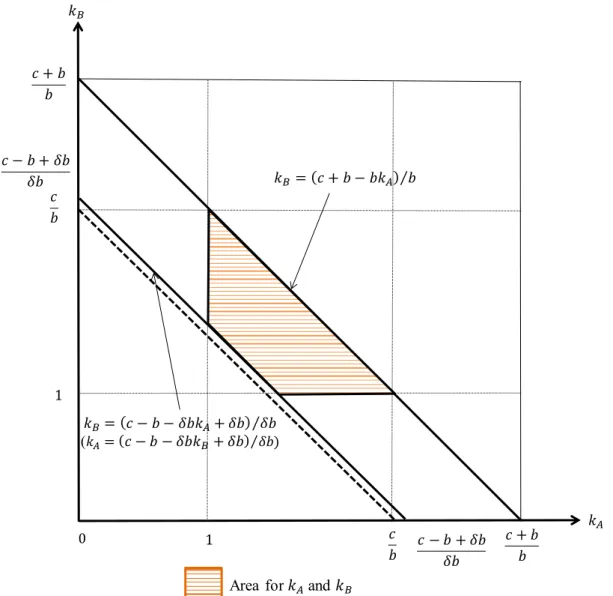
{𝑐 𝑏⁄ < 𝑘𝐴 ≤ 𝑐 𝑏 + 1⁄ , 𝑐 𝑏⁄ < 𝑘𝐵 ≤ 𝑐 𝑏 + 1⁄ ,
where 𝑘𝐴 and 𝑘𝐵 denote the number of participating countries in regions A and B, 𝑏 is the slope of the benefit function from abatement, and 𝑐 denotes the cost of cooperation.14 For the proof, see Appendix 2B.
2.4.4 The Penance-m strategy
In Section 2.4.3, Asheim et al. (2006) reveals that two regional agreements can be achieved. However, full participation IEA is not considered in their model. Froyn and Hovi (2008) show that a full participation agreement is formed as a WRP equilibrium using the strategy called Penance-m within the linear abatement benefit and cost functions. The main feature of Penance-m is to select 𝑚 (1 ≤ 𝑚 ≤ 𝑛 − 1) punishing countries. Penance-m is specified as follows:15
(i) Any signatory plays cooperate, unless another signatory has been the sole deviator
14 Asheim et al. (2006) and Froyn and Hovi (2008) consider that the public benefits of countries selecting an abatement action are greater than or equal to the benefits when they select free riding. However, they do not provide reasons for this difference implicitly. Additionally, one of aims in this chapter is to know the fundamental structure of strategies. Therefore, we consider that these benefits have same characteristic for simplicity.
15 For more details on Penance-m, see Froyn and Hovi (2008, p.318).
18
from Penance-m in the previous period.
(ii) If a unilateral deviation occurs, 𝑚 countries are selected from among the signatories, other than the deviator, and these 𝑚 countries play defect. On the other hand, 𝑛 − 𝑚 countries play cooperate. Punishment in this case means that 𝑚 punishing countries abandon their abatement actions.
(iii) If a deviator plays cooperate after a deviation, the cooperative relationship will be resumed afterwards.
Based on Froyn and Hovi (2008), we obtain a WRP equilibrium to sustain an agreement with full participation as follows (given that 𝛿 is close to 1):
(𝑐 − 𝑏) 𝑏⁄ < 𝑚 ≤ 𝑐 𝑏⁄ ,
where 𝑏, 𝑐 are the same as those defined in Section 2.4.3. For the proof, see Appendix 2C.
2.5 Summary and discussion
In this chapter, we discussed several studies on IEAs that use the following frameworks of game theory, reduced-stage and repeated game models. In the reduced-stage game models, a deviation by a signatory is not considered and self-enforcement, an equilibrium concept, must satisfy internal and external stabilities. In repeated game models, a deviation by a signatory can occur and a WRP equilibrium is obtained in terms of the subgame perfection and renegotiation-proof requirements. In reality, an agreement is implemented over several periods and must address the issue of deviations.
Therefore, studies on IEAs using repeated games are highlighted in this thesis.
Several environmental agreements have been implemented over the past three
19
decades (e.g., the European Climate Change Programme, Kyoto Protocol, Helsinki Protocol, and Montreal Protocol).16 To address the climate change problem, for example, a new framework for international cooperation by all countries, including developing countries, must be implemented as a post-Kyoto Protocol. Such a framework, aimed at the prevention of global warming, was compiled during COP21, the scope of which upholds and promotes regional and international cooperation to mobilize stronger and more ambitious climate actions by all parties and non-party stakeholders (UNFCCC, 2016). Although Froyn and Hovi (2008) and Asheim and Holtsmark (2009) present pioneering research on full IEA participation, there remains plenty of room for analyses on such IEAs within a repeated game framework.
In the next chapter, we investigate IEAs in which all countries participate when each country is altruistic towards the other and show the effectiveness of altruism on the IEA.
Appendix 2A
The consensus treaty specifies that (i) each country takes 𝑞𝑖, unless another country has been the sole deviator from the consensus treaty in the previous period, and (ii) if a deviation occurs, the deviator takes the abatement level 𝑞𝑗, and the 𝑛 − 1 countries, other than the deviator, take 𝑞𝑚 as punishment for the deviator.
The total benefit for country i consists of public benefits and private costs from abatement. The payoff for participation by country 𝑖 is:
𝜋𝑖 = 𝑏𝑄 − 𝑐𝑞𝑖,
where 𝑏 is parameter of abatement benefit, c is the parameter of abatement cost, and 𝑄 is total abatement. To simplify the analysis, suppose that discount factor is sufficiently
16 The United Nations Conference on Environment and Development was held in Rio de Janeiro, 1992.
20
high (near 1). The public good part of the benefits, 𝑏𝑄, depends on the total abatement, and the abatement cost, 𝑐𝑞𝑖, depends on the individual abatement, 𝑞𝑖. Here, 𝜋̅𝑆 is the maximum payoff that can be sustained by the consensus treaty. The deviator 𝑗 plays cooperate after a deviation if
𝑏(𝑛 − 1)𝑞𝑚 ≤ 𝜋̅𝑆. (2A.1)
The left-hand side of the inequality (2A.1) is the payoff a deviator j can get by continued non-compliance to the consensus treaty. The right-hand side of (2A.1) is the average payoff that j will receive if he/she plays in accordance with the treaty, allowing a new cooperative relationship to be established. Thus, there is no incentive for one country to deviate when (2A.1) holds and, thus, the consensus treaty satisfies the subgame perfection requirement.
Next, we check for renegotiation-proofness. The 𝑛 − 1 punishing countries punish the deviator by choosing to 𝑞𝑚, in accordance with the consensus treaty, if
𝑏(𝑞𝑗 + (𝑛 − 1)𝑞𝑚) − 𝑐𝑞𝑚 ≥ 𝜋̅𝑆. (2A.2) If 𝑞𝑗 = 1, from inequalities (2A.1) and (2A.2), the abatement levels of punishing countries is
(𝜋̅𝑆− 𝑏) (𝑏(𝑛 − 1) − 𝑐) ≤ 𝑞⁄ 𝑚 ≤ 𝜋̅𝑆⁄𝑏(𝑛 − 1). (2A.3)
Appendix 2B
Assume that 𝑏(𝑛 − 1) > 𝑏𝑛 − 𝑐, meaning that full participation is not a Nash equilibrium of the stage game, and full participation Pareto-dominates no participation.
2B.1 Subgame perfection requirement
We examine the following three incentive constraints for each country following the
21
Regional Penance strategy.
(i) The incentive constraints of each country to play cooperate when there is no deviation at any given period. A country 𝑗 in region A receives 𝑏(𝑘𝐴 + 𝑘𝐵) − 𝑐 in each period if no deviation has occurred in the previous period. If country 𝑗 deviates in period t and returns to Regional Penance in period t+ 1, it receives 𝑏(𝑘𝐴 − 1 + 𝑘𝐵) in period t and 𝑏(1 + 𝑘𝐵) − 𝑐 in period t+ 1. Thereafter, each country receives 𝑏(𝑘𝐴 + 𝑘𝐵) − 𝑐 from period t+ 2 onwards. Therefore, each country plays Regional Penance in all periods if
(1 + 𝛿)(𝑏(𝑘𝐴 + 𝑘𝐵) − 𝑐) ≥ 𝑏(𝑘𝐴− 1 + 𝑘𝐵) + 𝛿(𝑏(1 + 𝑘𝐵) − 𝑐).
Now, if 𝛿 is close (but not equal) to 1 in the above inequality,
𝑘𝐴 > 𝑐 𝑏⁄ . (2B.1)
(ii) Assuming that a unilateral deviation by a country in region A occurs in period t− 1, consider the incentive constraints of the deviator and 𝑘𝐵 countries in following Regional Penance, and in playing cooperate after the deviation.
First, we consider the incentive constraints of the deviator. If the deviator plays cooperate in period t, it first receives 𝑏(𝑘𝐵+ 1) − 𝑐, and then 𝑏(𝑘𝐴+ 𝑘𝐵) − 𝑐 from period t+ 1 onward. If it deviates again in period t and returns to Regional Penance in period t+ 1, it first receives 𝑏𝑘𝐵, and then 𝑏(𝑘𝐵+ 1) − 𝑐 in period t+ 1 because of the punishment by 𝑘𝐴− 1 countries. Thereafter, it receives 𝑏(𝑘𝐴+ 𝑘𝐵) − 𝑐 from period t+ 2 onward. Therefore, it needs to compare the payoffs in periods t and t+ 1. The deviator plays Regional Penance after a unilateral deviation if