chemical reaction space16). A capillary chromatography system in which the outer phase acts as a pseudo-stationary phase under laminar flow conditions has been developed based on the TRDP. We call it “tube radial distribution chromatography” (TRDC) 9,12,13).
The TRDP appears through phase separation from homogeneous solution to heterogeneous solution including two phases with pressure and temperature changes. The phase separation with associated changes forms an upper and lower phase in a batch vessel under the control of gravity. At the same time, the phase separation introduces TRDP, including inner and outer phases in a micro-flow where is under non-control of gravity and laminar flow conditions17). During the TRDP and TRDC investigation, we considered that the solubility curves on the phase diagram must be useful tools for investigation. In this study, various component ratios of the ternary mixed solvents on the phase diagram including solubility curves were used as carrier solutions in the TRDC, and the obtained chromatograms are considered together along with the data provided through the solubility curves.
([SHULPHQWDO
2.1 Reagents and capillary tube
Water was purified using an Elix 3 UV purification system (Millipore Co., Billerica, MA). All
reagents used were commercially available and were of analytical grade. 1-Naphthol, 2,6-NDS, Eosin Y, perylene, acetonitrile, and ethyl acetate were purchased from Wako Pure Chemical Industries, Ltd. (Osaka, Japan). The fused-silica capillary tube (50-μm inner diameter) was purchased from GL Science (Tokyo, Japan).
2.2 TRDC system
A schematic diagram of the present capillary chromatography system (TRDC system) comprised an open-tubular fused-silica capillary tube (120-cm total length and 100-cm effective length), microsyringe pump (MF-9090; Bioanalytical Systems, Inc., West Lafayette, IN), and absorption detector (modified SPD-10AV spectrophotometric detector; Shimadzu Co., Kyoto, Japan) (Fig. 1). The tube temperature was controlled by dipping the capillary tube in water maintained at a definite temperature (5 or 20°C) in a beaker with stirring. Water–acetonitrile–ethyl acetate solvent mixtures were used as carrier solutions. Analyte solutions including 1-naphthol and 2,6-NDS (1 mM each) were prepared using the carrier solutions.
The analyte solution was introduced directly into the capillary inlet using the gravity method (20 s × 30 cm height). After analyte injection, the capillary inlet was connected through a joint to a microsyringe. The syringe was set on the microsyringe pump. The carrier
Micro-syringe pump
Joint
Capillary Absorption detector
To waste
Stirrer 70 cm coilded capillary in water
Fig. 1. Schematic diagrams of open-tubular capillary chromatographic system (TRDC system).
solution was fed into the capillary tube at a definite flow rate (0.2 PL min−1) under laminar flow conditions.
On capillary absorption detection (254 nm) was performed using the detector.
5HVXOWVDQG'LVFXVVLRQ
3.1 Phase diagram for ternary solvents
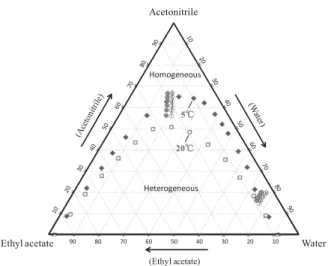
A phase diagram for the ternary mixture of water–acetonitrile (hydrophilic organic solvent)–ethyl acetate (hydrophobic organic solvent) was examined in a batch vessel at temperatures of 5 and 20°C. The obtained phase diagram is shown in Fig. 2.
Fig. 2. Phase diagram for water–acetonitrile–ethyl acetate mixture at 5 and 20°C. The curves expressed with symbols of یی and □ in the diagram indicate the solubility curves at 5 and 20°C, respectively. The symbols of ەەshow the component ratios of the solution 1-10 that gave the chromatograms as shown in Fig. 4.
The curves expressed in the diagram (یی: 5 °C and ڧ: 20°C) indicate the solubility curves. The inside and outside of the curves represent heterogeneous and homogeneous solutions, respectively. The phase diagram shows that each component ratio of the
solvents forms a homogeneous (one homogeneous phase) or heterogeneous (two homogeneous phases) solution. The heterogeneous solutions include the upper (organic solvent-rich solution) and lower (water-rich solution) phases in the batch vessel. The component ratios of the solvents in the solutions 1–10 are plotted in the diagram.
3.2 Chromatograms obtained with tube temperatures of 20°C
The model analytes, hydrophobic 1-naphthol and hydrophilic 2,6-NDS, were examined with the present TRDC system at a tube temperature of 20°C. The ternary mixture of water–acetonitrile–ethyl acetate homogeneous solution 1 (the volume ratio of 3:9:4) and 7 (60:13:7) were used as the organic solvent-rich and water-rich carrier solutions, respectively. The compositions of solvents 1 and 7 were positioned close to the solubility curve at 20°C (Fig. 2). 1-Naphthol and 2,6-NDS were separated in this order with the organic solvent-rich carrier solution, but were not separated with the water-rich carrier solution (Fig. 3).
Fig. 3. Chromatograms of 1-naphthol (peak 1) and 2,6-NDS (peak 2) by the TRDC system with tube temperature of 20°C. a) Organic solvent-rich and b) water-rich carrier solution have water–acetonitrile–ethyl acetate mixture volume ratio of a) 3:8:4 and b) 60:13:7, respectively.
Acetonitrile
(Ethyl acetate)
90 80 70 60 50 40 30 20 10 Water
Ethyl acetate
䐟 䐠 䐡䐢䐣䐤
Heterogeneous Homogeneous
20Υ 5Υ
䐥䐦䐧䐨
Water-acetonitrile-ethyl acetate mixture solution (3:8:4, v/v/v); plot 䐟in Fig. 2
Water-acetonitrile-ethyl acetate mixture solution (60:13:7, v/v/v); plot 䐥in Fig. 2
a) b)
Time / min
5 10 15 20
0
Absorbance at 254 nm
Time / min
5 10 15 20
0
Absorbance at 254 nm
2 1
1, 2