害虫種を含むヤガ類(昆虫綱チョウ目)の
分類・生態学的研究とその応用
2019 年
目 次
第1章 緒言・・・・・・・・・・・・・・・・・・・・・・・・・・・・・1 第2章 果樹害虫ヤガ類を中心とした分類・生態学的研究・・・・・・・・・4 2-1 果樹等共通の害虫 I:ハスモンヨトウとその近縁種・・・・・・・・5 2-2 果樹等共通の害虫 II:ノコバヨトウとその近縁種・・・・・・・・・20 2-2-1 Tiracola rufimargo グループの分類学的研究・・・・・・・・・21 2-2-2 Tiracola plagiata グループの分類学的研究・・・・・・・・・41 2-3 カキノキ科の害虫:ムーアキシタクチバとその近縁種・・・・・・67 2-4 フトモモ科の害虫:ネグロフサヤガとその近縁種・・・・・・・・89 2-5 農・園芸作物の害虫:ベニモンアオリンガとその近縁種・・・・・130 2-5-1 ベニモンアオリンガの生態学的研究・・・・・・・・・・・131 2-5-2 ベニモンアオリンガとオオベニモンアオリンガの分類学的研究・・ ・・・・・・・・・・・・・・・・・・ ・・・・・・・・140 第3章 総合考察(応用研究:害虫化に関わる主要因子の探索)・・・・・・157 謝辞・・・・・・・・・・・・・・・・・・・・・・・・・・・・・・・・175 Summary・・・・・・・・・・・・・・・・・・・・・・・・・・・・・・1761
第1章
緒言
2
ヤガ上科は,チョウ目中最大の一群で,全世界で 70,000 種以上を含むグルー プである(上田・吉松,2011).そのため本グループの高次分類体系は今なお混 沌とした状況にあり,近年の分子分類学的研究によると,ヒトリガ類,ドクガ 類,トモエガ類では,科・亜科レベルにおいてその扱いが安定しない状況とな っているほか(Zahiri et al., 2013;Wang et al., 2015),本論文で研究対象としたフ サヤガ科も,近年亜科から科への昇格が提唱されたばかりである(Zahili et al., 2011).また日本国内だけで,最近数年間に限っても日本初記録種や新種が多数 報告されていることからもわかるように(枝・岸田,2015;藤平,2016;四方 ほか,2017;岸田,2018 等),種レベルでの分類学的研究にも未だ多くの課題 が残されている状況にある.さらに本グループは成虫に比べて幼虫の分類学的 研究が大変遅れており,農業の現場において害虫種を確実に識別し,防除につ なげるためにも,害虫種を中心とした(若齢期を含む)幼生期の解明が望まれ ている.幼生期の形態や生態情報は,高次系統分類でもその有用性が示唆され ているため(Kristensen, 1999;Miller, 1991 等),それらの研究は分類学全体の進 展にも大きく寄与すると考えられる. またヤガ上科はチョウ目の中でも特に害虫種が多いグループで,日本のチョ ウ目害虫 885 種(日本応用動物昆虫学会,2006)のうち,ヤガ上科の主要なグ ループのヤガ科だけでも,その割合は約 21 %(186 種)を占める計算となる. こ れ ら に は ハ ス モ ン ヨ ト ウ Spodoptera litura (Fabricius) や オ オ タ バ コ ガ Helicoverpa armigera (Hübner) ,イラクサギンウワバ Trichoplusia ni (Hübner) と いった近年顕著に害虫化した種も含まれており,その対策が急がれている.な おこれらが害虫化した背景には,気候変動による昆虫相の変遷(井上,2016) や,栽培法の変遷(吉松・仲田,2003),新規作物の導入(加藤,1953)といっ た様々な外的要因が複合的に関わっているとされる.世界的に見てもヤガ上科 は多数の害虫種を含んでおり,近年は自力で飛来・侵入する長距離移動性害虫 が世界各地で問題となっている(吉松ほか,2011;Goergen et al., 2016;Shylesha et al., 2018 等).
こうした侵入害虫の発生リスクを作物別に考えた場合,果樹栽培では,「凍結 解凍覚醒法」(一般財団法人 ASCO)をはじめとした栽培技術の目覚ましい発展
3 により,近い将来日本における果樹栽培地が劇的に拡大・変化する可能性があ るため,今後これら侵入害虫の発生リスクが高まることが想定される.さらに 果樹は害虫相の変遷が激しい作物であるため(宮原ほか,1970),侵入害虫対策 が急務といえる.なお,こうした侵入害虫に対して,日本ではこれまでにいく つかのリスク分析の開発が行われてきたが,現手法は輸入農作物に随伴する害 虫にのみ有効であるため,上記のように自力で飛来・侵入するような害虫種に も対応可能な,新たなリスク分析の開発が求められている(佐々木ら,2015). そこで本研究では,まずヤガ類の中で外見による識別が困難な果樹害虫を含 むいくつかの分類群を対象とし,それぞれの成虫と幼生期の分子・形態分類学 的研究ならびに生態学的研究を行った(第 2 章).なお,ここでは参考までに農・ 園芸作物の害虫も一部含めて研究を行った.次にこれら第 2 章で得られた成果 と,各種が持つ食性・分布・害虫としての発生状況といった既知情報を比較検 討し,害虫化に関わる主要因子の探索を行った(第 3 章).これら主要因子は, あらゆる害虫種で比較検討を行うことによって,前述のようなリスク分析にお ける害虫の評価基準にできる可能性があり,本研究ではこうした知見の探索と 蓄積を通して,新たなリスク分析の開発へ貢献できるか試行を行った. 本論文では,動物命名法国際審議会(1999)の条 8.2 および 8.3 に則り,すべ ての命名法的行為を棄権する.これに伴い,本研究で得られた Targalla 属およ び Tiracola 属の種名不確定種は,それぞれ“sp. 1, 2, 3....”として扱った.
4
第2章
果樹害虫ヤガ類を中心とした
分類・生態学的研究
5
2-1 果樹等共通の害虫 I:ハスモンヨトウとその近縁種
日本産ハスモンヨトウ属の種の識別法開発と 2010 年から 2013 年に南西諸島で害虫化した アフリカシロナヨトウの侵入経路の推定 緒言ハスモンヨトウ Spodoptera litura (Fabricius) を含む Spodoptera 属は世界で 30 種が知られ(Pogue, 2002),熱帯から亜熱帯を中心に広く分布し,一部は温帯に も進出している.本属に含まれる種の多くは,野菜,穀物,牧草,果樹等を加害 する農業上重要な害虫であり,日本から知られている 8 種のうち,ハスモンヨト ウ,シロイチモジヨトウ S. exigua (Hübner),スジキリヨトウ S. depravata (Butler), シロナヨトウ S. mauritia (Boisduval),クシナシスジキリヨトウ S. cilium Guenée, アフリカシロナヨトウ S. exempta (Walker) の 6 種が日本では農業害虫として知 られる(日本応用動物昆虫学会,2006; 廣森ほか,2003; 吉松ほか,2011).そ のうちハスモンヨトウは,ハウス栽培の普及に伴い 1950年代より様々な農作物で 害虫化したとされる種である(内藤ほか,1971;梅谷・岡田,2003). 熱帯から亜熱帯を中心に分布する害虫が多く,アメリカ大陸に産する同属の S. frugiperda (J. E. Smith) がアフリカ大陸やインド地方に侵入,大発生し,現在大き な問題となっているほか(Goergen et al., 2016; Shylesha et al., 2018),日本本土に おいても以下の 2 種の害虫化が近年報告されている.すなわち,クシナシスジキ リヨトウは元来台湾やアフリカにおいて芝草の害虫として知られていたが,1999 年頃より静岡県のゴルフ場の芝草において甚大な食害被害を引き起こした(廣森 ほか,2003).アフリカシロナヨトウは 2010 年に日本において初めて害虫化が 確認された種で,同年 7 月から 11 月にかけて沖縄県多良間島と西表島,鹿児島 県喜界島と奄美大島のイネ科牧草地やサトウキビ圃場において,多発生および食 害が確認された(上里ほか,2011;吉松,2011;吉松ほか,2011).アフリカシ ロナヨトウは英名を African armyworm と言い,アフリカ,アジアの熱帯地域, オーストラリア,ハワイを含む島嶼に分布する.イネ科,カヤツリグサ科,マメ
6 科などを食害する害虫として知られ,アフリカでは著名な害虫である.日本にお いては 2010 年に多発生した後,2011 年には発生が確認されなかったものの,本 種による被害が沖縄県で確認された 2010 年 8 月とほぼ同時期に,鹿児島県本土 の薩摩郡紫尾山(しびさん,標高 1,067 m)で 2 個体が得られているほか(福田, 2012),2012 年から 2013 年にかけて沖縄県と鹿児島県の離島で再び発生が確認 された.本種は前述のツマジロクサヨトウと同様に長距離移動性を持つため,今 後も引き続き発生には注意を要する. 発生予察調査等で用いられるフェロモントラップでは,対象外昆虫の混入が しばしば起こるが(「フェロモン剤利用ガイド」編集委員会編,2000),沖縄 県病害虫防除技術センター,ならびに鹿児島県農業開発総合センターがアフリ カシロナヨトウの多発生当初より行ってきた,アフリカシロナヨトウ用合成性 フェロモントラップによる発生調査でも,得られた個体を解剖,同定した結果, 本属の複数種が得られていたことが判明した.本属は類似した種が多く,特に フェロモントラップで用いる粘着板に付着した個体は,鱗紛等が脱落・変色し, 外部表徴等による同定が困難になる.そのため,フェロモントラップに複数種 が混じって捕獲される可能性がある場合は,確実な同定方法が必要となる. そこで,今後のフェロモントラップを用いた発生調査等の参考となるよう, 主に雄交尾器形態を用いた日本産 Spodoptera 属の簡易識別法の開発を行った. さらに,フェロモントラップでは多数の個体をより効率的に同定する手法が必 要となることから,ミトコンドリア DNA(COI)バーコード領域を用いた標準 的な DNA バーコディングによる簡易識別の有用性についても並行して検討し た.さらに,2010 年,2012 年および 2013 年に日本国内で多発生が確認され たアフリカシロナヨトウに着目し,日本を含むアジア・オセアニアのハプロタ イプの情報と,Graham and Wilson(2013)により報告されたアフリカ産のハプ ロタイプの情報を用いて,ハプロタイプネットワークを作成し,南西諸島にお ける本種の侵入経路の推定を行った.
7 材料および方法 1.形態分類学的研究 合成性フェロモントラップにより得られた個体の同定 アフリカシロナヨトウの多発生が日本において初めて確認された 2010 年よ り沖縄県と鹿児島県の南西諸島各地において,合成性フェロモントラップによ る発生調査を,沖縄県病害虫防除技術センターおよび鹿児島県農業開発総合セ ンターが中心になり実施した.沖縄県で多発生した個体群の性フェロモン成分 の組成は既に同定されているが(Wakamura et al., 2011),2010 年の多発生時に はまだ同定されていなかったため,性フェロモンはケニヤで同定された性フェ ロモン成分の組成(Cork, 1989)を元に京都学園大学の若村定男教授が作製した ものを使用し,トラップは粘着型トラップ(SE トラップ:サンケイ化学社製) を使用した.これらのフェロモントラップで得られた個体は,捕獲虫の周辺を 粘着板ごと切り抜いて個体毎にヘキサンに浸漬し,10 分程度浸漬した後に,ろ 紙上でドラフトチャンバーを用いて風乾させた.その上で,以下の雄交尾器に よる検索表の作成に向け,雄 56 個体の解剖と同定を行った.なお,用いた標 本はすべて国立研究開発法人 農業・食品産業技術総合研究機構 農業環境変動 研究センター(以下,農業環境変動研究センター)が保管している. 雄交尾器による日本産 Spodoptera 属の検索表 日本産 Spodoptera 属の全 8 種について,主に雄交尾器による検索表を作成し た.なお,本研究ではフェロモントラップを前提としているため,汚損した個体 の同定にも対応できるよう,交尾器を含む雄成虫の外部形態のみを取り上げた. 成虫の画像,および標本の観察と検索表中の図の画像は農業環境変動研究センタ ー所蔵の杉繁郎コレクションと,上述の 2010 年に南西諸島で合成性フェロモン トラップを用いて採集された個体を用いた.
8 2.分子分類学的研究 サンプルの収集 日本で害虫として報告されている 6 種を扱った.そのうちアフリカシロナヨト ウは,2010 年から 2012 年に沖縄県病害虫防除技術センターの合成性フェロモン トラップによる発生調査で得られた個体と,鹿児島県の離島で 2013 年に野外で 採集された幼虫と蛹より羽化した個体を用いた.クシナシスジキリヨトウ,シロ ナヨトウ,ハスモンヨトウの 3 種は 2010 年に沖縄県病害虫防除技術センターの 合成性フェロモントラップによる発生調査で得られた個体を用い,シロイチモジ ヨトウは 2011 年に鹿児島県農業開発総合センターのシロイチモジヨトウ用の合 成性フェロモントラップで得られた個体を供試虫として用いた.スジキリヨトウ は 2011 年に埼玉県ふじみ野市の街灯で得られた個体を用いた.外群として用い たアワヨトウ Mythimna separata (Walker) は 2010 年に沖縄県で採集されたもの を,スモモヒメシンクイ Grapholita dimorpha Komai は山形県で 2011 年 8 月に 幼虫ごと被害果を採集し,飼育羽化させた個体を用いた.シロイチモジヨトウ, アワヨトウ,スモモヒメシンクイは乾燥標本を使用し,その他の種は冷凍保存さ れていたものを使用した.これらの用いた標本はすべて農業環境変動研究センタ ーが保管している他,得られた塩基配列は,詳細なラベルデータ(採集日・採集 地等)と併せて国際塩基配列データベースの GenBank に登録した(Table 1). また今回の実験においてアフリカシロナヨトウの種内変異も比較したが,そこで は上記の個体に加えて,DDBJ / EMBL / GenBank に登録されているタンザニア産 のハプロタイプ(JQ315120, JQ315122, JQ315125–JQ315131, JQ315136),および ガボン産のハプロタイプ(HM893111)を用いた. DNA の抽出,増幅,塩基配列解析
DNA の抽出には,左右いずれかの脚 1–3 本を使用し,DNeasy Blood & Tissue Kit(QIAGEN)を用いて,抽出キットのプロトコルに従い行った.DNA バーコ ード領域の増幅には LCO1490(GGTCAACAAATCATAAAGATATTGG)と HCO2198(TAAACTTCAGGGTGACCAAAAAATCA)(各3. 2μl),GoTaq® Hot Start
9
Green Master Mix(20μl)(プロメガ)を用い,各々の反応液を PCR チューブ に入れ,サーマルサイクラー TaKaRa PCR Thermal Cycler Dice®(タカラバイオ)
により反応させた.94. 0 ℃で 5 分反応させた後に 94. 0 ℃で 30 秒,47 ℃で 30 秒,72 ℃で 1 分の反応を 35 サイクル行い,最後に 72 ℃で 5 分間反応させ た.塩基配列の解析はタカラバイオ株式会社ドラゴンジェネミクスセンターに てプレート単位塩基配列解析を依頼し,Applied Biosystems 3730xl DNA Analyzer (ライフテクノロジーズジャパン社),および BigDye Terminator v3. 1 Cycle sequencing kit(Applied Biosystems)を用いて行われた.得られた塩基配列データ のアライメントは ATGC (Ver. 6) sequence assembly software(GENETYX)を 用いて行った.MEGA 5(Tamura et. al., 2011)を使用し,塩基配列から近隣結合 法 (neighbor-joining method:NJ) を用いて分岐図を作成した.また,塩基置 換率の算出には DnaSP(Ver. 5)(Rozas and Librado, 2009)を用い,ハプロタイ プネットワークの作成には TCS ver. 1.21(Clement et al., 2000)を用いた.
結果および考察 1.形態分類学的研究 合成性フェロモントラップにより得られた個体の同定 沖縄県病害虫防除技術センターが 2010 年 10 月および 11 月に行ったアフリ カシロナヨトウ用の合成性フェロモントラップを用いた発生調査において得られ た個体のうち 56 個体を解剖,同定した結果,約 7 割はアフリカシロナヨトウで あったが,同属のクシナシスジキリヨトウ,ハスモンヨトウ,シロナヨトウおよ び他属のヒメホシミミヨトウ Platysenta selva (Walker) が混じって得られていた (Table 2).また鹿児島県農業開発総合センターの設置した同成分組成のフェロ モントラップで誘殺された Spodoptera 属を解剖,同定した結果,同属のシロイ チモジヨトウが誘殺されており,アフリカシロナヨトウ用の合成性フェロモント ラップでは,アフリカシロナヨトウの他に同属の 4 種が得られたことになる.
10 雄交尾器による日本産 Spodoptera 属の検索表 Pogue(2002)を参考に日本産 Spodoptera 属の全 8 種の検索表を作成した. 各部の名称(Fig. 1)も主にそれに従った.また,アカマダラヨトウは前翅の斑 紋により明瞭に識別できるため,アカマダラヨトウのみ交尾器ではなく前翅の 斑紋を用いた.さらにより簡易な利用のため,図解検索表も作成した(Fig. 2). -検索表- 1 前翅はクリーム色の地色に赤い斑紋がある・・アカマダラヨトウ S. picta - 前翅は薄茶色から黒褐色,もしくは灰褐色で,赤い斑紋はない・・・2 2 膜質の anellifer が valva の外縁で cucullus と valvula を隔てない ・・・・・・・・・・・・・・・・・・・シロイチモジヨトウ S. exigua - 膜質の anellifer が外縁まで達し cucullus と valvula を隔てる・・・3 3 中央構造物(ampulla + clasper proper)の2つの突起が valva 背方の 縁を超えて突出する・・・・・・・・・クシナシスジキリヨトウ S. cilium - 中央構造物(ampulla + clasper proper)の突起は valva 背方の縁を こえて突出しない・・・・・・・・・・・・・・・・・・・・・・4 4 Valvula と sacculus の腹方の縁が交わる角度は深い・・・・・・・・・ ・・・・・・・・・・・・・・・・・・・・・ハスモンヨトウ S. litura - Valvula と sacculus の腹方の縁が交わる角度は浅い・・・・・・・・5 5 Cucullus は幅狭く,中央構造物は太い・・・・・・・・・・・・・・6 - Cucullus は幅広く,中央構造物は細長い・・・・・・・・・・・・・7 6 中央構造物(ampulla + clasper proper)の突起の末端は背方へ向かって尖
る・・・・・・・・・・・・・クシヒゲスジキリヨトウ S. pecten - 中央構造物(ampulla + clasper proper)の突起は決して背方へ向かって尖
ることはない・・・・・・・・・・・スジキリヨトウ S. depravata 7 Uncusは後半部で太くなる・・・・・・・・・シロナヨトウ S. mauritia - Uncus は一様に細い・・・・・・・・・アフリカシロナヨトウ S. exempta
11 2.分子分類学的研究 スズメガ上科,シャクガ上科,ヤガ上科の 3 上科を代表させて算出したチ ョウ目の同属内の種間におけるミトコンドリア DNA(COI)バーコード領域の 塩基置換率は,その平均値がおよそ 6.8 %である(Hebert et al., 2003).今回の研 究において取り上げた日本産 Spodoptera 属内の 6 種における塩基置換率は, 平均値が 5.6 %であり,先の Hebert et al.(2003)より低い数値を示した.また, 最も高い塩基置換率を示したシロイチモジヨトウとシロナヨトウ(8.4%)を除 いた 4 種の平均値は 4.3 %であり,日本産 Spodoptera 属の種間におけるミト コンドリア DNA(COI)の塩基置換率はチョウ目内では比較的小さい差異であ ると考えられる.しかしながら,本研究において作成した日本産 Spodoptera 属 のうち害虫として知られる 6 種を用いた近隣結合樹(Fig. 3)からは,6 種全て が種毎にクレードを形成し,標準的な DNA バーコーディングに基づく同定が可 能であることが示された.本研究で扱った Spodoptera 属の種とは異なる種を多 数含むフロリダ産の Spodoptera 属を用いたミトコンドリア DNA(COI)領域に 基づく研究(Nagoshi et al., 2010)では,フロリダ産の Spodoptera 属の各々の種 においても同様にミトコンドリア DNA(COI)バーコーディングによる識別が 可能であることが示されている.なおチョウ目の場合,卵や幼虫,蛹のステー ジにおける同定は困難であることが多く,それらが得られた場合は,現状では 飼育羽化させた成虫を用いて同定を行うことが多いが,今回行った分子実験に より標準的な DNA バーコーディングを用いた同定が可能であることが分かり, 日本で害虫として知られている Spodoptera 属 6 種においては,卵,幼虫,蛹, 成虫の全てのステージにおける同定が可能であることが示された.今後,特に 発生の初期段階での調査においては,実際に作物を加害中の幼虫などを飼育す ることなく,直接用いて同定することも可能になった訳で,DNA バーコーディ ングを用いた同定方法は,フェロモントラップを利用せずとも,より迅速かつ 効率的な対応を行うことに貢献すると考えられる.そのほか,Nagoshi et al. (2010)および Hebert et al.(2010)のミトコンドリア DNA(COI)を用いた研
12 究においてシロイチモジヨトウが他の Spodoptera 属のクレードと姉妹群の関 係にあることが示されているが,本研究結果においても同様の結果を示し(Fig. 3),これらの研究を支持する結果となった.なおこの結果は,形態情報に基づ く Pogue(2002)の見解においても支持されている. 次に,これまで GenBank にミトコンドリア DNA(COI)の塩基配列が登録 されているアフリカ大陸(タンザニアとガボン)のアフリカシロナヨトウの個 体群の塩基配列と,今回南西諸島において得られた個体群の塩基配列を比較・ 解析し,ハプロタイプネットワークを作成した(Fig. 4).その結果,遺伝的多様 性の高いアフリカの個体群に対し,2010 年,2012 年および 2013 年に発生し た日本産の個体群は,供試した全 80 個体中に 3 つのハプロタイプが確認され たのみで,遺伝的均一性が高いことが示された.また,アフリカと日本間にお いて塩基配列が一致するハプロタイプは存在しなかった.GenBank に登録され ていたパプアニューギニア産 3 個体とオーストラリア産 3 個体のハプロタイ プは,5 個体が日本産の最も頻度の高いハプロタイプ(Asia-Oceania 1)に一致 し,残りのオーストラリア産 1 個体も日本産の 2 番目に個体数が多かったハ プロタイプ(Asia-Oceania 2)と一致した.そのため,これらのハプロタイプは 東南アジアからニューギニア,オーストラリアにかけて広く分布している可能 性が示され,さらに本種は移動分散能力の高い種であることが示されているこ とから(Brown and Swaine, 1966),2010 年,2012 年および 2013 年に南西諸島 で発生した個体群は,アフリカからではなく,これらの地域から侵入した可能 性があることが分かった.ただし東南アジア各地の標本を用いた遺伝子解析は まだ行われていないため,現時点では,これら日本で発生した個体群が,東南 アジア,ニューギニア,オーストラリア等のどの地域から飛来・侵入してきた のかを確定することはできない.2010 年以前より南西諸島に生息,定着してい た可能性もある他,分子分類学的研究からいくつかの隠蔽種やシノニムの存在 も示唆されているため(Dumas et al., 2015).今後の東南アジアを中心とした地 域における本種の網羅的な遺伝子解析が望まれる.
13
引用文献
Brown, E. S. and G. Swaine, 1966. New evidence on the migration of moths of the African armyworm, Spodoptera exempta (Walker) (Lepidoptera: Noctuidae). Bulletin of Entomological Research 56: 671–684.
Clement, M., D. Posada and K. A. Crandall, 2000. TCS: a computer program to estimate gene genealogies. Molecular Ecology 9: 1657–1659.
Cork, A., J. Murlis and T. Megenasa, 1989. Identification and field testing of additional components of female sex pheromone of African armyworm, Spodoptera exempta (Lepidoptera: Noctuidae). Journal of Chemical Ecology 15: 1349–1364.
Dumas, P., J. Barbut, B. L. Ru, J. F. Silvain, A. L. Clamens, E. d'Alençon and G. J. Kergoat, 2015. Phylogenetic molecular species delimitations unravel potential new species in the pest genus Spodoptera Guenée, 1852 (Lepidoptera, Noctuidae). PLoS ONE 10: e0122407.
福田輝彦, 2012. アフリカシロナヨトウ(ヤガ科)紫尾山にも飛来.Satsuma 62: 164.
Goergen, G., P. L. Kumar, S. B. Sankung, A. Togola and M. Tamò, 2016. First report of outbreaks of the fall armyworm Spodoptera frugiperda (J E Smith) (Lepidoptera, Noctuidae), a new alien invasive pest in west and central Africa. PLoS ONE 11: e0165632.
Hebert, P. D. N., A. Cywinska, S. L. Ball and J. R. DeWaard, 2003. Biological identifications through DNA barcodes. Proceedings of the Royal Society B: Biological Sciences (270): 313–321.
Hebert, P. D. N., J. R. De Waard and J. F. Landry, 2010. DNA barcodes for 1/1000 of animal kingdom. Biological Letters 6: 359–362.
廣森 創・合田光太郎・吉松慎一・廿日出正美,2003. 芝草地に発生するクシナ シスジキリヨトウの形態および生態学的特徴に関する研究. 芝草研究 31: 128–131.
14
Nagoshi R. N., J. Brambila and R. L. Meagher, 2010. Use of DNA barcodes to identify invasive armyworm Spodoptera species in Florida. Journal of Insect Science 11: 1–11. 内藤 篤・服部伊楚子・五十嵐良造,1971.わが国のハスモンヨトウの分布と 発生.植物防疫 25: 475–479. 日本応用動物昆虫学会,2006.農林有害動物・昆虫名鑑 増補改訂版: 387 pp. 日 本植物防疫協会,東京. 「フェロモン剤利用ガイド」編集委員会,2000. フェロモン剤利用ガイド: 111 pp. 社団法人日本植物防疫協会,東京.
Pogue, M. G., 2002. A world revision of the genus Spodoptera Guenée (Lepidoptera: Noctuidae). Memoirs of the American Entomological Society 43: 1–202.
Rozas, J. and P. Librado, 2009. DnaSP v5: a software for comprehensive analysis of DNA polymorphism data. Bioinformatics 25: 1451–1452.
Shylesha, A. N., S. K. Jalali, A. Gupta, R. Varshney, T. Venkatesan, P. Shetty, R. Ojha, P. C. Ganiger, O. Navik, K. Subaharan, N. Bakthavatsalam and C. R. Ballal, 2018. Studies on new invasive pest Spodoptera frugiperda (J. E. Smith) (Lepidoptera: Noctuidae) and its natural enemies. Journal of Biological Control 32: (doi: 10.18311/jbc/2018/21707).
Tamura, K., D. Peterson, N. Peterson, G. Stecher, M. Nei and S. Kumar, 2011. MEGA5: Molecular evolutionary genetics analysis using maximum likelihood, evolutionary distance, and maximum parsimony methods. Molecular Biology and Evolution 28: 2731–2739. 上里卓己・瑞慶山浩・島谷真幸・山口綾子・兒玉博聖・渡嘉敷唯彰・若村定男, 2011.琉球列島におけるアフリカシロナヨトウの大発生.植物防疫 65: 365–370. 梅谷献二・岡田利承,2003.日本農業害虫大辞典: 1203 pp. 全国農村教育協会, 東京.
Wakamura, S., H. Yasui, M. Shimatani, T. Tokashiki, T. Okuhira, N. Fujiwara-Tsujii, M. Ishikawa, T. Uesato, H. Zukeyama and H. Tobaru, 2011. Sex pheromone of the
15
African armyworm Spodoptera exempta (Lepidoptera: Noctuidae): identification of components of the Okinawan population and formulation for population monitoring. Applied Entomology and Zoology 46: 415–420.
吉松慎一,2011. 日本初発生の害虫アフリカシロナヨトウを同定.農環研ニュー ス(91): 6–8.
吉松慎一・上里卓己・指宿 浩・湯田達也,2011.日本で初めて害虫化したア フリカシロナヨトウとこれまでの成虫の採集記録.蛾類通信(260): 243–245.
図
Fig. 1. Used terminology of male genitalia of Spodoptera spp. Right valva and ring of S. exempta were shown. Left valva and tuba analis were omitted.
【図の引用元】綿引大祐・吉松慎一・吉武啓・馬場友希・上里卓己・島谷真幸・指宿浩・湯田達也(2013)アフリ
カシロナヨトウ用の合成性フェロモントラップで誘殺される日本産 Spodoptera 属成虫の識別法の開発.日本応用動物昆 虫学会誌 57: 19–26.
16
Fig. 2. An illustrated key to species of Japanese Spodoptera spp. based on forewing maculation and male genitalia.
【図の引用元】綿引大祐・吉松慎一・吉武啓・馬場友希・上里卓己・島谷真幸・指宿浩・湯田達也(2013)アフリカ
シロナヨトウ用の合成性フェロモントラップで誘殺される日本産 Spodoptera 属成虫の識別法の開発.日本応用動物昆虫 学会誌 57: 19–26.
17
Fig. 3. Neighbor-joining tree for Japanese pest species of Spodoptera spp. based on 573 bp of the mitochondrial COI gene. COI sequences from Mythimna separata and Grapholita dimorpha were used as outlier sequences. Bootstrap probabilities (1,000 replicates) are provided on each branch when they are greater than 50%.
【図の引用元】綿引大祐・吉松慎一・吉武啓・馬場友希・上里卓己・島谷真幸・指宿浩・湯田達也(2013)アフリカ
シロナヨトウ用の合成性フェロモントラップで誘殺される日本産 Spodoptera 属成虫の識別法の開発.日本応用動物昆虫 学会誌 57: 19–26.
18
Fig. 4. Haplotype network of African and Asia-Oceanian Spodoptera exempta based on 585 bp of the mitochondrial COI gene. Numbers of individuals of each haplotypes are shown if not single. The haplotype of Africa 10 became the same as that of Africa 1 because they are compared with Asia-Oceanian haplotypes together. Therefore the haplotype of Africa 10 is not shown and not counted as Africa 1 here. PNG means Papua New Guinea.
【図の引用元】Shin-ichi Yoshimatsu, Daisuke Watabiki, Toshihiko Nishioka, Hiroaki Nakamura, Takuhiro Yamaguchi, Ken Takesaki, Masayuki Shimatani and Takumi Uesato (2014) Additional information on DNA barcoding of the African armyworm,
19
表
Table 1. Accession numbers of the Spodoptera spp., Mythimna separata and Grapholita dimorpha registered in GenBank.
Table 2. Scientific names of moths with number of individuals and collecting localities captured by synthetic sex pheromone traps for S. exempta at Okinawa Pref. in October and November, 2010, identified after dissecting the male genitalia. Besides the species mentioned below, S. exigua was collected by synthetic sex pheromone traps for S. exempta at Kagoshima Pref., Japan in 2010.
【表の引用元】綿引大祐・吉松慎一・吉武啓・馬場友希・上里卓己・島谷真幸・指宿浩・湯田達也(2013)アフリカ シロナヨトウ用の合成性フェロモントラップで誘殺される日本産 Spodoptera 属成虫の識別法の開発.日本応用動物昆虫 学会誌 57: 19–26.
20
2
-2 果樹等共通の害虫 II:ノコバヨトウとその近縁種
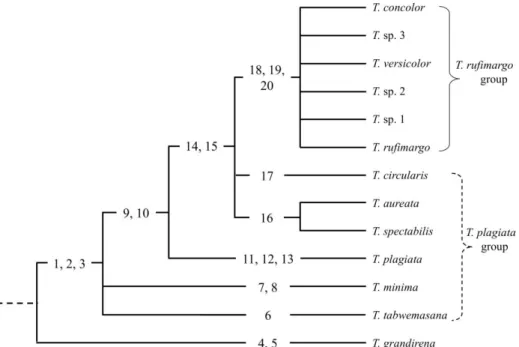
概要 Tiracola 属は東南アジアを中心に分布するヨトウガ亜科の 1 グループで,イ ンドからオセアニア地域にかけて 9 種 2 亜種,アメリカ大陸に 1 種 1 亜種が 知られている(Holloway, 1989; Poole, 1989).そのうち,本属のタイプ種のノコ バヨトウ T. plagiata Walker は広食性種で,東南アジアではアオイ科のカカオ Theobroma cacao Linnaeus やバショウ科のバナナ Musa spp.,トウダイグサ科の パ ラ ゴ ム ノ キ Hevea spp. 等 を 食 害 す る 農 林 業 害 虫 と し て 知 ら れ て い る (Kalshoven and Laan, 1981).本属は,Tams(1935)や Robinson(1975),Holloway(1979, 1989),Todd and Poole(1982)によって雌雄交尾器も含めた分類学的な検討が行われてきたもの の,ニューギニア島を中心としたオセアニア地域に分布する T. rufimargo グル ープは分類学的研究が不十分であること,本属のほとんどの種は幼生期が解明 されておらず,また幼生期の解明されている種も幼虫で明瞭に種の識別がなさ れていないことから,それぞれの種の寄主植物の記録も不確実であること等の 問題を抱えていた. そこで今回,研究が遅れているオセアニア地域のタクサに着目した成虫の形 態分類学的研究(2-2-1 Tiracola rufimargo グループの分類学的研究)と, 害虫種である T. plagiata とその近縁種の幼生期を含めた分子・形態分類学的研 究(2-2-2 Tiracola plagiata グループの分類学的研究)を行い,本属全体 の分類体系の解明に取り組んだ.
21
2-2-1 Tiracola rufimargo グループの分類学的研究
緒言
T. rufimargo グループは,T. rufimargo rufimargo Warren,T. rufimargo samoensis Tams,T. rufimargo concolor Prout,T. versicolor Prout の 2 種 3 亜種が知られ, 主にニューギニア島を中心としたオセアニア地域の島嶼部に分布する.同属の T. plagiata グループに含まれるノコバヨトウ T. plagiata (Walker), T. spectabilis (Walker), オ オ ノ コ バ ヨ ト ウ T. aureata Holloway と は 同 地 域 で 混 生 す る が (Holloway, 1989),T. plagiata グループは後翅が一様に暗褐色であるのに対し, 本グループは後翅の縁が赤色を帯びる特徴を持つ.なお T. plagiata グループの ノコバヨトウ T. plagiata は,インドを含む南アジア地域や東南アジア地域にお ける著名な害虫種である(Kalshoven and Laan, 1981).
T. rufimargo グループには害虫種が知られていないものの,Warren(1912, 1915) によって多数の異常型(aberration)が記録されていることや,性的二型や個体 変異が著しいグループであること等から,詳細な分類学的研究が進んでいなか った.そこで本研究では,ニューギニア島やスラウェシ島等より得られたサン プルを用いて,本グループの分類学的研究を行った.なお,先行研究によって 詳細な記載がなされている種や,同定が容易な種については,それぞれの形態 的特徴および他種との識別点について簡単な記述を行うに留めた.また,海外 産の種には和名の無いものが多く,混乱を避けるために,以下各種名の表記は 学名に統一した. 材料および方法 雌雄交尾器を含む成虫の腹部の解剖と観察は,5–7 % 水酸化カリウム水溶液 による 5–10 分間の煮沸を経た後に行った.供試標本には,農研機構 農業環境
22 変動研究センター所蔵コレクション(NIAES),国立科学博物館所蔵コレクショ ン(NSMT),千葉県立中央博物館所蔵コレクション(NHMIC),増井武彦氏所 蔵コレクション(TMC)を用いた.ロンドン自然史博物館(NHM)の標本(主 にタイプ標本)も,同博物館の Alberto Zilli 博士に協力してもらい検討した. 標本の詳細なラベル情報は,結果のそれぞれの種の供試標本の中で述べた.図 中で用いた外部形態の名称は,Pierce(1909), Klots(1956), Ueda(1984), Holloway (1989), Yoshimatsu(1994),駒井ほか(2011)に従った.なお本論文では,今 後の論文投稿の予定も考慮して,分布と備考を除く各種の記載については英文 で行った.
結果および考察
Genus Tiracola Moore Tiracola Moore, 1881: 351.
Type species. Agrotis plagiata Walker, 1857.
Tiracola rufimargo rufimargo Warren, 1912
Tiracola rufimargo Warren, 1912: 10. Type locality: Membare river, Biagi, Papua New Guinea.
Tiracola rufimargo ab. grisescens Warren, 1922: 10. (nomen invalidium)
Tiracola rufimargo rufimargo: Prout, 1929: 200; Tams, 1935: 199; Holloway, 1979: 406; Poole, 1989: 963.
Male (Figs 1–3). Forewing length 24–27 mm. Head: labial palpi reddish brown or fawn brown with scattered black scales; frons and vertex uniformly fawn brown, often tinged with fuscous; antenna ciliate. Thorax: tegulae fawn brown, often tinged with fuscous, sparsely scattered with black scales; fore-, mid- and hind-legs fawn brown
23
or fuscous, sparsely mixed with black scales entirely. Abdomen: fuscous brown dorsally, fawn brown with sparsely scattered black scales ventrally. Forewing: pale reddish brown or greenish grey, distal area of submarginal line and anterior half of medial area usually darkened, outer margin serrated; subbasal and antemedial line usually dark brown, indistinctly blurred or almost absent; orbicular stigma inconspicuous or almost absent, sometimes speckled circle shaped, outlined with faint white; reniform stigma suffused with whitish yellow and often strongly tinged with dark brown, outlined with dull red brown, distortedly oval shaped and concave on the outside; medial line represented by a conspicuous dark brown line dorsally and its basal half almost absent, excurved at the base of reniform stigma; postmedial line blakish brown, inconspicuously serrated, often represented by black dots on veins or sometimes almost absent; submarginal line brownish yellow, slightly excurved, almost absent near the apex, its outer area darker than its inner area; marginal line whitish yellow, curved along outer margin, series of black dots on interspaces of veins marginally; cillia dark brown, often tinged with brownish yellow at the distal end of veins. Hindwing fuscous brown or dark brown, suffused with pinkish red along costal and outer margin, sometimes uniformly covered by pinkish red at the outer half; cillia whitish or fawn brown and sparsed with pinkish red scales.
Female (Figs 4–6). Forewing length 25–27 mm. Almost same ground color of the wings as male, but often covered by dark brown band medially on the forewings.
Male genitalia (Fig. 16). Uncus small, short, barely bifid at the apex, densely suffused with hairs on dorsal side; socius absent. Tegumen slender, roundely squarish-shaped, slightly distorted; vinculum slightly longer and more distorted than tegumen, and rounded ventrally; saccus moderately long, protruded and tapering posteriorly; juxta sclerotized, elongate at the dorsal half, distorted rectangular-shaped at the ventral half. Valva except cucullus synmetrical, rounded; costa almost straight; ampulla very small, weakly sclerotized, sometimes with a small process and one or two spines; sacculus broad, rounded, slightly angulated at the distal margin; harpe (sacculus projection) very small, weakly sclerotized, its distal portion rounded and often with one
24
or two spines; cucullus protruded dorsally, rounded rectangular-shaped with stout spines (coronal setae) densely on the inside surface, its subapical ventral projection (pollex) modelately long; coremata bearing two eversible lobes (double coremata sensu Holloway (1989)) with hair tufts, dorsal lobe half length of the valva and longer than the ventral lobe. Phallus moderately long, curved near the middle, slightly shorter than the vanva; rostellum weakly sclerotized and relatively short; vesica long with a well-developed lateral lobe, bearing deciduous brush-like cornuti subbasally and many conspicuous large cornuti on the apex of the lateral lobe.
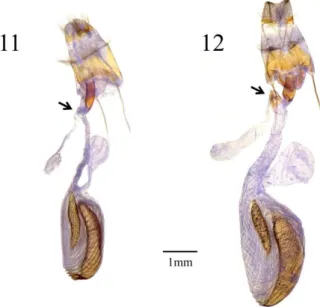
Female genitalia (Fig. 20). Apophyses posteriores and apophyses anteriores long. Ostium bursae sclerotized. Ductus bursae long, sclerotized and strongly waved on posterior half, weakly sclerotized on anterior half, the junction with the corpus bursae slightly sclerotized. Corpus bursae rounded, oblong with a weakly sclerotized and elongated signum. Appendix bursae spiraled 3–4 times, strongly sclerotized at the basal half of inner surface, arising from the middle part of the ductus bursae.
供試標本:[INDONESIA] 18♂, 11♀, Pass-valley, Wamena, Papua province, alt. 2,000 m, Light Trap, VII–VIII. 1997 (NIAES; TMC); [PAPUA NEW GUINEA] 1♀, Membare river, Biagi, 5,000 ft., B. N. G., III. 1906, A. S. Meek leg., type of Tiracola rufimargo ab. grisescens by Warren, 1912 (NHM; NHMUK010914544).
分布:インドネシア(ニューギニア島西半部),パプアニューギニア(ニュー ギニア島東半部). 備考:本種は,前翅の斑紋および色調の個体変異が本属中で最も大きい.ま た T. sp. 1 とは,雌雄ともに外部表徴がよく似ているため,正確な同定には雌雄 交尾器を検する必要がある.これら 2 種の識別点については,T. sp. 1 の項で述 べた.なお本論文では,Warren(1912)によって記録された多数の異常型 (aberration;命名規約上は無効)の整理も参考までに行ったが,その中の 1 つ である " grisescens " は,タイプ標本とされる個体の外部表徴を見る限り,本種 であると考えられる.
25
Tiracola rufimargo samoensis Tams, 1935
Tiracola rufimargo samoensis Tams, 1935: 197; Robinson, 1975: 120; Holloway, 1979: 406; Poole, 1989: 963. Type locality: Malololeilei, Upolu Island, Samoa.
分布:サモア. 備考:原記載(Tams, 1935)において雄個体の標本が図示されているほか, Robinson(1975)と Holloway(1979)によって,雄交尾器を含む外部形態の特 徴が示されている.本研究でも,それらの先行研究を踏まえ,T. rufimargo の 1 亜種として扱う.本亜種は,後翅の基半部が白色を帯びることによって,基亜 種および他種と識別できる. Tiracola sp. 1
Male (Figs 7–8). Forewing length 24–27 mm. Head: labial palpi reddish brown or fawn brown with scattered black scales; frons and vertex uniformly fawn brown, often tinged with fuscous; antenna ciliate. Thorax: tegulae fawn brown, often tinged with fuscous, sparsely scattered with black scales; fore-, mid- and hind-legs fawn brown or fuscous, sparsely mixed with black scales entirely. Abdomen: fuscous brown dorsally, fawn brown with sparsely scattered black scales ventrally. Forewing pale reddish brown or greenish grey, distal area of submarginal line and anterior half of medial area barely darkened, outer margin serrated; subbasal and antemedial line usually dark brown, indistinctly blurred or almost absent; orbicular stigma inconspicuous or almost absent, sometimes speckled circle shaped, outlined with faint white; reniform stigma suffused with whitish yellow and often strongly tinged with dark brown, outlined with dull red brown, distortedly oval shaped and concave on the outside; medial line represented by a conspicuous dark brown line dorsally and its basal half almost absent, excurved at the base of reniform stigma; postmedial line blakish brown, inconspicuously serrated, often represented by black dots on veins or sometimes
26
almost absent; submarginal line brownish yellow, slightly excurved, almost absent near the apex, its outer area slightly darker than its inner area; marginal line whitish yellow, curved along outer margin, series of black dots on interspaces of veins marginally; cillia dark brown, often tinged with brownish yellow at the distal end of veins. Hindwing: fuscous brown or dark brown, suffused with pinkish red along costal and outer margin, sometimes uniformly covered by pinkish red at the outer half; cillia whitish or fawn brown and sparsed with pinkish red scales.
Female (Figs 9–10). Forewing length 25–27 mm. Almost same ground color of the wings as male, but often covered by dark brown band medially on the forewings.
Male genitalia (Fig. 17). Uncus small, short, barely bifid at the apex, densely suffused with hairs on dorsal side; socius absent. Tegumen slender, roundely squarish-shaped, slightly distorted; vinculum slightly longer and more distorted than tegumen, and rounded ventrally; saccus moderately long, protruded and tapering posteriorly; juxta sclerotized, elongate at the dorsal half, distorted rectangular-shaped at the ventral half. Valva except cucullus synmetrical, rounded; costa almost straight; ampulla very small, weakly sclerotized, sometimes with a small process and one or two spines; sacculus broad, rounded, slightly angulated at the distal margin; harpe (saccullus projection) very small, weakly sclerotized, its distal portion rounded and often with one or two spines; cucullus protruded dorsally, rounded rectangular-shaped with stout spines densely on the inside surface, its subapical ventral projection (pollex) modelately long; coremata bearing two eversible lobes with hair tufts, dorsal lobe three-quaters length of the valva and longer than the ventral lobe. Phallus moderately long, curved near the middle, slightly shorter than the vanva; rostellum weakly sclerotized and elongate; vesica long with a relatively short lateral lobe, bearing deciduous brush-like cornuti subbasally, the cornuti on the lateral lobe absent.
Female genitalia (Fig. 21). Apophyses posteriores and apophyses anteriores long. Ostium bursae sclerotized. Ductus bursae long, sclerotized and strongly waved on posterior half, weakly sclerotized on anterior half, the junction with the corpus bursae nearly membraneous. Corpus bursae rounded, oblong with a weakly sclerotized and
27
elongated signum. Appendix bursae spiraled 3–4 times, strongly sclerotized at the basal half of inner surface, arising from the middle part of the ductus bursae.
供試標本: [INDONESIA] 4♂,5♀, Pass-valley, Wamena, Papua province, alt. 2,000 m, Light Trap, VII–VIII. 1997 (NIAES; TMC).
分布:インドネシア(ニューギニア島西半部).
備考:本種は斑紋と色調が T. rufimargo rufimargo と似る.T. rufimargo rufimargo は,本種よりも前翅の亜外縁線の外側がより黒化する傾向にあるものの,正確 な同定には雌雄交尾器を検する必要がある.T. rufimargo rufimargo の雄交尾器は, vesica 上にある lateral lobe が棘状の cornutus を 7 本程備えるのに対し,本種は lateral lobe がより短く,cornutus を持たないことによって識別できる.雌交尾器 は,ductus bursae と corpus bursae の接合部付近が,T. rufimargo rufimargo と比 較して骨化が弱く膜質化することから識別できる.
Tiracola versicolor A. E. Prout, 1922
Tiracola rufimargo versicolor A. E. Prout, 1922: 200. Type locality: Manusela, Ceram Island, Indonesia.
Tiracola versicolor: Holloway, 1979: 406.
供試標本:♂, Manusela, Ceram Is., X–XII. 1919, C. F. and J. Pratt leg. Syntype of T. versicolor (NHM; NHMUK 010914548). 分布:インドネシア(ブル島,セラム島). 備考:ロンドン自然史博物館所蔵の本種のタイプ標本の画像データを検した. 本種は長らく T. rufimargo のセラム島亜種として扱われてきたが,Holloway (1979)によって雄交尾器が詳細に検討され,独立種とされた.本種は T. rufimargo rufimargo および T. sp. 1 と比較して,前翅の各横線や斑紋が明瞭に表 われることによって識別できるが,斑紋があまり顕著に表れない個体も存在す ることから(ロンドン自然史博物館の Zilli 博士より私信),正確な同定には雄 交尾器を検する必要がある.すなわち,本種は vesica 上の lateral lobe を持た
28 ないことによって同属他種から識別できる(Holloway, 1979).なお本研究ではブ ル島産の標本を取り扱わなかったが,Zilli 博士により,同島産の本種標本がロ ンドン自然史博物館に収められていることが確認されたため,ここでは本種の 分布にブル島を含めた. Tiracola sp. 2
Tiracola rufimargo ab. pallidistigma Warren, 1912: 74. (nomen invalidium)
Male (Fig. 11). Forewing length 25–28 mm. Head: labial palpi dark reddish brown or reddish brown with scattered black scales; frons and vertex uniformly fawn brown, often tinged with reddish brown; antenna ciliate. Thorax: tegulae reddish brown, sparsely scattered with black scales; fore-, mid- and hind-legs brown, sparsely mixed with black scales entirely. Abdomen fuscous brown dorsally, reddish brown ventrally. Forewing dark reddish brown uniformly, distal area of submarginal line and medial area between postmedial and submarginal lines slightly darkened, outer margin serrated;subbasal line dark brown, often almost absent; antemedial line indistinctly sinuous or almost absent, and its inner area slightly lighter than outer area; orbicular stigma inconspicuous or almost absent, sometimes speckled circle shaped, outlined with faint white; reniform stigma often strongly suffused with whitish yellow, more or less mixed with grey, outlined with dull red brown, distortedly oval shaped and concave on the outside; medial line blurred dark brown, inconspicuous, excurved at the base of reniform stigma, sometimes almost absent; postmedial line blakish brown, almost absent, sometimes represented by inconspicuously serrate or black dots on veins; submarginal line brownish yellow, slightly excurved, almost absent near the apex, its outer area relatively darker than its inner area; marginal line brownish yellow, curved along outer margin, series of black dots on interspaces of veins almost absent; cillia dark reddish brown. Hindwing fuscous brown or dark brown, suffused with pinkish red along costal and outer margin, sometimes uniformly covered by pinkish red at the outer
29
half; cillia whitish or fawn brown and sparsed with pinkish red scales.
Female (Fig. 12). Forewing length 27–29 mm. Almost same ground color of the wings as male, but sometimes yellowish brown and often covered by slightly dark brown band centrally.
Male genitalia (Fig. 18). Uncus small, short, barely bifid at the apex, densely suffused with hairs on dorsal side; socius absent. Tegumen slender, roundely squarish-shaped, slightly distorted; vinculum slightly longer and more distorted than tegumen, and rounded ventrally; saccus moderately long, protruded and tapering
posteriorly; juxta sclerotized, elongate at the dorsal half, distorted rectangular-shaped at the ventral half. Valva except cucullus symmetrical, rounded; costa almost straight; ampulla very small, weakly sclerotized, sometimes with a small process and one or two spines;sacculus broad, rounded, slightly angulated at the distal margin; harpe (saccullus projection) very small, weakly sclerotized, distal portion rounded and often with one or two spines; cucullus protruded dorsally, rounded triangular-shaped with stout spines densely on the inside surface, its subapical ventral projection (pollex) relatively short; coremata bearing two eversible lobes with hair tufts, dorsal lobe relatively short and almost same length of the ventral lobe. Phallus moderately long, curved near the middle, slightly shorter than the vanva; rostellum weakly sclerotized and relatively short; vesica long with a well-developed lateral lobe, bearing deciduous brush-like cornuti subbasally and many conspicuously large cornuti on the apex of the lateral lobe.
Female genitalia (Fig. 22). Apophyses posteriores and apophyses anteriores long. Ostium bursae sclerotized. Ductus bursae long, sclerotized and strongly waved on posterior half, weakly sclerotized on anterior half, the junction with the corpus bursae nearly membraneous. Corpus bursae rounded, oblong with a weakly sclerotized and elongated signum. Appendix bursae spiraled 4–5 times, strongly sclerotized at the basal half of inner surface, arising from the middle part of the ductus bursae.
供試標本:[INDONESIA] 5♂, 1♀, Pass-valley, Wamena, Papua province, alt. 2,000 m, Light Trap, VII–VIII. 1997 (NIAES; TMC); [PAPUA NEW GUINEA] 1♂, Membare river, Biagi, 5,000 ft., B. N. G., III. 1906, A. S. Meek leg., type of Tiracola rufimargo ab.
30
pallidistigma by Warren, 1912 (NHM; NHMUK 010914545); Upper Setekwa river, Snow Mts., 2,000–3,000 ft., IX. 1910, A. S. Meek leg., type of Tiracola rufimargo ab. pallidistigma by Warren 1912 (NHM; NHMUK 010914547).
分布:インドネシア(ニューギニア島西半部),パプアニューギニア(ニュー ギニア島東半部).
備考:本種は他種と比較してやや大きく,前翅の色調は明らかに黒化して濃 色となることから識別できる.また本種の雄雌交尾器も同属他種とは明確に異 なり,雄交尾器は cucullus の先端が三角形状に突出すること,valva 側面にある coremata が短いこと,雌交尾器は appendix bursae が本種は 4.0–4.5 回巻いた形 状となるのに対し,T. rufimargo rufimargo と T. sp. 1 は 3.0–3.5 回巻いた形状と なること等から識別できる.
Tiracola sp. 3
Tiracola rufimargo ab. albifusca Warren, 1915: 149. (nomen invalidium)
Male (Figs 13–14). Forewing length 25–28 mm. Head: labial palpi reddish brown or fawn brown with scattered black scales, often completely covered by black scales; frons and vertex uniformly fawn brown, often tinged with fuscous; antenna ciliate. Thorax: tegulae fawn brown, often tinged with fuscous, sparsely scattered with black scales; fore-, mid- and hind-legs fawn brown or fuscous, sparsely mixed with black scales entirely. Abdomen: fuscous brown dorsally, fawn brown with sparsely scattered black scales ventrally. Forewing pale reddish brown or greenish grey, distal area of submarginal line and anterior half of medial area usually darkened, outer margin of forewings serrated; subbasal and antemedial line usually dark brown, indistinctly blurred or almost absent; orbicular stigma inconspicuous or almost absent, sometimes speckled circle shaped, outlined with faint white; reniform stigma suffused with whitish yellow and often strongly tinged with dark brown, outlined with dull red brown, distortedly oval shaped and concave on the outside; medial line represented by a
31
conspicuous dark brown line dorsally and its basal half almost absent, excurved at the base of reniform stigma; postmedial line blakish brown, inconspicuously serrated, often represented by black dots on veins or sometimes almost absent; submarginal line brownish yellow, slightly excurved, almost absent near the apex, its outer area darker than its inner area; marginal line whitish yellow, curved along outer margin, series of black dots on interspaces of veins marginally; cilcia dark brown, often tinged with brownish yellow at the distal end of veins. Hindwing fuscous brown or dark brown, suffused with pinkish red along costal and outer margin, sometimes uniformly covered by pinkish red at the outer half; cillia whitish or fawn brown and sparsed with pinkish red scales.
Female (Fig. 15). Forewing length 28 mm. Almost same ground color of the wings as male, but sometimes whitish brown and often covered by dark brown band medially on the forewings.
Male genitalia (Fig. 19). Uncus small, short, barely bifid at the apex, densely suffused with hairs on dorsal side; socius absent. Tegumen slender, roundely squarish-shaped, slightly distorted; vinculum slightly longer and more distorted than tegumen, and rounded ventrally; saccus moderately long, protruded and tapering posteriorly; juxta sclerotized, elongate at the dorsal half, distorted rectangular-shaped at the ventral half. Valva except cucullus synmetrical, rounded; costa almost straight; ampulla very small, weakly sclerotized, sometimes with a small process and one or two spines; sacculus broad, rounded, slightly angulated at the distal margin; harpe (saccullus projection) very small, weakly sclerotized, distal portion rounded and often with one or two spines; cucullus protruded dorsally, rounded triangular-shaped with stout spines densely on the inside surface, its subapical ventral projection (pollex) relatively long; coremata bearing two eversible lobes with hair tufts, dorsal lobe half length of the valva and almost same length of the ventral lobe. Phallus moderately long, curved near the middle, slightly shorter than the vanva; rostellum weakly sclerotized and relatively short; vesica long with a well-developed lateral lobe, bearing deciduous brush-like cornuti subbasally and many relatively short cornuti on the apex of the lateral lobe.
32
Female genitalia (Fig. 23). Apophyses posteriores and apophyses anteriores long. Ostium bursae sclerotized. Ductus bursae long, sclerotized and strongly waved on posterior half, weakly sclerotized on anterior half, the junction with the corpus bursae slightly sclerotized. Corpus bursae rounded, oblong with a weakly sclerotized, slightly large and distorted oblong-shaped signum. Appendix bursae spiraled 5–6 times, strongly sclerotized at the basal half of inner surface, arising from the middle part of the ductus bursae.
供試標本:[INDONESIA] 2♂, Sampuraga, Sulawesi Is., alt. 1,000 m, 28. V. – 3. VI. 1986 (NIAES); 1♂, Same locality, alt. 1,300 m, 1. I. 1995, S. & A. Saito et al. leg. (NIAES); 1♂, Same locality, alt. 1,350 m, 28. IV. 1994, S. & A. Saito et al. leg. (NIAES); 1♂, same locality, alt. 1,350 m, 25. XII. 1994, Rudy Hartono leg. (NHMIC); 1♂, Same locality, alt. 1,400 m, 23. VIII. 1994, T. Masui leg. (TMC); 1♂, Same locality, alt. 1,500m, X. 1995 (NIAES); 8♂, 1♀, Same locality, alt. 1,500 m, IX–X. 1985, S. Nagai leg. (NIAES); 1♂, Same locality, 20. VIII. 1986, N. Onishi leg. (TMC). [PAPUA NEW GUINEA] 1♀, Mt. Goliath, 5,000–7,000 ft., II. 1911, A. S. Meek leg., type of Tiracola rufimargo ab. albifusca by Warren, 1915 (NHM; NHMUK010914546).
分布:インドネシア(スラウェシ島,ニューギニア島西半部),パプアニュー ギニア(ニューギニア島東半部).
備考:本種成虫は T. rufimargo rufimargo よりもやや大きく,雌雄交尾器は同 属他種とは明瞭に異なる.すなわち,雄交尾器の cucullus は背方へ向かって強 く突出し,その先端の腹側にある突起(pollex)も顕著に発達する.また vesica の lateral lobe 上にある棘状の cornutus は,同属他種と比べて明らかに短い.雌 交尾器は,appendix bursae が 5.0–5.5 回巻いた形状となることにより,T. rufimargo rufimargo や,T. sp. 1,T. sp. 2 から識別できる.なお本論文では,Warren(1912) によって記録された多数の異常型(aberration;命名規約上は無効)の整理も参 考までに行ったが,その中の 1 つである " albifusca " は,タイプ標本とされる 個体の外部表徴を見る限り,本種であると考えられる.スラウェシ島で多く得 られている.
33
Tiracola concolor A. E. Prout, 1922 stat. rev.
Tiracola concolor A. E. Prout, 1922: 201. Type locality: Manusela, Ceram Island, Indonesia.
Tiracola rufimargo concolor: Holloway, 1979: 406.
供試標本:[INDONESIA] 1♂, Manusela, Ceram Is., 6,000 ft, X–XII. 1919, C. F. and J. Pratt leg. syntype of T. concolor (NHM; NHMUK 010914549); 1♀, Manusela, Ceram Is., 6,000 ft, X–XII. 1919, C. F. and J. Pratt leg. syntype of T. concolor.
分布:インドネシア(ブル島,セラム島). 備考:Prout(1924 in 1922–1924)によって成虫の詳細な記載がなされており, レクトタイプを含む雌雄標本も同文献で図示されている.前翅の色調や斑紋は 個体変異が大きいが,成虫は同属他種よりも顕著に大きく,前翅長が約 30 mm 程度であることから識別できる.本種は Holloway(1979)によって T. rufimargo の亜種として扱われたが,上述のように同属他種と比較して明らかに大きいこ と,雄交尾器は cucullus が背方へ向かって強く突出し,その先端の腹側にある 突起(pollex)が T. rufimargo rufimargo よりも明らかに発達すること等から,本 論文では独立種として扱う.なお外部形態は T. sp. 3 とも似るが,本種は前翅長 が明らかに長く,また黄色の亜外縁線が点線状となることによって識別できる. 亜外縁線が点線状となるのは本属中で本種のみであり,同属他種は途切れずに 線状となる. 本種の命名者である Prout(1922 in 1922–1924)はインドネシアのセラム島よ り得られた多数の標本(雄 22 個体と雌 3 個体)に基づき本種を新種として記 載し,さらにその 2 年後,それら標本に含まれる雌雄 1 個体ずつをホロタイプ およびアロタイプとして改めて指定,図示を行った(Prout, 1924 in 1922–1924). そのため本種のホロタイプは原記載とは別の文献で指定されたこととなり,ホ ロタイプの指定基準を満たしていない.しかしながら動物命名法国際審議会 (1999)の条 74.5 よりレクトタイプの指定基準は満たしていると考えられたこ とから,本論文では Prout(1924 in 1922–1924)により指定,図示されたホロタ イプはレクトタイプとして扱った.当該標本はロンドン自然史博物館に収蔵さ
34
れている(NHM; NHMUK 010914549).なお本研究ではブル島産の標本を供試で きなかったが,Zilli 博士により同島産の本種標本がロンドン自然史博物館に収 められていることが確認されたため,ここでは本種の分布にブル島を含めた.
引用文献
Common, I. F. B., 1990. Moths of Australia: 535 pp. Melboume University Press, Melboume, E. J. Brill, Leiden.
Firake, D. M., R. Kumar, G. T. Behere, P. D. Firake, N. S. A. Thakur, V. K. Varma, N. A. Deshmukh and S. V. Ngachan, 2014. First report of Tiracola plagiata Walker (Lepidoptera: Noctuidae) attacking Dolichos bean, Lablab purpureus L. from Meghalaya, India. Entomological News 123: 364–369.
Holloway, J. D., 1979. A survey of the Lepidoptera, biogeography and ecology of New Caledonia. (Series Entomologica 15): 588 pp. W. Junk B. V. Publishers, London. Holloway, J. D., 1989. The Moths of Borneo, Part 12. Malayan Nature Journal 42:
57–226, The Malayan Nature Society, Kuala Lumpur, Malaysia.
動物命名法国際審議会, 1999.国際動物命名規約第 4 版:306 pp. 日本動物分類 学関連学会連合,茨城県つくば市.
Kalshoven, L. G. E. and P. A. Laan, 1981. Revised and translated by P. A. van der Laan with cooperation of G. H. L. Rotschild, Pests of Crops in Indonesia: 720 pp. Ichtiar Baru-Van Hoeve, Indonesia.
Klots, A. B., 1956. Lepidoptera. Tuxen, S. L. (ed.), Taxonomist's Glossary of Genitalia in Insects (Second revised and enlarged edition): 115–130. Munksgaard, Copenhagen.
駒井古実・橋本里志・吉安 裕,2011.形態.駒井古実・吉安 裕・那須義次・ 斉藤寿久(編),日本の鱗翅類: 3–36.東海大学出版会,神奈川.
35
Pierce, F. N., 1909. The genitalia of the group Noctuidae of the Lepidoptera of the British Islands, An account of the morphology of the male clasping organs: 88 pp. A. W. Duncan, Liverpool.
Prout, A. E., 1922–1924. On some apparently new species and forms of Noctuidae. Collected by C. F. and J. Pratt, in the mountains of Central Ceram, October, 1919, to February, 1920. Bulletin of the Hill Museum 1 (2) (1922): 193–251; (3) (1924): pls. 18–21.
Poole, R. W., 1989. Lepidopterorum Catalogus (New Series), Fascicle 118, Noctuidae, Part 1–3: 1,314 pp. E. J. Brill, Leiden, New York, København, Köln.
Robinson, G. S., 1975. Macrolepidoptera of Fiji and Rotuma. A taxonomic & geographic study: 362 pp. Classey Ltd., Faringdon.
Sakthivel, N., J. B. N. Kumar, T. Sivasubramanian, Chikkanna and V. Sivaprasad, 2015. New record of Tiracola sp. (Lepidoptera: Noctuidae) as a pest of mulberry from Tamil Nadu, India. Current Biotica 9: 74–77.
Tams, W. H. T., 1935. Insects of Samoa and other Samoan Terrestrial Arthropoda. Part III, Lepidoptera, fascicle 4, Heterocera: 169–290. British Museum, London. Todd, E. L. and R. W. Poole, 1980. The American species of the Tiracola plagiata
Walker complex (Lepidoptera: Noctuidae: Hadeninae). Proceedings of the Entomological Society of Washington 82: 396–400.
Ueda, K., 1984. A revision of the genus Deltote R. L. and its allied genera from Japan and Taiwan (Lepidoptera: Noctuidae; Acontiinae) Part 1. A generic classification of the genus Deltote R. L. and its allied genera. Bulletin of Kitakyushu Museum of Natural History 5: 91–133.
Warren, W., 1912. New Noctuidae in the Tring Museum, mainly from the Indo-Australian region. Novitates Zoologicae 19: 1–57.
Warren, W., 1915. New Palaearctic and eastern Noctuidae in the Tring Museum. Novitates Zoologicae 22: 147–153.
Wen, H. C. and W. J. Wu, 2012. The ecology and control of the insect pests of guava in Taiwan. Special issue, "The seminar of cultivation technology and management of
36
guava, No. 108": 165–187. Taichung District Agricultural Research and Extension Station, Council of Agriculture, Executive Yuan, Taipei. (In Chinese with English abstract)
図
Figs 1–10. Adults of Tiracola spp. 1–3: T. rufimargo rufimargo Warren, ♂. 4–6: Ditto, ♀. 7–8: T. sp. 1, ♂. 9–10: Ditto, ♀.
37
Figs 11–15. Adults of Tiracola spp. 11: T. sp. 2, ♂. 12: Ditto, ♀. 13–14: T. sp. 3, ♂. 15: Ditto, ♀.
38
Figs 16–17. Male genitalia of Tiracola spp. (a: valva + ring in ventral view; b: phallus in left lateral view). 16: T. rufimargo rufimargo Warren. 17: T. sp. 1.
39
Figs 18–19. Male genitalia of Tiracola spp. (a: valva + ring in ventral view; b: phallus in left lateral view). 18: T. sp. 2. 19: T. sp. 3.
40
Figs 20–23. Female genitalia of Tiracola spp. in ventral view. 20: T. rufimargo rufimargo Warren. 21: T. sp. 1. 22: T. sp. 2. 23: T. sp. 3.