ソリトン理論の最近の話題一超離散の応用と交通流
-Recent development
in Soliton
theory-
Ultradiscrete
method and
its
applications-龍谷大学理工学部 西成 活裕(Katsuhiro Nishinari)
Dept.
of Info.
Math., Ryukoku
University 1One dimensional cellular automaton (CA) models of vehicle traffic and ant traffic
are
proposed in this paper. These models
are
closely related to the Burgers $\mathrm{C}\mathrm{A}$, which isknown
as an
integrableCAderived by using the ultradiscretemethod. Differencesbetweenvehicleand ant traffic
come
from mainly theexistenceof pheromone in the ant trailmodel,which allows long
range
interactionfor ants. In the caseof vehicle traffic, it is importanttoconsider socalled synchronizedstate, where both flow and density
are
high. The modelproposed in this
paper
is shown toreproduce this state around the critical density.1
Introduction
Trafficproblems have beenattractingnotonly engineers but also physicists [1]. Especially
it has been widely accepted that the phase transition from free to congested traffic flow
can
be understood using methods from statistical physics $[2, 3]$.
In recent years cellularautomata(CA) $[4, 5]$ have been used extensively to study traffic flow in this context. Due
to theirsimplicity, CA models have also been applied byengineers, e.g.for the simulation
ofcomplex traffic systemswith junctions and
traffic
signals [6]. Many trafficCA
modelshave been proposed so far [2, 7, 8], and
among
these $\mathrm{C}\mathrm{A}$,
the deterministic rule 184 CAmodel (R184),which is
one
of
theelementaryCA
classified byWolfram
[4],is the prototypeof all traffic CA models. R184 is known to represent the minimum movement of vehicles
in
one
lane and showsa
simple phasetransition from freetocongestedstateoftraffic flow.In
a
previouspaper
[9], using the ultra discrete method [10], the Burgers CA (BCA) hasbeen derived from the Burgers equation
$v_{t}=2vv_{x}+v_{xx}$
,
(1)57
which was interpreted as a macroscopic traffic model [11]. The BCA is written using the
minimum function $\min$ by
$U_{j}^{t+1}=U_{j}^{t}$ $+$ $\min\{U_{j-1}^{t}, L-U_{j}^{t}\}-$ $\min\{U!, L-U_{j+1}^{t}\}$, (2)
where $U_{j}^{t}$ denotes the number of vehicles atthe site$j$ andtime $t$
.
Ifwe
put therestriction$L=1,$ it
can
be easily shown that theBCA
is equivalent toR184. Thuswe
haveclarifiedthe connection between theBurgers equation and R184,which offers better understanding
of the relation between macroscopic and microscopic models. The BCA given above is
considered as the Euler representation of traffic flow. As in hydrodynamics there is
an
another representation, called Lagrange representation [12], which is specifically used for
car-following models. The Lagrange version of the
BCA
is given by [13]$x_{\dot{1}}^{t+1}=x_{1}^{t}$. 1 $\min\{V_{\max}, x_{\dot{\iota}+S}^{t}-x_{*}^{t}. -S\}$, (3)
where $V_{\max}=S=L$ and $x_{1}^{t}$. is the position of $i$-th car at time $t$
.
Note that in (3) $S$corresponds a “perspective” or anticipation parameter [14] which represents the number
of
cars
thata
driversees
in front, and $V_{\max}$ is themaximumvelocity ofcars. (3) is derivedfrom the
BCA
mathematically byusingan
Euler-Lagrange
(EL)transformation
[13] whichis a discrete version of the well-known EL transformation in hydrodynamics.
2
A
new
traffic
model
In thissection we will develop theBCA (3) to a
more
realistic model by introducingslow-tostart $(\mathrm{s}2\mathrm{s})$ effects [15, 16, 17, 18] and a driver’s perspective $S$
.
First, let us extend (3)tothe case $V_{\max}\mathrm{z}$$S$ andcombine it with the$\mathrm{s}2\mathrm{s}$model. The$\mathrm{s}2\mathrm{s}$model [12] iswritten in
Lagrange form
as
$x:+$’ $=$ $x_{i}^{t}+ \min\{1, x:_{+1}-x_{i}^{t}- 1, x_{i+1}^{t-1}-x_{\dot{l}}^{t-1}-1\}$
.
(4)Note thatthe inertiaeffect ofcars is taken into account in this model. Now by combining
(3) and (4)
we propose a new
Lagrange model with general $S$as
follows:$x_{\dot{1}}^{t+1}$ $=$ $x_{}^{t}+ \min\{V_{}^{t},\min_{k=1,\cdots,\mathrm{S}-1}(x_{i+k}^{t}-x_{\dot{\iota}}^{t}-k +V_{i+k}^{t})$$\}$, (5)
where the last term represents thecollision-free condition, and
The condition thatthere is
no
collision between the$i$-th and$i+k$-thcars $(k=1, \cdots, S-1)$is given by
$x_{*+k}^{t}.-x\mathrm{i}$ $-k+V_{*+k}^{t}.\geq V_{}^{t}$, (7)
for $S\geq 2$ (if $5=1$ then
we
simply put $k=1$), which is identical tothelast term in (5).In
contrast
to theNS
model, the velocity ofthe preceedingcar
is taken into account inthe
calculation
of the safe velocity, i.e.our
model
alsoincludes
anticipationeffects.
3
Metastable
branches
and their
stability
Next, we investigate the
fundamental
diagram of thisnew
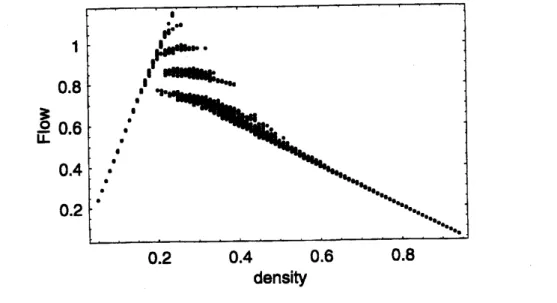
hybrid model. In Fig. 1,we
Figure 1:
Fundamental
diagramofthenew
Lagrange model. Parametersare
set to$V_{\max}=$$5$ and $S=2,$ and the spatial period is 100 sites. The initial
car
density is varied from0.05 to
0.95
in steps of0.01.
At each density,we
start calculations from 30 randomlygenerated initial
configurations, and show only the data at the time $t=100.$We
observegiven
1 metastabl
$\mathrm{e}$ branches in the detqrministiccase.
The fluctuations of the branchesshow the fact that theasymptotic flow of the systemsometimes becomes periodic
instead
of stationary between $0.2\leq\rho\leq 0.5.$
observeacomplex phase transition from
a
free tocongested statenear
the critical density0.2\sim 0.4. There are many metastable branches in the diagram, similar to
our
previousmodels i$\mathrm{n}$ Euler form $[19, 20]$
or
in other models with anticipation [21]. We also pointout that there is
a
wide scatteringarea near
the critical density in the observed data[22]which
may
berelated
to thesemetastable
branches. These branches mayaccount forsome
aspects of the scattering
area
observed empirically.59
branches we find phase separationinto a free-flow and a jamming region. In the former,
pairs
move
with velocity $v_{f}$ and aheadwayof$d_{f}$ emptycells between consecutive pairs. Inthejammed region, the velocityof thepairs is$v_{j}$ and the headway $d_{j}$
.
$N_{j}$ and $N_{f}$are
thenumbersof
cars
in the jammingcluster
and the free uniformflow, respectively. Weassume
$N_{f}$ and $N_{j}$ tobe even
so
that thereare$N_{f}/2$and $N_{j}/2$pairs, respectively. Then the totalnumber of
cars
$N$ is given by $N=N_{j}1N_{f}$ and the total length of the system becomes$\mathit{1}=(d_{j}+2)N_{j}/2+(d_{f}+ 2)$Nj/2. Since the average velocity is $\overline{v}=\{NfVf+NjVj)/N$
and density and flow of the system are given by $\rho=N\oint l$ and $Q=\rho\overline{v}$, we obtain the
flow-density relation
as
$Q=2 \frac{vf-v_{j}}{d_{f}-d_{j}}+(v_{j}-(d_{j}+2)\frac{v_{f}--v_{j}}{d_{f}d_{j}})\rho$
.
(8)It is shown that these branches are generally unstable to perturbations like braking[23].
4
The
ant-trail
model(ATM)
Theantscommunicatewith each other by droppingachemical (genericallycalledpheromone)
on the substrate as they crawl forward [24]. Although we cannot smell it, the trail
pheromone sticks to the substrate long enough for the other following sniffing ants to
pick up its smell and follow thetrail. Ant trails may
serve
different purposes (trunk trails,migratory routes) and may also be used in
a
different way by different species. Thereforeoneway trails
are
observedas
wellas
trails with counterflow of ants.In [25] we developed a particle-hopping model, formulated in terms of stochastic$\mathrm{C}\mathrm{A}$,
which may be interpreted
as a
model ofunidirectional flow in an ant-trail. Asin ref. [25],rather than addressing the question ofthe emergence of the ant-trail, we focus attention
here
on
the traffic ofantson
a trail which has already been formed.Herewe define the model which was originally introduced in ref.[25]. Each site of
our
one
imensional ant-trail model representsa
cell thatcan
accomodateat mostone
ant ata time (seeFig. 2). The lattice sites are labelled by theindex $i(i=1,2, \ldots, L);L$ being the
lengthofthe lattice. We associate two binary variables $S_{\dot{l}}$ and $\sigma$
:
with each site$i$where $S_{1}$.takes the value0
or
1dependingon
whether the cell is emptyor
occupied byan
ant.Simi-larly, $\sigma i=1$if the cell $i$contains pheromone; otherwise, $\mathrm{y}_{i}=0.$ Thus,
we
have two subsetsofdynamicalvariablesinthismodel, namely, $\{S(t)\}\equiv\{\mathrm{S}(\mathrm{t})\}S_{2}(t)$,$\ldots$,$S_{i}(t)$,$\ldots$,$S_{L}(t))$ and $\{\mathrm{S}(\mathrm{t})\}\equiv(\sigma_{1}(t), \sigma_{2}(t)$,$\ldots$,$\sigma:(t)$,$\ldots$,$\sigma$z(t)$)$
.
The instantaneous state (i.e., the configuration)of the system at any time is specified completely by theset $(\{5\}, \{\sigma\})$
.
which may be interpreted
as
amodel ofunidirectional flow in an ant-trail. Asin ref. [25],rather than addressing the question ofthe emergence of the ant-trail, we focus attention
here
on
the traffic ofantson
atrail which has already been formed.Herewe define the model which was originally introduced in ref.[25]. Each site of
our
one-dimensional ant-trail model represents
a
cell thatcan
accomodateat mostone
ant ata time (seeFig. 2). The lattice sites are labelled by theindex $i(i=1,2, \ldots,L);L$ being the
lengthofthe lattice. We associate two binary variables $S_{\dot{l}}$ and $\sigma$
:
with each site$i$where $S_{1}$.takes the value0
or
1dependingon
whether the cell is emptyor
occupied byan
ant.Simi-larly, $\sigma i=1$if the cell $i$contains pheromone; otherwise,$\sigma i=0$
.
Thus,we
have two subsetsofdynamicalvariablesinthismodel, namely, $\{S(t)\}\equiv(S_{1}(t),S_{2}(t),$ $\ldots$,$S_{i}(t)$,$\ldots,S_{L}(t))$and
$\{\sigma(t)\}\equiv(\sigma_{1}(t), \sigma_{2}(t)$,$\ldots$,$\sigma:(t)$,$\ldots$,$\sigma L(t))$
.
The instantaneous state ($\mathrm{i}.\mathrm{e}.,$ the configuration)
$\cap \mathrm{q}$ $\cap \mathrm{Q}$ $\cap \mathrm{q}$ $\mathrm{S}(\mathrm{t}$} ants $\sigma(\mathrm{t})$ pheromone $\mathrm{a}\mathrm{n}\alpha$ pheromone ants phmrnone $*\mathrm{m}\mathrm{I}\mathrm{w}\mathrm{n}\mathrm{e}$ $\mathrm{a}\mathrm{n}\mathrm{t}s\mathrm{P}^{\mathrm{h}\mathrm{m}\mathrm{t}\mathrm{n}\mathrm{o}\mathrm{n}\mathrm{e}}$
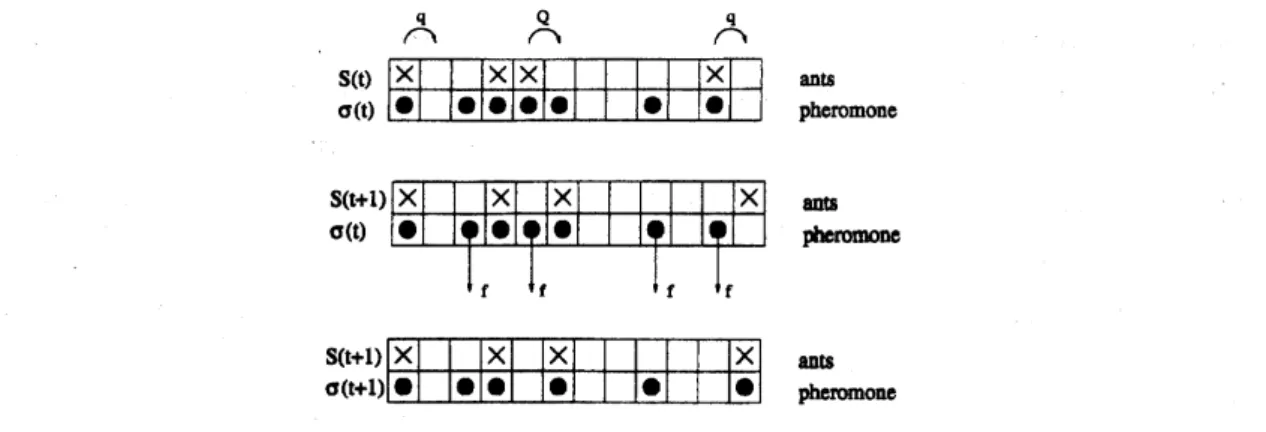
Figure 2: Schematic representation of typical configurations; it also illustrates the
up-date procedure. Top: Configuration at time $t$, i.e.
before
stage I of the update. Thenon-vanishing hopping probabilities of the ants
are
also shown explicitly. Middle:Config-uration
after
one possible realisation ofstage $I$.
Two ants have moved compared to thetop part of the figure. Also indicated arethe pheromonesthat may evaporatein stage $II$
of the update scheme. Bottom: Configuration
after
one
possible realization of stage $II$.
Twopheromones haveevaporated and
one
pheromonehas been created due to the motionof
an
ant.Since
a
unidirectional motion is assumed, ants do notmove
backward. Theirforward-hopping probability is higher if it smells pheromone ahead of it. The state of the system
is updated at each time step in two stages. In stage I ants
are
allowed tomove.
Here thesubset$\{S(t+1)\}$atthetime step$t+1$ isobtained using the full information$(\{S(t)\},$$\{\mathrm{v}(\mathrm{t})\}$
at time $t$
.
Stage II corresponds to the evaporation of pheromone. Here only the subset$\{\mathrm{v}(\mathrm{t})\}$isupdated
so
thatatthe end of stageIIthenew
configuration $(\{S(t+1)\}, \{\sigma(t+1)\})$ at time $t+1$ is obtained. In each stage the dynamical rulesare
applied in parallelto allants and pheromones, respectively.
Stage I.$\cdot$ Motion
of
antsAn ant in cell $i$ that has
an
empty cell in front ofit, i.e., Si(t) $=1$ and $S_{i+1}(t)=0,$ hopsforward with
probability $=\{$ $Q$ if $\sigma:+1(t)=1,$ (9)
$q$ $i$ $\sigma_{\dot{|}+1}(t)=0,$
where, to be consistent with real ant-trails, we
assume
$q<Q.$Stage $\mathrm{I}\mathrm{I}$
.
Evapo rationof
pheromonesAt each cell $i$occupied by
an
ant after stage Ia
pheromone will be created, i.e.,61
$\mathrm{g}$
$e_{2}\mathrm{o}\mathrm{e}5,\ovalbox{\tt\small REJECT}_{4}$
$\mathrm{D}\mathrm{e}\mathrm{n}\mathrm{a}[] \mathrm{y}$
(a)
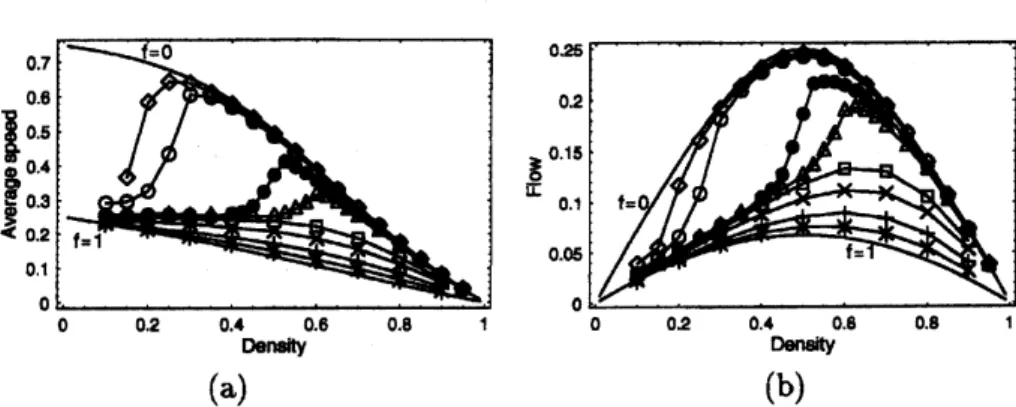
Figure 3: Theaverage speed (a),flux (b) of theants,extracted fromcomputersimulation
data,areplotted againsttheir densities fortheparameters$Q=0.75$,$q=$ 0.25. The discrete
data points correspondingto$f=$ 0.0005(0), 0.001(0),0.005(0), 0.01(A), 0.05(D), 0.10(x),
0.25(+),0.50(*) have beenobtained fromcomputersimulations; thelines connecting these
data points merelyserve as the guideto the eye. In (a) and (b), the
cases
$f=0$and $f=1$are
also displayed, which correspond to theNS
model with qeff $=Q$ and $\mathrm{g}$, respectively.On the other hand, any ‘free’ pheromone at asite $i$ not occupied by
an
ant will evaporatewith the probability $f$ per unit time, i.e., if$S\{(t+1)=0$,(Ti(t) $=1,$ then
$\sigma_{i}(t+1)=\{$ 0 with probability
$f$,
(11)
1 with probability $1$
-f.
Note that the dynamics conserves the number $N$ of ants, but not the number of
pheromones.
The rules
can
be written ina
compact formas
thecoupled equationsNote that the dynamics conserves the number $N$ of ants, but not the number of
pheromones.
The rules
can
be written ina
compact formas
thecoupled equations$S_{j}(t+1)$ $=$ $S_{j}(t)+ \min$($\eta_{j-1}(t)$,Sj $\{\mathrm{t}$), 1-Sj$( \mathrm{t})-\min$($\eta_{j}(t)$,Sj$\{\mathrm{t}$), $1-S_{j+1}(t)\phi 12)$
Sj$(\mathrm{t}+1)$ $=$ Sj$(\mathrm{t}+1),$$\min(\sigma_{j}(t),\xi_{j}(t)))$, (13)
where $\xi$ and 7
are
stochastic variables defined by $4_{\mathrm{i}}(t)$ $=0$ with the probability $f$ andSj(t) $=1$ with 1 –f, and Sj(t) $=1$ with the probability $p=q+(Q-q)\sigma_{j+1}(t)$ and
(Ti(t) $=0$ with l-p. This representation is useful for the development ofapproximation
schemes.
The flux $F$ and the average speed $V$ of
vehicles
are
related by the hydrodynamicrelation $F=$ pV. The density-dependence of the
average
speed inour
ATM is shownin Fig. $3(\mathrm{a})$
.
Over a range
of small values of $f$, it exhibits an anomalous behaviourin the
sense
that, unlikecommon
vehicular traffic, $V$ is nota
monotonically decreasingfunction of the density $\rho$
.
Insteada
relatively sharpcrossover
can be observed where thespeed increaseswith thedensity. A proper theory oftheATMshould reproduce the
non-monotonic variation of the average speed with density (shown in Fig. $3(\mathrm{a})$) and, hence,
5
Zero Range Process
It is known that the
zero
range
process(ZRP) isone
of the exactly solvable stochasticmodels. It is a process that the particle hopping probability is realted to the number of
gaps
in front. Thus it is closely related toour
ATM, since the hopping probability $u$ ofanant is given by
$u(x)=q+(Q-q)g(x)$ (14)
where we take $g(x)=(1-f)^{x/v}$, $x$ is the
gaps
and $v$ is themean
velocity of ants. Thusby usingthe ZRP, the
average
velocity $v$ ofants is calculated by$v= \sum_{x=1}^{L-M}u(x)p(x)$ (15)
where $L$ and $M$
are
the system size and the number of ants respectively (hence $M/L$ isthe density), and
$p(x)=h(x) \frac{Z(L-x-1,M-1)}{Z(L,M)}$
,
(16)where $Z$is the partition function and $h(x)$
can
be calculated as[27]$h(x)=\{$
1-u(l) for $x=0$
$\frac{1-u(1)}{1-u(x)}\prod_{y=1}^{x}\frac{1-u(y)}{u(y)}$ for $x>0$ (17)
The partition function $Z$ is obtained by the
recurrence
relation$Z$($L$Jf) $= \sum_{x=0}^{L-M}Z$(
$L-x-$
1Jf
-l)h(a), (18)with $Z(x, 1)=h(x$- 1$)$ and $Z$(x,$x$) $=$ h(x).
By using theseformulae,
we
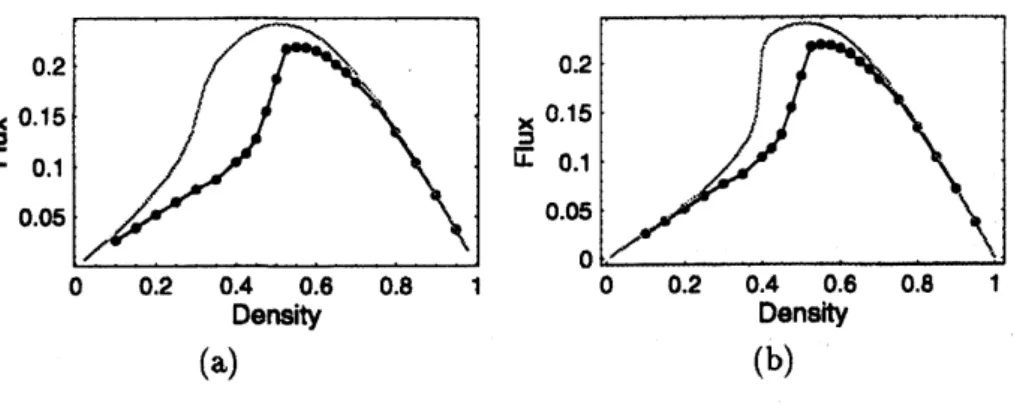
obtain the following fundamental diagram. We could setat most $L=200$ up to
now
because ofthe numerical precision restriction. Fundamentaldiagram of ATM is given by the figure 4. The blackcurvewith circlesis the numerical data,
and the simple black
curve
is the thereticalcurve
calculated by using ZRP. Systemsize is$L=100(\mathrm{F}\mathrm{i}\mathrm{g}.4(\mathrm{a}))$and $L=200(\mathrm{F}\mathrm{i}\mathrm{g}.4(\mathrm{b}))$
.
Parametersare
$Q=0.75$,$q=$0.75,$f=$0.001.
We
see
that the theoreticalcurve
approaches to the numericalone
ifwe
take lager $L$’s.6
Concluding discussions
In thispaper we have proposed a new hybrid model of traffic flow of Lagrange type which
B3
$\cup’.d$ $l^{f}$ $n\mathrm{r}\epsilon$ 0.1 0.05 0 0.2 0.4 0.6 0.8 1 0 $\mathrm{n}\mathrm{s}$.
(a) (b)Figure 4: Comparison ofthe results by using ZRP with simulations in the
case
of $(\mathrm{a})Z=$$100$ and $(\mathrm{b})Z=200.$
branches around the critical density in its fundamental diagram. The upper branches
are
unstable and will decrease its flow under perturbations. Moreover, we have shown anew
ant traffic model by taking into account the effect of pherornone. The fundamentaldiagramshowsunusual velocity-density relation, which is analyzed by using the
zero
rangeprocess.
References
[1] D. Helbing and H.J. Herrmann and M. Schreckenberg and D. E. Wolf $(\mathrm{e}\mathrm{d}\mathrm{s}.)$,“Traffic
and Granular Flow ’99”, (Springer, 2000, Berlin).
[2] D. Chowdhury, L. Santen and A. Schadschneider, Phys. Rep. 329 (2000) 199.
[3] D. Helbing, Rev. Mod. Phys., 73 (2001) 1067.
[4] S. Wolfram, Theory and applications
of
cellular automata, (World Scientific, 1986,Singapore).
[5] B. Chopard and M. Droz, Cellular Automata Modeling
of
Physical Systems,(Cam-bridge University Press, 1998).
[6]
S.
Bandini, R. Serra and F.S.
Liverani $(\mathrm{e}\mathrm{d}\mathrm{s}.)$, CellularAutomata: Research TowardsIndustry, (Springer, 1998).
[7] M. Fukui and Y. Ishibashi, J. Phys. Soc. $\mathrm{J}\mathrm{p}\mathrm{n}$
.
65 (1996) 1868.[8] K. Nagel and M. Schreckenberg, J. Phys. I France 2 (1992) 2221.
[10] T. Tokihiro, D. Takahashi, J. Matsukidaira, and J. Satsuma, Phys. Rev. Lett. 76
(1996) 3247.
11] T. Musya and H. Higuchi, J. Phys. Soc. Jpn. 17 (1978) 811.
12] K. Nishinari, J. Phys. A 34 (2001) 10727.
13] J. Matsukidaira and K. Nishinari, Phys. Rev. Lett. 90 (2003) 088701.
14] K. Nishinari and D. Takahashi, J. Phys. A 33 (2000)
7709.
15] M. Takayasu and H. Takayasu,Fractals 1 (1993)
860.
16] $\mathrm{S}.\mathrm{C}$
.
Benjamin and $\mathrm{N}.\mathrm{F}$.
Johnson, J. Phys. A 29 (1996) 3119.17] A. Schadschneider and M. Schreckenberg, Ann. Physik 6 (1997) 541.
11] T. Musya and H. Higuchi, J. Phys. Soc. $\mathrm{J}\mathrm{p}\mathrm{n}$
.
17 (1978) 811.12] K. Nishinari, J. Phys. A 34 $(2001\rangle 10727$
.
13] J. Matsukidaira and K. Nishinari, Phys. Rev. Lett. 90 (2003) 088701.
14] K. Nishinari and D. Takahashi, J. Phys. A 33 (2000)
7709.
15] M. Takayasu and H. Takayasu, Fractals 1 (1993)
860.
16] $\mathrm{S}.\mathrm{C}$
.
Benjamin and $\mathrm{N}.\mathrm{F}$.
Johnson, J. Phys. A 29 (1996) 3119.17] A. Schadschneider and M. Schreckenberg, Ann. Physik 6 (1997) 541.
18] R. Barlovic, L. Santen, A. Schadschneider, and M. Schreckenberg, Eur. Phys. J. 5
(1996) 793.
[19] K. Nishinari and D. Takahashi, J. Phys. A., 32 (1999)
93.
[19] K. Nishinari and D. Takahashi, J. Phys. A., 32 (1999)
93.
[20] M. Fukui, K. Nishinari and D. Takahashi and Y. Ishibashi, Physica $\mathrm{A}$, 303 (2002)
226.
[21] $\mathrm{M}.\mathrm{E}$
.
Larraga, $\mathrm{J}.\mathrm{A}$.
del Rio and A. Schadschneider, (2003) c0nd-mat/0306531.[22] K. Nishinari and M. Hayashi,
Traffic
statistics in Tomei express way, (TheMathe-matical Society ofTraffic Flow, 1999, Nagoya).
[23] K. Nishinari, M. Fukui and A. Schadschneider, to be published in J.Phys.A.
[24] $\mathrm{E}.\mathrm{O}$
.
Wilson, The insect societies (Belknap, Cambridge, USA, 1971); B. Holldoblerand $\mathrm{E}.\mathrm{O}$
.
Wilson, The ants (Belknap, Cambridge, USA, 1990).[25] D. Chowdhury, V. Guttal, K. Nishinari and A. Schadschneider, J. Phys. $\mathrm{A}:\mathrm{M}\mathrm{a}\mathrm{t}\mathrm{h}$
.
Gen. 35, L573 (2002).
[26] Nishinari, K., D. Chowdhury and A. Schadschneider, Phys. Rev. $\mathrm{E}67$, p.036120
(2003).
[27] M. R. Evans, J. Phys. $\mathrm{A}$:Math. Gen. 30, p.5669 (1997).
[25] D. Chowdhury, V. Guttal, K. Nishinari and A. Schadschneider, J. Phys. $\mathrm{A}:\mathrm{M}\mathrm{a}\mathrm{t}\mathrm{h}$
.
Gen. 35, $\mathrm{L}573(2002)$
.
[26] Nishinari, K., D. Chowdhury and A. Schadschneider, Phys. Rev. $\mathrm{E}67$, p.036120
(2003).