ポータルの試験実装とメタデータ仕様
麻生和彦
行木孝夫
KAZUHIKO ASOU
TAKAO
NAMIKI
東京大学
北海道大学
THE
UNIVERSITY
OF
TOKYO
HOKKAIDO UNIVERSITY
Abstract
Worid
Digital
Mathematics Library に関連する情報を報告し、 数学会および各教室の紀要
等に関する情報を統合したボータルサイトの構築に関する考察を行い、 Hokkaido Mathematical
Journal
の電子化に関して述べる。
WDML
に関しては麻生が執筆し、 それ以外を行木が作成
した。
1
WDML
に関する報告
2005
年
4
月
15
日
(
金
)
9:00
から
17
日
(
日
)
12:00
にかけて
MSRI
で
WDML
に関するワーク
ショップが開催された。
本節はその報告である。
1.1
概要
正式名称は
”
$\mathrm{D}\mathrm{i}_{\Leftarrow\}}\sigma \mathrm{i}\mathrm{t}\mathrm{i}\mathrm{z}\mathrm{i}\mathrm{n}\mathrm{g}$Older
Mathematical
Journals”
であり、
開催場所は
Mathematical
Sci-ences
Research
Institute
(Berkeley, USA)
である
. 主催者は
Philippe
Tondeur(
イリノイ大学
.
元
NSF
メンバー
),
David
Eisenbud(MSRI),
John
Ewing(AMS)
となっている。
参加総数
38
名、
年齢は
50
歳前後でほぼ全員がそれぞれの所属での担当責任者であった。
国別に
みるとアメリカ、 イギリス、 ドイツ、
フランス、
日本他であり、 アジアからは麻生と行木である。
所属別には大学
(
$\mathrm{M}\mathrm{S}\mathrm{R}\mathrm{I},\mathrm{U}\mathrm{C}\mathrm{B}$,
Cornell,
Cambridge, 北大嫁
.
)
、研究所
$(\mathrm{M}\mathrm{S}\mathrm{R}\mathrm{I})_{\text{、}}$団体
(AM
$\mathrm{S}$
, EMS,
JMS, LMS, CMS, SIAM,
$\cdots)_{\text{、}}$出版社
(Springer, Euclid,
$\cdots$)
となり、
専門別には数学者、 司書、
出版社、 経済学者などであった。
12
ワークショップの様子
会議の進行は、
通常の講演形式でなくセッションごとに話題提供者がテーマに関するトピックス
や問題点を提案しその後、 ほとんどの時間を全員で議論する形式であった。
内容は、
WDML
プ
ロジェクトをどう実現していくか、
問題点をどう解決していくかなど具体的な議論が中心。
参加者
は、
既に何度か同じメンバーで会議を行っているようで初めての参加者は少なかった
(日本以外い
なかった)
。
13
WDML
プロジェクトとは
World Digital Mathematics
Library
の略称であり、
デジタイズに限らず
web of literature
を目
指している。
各大学
/
研究機関で行われている電子ジャーナルのオンライン公開プロジェクトを統
一運用化を目指すものである。
具体的な目標は、過去に発行された紙媒体のすべてのジャーナルに対しスキャナーを使って電子化
を行いオンライン上で公開し、
公開されたジャーナルに含まれるそれぞれの論文ごとにメタデータ
(
書誌情報
) を作成すること、作成されたメタデータをオンライン上で自動収集できるようにし、収集
されたメタデータを元にして数学分野の代表的なレビュー雑誌
Mathematical
Reviews(MathSciNet
$)$や
Zentralblatt
Math
から論文を参照でき、
さらにリファレンスからも参照できるようにするこ
とである。
これを実現するには各プロジェクトによって微妙に違うメタデータを標準化する必要があり、ベー
スとなるのは、
Dublin
Core
の
Metadata
Initial
‘
$\mathrm{s}$element set
であろう。 メタデータの交換方式
は、
OAI-PMH
を採用する。 分類
(classffication)
は
MathSciNet
の分類
(MSC)
を利用し、 国際的
に利用可能にするためには文字コードに
Unicode
を採用する必要がある。
オープンでフリーなア
クセス環境を提供することが理想だが、
アクセスにかかるコスト負担は問題である。
進行中のプロジェクトはフランスの
NUM DAM
$($WDML
の試験実装
$\mathrm{m}\mathrm{i}\mathrm{n}\mathrm{i}- \mathrm{D}\mathrm{M}\mathrm{L})_{\text{、}}$ドイツでは
Ernani(中国、韓国 KISTI
が参加済)
アメリカでは
EUCILID
などである。
14
ポータル
ユーザに活用してもらうために電子化されたジャーナルのリンクを集約したサイトが必要であ
る。
MathSciNet,
Zentralblatt Math
が
DML
のポータルサイトであり、 オンラインで公開されて
いるジャーナルに対してすべてリンクを作成する。 ジャーナルがオンライン公開された後、
ポータ
ルサイトに反映するまでの時間は重要である。
Scholar との違いは何かといえば、
分類が
あるかどうかである。
15
権利関係
出版社の権利、
著者の権利の明確化が必要だが,
どこのプロジェクトも困っている。 過去の文献
に対する権利の扱い、
国ごとの
copyright
の違いなど、 個別対応になる。
出版社の利益を守るため
には公開までの期間を設定 (moving wall)
したほうがよい。
ポータルサイトの役目として権利所有
リストの保守もある。
16
日本ではどうするか
ジャーナルの電子化は、 現在の研究遂行のためだけでなく、
未来の研究者や社会への説明責任の
ために必要なものである。
日本の数学界の数年後を考えると早急にジャーナルの電子化
$\dot{\text{を}}$進める必
要がある。
電子化と
OAI-PMH
対応を独自で行う例は、
北大の 「数学の海」 プロジェクトでの
HMJ
にあ
る。
電子化したジャーナルに関して日本独自のポータルサイト jpDML(
仮称
)
を立ち上げることも
必要。
日本でのジャーナル電子化をコーディネイトするのはどこか。
日本数学会か数学コンソーシ
アムか。
数学者だけではマンパワーの問題で不可能な時期が来ると思われるので、 NII
のリポジトリ事業、
JST
の
$\mathrm{J}$-STAGE
との連携を考えるべきであろう。
次回の
WDML
ワークショップには、
図書館側
の立場からも参加を要請するべきである。
2
ポータルの構築
数学会は欧文誌
(
紀要
),
「数学」
,
「数学通信」 など、
多様な形態の定期刊行物を発行し、
各数
学教室においても紀要、 講究録、
公開講座の資料など多くの出版物を持つ。
通常の流通経路を除き、 従来はその一部が
web
ページとして公開され、 サーチエンジンやリンク
等を経由して利用されていると考えられる。問題は、 これらの二三コンテンツ各々について
WDML
をはじめとするポータルに組み込む手段と手続きであろう。
本稿では、
ポータルとしてこれらを統合する技術の一部を紹介し、
WDML
への前段階となるで
あろう国内でのポータル構築に関して考察する。
21
基礎技術
出版物の電子化は論文等の単位によって
等のファイルに収め、
HTM
IL
によって
web
から
公開するものという認識が一般的であろう。 実際、 いくつかの紀要はこのように公開されている。
つまり、
$\mathrm{T}\mathrm{C}\mathrm{P}/\mathrm{I}\mathrm{P}$上の
HTTP
アクセスによる公開を基礎とすることになる。
このような基礎の上に何を構築すればその価値を向上させられるだろうか。 一つのアイデアは何
らかのリンク集を作成し、
その上に
等を用いた簡易検索サービスを構築することであろう。
場合によってはリンク先サイトと協力してデザイン等を統一するなどの共同作業も可能である。
多
くのポータルサイトはこのように作成されている。
しかしながら、
このような人力に頼ったポータルの維持はそこに参加するサイトが増えるほど困
難になる。
加えて、
ポータルを作成した後からは多くのアイデアが出るものである。 特に分野を特定しない
電子化された刊行物から特定の分野の論文や記事を取り出して再構成したいなどの発想は誰でも抱
くものであろう。
このような発想に対応しようと思えばその作業は膨大なものになる。
このような作業こそ計算機
に任せるべきである。 幸い、 同様の問題は
web
一般においても重要視されており、 多くの技術が
提案され、 実装され、 普及している。
Wiki, blog
などの隆盛はその一部であろう。
誤解を恐れずに述べることにすれば、 電子図書館に関連して有効な技術が存在する。
各地に散在
する書誌情報
(メタデータ)
を同時にアクセスすることで検索を一元的に実行するプロトコル
Z3950
は早くから実装されてきた。 現在では
Open
Archives
Initiative (OAI)
が提唱するメタデータ交換
プロトコル
(OAJ-PM
$\mathrm{I}\mathrm{H}$,
RFC2119)
の実装が増え、 いくつかのコンテンツ管理システムはこれをサ
ポートしている。
EPrints,
DSpace
などはその代表である。
22
保存
ポータルを支えるものは利用者には見えない保存に関する機能である。
入力
,
保存と維持にかか
るコストに応じ、
JSTAGE
や
EUCLID
など既存のジャーナルプラットフォームを利用するか、
機
関リポジトリ等を利用するか、 独自に行うかという選択になる。 技術的な蓄積を重視するなら後者
を選択し、
即効性を期待するなら前者である。
機関リポジトリはこれから成長するプラットホーム
であろうから、
中間的な性格を持つ。第一候補は既に実績のある
EUCLID
や
JSTAGE
である。第
二候補として千葉大や北大に例を見る機関リポジトリが続く。
独自の電子化はリスクが高い。
理由を以下に述べる。
ハードウエア、
$\mathrm{O}\mathrm{S}$, web
サーバの維持を
含むシステム管理、 更新やチェックを含む web
コンテンツ管理、 入力に関わる教育、
OCR
作業な
どを考えればコンテンツ管理システム (CMS)
は必須となる。
Web
ページの設計についてさえも
HTML
を書けてディレクトリ構造を維持できるような支援員の確保は至難になりつつある現在、
これらの業務をこなす人材を確保することは難しい。
ただし、
独自の電子化をあきらめた場合には時代の変化へ追従することも不可能になる。
ここは
組織としての政策判断が必要であろう。
将来的に何が必要になるか不明であるならば、 WDML
の仕様変化への対応も考慮し、 内部で
維持するメタデータは可能なかぎり詳細にする必要がある。
内部メタデータを適切に管理できる
CMS
はリポジトリ構築ツールであり、
DSpace,
GNU EPrints
等は紀要や予稿の保存には最適な
CMS
といえる。
WDML
に必要な
OAI-PMH
対応は結果としてついてくる。
23
公開
ポ
–
調
)
として利用者側に必要な機能は、
各紀要ごと分野ごとの一覧
検索、 新着通知、
$\mathrm{M}\mathrm{R}$へ
のリンク
(
リファレンス、
本文)
などであろう。
これらは公開に関する機能と考えられる。
主な対象読者は研究者だが、 公開した瞬間に研究者だけが読むとは限らない。
従って、
読者階層
別に分ける機能も必要である。
総合報告などはそれだけを横断的に取り出すなど、
公開手段としては可能な限り体系的に公開し
たい。
しかしながらカテゴリー分けは労力が大きいので、 これを人手で解決しようとすれば問題が
あろうし、
現在の新理論も後世では教育資料になるかもしれない。
現実的な解決法として、
当面は
MSC
の後二桁で対応する。
MSC
は後二桁の
00
から
06
の範囲
は全分野共通になっており、
階層化を可能にしている。
数論の例を挙げておく。
$11-\mathrm{x}\mathrm{x}$
Number theory
::8
巽
nens
terrualct
rl8nfaeI0n00owsQltrklosn
11-02
Research
exposition
+
‘
81
$\S_{\mathrm{x}\mathrm{p}}^{\mathrm{i}\mathrm{s}}\sigma_{1\mathrm{C}1\mathrm{t}\mathrm{m}\mathrm{a}\mathrm{c}\mathrm{h}\mathrm{i}\mathrm{n}\mathrm{e}}^{q\mathrm{r}\mathrm{i}\mathrm{c}\mathrm{a}1}$computation
and
programs
11-06Proceedings, conferences, collections,
etc.
llAxx Elementary number theory
llCxx
Polynomials
and matrices
llDxx
Diophantine equations
llExx
Forms
and linear
algebraic
groups
llFxx
Discontinuous
groups
and
automorphic
forms
llGxx
Arithmetic
algebraic geometry (Diophantine
geometry)
llHxx Geometry of numbers
llJxx
Diophantine approximation, transcendental number
theory
llKxx
Probabilzstic
theory: distribution modulo
$1$;
metrxc theory of algorithms
llLxx Exponential
sums
and
character
sums
llMxx
Zeta and
$L$-functions
:
analytic theory
llNxx
Multiplicative
number
theory
llPxx Additive
number
theory;
partitxons
llRxx
Algebraic
number
theory: global
$\mathrm{f}$ields
llSxx
Algebraic number theory
:
local and
$P$-adic
$\mathrm{f}$ields
llTxx
Finite
$\mathrm{f}$ields and
commutative
rings
(number-theoretic
aspects)
llUxx
Connections
with
logic
llYxx
Computational
number
theory
llZ05
Miscellaneous
applications
of number
theory
従って、 後二桁に
00
から
06
までの値を含む
MSC を指定したコンテンツは公開時に別扱いする
という処理も可能である。通常の新着順などの表示とは別に、 想定する利用者として高校生から研
究者、
評価機関までを想定した処理が考えられよう。
公開講座、
サーベイ、
新着論文、 教材
(OCW)
などによる分類も有効であると思われる。
24
実装へ向けて
これらの実装に当たってはメタデータの収集による実現を考えよう。
当面は
OAI-PM
$\mathrm{I}\mathrm{H}$による
メタデータ収集が現実的である。 メタデータ形式は
oai-dc
に準拠し、
内部構造は
Euclid
に従えば
比較的簡単に実現できる。
内部メタデータについては
EPrints
なり
DSpace
なりの内部メタデー
タに従えば最低限の内容は確保できる。
独自に電子化する場合は実質的に保存サーバが公開サーバを兼ね、
開発ツール、
web
ページ等を
ミラーすることになるであろう。
EUCLID
および独自電子化を行った
Hokkaido
Mathematical Journal
から
$\mathit{1}\backslash$一ベストしたメタ
データを用い、
簡単なポータルの実装をした
web
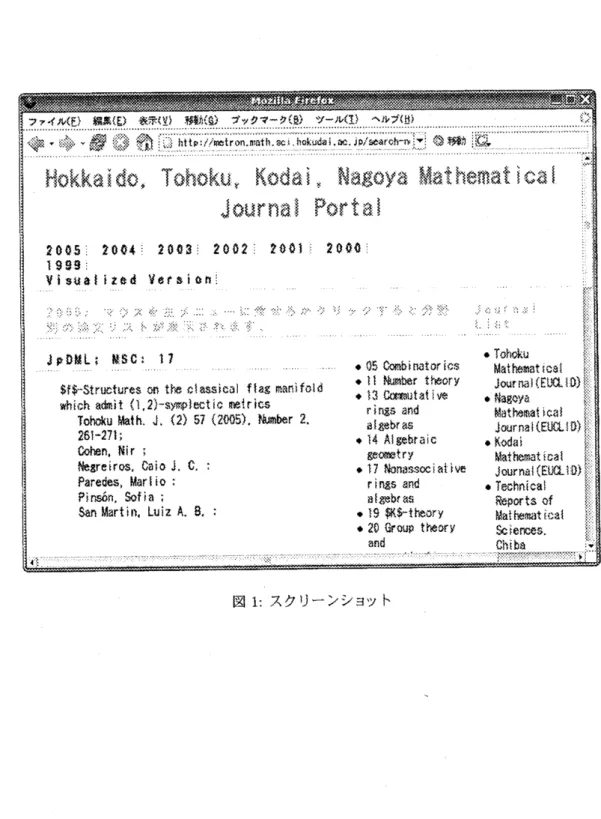
ページを図
1
に示す。
最も右側に各ジャーナルへのリンク情報を示している。
上部には発行年による統合インデックスへのリンクを置き、
$\mathrm{J}\mathrm{a}\mathrm{v}\mathrm{a}\mathrm{S}\mathrm{c}1^{\urcorner}\mathrm{i}\mathrm{p}\mathrm{t}$によってクリックは不要
なインターフェースとしている。
発行年を指定すれば
MSC
インデックスによって分類が表示され
る。
それぞれのリンクによって論文のリストを表示する。
分野を特定しないジャーナルを集約し、
再構成することで比較的扱いやすいインターフェースに
なっていると思われる。
25
メタデータの例
251
メタデータの仕様
Project
EUCLID–OAI DC
Project
Euclid
は数学関連ジャーナルのポータルとしてコーネル大学にて運営されている。
OAI-PMH
によって提供するメタデータは下記のような仕様であり、
subject
は
MSC
と自由キーワード
title:
The
distribution
of
general
$\mathrm{f}$inal
state
random
variables
for
stochastic epidemiC
models
creator:
Ball,
Frank
creator:
0’Neill,
Philip
subject:
$92\mathrm{D}30$
(MSC2000)
subject:
$60\mathrm{K}99$
(MSC2000)
subj
$\mathrm{e}\mathrm{c}\mathrm{t}$:
Epidemic
sub
$\mathrm{b}\mathrm{j}\mathrm{e}\mathrm{c}\mathrm{t}$:
final size
subject:
$\mathrm{f}$inal
severity
subject: Gontcharoff polynomial
publisher: Applied
Probability Trust
date:
1999-06
(Issued)
type: text
format:
applicationlpdf
ident if
$\mathrm{i}\mathrm{e}\mathrm{r}$:
http
$://\mathrm{P}\mathrm{r}\mathrm{o}\mathrm{j}\mathrm{e}\mathrm{c}\mathrm{t}\mathrm{E}\mathrm{u}\mathrm{c}\mathrm{l}$
id
.
$\mathrm{o}\mathrm{r}\mathrm{g}/\mathrm{g}\mathrm{e}\mathrm{t}\mathrm{R}\mathrm{e}\mathrm{c}\mathrm{o}\mathrm{r}\mathrm{d}?\mathrm{i}\mathrm{d}=\mathrm{e}\mathrm{u}\mathrm{c}\mathrm{l}$id
.
$\mathrm{j}\mathrm{a}\mathrm{p}/$1029349824
ident
if
$\mathrm{i}\mathrm{e}\mathrm{r}$:
euclid
.
$\mathrm{j}\mathrm{a}\mathrm{p}/$1029349824
identif
$\mathrm{i}\mathrm{e}\mathrm{r}$: Citation:
J.
Appl.
Probab.
36
(1999),
no.
2,
473-491
language:
en
rights: Copyright 1999 Applied
Probability Trust
description: In
this
paper
we
introduce
the
notion
of
general
$\mathrm{f}$inal
state
random variables
for
generalized epidemic
models. These random
variables
are
$\mathrm{d}\mathrm{e}\mathrm{f}$ined
as sums over
all
ultimately
infected
individuals
of
randOm
quantities
of interest associated with
an
individual;
examples
include final
severity.
By
exploiting a
construction
originally
due to
Sellke
(1983)
, exact
results
concerning
the final
size
and
general
final
state
random
variables
are
obtained in terms of Gontcharoff
polynomials,
In
particular, our
approach highlights the
way
in
which these
polynomials
arise via
simple
probabilistic
arguments. For
ease
of
exposition
we
focus
initially
upon
the
single-population case
$\mathrm{b}\mathrm{e}\mathrm{f}$ore
extending
our
arguments
to
multi-population
epidemics
and
other
variants of
our
basic model.
252
メタデータの仕様千葉大学リポジトリー
OAI-DC
機関リポジトリの例として千葉大学附属図書館から例を採った。
subject
は
NDC(
日本十進分類
)
と自由キーワードであり、 日本語著者名を追っている点に注目するべきである。
identifier
には
title: Dualities
$\mathrm{f}$or
the
Domany-Kinzel model
creator:
Katori,
Makoto
creator:
Konno,
Norio
creator
:
Sudbury,
Aidan
creator:
Tanemura, Hideki
creator: 香取
,
眞理
type: 雑誌掲載論文
type:
研究成果 r 論文
identif
$\mathrm{i}\mathrm{e}\mathrm{r}$:
http:
$//\mathrm{m}\mathrm{i}\mathrm{t}\mathrm{i}\mathrm{z}\mathrm{a}\mathrm{n}\mathrm{e}.11$. chiba-u.
$\mathrm{j}\mathrm{p}/\mathrm{m}\mathrm{e}\mathrm{t}\mathrm{a}\mathrm{d}\mathrm{b}/\mathrm{u}\mathrm{p}/\mathrm{C}0000050988/\mathrm{M}\mathrm{R}2054582$.
dvi
identifier:
BibliographicCitation
:
info
:
of
$\mathrm{i}/$fmt
:
kev :
mtx
:
ctx
:
Journal of
Theoretical
Probability Vo1.17
no.1
page.
$13\mathrm{I}-144$
(2004)
language :
eng
relation:
hasVersion
:
http
$://\mathrm{d}\mathrm{x}$.
doi
.
$\mathrm{o}\mathrm{r}\mathrm{g}/10$.
$1023/\mathrm{B}$
:
JOTP
.
0000020478
.
24536
.
26
3
Hokkaido Mathematical Journal
の電子化
Hokkaido
Mathematical Journal
は
1972
年から
Journal of Faculty of Science, Hokkaido
Uni-versity,
Ser.
1
の後続誌として刊行されている。
これの電子化を独自に行うに当たり次の点に留意した。
.
登録作業等の軽減
これを実現するためにコンテンツ管理には
EPrints 23
を利用した。
OAI-PMH
によるメタデー
タハーベスティングは実装されており、 多少の調整を施すだけでよい。
結果として、
web
ページ等の作成はトップページ、 共通スタイルファイル等を作成しておくだけ
で済み、
特に技術的知識を要求せずに論文の登録をできるようになっている。
交換先とは
IP
アドレスにより公開する。 販売先とは代理店を経由して
IP
アドレスを取得する。
IP
アドレスの管理は簡単ではない。 特にクラス
$\mathrm{C}$数十個で登録する場合はミスが生じやすく、
今
後の問題である。
新規に発行する
34
巻以降については著者から著作権委譲の確認をとり、
33
巻以前についてはま
ず告示で対応する予定である。
最新巻から
3
年より古い巻に関しては
Open
Access
とすることに
なっている。
内部メタデータについては
EPrints
の内部形式を用い、 以下のように設計した。
$<\mathrm{e}\mathrm{p}\mathrm{r}\mathrm{i}\mathrm{n}\mathrm{t}\mathrm{s}\mathrm{d}\mathrm{a}\mathrm{t}\mathrm{a}>$ $<\mathrm{r}\mathrm{e}\mathrm{c}\mathrm{o}\mathrm{r}\mathrm{d}>$$<\mathrm{f}$
ield
name
$=’ \mathrm{d}|\mathrm{a}\mathrm{t}\mathrm{e}\mathrm{s}\mathrm{t}\mathrm{a}\mathrm{m}\mathrm{p}^{11}>2005-05-16</\mathrm{f}\mathrm{i}\mathrm{e}\mathrm{l}\mathrm{d}>$$<\mathrm{f}$
ield
name
$=\mathrm{t}\prime\prime \mathrm{y}\mathrm{p}\mathrm{e}’’>\mathrm{a}\mathrm{r}\mathrm{t}\mathrm{i}\mathrm{c}\mathrm{l}\mathrm{e}</\mathrm{f}\mathrm{i}\mathrm{e}\mathrm{l}\mathrm{d}>$ $<\mathrm{f}$ield
name
$=|\prime \mathrm{c}\mathrm{r}\mathrm{e}\mathrm{a}\mathrm{t}\mathrm{o}\mathrm{r}\mathrm{s}’’$ $\mathrm{i}\mathrm{d}=’>\prime 1|$$<\mathrm{p}\mathrm{a}\mathrm{r}\mathrm{t}$
name
$=\prime\prime$given
$>\mathrm{R}\mathrm{i}\mathrm{k}\mathrm{i}\mathrm{o}</\mathrm{p}\mathrm{a}\mathrm{r}\mathrm{t}><\mathrm{p}\mathrm{a}\mathrm{r}\mathrm{t}$
name
$=\mathrm{f}\prime\prime \mathrm{a}\mathrm{m}\mathrm{i}1\mathrm{y}^{11}>\mathrm{Y}\mathrm{o}\mathrm{n}\mathrm{e}\mathrm{d}\mathrm{a}</\mathrm{p}\mathrm{a}\mathrm{r}\mathrm{t}>$ $</\mathrm{f}\mathrm{i}\mathrm{e}\mathrm{l}\mathrm{d}>$$<\mathrm{f}\mathrm{i}\mathrm{e}\mathrm{l}\mathrm{d}$
name
$=^{\mathfrak{l}1}\mathrm{t}\mathrm{i}\mathrm{t}1\mathrm{e}’’>\mathrm{M}\mathrm{u}\mathrm{l}\mathrm{t}\mathrm{i}\mathrm{p}\mathrm{l}$ication
operators, integration
operatOrS and
companion operators on weighted
Bloch
$\mathrm{s}\mathrm{p}\mathrm{a}\mathrm{c}\mathrm{e}</\mathrm{f}\mathrm{i}\mathrm{e}\mathrm{l}\mathrm{d}>$$<\mathrm{f}\mathrm{i}\mathrm{e}\mathrm{l}\mathrm{d}$
name
$=\mathrm{i}\prime \mathrm{I}\mathrm{s}\mathrm{p}\mathrm{u}\mathrm{b}1\mathrm{i}\mathrm{s}\mathrm{h}\mathrm{e}\mathrm{d}’’>\mathrm{p}\mathrm{u}\mathrm{b}</\mathrm{f}\mathrm{i}\mathrm{e}\mathrm{l}\mathrm{d}>$$<\mathrm{f}$
ield
name
$=\mathrm{s}\mathrm{u}\mathrm{b}\prime\prime \mathrm{j}\mathrm{e}\mathrm{c}\mathrm{t}\mathrm{s}^{l1}>30\mathrm{D}55(\mathrm{I}^{\mathrm{I}}\mathrm{I}\mathrm{S}\mathrm{C}2000)</\mathrm{f}\mathrm{i}\mathrm{e}\mathrm{l}\mathrm{d}>$ $<\mathrm{f}$ield
$\mathrm{n}\mathrm{a}\mathrm{m}\mathrm{e}=^{1\prime}$subject
s
$>\mathrm{Q}\mathrm{A}</\mathrm{f}\mathrm{i}\mathrm{e}\mathrm{l}\mathrm{d}>$$<\mathrm{f}$
ield
$\mathrm{n}\mathrm{a}\mathrm{m}\mathrm{e}=\mathrm{f}\prime\prime \mathrm{u}11_{-}\mathrm{t}\mathrm{e}\mathrm{x}\mathrm{t}_{-}\mathrm{s}\mathrm{t}\mathrm{a}\mathrm{t}\mathrm{u}\epsilon^{1\mathrm{t}}></\mathrm{f}\mathrm{i}\mathrm{e}\mathrm{l}\mathrm{d}>$ $<\mathrm{f}$ield
name
$=$
k
$\prime \mathfrak{s}$
eywords
$>\mathrm{B}\mathrm{l}\mathrm{o}\mathrm{c}\mathrm{h}\mathrm{s}\mathrm{p}\mathrm{a}\mathrm{c}\mathrm{e}_{2}$boundedness c,ompactness.
$</\mathrm{f}\mathrm{i}\mathrm{e}\mathrm{l}\mathrm{d}>$ $<\mathrm{f}$
ield
$\mathrm{n}\mathrm{a}\mathrm{m}\mathrm{e}=\mathrm{a}\mathrm{b}’\{\mathrm{s}\mathrm{t}\mathrm{r}\mathrm{a}\mathrm{c}\mathrm{t}^{1\prime}></\mathrm{f}\mathrm{i}\mathrm{e}\mathrm{l}\mathrm{d}>$$<\mathrm{f}$
ield
$\mathrm{n}\mathrm{a}\mathrm{m}\mathrm{e}=\mathrm{d}\prime 1\mathrm{a}\mathrm{t}\mathrm{e}_{-}\mathrm{s}\mathrm{u}\mathrm{b}^{1\prime}>2003-01-07</\mathrm{f}\mathrm{i}\mathrm{e}\mathrm{l}\mathrm{d}\succ$$<\mathrm{f}$
ield
$\mathrm{n}\mathrm{a}\mathrm{m}\mathrm{e}=|\mathrm{d}\prime \mathrm{a}\mathrm{t}\mathrm{e}_{-}$issu
e
$’>2005-02-00</\mathrm{f}\mathrm{i}\mathrm{e}\mathrm{l}\mathrm{d}>$
$<\mathrm{f}$ield
$\mathrm{n}\mathrm{a}\mathrm{m}\mathrm{e}=^{\mathrm{I}\prime}\mathrm{d}\mathrm{a}\mathrm{t}\mathrm{e}_{-}\mathrm{e}\mathrm{f}\mathrm{f}\mathrm{e}\mathrm{c}\mathrm{t}\mathrm{i}\mathrm{v}\mathrm{e}’’>2005-02-00</\mathrm{f}\mathrm{i}\mathrm{e}\mathrm{l}\mathrm{d}>$ $<\mathrm{f}\mathrm{i}\mathrm{e}\mathrm{l}\mathrm{d}$name
$=$
”
$\mathrm{p}\mathrm{u}\mathrm{b}\mathrm{l}\mathrm{i}$cat io
n
$>\mathrm{H}\mathrm{o}\mathrm{k}\mathrm{k}\mathrm{a}\mathrm{i}\mathrm{d}\mathrm{o}\mathrm{M}\mathrm{a}\mathrm{t}\mathrm{h}\mathrm{e}\mathrm{m}\mathrm{a}\mathrm{t}\mathrm{i}\mathrm{c}\mathrm{a}\mathrm{l}\mathrm{J}\mathrm{o}\mathrm{u}\mathrm{r}\mathrm{n}\mathrm{a}\mathrm{l}</\mathrm{f}\mathrm{i}\mathrm{e}\mathrm{l}\mathrm{d}>$ $<\mathrm{f}$
ield
$\mathrm{n}\mathrm{a}\mathrm{m}\mathrm{e}--(\prime \mathrm{v}\mathrm{o}1\mathrm{u}\mathrm{m}\mathrm{e}’’>34</\mathrm{f}\mathrm{i}\mathrm{e}\mathrm{l}\mathrm{d}>$$<\mathrm{f}$
ield
$\mathrm{n}\mathrm{a}\mathrm{m}\mathrm{e}--|\prime \mathrm{n}\mathrm{u}\mathrm{m}\mathrm{b}\mathrm{e}\mathrm{r}’’>1</\mathrm{f}\mathrm{i}\mathrm{e}\mathrm{l}\mathrm{d}>$$<\mathrm{f}$
ield
name
$=^{\mathfrak{l}\prime}\mathrm{p}\mathrm{u}\mathrm{b}1\mathrm{i}$sher
$\prime\prime>\mathrm{D}\mathrm{e}\mathrm{p}\mathrm{a}\mathrm{r}\mathrm{t}\iota \mathrm{n}\mathrm{e}\mathrm{n}\mathrm{t}$of Mathematics,
Faculty
of
Science,
Hokkaido
University; Sapporo,
$\mathrm{J}\mathrm{a}\mathrm{p}\mathrm{a}\mathrm{n}</\mathrm{f}\mathrm{i}\mathrm{e}\mathrm{l}\mathrm{d}>$ $<\mathrm{f}\mathrm{i}\mathrm{e}\mathrm{l}\mathrm{d}$ $\mathrm{n}\mathrm{a}\mathrm{m}\mathrm{e}=\mathrm{p}\mathrm{a}\mathrm{g}\mathrm{e}\mathrm{r}\mathrm{a}\mathrm{n}\mathrm{g}\mathrm{e}^{\prime 1}>\prime\prime 135-147</\mathrm{f}\mathrm{i}\mathrm{e}\mathrm{l}\mathrm{d}>$$<\mathrm{f}$
ield
$\mathrm{n}\mathrm{a}\mathrm{m}\mathrm{e}=\mathrm{p}\mathrm{a}\mathrm{g}\mathrm{e}\mathrm{s}^{\prime \mathrm{l}}>[]’</\mathrm{f}\mathrm{i}\mathrm{e}\mathrm{l}\mathrm{d}>$ $<\mathrm{f}$ield
$\mathrm{n}\mathrm{a}\mathrm{m}\mathrm{e}=\mathrm{r}\mathrm{e}\mathrm{f}\prime\prime \mathrm{e}\mathrm{r}\mathrm{e}\mathrm{e}\mathrm{d}^{prime}>\mathrm{T}\mathrm{R}\mathrm{U}\mathrm{E}</\mathrm{f}\mathrm{i}\mathrm{e}\mathrm{l}\mathrm{d}>$ $<\mathrm{f}$ield
$\mathrm{n}\mathrm{a}\mathrm{m}\mathrm{e}=$i
$\prime\prime$
ssn
$’>\{0385-4035</\mathrm{f}\mathrm{i}\mathrm{e}\mathrm{l}\mathrm{d}>$
$<\mathrm{f}$
ield
$\mathrm{n}\mathrm{a}\mathrm{m}\mathrm{e}=^{l1}\mathrm{f}$ileinf
o
$>$
pdf ;http:
$//\mathrm{h}\mathrm{m}\mathrm{j}$.
math
.
sci,
hokudai.
$\mathrm{a}\mathrm{c}.\mathrm{j}\mathrm{p}/\mathrm{s}\mathrm{e}\mathrm{c}\mathrm{u}\mathrm{r}\mathrm{e}/00000015/01/302.$
$</\mathrm{f}\mathrm{i}\mathrm{e}\mathrm{l}\mathrm{d}>$
$<\mathrm{f}$
ield
$\mathrm{n}\mathrm{a}\mathrm{m}\mathrm{e}=$”
$\mathrm{r}\mathrm{e}\mathrm{f}\mathrm{e}\mathrm{r}\mathrm{e}\mathrm{n}\mathrm{c}\mathrm{e}\mathrm{t}\mathrm{e}\mathrm{x}\mathrm{t}"></\mathrm{f}\mathrm{i}\mathrm{e}\mathrm{l}\mathrm{d}>$ $</\mathrm{r}\mathrm{e}\mathrm{c}\mathrm{o}\mathrm{r}\mathrm{d}>$ $</\mathrm{e}\mathrm{p}\mathrm{r}\mathrm{i}\mathrm{n}\mathrm{t}\mathrm{s}\mathrm{d}\mathrm{a}\mathrm{t}\mathrm{a}>$この内部形式を
OALDC
へ変換し、
メタデータハーベスティングへ対応する。
4
おわりに
世界的な電子化関連の動向に追随することは容易ではないが、必要であることも事実である。
日々
提唱される新技術から本質を見極めて対応しなければならない。
参考文献
[1]
数理解析研究所講究録
1446
電子情報交換に関する最近の話題
[2]
Stephen Pinfield,
Mike
Gardner
and
John
MacColl,
Setting
up
an
insfitutional
$\mathrm{e}$-pnnt
archive,
Ariadne.
Issue
31,
March-April, 2002,
(
邦訳
:
http:
$//\mathrm{w}\mathrm{w}\mathrm{w}.$ni
$\mathrm{i}.\mathrm{a}\mathrm{c}.\mathrm{j}\mathrm{p}/\mathrm{m}\mathrm{e}\mathrm{t}\mathrm{a}\mathrm{d}\mathrm{a}\mathrm{t}\mathrm{a}/\mathrm{o}\mathrm{a}\mathrm{i}-\mathrm{p}\mathrm{m}\mathrm{h}/\mathrm{e}\mathrm{p}\mathrm{r}\mathrm{i}\mathrm{n}\mathrm{t}\mathrm{s}/$