Abstract: Three activities aimed at kindergarten/lower elementary school students are presented. The unifying intention is to create opportunities to successfully use the English learned, and to provide open ended chances to develop creativity and express themselves in English. この三つの英語アクティビティは幼稚園・小学校低学年齢で試みたものである。基本的な教育 方針は子供たちが教わった英語をすぐに使えて、成功できる機会を与える。そしてこのアクティ ビティによって、創造性を養い、自分の言いたいことを自由に表現できるきかいをあたえること である。
Introduction
Being from Canada, I had to learn French when I was in school, starting from grade 4 or so. As far as I remember, my teachers were reasonably skilled, and wonderful people to be sure, (and they did their best with the caliber of student that I was) but I never progressed very much. One reason was that I couldn’t see anywhere to use the French language. I also thought I was not good at learning languages, but here I am in Japan, and
Use It or Lose It
Giving children a chance to use their English in the
kindergarten classroom
教室で、教わった英語をすぐに使う機会を与える
Michael Brinkman
マイケル ブリンクマン
in fact I can now speak more than enough to get around easily. My first job here in Japan provided me with some language training, but what really motivated me was when the proprietor of a small shop on the way to the language school where I worked tried to talk with me in Japanese, and I could actually figure out what she was saying! I could use my (ten words of) Japanese! I never thought of it until I was writing this paper, but perhaps that experience was something that deeply influences how I teach.
In this paper I would like to share a few activities that have worked very well for me in the kindergarten classroom. What sets them apart from many other activities is that they are providing children with a chance to use English in a very free way, to attain goals that they themselves have set, or express something they themselves feel. This emotional involvement is crucial for remembering and retaining the language,1
and helps motivate the students as well. Additionally, the sense of accomplishment attained by the successful use of the language provides a positive memory to help maintain interest and motivation in the future.
The first activity is very simple, and works with even three year old children. The second could be a part of a routine. It’s very open-ended, and ties into people’s natural reactions. The third activity is quite complex, but by preparing for it in steps which have their own games and activities, is quite manageable. It too is very open ended, and gives the children a chance to exercise their creativity and problem solving abilities as well.
1. Please and Thank you
One of the most basic yet useful sentence patterns is ~please/Thank you. I often introduce this very early in the 3&4 year old class (nensho), but depending on the class, around the middle of the school year might be more appropriate. The way I introduce it is as follows: After a ‘good morning’ greeting/warmup, I suddenly start a little skit (ikinari geki/sudden skit, see appendix 1 below) that I have
prearranged with the homeroom teacher. I notice that the homeroom teacher is holding a couple pieces of plastic cake or some sort of attractive food. I rub my stomach and say ‘hungry’ to the kids as I look at the cake. Then I shyly
Preparation necessary: Muscle training! A pair of plastic cakes or other attractive food. ―66―
approach the teacher and hold out my hand and say ‘cake’. She, of course, doesn’t give it to me. I try a little louder. She still doesn’t give it to me. I look puzzled and look at the kids and say, ‘I know, I’ll get angry!’, and demonstrate angry with body language to the kids, and then angrily ask the teacher one more time, ‘cake!’, while stomping my feet and having a little tantrum. The teacher reacts in shock, pulling back with her cake in hand. (The students are generally quite amused to see a forty year old guy with a beard acting like a two-year-old). I look disappointed, and ask the children what I should do. Someone might say, “chodai”, or “kudasai” or something. Then I have an ‘aha’ moment, and ask the teacher one more time, in a nice voice, “cake, please.” She smiles and gives me a piece. I take it and go away and pretend to eat it. Then I look back at the teacher, who is looking shocked and sad. I am startled and ask “what’s wrong?” to the children. Someone may suggest, “arigatou”. I have another ‘aha’ moment and go back and say ‘thank you’, and the homeroom teacher looks happy again.
Then we repeat the skit briefly and see if the students can pick out how to say please and thank you. Some children might try to say ‘cake please’ . In that case, give it to them and wait for them to say thank you. Otherwise, pretend to offer it to someone and cup your hand around your ear, to help them get the idea. Otherwise the homeroom teacher can drop some hints for the children. Fool around with a few pieces of cake and let a few children succeed with it, and then ask for a volunteer. Have them say ‘Up please’, and then lift the child up as high as you can, even bumping their head gently on the ceiling. Make sure to lift the child so the other children can see his/her face for maximum fun. It may be more natural to say ‘lift me up please’, but it is important to keep it as simple as possible for small children.
Have them line up or if they are in a circle, work your way around the circle. For larger classes, you could split into doing the girls one week, and the boys next week. If a child is too shy or scared of heights, they can have a handshake or something else less threatening. If someone forgets, rather than you or the homeroom teacher helping right away, have the other students help. It’s a good idea to take the focus off the student who forgot by asking everyone to help, and suddenly it’s everyone’s problem, not just the one child’s. It is interesting to see that often a child who helps other children forgets when
it is his/her turn! I tell the class that if they ask me during play time, I’ll do it again for anyone who asks. Some classes develop a custom after the goodbye song, to line up and ask me to lift them up at the end of every class. (This provides a great exercise opportunity for the teacher as well!) For teachers who are not sure their Japanese language skills are able to communicate the ideas to the Japanese homeroom teacher, there is an English/Japanese outline of the skit in Appendix 1, and in Appendix 2, there are some general phrases/ suggestions, also in Japanese and English, for helping to explain the idea of the children helping each other as much as possible. Of particular note is the one about ‘I’ll trust your judgment’. I would just like to remember that the homeroom teachers are trained for that job, and know what their students can do, and know what their students need to succeed. It is essential to work with them and learn from them. I hope I can empower the people I work with, and am indebted to their experience, ideas and energy, and of course classroom management skills!
Variations: To make it more open ended/provide a choice, after they master “up, please,” provide a choice of lifting or a washing machine simulation (“wash me please” -pick up the child and turn back and forth a few half turns, and then it’s the spin cycle!) Or, pretend to drop them if they don’t say, “up please, be careful”. After they are familiar with the basic version, and you have introduced ‘big’ and ‘little’, you might ask them if they want a ‘big up please’ or a ‘little up please’, and see if they substitute any other words they might learn at a later time.
2. “Reaction Pictures”
Have you ever wished you could find a use in class for those goofy pictures of cats and whatnot that you find on the internet when you are fooling around? Well, you are in luck. Here’s what to do. I use this in middle and senior kindergarten classes to great effect, but have also used it a few times in higher level classes. Basically, you need to find a variety of pictures that will amaze, gross out, delight, or amuse your students. Aim to have an assortment to elicit different reactions from the students. I have pictures of dogs with glasses (cute), zooms of monkey faces with lipstick (funny), a strange and horrible bug crawling on a man’s face2
(scary/disgusting), a
beautiful sunset, a space shuttle taking off (cool/amazing), a snake (scary), a casual family photo3
(boring, until I ask how many people there are and when they tell me, I say, no, there is one more! Then they notice the face of the man that everyone is sitting on peering out from under the family, and say ‘scary’). Of course the reactions of the students are their natural reactions, there is no wrong answer. If there is a new reaction that they want to express, I teach them the word and try to find another picture that might elicit the same reaction.
I generally do this during the last five minutes of class, or in the middle before a game and after reviewing some earlier material. I try to spend some time on this activity every week. The first time I will show a picture of something funny or cute, and when they quiet down, I’ll ask ‘cute?’, and have them repeat. Then maybe something funny but not cute, and ask ‘cute?’ and they say no, so I say ‘not cute. Funny?’ If they don’t understand I’ll point at the picture and pretend to laugh and say ‘funny’ Then perhaps I’ll show a picture of a cobra or threatening snake, and ask ‘cute’, if anyone says ‘cute’, I’ll be a little surprised but say ‘OK’ and smile and accept their idea. I’ll try another child and they might say ‘no’, so I’ll say ‘scary’ and point at the snake and look scared. Hopefully someone will pick it up and repeat. Then I’ll get everyone to repeat it. A few more pictures along those lines and
Preparation:
Surf the net for interesting pictures.
Print them off, or use a screen. Search Google images
for “funny cats”, “scary spider on face”,
scary family photo” etc. (could use video
if you have the resources to
show them.)
lots of kids shouting out their reaction, and then I’ll start to put everything away. A student might ask for one more (guide them towards using English for that too), and I might show another one (or two if they ask really nicely).
During the picture time in next week’s class, I’ll re-use a few pictures to review the words, and show a few more along the same lines, and then some new types aiming to get different responses, e. g. beautiful or disgusting. Sometime during the first or second week, I’ll ask individual students, ‘cute?’ about a scary scene or something, and if they disagree I’ll teach them ‘not cute’. You could also work on ‘a little cute’, or ‘very funny’ etc.
To reiterate, there are no wrong answers, and they are of course allowed to string them together i. e. cute and scary, or whatever they think of doing. Some students (usually boys of course) delight in saying ‘boring’ about a few pictures just for the fun of it, but don’t worry, it helps them and everyone else remember that word too! (and they soon tire of that game).
There is a list of English and Japanese words commonly used in appendix 3. You can also use interesting pictures for review of other questions, eg. “Do you like ~~”, “Can you do this?” etc.
Again, with well chosen pictures, the children are naturally drawn to express themselves, and the high level of interest aids retention.
3. Shape Pictures
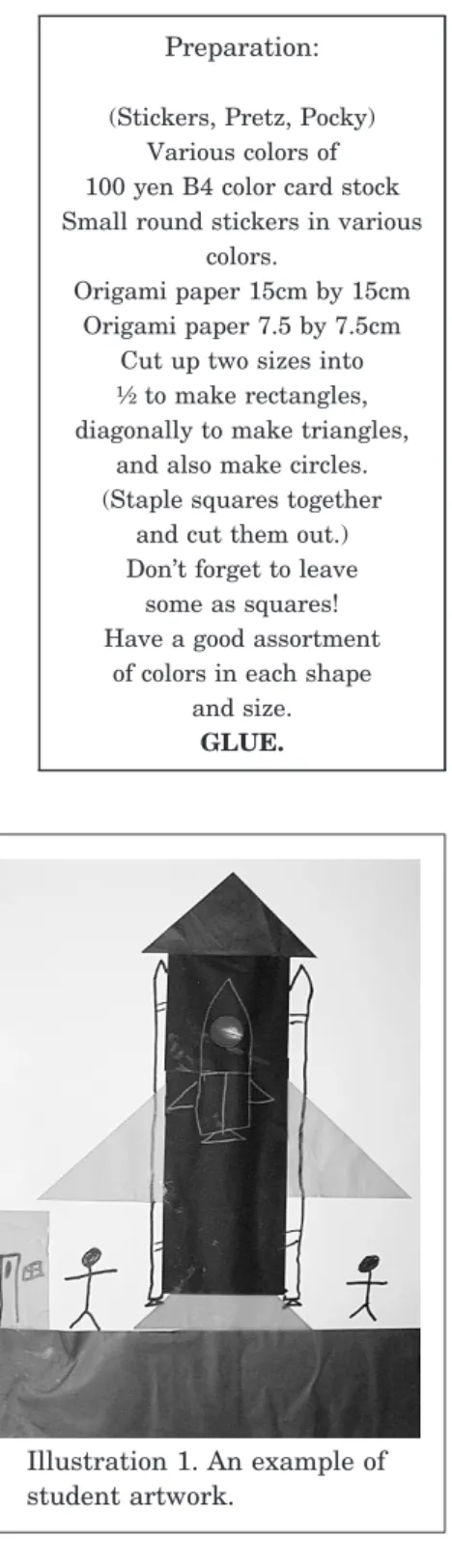
For the final activity of this paper I would like to introduce a series of lessons, culminating in a simple and very open ended craft. In this series of lessons/ activities, the children will work towards asking for shapes of different shapes and colors in English to produce their own original picture.
It was inspired by a little boy in one of the classes I helped out with, many years ago. The other kids in the class had been taking English for a number of years, but he had only recently joined, so he was disadvantaged for the competitive activities. The activity/ game for the month was listening for a color and shape and racing against a member of the other team to pick one up out of a circle on the floor. He never won. He always tried his best, but his eyes showed that he didn’t enjoy losing all the time.
This project practices the same target, but rather than being competitive, it allows children to develop their creativity. When the projects are done, the children can enjoy looking at each other’s ideas, and the pictures can be used as flashcards to teach what the children have made. Sometimes the rowdier boy come up with the most interesting pictures, and it is a good chance to channel some of their energy into the class. It is also good for classes with a wide range of abilities, as each student can be engaged with English at their level. The lessons along the way can be taught by one person and are suitable for any size of class,
Preparation:
(Stickers, Pretz, Pocky) Various colors of 100 yen B4 color card stock Small round stickers in various
colors.
Origami paper 15cm by 15cm Origami paper 7.5 by 7.5cm
Cut up two sizes into ½ to make rectangles, diagonally to make triangles,
and also make circles. (Staple squares together
and cut them out.) Don’t forget to leave
some as squares! Have a good assortment
of colors in each shape and size.
GLUE.
Illustration 1. An example of student artwork.
but you may need some assistance for the final craft/project. I have done it with just myself and the homeroom teacher in classes up to 18, but a third person wouldn’t hurt even at that size. I often time it for completion on senior kindergarten or language school parental open house days (usually in the second half of the year), and ask some parents to participate in distributing the shapes that the children request. At senior kindergarten level, this process should be given at least four weeks/classes, if some of the English used has already been taught. I often use part of class for eight weeks to prepare. It is important that the children are comfortable with the required English so that they can use it freely. I also use it with older children, who might already know some of the required English, and therefore it can be completed more quickly.
There are two necessary elements for the project: the English for asking for something, and the English for the shape, color and size. First I will discuss the English for asking for something, with the shape-teaching ideas following below.
3.1. Teaching How to Ask For Something
There are a number of phrases you can use to ask for something in English. “I want. . . “ or for advanced classes, “I’d like . . . are useful, but I usually use “May I have”, because I have a lot of little activities for “may I . . .”. Usually I have introduced “May I try” using some sort of attractive toy/game (such as a yo-yo/bunjee ball or crocodile dentist game) introduced in class and available for perusal after the lesson, if they ask me in English of course). I may have also introduced “May I go”, as the magic keyword necessary to get outside to play (A child can’t go outside past my arm at the door unless he/she asks, “May I go?”). I often introduce “May I have” with a candy or treat (or a sticker if you would like to avoid food), which they can ask me for in English after they are finished their lunch. For the sake of providing choice, and because different kids like different things, I usually have two kinds of treat; Pocky and Pretz are good selections. (sweet and not so sweet). If there are kids with wheat or other allergies, you need to provide some other preapproved treat.
If you can’t be there after lunch, entrust the treats/stickers to the homeroom teacher. This is a good way to increase the children’s exposure to English without taking more of
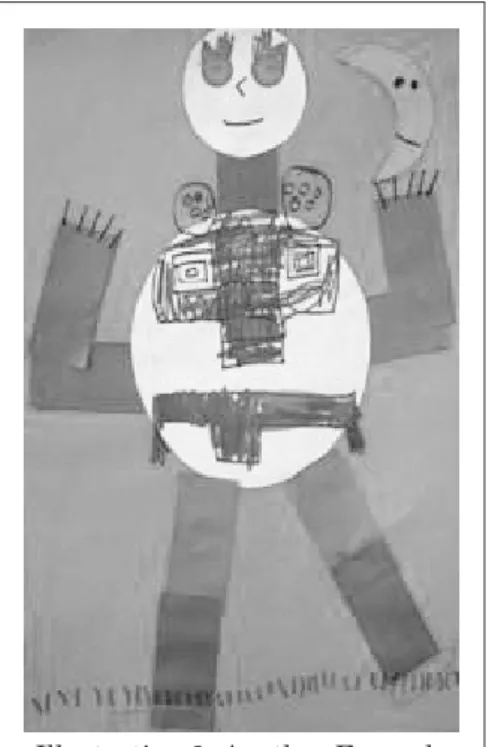
Illustration 2. Another Example of Student Work.
your time or increasing the school’s expenses.
Depending on the time available, the “May I . . . “ sequence is a good chance to let kids try to figure out how to manipulate the language by themselves. If they know, for example, “May I try?” and “May I play?”, and also they know “touch”, sometimes if you show a toy or object that invites children to touch it, (such as fake food commonly seen at restaurant windows in Japan, or a book (I often use Matthew Van Fleet’s Fuzzy Yellow Ducklings) a few kids can figure out how to make “May I touch?”. You could elicit (I usually use Japanese here) “May I play?”, “May I try?”, and “touch”, so they have all the pieces handy. If no kids can come up with it, then the teacher can say it of course, but it is preferable that the kids help each other, and learn from each other, if the teacher can facilitate it.
Another opportunity to use “May I ~?” can be provided by using 3D books, either those requiring the colored 3D glasses, or the books with lenses built into the cover. There are many titles that appeal to boys especially. Of course only one student can look through the glasses at a time, so they have to take turns, using “May I look?”.
Shape Chant with Actions
circle circle oval, Spin around with arms outstretched, then make an oval shape with your arms.
rectangle rectangle square, Hold your arms up straight, with your fingers bent, forming a kind of tall narrow rectangle, jumping twice with the words, then crouch down with your elbows bent, making a rough square.
triangle triangle diamond, Make a triangle shape with your arm bent, hand on your head, one side then the other, then a diamond.
heart heart star! Bend your arms and hands to make a sort of heart, with your fingers touching each other on the top of your head, finally jump into the air while shouting ‘star’, with your arms and legs out straight, in the form of a star.4
3.2. Teaching the Names of Shapes
Shapes are not in the high frequency usage group, but four basic shapes (square, circle, triangle and rectangle) are necessary for this project. There is a useful chant about shapes on the internet, reproduced below with the actions. There are more shapes than we need, but it is such a fun activity that the children understand and remember all eight of them quite easily.
The original author also suggested trying to fake out the kids for the last word, and chanting it faster and slower. I often ask the kids if they want to do it fast, and usually someone does, so we get very fast. Of course the kids can’t chant that fast, but it’s fun. When we end up with a repetition at slow or normal speed, they are very focused.
We’ll also have a shape hunt at some point. I will call out, “Who can find a (triangle)?”, and perhaps start by pointing out a few around the room excitedly, while exclaiming ‘triangle!’. Once the students get the idea, they will try to show me or the homeroom teacher their discoveries, all the while repeating ‘triangle’ (If some are using Japanese, repeat back to them with excitement the English word.) It may be a good idea to break that up into two weeks depending on your classes’ attention span.
If time permits, another activity to reinforce shapes is to have them get into groups of 5 to 10 and give them a string tied in a loop, and have them all hold it and make shapes that you call out. It is interesting to see which children take up leadership of the group to get the job done.
Also, the children need to know sizes (big and small) and colors, review as necessary.
3.3. Doing the Project
Once the children know shapes, sizes, and colors, and the target phrase, they can do the project. (See the list of materials in the preparation box in section 3.0). Paper is of course obvious, but don’t forget glue. Glue sticks work well, or putting a daub of glue on a card of milk box from a big bottle of paste glue works well too.) To start out with, the children have to select a paper base
Illustration 3. Notice how they made the star and crescent moon by overlapping shapes. (photograph by author)
(100yen store B4 card stock works well) in the color of their choice (a good chance to use the target phrase). The homeroom teacher and I operate ‘shape-stores’, and the children line up to ask for the shapes of their choice. At first, it is a bit congested, but once everyone has been through the line once, the children don’t have to wait as long. If a child is taking too long to choose when it is his/her turn, I ask the next child in line, and come back to the slow child. Sometimes seeing another person do it provides the necessary hint for them to do it themselves. And of course, not all children are at the same level, so if they can’t say the sentence, I coach them to say what they can, or for very unsure children, accept pointing and I say what they have selected. They will need to come through the line numerous times, to get the shapes they need for their project, so hopefully by the end of the project, they are more fluent. And, the excitement of having used English to complete a project that they were in control of will hopefully be a good memory, and the project may provide a visual reminder of their successful use of English.5
I usually show a few example of what can be done, but not for very long. I hope that they can think of their own ideas. Additionally, there are many opportunities for problem solving. For example, sometimes children want to use scissors to make a shape. I usually don’t allow scissors, because there are other ways to get more shapes, such as folding, ripping, and (most cleverly) overlapping. (for example, to get a crescent moon, mostly cover a yellow circle by a circle of the same color as the background). Additionally, it is up to you to decide if you want to allow markers or other writing instruments to finish up.
Conclusion
The three activities detailed here have proven to be engaging and interesting in a wide variety of situations, including after school English classes and regular kindergarten classes of various sizes, and even elementary school students enjoy the second and third activities. I hope that these ideas are useful in and of themselves, but more than that, I hope they serve as examples of some ways to provide meaningful situations to use English in the classroom/school, and inspire you to develop your own.
Appendix 1. Please and Thank You “Ikinari Geki” Outline in English and
Japanese「いきなり劇」の概要と和英訳
I would like to do a simple skit with you. 一緒に簡単な劇をやってみましょう。
The purpose is to have the children
guess the meaning of the English (くだ さい・お願いします・頂戴 と ありがとう, and try to catch the English words used (please/thank you).
目的は子供達が英語の言葉(Please/Thank you)の意味を自分で推測させることです。 英語の言葉を聞き取ってみましょう。
Let’s ham it up! 大げさな演技をしましょう!
Please hold onto these things. これを持っていて下さい。
Don’t give them to me unless I say ‘please’. When I pretend to get angry, pretend to be scared.
‘Please’ を言わない限り、私に渡さないで
ください。私が怒っているふりをしたら、 怖がってください。
At this time, the children might make some suggestions about what to say. If so, please praise them.
この時、子供たちがいうべき言葉を提案す るかもしれません。言いましたら、ほめて ください。
When I say ‘please’, give one to me, but when I forget to say ‘thank you’, look disappointedly at me until I realize I forgot something.
私が ‘Please’ といいましたら、一つを私に ください。でも ‘Thank you’ と言わなか ったら、何かを忘れていることに気付くま で悲しそうに私を見つめてください。
Hopefully the children will make some suggestions again.
この時、うまくいけば子供たちがまた、い うべき言葉を提案するかもしれません。
When I say ‘thank you’ we can all look happy.
‘Thank you’ を言いましたら、嬉しそうな 顔をしてください。
That’s all! 以上です。
Appendix 2. Other Useful Phrases
Try to let the children guess the meaning. 子供たちに意味を推測させてみてください。
If a child can’t say it when it is his turn, encourage the other children to help.
自分の番の時に言えない子供がいたらなら、 ほかの子供たちにを手伝うように促してく ださい。
Wait to see if the other children can help. ほかの子供たちが手伝うのを少し待ってく ださい。
I’ll trust your judgement. あなたの判断能力を信頼します。
Offer hints before giving the answer. 答えの前に、まずヒントをあげてください。
Today is the girls’ turn. Next time is the boys’ turn.
今日は女の子の番。次回は男の子の番。
Appendix 3. Table of Common Responses/Adjectives for Activity 2
Cool! かっこいい・おもしろい・すごい! Beautiful. 美しい。 Cute. かわいい。 Scary. こわい。 Funny! 可笑しい!笑っちゃう! Strange. 変、あやしい。 Interesting. おもしろい。 Disgusting. 気持ち悪い。 Boring. つまらない。 Very scary. とっても怖い。 A little cute. 少しかわいい。 Not funny. 可笑しくない。 ―78―
1
Paul, David. Teaching English to Children in Asia. Hong Kong: Pearson Longman Asia ELT, 2003 Print. P.20.
2
Listverse staff. “10 Creatures That Crawled Out of Your Nightmares.” listverse. com N.p., 17 January 2010. Web. 4 December 2014. (or do a Google Image search for “camel spiders on face”, or “solifugae on face”.
3
Swank, Todd. “Scary Family Photo.” Swankboys. com N.p. 11 October 2009. Web. 4 Dec 2014.
4
Horne, Kim. “Ideas for Kindergarten.” ETJ-Activities. groups.yahoo.com 26 October 2007. N.p., Web. 4 Dec 2014.
5 Murphey, Tim. Teaching in Pursuit of Wow! Tokyo: ABAX ELT Publishers, 2012. Print. P.38.
Works Consulted
Horne, Kim. “Ideas for Kindergarten.” ETJ-Activities. groups. yahoo. com 26 October 2007. N.p., Web. 4 Dec 2014.
Listverse staff. “10 Creatures That Crawled Out of Your Nightmares.” listverse. com N.p., 17 January 2010. Web. 4 December 2014.
Murphey, Tim. Teaching in Pursuit of Wow! Tokyo: ABAX ELT Publishers, 2012. Print. Paul, David. Songs and Games for Children. Oxford: Macmillan Heinemann English Language Teaching, 1998. Print
Paul, David. Teaching English to Children in Asia. Hong Kong: Pearson Longman Asia ELT, 2003. Print.
Reilly, Vanessa, and Sheila M. Ward. Very Young Learners. Oxford: Oxford University Press, 2003. Print.
Swank, Todd. “Scary Family Photo.” Swankboys. com N.p. 11 October 2009. Web. 4 Dec 2014.
Van Fleet, Matthew. Fuzzy Yellow Ducklings. New York: Dial Books, 1995