教育実習生の英語絵本に関す る知識 と対話型読み聞かせ能力 におけ る洞察力
Insight into Student Teachers' Knowledge of English Picture Books
and Their Ability to Do Interactive Shared Reading
Wendy Tada*
This study aimed to better understand Japanese student teachers' knowledge and beliefs about English picture books, and to identify beliefs about their abilities that may influence their use of English picture books and interactive shared reading techniques in their English classrooms in the future. For this study, 86 1st year undergraduate students attending a national uni versity for teacher education completed a survey in 2017, and participants from one class also subm itted a j ournal after attending a course focusing on picture books, foreign authors, shared reading methods and phonics. The survey results showed that most participants consider picture books to be a good teaching resource, even though most participants had little knowledge about picture books written in English before commencing their university studies. Furthermore, the majority of participants were concerned about their pronunciation ski lls, reading aloud ability and their abi lity to speak English in front of a class, which are all likely to lead to di fficulties in including picture books in their future English classrooms.
Key words: student teacher education, picture books, interactive shared reading, English education
1. Intr oduction
In 2017, the new Course of Study subject guidelines for elementary school education (M EXT, 2017a) were released with adj ustments to f orelgn anguage cflvzfzes and the addition of Foreign Language Classes. For new student teachers, this means there is a growing expectation they will need to improve their English language skills and learn how to teach English as a formal subject to students in the upper levels of elementary school. Amongst the changes, there is also an increasingly positive view towards picture books and shared reading. According to the new Elementary School Foreign Language Activities Foreign Language Training Guidebook (MEXT, 2017b), shared reading is an effective activity for listening development. To support this view, the MEXT website provides a link to a pdf (MEXT, 2016a), recommending original picture books from Hi Friends Story Books (MEXT, 2016b) as supplementary materials for middle grade elementary school students. Since the use of picture books for teaching elementary school students is now recommended in the new Course of Study (M EXT, 2017a), understanding and developing student teachers' k nowledge, interest and abilities will be necessary to effectively add picture books to English lessons.
* 兵庫教育大学大学院教科教育実践開発専攻言語系教育 コ ース 講師
1.1 W hat are picture books?
Picture books are recognized as one aspect of children's literature and according to Barber Bader:
A picture book is text, illustrations, total design; an item of manufacture and a commercial product; a social, cultural, historic document; and foremost, an experience for a [reader]. As an art form it hinges on the interdependence of illustrations and words, on the simultaneous display of two facing pages, and on the drama of the turning page (Bader, 1976, p. 1).
They are also unique as a teaching resource because picture books provide authentic language, a wide range of themes, and their illustrations provide visual scaffolding which promotes interest and enables both first and second language learners to confirm or expand their understanding of the text.
1.2 W hat is inter active shared reading and what are the benefits of using it?
Over several decades, shared reading of picture books has received a great deal of attention in early childhood education. However, two shared reading methods are commonly confused, which are tnteractlve shared readzng
and the more recent term dialogic reading. According to Trivette & Dunst (2007) znteractive shared reading “involves an adult reading a book to a child or a small group of children and using a variety of techniques to engage the children in the text” (p 2). Whereas, the term dzafogzc readzng that was first published in the 1980 's (Whitehurst et al., 1988), encourages questioning during the shared reading practice and concludes by encouraging the child/children to retell the story. Dialogic reading is strongly associated with the application of two scaffolding techniques known as PEER sequence and CROWD prompts that can be applied with either shared reading method. For Japanese elementary school classes dialogic reading may be too challenging, but interactive shared reading using the PEER sequence and CROWD prompts is a good way for student teachers to try interactive shared reading. Thus, teachers can greatly benefit from remembering the CROWD prompts which include: completion questions, recall questions, open-ended questions, wh~ questions and distancing prompts and PEER sequence which stands for Prompt, Evaluate, Expand, and Repeat (WWC, 2007). I f student teachers can learn to use the PEER sequence and CROWD prompts, they will have an effective method to use picture books in their classroom s.
However, up until now EFL teachers have often been reluctant to use picture books in their classrooms since most research on interactive shared reading and dialogic reading has focused on parents and children or young learners in a first language setting. Some of the main findings include:
●
Young children experienced significant improvements to expressive vocabulary and produced significantly longer utterances.
(Whitehurst, et al l 988).
●
Young children's phonological awareness, understanding of print concepts and comprehension improved (Swanson et al., 2011).
●
Dale et l l. (1996) discovered that pre-schoolers with somewhat advanced sk ills improved their grammatical competence with dialogic reading activities. On the other hand, less advanced pre- schoolers experienced a growth in their expressive vocabulary.
●
The degree of explicit vocabulary instruction during various types of reading aloud instruction influences gains in vocabulary (Swanson et al., 2011).
In addition to research in L1 settings, there is also evidence suggesting students who loam English as a second language can benefit from interactive shared reading of picture books. The main benefits for second language learners who experience an interactive shared reading method with picture books include:
●
Improvements to their L2 vocabulary (Hatae, 2013).
●
Incidental learning of L2 vocabulary (Hatae, 2013).
●
Improved phonological awareness (Chow, et l l.,
2010).
●
Higher proficiency students learned more words than lower proficiency students (Lin, 2014).
Regarding the studies by Hatae (2013) and Lin (2014), the same book was read four times with di fferent scaffolding techniques which suggests multiple exposures to the same book may be a key factor for second language learners.
Overall, teachers can provide scaffolding during interactive shared reading which can work on narrowing the gap between their students' current level and their potential level of understanding which is the basis of Vygotsky's theory called the Zone of Proximal Development (1978). Thus, picture books are an ideal resource for the support of language development.
1.3 The I nfluence of Student Teachers' Cognitions Over the past 20 years, teacher cognition research has focused on understanding teachers' beliefs and knowledge about teaching, and how these beliefs and knowledge develop, and how they are revealed in teaching practice (Borg, 2015). Student teachers are required to gain both formal subject knowledge and practical knowledge to teach successfully. According to Borg (2011), teacher cognition includes “constructs such as attitudes, identities and emotions” that are an unobservable dimension of teaching” (p i t ) and these are “defined and refined on the basis of educational and professional experiences” (2015, p. 35). M ost studies on teacher cognition have tended to focus on grammar or the four language skills (Baker and M urphy, 2011), However, the development of courses for preparing elementary school English teachers can be improved by understanding students' evaluation of their own abilities, in addition to their beliefs and atti tudes about content introduced in teacher training courses. The purpose of this study is to better understand Japanese student teachers' knowledge and beliefs about English picture books, and to
identify beliefs about their abilities that may influence whether or not they use English picture books and interactive shared reading techniques in their English classrooms in the future. By looking at these factors, the researcher hopes that new ways of preparing Japanese student teachers to teach English in elementary schools can be discovered.
2. Research Design 2. l Research Questions
This study was guided by three research questions: 1. To what extent are 1st year undergraduate students aware of picture books in English and foreign authors? 2. Do student teachers believe picture books are a good teaching resource?
3. What positive and negative factors linked to student teachers' knowledge, interests and beliefs are likely to affect the inclusion of picture books and interactive shared reading in their future elementary school English classes?
2.2 Par ticipants
The survey was completed by 86 1st year undergraduate students enrolled in a national university for teacher education in Japan in the first semester of 2017, and did not include students enrolled from other year levels or remedial students. It is worth noting that less than six percent of the group were majoring in English and most of them were female. A lso, the maj ority of the participants were interested in teaching English at elementary school. However, two percent indicated that they currently do not want to teach at elementary school in the future, and an additional ten percent were not particularly interested in teaching at elementary school in the future. Since this survey was administered in the i st year of first semester of the participants' undergraduate courses, they were likely to be uncertain about what level they will teach in the future, and their ability to obtain a teacher 's license would also influence where they eventually teach. Thus, regardless of the level they indicated an interest in teaching, all responses were included in this study. In addition to the survey, 31 participants also completed reflective journals in English.
2.3 Survey and Reflective Jour nal
Before completing the survey and journal in this study, the participants were reassured that their identity would not be revealed and that their course scores would also not be affected. The survey consisted of a four point
Likert Scale including responses for “agree”, “mildly agree”, “mildly disagree” and “disagree”, and the questions focused on knowledge of picture books and authors, and beliefs about their own abilities. Besides the survey, 31 participants who were taking a class focusing on picture books, authors and shared reading techniques also submitted a reflective journal in English that was composed outside of lesson time.
2.4 Analysis
In order to analyse the data, the results of the survey using the four-point Likert scale were calculated into percentages. A lso, the comments from the reflective journals were arranged into categories to understand the distribution and popularity of the topics of the journal comments. Subsequently, common views that were clearly stated were chosen to represent the key topics.
2.5 Results and Discussion
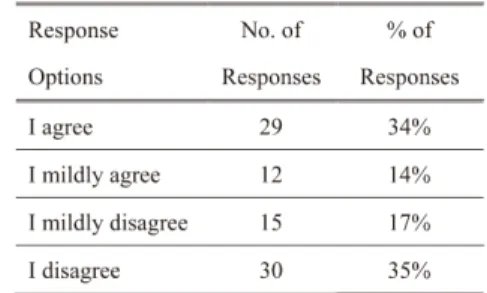
The first research question aimed to ascertain whether or not 1st year undergraduate students were familiar with any picture books in English and foreign authors. According to the survey results, only one participant could promptly provide an example of a foreign author and only a few participants could recall picture books written in English. Three participants listed characters of picture books, for example, Curious George, M aisy, and M iffy and four participants surprisingly wrote, “The little pr ince '', by Antoine de Saint-Exupery who is not so well known in English speaking countries since he is a French author. 0 verall, this poor result could be due to a range of factors. The results in Table t . show that less than half of the participants either agreed or mildly agreed that their teachers read books to them during elementary school. Furthermore, this result may be influenced by their English learning experiences in elementary school or private English lessons. Basically, elementary school and preschool are the most likely periods for Japanese to experience English picture books in their classrooms and their limited exposure could explain their di fficulty answering the question.
Table t . Student Teachers' Picture Book Exper ience in Elementary School (N=86)
M y teachers read picture books in class when I was an elementary school student
Response No. of % of
Options Responses Responses I agree 29 34%
I mildly agree 12 14%
I mildly disagree 15 17%
not only book choice, but the way of reading and teachers' awareness of chi ldren's reactions to the book are essential for ensuring that students can understand what they hear and enable them to respond to questions. M oreover, several participants also commented that a maj or reason to read picture books is simply because they are enj oyable and motivating. Thus, the survey results and j ournal comments showed that many 1st year undergraduate students believe picture books are a good teaching resource for a range of reasons.
I disagree 30 35%
Overall, participants had trouble recalling authors of English books since only Oscar Wilde was provided. Since nearly all of the participants were unable to provide picture book titles and authors, it shows the participants are not very familiar with picture books in English or foreign authors.
The second research question in this study aimed to determ ine whether 1st year undergraduate students studying to be teachers believe picture books are a good teaching resource to improve the language sk ills of elementary school students. The maj ority of participants disagreed with the statement that picture books are not a good teaching resource as shown in Table 2 below. This result is interesting since roughly hal f of the participants indicated that they had not experienced an elementary school teacher reading a picture book as shown in Table 1. This suggests that the participants' experiences with picture books in elementary school have not influenced their belief that picture books can be a good teaching resource.
Table 2. Student Teachers' Beliefs (N=86)
I do not think picture books are a good teaching resource to improve language sk ills of elementary school students.
Response No. of % of
Options Responses Responses
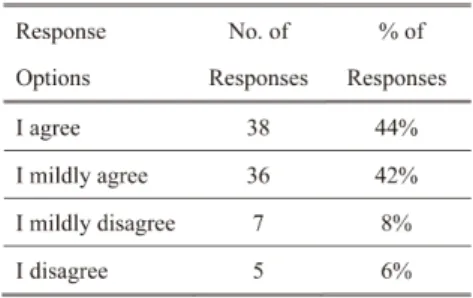
The next research question focused on identi fying what positive and negative factors linked to student teachers' cognitions are likely to influence the inclusion of picture books in their future elementary school English classes. There were numerous factors that should positively influence the inclusion of picture books in their future classrooms. As shown in Table 3 and Table 4, most participants indicated that they are interested in improving their pronunciation sk ills and ability to read aloud, which shows they want to develop their skills which will influence their ability to use picture books in the future.
Furthermore, many participants also believe picture books are a good teaching resource as shown in Table 2. Journal comments show some participants feel that elementary school students could gain a lot from picture books. In reference to one story, a one female student commented that it was “not only interesting_ but also, a moral lesson for children”. Overall, the participants tended to make positive comments focusing on the useful and motivating content of picture books and the potential to teach new w ords.
Table 3. Student Teachers' I nterest in Developing their Pronunciation Skills (N=86)
I want to improve my English pronunciation.
Resp onse No. of % of
Options Responses Responses I agree 78 91%
I agree 11 13% I mildly agree 9%
I mildly agree 9% I mildly disagree 0%
I mildly disagree 19 22% I disagree 0%
I disagree 48 56%
In the journals, participants wrote about the benefits of picture books and some participants pointed out that
Table 4. Student Teachers' I nterest in Developing their Reading Aloud Abilities (N=86)
I want to improve my ability to read aloud.
Table 6. Student Teachers' Self Evaluation of their Ability to Read Unknown Wor ds (N=86)
W ords I don' t know are di ffi cult to read.
Response No. of % of
Options Responses Responses
Response No. of % of
Options Responses Responses
I agree 66 77% I agree 38 44%
I mildly agree 18 21% I mildly agree 36 42%
I mildly disagree 1% I mildly disagree 8%
I disagree 1% I disagree 6%
Participants also indicated an interest in reading English books by foreign writers which means they are likely to respond positively to more opportunities to read English books by foreign writers in their classes. Please refer to Table 5 below.
Table 5. Student Teachers' I nterest in Reading Books by Foreign Wr iters (N=86)
I want to read English books by foreign writers.
Response No. of % of
Options Responses Responses I agree 39 45%
I mildly agree 31 36%
There is high possibility that they will come across words that they are unfamiliar with during shared reading. Yet picture books are useful for teaching vocabulary and relatively uncommon words can also be learned during dialogic reading (Zevenbergen & Whitehurst, 2003). Thus, sufficient preparation before shared reading needs to be encouraged to overcome such concerns.
Participants also quite negatively assessed their own pronunciation skills as shown in Table 7. Like their ability to read unknown words, their ability to be understood by others would influence their confidence in doing shared reading in their future classrooms.
I mildly disagree 13 15%
I disagree 4%
However, there were also some negative factors that are likely to make it di fficult for the participants in this survey to include picture books in their future English classes. Firstly, most participants in this study feel they have trouble reading unknown words and have trouble asking questions in English which was evident in some of the journal comments.
Table 7. Student Teachers' Self Evaluation of their Pronunciation Skills (N=86)
I think my pronunciation of English is understandable for others.
Response No. of % of
Options Responses Responses
I agree 6%
I mildly agree 18 21%
I mildly disagree 42 49%
I disagree 21 24% I felt it is di fficult to ask a lot of questions. So,
I had many questions that everyone can answer _ “yes” or “no”. (Female student A)
This was also apparent in the survey responses as illustrated in Table 6 below. A high percentage of participants either agreed or m ildly agreed with the statement about having problems reading unknown words.
Furthermore, the results of this study also show that student teachers need to loam ways to overcome anxiety when using English in 2 types of classroom activities as well as reducing anxiety about mak ing errors. The survey results in Table 8 reveal that most participants either agreed or mildly agreed that they feel nervous speak ing English in front of the class which is not a particularly surprising result.
Table 8. Student Teachers' Anxiety Speaking English in Front of the Class (N=86)
I get nervous when I speak English in front of the class.
Response No. of % of
Options Responses Responses I agree 42 49% I mildly agree 31 36% I mildly disagree I disagree 10% 5%
The results show that many participants agreed or m ildly agreed that they practiced reading aloud as a junior or senior high school student in Table 9. However, their answers suggest that they have not gained confidence from that experience which means a di fferent approach to reading aloud is necessary
Table 9. Student Teachers' Reading Aloud Exper ience in Junior or Senior High School (N=86)
I used to practice reading aloud when I was a junior or senior high school student
reading, participants practiced it in pairs six times before leading an interactive shared reading activity alone in front of the whole class. The researcher observed that nervousness tended to influence their reading speed and use of voice to create interest in the picture book. By writing the reflective j ournal most participants recognized the negative aspects of their shared reading activity and indicated that they felt very nervous and unsatisfied with their own per formance. Such views about their interactive shared reading experiences are likely to remain i f they are unable to have a positive experience later on. Therefore, students may feel more com fortable by doing more reading aloud practice in small groups before their solo interactive shared reading activity due to the types of skills and English abilities it requires.
Surprisingly, the results below in Figure 1 revealed that more than hal f of the participants either agreed or m ildly agreed that they feel nervous when they speak English in pair activities. This shows that even though speak ing English in front of the class might create added anxiety, a relatively high number of the participants are anxious when they speak in pairs as well.
Response No. of % of
Options Responses Responses I agree 32 37%
I mildly agree 28 33%
I mildly disagree 17 20%
I disagree 10%
One student wrote the following in his journal
I was more nervous than I thought. M y mind went blank as soon as I took the seat. I wanted to read it in a louder voice. I should have read it more slowly. I wanted to try one more time. (M ale student A)
Interactive shared reading requires a range of abilities, since teachers are required to use their voice to create interest in the story and bring the characters to li fe. A lso, considering that reading aloud in junior high and high school is usually done in unison, it was quite natural for many participants to write about how nervous they felt about doing presentations and interactive shared reading in English. During their course on picture books and shared
Figure l . English Speaking Anxiety Dur ing Classroom Activities
The results of Figure 1 on anxiety due to speaking English during classroom activities might be linked with the results on anxiety about mak ing errors as shown in Table 10. M any participants indicated they get anxious about speaking incorrect English which may influence how they feel during any task. This negative factor is particularly problematic since it can reduce language usage in their f uture classroom s.
Table 10. Student Teachers' Anxiety Regar ding M aking Er rors in English (N=86)
I get anxious about speak ing incorrect English.
Response No. of % of
Options Responses Responses I agree 33 38%
I mildly agree 41 48%
I mildly disagree 9%
about the di fficulties creating suitable questions, even though they realized the questions can maintain students' interest throughout the interactive shared reading activity. One student commented that:
I got used to shared reading_but it is still di fficult for me to ask about the story. I need to think of various types of questions. (Female student B)
I disagree 5%
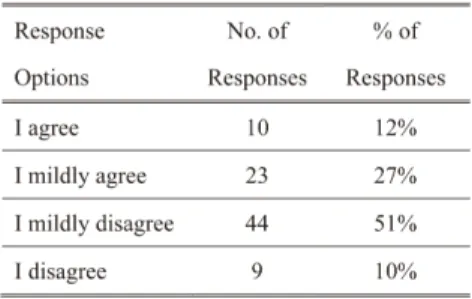
In addition to the results regarding their anxiety levels, two more negative factors were discovered. The results show that student teachers are not confident about their ability to read aloud and ability to ask questions. M ore than hal f of the participants felt to some extent that they are not good at reading aloud as shown in Table 11, and most participants agreed or mildly agreed that they have di fficulty ask ing questions in English as shown in Table t2.
Table 11. Student Teachers' Self Evaluation of their Ability to Read Aloud (N=86)
I think I am good at reading aloud.
Response No. of % of
Options Responses Responses
I agree 10 12%
I mildly agree 23 27% I mildly disagree 44 51%
I disagree 10%
Even though the participants were given very clear guidelines based on scaffolding techniques known as the PEER sequence and CROWD prompts (Whitehurst et l l, 1998) from the start of their course and prepared their questions in advance, many participants in this study still found it challenging to ask questions to enhance and effectively engage the class during their interactive shared reading activity.
Finally, the last negative factor that is likely to influence their future use of picture books is their limited knowledge about foreign authors and picture books in English. This factor is likely to make it difficult for them to choose suitable books. However, according to the journal comments, most participants could quickly identi fy the benefits and challenges of picture books that were introduced during their course and they already believed that picture books are a good teaching resource. Furthermore, the participants also felt that they learned a lot from listening to the presentations about foreign authors by other students.
Table 12. Student Teachers' Self Evaluation of their Ability to Ask Questions in English (N=86)
I feel it is di fficult to ask questions in English.
I could know about various author 's picture books and backgrounds_ I wanted to read the picture book I recommended. (Female student C)
Response No. of % of
Options Responses Responses I agree 32 37%
I mildly agree 39 45%
I had little knowledge about overseas writers_ I became interested in this topic and I want to read books written by foreign authors. (Female student D)
I mildly disagree 11 13%
I disagree 5%
The participants were introduced to interactive shared reading after completing the survey, and this method required the student teachers to ask a variety of questions to assist learning and understanding during picture book reading. Some participants commented in their journal
This suggests that they were able to gain a better awareness about English picture books during the course and according to the participants' j ournal comments, they benefited from actively searching for an author and listening to the presentations of others. In order to do a presentation on a picture book author, they were initially given a list and then required to search for background
information, make judgements about the writing and illustration style of the author 's picture books, provide famous titles, and recommend a book for interactive shared reading. However, access to picture books introduced in the presentations may be di fficult to find in their future work locations which means popular authors, such as Eric Carie, N ick Sharatt, Aaron Babley, and Leslie Patrice11i will need to be introduced early on in their university studies.
2.6 Limitations of the Study
Although this study did provide basic information regarding Japanese student teachers' knowledge and beliefs about English picture books, and revealed their sel f- evaluated views of their abilities regarding interactive shared reading, it should be mentioned that this study also has some limitations. In addition to the initial survey and journal, a follow-up survey after the course, would have been useful for determ ining any changes in their knowledge, views and abilities. A lso, since this survey was adm inistered in the first semester of their undergraduate teaching degree, it is unclear how their responses m ight change after they graduate and go on to teach. However, this study does provide a base for comparing changes in student teachers knowledge and beliefs, and this information is likely to be of interest to course educators of undergraduate courses in English teacher education.
Conclusion
The findings of this study indicate that student teachers' limited knowledge of picture books, positive beliefs about picture books and negative beliefs about their own abilities to do interactive shared reading are all likely to have an impact on their willingness and their capability to apply their knowledge in their future teaching careers. Course content needs to take into account student teacher cognitions, particularly i f they negative. Educators of student teachers who will teach English will need to not only introduce them to a wide range of books and authors and provide sufficient practice of interactive shared reading techniques, but also consider ways to positively develop student teachers' beliefs regarding their own abilities to ensure elementary school English teachers provide an effective environment for second language acquisition.
Refer ences
Bader, B. (1976). American Picture books from Noah 's
Ark to The Beast Wl thin. New York: Macmillan. Baker, A. & Murphy, J. (2011). Knowledge base of
pronunciation teaching: stak ing out the territory. Tesl
Canada Journal, 28(2), 29-50.
Borg, S. (2011). The impact of in-service education on language teachers' beliefs. System, 39(3), 370-380. Borg, S. (2015). 「eac or cogmfzon and ang age
ducafzo .・ esearc an Practice. London: Bloomsbury.
Chow, B. W.-Y., McBride-Chang, C., & Cheung, H. (2010). Parent-child reading in English as a second language: Effects on language and literacy development of Chinese kindergartners. Journal of
Research In Reading, 33(3), 284-301.
Dale, P. S., Crain-Thoreson, C., Notari-Syverson, A., & Cole, K. (1996). Parent-child book reading as an intervention for young children with language delays. 「opzcs zn arfy C f d ood Specza d cafzon, 16,
213-235.
do Saint-Exupery, A. (1956). The 1前1e prince. NY: Reynal and Hitchcock.
Hatae, M. (2013). Shougakko gazkokugo katudou m okeru
“e on '' no af ye o rut ez a fo u ye eu eu m an s ru Jzssenfez z e uu [ Categorization and Application of Picture books in Elementary School Foreign Language Activity] . Retrieved from https://
kaken nil ac .jp/j a/file/KAKENHIPROJECT-22520640/
22520640seika.pdf
Lin, L. (2014). Learning word meanings from teachers repeated story read-aloud in EFL primary classrooms.
ng zs ang age 「eac zng, 7 (7), 68-81.
M inistry of Education, Culture, Sports, Science and
Technology (MEXT). (2016a). Cyuugakkunen we
fazsyo fos zta, e on atuyo m ans z onfe zna kangae Basic Approach towards the Application of Picture books in the M iddle Grades] . Retrieved from http : //www mext go .jp/a_menu/kokusai/gaikokugo/
_ icsFiles /afieldfile/2016/05/02/1370109_1_1 .pdf
M inistry of Education, Culture, Sports, Science and Technology (MEXT). (2016b). Hi Fr iends Story Books. Retrieved from http://www.mext.go jp/a_menu/
kokusai/gaikokugo/1370103 .htm
M inistry of Education, Culture, Sports, Science and Technology (MEXT). (2017a). Syougakkou gakusyuu sldou youryou [ Elementary School Course of Study] . Retrieved from http://www.mext.go.jp/component/a_
menu/education/micro detail/ icsFiles/afieldfile/2017/
M inistry of Education, Culture, Sports, Science and
Technology (MEXT). (2017b). Syougakkou galkokugo
afudou ・ gaz o go ensyuu gazdo u . [Elementary School Foreign Language Activities -Foreign Language Training Guidebook.] . Retrieved
from http://www.mext.go jp/a_menu/kokusai/gaikokugo
/1387503.htm
Swanson, E. A., Wanzek, J., Petscher, Y., Vaughn, S., Heckert, J., Cavanaugh, C., Kraft, G and Tackett, K. (2011). A Synthesis of Read-Aloud Interventions on Early Reading Outcomes Among Preschool through Third Graders at Risk for Reading Difficulties. Jo m a of eam ng zsa z zfzes, (3), 258-275. Trivette, C. M. & Dunst, C. T. (2007). Relative
effectiveness of dialogic, interactive, and shared reading inventions, Center f or Early Literacy
Learmng, 1(2), 1-12.
Vygots , L. (1978). Mznd zn socze .・ e deve o menf of zg er syc o ogzca rocesses. Cambridge, M ass : Harvard University Press.
Whitehurst, G. J., Falco, F. L., Lonigan, C. J., Fischel, J. E., DeBaryshe, B. D., Valdez-Menchaca, M. C., & Caulfield, M. (1988). Accelerating Language Development through Picture book Reading. Developmental Psychology, 24(4), 552-559.
WWC (What Works Clearinghouse) (2007). Research Summa o za ogzc eadz g. US Depa ment of Education. Institute of Education Sciences, National Center for Education Evaluation and Regional Assistance. Retrieved from http://community.fpg.unc. edu/sites/community.fpg.unc.edu/files/resources/ Handout/CONNECT-Handout-6 -1 .pdf
Zevenbergen, A. A., & Whitehurst, G. J. (2003). Dialogic reading: A shared picture book reading intervention for preschoolers. In van Kleeck, A., Stahl, S. A., &. Bauer, E. B. (Eds ), On Reading Books to Children・ Parents and Teachers (pp.170-192). Center for Improvement of Early Reading Achievement, CIERA. New York: Routledge.