• 検索結果がありません。

Implementing Cooperative Learning in EFL Reading Classes at a Japanese University

N/A
N/A
Protected

Academic year: 2021

シェア "Implementing Cooperative Learning in EFL Reading Classes at a Japanese University"

Copied!
15
0
0

読み込み中.... (全文を見る)

全文

(1)

Implementing Cooperative Learning in EFL Reading Classes at a Japanese University

SAKURAI Yoko

要 旨

 本論文は,協同学習(cooperative learning)を取り入れた大学でのリー ディング授業の有効性の考察を行う事を目的としている。協同学習の概要 を述べるとともに,Kaganによる協同学習へのアプローチである

Structural

Approach

に焦点をおき,その特徴となっている協同学習ストラクチャー

を具体的な例とともに紹介する。また,Kaganによる

Structural Approach

を基本とし取り入れられた協同学習が,どのように大学のリーディングの 授業で実施されたかを紹介する。学期末に行われた授業に対するアンケー トによると,多くの学生が協同学習を取り入れた授業形態に満足したと回 答している。更に,多くの学生が協同学習の理念を取り入れたグループで の活動やアクティビティーにより,授業に集中し,授業活動への参加を楽 しみ,英語力を伸ばすことができたと回答した。また,その理由としては 協同学習により促された安心感,学生同士のコミュニケーションや助け合 い,グループの一員としての責任感,学習に対する前向きな態度などが挙 げられた。

Abstract

This paper aims to examine how university students view co-

operative learning-based reading classes, and consider the potential

(2)

of them in tertiary education. The article provides an overview of Cooperative Learning (CL) within Kagan’s Structural Approach as well as an introduc tion of how it was incorporated in EFL university reading classes. The data analysis of the questionnaire suggests CL effectively helped students stay focused on tasks, encouraged enjoyable, active class participation, and helped improve English skills.

キーワード:
cooperative learning

協同学習

, university reading class

大学 でのリーディングクラス

, group work(

グループワーク

, English language instruction

英語教育

, L2 acquisition

第二言語習得

Introduction

As the trend in teaching practice has shifted from teacher-centered instruction to student-centered instruction, CL has been a popular and successful teaching approach in educational institutions around the world. There have been a great deal of research on the benefits and effects of adopting CL with students of different grade levels in courses of various subject areas. Findings of reviewing over 700 projects suggest if students work cooperatively, they can achieve higher academic performance and greater productivity than if they work competitively and individually. Furthermore, CL allows students to build more positive relationships with their classmates, and helps develop social skills and competencies (Johnson, Johnson & Holubec, 1994). In addition, based on their substantial studies and reviews of hundreds of studies, leading researchers in the field, Kagan and Kagan, have identified various positive learning outcomes of utilizing CL including enhanced academic achievement, stronger motivation, higher cognitive development, increased self-confidence, and development of interpersonal skills (2009).

In English as a Foreign and Second Language (EFL & ESL) education, there have also

been many research projects reporting successful implementation of CL in classes

including Motaei, (2014), Marzban & Alinejad (2014), Chen & Goswami (2011), and Ning

(2010).

(3)

Overview of CL What is CL?

Johnson and Johnson (1991) define CL as “the instructional use of small groups so that students work together to maximize their own and each other’s earning” (5). One of the distinctive differences between a teacher-centered lecture style class (henceforth

‘traditional classroom’) and CL lies in the way that the teacher and students interact with the curriculum. In traditional classrooms, a teacher lectures on a subject matter with the aim to transmit their knowledge to students. In this form of teaching, students are mostly working independently and, in many cases, compete against each other for better grades.

In CL, on the other hand, the teacher’s role is creating CL learning experience where all students, including weaker ones, can learn equally through cooperative and supportive student-student interaction.

Johnson and Johnson (1991) further state that positive effects of CL “…do not automatically appear when students are placed in groups. For [CL] to occur, the professor must carefully structure learning groups” (5). In this respect, CL is also distinguished from group work where students merely work together in groups in order to complete an assigned exercise, give a group presentation, or work on a group project. It is this unique structure that differentiates CL from group work. In CL, inclusion of key principles developed from cooperative learning theory into lessons is essential. The key principles structure the way the teacher designs and delivers a lesson, and how students interact with each other.

Kagan’s Structural Approach to CL

Among different approaches to CL, one of the major ones that have been incorporated in classrooms around the world is Kagan’s Structural Approach. One distinctive characteristic of Kagan’s approach is the adaptation of CL structures. His structure has the following features:

1. Though often confused with a learning activity, the structure is not an activity with a specific content. High (1993, p. 1–1) explains it using the formula:

‘Structure + Content = Activity’. The structure, in Kagan’s approach, is more

of a content-free, repeatable framework that describes how the teacher interacts

(4)

with the students and how students interact with each other over a learning content. By adding a target grammar item into the structure, for instance, the teacher is able to create an activity that meets the students’ learning needs for a specific lesson. Some examples of structures are introduced later in the paper.

2. The CL structure also implements the four cooperative learning principles symbolized by the acronym: PIES: Positive interdependence, Individual accountability, Equal participation and Simultaneous interaction (Kagan, 2009).

These elements are indispensable for CL to effectively occur.

While many CL approaches are lesson-based or curriculum based, Kagan’s structure could require only one minute of class time. These flexible, practical traits of the structure allow the teacher to produce an infinite number of different activities and implement them in the existing curriculum.

Kagan’s Structures and Other Similar CL Strategies Timed Pair Share

The teacher states a topic (or a question) and the time limit. Students are given think time, and then share their answers in pairs. Partner A shares first and Partner B listens with positive responses such as nodding or saying positive comments like

“I agree” or “That’s a great idea.” Then Partner B shares and Partner A listens and responds positively.

Jot Thoughts

The teacher poses a question or a topic. After several minutes of think time, students write as many ideas as possible on slips of paper within the time limit set by the teacher. The team goal is to come up with as many ideas as possible and cover the table with slips of ideas. In a reading class, the structure can be used as a pre-reading activity to elicit what students have already known about the reading topic or what they want to know about the topic.

Think / Pair / Share

The think / pair / share activity was developed by Lyman in 1978. In this activity,

a question or a task is given to students. Students first think individually, then talk

with a partner and share their responses with the whole class. For instance, students

first read and understand the assigned reading text, check their comprehension with

(5)

pairs (or group members), and share and correct it with the whole class.

CL Roles

A CL role is an action or a task that each group member is assigned to carry out.

CL roles can be the recorder whose task is taking notes, the time-keeper who makes sure the team finishes the task on time and the speaker who shares ideas with the class on behalf of the team. Students play different roles in turn so that they can improve different skills required by the roles.

The Teacher’s Role in the Classroom

Due to the nature of CL, the teacher gets “down time” while students work in teams.

The teacher takes advantage of the time to circulate around the classroom and visit teams making sure they are on task and checking that each member is responsibly playing her/his role. The teacher also checks comprehension answers questions, and gives any necessary help. CL allows the teacher to spend more time paying closer attention to each student and responding to individual needs more easily.

The Benefits of CL in L2 Language Learning

CL deals with many fundamental needs of L2 learning. Firstly, it promotes more frequent use of the target language, which is crucial for language learning as it takes repetition so that new information and skills can be acquired and stored in the long-term memory. A study indicates that the active participation rate per student in a CL classroom can be as much as 30 times higher than that of a traditional classroom (Kagan, 2009).

This means, according to Kagan, a traditional class only gives less than one minute an hour per student to speak. This number is considerably low in order to retain any kind of language skills or knowledge. In addition to abundant output and input opportunities, a CL environment provides those opportunities through more meaningful ways such as explaining or negotiating the meaning of an unknown word or a grammatically confusing sentence, and giving and receiving peer-correction.

Secondly, CL supports a great deal of affective factors such as self-confidence,

lowering language anxiety, positive experience of success, higher expectancy of success,

positive emotional tone of a group or a class, and cooperation among students, all

of which Dörnyei states would promote an L2 learner’s motivation (2001). The non-

threatening, supportive, environment and positive emotional atmosphere that CL creates

(6)

help language learners reduce language anxiety as well as increase motivation and self- confidence. As a result, a positive attitude toward actively communicating with the target language could be fostered. Kagan suggests, “Brains are more engaged during social interaction…greater engagement leads to greater retention” (2009, p. 4–1). Moreover, in CL where opportunities to succeed are equally assured, every student could benefit from those positive learning experiences to be more effective language learners.

Thirdly, CL is both brain and language learning friendly. Caine & Caine (1994) and Ronis (2000) summarize that collaborative learning forms, including CL, are brain compatible because it appeals to some innate attributes of our brain such as seeking meaning, learning from and with others, contemplating diverse ideas and remembering emotionally attached ideas (both cited in Erlauer, 2003, p. 136–137). Humans are social beings and our brains naturally learn better through interaction and collaboration with other people. These innate attributes of our brain deeply correlates to the essence of L2 acquisition of learning how to communicate with others. Dörnyei states, “in the L2 field, various forms of peer cooperation have become well-established techniques, which is due to the fact that peer interaction is seen in modern language teaching methodologies as prerequisite to building the leaners’ communicative competence” (2001, p. 100). CL could appeal to both the nature of our brain function and the core element of language learning.

Background for the Study Rationales

The idea of implementing CL initially occurred when exploring ways to teach EFL

reading classes at Japanese universities. A study targeted at Japanese university students

indicates that the grammar-translation method, still predominantly used at Japanese

junior and senior high schools, is a major external demotivating factor in learning

English (Falout et al, 2009). The objective of implementing CL was to create a more

interactive and engaging reading experience that encourages students’ collaboration

and participation in groups. The reason why Kagan’s Structural Approach was adopted

as a basis was due to its adaptability as it is structure-based not lesson- or curriculum-

based. To examine the benefits of CL from students’ perspectives, the following research

question was formed: “How do students feel about the CL that they experience?”

(7)

Overview of the Course and Lessons

On the first day of the semester, CL groups or pairs were formed and a CL role for each member was decided. In the first half of the semester, students chose group members, and then the teacher assigned group members the second half. CL roles were rotated by the group members to assure every student would have a chance to serve all the three roles multiple times. The three roles were adopted from CL roles: the speaker, the note-taker and the facilitator. The speaker was responsible for sharing answers and ideas on behalf of the group while the note taker took notes during discussions and completed assigned written work. The facilitator watched the time and made sure every member equally contributed to completing the task. When they worked in pairs, one member took the speaker role and the other took the note-taker role. In these CL groups, students worked on language learning activities that were developed based on CL structures including the ones addressed earlier in the paper. Most of the activities required students to help each other, agree on which idea to share and/or check which answer was correct when they had different answers. The teachers monitored each group walking around the classroom and gave any necessary help, correction and/or encouragement. At the end of each class, students submitted a final group product such as a complete worksheet and a poster. Points would be given to each group member if the product was complete, but points would be taken off from each group member if it was incomplete.

Methods Participants

CL was used at four reading courses of a private liberal arts university in Japan.

A total of 131 students majoring Chinese studies and other majors (law, economics and

business administration) participated in the study, as shown in the table below. The

detailed information on each course is as follows:

(8)

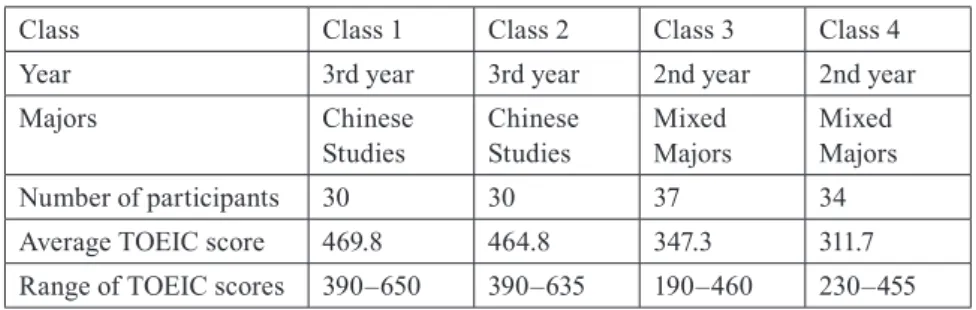
Table 1. Summary of the Classes and Students’ TOEIC Scores

Class Class 1 Class 2 Class 3 Class 4

Year 3rd year 3rd year 2nd year 2nd year

Majors Chinese

Studies

Chinese Studies

Mixed Majors

Mixed Majors

Number of participants 30 30 37 34

Average TOEIC score 469.8 464.8 347.3 311.7

Range of TOEIC scores 390–650 390–635 190–460 230–455

Data Collection

On the last day of the course, the final class assessment was administered, which included five questions for this study (see Appendix 1). The final assessment was assigned either in class or as a homework assignment. The results of individual classes and all the four classes are shown in tables (see Appendix 2). The numbers in the parenthesis are the percentages. The questions were given in Japanese for the convenience of the students.

The students selected their answers from five options (strongly agree, agree, neutral, disagree, and strongly disagree), and stated reasons to support their answers. Of the 131 students, 128 students stated reasons for question 1, and 127 stated reasons for questions 2-4. The final survey question about the content of lessons was open-ended, so students could write any suggestions to improve the course. Some information acquired from this section was used for the analysis. The students were explicitly told that their answers and comments would not affect their grades.

Results and Discussion

This section details the results of the study, and includes a brief discussion for each survey question. However, most pertinently referring to question 5 first, 81%

(29%: strongly agree, 52%: agree) of the students were satisfied with CL based classes suggesting that students recognized its benefits in language learning instruction (Table 2, Appendix 2). Because of the strong positive response, it would seem that further research on this topic is justified. The results of the other questions are provided below.

Survey Question 1: Engagement in Class Work

As a whole, around 75% of the students (20%: strongly agree, 55%: agree) perceived

(9)

that CL helped them stay focused on tasks (Table 2, Appendix 2). By individual classes, the highest number was 90% (27%: strongly agree, 63%: agree) with Class 2 and the lowest was 63% (14%: strongly agree, 49%: agree) with Class 3 (Tables 4 and 5, Appendix 2).

An analysis of students’ comments revealed that a major factor that promotes students’ engagement in tasks was peer-interaction including sharing ideas, helping each other, thinking collectively to find an answer, and receiving correction. For instance, the interaction promoted by CL helped students develop perseverance and willingness to comprehend long reading texts or to accomplish challenging assignments. One student commented that she could not have maintained her concentration on reading tasks if she had to work alone while another remarked that she would have given up as soon as she had got stuck with one problem or when things became too difficult. Another mentioned that working with group members motivated her to try to read difficult reading tasks.

Increased productivity and efficiency in the process of completing tasks also contributed to promote students’ engagement. Students were more willing to continue reading when encountering difficulties when they could obtain an answer, confirmation or corporation from peers on the spot. They felt receiving immediate feedback made reading faster and more fluent and, therefore, found themselves more deeply involved in tasks.

The second most stated point was the sense of responsibility. In a CL group, every student is required to serve a role and each role is indispensable for the entire group to meet a shared objective. In this CL group norm, students became hesitant to cause trouble for the group members by not fulfilling their assigned role and pushed themselves harder for the sake of group members.

Survey Question 2: Enjoyment in Class Participation

The interaction mediated through CL, also helped create a safe environment to enjoy participating in learning activities. The average of the four classes was 92% (29%:

strongly agree, 63%: agree), and the percentage increased to 97% (30%: strongly agree, 67%: agree) for Class 2 (Tables 2 and 4, Appendix 2). The lowest was still as high as 86%

(27%: strongly agree, 59% agree) for Class 3 (Table 5, Appendix 2). Many of the students

expressed that communicating with group members made learning fun and engaging

while some also appreciated a chance to work with classmates that they did not usually

interact with. Additionally, forming feedback and support provided by peers, allowed

(10)

students, weaker and less confident ones in particular, to gain the sense of security and the sense of accomplishment needed to actively participate and enjoy English learning.

One student indicated that he enjoyed participating because he was able to catch up with the class thanks to the help of peers. Another student wrote that he was able to enjoy English lessons for the first time in his life. A student also wrote, “Helping each other makes me feel safer to work on tasks

1

.”

Another matter that should be noted is that intellectual stimulation from peers was suggested by many students as a factor that they enjoyed class activities. This means students merely enjoyed chatting with friends or making new friends as an extension of socializing. They took pleasure in gaining new insights and differing perspectives, and deepening an understanding of a reading text and the English language. Some reasons expressed by students were “Through discussing with peers, I’ve found English learning fun and interesting”, “I enjoyed gaining diverse points of view through discussions with classmates”, and “It was fun to listen to what other members have to say.”

Survey Question 3: The Improvement of the Linguistic Skills

The linguistic improvement, particularly in vocabulary and grammar knowledge, marked the lowest positive answers among all the five questions. Of the participants, 54%

(14%: strongly agree, 40%: agree) recognized the effectiveness of CL on improving the reading skills, grammar and vocabulary (Table 2, Appendix 2). Relatively varied reasons were observed for this item. Those include “Thinking about unknown or uncertain things collectively made ideas and information more memorable”, “Working with others made it clear what I knew and what I did not know”, “Watching a member who was more proficient than me read texts helped me learn how to read more effectively”, “Correcting each other’s mistakes led to the deeper understanding of grammar”, and “Meaningful use of vocabulary led to retention of new vocabulary”. Those students who recognized the effectiveness relatively had positive attitudes towards learning from and with classmates and accepting the concept of having peers as a source of information.

For this question item, the neutral accounts for 31% (Table 2, Appendix 2). One

reason brought up by some students was that English skills, particularly vocabulary and

grammar, should or can be improved by individual effort. Some students also claimed

that they became too dependent on the group members, especially when they worked

with more proficient students. One student mentioned that she could concentrate more

(11)

when she works individually while another stated that her group did not work well as a team. Those students who chose the neutral did not feel that CL particularly exceled other ways of learning while they recognized its benefits to some extent.

Students who perceived the improvement in these skills tended to see the English skills in terms of retention, reading comprehension, reading skills, while those answered the neutral or negatively more focused on gaining new knowledge. Two different sorts of responses revealed an issue that the benefits gained more efficiently through individual learning could be neglected or less valued, consciously or unconsciously, in the CL structure. Johnson and Johnson argue that specific information and simple skills like spelling can be effectively gained through individual procedures, while cooperative procedures are effective to retain those knowledge and skills (1975). Better ways to incorporate individualized learning to the CL based instruction should be explored.

Secondly, the response variance may be due to different learning styles and preferences.

Some learners can learn more effectively through human interaction while some respond better to individualistic learning.

Survey Question 4: The Affects and Benefits of CL Roles

This question item was to examine how students perceived the affects and benefits of CL roles. Findings indicated that 79% of the students (28%: strongly agree, 51%:

agree) responded positively to the idea of playing a CL role during group work (Table 2, Appendix 2). The highest was Class 2 with 83% positive answers and the lowest was Class 1 with 74% positive answers (Tables 4 and 3, Appendix 2). A large number of students addressed that having a role allowed them to develop the sense of responsibility.

The sense of responsibility gained through CL roles led to various positive outcomes

such as more serious and active class participation, commitment to assignments, and

increased effort put into learning. One student noted that she developed the sense of

responsibility in completing her role and was able to participate in class more actively

than usual. Many students appreciate opportunities provided by serving the speaker. One

of them remarked that she would not have spoken up if there had not been a speaker role

because she was not good at talking to the whole class. Another regarded that she was shy

and avoided speaking, but the role provided the motivation and push necessary to speak

up. In a collectivist culture like Japan, some students are afraid of putting themselves

forward too much by speaking up without being called on. Providing shy students with a

(12)

specific role helped them feel more certain and confident in what to do.

Some students commented that clearly knowing what their job was in the group helped them to focus more during class while some felt they were able to more efficiently improve the different academic skills required. Some also addressed practical reasons like saving time of deciding on who to speak when the group was picked on to share ideas.

One issue raised by multiple students was the role of the facilitator and time keeper.

This role, compared with the other two roles, requires more autonomy to fully serve the role, and less motivated students could take the easy way out of the responsibility. Some indicated that the facilitator did not work as hard as the other two roles or they depended on other members too much when they were serving the role.

Conclusion

The study has revealed that CL supported and encouraged students’ engagement in learning activities, enjoyment of participating, and improvement of some English skills.

Furthermore, other positive learning outcomes of CL emerged from many of the students’

comments such as a positive attitude toward learning, willingness to help each other,

acceptance of different views and perspectives, the sense of responsibility, and reduced

anxiety. These are all essential in language learning. Referring to research specifically

within ELT, Dörnyei claims, “students in cooperative environments have more positive

attitudes toward learning and develop higher self-esteem and self-confidence than in

other classroom structures” (2001, p. 100). In the researcher’s own experience, providing

the necessary individual attention and sufficient, meaningful learning opportunities

could be challenging with classes of 30 to 40 students. However, many of these needs

could be met by effectively encouraging more student-student interaction in the CL

structure. It appears that CL has great potential in Japanese university reading classes.

(13)

Appendix 1 Survey Questions

1. Did group work or pair work help you focus on class work?

2. Did group work or pair work help you enjoy participating in class activities?

3. Did group work or pair work help you improve your reading skills, grammar and vocabulary?

4. Was being assigned a role effective?

5. With all things considered, did you feel working in groups or pairs make the classes effective?

Appendix 2

Table 2. Distribution of Student Responses for Survey Questions of All the Four Classes (n=131)

1 2 3 4 5

Strongly agree 26 (20) 38 (29) 18 (14) 37 (28) 38 (29)

Agree 72 (55) 82 (63) 52 (40) 67 (51) 68 (52)

Neutral 22 (17) 8 (6) 40 (31) 19 (15) 17 (13)

Disagree 9 (7) 2 (2) 18 (14) 6 (5) 6 (5)

Strongly disagree 2 (2) 1 (1) 3 (2) 1 (1) 1 (1)

N.A. 0 (0) 0 (0) 0 (0) 1 (1) 1 (1)

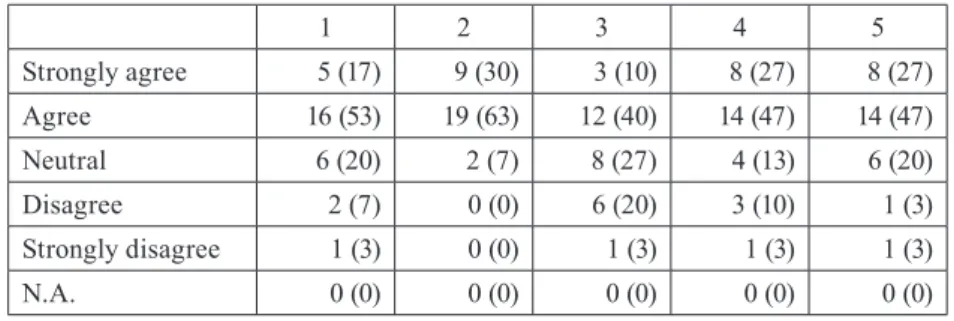
Table 3. Distribution of Student Responses for Survey Questions of Class 1 (n=30)

1 2 3 4 5

Strongly agree 5 (17) 9 (30) 3 (10) 8 (27) 8 (27)

Agree 16 (53) 19 (63) 12 (40) 14 (47) 14 (47)

Neutral 6 (20) 2 (7) 8 (27) 4 (13) 6 (20)

Disagree 2 (7) 0 (0) 6 (20) 3 (10) 1 (3)

Strongly disagree 1 (3) 0 (0) 1 (3) 1 (3) 1 (3)

N.A. 0 (0) 0 (0) 0 (0) 0 (0) 0 (0)

(14)

Table 4. Distribution of Student Responses for Survey Questions of Class 2 (n=30)

1 2 3 4 5

Strongly agree 8 (27) 9 (30) 5 (17) 7 (23) 11 (37)

Agree 19 (63) 20 (67) 14 (47) 18 (60) 17 (57)

Neutral 3 (10) 1 (3) 8 (27) 5 (17) 2 (7)

Disagree 0 (0) 0 (0) 3 (10) 0 (0) 0 (0)

Strongly disagree 0 (0) 0 (0) 0 (0) 0 (0) 0 (0)

N.A. 0 (0) 0 (0) 0 (0) 0 (0) 0 (0)

Table 5. Distribution of Student Responses for Survey Questions of Class 3 (n=37)

1 2 3 4 5

Strongly agree 5 (14) 10 (27) 6 (16) 11 (30) 7 (19)

Agree 18 (49) 22 (59) 8 (22) 19 (51) 20 (54)

Neutral 8 (22) 3 (8) 14 (38) 6 (16) 6 (16)

Disagree 5 (14) 1 (3) 7 (19) 1 (3) 3 (8)

Strongly disagree 1 (3) 1 (3) 2 (5) 0 (0) 0 (0)

N.A. 0 (0) 0 (0) 0 (0) 0 (0) 1 (3)

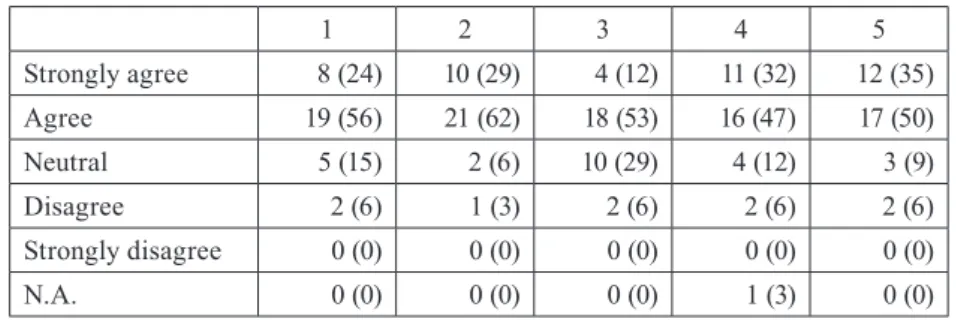
Table 6. Distribution of Student Responses for Survey Questions of Class 4 (n=34)

1 2 3 4 5

Strongly agree 8 (24) 10 (29) 4 (12) 11 (32) 12 (35)

Agree 19 (56) 21 (62) 18 (53) 16 (47) 17 (50)

Neutral 5 (15) 2 (6) 10 (29) 4 (12) 3 (9)

Disagree 2 (6) 1 (3) 2 (6) 2 (6) 2 (6)

Strongly disagree 0 (0) 0 (0) 0 (0) 0 (0) 0 (0)

N.A. 0 (0) 0 (0) 0 (0) 1 (3) 0 (0)

(15)

Note

1 All students’ quotes were translated by the researcher with an attempt to retain the students’

probable intended meaning.

References

Chen, H., & Goswami, J. S. (2011). Structuring cooperative learning in teaching English pronunciation.

English Language Teaching, 4(3), 26–32. doi: 10.5539/elt.v4n3p26

Dörnyei, Z. (2001). Motivational Strategies in the Language Classroom. Cambridge, UK: Cambridge University.

Erlauer, L. (2003). The brain-compatible classroom: Using what we know about learning to improve teaching. Alexandria, VA: Association for Supervision and Curriculum Development.

High, J. (1993). Second language learning: Through cooperative learning. San Clemente, CA: Kagan Publishing.

Johnson, D. W., Johnson, R. T., & Holubec, E. J. (1994). The nuts and bolts of cooperative learning.

Edina, MN: Interaction Book Company.

Johnson, D. W., & Johnson, R. T. (1975). Learning together and alone cooperation, competition, and individualization. Englewood Cliffs, NJ: Prince-Hall.

Johnson, D. W., Johnson, R. T., & Smith, K. A. (1991). Cooperative learning: Increasing college faculty instructional productivity. ASHE-ERIC Higher Education Report No. 4. Washington, D.C: The George Washington University, School of Education and Human Development.

Falout, J., Elwood, J., & Hood, M. (2009). Demotivation: Affective states and learning outcomes.

System, 37, 403–417. doi: 10.1016/j.system.2009.03.004

Kagan, S., & Kagan, M. (2009). Cooperative learning. San Clemente, CA: Kagan Publishing.

Marzban, A., & Alinejad, F. (2014). The effect of cooperative learning on reading comprehension of Iranian EFL learners. Procedia—Social and Behavioral Sciences, 116, 3744–3748. doi:

10.1016.j.sbspro.2014.01.834

Motaei, B. (2014). On the effect of cooperative learning on general English achievement of Kermanshah Islamic Azad University students. Procedia-Social and Behavioral Sciences, 98, 1249–1254.

doi: 10.1016/j.sbspro.2014.03.540

Ning, H. (2010). The impact of cooperative learning on English as a Foreign Language tertiary

learners’ social skills. ELT Journal, 65(1), 60–70. doi: 10.1093/elt/ccqo21

Table 1.  Summary of the Classes and Students’ TOEIC Scores
Table 3.  Distribution of Student Responses for Survey Questions of Class 1 (n=30)
Table 6.  Distribution of Student Responses for Survey Questions of Class 4 (n=34)

参照

関連したドキュメント

(2013) Tactics for The TOEIC Test: Listening and Reading Test Introductory Course, Oxford University Press. There is a lamp in the corner of

This paper presents a case of material and classroom guideline design to motivate autonomous learning of kanji and vocabulary in advanced Japanese language classes. The main goal

Working memory capacity related to reading: Measurement with the Japanese version of reading span test Mariko Osaka Department of Psychology, Osaka University of Foreign

The studies on the Connectivity of Hills, Humans and Oceans (CoHHO) is an interdisciplinary science including both natural and social expertise to achieve the construction

課題 学習対象 学習事項 学習項目 学習項目の解説 キーワード. 生徒が探究的にか