No.2 (2015) 69-91
Academic Culture: An Alternative Conceptual and Analytical Framework for Discussions on
International Collaboration in Social Sciences
Kazumi Okamoto
Karlsruhe Institute of Technology, Germany World Social Sciences and Humanities Network
(Received 12 December 2014. Accepted 2 February 2015)
Abstract
The structure of knowledge generation in social sciences has been described and discussed with contrastive terms such as North/South, centre/periphery, and dominating/dominated, in order to focus on its skewed balance in academic work. Such terms and the structure of academic work, in a certain sense, reflect the reality of the globalized social science world. Nonetheless, this type of discussion seems rather stagnated as academic debates, since the discussions so much involve today= s nation states’ view of science which considers science as a means to enhance the competitiveness of a nation state.
World ranking systems value comparison of the number of citations between countries, and these are central components of the existing discussions on globalized academic activities to indicate skewedness, inequality, and dependence of small (often developing) countries in globalized academic work. This approach strongly exhibits the competitive nature that advocates of such discussions are interested in. Even though academic activities and mobility of scholars have crossed geographical national borders, the ways in which academic activities are discussed are strongly confined within and fixed by nationalities of scholars/institutional affiliations.
In order to overcome the lack of academic people’s own perspectives on academic work, particularly focusing on knowledge generation activities in relation to international academic collaborations, a new conceptual and analytical framework that is called “academic culture” is introduced.
Academic culture, inspired by the concept of “small cultures” advocated by
British linguist, Adrian Holliday, would be an alternative approach to
discussion of academic work in a context of international collaboration. It could emancipate us from ordinary intercultural perspectives in studying any encounter of people from different global regions. Such perspectives can only repeat that we/they are different from others/us because of national cultural traits. Approaches such as Adrian Holliday’s enable us to go beyond such stereotypical analyses of people with a non- essentialist approach that tries not to classify people simply by their nationalities.
By the concept and framework of academic culture, international academic activities such as international collaborations can be discussed and analysed from academic people’s own perspectives on knowledge generation with much less emphasis on competitiveness in academic work, and factors that influence international academic collaboration could be clarified.
Consequently, topics of globalized academic work in social sciences could be deployed from more diverse and different angles than the existing discussions which stick to and are confused with nation states’ perspectives on academic activities.
Keywords: International collaboration, social sciences, globalization, culture, non-essentialist approach
Introduction
It has already been a couple of decades since globalization gained its popularity as phenomena in almost every field of our lives, such as economy, trade, communication and technology, politics, and other societal matters. Accordingly, scientists in related disciplinary fields have attempted to explain, and often to solve, matters concerning globalization, and consequently, such studies have formed a research field of globalization studies. Today, globalization is a kind of fashionable word that nation states, funding agencies, and research institutions around the world favour. Thus, there is no doubt that globalization is one of the most discussed issues, and is seen as a relevant research theme in various scientific fields.
Despite the fact that academic activities in social sciences (SS), which have been affected by a big wave of globalization, are also not an exception, it seems that studies on academic work and/or academic people that are influenced by phenomena of globalization have been rather scarce. Although the field of such studies is not quantitatively scarce, it is difficult to find diverse discussions on globalization and academic work from different perspectives.
Therefore, this article attempts to exhibit a new approach to constructing discussion
paths on the above- mentioned matter, especially focusing on academic work. This new
approach is necessary in order to overcome the repetitive nature of current discussions on
this matter, which are often national comparative studies that tend to end up with mere
description of one country/region in which international academic activities are implemented. It is rather problematic to put so much emphasis on differences and particularities of each country and/or global region, especially in order to further deploy discussions in relation to international academic activities, since such differences could simply create more distance, and in an extreme case unnecessary hostility, between academic communities in which people work under different academic circumstances.
In order to achieve the purpose of this article, it is organized into five sections. First, current mainstream discussions on structures of globalized academic work in SS will be reviewed. Second, meanings of international collaboration will be explored. Third, analyses of international collaborations exploiting intercultural studies will be revealed, according to my past research. Fourth, a new approach on this issue conceptualized by and based on Adrian Holliday’s “small cultures” (Holliday, 1999) will be introduced and explained. Simultaneously, the framework which is called “academic culture” will also be introduced, and the necessity and validity of using this framework to better understand and analyse relationships between academic culture and academic work such as international collaborations will be discussed. Fifth and finally, some concluding remarks from the above discussions will be exhibited.
Current Discussions: Structures of Globalized Academic Work in SS
1Although it is very difficult to grasp all discussions which exist in each disciplinary field of SS regarding the current status of academic work that crosses national borders, the World Social Science Report published in 2010 can be a useful source to draw an overview of the current status and issues in the field of SS
2. This report is heavily committed to describing how skewed the work in SS is. In other words, as the title of this report suggests
3, it shows how the academic work in SS is divided between those who have more privileged working conditions for carrying out conventional academic work- - such as publishing in academic journals, participating in international conferences- - and other activities and those who do not have such conditions. If we observe some chapter headlines
4of the report, we would already come to a conclusion, without reading each article closely, that the world of SS has two sectors: One is a group of scholars and/or academe that leads the whole world SS not only theoretically but also institutionally, and the other is those who feel un- noticed, left behind, and even dependent on their powerful counterparts in the North America and European global regions.
Some similar contrastive terms are frequently seen, such as North versus South,
centre and periphery, dependent, power, and hegemony, in order to depict the current
situation in SS, concerning skewed balance of human resources, funding, publication, and
other academic practices that are seen in globalized academic work. Whichever term is used, the central message of advocates of these terms is that small and less powerful academe, particularly in developing countries, are not able to join international academic practices such as publishing in prestigious academic journals, making presentations in international conferences, and academic collaborative activities, due to the lack of financial and human resources, English language ability that is necessary to join the mainstream SS academe, and theoretical and conceptual understanding by the Euro- American colleagues who are considered as hegemonic power of SS world. That is, it is an impression that the winner oppresses the small participants in the world SS
5.
On the one hand, it is relevant to discuss such disparity in globalized academic work in SS, but on the other hand, it seems a great drawback to endlessly continue this type of discussion. As is already indicated above, this contrastive discussion can only depict and emphasize different working conditions among SS academics in the world. Drawing an attention to the fact that there is a disparity in academic work seems meaningful as a starting point to discuss the globalized academic work in SS; however, blaming academic people and/or academe of the so- called dominating academic communities in SS would only leave antagonism expressed by those who do not dominate in the world SS. Kuhn criticizes this situation as “a battlefield of national science communities” (2013:40) and questions:
Are they seriously thinking an internationally acting academic is a kind of intellectual soldier gathered and organised in national science entity fighting a battle between national science organisations from different countries? (ibid.: 43)
Battlefield as a metaphor of the current status of globalized knowledge generation
practice is really to the point to reveal the competitive nature of academic activities as a
whole
6. If this nature is taken into consideration in thinking about and discussing the
current status of globalized SS, there would be no surprise that the above- mentioned
advocates only and always make contrastive remarks such as North/South,
centre/periphery, and dominating/dominated to discuss this issue. This, to my mind, is the
most problematic point in these discussions, since such comparisons, or complaints, can
merely focus on the fact that they/we are different and that we do not have working
conditions as favorable as our powerful counterparts. The main point of their discussion,
therefore, is that we would also like to be a winner in this battlefield. It is quite obvious, if
you look at what is happening in the global economy, that globalization implies more
severe worldwide competitions among participants. There would be no harmonious
competition in which everyone is the winner at the same time, due to the fundamental nature of competition (Okamoto, 2012). At this very point, such discussions are really stagnated, and can only be repetitive, since no interests would be required to participate in such discussions other than being a winner in this battlefield.
The advocates of the discussions might insist that in order to have future academic collaborations where people with different academic backgrounds and experiences could meet and work together, it is necessary to realize that there are difficulties, different working conditions, and fixed frameworks for academic work such as publication practices under which certain groups of academic people have more advantages than the others. Albeit most of their claims about their working conditions/circumstances can be the reality, a strong wish that they would also like to be recognized and dominant in the globalized academic arena can be seen behind the terms such as ‘inequality’, ‘dependent’,
‘periphery’, and others. It is not to say that people should not be so ambitious in their work
7, but to question the validity of the argument that they are not recognized and therefore are not prestigious because of disadvantageous working conditions and the current structure of globalized academic work. Such an advocacy is very contradictive, because they hate the current system and conditions where their work takes place, but at the same time, they love to be included in the very system which they fiercely accuse.
This means that it would be all fine if they were finally recognized by the world audience, and they would be able to forget about complaints and accusations that they ever made as soon as they shift their position from the weaker side to the stronger one (Okamoto, 2013).
The fundamental nature of current discussion on international collaborations is much the same as the above- mentioned individual prestige competitions. In the case of international collaborations, more political implications are involved, such as that country A is better than B and C in the region, since science is nowadays considered as a means to enhance competitiveness of a nation state
8. It is certainly necessary to closely observe the current status of the globalized academic work in SS. Nevertheless, we should also realize the great discrepancy between collaboration, which means working together with others to create something, and competition which means, as discussed, deciding the winners and the losers. In the next section, I will discuss what international academic collaboration is in the fields of SS. That is, how globalized academic collaboration is understood among SS scholars.
Implication of International Collaborations in SS
The term “collaboration” may give us an impression that it is peaceful and harmonious
joint activities between participants. It might not be wrong in a general sense; however, it is not necessarily the case in discussions on the globalized academic work in SS.
Unfortunately, very few studies on international collaborations such as cross- national research projects in SS exist. Instead, co- authoring seems to be considered as a synonym of academic collaboration (e. g. Franceschet & Costantini, 2010; Shin & Cummings, 2010; Sonnenwald, 2007; Glänzel & Shubert, 2005; Katz& Martin, 1997). Consequently, extent and/or impact of collaborations tend to be measured by databases of citation indices. Again, the implication of measuring any activity has the competitive orientation, because measuring has a clear intention of ranking participants quantitatively. Although a number of scholars not only in SS but also in natural sciences claim that measuring scholars’ quality of work and/or internationality by use of science citation database indices is inappropriate (e.g. Bedeian, Van Fleet, & Hyman, 2009; Lariviere, Gingras, &
Archambault 2006; Hicks, 2005; Klein & Chiang, 2004; van Leeuwen et al. 2001; Seglen, 1997). Because of various biases in those databases, this approach to evaluate work of scientists is very common and seems to be the only approach to discussing quality and productivity of scholars in the international context. The consequence of the usage of this approach is ranking scholars (or countries) by the number of citations, and it accelerates world competitions among scholars.
Scientific outcome is surely a significant aspect of academic work. Nevertheless, in respect of academic collaborations, co- authoring is not the exclusive form of collaborative work. Rather, it can be assumed that there should be many more phases of collaborative work until they achieve a form of co- authoring, and even collaborations without any formal publication such as journal articles and books is also possible. In this sense, it seems too reckless to consider that co- authoring is the exclusive and representative form of academic collaborations. Thus, an important question is raised:
How do we define international academic collaborations?
In order to deploy a new discussion path on international academic collaboration, it is not unimportant that we go beyond any competitive aspects of conventional understanding on international collaboration. Otherwise, as is the case in the current discussions on the issue of academic working conditions and structure of knowledge dissemination, SS scholars would only be busy with comparing between self and others/
my country and other countries about their academic prominence. Besides, such
discussions tend to focus more on nation states’ perspectives that put great importance on
competitiveness of people/organizations in a country, and as a result, the discussions
seem more political than academic. There might be some exceptions, but practitioners of
academic work in SS, particularly of international collaborations, are more interested in
joining international research collaboration, due to their intellectual curiosity to know and understand what scholars of the same field in other global regions think about and how they carry out research activities (Kuhn & Okamoto, 2008). Therefore, I attempt to suggest a new framework which is called “academic culture” to explore academic work in SS, in order to see international collaboration in a different light.
Different Working (National) Cultures? : Irrelevance of Total Reliance on National Cultural Characteristics in Analyses on Academic Work
Before academic culture is introduced, it is necessary to mention some points about cultural/intercultural studies regarding the context of the topic which this article mainly deals with. As soon as the term “culture” is seen, people tend to think of “national culture”, and intercultural study is a very common approach when people would like to analyse behaviour and phenomena occurring between people coming from different global regions. Thus, it has been very conventional to employ this approach when studying international educational/academic scenes. Particularly, studies on international students, which often means Asian/non- Western origin students, in Western (often English- speaking) higher education institutes employ an intercultural study approach, explaining why international students tend to experience difficulties and challenges in their degree courses, how to better handle these students from administrative and/or educational staff perspectives, and other challenges people involved in such settings encounter. Needless to say, intercultural studies are widely adopted to study other social settings such as international corporations (e.g. Hofstede, 1984), local communities where many immigrants live, etc. Therefore, it seems that employing an intercultural approach to studying interactions in any group of people who come from different countries is the right direction, according to existing studies.
With this background, some years ago I implemented a study on Japanese scholars of
social sciences and humanities in international academic activities, focusing on
disagreement discourse, (Okamoto, 2010). My hypothesis was that Japanese scholars
would have difficulties when encountering disagreement made by their foreign
counterparts in international academic collaborations. It is because Japanese cultural
characteristics are often defined as “collectivism”, “uncertainty avoidance” (Hofstede,
1984) and “high- context culture” (Hall, 1976). These definitions provide people particular
images about Japanese people that their thoughts are so implicit that they would not
express their feelings to others directly, and that people respect harmony in a group/ a
society rather than individual opinions and/or interests. That is, Japanese people might be
generally understood as tending not to reveal what they really think when they witness
that other people have different opinions, due to these national cultural traits. However, despite of my hypothesis, it turned out that Japanese scholars who participated in my study confirmed the opposite of my hypothesis
9. This research outcome simply made me question the sole and total reliance on intercultural theories, which very roughly classify people’s behaviour around the world, for analyses of working life of academics. In other words, there should be other approaches besides intercultural studies in order to study SS scholars as a unit of group that carries out, more or less, similar, if not the same, work regardless of the places they are located.
My realization that exploiting national cultural characteristics for the above- mentioned research aim is not workable is, at the same time, a realization of a different approach which is called a non- essentialist approach. In the following section, I introduce the fundamental concept of “small cultures” deployed by Adrian Holliday to underlie “academic culture” as the new framework to develop discussions on international academic collaborations in SS from a different direction.
Basic Framework of Conceptualising Academic Culture: Holliday’s
‘Small Cultures’
Among other linguists who have teaching experiences of English language in non- English speaking countries (e.g. Guest, 2002; Stapleton, 2002; Littlewood, 1999), Adrian Holliday is also a scholar who felt uncomfortable about the essentialist approach to investigating students’ learning attitudes, for using stereotypical national cultural traits only generates “reductive statements” (Holliday, 2000: 40) that are already known before any research activity starts. This means, since the national cultural traits are already defined and fixed, any research findings would be biased to only confirm that their research samples/participants do have the very cultural traits that are already known.
Additionally, Holliday suggests that frequented cultural traits such as individualism versus collectivism and masculinity versus femininity, which can imply one culture is right and other is wrong, “supports various spheres of political interest” (1999: 243). To avoid bringing political interest into academic research and repeating the same statement about people studied, Holliday took another way to bridge people’s behaviour and culture, which is the non- essentialist approach. For Holliday (2000), culture can be “discovered”
by the non- essentialist approach, because it “can help us to unlock any form of social behaviour by helping us to see how it operates as culture per se.” (Emphasis in original).
His intention is not to define culture as “X rather than Y, but to clarify what we mean
when we use the word in different ways for different purposes.” (1999: 238) Hence, what
Holliday claims is not that the non- essentialist approach (that is later introduced as
“small cultures”) is correct and the only one that should be used to analyse people’s behaviour, but that he introduces an alternative way to approach an understanding of people’s behaviour. This approach could be more explorative than looking at pre- defined ethnic/national cultural traits in people.
From the aforementioned conceptual standpoint, Holliday distinguishes culture as two forms: One is large cultures and the other is small cultures. The distinction of these is not exclusively Holliday’s own; however, his meaning of small cultures could be different from others. Large cultures mean cultures that are classified by geographical region/country such as Asian and Japanese, which is the foundation of the essentialist approach as seen above. On the other hand, however, small cultures are seen differently:
Some people might see small cultures as a matter of size, and therefore, might understand them as sub- cultures, and simultaneously, sub- culture is considered as a deviant form of large culture. Then, sub- culture, as Holliday points out, is “essentially a large culture concept” (ibid.: 238- 9). That is to say, sub- culture is only small due to its size compared to large culture, but it belongs to large culture as its fundamental concept. Holliday calls this structure and relationship between large and sub- cultures as “Russian doll or onion- skin” to visualize it, and what he advocates as small culture is not sub- culture.
Rather,
The idea of small cultures (…) is non- essentialist in that it does not relate to the essence of ethnic, national, or international entities. Instead it relates to any cohesive social grouping with no necessary subordination to large cultures. (ibid.: 240)
Thus, in his concept, small culture has little to do with size, and is different from
so- called “sub- culture” which is a component of large cultures that are categorized under
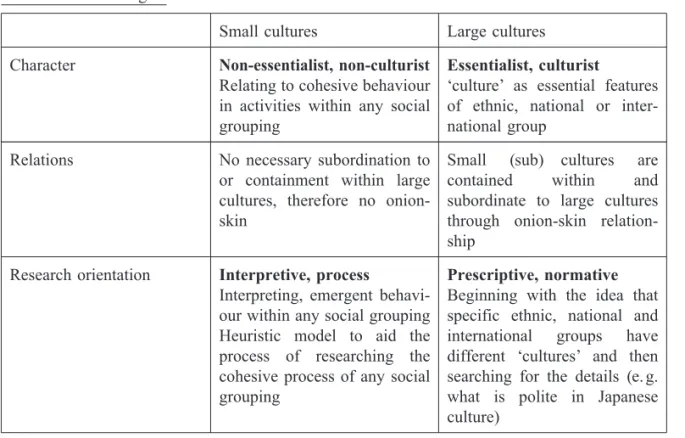
ethnicity/nationality. In the table below, the two paradigms of small and large cultures are
briefly explained and characterized. It seems quite obvious that his emphasis on small
cultures is based on strong disagreement about observing ‘culture’ as something
pre- defined, fixed, and an over- simplified, stereotypical categorization by mere
ethnicity/nationality. Therefore, Holliday’s concept of “small cultures” can be assumed to
be a new concept of cultures that would attempt not to bind people’s behaviour but to
understand it by looking at them as units of cohesive social groups.
In the following sections, there is an explanation of why it is relevant to exploit the concept of small cultures described above to generate “academic culture.” The following sections also discuss what can be expected from the application of small cultures to discussions of academic work in SS.
Academic Culture: Application of Small Cultures to Discussion of Academic Work in SS
It is neither easy nor straightforward to discuss people’s behaviour by using the term
“culture”, since this term almost always implies and puts much emphasis on differences between ‘we’ and ‘others/foreign’, and consequently, our mind is caught by the categorization of ‘we’ and ‘others’ as if ‘we’ and ‘others’ were always different when people have different ethnicity/nationality. It is simply because most of us take for granted that the term ‘culture’ means large cultures, as Holliday (1999) notes, which is conceptualized based on the geographical regions/countries where people come from.
Although there could be such regional/national cultural traits in people’s behaviour and minds, there certainly is a risk of over- generalization about people under study when the concept of large cultures is the only one that is available as a conceptual framework to study diverse people’s behaviour. It is, therefore, apparent that my previous study on
Source: Holliday, 1999: 241
Prescriptive, normative
Beginning with the idea that specific ethnic, national and international groups have different ‘cultures’ and then searching for the details (e.g.
what is polite in Japanese culture)
Interpretive, process
Interpreting, emergent behavi- our within any social grouping Heuristic model to aid the process of researching the cohesive process of any social grouping
Research orientation
Small (sub) cultures are contained within and subordinate to large cultures through onion-skin relation- ship
No necessary subordination to or containment within large cultures, therefore no onion- skin
Relations
Table 1 Two Paradigms
Essentialist, culturist
‘culture’ as essential features of ethnic, national or inter- national group
Non-essentialist, non-culturist
Relating to cohesive behaviour in activities within any social grouping
Character
Large cultures
Small cultures
Japanese scholars failed to confirm
10that so- called Japanese cultural traits existed in and underlay academic activities of Japanese scholars when they encountered discourses with their foreign counterparts. Then, a different framework has to be sought for beyond this popular essentialist framework to study academic work in SS.
A great attention was paid to the concept of small cultures advocated by Holliday, for I noticed that SS scholars around the world carried out similar, if not the same, contents and aspects of academic work. In terms of generating academic knowledge, there is not Japanese, American, or African academic work, but fundamental academic work which can share its concepts and practices around the world such as acquiring existing knowledge, planning and carrying out a research project, and publishing his/her research findings. Then, SS scholars around the world can be assumed to form a certain culture around academic work, regardless of their individual nationalities. Borrowing Holliday’s notions, SS scholars around the world could be a unit of “social group” and academic work could be the “cohesive process of any social grouping” (ibid.: 241). Thus, the concept of small cultures is suitable for establishing a concept of academic culture which has no subordination of national/regional culture.
By setting up the framework of academic culture, not only could we closely observe academic work in a confined setting
11but also we could exploit the observation for future similar studies to clarify and confirm elements and factors which could have an influence on international academic activities. An ultimate aim of establishing academic culture is to achieve mutual discussions among scholars on academic work in SS without the aforementioned “battlefield” nature of discussion by understanding what aspects and practices affect activities generating academic knowledge. I expect that this new type of discussion could be deployed with more qualitative nature of research that would look into details of academic work rather than conventional quantitative analyses of academic work. It is not to reject quantitative analysis on this issue, but to suggest introducing an alternative way to analyse and discuss it, so that SS scholars could see their own work from various angles
12, especially when their work is located in a global setting.
Construct of Academic Culture
Academic culture can contain any aspects of academic work/life, dependent on a researcher’s own interest. As long as the principal of its conceptual framework is a non- essentialist approach and is based on keeping the small culture concept, academic culture can be exploited for a number of studies as an alternative to studies which would normally have intercultural study orientation.
In my current study, academic culture is constructed in order to investigate and
analyse aspects of academic work that could be related to and therefore an influence on activities of international collaborations, which is, in this research context, considered as collaborative activities of academic knowledge generation. In other words, academic work is defined in this research as generating academic knowledge. Therefore, even though most of SS scholars are based in university institutes and are committed to teaching and supervising students as well as their own research activities, teaching work is much less counted as academic work in this study. Moreover, any aspects which are specific to a particular country, discipline, and university are not explored, because collaboration in this study presupposes that it can be international, inter/cross- disciplinary, and/or across diverse universities. If any specific aspects are taken into account, the research outcome would put more emphasis on differences rather than shared aspects of academic work. It is true that individual countries, disciplines, and universities may have their unique aspects; however, the uniqueness is outside the scope of this research
13.
Academic culture in this research is divided into three levels
14: Macro, micro, and social relations. The following are the details of each respective level:
1. Macro level
Macro level is largely an environment where academic work is located. Although it is important to investigate academic work itself, it is not advisable to ignore backgrounds, settings, and locations of academic work, since they could also influence the ways academic work is structured and carried out. In order to investigate such background aspects, certain factors are identified:
J National science policy
Such factors as funding systems/programmes and nationally prioritized research topics/fields could directly influence ways in which academic work –in other words, research activity- - is structured. Additionally, national science policy has also certain impacts on funding programmes/topics of private funding agencies to some extent. In this sense, academic work is largely framed by national science policy, and is influenced by research stakeholders’ interests. Of course, it might not be always the case, but it is apparent that there are always research trends, buzzwords for research topics/themes, and societal/national demands for academic research, which are largely defined and decided by national science policies.
J Institutional infrastructure: Roles of Higher Education
For many researchers, universities are the place for their academic work.
Universities have diverse roles, which are not necessarily related to academic knowledge generation in all countries
15. Even though universities are considered as places where various forms and processes of knowledge generation take place in this research context, it might not be the main and/or only role of university institutions in reality. Such diverse roles of universities are likely to be easily overlooked, since universities are considered as institutions which obtain universally shared concepts, roles, and systems across the world. It might be true to a certain extent; nevertheless, roles of universities might not be totally identical throughout the world. Universities should be can be influenced by policies, demands from society, and other elements that come from outside of universities. It is not diversity of the role of universities but understanding of working environments of SS scholars in which they try to carry out academic work that interests us in the context of this research. The working environment could impact their academic working life, since the working environments could also be an important element that defines what work they are expected to do in universities.
J Mission of academics in the society
Connected to the above roles of universities, the mission of academics in society is explored. That is: How are academics seen/understood in the society? What do the public expect academics to do in the society? These questions are raised to unfold how academics are perceived by the public.
When academics are defined as people who generate academic knowledge, these questions ask what position academics occupy in society. It might seem less relevant, at a glance, to investigate such aspects, but, considering that academic work and scholars do not exist only in academic environments such as universities and other academic societies/institutions, they are certainly connected to the public world, which is non- academic society. Investigating the position and perception of academic people in public society would clarify the relationship between academics, who are people generate academic knowledge, and society. It could also reveal much about the society
16in which they work.
J Academic knowledge in society
Similar to the previous aspect (academics in the society), roles of academic
knowledge and/or relationship between academic knowledge and the society
will be examined.
2. Micro level
Contrary to the macro level, more practical academic work will be explored at the micro level. As already mentioned, the factors in this level as scholars’ practical (daily) work focus on activities/aspects concerning academic knowledge generation.
As relevant factors at micro level, the following five factors are identified:
J Academic discourse practices J Publication practices
J Managing academic activities J Knowledge acquisition practices J Disciplinary practices
These factors are all very straightforward. By investigating these academic practices, a closer look at scholars’ academic working life will be possible. There are inquiries such as: How they communicate with their colleagues, what they discuss with their colleagues, where, how and why they acquire academic knowledge, where, and why they publish their academic work, and other aspects in their daily working life. Earlier in this article, I mentioned that fundamental aspects of academic work can be shared around the world. That is to say, there is no nationally confined or specific academic work. I insist on this point, but it has been much ignored in the study of what academic people actually do in their working life. Therefore, it is not irrelevant to look at something that seems normal, usual, and known to confirm that all these conventional activities are surely carried out with certain purposes and in certain ways.
3. Social relations in academic work
In this section, the below factors are explored:
J Hierarchy/ Status J Gender
J Nationality/Ethnicity
These factors are often considered as components of national cultural characteristics. Including these has little intention of emphasizing national culture per se, but has an intention of simply exploring these factors at work. That means whether or not such social relations influence implementation of academic work.
Further, even if it turns out by empirical study that such social relation factors
influence academic work, this would not directly relate to influence of national
cultural traits because the same could be true in other countries with regard to these
factors
17. Then, it would be rather considered as a part of shared academic culture
across countries/regions. Additionally, there could be other social relation factors in this level. However, I try to limit the factors which could be related to knowledge generation activities, according to the context of the research.
Thus, academic culture is constructed as above. There are many other possibilities to construct academic culture, as suggested earlier. Nevertheless, the construct of aforementioned academic culture is strictly focused on academic work, particularly on academic knowledge generation that is a core of not only individual academic work but also of collaborative work. In the next section, therefore, I will discuss the interrelationship between academic culture and international collaboration.
Academic Culture and International Academic Collaborations
Academic culture to understand international academic collaboration is necessary because it has almost never been attempted to establish a conceptual and analytical framework for this purpose, especially ones which go beyond the nationally confined views that are only used for comparative, country- specific studies. As discussed earlier, international collaborations mean, for academic practitioners, satisfying their intellectual curiosity by working together with others. They are not individually motivated to compete against each other with their national flags. In this light, the existing discussions and analyses would be much less relevant in order to observe academic work from academic scholars’ own viewpoints. In other words, the existing studies have been intensively discussing mainly from the perspective of nation states, and such perspectives suggest they represent scholars themselves consider academic work as a means for international competition. If we think of reasons why we carry out academic work as an occupation, it is certainly not because we would like to beat someone else from other countries. Of course, the reasons for this vary from one person to another, but it can be assumed that SS scholars are interested in knowing and understanding what makes up the world around them. Simultaneously, it is supposed that they are interested in how their foreign counterparts generate knowledge. A possible motivation for academic collaboration can be as simple as this. Then, it is better to totally leave the existing framework and discussions on academic competition, and to consider scholars as those who share aims and motivations for joining academic collaborations, as a unit of social groups.
Academic culture, based on the concept of small cultures advocated by Holliday,
would be more helpful to observe and analyse academic work, even that is carried out
within a country, since, after all, such everyday work is the foundation of all work,
whether it is carried out nationally or internationally. In my current research project, the
Japanese SSH scholars are studied by the framework of academic culture. It does not have an intention to study the “Japanese” academic culture, but to set up the academic culture whose construct would be applicable to academic work in any country. Japan is a case for the first attempt to apply academic culture. Of course, the contents of each factor described above can be diverse from one setting to another. Nevertheless, academic culture is not interested in descriptions of each country’s case and differences between countries. Instead, it is more focused on how those factors would influence academic work in global settings.
Having better understanding of academic work through academic culture would lead us to better analyses of academic work carried out in international scenes. Because academic culture would be able to show ways in which academic work is carried out and the broader background in which academic work takes place, it enables explanation and analysis of activities that could impact and influence international collaborations.
Academic culture does not provide any fixed definitions of academic work. Instead, it provides a broad framework in which diverse activities and phenomena could be observed to analyse academic work. Since each scholar carries academic culture, this framework would be used to explain and analyse joint academic activities when they meet their counterparts, may they be foreign or of the same nationality. Hence, academic culture could provide a different analytical framework to discuss international academic activities beyond a national cultural framework and the competitive nature of discussions of the issue.
Concluding Remarks
Academic culture is not exclusive of the nature of academic work, but is an important
component of academic work when discussing world /globalised SS. It is not to deny any
influence of different working conditions in academic work. Nonetheless, focusing on
differences we encounter in academic work/working conditions would not promote
scientifically fruitful collaborations, and it could rather shed light on more conflictual
aspects in academic work. Needless to say, we have to observe the current situations in SS
that is increasingly globalized and has become borderless in terms of mobility and
interaction between academics from various angles. The existing discussions regarding
international academic activities, however, seem too much interested in differences in
opportunities, materials, prestige, human resources, and other aspects that are claimed as
unequal in different parts of the globe. Although it is not unimportant to discuss and
analyse such conditions, it would be only repetitive if it is the sole point raised in
discussing the globalised academic activities. Additionally, it seems quite evident that
analysing international academic work only from an intercultural study’s viewpoint is rather irrelevant, according to the previous study implemented by the author. Therefore, based on the concept of Holliday’s small cultures, the construct of academic culture is devised in order to build up a totally different approach to analyses of academic work, regardless of the nationality of practitioners. Suggesting this alternative approach to discussions of international academic work could bridge gaps that we have missed in dealing with this challenging thematic discussion.
Acknowledgements
This article is based on my ongoing doctoral thesis project “Investigating Elements in Academic Work for International Knowledge Production in Social Sciences and Humanities: The Case of Japan” (the title is provisional). The project was awarded the research fund by the Konosuke Matsushita Memorial Foundation for the period of October 2012-September 2013.
Notes
1. At a glance, it might seem that the current discussions on structures of globalized academic work in SS have little to do with international collaborations. Nonetheless, the contrastive structures described in this section have strong influence on international collaborative academic activities. As this article discusses, if international collaborations are widely considered as a synonym to ‘international co-authorship’, the relevance of the current discussions dealing with matters of ‘North-South’,
‘centre-periphery’ and other similar topics can be found as a fundamental background of international collaborative activities. Moreover, studies on international academic collaborations are very rare to find, particularly in the field of social sciences. When scholars discuss any aspects of international academic activities, they tend to discuss same/similar topics in the section of the article. This point is also easily found the mentioned World Social Science Report (UNESCO, 2010) to discuss internationalization of world social sciences.
2. However, quite some number of authors in this report seem to be sociologists and bibliometricians.
Therefore, in a strict sense, the discussions do not necessarily represent all social scientific disciplinary fields.
3. The title is “Knowledge Divides” (UNESCO, 2010).
4. For instance, chapter three is titled as “unequal capacities”, chapter four as “uneven internationalization” and chapter five as “homogenizing or pluralizing social sciences?”.
5. For more detailed discussion about this, see “Hegemonic Science: Critique Strands, Counterstrategies, and Their Paradigmatic Premises” (Kuhn, 2013).
6. Ranking system for Higher Education Institutions worldwide also indicates this competitive nature in academic activities.
7. Becher and Trowler (2001) point out that majority of academicians are motivated to acquire individual prestige in their academic fields.
8. In the case of Japan, the Ministry of Education, Culture, Sports, Science and Technology (MEXT) has just launched a new funding project, namely “Top Global University Project” in autumn 2014. This is
“a funding project that aims to enhance the international compatibility and competitiveness of higher education in Japan. It provides prioritized support for the world-class and innovative universities that lead the internationalization of Japanese universities.” (MEXT, 2014 Retrieved on 5 December 2014 from the MEXT website: http://www.mext.go.jp/b_menu/houdou/26/09/__icsFiles/afieldfile/2014/10/
07/1352218_02.pdf)
9. The research participants of this study expressed that it was not different communication style and/or different national cultural traits that could be obstacles in international academic collaborations. Instead, they were much more concerned about that Western-centred methodological approaches and dealing with concepts which rarely exist in research partners’ countries. These would render such international collaborations more problematic and make it more difficult to achieve mutual understandings. From this viewpoint, aspects of conventional intercultural studies seem rather irrelevant to investigating international academic work.
10. Confirming that it is how they are because of their national cultural trait is a typical analytical style of intercultural studies. It is the essentialist/culturist approach exploiting the concept of large cultures.
11. In this research project, the setting is the Japanese SS scholars/academe. It often tends to be interpreted that the study seeks ‘Japanese’ particularities in academic work if one has an image of conventional cultural/intercultural studies. This study has, however, little intention of finding ‘Japaneseness’ in academic work, but to exploit the Japanese SS scholars and academe as a case in order to obtain broader views that are applicable to other similar settings, which, in the context of this study, would be other countries’ scholars and academe.
12. Currently, academic work can be only evaluated quantitatively by number of citations, as discussed earlier in this article.
13. Needless to say, in other research contexts/settings, it would be possible to include the specific aspects that are mentioned in this article. For instance, researching a particular discipline’s academic culture would be possible. What I emphasize here about the specific aspects is to clarify the construct of academic culture for this particular study on academic work with regard to international academic collaborations.
14. The three levels and individual factors are identified and set up, according to a variety of literature on structure of Higher Education (HE) systems, roles of HE institutes, and numerous other studies on HE in general. Strictly speaking, they are too broad to identify and define academic work at more individual and practical level, since the interests of above literature do not necessarily match the interest of this study. However, since there are few studies which has similar orientations to this study, no clear identity
and definition of academic work in this context could be found in existing literature. These levels and factors had to be newly identified and devised by the author.
15. In the case of Japan, universities are expected to contribute to education, research, and contribution to/
cooperation with local communities/societies.
16. Such a question is raised because societal demands have influence on academic work, as previously pointed out. Although the societal demands do not directly come to scholars, what the society requires can often be top priorities as today’s research agenda (e.g. poverty, aging population, unemployment, etc.). Under such circumstances, it is not unimportant to understand what the public society thinks about academics as people generating knowledge.
17. At this moment, we cannot know whether or not it is the case, since the article is based on the study on academic culture focusing on the Japanese SS scholars as a case study. Therefore, it would be clearer about this point when the same/similar studies are implemented in other countries. This entire research project does not yet aim at making a grand generalization on academic culture worldwide, but attempts to suggest another approach to discussion of globalized academic work as such.
References
Becher, T., and P. R. Trowler, 2001,Academic Tribes and Territories: Intellectual Enquiry and the Culture of Disciplines.2nd. Buckingham: SRHE and Open University Press.
Bedeian, A. G., D. D. Van Fleet, and H. H. Hyman, 2009, Scientific Achievement and Editorial Board Membership.Organizational Reseach Methods12-2:211-238.
Franceschet, M., and A. Costantine, 2010, The Effect of Scholar Collaboration on Impact and Quality of Academic Papers.Journal of Infometrics4-4:540-553.
Glänzel, W., and A. Schubert, 2005, Analysing Scientific Networks Through Co-Authorship. In Moed, Henk F., W. Glänz el and U. Schmoch (eds.),Handbook of Quantitative Science and Technology Research, Springer, pp.257-276.
Guest, M., 2002, A Critical 'Checkbook' for Culture Teaching and Learning.ELT journal56 -2:154-161.
Hall, E. T., 1976,Beyond Culture.Anchor Books.
Hicks, D., 2005, The Four Literature of Social Science. Chap. 21. In Moed, Henk F., Wolfgang Glänzel and Ulrich Schmoch (eds.), Handbook of Quantitative Science and Technology Research, Springer, pp.
473-496.
Hofstede, G., 1984, Culture's consequences: International Differences in Work-related Values.Newbury Park: Sage.
Holliday, A., 2000, Culture as Constraint or Resource: Essentialist Versus Non-essentialist View. Iatefl Language and Cultural Studies SIG Newsletter, 38-40.
Holliday, A., 1999, Small Cultures.Applied Linguistics(Oxford University Press) 20-2:237-264.
Katz, J. S., and B. R. Martin, 1997, “What is Research Collaboration?”Research Policy26-1:1-18.
Klein, D. B., and E. Chiang, 2004, “The Social Science Citation Index: A Black Box - with an Ideological Bias.”Econ Journal Watch1-1:134-165.
Kuhn, M., 2013, " Hegemonic Science": Critique Strands, Counterstrategies, and Their Paradigmatic Premises. In Kuhn, M. and S. Yazawa (eds.),Theories about and Strategies against Hegemonic Social Sciences, Tokyo: Center for Glocal Studies, pp.31-54.
Kuhn, M., and K. Okamoto, 2008, Through International Collaborations Towards a Multipolar SSH 'World Order'. Research project report.
Lariviere, V., Y. Gingras, and E. Archambault, 2006, Canadian Collaboration Networks: A Comparative Analysis of the Natural Sciences, Social Sciences and the Humanities.Scientometrics68-3:519-533.
Littlewood, W., 1999, Defining and Developing Autonomy in East Asian Contexts.Applied Linguistics20-1:
71-94.
MEXT (Ministry of Education, Culture, Sports, Science and Technology, Japan). 2014. “Top Global University Project.”MEXT (Ministry of Education, Culture, Sports, Science and Technology, Japan).
Accessed December 5, 2014. http://www.mext.go.jp/b_menu/houdou/26/09/__icsFiles/afieldfile/2014/
10/07/1352218_02.pdf.
Okamoto, K., 2010a, Challenges for Japanese Social and Human Scientists in International Collaborations (Unpublished Masters Degree Thesis submitted to the University of London).
Okamoto, K., 2010b, Internationalization of Japanese Social Sciences: Importing and Exporting Social Science Knowledge. In Kuhn, M. and D. Weidemann (eds.),Interntaionalization of the Social Sciences, Bielefeld: transcript. pp.45-65
Okamoto, K., 2012, Presentation: What is Hegemonic Science?: Power in Scientific Activities in Social Sciences in International Context.Presentation Document: World SSH Net Thinshop in Tokyo.
Okamoto, K., 2013, What is Hegemonic Science?: Power in Scientific Activities in Social Sciences in International Contexts. In Kuhn, M., S. Yazawa and K, Okamoto (eds.),Theories about and Strategies against Hegemonic Social Sciences, Tokyo: Center for Glocal Studies, pp.55-73.
Seglen, Per O., 1997, Why the Impact Factor of Journals should not be Used for Evaluating Research.BMJ 314:498-502.
Shin, J.C., and W. K. Cummings, 2010, Multilevel of Analysis of Academic Publishing across Disciplines:
Research Preference, Collaboration, and Time on Research.Scientometrics85-2:581-594.
Sonnenwald, D. H., 2007, Scientific Collaboration.Annual Review of Information Science and Technology 41-1:643-681.
Stapleton, P., 2002, Critical Thinking in Japanese L2 Writing: Rethinking Tired Constructs.ELT Journal 56-3:250-257.
UNESCO, 2010,World Social Science Report. Paris: UNESCO. Accessed April 10, 2014. http://unesdoc.
unesco.org/images/0018/001883/188333e.pdf.
van Leeuwen, T. N., H. F. Moed, R. J.W. Tussen, M. S. Visser, and A. F.J. van Raan, 2001, Language Biases
in the Coverage of the Science Citation Index and its Consequences for International Comparisons of National Research Performance.Scientometrics51:335-346.
アカデミック・カルチャー:社会科学分野における国際的学術 協同活動に関する議論のための新たな概念的、分析的枠組み
岡本 和美