1. INTRODUCTION
“Eco-M・C・P・S” database (simply referred to hereinafter as Eco-MCPS) is a freely accessible web- based database system developed by the database subcommittee of Ecomaterial Forum in 2006 [1]. Eco- MCPS includes fact data provided by the manufacturers and environmental category descriptions on environment-friendly (environment-conscious) items that fall in one of the groups of materials (M), components (C), products (P), and services (S). Data in Eco-MCPS were initially collected by inquiry survey to companies. Each data is categorized in two different points of view; i.e., product type categories and environmental categories. The product type categories include the materials, components, products, services, and miscellaneous, and each category has a page which provides a list of product items. The environmental categories are further divided into three types; environmental impact, environmental performance, and the life cycle stages of interest [2]. Eco-MCPS has been revised several times; the latest version is Ver. 5, with
- Mining Analysis of Eco-MCPS, a Web-database for Ecomaterials and Products
Riko OZAO1, Taisuke UTSUMI1, Takuya ISHII2, Yoshikazu SHINOHARA3, Kohmei HALADA3
1 Sony Institute of Higher Education, Atsugi, Kanagawa 243-8501, Japan
2 Chiba Prefectural Government, Chiba, 260-8667, Japan
3 National Institute for Materials Science, Tsukuba, Ibaraki 305-0047, Japan
【
abstract】
Eco-MCPS database is a freely accessible web-based database system that contains data of environment- conscious materials, components, products, and services. The text data compiled in Eco-MCPS and the access log data of Eco-MCPS were subjected to data mining. By analyzing the access log, the interest of the visitors accessed to web-site can be understood. The page views (PVs), which represent the visitors’ interest, were related with the frequently used term in the commentary part of the Eco-MCPSs’ Web pages. The PVs before and after the Great East Japan Earthquake on March 11, 2011, showed that the social consciousness on environment-friendly products greatly changed after the Earthquake.
【
key words】
eco-material, eco-product, web database, data-mining, text-mining
- 11 -
――――――――――――――――――――――
<連絡先>
小棹 理子 [email protected]
湘北紀要 第 37 号 2016
intensified security level and newly added functions such as suggesting related information or showing the searched item ranking and the searched word ranking [3]. The data in the database are renewed every year by sending enquiry sheets to the companies. Furthermore, the items are related to each other by the keywords given thereto, and can be found through “Keyword Search”. Therefore, users can search each item from a variety of viewpoints. Thus, Eco-MCPS is not only a simple compilation of facts, but also an interactive site which changes according to the access made by the Web site visitors.
It has been reported [1] that the people’s interests on the environmental issues can be effectively studied by analyzing the access log of Eco-MCPS using a data mining technique. Since environmental problems are not only a matter of technology but are also related to human behavior or consciousness, it is extremely important to involve such methodologies of social science in analyzing the general trends of eco-materials.
For instance, by applying text mining [5] to the text data compiled in Eco-MCPS as product “profile (short sentence describing the product)” and “comments (longer description on the product)”, it was found that in the term 2008-2009, the manufacturers and set-up companies used the term “environment-friendly” to stress their product superiority in energy saving or resource saving [6].
The present analyses have been made to understand how the social consciousness on environment- friendly products had changed after experiencing the Great East Japan Earthquake on March 11, 2011, by applying mining techniques on the facts stored as data in the Eco-MCPS and on the access-log obtained in the period 2010-2011.
2. METHOD
2.1. Details and Functions of Eco-MCPS Web database
The database is open and freely accessible at URL http://eco-mcpsdb.sntt.or.jp/index.php. As reported elsewhere [7], the products can be accessed either from the product categories, the key categories, or the environmental categories (from the viewpoint of environmental impact reduction, the environmental performance required for resolving the problems, or from the life cycle stages of interest). The environmental impacts considered were: (A-1) climate change, (A-2) air pollution, (A-3) hazardous substances, (A-4) wastes, and (A-5) resource consumption. The environmental performance categories include (B-1) easy- to-recycle, (B-2) longer life, (B-3) resource saving, (B-4) higher performance, (B-5) energy saving, (B- 6) environment cleaning, and (B-7) use of recycled materials. Concerning the life cycle of the product, six stages as follows were set: (C-1) extraction, (C-2) material and parts preparation, (C-3) product design, (C-4) production, (C-5) product use/maintenance/repair, and (C-6) waste.
In the Key categories, some products are related to others through “keys”; for instance, products categorized as OA/IT equipment should have main components such as “housing”, and if bio-polymer is used for the casing of a cell phone, this product is linked to other products such as computers via “housing”.
In each product page, two types of Japanese text data are provided as descriptions. One is “profile” and
- 12 -
Environmental Consciousness in Japan after the Great East Japan Earthquake
the other is denoted as “comment”. The “profile” is a short phrase to explain the item’s feature. The “comment”
is a detailed explanation of the item.
2.2. Analysis of item feature
Text mining [5] was applied to the text data; more specifically, the text data compiled as the “profile”
and “comment” in each data sheet were imported into Text Mining Studio (now NTT Data Mathematical Systems, Inc.), which is a package program for text-mining, and were subjected to word-frequency analysis.
The frequency of used words were determined according to the method reported elsewhere [7].
2.3. Analysis of access log
The access log data were obtained on Eco-MCPS data in the same manner as described previously [7].
The total page views were obtained between November 2010 and October 2011. Furthermore, access log obtained during November 1, 2010 to March 11(14:33 pm, the time at which Great East Japan Earthquake occurred), 2011, and that obtained for three months after March 11 (from 14:56 pm to June 30) were subjected to detailed analysis.
3. RESULTS AND DISSCUTION
The total page views before and after March 11 were 2671 and 2311, respectively. The change in page views(PVs) for each category (given in percentage to total PVs) is shown in Fig. 1.
- 13 -
Figure 1 Results of frequency analysis on access log data
“profile” and the other is denoted as “comment”. The “profile” is a short phrase to explain the item’s feature. The “comment” is a detailed explanation of the item.
2.2. Analysis of item feature
Text Mining [5] was applied to the text data; more specifically, the text data compiled up in the database as the “profile” and “comment” of each data sheet, were imported in Text Mining Studio (now NTT Data Mathematical Systems, Inc.), which is a package program for text-mining, and were subjected to word-frequency analysis. The frequency of used words were determined according to the method reported elsewhere [7]..
2.3. Access log
The access log data were obtained on Eco-MCPS data in the same manner as described previously [7]. The total page views were obtained between November 2010 and October 2011.
Furthermore, access log obtained during November 1, 2010 to March 11(pm14:33, the time at which Great East Japan Earthquake occurred), 2011, and that obtained for three months after March 11 (from pm14:56 to June 30) were subejcted to detailed analysis.
3. RESULTS AND DISSCUTION
The total page views before and after March 11 were 2671 and 2311, respectively. The change in page views(PVs) for each category (given in percentage to total PVs) is shown in Fig. 1.
In Fig. 2 is also given the top ten growth rate in PVs, from the largest to the smallest, per category.
湘北紀要 第 37 号 2016
In Fig. 2 is also given the top ten growth rate in PVs per category, from the largest to the smallest.
Figures 1 and 2 clearly show that, after the break of Great East Japan Earthquake, there had been a considerable increase in the access to pages related to “Industrial machines” and to “Use of reproduced materials”; i.e., the PVs increased five-fold and three-fold, respectively, with respect to the PVs obtained in the period prior to the Great East Japan Earthquake.
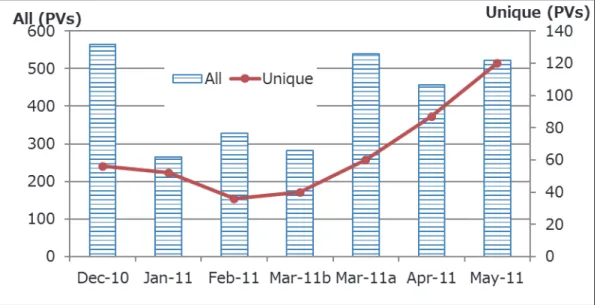
Figure 3 shows the total access log (columns) and the unique number of visitors (line) taken during
- 14 -
Figure 2 Results of growth rate of access log data per category
Figure 3 Traffic data for ECO-MCPS Database
Figures 1 and 2 clearly show that, after the the break of Great East Japan Earthquake, there had been a considerable increase in the access to pages related to "Industrial machines" and to "Use of reproduced materials"; i.e., the PVs increased five-fold and three-fold, respectively.
Figure 3 shows the total acccess log (columns) and the unique number of visitors (line) taken during December 2010 to May 2011 on Eco-MCPS. For March 2011, the period is divided in two;
before March 11 (Mar-11b) and after March 11(Mar-11a). Fig. 3 shows that the traffic became busy after March 11. From Fig.3, it is confirmed that users are frequently visiting Eco-MCPS. Thus, by taking into account the results obtained through Figs. 1 to 3, it can be understood that the
visitors are browsing the Eco-MCPS to search for concrete objectives, such as certain kinds of industrial machines, or re-use of materials.
Figures 1 and 2 clearly show that, after the the break of Great East Japan Earthquake, there had been a considerable increase in the access to pages related to "Industrial machines" and to "Use of reproduced materials"; i.e., the PVs increased five-fold and three-fold, respectively.
Figure 3 shows the total acccess log (columns) and the unique number of visitors (line) taken during December 2010 to May 2011 on Eco-MCPS. For March 2011, the period is divided in two;
before March 11 (Mar-11b) and after March 11(Mar-11a). Fig. 3 shows that the traffic became busy after March 11. From Fig.3, it is confirmed that users are frequently visiting Eco-MCPS. Thus, by taking into account the results obtained through Figs. 1 to 3, it can be understood that the
visitors are browsing the Eco-MCPS to search for concrete objectives, such as certain kinds of industrial machines, or re-use of materials.
December 2010 to May 2011 on Eco-MCPS. For March 2011, the period is divided in two; before March 11 (Mar-11b) and after March 11(Mar-11a). Fig. 3 shows that the traffic became busy after March 11. From Fig.3, it is confirmed that users are frequently visiting Eco-MCPS. Thus, by taking into account the results obtained through Figs. 1 to 3, it can be understood that the visitors are browsing the Eco-MCPS to search for concrete objectives, such as certain kinds of industrial machines, or re-use of materials.
As reported earlier [7], the PVs between October 2010 and September 2011 represent the visitors’
interest in this period, while the frequently used terms in the comments of Eco-MCPS data sheets represent the manufacturers’ intensions on their products. It was concluded that the high PVs for “Easy to Recycle”
products, products having environmental influence to “Wastes”, and those related to “Use of Recycled Material” were all attributed to the Great East Japan Earthquake.
The results suggest that the Eco-MCPS database was utilised for searching methods for recovering earthquake damages and for re-utilizing rubbish as materials in environmentally friendly applications. This is in conformity of the statistics given by The Japan Construction Equipment Manufacturers Association [8]. Figure 4 compares the number of Industrial machines in Eco-MCPS’ access and the trends in shipments of construction machinery. After many visitors viewed the pages of machines just after the 311 disaster, the production of industrial machines turned to increase. In other words, the demand for machines, e.g., construction machinery, expanded after the increase in PVs of Eco-MCPS.
- 15 -
Figure 4 Traffic of Industrial machines and Shipments of construction machinery
As reported earlier [7], the PVs between October 2010 and September 2011 represent the visitors’ interest in this period, while the frequently used terms in the comments of Eco-MCPS data sheets represent the manufacturers' intensions on their products. It was concluded that the high PVs for "Easy to Recycle" products, products having environmental infuluence to "Wastes", and those related to "Use of Recycled Material" were all attributed to the Great East Japan Earthquake.
The results suggest that the Eco-MCPS database was utilised for searching methods for recovering earthquake damages and for re-utilizing rubbish as materials in environmentally friendly applications. This is in conformity of the statistics given by The Japan Construction Equipment Manufacturers Association [8]. Figure 4 compares the number of Industrial machines in Eco-MCPS' access and the trends in shipments of construction machinery. After many visitors viewed the pages of machines just after the 311 disaster, the production of industrial machines turned to increase. In other words, after the increase in PVs of Eco-MCPS, the demand for machines, e.g., construction machinery, expanded.
4. CONCLUSION
It was also found that the increase in access to Eco-MCPS was in relation with the shipments of construction machinery. By analyzing text data and access log of Web-based database Eco-MCPS,
湘北紀要 第 37 号 2016 4. CONCLUSION
The increase in access to Eco-MCPS after March 11, 2011, was closely related with the shipments of construction machinery. By analyzing text data and access log of Web-based database Eco-MCPS during the period of November 2010 to June 2011, it was suggested that the social interest on environmentally friendly products greatly changed after the Great East Japan Earthquake attacked on March 11, 2011. More specifically, eco-materials and products had been searched with the intention to seek tools and methods to recover the damage caused by the earthquake, and searches were made particularly on indudstrial machines and recycled products.
It was also suggested that Eco-MCPS is not only a fact database, but also a tool to understand the social trends and consciousness on environmentally friendly products.
References
[1] R. Ozao: Development of Ecomaterial Database: Kogyo Zairyo, 54 (11), pp62-68 (in Japanese).
[2] R. Ozao, M. Iji, T. Furuyama, K. Yamada, C. Yoshida, Y. Nishimoto, Y. Shimura, K. Halada, “Report on Ecomaterials for Sustainable Society and Feasibility Study on the Development of Eco-materials Database”, Report for The Watanabe Memorial Foundation for the Advancement of Technology (2006).
[3] T. Utsumi, R. Ozao, R. Ishii, H. Kakisawa, Y. Xu, Y. Shinohara, K. Halada: Suggest Function of Eco-M.C.P.S.
Database, Abstract Book of The International Conference of IUMRS in Asia, A1-P26-013 (2014).
[4] R. Ozao, T. Sawaguchi, H. Ishida, M. Iji, T. Furuyama, Y. Shinohara, K. Yamada, K. Halada: Eco-MCPS: a Newly Developed Web-Based Database for Eco-Materials in Japan, Materials Transactions, 48 (2007), pp.3043- 49.
[5] R. Feldman and I. Dogan: Knowledge Discovery in Textural Databases (KDT), Proc. 1st Int’l Conf. on Knowledge Discovery (KDD-95) (1995) pp. 112-117; P. Cabena, P. Hadjinian, R. Stadler, J. Verhees, A. Zanasi, “Discovering Data Mining, from Concept to Implementation”, Prentice Hall, New Jersey (1997).
[6] H. Ishida, R. Ozao, T. Utsumi, Y. Shinohara, K. Halada, Y. Nishimoto: Trends in Eco-materials and Products as Observed through Studies on a Web Database, Eco-MCPS, Trans. Mater. Res. Soc. Jpn., 34 (2009), pp.249-252.
[7] R. Ozao, T. Utsumi, T. Ishii, Y. Seki, H. Ishida, Y. Shinohara, K. Halada, Y. Nishimoto: Environmental Consciousness in Japan on Materials and Products - Analysis of Eco-MCPS, a Web-database for Ecomaterials- , Journal of Shohoku College, 35 (2014), pp15-24.
[8] The Japan Construction Equipment Manufacturers Association, Trends in Construction Machinery Production (2010 & 2011); http://www.cema.or.jp/general/index.html (accessed on Sept. 6, 2012)
- 16 -