PAPER
Special Section on Smart Multimedia & Communication SystemsDetecting Surface Defects of Wind Tubine Blades Using an Alexnet Deep Learning Algorithm
Xiao-Yi ZHAO†,††,Nonmember, Chao-Yi DONG†,††a),Member, Peng ZHOU†,††, Mei-Jia ZHU†,††, Jing-Wen REN†,††,andXiao-Yan CHEN†,††,Nonmembers
SUMMARY The paper employed an Alexnet, which is a deep learning framework, to automatically diagnose the damages of wind power gener- ator blade surfaces. The original images of wind power generator blade surfaces were captured by machine visions of a 4-rotor UAV (unmanned aerial vehicle). Firstly, an 8-layer Alexnet, totally including 21 functional sub-layers, is constructed and parameterized. Secondly, the Alexnet was trained with 10000 images and then was tested by 6-turn 350 images. Fi- nally, the statistic of network tests shows that the average accuracy of dam- age diagnosis by Alexnet is about 99.001%. We also trained and tested a traditional BP (Back Propagation) neural network, which have 20-neuron input layer, 5-neuron hidden layer, and 1-neuron output layer, with the same image data. The average accuracy of damage diagnosis of BP neural net- work is 19.424% lower than that of Alexnet. The point shows that it is fea- sible to apply the UAV image acquisition and the deep learning classifier to diagnose the damages of wind turbine blades in service automatically.
key words: deep learning, Alexnet, 4-rotor UAV, BP neural network, wind power generator blade, damage diagnosis
1. Introduction
Presently, with the power generation capacity of wind tur- bines increasing gradually, the volume, the height, and the surface area of generating units have increased tremen- dously. It becomes more and more difficult to observe the surface condition of wind power generator blades in an overall and detailed manner. Current detection meth- ods for blade surface damage include: ground percussion sound detection, telescope observation, or close inspection by maintenance engineer transport. When applied for the diagnosis of wind power generator blade surface damages, these aforementioned methods usually have some limita- tions: for example, large blind areas, high risks, low pre- cisions, long time consumptions, and large power consump- tions[1]. Compared to other UAVs, rotary-wing UAVs have more significant characteristics of low cost and good adapt- ability to environment. In addition, only through the con- trol of four motors, rotary-wing UAVs can perform a vari- ety of flight attitude adjustments and changes, such as tum- bling, pitching, yaw, and vertical take-offand landing. Thus, compared to the traditional fix-wing UAVs, they are more
Manuscript received February 11, 2019.
Manuscript revised June 16, 2019.
†The authors are with Inner Mongolia University of Technol- ogy, Hohhot, Inner Mongolia, 010080, China.
††The authors are with Inner Mongolia Key Laboratory of Me- chanical and Electrical Control, Hohhot, Inner Mongolia, 010051, China.
a) E-mail: [email protected] (Corresponding author) DOI: 10.1587/transfun.E102.A.1817
suitable for the implementation of fixed-height and fixed- point hovering tasks. Therefore, rotary-wing UAVs are used extensively in plant protection, wire-inspection of electric power systems, emergency rescue, express delivery, and etc.
Yuan B., Wang C. et al. [2] proposed a novel wind turbine blade anomaly detection system based on Wavelet- FCNN (Fully Convolutional Neural Network) classifier.
The experimental results show that the accuracy of Wavelet- FCNN classifier in detecting icing fault reaches 81.82%, which is 15.91% higher than the original FCNN classifier without combining the Wavelet method.
Gao F., Wu X.J. et al. applied a new method to de- tect blade damage of wind turbines using wavelet packet energy spectrum analysis and operation mode analysis[3].
This method employs wind simulation software to simulate the damage fault of wind turbine blades, analyzes the dis- placement signal of leaf tip by Fourier analysis and wavelet packet energy spectrometry, and makes a preliminary eval- uation and classification of blade damages. This method is limited to simulation analysis, and has not been applied to actual production and operation occasions.
By manipulating a rotary-wing UAV, we can obtain the surface images of wind power generator blades. Then, a pattern recognition algorithm, based on the machine visions and a deep learning framework is applied to diagnose and classify the surface damages. More detailedly, the research adopts an Alexnet architecture to design the damage defect classifier. The processes of feature extraction and cluster- ing are integrated into the network training process, which greatly improves the effectiveness of the automatic classify- cation of wind power generator blades surface damage.
In contrast, our paper analyzes the image data of wind turbine blades operating on the wind power generation pro- duction sites, and uses the deep learning algorithm to au- tomatically diagnose the wind turbine blade damages. The higher diagnostic accuracy verifies the validity and practica- bility of the proposed wind turbine blade damage inspection method. The wind turbine blade damage diagnosis method proposed in our paper is a non-destructive testing method, and it is not necessary to install any signal acquisition de- vice for the wind turbine blade.
At present, UAVs are widely used in the fault detec- tion of power equipment (including high-voltage transmis- sion lines, towers, fittings, photo-voltaic panels, etc.), how- ever a deep learning algorithm is rarely reported in the de- tection of blade surface defects of wind turbines. Based on Copyright c2019 The Institute of Electronics, Information and Communication Engineers
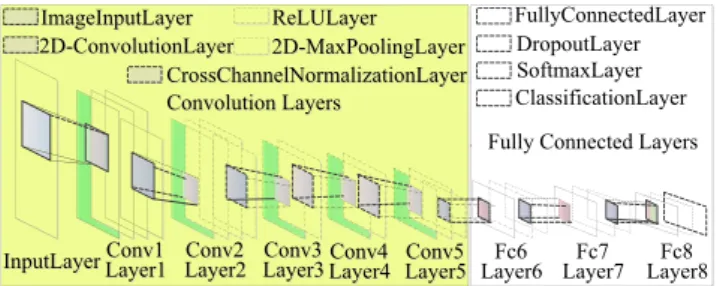
Fig. 1 The framework diagram of an Alexnet.
the above research, at present, we can plan the cruise route of UAV in advance, realize the full-automatic damage di- agnosis of wind turbine blades, and establish the full-cycle health records of wind turbine blades.
2. Method
2.1 Alexnet
In 2012, the team directed by Alex Krizhevsky from Toronto University, firstly introduced the Alexnet architecture to the ImageNet competition and won the championship of the competition. The Alexnet is one kind of deep convolutional neural network (CNN) with 8 layers as shown in Fig. 1.
The Alexnet consists of 5 convolution layers and 3 fully connected layers, and each layer contains 2∼4 functional sub-layers. The functional sub-layers belonging to the con- volution layers are composed of: one ReLU sub-layer, one cross channel normalization sub-layer, one Max-Pooling 2- D sub-layer. The functional sub-layers inside the fully con- nected layers consists of: one fully connected sub-layer, one ReLU sub-layer, one dropout sub-layer, one softmax sub- layer, and one classification sub-layer. Such a deep learning framework has three distinct characteristics: 1. In the convo- lution sub-layers, the dimension of the convolution nucleus is always larger than the convolution step length. It is shown that the descriptions of image pixels by the convolution sub- layers are overlapped with each other, which facilitates the comprehensive expression of the feature pixels. Thus, such comprehensive expression makes feature learning and pre- dictions more accurately. 2. Seven of eight network layers contain the ReLU sub-layers. As an activation function of a mathematical mapping from sub-layer input data to network weights, ReLU sub-layers make linear corrections for the in- put data. Since about 50% neurons of ReLU sub-layers are activated[4], such sparse activation states induce relatively sparse network connections and greatly alleviates the heavy training and testing tasks of the Alexnet. 3. The Dropout sub-layers can prevent an over-fitting of the feature data by randomly concealing some of neurons temporarily. Suppose that one Dropout sub-layer hasnneurons, the network has a predictive ability, improvements of the Alexnet framework mainly lie in the two aspects: namely, the ReLU sub-layers supported by the ReLU activation function and the Dropout sub-layers with the temporarily randomly hidden neurons.
2.1.1 ReLU Sub-Layer
Rectified Linear Unit (ReLU) function, being a variation of the slope function, becomes a breakthrough technology in the field of constructing nonlinear activation functions. In general, the ReLU function refers to the ramp function in mathematical viewpoint:
f(x)=max(0,x) (1)
In the framework of Alexnet, ReLU, as the activation function of the neurons, determines the nonlinear outputs of the current layer. The input of ReLU is formed by a linear transformation (ωTx+b) of the layer input x, whereω is a non-zero row vector andb is a column vector. Based on the principle of brain network communications, the infor- mation encoding of biological neurons is usually dispersed and sparse[5], instead of densely connected with each other.
In fact, only 1%∼4% neurons in brains are activated at one moment. For the biological neural networks, the neurons employ any non-linear activation function so that the single- layer biological neurons could acquire the ability to solve linear inseparability. The application of linear correction and regularization can effectively debug the degree of activ- ity of neurons in neural networks, i.e. the outputs of layers are positive.
By contrast, the logistic function outputs 1/2 when the input is 0. The half-saturation state does not conform to the expectations of the output of the actual biological neu- rons [4]. However, the ReLU activation function enables approxi-mately 50% of the neurons in the layer to be ac- tivated [4], which complies with the principle of biology.
Generally, the use of ReLUs enhances the efficiency of Alexnet, and also alleviates the problems of gradient di- vergence, gradient disappearance, network parameter over- fitting.
2.1.2 Dropout Sub-Layer
The Dropout algorithm is applied to the field of machine vi- sion based on deep learning for alleviating the over-fitting situations in the deep learning network. The algorithm forces one neuron to connect with the remaining randomly emerging neurons and communicate with each other. This process weakens the joint-adaptability between the neurons, enhances the generalization ability of the network, and ef- fectively reduces the computing consumption of network in- formation transmission.
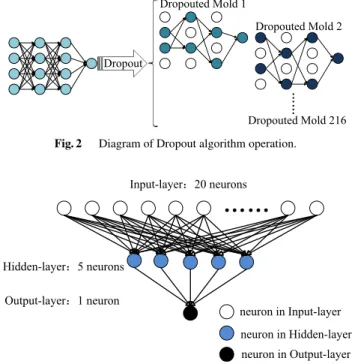
In Alexnet, the probability of random hidden neu- rons in the Dropout sublayer is 0.5. The process of cross- validations shows: the number of possible randomly gen- erated Dropout sub-layer network structures arrive its max- imum, when the probability of random hidden neurons in the Dropout sublayer is 0.5. The maximum corresponds to the strongest generalization ability. Take an example of a m-layer network withnneurons in each layer. Suppose that
Fig. 2 Diagram of Dropout algorithm operation.
Fig. 3 The framework diagram of the constructed BP neural network.
m=3,n=4, the dropout probability ratio is 0.5. The work- ing process diagram of the Dropout layers is illustrated as follows:
2.2 BP Neural Network
BP neural network, is a kind of multi-layer feedforward ar- tificial neural network put forward by Rumelhart and Mc- Clelland in 1986 [1]. As stated by its name, the training processes of the BP neural networks are based on an error inverse propagation algorithm and in theory a 3-layers BP neural network can simulate any nonlinear mapping.
For a BP neural network, which is a traditional pattern recognition method, it is necessary to extract the image fea- tures artificially before the network is trained. However, for an Alexnet, which is deep learning network, it can extract the features of the original data autonomously in its front layers. Therefore, the process of feature extractions is not necessary for a Alexnet. Nevertheless, a feature extraction is still a prerequisite for a BP network training.
In this paper, a three layers BP neural network is con- structed. The input layer corresponds to the extracted fea- tures. Considering that there are 20 features were extracted for the BP network, the output layer has 20 neurons and one neuron represents a feature. The value of an output layer indicates a class which the input vector belongs. Therefore, the output layer includes one neuron. Here, the BP network only contains one hidden layer, and the number of neurons in the hidden layer can be determined by a test process. In other words, by the optimization method, we can find the optimal network structure of the BP Neural network with a peak of the network test accuracy. The framework diagram of theconstructedBP Neural network is show in Fig. 3.
3. Experiments and Results
The Alexnet was built on the MATLAB 2017b to automati- cally diagnose the surface damages of wind power generator blades based on UAVs’ machine visions. Firstly, the im- ages, collected by UAVs, are cropped and the typical dam- age images of wind power generator blades are marked and selected for training. Then, the training process was per- formed using 10000 images. Based on the trained Alexnet, 6 turns of tests for 6 different groups of images are con- ducted. Finally, a sub-layer visualization was applied to the convolution layers of the untrained and the trained Alexnet, and an output feature map of the sub-layer-visualization was analyzed.
3.1 An Brief Introduction to the Wind Power Generator Blade Images Captured by UAVs
Normally, each initially captured image includes 5472 × 3078 pixels. When the storage space becomes limited and the UAV is still under the working conditions, the UAV sys- tem goes into the saving storage mode and the size of images is compressed into 4096×2160 pixels. We crop the original images into the sub-images with a pixel size of 227×227.
With the additional 3 dimensional RGB information, the to- tal size of the input images for Alexnet training and testing is 227×227×3. Zero pixel borders, i.e., black compensa- tion edges, are need to be added in the cropped sub-images, when the number of cropped image pieces is not integer. All images are classified into 3 categories: No defect or false de- fect, cracks, and sand holes, which are the 3 kinds of outputs of Softmax sub-layers.
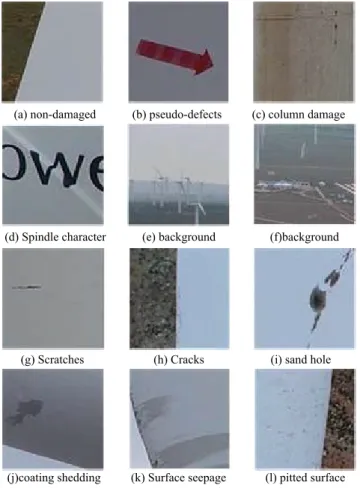
The class of no defect or false defect includes back- grounds, pseudo-defects, column damages, characters on the outer shells of wind power generator blade spindle, and non-damaged wind power generator blade; the class of cracks includes fine cracks, slight scratches, and strip en- larged damages cumulated by unrepaired wind power gen- erator blade defects; the class of sand holes includes the tiny black sand holes, the coating peeling off, the pitted surface caused by some sand holes accumulation and the surface water seepage of the blades.
In the experiment, 10000 images were used to train the Alexnet where 568 images were labeled as the crack class, 8176 images were taken as no defect or false defect class, and 1256 images were considered as sand holes class. Run- ning on an Intel Core i5 CPU and 4G RAM, the training pro- cess lasted for about 84 hours, and 550 iterations of training happened.
Based on the trained Alexnet, 6 rounds of tests were performed, each round used 350 images. Compare the orig- inal category labels to the network output labels one by one.
By calculation, the average accuracy rate of damage diag- nosis is 99.001%. The results of 6 round of experiments based on the machine visions for automatic diagnosing wind power generator blade surface damages are shown in Ta-
Table 1 Statistics of Alexnet diagnosis.
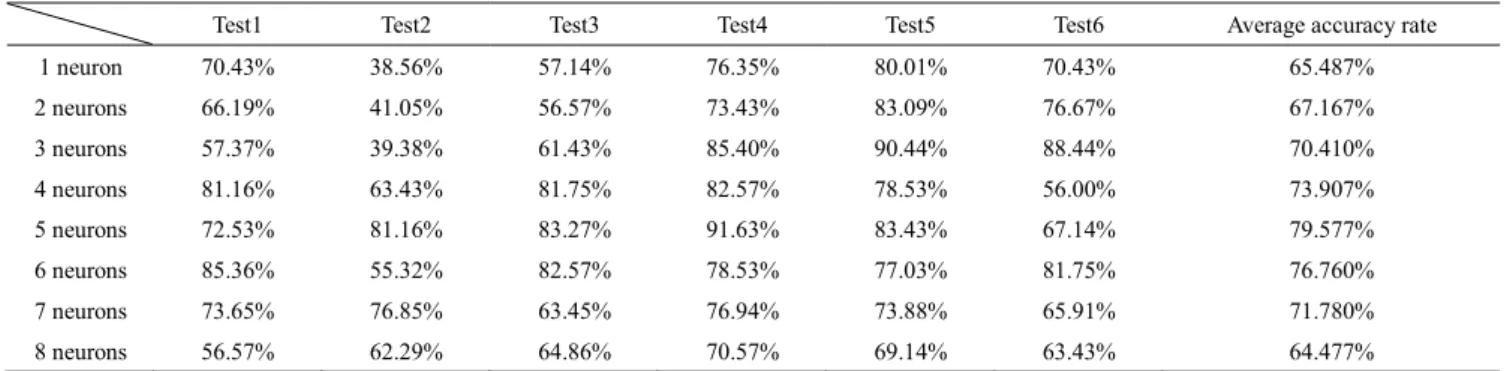
Table 2 Statistics of 6 turn tests for different scales of the hidden layer of the BP network.
ble 1.
3.2 Experiment Protocols of the BP Neural Network In the BP neural network, number of neurons in hidden- layer is determined by network testing. The BP Neural net- work uses the same training data and testing data as the Alexnet did. Initially, the number of neurons is increased from 1 to 8 one by one. When one the hidden layer neurons is added, it needs to be re-trained and tested 6 times with 6 different sets of image data (see Table 2). The average ac- curacy of the tests is the basis of determining the number of neurons in the hidden layer. As we can see in Fig. 6, the accuracy of diagnosis is gradually increasing at the begin- ning, and the accuracy of diagnosis begin to decrease after the number of hidden layer neurons is greater than 5. This indicates that the optimal neuron number of the hidden layer is 5.
3.3 Reverse Observed Alexnet Network Structure Based on Sub-Layer-Visualization
The process of feather extractions by sub-layer-visualization can be implemented by an activation function. According to their functions, the 8-layer structures of Alexnet can be divided into two groups: the convolution 2D layer and the fully connected layer.
In the sub-layer-visualization method, a tested original image is directly taken as the input data of the current visu- alized sub-layer. That means that only one sub-layer is con- sidered when the sub-layer-visualization method is working.
Through the observations in Fig. 8 and Fig. 9, it is easy to know that according to the outputs of the 4 sub- layers in layer1 the performances of trained Alexnet are bet- ter than that of untrained Alexnet in a respect of depress- ing the noise. For ReLU sub-layers, the trained Alexnet mapping typical damage features are more vivid than un- trained Alexnet.
Each convolution 2D layers consists 2, 3, or 4 func- tional sub-layers and each fully connection layers consists of 3 functional sub-layers. Take an example of the conv1 layer, which has the maximal number of functional sub- layers among 5 convolution 2D layers. Activate every func- tional sub-layer in conv1 layer and observe the processes of its convolutions and max-pooling. But on fully connected layer, transformed from pixel arrangement the feature to the data form, pixel-point output is distortion. So there is not to research that.
We can acquire layer output feature pixel images, so that it is easy to know the working states of forward training.
If let an image fed in Alexnet, we can see the working states of testing process.
4. Discussion
4.1 UAVs’ Application to Image Acquisition
The data applied for the damage diagnosis come from a large amount of field captures by a 4-rotor UAV in the Guohua WuChuan wind farm and Huarun ChaYouZhongQi wind farm. Through the field investigations of wind power industries, a variety of schemes of cruise paths for detecting
Fig. 4 Surface sample image of blades.
Fig. 5 The trend of the average test accuracy with an increase of the neuron number of the hidden layer.
the images of wind turbine blades are designed according to the different running states of wind turbines. During the period of weak wind, the wind turbine is shut down or in a slow operating speed. A close-range and slow-speed in- spection scheme could be adopted. When the wind turbine runs at a rated load, a scheme of plane slow-track inspec-
Fig. 6 The original image of sub-layer-visualization.
Fig. 7 Sub-layer-visualization experiment on layer1 of untrained Alexnet.
tion with fixed distance from the rotating plane of the blade is adopted. When the wind season is coming and the speed of the wind power blade is over a rated speed, a fixed-point shooting plan with a fixed distance from the blade rotation plane is adopted.
4.2 Automatic Diagnosis
For the traditional classification method, BP classifier, it is necessary to artificially extract the damage features of wind turbine blades images. In addition, to ensure the validity of the feature parameters, a preprocess and segmentation of images is usually conducted before extracting the feature pa- rameters. However, the deep learning classification method, Alexnet can extract the features of the original data automat- ically in its front layers. Therefore, Alexnet does not need
Fig. 8 Sub-layer-visualization experiment on layer1 of trained Alexnet.
the preprocess and segmentation of images.
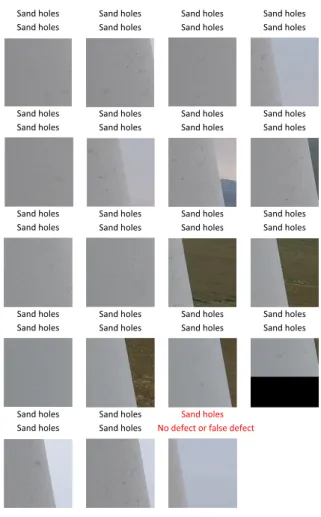
For Alexnet, some of test examples are shown in Fig. 9.
The labels on the top of the image are the original label and the classified label from top to bottom. When the two labels are the same, they are indicated by black color, otherwise by red color. According to Fig. 9, 18 of 19 samples of sand holes were classified correctly, 1 of 19 sample was identified wrongly. The wrong one was mistakenly divided into no defect or false defect class rather than sand hole class, which is a realistic case. For the image not categorized correctly, the diagnosis system can locate its file path and validate its classification accuracy as shown in Fig. 10.
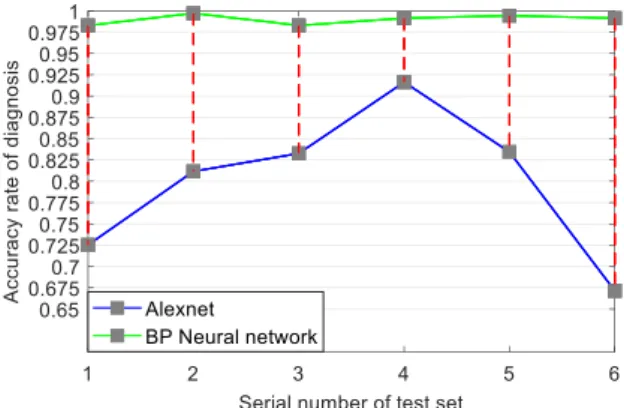
The diagnostic accuracy of 6 test sets for the surface damages of wind power generator blades on the Alexnet and BP neural network are compared in Fig. 11. The diagnosis result of the Alexnet is more robust than that of the BP neu- ral network, when both of them are applied for detecting the surface damages of wind power generator blades. In 6 rounds of tests, the fluctuation range of test accuracy for the BP neural network is 0.2449, which is quite higher than that of Alexnet.
5. Conclusion
In this study, we employed an Alexnet, a deep learning framework, to automatically diagnose the damages of wind power generator blade surfaces in real industrial fields.
Fig. 9 Classification results of sand holes.
Fig. 10 Map of misclassification image.
UAVs are used to inspect the operational wind turbine blades. Under the condition of keeping a certain safe dis- tance, normally 5 m∼20 m, the wind turbine blades placed at the height are carefully and comprehensively observed, and the high-quality images are obtained. Manipulating UAV to cruise around the operational wind turbine blades and to capture images realizes the damage inspections without shutdown economic loss. Compared to the traditional clas- sifier, the deep learning classifier has a higher degree of au- tomation. Alexnet not only eliminates the tedious steps of manually extracting features included in the framework of traditional classifiers, but also has a higher diagnostic accu- racy. For practical engineering application, it is more suit-
Fig. 11 Test accuracy rate of diagnosis in the Alexnet and the BP classi- fication methods for 6 tests.
able for wind turbine blade damage diagnosis because of its ease to use. We can plan a cruise route for UAVs to automat- ically capture wind power generator blade images. When large-scale images data are collected, the classification work can be distributed on multiple-core GPU (Graphics Process- ing Unit) server for performing a parallel computation pro- cess to save time. Thus, the proposed method can help wind plants to establish full-cycle health records of their wind tur- bine blades.
Acknowledgments
This work was supported by the Program for Scientific Re- search Projects of Institutions of Higher Learning in In- ner Mongolia Autonomous Region (NJZY16093), Young Talents of Science and Technology in Universities of In- ner Mongolia Autonomous Region (Grant No.NJYT-15- A05), the Program for Inner Mongolia Autonomous Region Prairie Excellence Specialist (the 5th batch), and Inner Mon- golia Science and technology achievements transformation project (CGZH2018129).
References
[1] L.-X. Xu, Study on Surface Defect Detection of Wind Turbine Blades, China Institute of Metrology, Hangzhou, Zhejiang, 2015.
[2] B. Yuan, C. Wang, F. Jiang, M. Long, P.S. Yu, and Y. Liu, “Wavelet- FCNN: A deep time series classification model for wind turbine blade icing detection,” arXiv:1902.05625, 2019.
[3] F. Gao, X. Wu, et al., “Fault simulation and online diagnosis of blade damage of large-scale wind turbines,” Energies, vol.12, no.3, pp.522–537, 2019.
[4] X. Glorot, A. Bordes, and Y. Bengio, “Deep sparse rectifier neural networ vhbks,” J. Jmlr. W. & Cp., vol.15, pp.315–323, 2012.
[5] A. Krizhevsky, I. Sutskever, and G.E. Hinton, “ImageNet classifica- tion with deep convolutional neural networks,” International Confer- ence on Neural Information Processing Systems Curran Associates Inc., pp.1097–1105, 2012.
[6] V. Nair and G.E. Hinton, “Rectified linear units improve restricted boltzmann machines,” International Conference on Machine Learn- ing Omnipress, pp.807–814, 2010.
[7] K. He, X. Zhang, S. Ren, and J. Sun, “Delving deep into rectifiers:
Surpassing human-level performance on imagenet classification,”
2015 IEEE International Conference on Computer Vision (ICCV), pp.1026–1034, 2015.
[8] D. Attwell and S.B. Laughlin, “An energy budget for signaling in the grey matter of the brain,” J. Cereb. Blood Flow Metab., vol.21, no.10, pp.1133–1145, 2001.
[9] J. Zhang, Research on Image Retrieval Based on Alexnet Fusion Feature, Chongqing University of Posts and Telecommunications, 2016.
[10] L.-W. Wang, “Recognition method of Oxford Flowers based on Alexnet,” J. Science and Technology Horizon, vol,14, p.83, 2017.
Xiao-Yi Zhao received her B.E. in Electri- cal Engineering and Automation from Jilin Uni- versity of Architecture and Technology in 2016, and her M.Sc. in Control Engineering from In- ner Mongolia University of Technology in 2019.
Her research interests include deep learning al- gorithm designs based on computer vision and pattern recognitions.
Chao-Yi Dong is a professor of College of Electric Power, Inner Mongolia University of Technology. He is a member of IEEE and IEICE. He received his B.E. in Electrical Engi- neering from Hefei University of Technology in 1997, his M.Sc. in Control Theory and Control Engineering from Inner Mongolia University of Technology in 2002, and his Ph.D. in Control and Robotics from Korea University (Korea) in 2009. He was a visiting scholar of Labora- tory for Systems Biology and Bio-Inspired En- gineering (SBIE)” in Korea Advanced Institute of Science and Technology (KAIST), Korea, in Jul., 2010. He also was an academic visitor of Indus- trial Control Center in University of Strathclyde, UK from March to Sept., 2016.
Peng Zhou received his B.E. in Electri- cal Engineering and Automation from Shengli College China University of Petroleum in 2014, and his M.Sc. in Control Engineering from In- ner Mongolia University of Technology in 2018.
His research interests include control system de- sign and pattern recognitions.
Mei-Jia Zhu received her B.E. in Au- tomation from Lanzhou University of Technol- ogy in 2016, and her M.Sc. in Control Sci- ence and Engineering from Inner Mongolia Uni- versity of Technology in 2019. Her research interests include system modelling and pattern recognitions.
Jing-Wen Ren received her B.E. in Electri- cal Engineering and Automation from College of Information and Business, North University of China in 2016, and her M.Sc. in Control Sci- ence and Engineering from Inner Mongolia Uni- versity of Technology in 2019. Her research interests include system modelling and pattern recognitions.
Xiao-Yan Chen received her B.E. in Au- tomation of Electric Systems from China Agri- cultural University in1997, and her M.Sc. in Control Theory and Control Engineering from Inner Mongolia University of Technology in 2003. Her research interests include control sys- tem design and machine learning.