2018 年(平成 30 年)度 博士学位論文
香港の上級日本語学習者の書くプロフィシェンシーの研究
―コミュニケーション能力の理論の枠組みとの関係から―
京都外国語大学大学院外国語学研究科 博士後期課程
異言語・文化専攻
言語教育領域
2016DC0001
上田 早苗
目次 第1 章 序論 本研究の背景と目的 1 第2 章 先行研究 5 2.1 本研究と関連する先行研究について 5 2.2 コミュニケーション能力の理論 6 2.2.1 Chomsky(1965) 6 2.2.2 Hymes(1971) 6
2.2.3 Canale and Swain(1980) 7
2.2.4 Canale(1983) 8 2.2.5 Bachman(1990) 8 2.2.6 コミュニケーション能力の理論に関する先行研究のまとめ 11 2.3「プロフィシェンシー」と評価 12 2.3.1 「プロフィシェンシー」の定義 12 2.3.2 ACTFL-OPI の運用能力評価基準 18 2.3.3 OPI を利用した日本語学習者のレベル別の言語特徴に関する先行 研究 25 2.4 ポライトネス理論 27
2.4.1 Brown and Levinson(1978) 27
2.4.2 北尾・北尾(1988) 29 2.4.3 宇佐美まゆみ(2003) 31 2.5 「依頼機能」に関する先行研究 33 2.5.1 柏崎(1993) 33 2.5.2 熊谷(1995) 33 2.5.3 猪崎(2000a)、猪崎(2000b) 34 2.5.4 李(2004) 35 2.5.5 大友(2009) 35 2.5.6 浜田(1995) 36 2.5.7 山口(1996) 36 2.5.8 中道・土井(1995) 36 2.5.9 「依頼機能」に関する先行研究のまとめ 37 2.6 メール文、手紙文の評価の観点 37 2.6.1 金澤編(2014) 37 2.6.2 宇佐美洋(2014) 40 2.6.3 メール文、手紙文の評価の観点のまとめ 41
2.7 日本語のアカデミックライティングの評価の観点 44 2.7.1 田中のライティングに関する研究 44 2.7.2 長谷川・堤(2011)、長谷川・堤(2012) 45 2.7.3 東京外国語大学留学生教育センター(2017)JLPTUFS アカデミ ック日本語Can-do リスト 46 2.7.4 アカデミック・ライティングの評価の観点に関する先行研究の まとめ 46 第3 章 問題提起 48 第4 章 調査の対象となるデータ 50 4.1 調査の対象となるデータ 50 4.2 なぜ「メール文」と「レポート」を研究対象とするのか 53 4.3 プロフィシェンシーテストとアチーブメントテスト 55 第5 章 香港の上級日本語学習者の書く力の現状-調査1 57 5.1 本章の目的 57 5.2 実験の概要 57 5.2.1 目的 57 5.2.2 対象 57 5.2.3 方法 57 5.3 結果 59 5.3.1 筆者による全体のレベル推定結果 59 5.3.2 サンプルのレベル推定結果の比較 59 5.3.3 サンプルのレベル推定理由の比較 60 5.4 本章のまとめ 65 第6 章 「メール文 1」の課題に見られる問題点-調査 2 66 6.1 考察の対象となる課題 66 6.2 学習者のメールに見られる問題点と考察 66 6.3 依頼の各展開要素の使用人数 67 6.3.1 予告(件名) 68 6.3.2 依頼前の行動 69 6.3.3 依頼(「受け入れてもらえるかどうか」を問い合わせる文) 77 6.3.4 依頼後の行動 79
6.4 本章のまとめ 82 第7 章 「メール文 2」の課題に見られる問題点-調査 3 83 7.1 考察の対象となる課題 83 7.2 「依頼」のメールに関する先行研究 83 7.3 依頼の各展開要素の使用人数 83 7.4 依頼の各展開要素 84 7.4.1 予告(件名) 84 7.4.2 依頼前の行動 86 7.4.3 予告(本文) 89 7.4.4 状況説明 89 7.4.5 読み手が必要とする情報が含まれている例 90 7.4.6 依頼 91 7.4.7 依頼後の行動 94 7.5 本章のまとめ 97 第8 章 「レポート」の課題に見られる問題点-調査 4 99 8.1 本章の目的 99 8.2 「初級」相当ではないと考えられる理由 99 8.3 「卓越級」相当に達しているかどうかわからない理由 100 8.4 「中級」相当であると考えられる理由 100 8.5 「上級」相当であると考えられる理由 103 8.6 「超級」相当であると考えられる理由 106 8.7 レポートにおける「超級」マーカー 109 8.7.1 経験・記録の「~ている」 110 8.7.2 行動提示の文 110 8.7.3 接続表現 112 8.7.4 コ系またはソ系指示詞 113 8.7.5 文末のバリエーション 113 8.8 本章のまとめ 115 第9 章 学習者が書いた文章に対する日本語母語話者のコメント-調査 5 116 9.1 本章の目的 116 9.2 調査の方法 116 9.3 「メール文 1」に対するコメント 117
9.4 「メール文 2」に対するコメント 122 9.5 「レポート」に対するコメント 135 9.6 本章のまとめ 142 第10 章 考察―コミュニケーション能力の理論の枠組みと学習者のライティン グに見られる問題点、評価の観点の関係 144 10.1 「メール文1」に現れる問題点とコミュニケーション能力の理論の 枠組み 144 10.2 「メール文 2」に現れる問題点とコミュニケーション能力の理論の 枠組み 148 10.3 「レポート」に現れる問題点とコミュニケーション能力の理論の枠 組み 151 10.4 「ストラテジー能力」の内容 155 10.5 本章のまとめ 158 第11 章 まとめと今後の課題 160 注 165 資料 169 参考文献 172 引用教材等 178 参考ウェブサイト 179
A Study of Writing Proficicency of Hong Kong-based Advanced
Japanese Language Learners from the Perspective of Relationship with
Communicative Competency Framework
UEDA Sanae
Abstract
Chapter 1 presents the backgrounds and objectives of this study.
What does proficient of a particular language refer to? Grammar
buildup approach textbooks are often used as teaching materials in traditional
Japanese language education. However, with the increasing concern over
the issue that learners are unable to communicate in real life situation through
classes with emphasis on grammar teaching, in recent years the concept of
“Proficiency” in teaching Japanese as a foreign language is receiving more
attention from different stakeholders in the field of Japanese language
education. It is generally believed that “Proficiency” has a close
relationship with “Communicative competency”. For those Hong
Kong-based Japanese language learners, since they have no resistance in
learning and using different languages, by utilizing the advantage of their
knowledge in Chinese character (Kango) words which those learners from
non-Chinese character regions do not possess, their Japanese language
proficiency can be strengthened effectively by extracting the differences in
communicaton competency between Hong Kong-based learners and native
speakers of Japanese as it is significant to make Hong Kong-based learners
realize such details in communicative competency comparsion between
themselves and native speakers of Japanese. This paper aims to uncover
how to coach Hong Kong-based Advanced Japanese language learners on
their writing skills so that they can write better (become more “proficient”)
than they have been doing by analyzing the papers of 3 types of tasks
performed by Hong Kong-based Japanese language learners as one of the
communication activity, namely “writing”.
Chapter 2 summarizes the literatuere review of this study.
First, the author of this paper summarizes the theories related to
“Communicative competence” from Chomsky (1965) to Hymes (1971),
Canale and Swain (1980) and Canale (1983) in a comprehensive way. In this
study, the author analyzed the writings of Hong Kong-based Japanese
language learners by applying Canale (1983)’s framework of theories in
“Communicative competence”, which is a revised version of Canale and
Swain (1980).
Second, studies related to introduction of “Proficiency and Assessment”
will be provided. To start with, the author aims to define the “Proficiency”
in this study by examining the previous studies, and then applying Canale
(1983)’s framework of theories in “Communicative competence”. Next, by
citing the “ACTFL Proficiency Guidelines 2012”, Makino, et al. (2001),
Kamata (2008, 2009) and Shimada (2008), the author gives an account for the
“ACTFL-OPI” and its assessment guidelines by the American Council on the
Teaching of Foreign Languages (ACTFL) as an assessment method for the
speaking ability of learners. In addition, “ACTFL Writing Assessment
Guidelines (Summary)” written by Yui (2009), which is based on the ideas of
Makino (1991), will be introduced too. Furthermore, previous studies on the
examination of Japanese language learners’ linguistic features in each level by
applying the method of OPI will be discussed.
Third, as previous studies on “E-mail writing”, the author introduces the
“Politeness Theory” of Brown and Levinson (1978) and the “Discourse
Politeness Theory” (DP Theory) proposed by Mayumi USAMI (2003).
Fourth, the following previous studies on “E-mail writing” are discussed.
(i) Strategies for making request
(ii) “Making request” as a topic discussed in teaching Japanese as a
foreign language
(iii) Comparison between native speakers of French and Japanese on the
strategies of “Making request”
(iv) Comparison between native speakers of Chinese and Japanese on
the strategies of “Making request”
In addition, Lee (2004), a study on the details in e-mails of making request
written by Taiwanese people; and Ôtomo (2009), an extended version of Lee
(2004)’s study on the details in e-mails of making request written by Chinese
people, are also introduced in this chapter.
Fifth, the author introduces Kanazawa ed. (2014) and Yô USAMI (2014)
where both studies are examples of previous studies on the evaluation of
writing in the format of e-mail and letter respectively. By comparing the
relationship between the perspectives of assessment and “content of
communicative competence” in previous studies, the author argues that it is
possible to say that each individual assessment perspective can straddle
multiple areas of communicative competence.
Last but not least, the author introduces the perspectives of assessment
on both argument writing and academic writing as well as the “Academic
Japanese Can-do List for Japanese Language Centre of Tokyo University of
Foreign Studies (AJ Can-do List)” (2017).
In Chapter 3, the author discusses the following topics.
(1) What and how should be taught in the “writing” class for advanced
Japanese language learners in Hong Kong?
(2) In order to find out the answer for (1) above, it is necessary to
identify the current writing proficiency of those advanced level
Japanese language learners in Hong Kong. Which level of writing
proficiency they have already achieved and whch level they should
further acheive?
(3) In order to find out the “focus of guidance” for the imporovement of
Japanese language learners’ writing proficiency, the author conducts
two examinations. a) What kinds of error can be found in the
writings produced by the advanced level learners in Hong Kong?
b) What comments will be received from native Japanese speakers
who have different backgorounds?
(4) In addition, under the 4 areas of “communicative competence” in
Canale (1983), namely “Grammar competence”, “Sociolinguistic
competence”, “Discourse comptence” and “Strategetic competence”,
how those errors found in the writings produced by advanced level
learners and issues pointed out by the evaluators can be categorized
into these areas? From the perspective of relationship between
those issues found in the writings and “communicative competency
framework”, the author aims to construct “the focus of writing
guidance” and makes them more efficient.
language learners in Hong Kong in order to further improve their “writing”
proficiency through the discussions stated above.
Chapter 4 presents the data sets collected in this study. The data sets in
this study include two “E-mail writing” papers and one “Argument writing”
paper written by a total of 75 learners taking “Advanced Japanese writing” in
a university in Hong Kong from academic years 2010-2011 to 2015-2016 as
their coursework submission. “Advanced Japanese writing” is a course
having a total of 39 contact hours (3 hours/week X 13 weeks), to be offered in
the first semester (September – early December) every year. The learners
providing the papers in this study, are all from Hong Kong with Cantonese as
their first language. All of them have passed Japanese Language Proficiency
Test N2 level or above. The details of the above 3 tasks are shown as below.
(1) Task of E-mail 1
You are a year 4 student of a university in Hong Kong and will be
graduating in next year. After graduation, you want to become a
supervisee of Professor Akiko WATANABE of the postgraduate
school of Heisei University. Write an e-mail to Professor
Watanabe and ask for her permission to be your academic supervisor.
You can decide the major subject of study by yourself.
(2) Task of E-mail 2
You will go to Japan for sightseeing purpose in the winter vacation
with your friend. Your friend told you that he/she had never seen
the home of Japanese people before. Please contact your host
mother in the host family which you know during your study in Japan
about this and ask for her permission to allow both of you staying at
her home for one night. You may add any supplementary
information which you think it may help in this e-mail.
(3) Task of argument writing
Please submit a paper of about 5,000 words (excluding tables and
bibliography) on the topic you choose (anything about Japan is
acceptable).
Chapter 5 presents the findings of estimating the current writing
proficiency of advanced level learners in Hong Kong by applying the
“ACTFL Proficiency Guidelines 2012 – Writing”. The current writing
proficiency of advanced level learners in Hong Kong is equivalent to
“Advanced level” and they should aim to attain “Superior level”.
Chapter 6 presents the findings of the study on “E-mail 1” produced by
all 75 leaners. This task is about “An enquiry e-mail sending to a professor
of M.Phil/Ph.D programme in the postgraduate school which the writer wants
to apply, asking for the professor’s permission to be the writer’s supervisor”.
By applying the “Elements have to be included in an e-mail for the purpose of
making request” proposed by Ôtomo (2009) to the task of “E-mail 1” with
minor amedments, the author aims to examine how Hong Kong learners
produce e-mails for the purpose of making request focusing on i) the stages
which appropriate wordings (elements) have to be used; (ii) the details of
those relevant wordings (elements); and iii) the number of appropriate
wordings (elements) to be used. Next, for each type of element in the
request e-mail, the author examined the “request” e-mail of learners on which
stage and how those errors were frequently made. The author also studied
the elements which should be included in a good example of “E-mail 1”.
The findings gained in this chapter are shown as below.
(ii) Incorrect way of addressing the addressee; and the undersigned and
contact method are missing at the end of the e-mail.
(iii) Information necessary for the addressee is not fully provided in the
e-mail.
(iv) Expressions of “conveying the sender’s hope” and “enquiry of the
possibility which sender’s request will be accepted” are incorrect.
(v) Person of lower rank should not praise a person of senior rank.
Chapter 7 examines the details of the study on “E-mail 2” as below.
This task is about “Making a request to the host family member, whom
the sender had homestay experience in the past, for the permission of staying
at the host family’s home for one night during the sightseeing trip in Japan”.
By applying the “Elements have to be included in an e-mail for the purpose of
making request” proposed by Ôtomo (2009), the author aims to examine how
Hong Kong learners produce e-mails for the purpose of making request
focusing on i) the stages which appropriate wordings (elements) have to be
used; (ii) the details of those relevant wordings (elements); and iii) the
number of appropriate wordings (elements) to be used. Next, for each type
of element in the request e-mail, the author examined the “request” e-mail of
learners on which stage and how those errors were frequently made. The
author also studied the elements which should be included in a good example
of “E-mail 2”. The findings gained in this chapter are shown as below.
(i) Many e-mails without the “Statement of request” stated in the
“Subjects” are found. However, there is opinion in this study
supporting the negative politeness strategy, in other words, without
making any clear statement of request in the e-mail subject, which
can be used for the purpose of not causing inconvenience to the
addressee.
(ii) There are various expressions used for “Request” in these e-mails.
They reflect the relationships of the senders and their host families.
(iii) Many different “Cushion words” are correctly used in these
“Request” e-mails.
(iv) A lot of grammatical errors are found in the “Subject” and “Request”.
(v) Although there are many cases that “prior notice of request (main
text)” are missing, but it may not sound abrupt if background
information of request such as “jitsuwa” (actually) is mentioned in
the e-mails.
(vi) Under the “Explanation of request” such as background information
or action to be taken after the request, the necessary information (e.g.
schedule of the trip, date of stay requested, the number and details
of companion(s) in the trip) for the consideration of addressee
whether to accept the request or not, is significant. The sender’s
thoughtfulness to the addressee can be demonstrated by providing
the above information because the addressee can save his/her time
and effort without asking the sender again by e-mail.
(vii) Although actions before making the request like “recent updates of
sender” and “greetings to the addressee from the sender” are not a
must, but it can serve as a positive politeness strategy if it is not too
long.
(viii) Actions after making the request like “apology” and “others
(consideration for the addressee’s feeling by assuming that the
addressee is not able to accept the request)” are not a must too.
However, these actions can serve as negative politeness strategy if
they are not too long.
(ix) Only 2 examples of action after making the request, namely
“expressing gratitude” is found in this task, which is extremely
underused. In addition, those 2 examples are incorrect in terms of
the perspective of grammatical structure in Japanese.
Chapter 8 examines the “argument writing” produced by advanced level
Japanese language learners in Hong Kong. This task requires the learners to
write a paper of about 5,000 words to present his/her own arguments on the
theme selected by the learner himself/herself. First, by selecting one paper
from the set of typical writings which are equivalent to “Intermediate level”
(sample E), “Advanced level” (sample C) and “Superior level” (sample A)
respectively, the author explained the reasons for such estimation by applying
the “ACTFL Proficiency Guidelines 2012 – Writing”. Next the author
examined the characteristics of “Argument writing” papers in each level”.
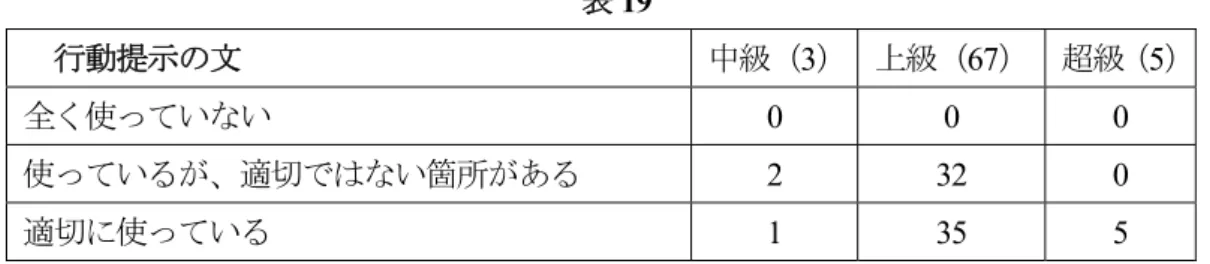
Finally, the author verified the validity of the 5 “Superior level” benchmarks
below as hypothesis.
(1) Is the usage of “teiru” correct for the meanings of experience and
record?
(2) Is “action indication” sentence being correctly used?
(3) Is there variety of usage of connective expressions in the paper?
Are they being correctly used?
(4) Are those “ko” and “so” demonstratives referring both
aforementioned and after-mentioned matter, being correctly used?
(5) Is there variety of usage of sentence end expressions in the paper?
Chapter 9 presents the comments to the students’ writings received from
6 native speakers of Japanese language whom are not experts of Japanese
language assessment, but educated members of Japanese society. The
purpose of this task is to find out the differences between these educated
members of Japanese society and experts of Japanese language assessment
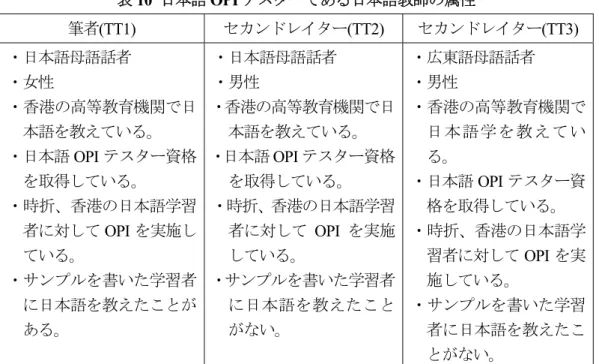
(such as certified OPI testers), if any in Chapter 6, 7 and 8.
Chapter 10 examines the relationship among the framework of
communicative competence theory, issues found in learners’ writing and
perspectives of assessment. Considering the issues found in learners’
writing and the comments collected through interviews from the viewpoint of
relationship with the framework of communicative competence theory, it is
clear that a particular issue in writing does not correlate only to one kind of
competence but almost every issue have relationship with multiple areas of
competence, namely “Grammar competence”, “Sociolinguistic competence”,
“Discourse competence” and “Strategetic competence”.
Chapter 11 summarizes the entire study and presents the issues for future
discussion. First, the level of current writing proficiency of advanced level
learners in Hong Kong is equivalent to “Advanced level” and these learners
should aim to attain “Superior level”. Second, the types of error found in the
writings produced by advanced level learners in Hong Kong have been
successfully identified in this study. By examining those errors, “the focus of
guidance” on how to write “e-mails” and “argument writings” is proposed.
Next the author wants to emphasize that we need to recognize that issues
surrounding learners’ writing are not only something one-sided but actually
many-sided problems. From the perspectives of strengthening all aspects of
“Grammar
competence”,
“Sociolinguistic
competence”,
“Discourse
competence” and “Strategetic competence” simultaneously, it is significant to
construct a set of “detailed guidance” for each writing task. Especially for
“Sociolinguistic competence”, we should differentiate the “Politeness strategy”
and “Default” between learners and native speakers of Japanese language.
. For the issues to be discussed in the future, we can a) apply the
perspectives stated in Chapter 10 not only to writing proficiency but also to
the proficiency in Japanese comprehensively; and b) uncover the details of
correlation between strategic competence and proficiency. The ultimate
purpose is to develop new teaching materials for improving writing
proficiency of Hong Kong-based advanced Japanese language learners by
applying the findings in this study.
第1 章 序論 本研究の背景と目的 言語教師であればだれもが、自分が教えている学習者が、目標言語において現状よ りももっと「熟達する」ことを目指しているに違いない。では、日本語において「熟 達している(proficient)」というのは、どういうことだろうか。 従来、日本語教育においては、いわゆる文型積み上げ式の教科書が使われてきた。 しかし、文型重視の授業では、学習者は実際の場面でコミュニケーションが取れるよ うにならないという声が高まるとともに、近年、「プロフィシェンシー(proficiency)」 の概念が日本語教育において注目されるようになってきた。牧野(2008:19)は、「プ ロフィシェンシー」について、次の 3 点にまとめている。 1. プロフィシェンシーとは、言語学習者の現在の熟達のレベル(つまり、熟達度)で ある。 2. プロフィシェンシーは言語の規則を使ってタスクをこなすことができる。 3. プロフィシェンシーを判定するためには規則をどう使えたらどのレベルになるか を記述した基準が必要。 「言語の規則を使ってタスクをこなすことができる」というのは、「言語を使ってコ ミュニケーションが取れる」と同じことを指していると考える。そうであるならば、 ある言語における「プロフィシェンシー」は、その言語における「コミュニケーショ ン能力」と非常に密接な関わりを持っていると考えられる。 筆者は、現在、香港にある大学で、日本語能力試験N2 レベル合格以上の力を持つ学 習者を対象とした「上級日本語作文」のコースを担当している。履修者の多くは 1 年 間の日本留学経験があり、日常会話に困ることはないというレベルであるが、卒業論 文のためのアンケート調査協力依頼のメール、大学院進学について日本の大学に問い 合わせるメール、研究計画書、就職のためのエントリーシートなど、いざ日常生活に おいて必要な文書を作成しようという時、日本語でどのように書けばいいのかわから ないといった相談を受けたり、書いたものを添削してほしいと頼まれたりすることが 多い。 よく知られているように、日本語能力試験には「書く」技能と「話す」技能を測る テストは含まれていないが、N2 合格以上の学習者なので、文法や語彙などの言語知識 はそれに相当するものを持っているはずである。しかし、彼らが書いた文章を読むと、 言わんとすることは大体わかるのだが、文法や語彙の使い方の間違いのほかに、構成 や表現などにおいて何かしっくりこない、あるいは、読み手にマイナスの印象を持た れる可能性があるのではないかと思われる箇所があることに気づく。由井(2005:187) は、「話すのが上級になった学習者でも、簡単なメモ1つとってみても十分に書けてい
るとは限らない。文法や語彙上の変な間違いがあったり、何か失礼な印象を受けるよ うな文であったりすることは多くの日本語教師が経験していることであろう。」と述べ ているが、香港の上級学習者の書く文章にもまさにこのような問題が起こっていると 言える。 単純に文法や語彙上の間違いであるならば、教師が間違いを指摘し、直せばよい。 実際、従来の作文教育では、教師は学習者の書いた作文に現れる文法や語彙の間違い を見つけ出し、添削するという作業が行われてきた。しかしながら、「変な間違い」「何 か失礼な印象を受けるような文」とは具体的にどのような文なのか、それはどうして 起こるのか、また、どうすれば解決できるのかについては、まだ十分に研究されてい ないと思われる。 そこで、筆者が本研究を始めるきっかけとなった、香港の学習者が実際に書いた次 のメール文を紹介したい。これは、香港の中級(日本語能力試験N4~N3レベル合格 程度)の日本語学習者から、実際に学期開始前のプレースメントテストに関する用件 で、筆者に送られてきたメール文である。当時、筆者とこの学習者は面識がなく、筆 者に対して初めてメールを送るという状況であった。
Subject: Placement Test Application
(※プレースメントテストの申し込み用紙が添付ファイルとして付けられている。) 上田先生へ 悪いけど、このメールをお受けになったら、返事を一通いただけませんか? 0XXXXXXX チン ダイブン 陳大文(注1) 上のメール文から、中級レベルの学習者であっても、最低限の用件を伝えるという 目的は果たしていることがわかる。しかしながら、同時に、いくつかの問題が含まれ ていることも明らかである。「悪いけど」は、この場面、この相手に対してふさわしく なく、添削対象となるが、それ以外には大きな文法の間違いは見られない。しかし、 このメール文のもっと大きい問題は、いきなり自分の要求で始まり要求のみで終わっ ていることではないだろうか。確かに、このメールにはプレースメンとテストの申し 込み用紙が添付されているので、受け取り手の筆者もこのメールの用件はすぐにわか るのだが、何のあいさつもなく、用件の簡単な説明すらなく、自分の要求のみという
本文メッセージは、「学校という場面」における「フォーマルな内容の用件」で「面識 のない教員宛て」ということを考えた場合、シンプルすぎて、少々失礼とさえ受け取 られる可能性がある。これは、学習者が中級レベルだからなのか、あるいは、筆者一 人の個人的な感じ方なのかというと、そうではなさそうである。 例えば、他にも次のような事例がある。上田・中西(2008)の口頭発表では、香港 と日本の学生のSNS 上での交流について報告した。主な活動は、上級作文コースの香 港の学生が日本語で書いた作文について、日本人大学生に文法の間違いを添削しても らったり、内容についてアドバイスをもらったりすることであった。やりとりは、SNS 上で書き言葉で行われた。上田・中西(2008)の発表では、この交流が終了した後、 香港の学習者が初回以外はあいさつをしないでいきなり本題に入ったり、日本人の学 生に作文の間違いを直してもらってもお礼の言葉がなかったりすることに対して、日 本人学生の多くが違和感を覚えたということに言及した。日本人学生からは「『親しき 仲にも礼儀あり』だと思う。」というコメントが出されたが、友人関係に近い同年代の 学生同士の交流においてもこのような意見が出るのであるから、目上の人宛てや仕事 上の文書などでは、さらに読み手が気にする可能性が高いだろう。 メール文に現れた表記ミスや文法ミス、アニメや漫画を通して覚えたのであろうい わゆる「ため口」的な表現は添削して指導すればよいが、実はもっと厄介なのは、「あ いさつがない」「用件の説明がない」といった、形のある間違いとしては現れてこない 問題である。これらは、「何か失礼な印象」を引き起こす大きな要因の一つではないか と考えられるのだが、学習者自身はもちろん、日本語教師も教える際に意識していな いことである。筆者も、上記の交流の後、日本側の教師から日本人学生の感想を受け 取るまでこのことには全く気づかなかった。これはほんの一部の例であり、形として 現れる現れないにかかわらず、香港の学習者が書いた文章の中に、その他の問題が潜 んでいることが十分に考えられる。これらのことから、「コミュニケーション能力を高 める」ことを目指す時、文法や語彙などの知識を増やすだけではなく、「失礼な印象を 与える可能性をできるだけ排除する」、さらには、「よい印象を与える可能性を高める」 ということも考えなければならないことがわかる。しかしながら、この「失礼な印象」、 「よい印象」とは、社会言語学的なものであり、言語使用者のバックグラウンドによ ってかなり違ってくるからこそ、難しいのである。 では、香港の学習者の言語使用におけるバックグラウンドとはどのようなものだろ うか。香港の公用語は中国語と英語で、香港出身の中国人学習者の母語は広東語であ る。香港は多言語・他民族・多文化社会であり、広東語、北京語、英語を中心に一人 の人が複数の言語を話すのがごく普通の社会である。香港の人同士で日常的な会話を する場合は広東語が用いられる。北京語や英語は母語とは言えないが、勉学や仕事の 上で非広東語母語話者と接する機会が多く、必要に迫られて頻繁に使わざるを得ない
ため、あるいは、お互いがその言語の母語話者でない場合も多いため、発音や文法の 細かいミスはあまり気にしないで、とにかく伝えたい内容をお互いに伝え合うことが 最優先される傾向が窺える。特にメールなどの文書のやりとりでは、漢字よりアルフ ァベットの方が速く打てて面倒がないという理由で、香港の人同士であっても中国語 ではなくあえて英語でコミュニケーションを取ることも日常的に多く行われている。 香港は漢字圏であり、しかも簡体字ではなく繁体字を使用するため、非漢字圏の学習 者と比較すると、日本語学習においては有利であると言える。多言語の環境に慣れて おり、多言語の習得と運用は普通のことであり、非漢字圏の学習者には難しいとされ る漢語の語彙ももともと知識として持っている香港の学習者のアドバンテージを十分 に生かした上で、さらに日本語力をもっと効率的に伸ばすためには、香港の学習者と 日本語母語話者のコミュニケーション能力の内容の相違点を抽出し、それを香港の学 習者に気づかせることが必要である。 筆者が教えている学習者の多くは、卒業後、日系企業に就職し、日本語を使って仕 事をすることを希望する。日本の大学院に進んで日本に関する研究を続ける者もいる。 将来、話すことだけでなく、書くことにおいても、自分で気づかないうちに「相手に 失礼な印象を与える」ことのないよう、また、読み手に対して自分の意見を論理的に わかりやすく伝えられるように書く指導をすることの重要性を常々感じている。 由井(2005:205)では、「書く」技能は「話す」技能に比べてコミュニケーション の観点からの研究が遅れていると指摘している。従来の作文指導で重視されてきた「正 確さ」は、文法などの形式的な正確さであり、具体的な「場面」が考慮されていなか ったため、学習者は、待遇的に不適切な表現や、情報伝達の点から不十分な文を書く ことが多かったとし、個々の場面や文書の特性によって、目的や読み手との関係、機 能、文法形式が異なることを学習者に意識させて「書く」教育を行うべきであると述 べている。本稿では、複数の言語を習得している香港の学習者の日本語を書くプロフ ィシェンシーをさらに高める「指導のポイント」を明らかにするために、香港の学習 者がタスクを達成するために書いた文章をプロフィシェンシーの観点から分析する。
第2 章 先行研究 2.1 本研究と関連する先行研究について 本研究は、香港の上級日本語学習者のプロフィシェンシーを向上させるための指導 のポイントを探ることを目的とし、学習者が書いた「メール文」と「レポート」を調 査対象としているため、さまざまな先行研究と関連がある。本章では、それらの先行 研究を紹介し、本研究との関連から議論するべき点を検討していく。
第一に、Chomsky(1965)から、Hymes(1971)、Canale and Swain(1980)、Canale (1983)、Bachman(1990)まで、「コミュニケーション能力(communicative competence)」
の理論に関する大きな流れをまとめる。「コミュニケーション能力」と「プロフィシェ ンシー」の関係をみる。 第二に、「プロフィシェンシーと評価」に関する研究について紹介する。まず、先行 研究における議論を踏まえた上で、Canale(1983)の「コミュニケーション能力」の理 論の枠組みを利用して、本研究における「プロフィシェンシー」の定義を確認する。 そして、学習者の話す力を測る方法として、アメリカ外国語教育協会の「ACTFL-OPI」 の方法とその評価基準、「ACTFL Proficiency Guidelines 2012」、牧野ほか(2001)、鎌田 (2008, 2009)、嶋田(2008)を引用しながら紹介する。また、牧野(1991)に倣って 由井(2009)が作成した「ACTFL ライティングの評価基準(概要)」も紹介する。さ らに、OPI を利用した日本語学習者のレベル別の言語特徴に関する先行研究を挙げる。 第三に、本研究で調査対象とする「メール文」の機能は「依頼」であるので、これ に関する先行研究として、Brown and Levinson(1978)の「ポライトネス理論」と、Brown and Levinson(1978)の問題点を指摘して「ディスコースポライトネス理論」(DP 理論) を提案した宇佐美まゆみ(2003)などを紹介する。 第四に、同じく「メール文」に関する先行研究として、依頼のストラテジーについ て論じたもの、日本語教育における「依頼」の扱いについて述べたもの、フランス語 母語話者と日本人の「依頼」のストラテジーを比較したもの、中国語母語話者と日本 人の「依頼」のストラテジーを比較したものを紹介する。また、台湾人の電子メール における依頼の展開要素を調査した李(2004)と、李(2004)を発展させる形で中国 語母語話者を対象に調査した大友(2009)を紹介する。 第五に、メール文、手紙文の評価の観点に関する先行研究として、金澤編(2014) と宇佐美洋(2014)を挙げ、先行研究における評価の観点と「コミュニケーション能 力の内容」の関係を比較する。 最後に、日本語のレポート、アカデミックライティングの評価の観点に関する先行 研究を紹介する。また、「東京外国語大学留学生教育センターJLPTUFS アカデミック日 本語Can-do リスト(AJ Can-do リスト)」(2017)を紹介する。これらについても、評価 の観点と「コミュニケーション能力の内容」の関係について言及する。
これまで主に個別のテーマとしてそれぞれ扱われてきた以上のような先行研究は、 「コミュニケーション」あるいは「プロフィシェンシー」という大きな観点からみる と、すべてがつながり、重なり合っていると考えられる。先行研究のように一つ一つ のテーマを深く掘り下げることはもちろん重要であるが、本研究では、今まであまり 注意を払われてこなかったと思われる、これらの多くの研究のつながり及び重なりに も注目しながら、考察を進める。 2.2 コミュニケーション能力の理論 2.2.1 Chomsky(1965) Chomsky(1965)は、言語学理論とは、「同一の発話コミュニティにおいて、実際の 運用の中でその言語の知識を応用する際、文法に無関係な条件に影響されない理想的 な話し手と聞き手に関するものである」と述べている。
Linguistic theory is concerned primarily with an ideal speaker-listener, in a completely homogeneous speech-community, who knows its language perfectly and is unaffected by such grammatically irrelevant conditions as memory limitations, distractions, shifts of attention and interest, and errors (random or characteristic) in applying his knowledge of the language in actual performance. (Chomsky 1965:3)
続けて、以下のように、「言語能力(competence)」と「言語運用(performance)」を 区別すると述べている。
We thus make a fundamental distinction between competence (the speaker-hearer’s knowledge of his language) and performance (the actual use of language in concrete situations). (Chomsky 1965:4)
コミュニケーション能力の内容に関する議論は、この Chomsky(1965)の主張から 始まっていると考えられる。
2.2.2 Hymes(1971)(Brumfit and Johnson eds.(1979)“The Communicative Approach to
Language Teaching”に抜粋掲載)
Hymes (1971)は、Chomsky(1965)の考えに反論し、言語学理論には社会言語学 的及び文脈的な能力も含まれるべきであると主張している。
understand (in principle) any and all of the grammatical sentences of a language. Consider now a child with just that ability. A child who might produce any sentence whatever – such a child would be likely to be institutionalized: even more so if not only sentences, but also speech or silence was random, unpredictable. (Hymes 1979:14-15)
また、次の一文は、Hymes(1971)の主張をよく反映しているものとして、複数の論 文で引用されている。
There are rules of use without which the rules of grammar would be useless. (これを知らな かったならば文法規則が役に立たなくなってしまうような言語使用の規則がある。) (Hymes 1979:15, ジョンソン・モロウ編著 小笠原訳 1984:2 から日本語訳を引用)
さらに、言語能力の二分法に関しては、Hymes(1979:18)は、「(underlying) competence」 ((潜在的な)能力)と「(actual) performance」((実際の)運用)に分けることを主張 している。
2.2.3 Canale and Swain(1980)
Canale and Swain(1980)は、当時のさまざまなコミュニケーション能力の理論につ いて検討した上で、彼ら自身が考える理論の枠組みを示している。
まず、「『コミュニケーション能力』という用語を、文法能力、つまり文法の知識及 びルールと、社会言語学的能力、つまり言語使用の知識及びルールの関係と相互作用 を指すために採用する」(Canale and Swain 1980:6, 筆者訳)と述べている。
その上で、言語能力の二分割に関しては、「Communicative competence は、(performance に特有の一般的な心理的制約下の)発話の実際の産出と理解におけるこれらの能力の 実現と相互作用である communicative performance と区別される」(Canale and Swain 1980:6, 筆者訳」と述べている。
以下は、Canale and Swain(1980)の、「communicative competence」が「知識」と「知 識の使い方」から成るという考えと、「communicative competence」と「performance」の 関係の捉え方をよく表している。
First, the fundamental theoretical distinction that we have accepted between communicative competence and performance suggests that communicative testing must be devoted not only to what the learner knows about the second language and about how to use it (competence) but also to what extent the learner is able to actually demonstrate this knowledge in a meaningful communicative situation (performance). (Canale and Swain 1980:34)
そして、コミュニケーション能力の構成要素としては、『grammatical competence(文 法能力)』、『sociolinguistic competence(社会言語能力)』、『strategic competence(ストラ テジー能力)』の3 つを挙げている(Canale and Swain 1980:28)。
2.2.4 Canale(1983)
Canale(1983)では、Canale and Swain(1980)コミュニケーション能力の理論の枠 組みに関する考えを踏襲し、修正を加えている。
Canale and Swain(1980)では、言語能力の二分割について「communicative competence」 と「communicative performance」という用語を用いていたが、Canale(1983:5)では、 「communicative competence」と「actual communication」に替えている。ただし、概念 的には同じことを指している。Canale(1983:5)は、Canale and Swain(1980:34)を受
けて、「コミュニケーション能力」が「知識」と「知識の使い方」の両方を指すことを
明確に示し、「知識の使い方」を「スキル」と名付けている。
さらに、Canale and Swain(1980)ではコミュニケーション能力の構成要素は 3 つと していた点を修正し、「コミュニケーション能力の理論の枠組みは、少なくとも 『grammatical competence(文法能力)』、『sociolinguistic competence(社会言語能力)』、 『discourse competence(談話能力)』、『strategic competence(ストラテジー能力)』の 4 つの知識とスキルの領域を含んでいる」(Canale 1983:6, 筆者訳)と述べている。
2.2.5 Bachman(1990)
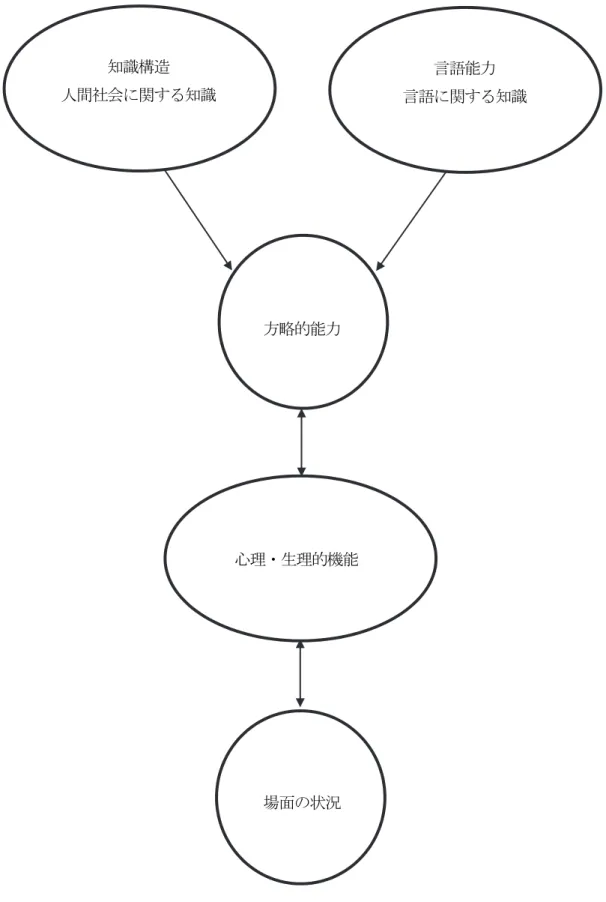
Bachman(1990)は、意思伝達言語能力(communicative language ability)の枠組みに
は、言語能力、方略的能力、心理生理的機能の 3 つの構成要素が含まれていると述べ
図1 意志伝達的言語使用における意志伝達言語能力の構成要素 (Backman1990:85, 大友ほか訳 1997:97) 知識構造 人間社会に関する知識 言語能力 言語に関する知識 心理・生理的機能 方略的能力 場面の状況
また、言語能力の構成要素を以下のように提示している。
言語能力
組織的能力
語用論的能力
文法的能力
テクスト的能力
発話内能力
社会言語学的能力
語彙 形態論統語論 音韻論/ 書記素論
方言ある いは変種 に対する 感受性
言語使用 域に関す る感受性 自然さに 対する感 受性 文化的指示 および比喩 的表現
観念的 機能
操作的 機能
学習的 機能
想像的 機能
結束性 修辞的 機能 図 2 言語能力の構成要素(Backman1990:87, 大友ほか訳 1997:99)
Bachman(1990)のモデルも、基本的には Canale and Swain(1980)、Canale(1983) の流れを汲むと考えられるが、Canale and Swain(1980)及び Canale(1983)のストラ テジー能力の定義は「方略的能力が働くメカニズムについて言及していない」として、 ストラテジー能力には「アセスメント要素」、「計画的要素」、「実行要素」の 3 つの構 成要素を含めている。各要素については、以下のように説明されている。 アセスメント要素:アセスメント要素によって次の4つのことが可能になる。 1. 言語の変種、あるいは方言を含む情報を明らかにすること。 2. 伝達目標を達成するためにその情報を最も効果的に応用するために母国語、第 二言語、あるいは外国語のどの言語能力を自由に使えるかを決定すること。 3. 対話者とわかちあえる能力と知識を確定すること。 4. コミュニケーションの試みに基づいて、その伝達目標がどの程度達成されるかを 評価すること。 計画的要素:計画的要素は言語能力から関連する項目(文法的、文脈的、発語内的、 社会言語学的等)を拾い出し、伝達目標の遂行が期待される計画を形作るものであ る。 実行的要素:実行的要素によって、関連のある精神生理学的機能が促され、伝達目 標や場面に適するように様相や伝達経路の面で計画が実施される。 Bachman(1990:98-102,大友ほか訳 1997:116-118) 2.2.6 コミュニケーション能力の理論に関する先行研究のまとめ
コミュニケーション理論の枠組みの研究としては、上述したようにCanale and Swain (1980)及び Canale(1983)、Bachman(1990)などがよく知られている。とりわけ、 Canale and Swain(1980)については、「これ(Hymes1971)以降、コミュニカティブ・ コンピテンスの内容に関わる部分的な議論また包括的な議論が盛んに行われたが、 Canale and Swain(1980)により一つの到達点に至った」(西口1990:100)、「an influential position paper」(Omaggio-Hadley 2001:3)と評価されているように、「コミュニケーショ ン能力」を議論する上で必ずと言ってよいほど引用される論文である。2.3 節で詳しく 述べるが、Canale(1983)の枠組みは、学習者のプロフィシェンシーを測る基準の一つ である「ACTFL Proficiency Guidelines」に深い影響を与えていると考えられるため、本 研究では、Canale and Swain(1980)を発展させ修正した Canale(1983)の枠組みに基 づいて学習者のライティングを分析してみたい。つまり、Canale(1983)の言語能力の 二分割(「communicative competence」と「actual communication」)、さらに「communicative
competence」は「知識」と「スキル」の両方を指すという考え方を採用し、コミュニケ ーション能力は、「grammatical competence(文法能力)」、「sociolinguistic competence(社 会言語能力)」、「discourse competence(談話能力)」、「strategic competence(ストラテジ ー能力)」の4 つの領域から成ると仮定する。 しかし、これらのコミュニケーション理論の枠組みについて、まだ解明されていな い点もある。Canale(1983:21-25)は、フランス語の授業のために実際に作成した「コ ミュニケーション能力の内容」の項目のリストを挙げている。もともとフランス語の ために作成されたもので汎言語的ではないので、「grammatical competence(文法能力)」 などに日本語と合わないもの(文法、音声など)が含まれているが、日本語における コミュニケーション能力の内容を考える上で非常に参考になる。しかし、注目したい のは「sociolinguistic competence(社会言語能力)」については、他の項目と比較して記 述が著しく簡潔な点である。これは、第一に、Bachman が指摘しているように「これ らのさまざまな構成要素を実証的に妥当化しようとする試みはいまだ結論を見ていな い(Bachman 1990:86, 大友ほか訳 1997:98)」ためであると考えられる。第二に、Canale 自身も述べているように、「第二言語で適切にコミュニケーションを取るために学び直 す必要がない適切な言語使用の普遍的な面があることは疑いがない。しかし、言語や 文化に特有の面もある(Canale 1983:8, 筆者訳)」ため、目標言語によって項目をかなり 変えていかなければならないからである。また、Bachman が自らのモデルの言語能力 の構成要素を示した樹形図について「それらがまるで互いに別々の独立しているもの であるかのように見えるというのは問題がある(Bachman(1990:86,大友ほか訳 1997: 100)」と述べているように、Canale(1983)の枠組みの 4 つの領域もきれいに線を引い て分けられるというようなものではなく、相互に作用していると考えられる。しかし、 4 つの領域がどのように相互作用し合っているのかについては明らかではない。さらに、 「strategic competence(ストラテジー能力)」についても、Bachman(1990)から批判と 提案がなされているが、Canale(1983)の枠組みにせよ Bachman(1990)の枠組みにせ よ、実証的な研究が必要である。 2.3「プロフィシェンシー」と評価 2.3.1 「プロフィシェンシー」の定義 第1 章で述べたとおり、本研究では、「プロフィシェンシー(proficiency)」の観点か ら香港の上級日本語学習者が書いた文章を分析しようとしている。しかし、その前に、 そもそも「プロフィシェンシー」とは何かという最も基本的な問題について改めて考 えておかなければならない。ここでは、まず、各先行研究においてプロフィシェンシ ーの定義や捉え方が統一されていないことを指摘し、次に、各先行研究におけるプロ フィシェンシーの定義を見る。そして、本研究におけるプロフィシェンシーの定義を
行う。
Bachman and Savignon(1986:380)によると、「プロフィシェンシー」が注目を浴び 始めたのは1980 年代初頭である。以下に、プロフィシェンシーの概念・定義について 言及した先行研究(Bachman and Savignon 1986, Omaggio-Hadley 2001, 根岸 2008)を年 代順に挙げる。
Equally obvious, however, is that the terms “proficiency” and “communicative competence” have acquired vastly different connotative meanings. (Bachman and Savignon 1986:381)
In the past thirty years, many teachers have come to understand that language proficiency is not a monolithic concept representing an amorphous ideal that students rarely attain; rather it is comprised of whole range of abilities that must be described in a graduated fashion in order to be meaningful. (Omaggio-Hadley 2001:8-9) この用語(プロフィシェンシー)は、言語能力の測定や言語教育の研究に際して も日常的に用いられている用語でもあります。このように様々な場面で頻繁に用い られている用語ですが、(中略)私たちの日常的な議論の中で十分な定義がなされな いままに用いられていることが多いのです(根岸2008:54)。 坂本(2009:22)は、プロフィシェンシーの定義を調べるためにさまざまな日英の 言語に関する辞典を見たところ、唯一見出し語としてプロフィシェンシー(proficiency) が出ていたのは『英語教育用語辞典』(大修館書店)だけであったとして、以下のよう に引用している。 proficiency(熟達度) 言語を運用する総合的な能力。第二言語/外国語においては、学習者が習得した言 語知識をさまざまな状況の中で、正確に、流暢に、かつ、適切に使いこなす程度を proficiency と呼ぶことが多い。(中略)proficiency の定義が、さまざまな形で試みら れているが、確立された定義はまだ完成していない。(P.245, 坂本による引用) つまり、「プロフィシェンシー」という考え方と用語が盛んに注目を集めるようにな ってから約40 年が経つが、その間にさまざまな意味を含むようになり、その定義は研 究者間及び言語教師間で共通の認識には至っていないということになる。 以下では、本研究における「プロフィシェンシー」の定義をするに先立って、プロ
フィシェンシー観、プロフィシェンシーの定義について言及した先行研究を紹介する。 根岸(2008:66-67)は、英語のテストや言語能力評価枠組みにおけるプロフィシェ ンシーの捉え方として、構成概念を拡大解釈して捉える「拡大版プロフィシェンシー」 と、構成概念を限定して捉える「限定版プロフィシェンシー」の2 つの選択肢がある とし、双方の長所と短所について述べている。「拡大版プロフィシェンシー」のアプロ ーチをとった場合には、測定対象に様々な要素が入り込み、内的一貫性が低くなる傾 向がある一方、「限定版プロフィシェンシー」のアプローチをとった場合は、内的一貫 性は高まるものの、充分な代表性を実現できない可能性があるとしている。また、中 間的な選択肢もあると述べ、自分がどのような立場を取るのかをはっきり認識する必 要があると指摘している。 Bachman(1990:3-4)は、言語テストとの関係において言語能力(language ability)の 定義を明確にするために次のように述べ、言語熟達度(langauge proficiency)について より広い見解がもたれるようになってきていると述べている。 多くの外国語あるいは第二言語の熟達度テスト(proficiency test)の開発は(中 略)技能と構成要素の枠組みに依然基づいているが、多くの言語テスト作成者は 今や言語能力に関してさらに広い知見をもっている。(中略)これらに見られる顕 著な特徴は言語を適切に使用するためには文を越えた文脈が重要であることを認 識したことである。この文脈には個々の文がその一部となる談話や形態および機 能の両面でその談話の性質をかなりの程度支配する社会言語学的場面が含まれて いる(大友ほか訳1997:4)。 一方、Bachman(1990:4-5)は、言語能力に関するもう一つの異なった見解として、 ACTFL などの特定のテストの尺度に基づく定義を挙げている。Bachman(1990:16)は、 自身の立場として、「言語能力」と「言語熟達度」は同義語であると述べている。ここ から、Bachman(1990)がプロフィシェンシーを広い意味で捉えていることがわかる。 このように「熟達度」という用語は異なる文脈において多様な意味や含意をも ってきた。(中略)私は「言語能力(language ability)」という用語だけを使いたい。 しかしながら時には「言語熟達度(language proficiency)」という用語を使う必要 があると思われる。そしてそのような場合には(中略)言語熟達度という用語は 言語能力(language ability)つまり言語使用における能力(ability in language use) と同意語である(Bachman1990:16,大友ほか訳 1997:18)。
牧野(1991)では、「プロフィシェンシー」について次のように述べている。 Proficiency は OED(注2)ではその基本的な意味を「進歩の度合い」と定義してい るが、ここでもproficiency をそのように解釈しよう。別のいい方をすると、proficiency とは「言語を含む、技能の能力のレベル」ということになる(牧野1991:15)。 次の牧野(2001)の説明から、OPI のプロフィシェンシーは、コンピテンスとパフォ ーマンスの両方を含んでいることがわかる。 OPI では言語能力を言語学的な 2 分法ではなくて、コンピテンスとパフォーマン スを一つにして、むしろパフォーマンスのほうから言語能力を見ているのです(牧 野2001:20)。 牧野(1991)及び牧野(2001)の「プロフィシェンシー」に関する説明も、「度合い」 「レベル」という語を含んでいることに注目したい。 坂本(2009:24-25)は、「プロフィシェンシー」の定義を考える際に、Taylor(1988) のコミュニケーション能力の3 分類を参考にしている。 表1 Taylor(1988)の 3 分法と 4 技能の関係(坂本 2009:25)
コミュニケーション能力 技能 competence Proficiency performance
受容能力 読む 様々な知識 知識の使用能力 文章理解 聞く 様々な知識 音声理解 産出能力 話す 様々な知識 発話 書く 様々な知識 文章 表1 にあるように、その 3 分類とは、知識を表す「能力」(competence)、力を表す「実 力」(proficiency)、結果を表す「パフォーマンス」(performance)(注3)である。そして、 坂本(2009:25)は、「従来考えられてきた言語運用(performacne)はより厳密に言う と、使用・処理する能力のproficiency とその結果としてなされる performacne によって 構成されている」とし、次のように「プロフィシェンシー」を定義している。 プロフィシェンシーとは、(様々な知識を有することを前提として、その)知識を 正しく、適切に、一貫性を持って、理解、産出の両面で処理する能力の程度を表す。 坂本(2009:25)
以上、「プロフィシェンシー」という用語の定義は、研究者や実践者間でまだ確立さ れていないことがわかったが、根岸が指摘しているように、「世の中のトレンドは言語 能力観の拡大解釈に傾いている」(根岸 2008:65)ことは確かであろう。もともと、「プ ロフィシェンシー」を最も狭義に捉えた場合の文法や語彙などの知識(Taylor(1988) の3 分類でいうと「能力」(competence)のさらに一部)だけでは、十分なコミュニケ ーションができるようにならないという教育現場における反省があってこそ「プロフ ィシェンシー」が注目されるようになったことからも、この流れは当然のことであろ う。「Taylor(1988)のコミュニケーション能力」でいうところの、知識を表す「能力」 (competence)、力を表す「実力」(proficiency)、結果を表す「パフォーマンス」(performance) のうちの全部を含む立場とそのうちの一つあるいは二つを含む立場、さらに何を含め るのかを明確にしていない場合などがある。また、ACTFL-OPI におけるプロフィシェ ンシーの考え方に代表されるように定義に「度合い」や「程度」の意味を含むかどう かによっても違いが出てくる。主流となっている拡大版プロフィシェンシーの中でも 定義があまり明確でない原因としては、これらのようなことが考えられる。 このように見ると、少なくとも「プロフィシェンシーとは何か」を考える上で、「コ ミュニケーション能力」について知ることが重要だということがわかる。以下では、「プ ロフィシェンシー」と「コミュニケーション能力」の関係に触れている先行研究を紹 介する。 Omaggio-Hadley(2001)は、次のように指摘している。
With the definitions of “commmunicative competence” of 1970s came new insights into the various components of language ability that needed to be developped in order to know a language well enough to use it. Yet most of these early models did not specify levels of competence in a way that could help practitioners measure their students’ progress or articulate program goals. (Omaggio-Hadley 2001:9)
牧野(2008)では、次のように述べ、両者の共通点と相違点を示している。 伝達能力(Communicative Competence)とプロフィシェンシー志向の考え方とはそ の基本が同じです。2 つとも学習者が言語の体系を使って『何ができるか』に目を 注いでいます(牧野2008:21)。 熟達度型は学習者の現在の学習熟達度がどこに位置していて、これから学習者が どのように熟達度を高めていくかという学習発達の経路を教師が学習者に気づかせ
るという点にあります(牧野2008:21)。 鎌田(2012)は、Omaggio-Hadley(2001)と牧野(2008)の考え方に沿って、以下 のように主張している。 プロフィシェンシーとはコミュニケーション能力(commmunicative competence) の側面から見た、まさしく外国語の「実力評価」である(鎌田 2012:5)。 以上をまとめると、「伝達志向型はプロフィシェンシーの母体」(牧野2008:21)で あり、「コミュニケーション能力とプロフィシェンシーの違いについて、後者は語学教 育に必要な測定という観点に立った概念だが、前者は能力の『レベル付け』には関与 せず、教育的意図も持たない」(鎌田2012:5)ということになるだろう。また、「コミ ュニケーション能力」の構成要素こそが、牧野(2008:19)の言う「プロフィシェン シーを判定するために必要な言語の規則」のもとになるものであると考えられる。 これまでの議論を踏まえ、本研究における「プロフィシェンシー」は、Canale(1983) の「コミュニケーション能力(communnicative competence)」の概念に基づいて、次の ように定義しておきたい。 「プロフィシェンシー」とは、「人がある言語においてその人が持つ『コミュニ ケーション能力(知識とスキル)』を使い、『実際のコミュニケーション』として どれぐらい適切かつ効果的に具現化できるかの程度」である。 上述したように、何をもって「プロフィシェンシー」と呼ぶかは、研究者によって 意見が分かれるところであるが、筆者は、「プロフィシェンシー」は「知識」も「スキ ル」も「実際のコミュニケーション」も全て含むという立場を取りたい。「知識」と「ス キル」は潜在的なもので目には見えないため、本当は「知識」と「スキル」を持って いても、現実のコミュニケーション場面における何らかの制約により「実際のコミュ ニケーション」として見せられない場合もあるかもしれない。しかし、例えば、楽器 のコンクールやスポーツの試合で、本番当日は緊張しすぎて、あるいはたまたまその 日は体調が悪かったために、普段の練習では難なくできていることができなかったと したら、それはやはり「できない」と判断せざるを得ないだろう。言語も同じで、た とえ望ましくない条件下にあったとしても、さまざまなストラテジーを駆使して乗り 越え、「実際のコミュニケーション」を成立させられるようにすることが、真に「プロ フィシェンシー」を向上させることであると思う。言語教師としては、そのような教