受付日:2016 年 9 月 2 日 受理日:2016 年 11 月 14 日
所 属 1) Mukogawa Women’s University School of Nursing, Graduate School of Nursing 2) Nishinomiya Kyouritsu Neurosurgical Hospital 連絡先 *E-mail:[email protected]
Report
Gender Differences in Occupational Career
Assessments and Professional Identities of Nurses
病院勤務の看護師の職務キャリア意識と
職業的アイデンティティの性差の検討
Keiko Sugiura
1) *, Naoko Kinoshita
2), Mineko Kiyota
2), Akinori Okayama
2)key words:Gender differences, Occupational Career Assessments, Professional Identities, Nurse キーワード:性差、職務キャリア意識、職業的アイデンティティ、看護師
Abstract
There has been a consistent increase in the number of male nurses in Japan. Male nurses who work with many female nurses have gender-specific distress.
We examined the differences in occupational career assessments and professional identities of male and female nurses according to demographic factors. Our study was focused on the proportion of males to females in the occupational environment.
A total of 229 male and female nurses completed the questionnaire used in the analysis. We evaluated demographic factors by t-tests and chi-squared tests, and applied Tukey’s multiple comparisons to professional identity scores and career assessment scores. Two-way ANOVA was used in evaluating the impact of the proportion of men to women in occupational environments to occupational career assessments and professional identities according to gender. The mean age of the nurse participants was about 36 years old. Fifty percent were female nurses. Occupational career assessments were higher for male nurses. Male nurses seem to prefer their nursing job as a career. Professional identity was higher for female nurses: nursing could be considered a subjective sense of awareness of “myself as a nurse” for them. There were no significant main or interaction effects of gender and the proportion of nurses in one’s own department to occupational career assessment and professional identity for nurses. As has been reported, professional identity may be highly relevant to female nurses, and occupational career assessment may be highly relevant to male nurses.
要 旨
本研究は病院勤務の看護師の職務キャリア意識と職業的アイデンティティにおける性差を検討するとともに、属性別 にその特徴を明らかにすることを目的とし、職場環境の一つとして職場における男性看護師の割合に着目した。 H26 年に 295 人に自記式質問紙調査票を郵送し 229 名から回答を得た。調査項目は基本属性、看護師の職務キャリア 意識尺度、職業的アイデンティティ尺度、所属部署の男性割合等で、分析は t 検定、χ2検定、2 元配置分散分析を行った。 対象の平均年齢は 36 歳で、女性が約半数だった。職務キャリア意識では男性が女性より有意に得点が高く、男性は看 護を“収入としての職業”として捉えている可能性が高いと考えられ、職業的アイデンティティは女性の方が有意に得 点が高く、女性は男性より看護師の業務をアイデンティティとして受容していると考えられた。所属部署の男性の割合 は 2 元配置分散分析においては主効果、交互作用は確認できなかった。20 items on a questionnaire developed by Sasaki & Hariu (2006). Professional identities for nurses were composed of belief, uniformity, continuity, self-esteem, and a sense of adaptation. Items responses ranged from 1 (hardly ever or never) to 5 (frequently or most of the time).
3. Analyses
T-tests, chi-squared tests and Tukey’s multiple comparison (e.g., loaded one-way analysis of variance) were used to compare demographic variables, career assessments, and professional identities for both male and female nurses. Two-way analysis of variance (two-way ANOVA) was used to evaluate the relevance of the proportion of male to female nurses in the working environment and occupational career assessments and professional identity by nurse’s gender. SPSS 16.0J for Windows was used for the analysis.
III Ethical considerations
Ethical approval was obtained from the researcher’s institutional ethics committee. Participants were informed of the purpose and procedures of the project via questionnaire. The questionnaire was confidential and anonymous. Participation was voluntary, and respondents were informed that they could opt out at any time. We promised to use the resulting evidence for research only. We obtained permission by telephone to use both scales.
IV Results
1. Status of male and female nurse related
gender in occupational environment
Table 1 provides the demographic characteristics of the participants by gender. Female nurses composed 50.2% of the sample. The mean age of the nurses was 36.3 (range 20-63, SD 9.5). There were no significant differences in age. A significant proportion of male nurses were married (61.1%), compared with female nurses (46.6%). Regarding the presence of family dependents, male nurses indicated a higher proportion than female nurses (56.1% vs. 24.1%). The majority of respondents reported nursing technical school as their highest level of education. The proportion of female nurses and occupational career assessment and
professional identity for each gender.
II Method
1. Participants
First, a random sampling was conducted with 20 of 214 hospitals with the number of beds of 100 and more in the A region. Second, if cooperation with this survey was obtained from the person in charge of the nursing section of the facilities and the hospital with this survey could be obtained from the person in charge of the nursing section of the facilities and the hospital, we asked them for equal numbers of men and women participants. We sent the request for the survey and anonymous, mailed self-report questionnaires with return envelopes to facilities that had agreed. We sent questionnaires to 295 nurses of 18 institutes. Male and female nurses (n=229) participated in this study. The rate of collection was 77.6%, and the response rate was 100%.
2. Measures
Demographic variables: Questions were asked about the nurses’ age, sex, marital status, presence of family dependents, educational background, previous employment (other than nursing), current position, current department, and the proportion of male to female nurses in that department.
Occupational career assessment: Ishii et al. (2005) developed an occupational career assessment scale for nurses termed the Nursing Career Assessment Scale. In this study, we selected 41 items from the Nursing Career Assessment Scale, as we found multiple scale items are nearly identical. Consequently, two items were excluded from original 43 scales, resulting in 41 items in our questionnaire. Examples of career assessment were “I can perform nursing appropriate to the patients’ and their families’ condition” and “I can bring out the staff’s ability.” Items were measured using a 5-point Likert scale (from 1=not important to 5=very important).
Professional identity for nurses: Professional identity for male and female nurses was assessed using
I Introduction
1. Background
The number of nurses in Japan continues to increase, with about 950,000 nurses working in various areas, such as hospitals, institutions, and making home visits in 2012 (Ministry of Health, Labour and Welfare, 2014). This increase has made a significant impact on the nursing workforce, including an increasing number of male nurses, workers with experience in other jobs, and foreign nursing aid in the nursing resources. (Japan International Corporation of Welfare Service, 2015). According to a national survey, the percentage of male nurses was 6.8% (73,968 nurses) in 2012, compared to 3.7% (26,160 nurses) in 2002 (Ministry of Health Labour and Welfare, 2014). This significant increase can partially be attributed to the enforcement of the Equal Employment Opportunity Act for Men and Women of 1986. In 2001, the job title for all nurses was integrated to kango-shi as gender neutral (before that it was fu for female nurses and kango-shi for male nurses), and the revised Act on Public Health Nurses, Midwives and Nurses conferred a new curriculum, which is gender neutral. The series of environmental changes for male nurses stated above influenced their work area, from working once solely in psychiatric wards to working in operating rooms, emergency units, long-term care wards, and general wards, in more recent times.
2. Career awareness of male nurses
Career development proved beneficial for maintaining the quality of nursing and necessary to increase satisfaction in the nursing workforce. There are some studies that show career development for male nurses in other countries (Yang, Gau, Shiau, Hu, and Shih, 2004; Boughn, 2001). For example, a few study reviewed the motives leading men to choose the nursing profession as their first career (Zamanzadeh, Valizadeh, Negarandeh, Monadi, & Azadi, 2013; Yi & Keogh, 2016). However, there is little research studying career development for male nurses in Japan. Studies in Japan have reported that male nurses are usually married and are willing to seek a more prestigious profession in the future (Toyoshima et al., 2014; Tsujimoto et al., 2014). Tsujimoto et al. (2014)
reported that male students were more likely to rate career opportunities and salary, as well as acquisition of educational qualifications, as more important motivators for entering into a profession. Male nurses tended to put more emphasis on their careers than female nurses. However, most studies have focused only on female nurses, and no reports have compared career development between male and female nurses.
3. Occupational position of male nurses in a
“feminine” profession
Although male nurses have the intention to continue working and want to improve their professional expertise, male nurses feel unsuited to their own positions and occupy an inferior role in a female-dominated profession (Okinaga et al., 2012). In professional situations, it was reported that male nurses felt themselves as not established and isolated, especially where their job description includes providing sexual health services for patients with female nurses (Simpson, 2005; Mullan & Harrison, 2008). In these situations, it may be difficult for their professional identity in the present feminine workplace environment. In spite of these past reports, professional identification as a nurse has been mainly attributed and described in Japan. It is necessary to acknowledge the professional identity of male and female nurses in order to maintain one’s own motivation. A previous study indicated that male nurses who worked together did not have significant levels of distress (Kimoto, Fukuda, & Akazawa, 2011). In addition, it is necessary to consider not only individual notions, but also the working environment where, due to increasing opportunity, men and women work together.
4. Purpose
We primarily examined the differences in career assessments and professional identities of male and female nurses. At the same time, we examined the differences that explain factors that are characteristic about occupational career assessment and professional identity for each gender.
Our study also focused on the proportion of male nurses to female nurses in the occupational environment. Regarding this, we aimed to identify the relationship between the proportion of male nurses to
3. A relation among male nurse proportion
in their own department, occupational
career assessment, and professional
identity for nurses
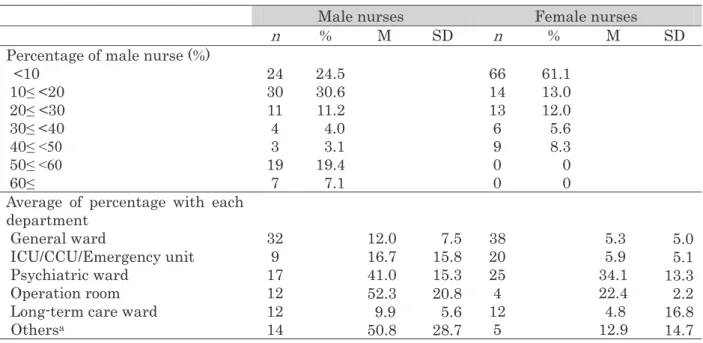
The mean of percentage of male nurses in their own department was 20.1% (SD 21.1). The highest percentage of male nurses worked in operating rooms (44.8%), followed by psychiatric wards (36.8%). Table 4 showed the proportion of male nurses in each assigned department, categorized by gender. Segmented by female and male nurses, approximately 27% of male nurses were working in an environment occupied by more than half with male nurses. Nearly 61% of female nurses were working in an environment indicated a more established professional identity in a
nursing occupational environment.
In terms of professional identity for nurses, the mean score was 59.9 (Range: 31-80, SD 8.0). In contrast to the occupational career assessment, female nurses expressed significantly higher levels of professional identity (61.0±6.2) than male nurses (58.8±8.0) (t-test,
p<.05).
Table 3 presents the gender differences of professional identity for nurses. In the male nurse’s situation, the chief nurses provided a higher score than staff nurses. On the other hand, professional identity scores are significantly relevant to presence of family dependents, only with female nurses.
for occupational career assessment was 116.9 (range: 45-191, SD 23.8).
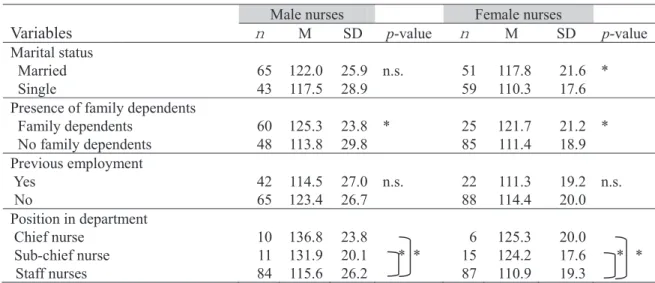
Male nurses indicated significantly higher occupational career assessment than female nurses (male nurses: 120.6 vs. female nurses: 113.3) (t-test,
p<.05). Male nurses who had the family dependents
and management positions demonstrated higher occupational career assessment scores than those who were without dependents or staff nurses. Similarly, these results occurred with female nurses. In particular, female nurses who were married indicated a higher score than those who were not married. Table 2 indicated the gender differences of occupational career assessment related to nurse’ demographic factors.
2) Professional identity of nurses
The present data showed sufficient internal consistency (Cronbach’s α=.89), and the total score was used for analysis (range: 20-100). Higher scores graduates of junior college or university were more
than twice as likely to be female than male. No significant differences in educational background were related to gender. Approximately, 39% of male nurses had experience outside of nursing, compared to 21.6% of female nurses. Approximately 20% of respondents were in management positions (e.g., chief nurse). No significant gender differences were reported in management positions. With regard to departmental differences, male nurses were more likely to work in operating rooms than their female counterparts.
2. Gender differences in occupational
career assessment and professional
identity of nurses
1) Occupational career assessment of nurses
The present data showed sufficient internal consistency (Cronbach’s α=.83), and the total score was used for analysis (range: 41-205). The mean score
1
Table 1. Demographics Based on Gender
Male nurses (n=114) Female nurses (n=116) Variables na % Mean(SD) na % Mean(SD) p-value
Age 114 37.2(9.9) 116 35.4(9.0) n.s.
Marital status
Married 69 61.1 54 46.6 * Single 44 38.9 62 53.4
Presence of family dependents
Family dependents 64 56.6 28 24.1 ** No dependents 49 43.4 88 75.9
Educational background
Assist nursing technical school 17 15.2 17 15.3 n.s. Nursing technical school 87 77.7 75 67.6
Junior college or university 8 7.1 17 17.1
Previous employment Yes 44 39.3 25 21.6 ** No 68 60.7 91 78.4 Position in department Chief nurse 10 9.1 6 5.3 n.s. Sub-chief nurse 13 11.8 16 14.0 Staff nurse 87 79.1 92 80.7 Department General ward 35 31.5 42 37.5 * ICU/CCU/Emergency unit 11 9.9 20 17.9 Psychiatric ward 19 17.1 25 22.3 Operation room 17 15.3 6 5.4 Long-term care ward 14 12.6 13 11.6
Othersb 15 13.5 6 5.4
Note. *p<.05. **p<.01. n.s.: not significant ; p-value of t-test and chi-squared test
aMissing value was excluded with a part of analysis bMost of the ‘Others’ engaged in dialysis section
1
Table 2. Gender Differences of Occupational Career Assessment
Male nurses Female nurses
Variables n M SD p-value n M SD p-value
Marital status
Married 65 122.0 25.9 n.s. 51 117.8 21.6 * Single 43 117.5 28.9 59 110.3 17.6 Presence of family dependents Family dependents 60 125.3 23.8 * 25 121.7 21.2 * No family dependents 48 113.8 29.8 85 111.4 18.9 Previous employment Yes 42 114.5 27.0 n.s. 22 111.3 19.2 n.s. No 65 123.4 26.7 88 114.4 20.0 Position in department Chief nurse 10 136.8 23.8 6 125.3 20.0 Sub-chief nurse 11 131.9 20.1 * * 15 124.2 17.6 * * Staff nurses 84 115.6 26.2 87 110.9 19.3
Note. *p<.05. **p<.01. n.s.: not significant ; p-value of t-test and Tukey’s multiple comparison
Table 3. Gender Differences in Professional Identity for Nurses
Male nurses Female nurses
Variables n M SD p-value n M SD p-value
Marital status
Married 69 59.0 9.5 n.s. 54 61.3 6.8 n.s. Single 44 58.1 9.3 61 60.9 5.6 Presence of family dependents Family dependents 64 59.9 8.7 n.s. 27 63.3 6.4 * No family dependents 49 57.1 10.1 88 60.4 6.0 Previous employment Yes 44 56.8 10.5 n.s. 25 61.4 5.3 n.s. No 68 59.7 8.5 90 60.9 6.4 Position in department Chief nurse 10 64.4 9.9 5 61.5 10.4 n.s. Sub-chief nurse 13 61.5 7.8 * 15 64.3 5.2 Staff nurses 87 57.6 9.4 92 60.4 5.8
Note. *p<.05. **p<.01. n.s.: not significant ; p-value of t-test and Tukey’s multiple comparison
of men being over half the staff and therefore needs further research. The second problem is that the male nurse proportion in the working environment did not have a relationship with occupational career assessment or professional identity. In other words, we could not identify that the higher proportion of male nurses in a working environment did not affect the nurse’s occupational career assessment and professional identity. Hereafter, the surveys, which evaluate female nurses working with a majority of male nurses, are needed. Ellis et al. (2006) found that male nurses could get support from male doctors rather than from female nurses, primarily due to circumstances like frequently working in male-dominated technical areas, such as operating rooms and ICU. Rather the proportion of male nurses in their workplaces showed a possible involvement of the relationships with other male nurses or the personality of male nurses.
There were several limitations to this study. First, only 18 institutes in the narrow A region agreed to participate. Due to sampling bias, we could not generalize the results of this study. Second, we did not obtain the number of years of work experience in questionnaire items, as past research showed little significant relationship with occupational career assessments and professional identity for nurses (Ishii et al., 2005; Sasaki et al., 2006). Past research on occupational careers and professional identity focused on female nurses in most cases, and there was a need to consider how the number of years of work experience of male nurses is relevant to occupational career and professional identity.
VI Conclusion
This study showed several gender differences of occupational career assessment and professional identity. It used almost equal sample sizes for male and female nurses. This study provides basic information about gender differences, occupational career assessment, and professional identity of nurses. In conclusion, occupational career assessment of male nurses was higher than female nurses. Owing to the fact that a relatively high proportion of male nurses are married and living with family dependents or are required to maintain a stable income as a not to choose to enter a school for nursing education as
his first choice (Wang et al., 2011; Yu & Keogh, 2016). In cases of female nurses with family dependents, a higher professional identity was reported, although the same could not be said for male nurses. The existence of family dependents may possibly increase professional identity among female nurses. Sasaki and Hariu (2006) explained the professional identity for nurses had subordinate conceptions, which were “continuousness” (the confidence that I will not change my career for a long time) and “sense of application” (the sense that the occupation of a nurse is suitable for me). Considering the fact that female nurses indicated a greater professional identity, it is fair to state that this greater professional identity may be a motive for female nurses to continue working, even if they had family dependents. Conversely, male nurses tend to have a work-centric life, and life events of dependents, such as marriage and pregnancy, have less of an impact on their work than on the work of female nurses; therefore, having dependents would not affect the professional identity of male nurses. Despite the fact that overall, male nurses expressed less professional identity than women, participants in the chief nurse position, a leading position, had a greater identity with the job of nursing when compared to both staff nurses and female nurses. Kiriaki (2010) reported that male nurses preferred to obtain major roles in their department and enhance their profession. There was a need to support male nurses in developing their expertise to broaden their roles.
3. A relation among male nurse proportion
in their own department, occupational
career assessment, and professional
identity
We focused on the male nurse proportion in their own department as one of working environment, and assumed this proportion would affect occupational career assessment or professional identity, but significant results were not obtained. There were a few problems that prevent us to prove our assumption in this study. The first problem is a sampling problem. The proportion of male and female nurses’ distribution are not the same, especially lack of existence of female nurses working in an environment with the proportion demographic situations of nurses, both male and
female nurses that had other family dependents showed a high score. They may hold a stronger consciousness of career advancement due to their positions as primary breadwinners who need stable incomes. It came as something of a surprise that only married female nurses indicated a higher score than unmarried female nurses. The ‘getting married’ seemed likely to impact female nurses more in occupational career assessments than male nurses.
2. Gender differences in professional
identity
Female nurses indicated a higher score for professional identity in comparison with male nurses. According to Erikson (1973), professional identity is a subjective “self-awareness through occupation”; thus, professional identity for nurses can be considered a subjective sense in awareness of “myself as a nurse.” Nursing has long been considered as a female occupation, and it is assumed as an axiom that female nurses may find it easy to commit themselves both socially and individually to tasks such as nursing care. Furthermore, uniformity and continuity of professional identity for females may easily be enhanced from the initial phase of nursing education, since a woman tends to choose nursing as a first choice, while a man tends with no more than a 10% male nurse proportion. No
female nurses were working with an environment occupied by more than half with male nurses.
We evaluated relationships between nurse’s gender and the proportion of male nurses in their own department to occupational career assessment and professional identity for nurses. There were no significant main or interaction effects of gender and the proportion of nurses in their own department to occupational career assessment (gender’s main effect: F=.001, p=.975; proportion of nurses: F=1.970,
p=.120; interaction effect: F=.204, p=.894), and
professional identity for nurses (gender’s main effect: F=1.425, p=.234; proportion of nurses: F=.749,
p=.524; interaction effect: F=.580, p=.629).
V Discussion
1. Gender differences in the occupational
career assessment
The average score for the occupational career assessment was significantly higher for male nurses. One reason for this result is that male nurses tend to put more importance on salary, work environment, and job security as motives to continue their employment, as reported in the preceding study (Bough, 2001). In regard to the differences of scores associated with
1
Table 4. The Proportion of Male Nurses in Each Assigned Section Related to Gender
Male nurses Female nurses
n % M SD n % M SD Percentage of male nurse (%)
<10 24 24.5 66 61.1 10≤ <20 30 30.6 14 13.0 20≤ <30 11 11.2 13 12.0 30≤ <40 4 4.0 6 5.6 40≤ <50 3 3.1 9 8.3 50≤ <60 19 19.4 0 0 60≤ 7 7.1 0 0
Average of percentage with each
department
General ward 32 12.0 7.5 38 5.3 5.0 ICU/CCU/Emergency unit 9 16.7 15.8 20 5.9 5.1 Psychiatric ward 17 41.0 15.3 25 34.1 13.3 Operation room 12 52.3 20.8 4 22.4 2.2 Long-term care ward 12 9.9 5.6 12 4.8 16.8 Othersa 14 50.8 28.7 5 12.9 14.7 Note:
aMost of the ‘Others’ engaged in dialysis section
jissai [The presence and experience about the career intention of male nurses]. Proceedings of Japanese
Nursing Association: Nursing Management, 44,
63-66.
Wang, H., Li, X., Hu, X., Chen, H., Gao, Y., Zhao, H., & Huang L. (2011). Perceptions of nursing profession and learning experiences of male students in baccalaureate nursing program in Changsha, China. Nurse Education Today, 31, 36-42.
Yang, C.I., Gau, M.L., Shiau, S.J., Hu, W.H., & Shih, F.J. (2004). Professional career development for male nurses. Journal of Advanced Nursing, 48. 642-650.
Yu. M. & Keogh, B. (2016). What motivates men to choose nursing as a profession? A systematic review of qualitative studies. Contemporary Nurse, 52, 95-105.
Zamanzadeh, V., Valizadeh, L., Negarandeh, R., Monadi, M., & Azadi, A. (2013). Factors influencing men entering the nursing profession, and understanding the challenges faced by them: Iranian and developed countries' perspectives. Nursing and
Midwifery Studies, 2, 49-56.
relationship of the distress and occupational carrere assessment for male nurses]. Annual reports of
School of Health Sciences Faculty of Medicine Kyoto University: Health Science, 7, 75-80.
Kiriaki, T. (2010). Dansei Kangoshi no kyaria ishiki no bunseki -daigaku byouin ni kinmu suru supesharisuto oyobi kango kanrisha heno intabyu wo tooshite—[The analysis of sense of career for male nurses]. Proceedings of Japanese Nursing
Association: Nursing Management, 41, 29-32.
Ministry of Health, Labour and Welfare. (2014).
Heisei 24 nen eisei gyousei houkoku rei [Report on
Public Health Administration and Services 2014]. Retrieved Oct 17, 2016, from
http://www.mhlw.go.jp/toukei/saikin/hw/eisei/14/dl/ kekka1.pdf
Mullan, B., & Harrison, J. (2008). Male and female nursing applicants’ attitudes and expectation towards their future careers in nursing. Journal of Research
in Nursing, 13, 527-539.
Okinaga, K., Iwamoto, Y., Kuma, Y., Hisama, Y., Tsutsui, N., & Okayasu, S. (2012). Dansei kangosi no kyaria hattatsu ni kansuru isiki to koudou [Awareness and behaviors related to career development among male nurses]. Bulletin of The
University of Shimane University Izumo Campus, 7,
11-19.
Sasaki, M., & Hariu, T. (2006). Kanngoshi no shokugyouteki aidenthithishakudo no kaihatsu [Development of the professional identity scale for nurses (PISN)]. Japan Journal of Nursing Science,
26, 34-41.
Simpson, R. (2005). Men in non-traditional occupations: career entry, career orientation and experience of role strain. Gender, Work &
Organization. 12, 363-380.
Toyoshima, M., Numazawa, S., Handa, N., Terashima, M., Takahashi, N., & Nagumo, M. (2014). Dansei kangoshi no kyaria ishiki no keikou [The trend of male nurses for conscious of occupational career].
Proceedings of Japanese Nursing Association: Nursing Management, 44, 67-70.
Tsujimoto, Y., Maeda, T., Tatematsu, S., Mizutani, A., Ito, D., Kitazawa, T., Araki, M., Uesugi, Y., Sugino, K., & Furukawa, Y. (2014). Dansei kangoshi no kyaria oyobi kyaria sikou ni kansuru ninshiki to principal breadwinner, they consequently may obtain
a high occupational career assessment. Professional identity of female nurses was higher than that of male nurses. Female nurses naturally recognized their job as their identity compared with male nurses. Especially, female nurses who had family dependents indicated a higher professional identity than female nurses without dependents. Regarding male nurses, men who took a leading position showed higher professional identity than male staff nurses.
Acknowledgments
We extend our thanks to all the participants in completing our questionnaires.
Conflicts of Interest
There is not the problem about the profit reciprocity.
References
Boughn, S. (2001). Why women and men choose nursing. Nursing Health Care Perspective, 22, 14-19.
Ellis, D. M., Meeker, B.J., & Hyde, B. L. (2006). Exploring men's perceived educational experiences in a baccalaureate program. Journal of Nursing
Education, 45, 523-527.
Erikson, E. H. (1959). Identity and the Life Cycle/ Okonogi, K, Trans (1973). Growth and Crisis of the healthy personality. (pp.49-127). Tokyo: Seishin Shobo. Ltd.
Ishii, K., Fujiwara, C., Hoshi, K., Takaya, Y., Kawakami, C., Nishimura, A, . . . Iwami, K. (2005). Kangoshi no shokumu kyaria shakudo no sakusei to sinraisei oyobi datousei no kentou [Development of the nursing careere assesment scale and to evaluate its reliability and validity]. Journal of Japan Society
of Nursing Research. 28, 21-30.
Japan International Corporation of Welfare Service (2015). Ukeire sien tou no torikumi/ ukeirejoukyo tou
ni tsuite [Explanation of the support the efforts and
acceptances for EPA]. Retrieved Oct 15, 2016, from http://jicwels.or.jp/files/E38090E7A2BAE5AE9AE 78988E38091H27E585A5E59BBDE59BB.pdf Kimoto, M., Fukuda, R., & Akazawa, C. (2011).
Dansei kangoshi ga kakaeru nayami ya mondai no genjoh to shokumu kyaria no kankei [The