1
Striking Difference between Succinimidomethyl and
Phthalimidomethyl Radicals in Conjugate Addition to
Alkylidenemalonate Initiated by Dimethylzinc
Ken-ichi Yamada*, Yusuke Matsumoto, Shintaro Fujii, Takehito Konishi, Yousuke Yamaoka, andKiyosei Takasu
Graduate School of Pharmaceutical Sciences, Kyoto University Yoshida, Sakyo-ku, Kyoto 606-8501, Japan
[email protected] R CO2Me CO2Me N I O O BF3·OEt2 TBHP Me2Zn CH2Cl2 rt + CO2Me R N CO2Me CO2Me R N CO2Me O O O O O O N
ABSTRACT: We used dimethylzinc to develop a conjugate addition reaction of imidomethyl radicals
to alkylidenemalonates using dimethylzinc, in which we observed a significant difference between succinimidomethyl and phthalimidomethyl radicals. This reaction provides new access to γ-aminobutyric acid derivatives, which often function as neurotransmitters.
INTRODUCTION
This document is the Accepted Manuscript version of a Published Work that appeared in final form in The Journal of Organic Chemistry, copyright © American Chemical Society after peer review and technical editing by the publisher. To access the final edited and published work see https://doi.org/10.1021/acs.joc.6b00485.
2 The utility of conjugate addition in synthetic organic chemistry is well documented.1,2 We previously
reported the dimethylzinc-mediated conjugate addition3
of α-oxygenated C-centered radicals to α,β-unsaturated imines 4
and alkylidenemalonates. 5
Under argon atmosphere, the reaction of benzylidenemalonate 1a and iodomethyl pivalate provided conjugate addition product 2 as a main product in 94% yield within 15 min, while a subsequent aldol reaction of the zinc enolate intermediate with formaldehyde, which was generated by the oxidation of a pivaloyloxymethyl radical, occurred to give α-hydroxymethylated adduct 3 in 99% yield after 3 h in the presence of air under ordinary atmosphere (Scheme 1).5c As part of our continuing studies, we investigated the conjugate addition of
imidomethyl radicals to alkylidenemalonate.6,7
It was reported that dimethylzinc-mediated conjugate addition of imidomethyl radicals to fumarate was followed by intramolecular addition of the resulting zinc enolate intermediate to the imido carbonyl group.7a
In contrast, the reaction of alkylidenemalonates proceeded without a subsequent intramolecular reaction and provided γ-aminobutyric acid (GABA) derivatives with a β-substituent, which often function as neurotransmitters.8
In addition, α,β-bis imidomethylation occurred in good yield when an excess amount of N-iodomethylphthalimide was used as a radical source. Herein, we report the β-mono and α,β-bis imidomethylation of alkylidenemalonate using dimethylzinc-mediated conjugate addition,9 as well as the significant difference among
pivaloyloxymethyl, succinimidomethyl, and phthalimidomethyl radicals.
Scheme 1. Previous Work: Me2Zn-mediated Pivaloyloxymethylation of Alkylidenemalonate. 5c Ph CO2Me PivO Me2Zn BF3·OEt2 TBHP CH2Cl2 rt Ph CO2Me CO2Me PivO OH CO2Me + 2 0% 3 99% 2 94% 3 5% under argon 15 min I PivO + under air 3 h + Ph CO2Me CO2Me 1a
3
RESULTS AND DISCUSSION
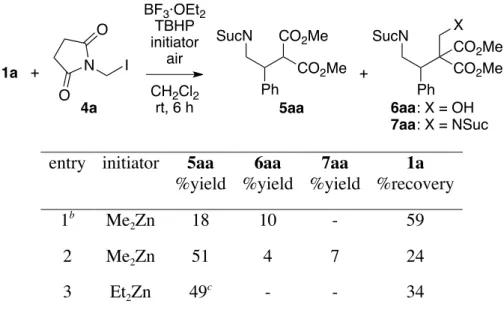
The reaction of benzylidenemalonate 1a and N-iodomethylsuccinimide (4a) was first conducted under the conditions reported for the reaction of 1a and iodomethyl pivalate.5c
tert-Butyl hydroperoxide (TBHP) and boron trifluoride diethyl etherate (1.2 equiv each), and then dimethylzinc (3 equiv) were added to a solution of 1a (1 mmol) and 4a (3 equiv) in dichloromethane (5 mL), and the mixture was stirred at room temperature under argon atmosphere. The reaction was so sluggish that it failed to complete even after 24 h, giving succinimidomethyl adduct 5aa in only 18% yield along with α-hydroxymethylated adduct 6aa (10%), with significant recovery (59%) of 1a (Table 1, entry 1). A plausible pathway to 6aa is shown in Scheme 2. The reaction is initiated by the action of dimethylzinc and oxygen or TBHP to generate a methyl radical. The methyl radical abstracts an iodine atom from 4a to give imidomethyl radical A, which undergoes addition to 1a. The resulting radical intermediate B is trapped by dimethylzinc to give zinc enolate C and a methyl radical, which restarts the chain reaction. As in the reaction with iodomethyl pivalate,5c
the formation of 6aa is attributable to the subsequent aldol reaction of C with formaldehyde, which is formed by the action of imidomethyl radical A and oxygen that invaded into the reaction flask, via imidomethanolate D.10
Table 1. Reactions of 1a with 2a.a
1a + N I O O 4a BF3·OEt2 TBHP initiator air CH2Cl2 rt, 6 h Ph CO2Me CO2Me 5aa SucN Ph CO2Me CO2Me 6aa 7aa SucN X + : X = OH : X = NSuc
entry initiator 5aa
%yield 6aa %yield 7aa %yield 1a %recovery 1b Me2Zn 18 10 - 59 2 Me2Zn 51 4 7 24 3 Et2Zn 49 c - - 34
4 4 Et3B 21 - 20 6 5d Me2Zn 78 4 4 - 6d,e Me2Zn 92 4 3 - a
The reaction was conducted using 1a (1 mmol) and 2a (3 equiv) with BF3·OEt2 (1.2 equiv), TBHP
(1.2 equiv), and initiator (3 equiv) in CH2Cl2 (5 mL) unless otherwise mentioned. Suc = succinoyl b
Under argon atmosphere for 24 h. c Ethyl adduct was produced in 6% yield. d TBHP (0.4 equiv) and
Me2Zn (1 equiv) were added every 2 h. e
The reaction was conducted in CH2Cl2 (10 mL).
Scheme 2. Plausible Reaction Pathways. Me2Zn Ph CO2Me CO2Me Ph CO2Me MeO OZnMe Me2Zn H3O+ O2 or t-BuOOH O2 O– H2C O 1a 4a 5aa 6aa Me• 7aa A B D C Me–I Me• NCH2• O O N O O N O O N O O N– O O
This slow reaction is in great contrast to the reaction with iodomethyl pivalate, which gave pivaloyloxymethyl adduct 2 in 94% yield within 15 min under the same conditions (Scheme 1). The slow reaction seems to reflect the inferior nucleophilicity of imidomethyl radical A to that of the acyloxymethyl radical, and indicates difficulty in the development of its reaction with an electrophilic double bond as we previously experienced in the reaction with imine.11
To enhance the generation of the methyl radical and increase the concentration of radical A in the reaction mixture, the reaction was conducted in the presence of molecular oxygen under ordinary atmosphere. As expected, the reaction
5 rate increased, but was still slow, and after 6 h, produced 5aa, 6aa, and α,β-bis imidomethylated product 7aa in 51%, 4%, and 7% yield, respectively, with 24% recovery of 1a (entry 2). The formation of 7aa was due to the radical–radical coupling between radical intermediate B and radical A (Scheme 2), and indicates that A existed in such a concentration in the reaction mixture, probably due to the low nucleophilicity of the radical, that its reaction with radical intermediate B could compete with that of dimethylzinc with B. It is noteworthy that only a tiny amount (4%) of 6aa was produced in the presence of oxygen, while the reaction with iodomethyl pivalate quantitatively gave α-hydroxymethylated product 3 after 3 h under ordinary atmosphere (Scheme 1). This is attributable to the stability of imidomethanolate D, an oxidized product of A that would supply formaldehyde more slowly than the PivOCH2O
–
formed in the reaction with iodomethyl pivalate because of the inferior leaving-group ability of the succinimide anion compared with the pivalate anion.12
When diethylzinc was used in place of dimethylzinc, 5aa was produced in almost the same yield (49%) with a small amount (6%) of ethyl adduct (entry 3). The lack of 7aa production probably reflected a faster trapping of the radical intermediate B with diethylzinc to form zinc enolate with liberation of the ethyl radical, which was more stable than the methyl radical. In the reaction with diethylzinc, no 4a remained in the crude mixture, and instead, a small amount (8% based on utilized 4a) of N-methylsuccinimide was observed, while ca. 40% of 4a remained unreacted after the reaction with dimethylzinc (entry 2). This is probably because the succinimidomethyl radical underwent not only addition to 1a but also an SH2 reaction with diethylzinc to give the succinimidomethylzinc species and
ethyl radical, as previously documented.7a
This probably contributed to reducing the concentration of the succinimidomethyl radical and resulted in suppressed 7aa production. The reaction with triethylborane gave almost the same amount of 5aa and 7aa (21% and 20% yields, respectively) with unidentified byproducts (entry 4). The increased production of 7aa and byproducts could be attributed to a slower reaction rate between radical intermediate B and triethylborane, as previously observed.5
6 intensively at the beginning and rapidly became slower, and most of the dimethylzinc seemed to be consumed within 2 h. Therefore, radical initiators, i.e., TBHP and dimethylzinc, were added in three portions (0.4 × 3 and 1 × 3 equiv, respectively) at 2-h intervals. To our delight, 1a was totally consumed after 6 h, and 5aa, 6aa, and 7aa were obtained in 78%, 4%, and 4% yield, respectively (entry 5). The yield of 5aa was further improved to 92% when the reaction was conducted in a more diluted condition with 10 mL CH2Cl2 (entry 6; Method A).
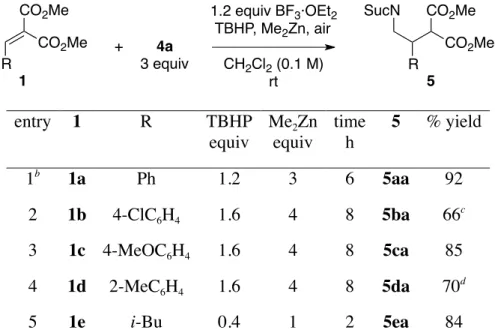
The scope of Method A was investigated using other alkylidenemalonates (Table 2). The reaction also proceeded with 1b, bearing an electron-withdrawing group, to give 5ba in 66% yield (entry 2). With 1c, bearing an electron-donating group, adduct 5ca was produced in 85% yield (entry 3). The reaction was slightly retarded with sterically hindered substrate 1d bearing an ortho-tolyl group to provide adduct
5da in 70% yield with 8% recovery of 1d (entry 4). The reaction with aliphatic substrate 1e proceeded
smoothly and afforded adduct 5ea in 84% yield after 2 h (entry 5).
Table 2. Conjugate Addition of Alkylidenemalonates with Method A.a
R CO2Me CO2Me 1 + 4a 1.2 equiv BF3·OEt2 TBHP, Me2Zn, air CH2Cl2 (0.1 M) rt 3 equiv R CO2Me CO2Me 5 SucN entry 1 R TBHP equiv Me2Zn equiv time h 5 % yield 1b 1a Ph 1.2 3 6 5aa 92 2 1b 4-ClC6H4 1.6 4 8 5ba 66 c 3 1c 4-MeOC6H4 1.6 4 8 5ca 85 4 1d 2-MeC6H4 1.6 4 8 5da 70 d 5 1e i-Bu 0.4 1 2 5ea 84
a Method A: TBHP (0.4 equiv) and Me
2Zn (1 equiv) were added every 2 h for the indicated reaction
time. Suc = succinoyl b
Data from Table 1, entry 6 for comparison. c
With 2% recovery of 1d. d
With 8% recovery of 1d.
7 In contrast to the reaction with 4a, that with N-iodomethylphthalimide (4b) was much faster and produced much more bis-imidomethylated product 7ab. When the reaction was conducted under the conditions shown in Table 1, entry 2 using 4b in place of 4a, 1a was completely consumed within 6 h, and 7ab was mainly produced in 76% yield along with adduct 5ab in 14% yield (Table 3, entry 1; Method B). The production of a significant amount (76%) of 7ab indicates that a high concentration of the phthalimidomethyl radical existed in the reaction mixture. NMR analysis of the crude mixture showed that a much smaller amount (9%) of 4b than 4a remained unreacted after this reaction under the same conditions (40% in Table 1, entry 2). These results clearly indicate that the methyl radical should react with 4b faster than with 4a, probably because of the higher stability of the phthalimidomethyl radical than of the succinimidomethyl radical. Indeed, the following isodesmic reaction indicated that the phthalimidomethyl radical was more stable by 1.3 kcal/mol than the succinimidomethyl radical at the B3LYP/6-311++G(3df,3pd)//B3LYP/6-31+G* level of theory (Scheme 3).13
Importantly, this radical–radical cross-coupling occurred highly selectively, and no homo coupling products such as N,N'-ethylenebisphthalimide were detected by 1
H NMR of the crude mixture, suggesting that the phthalimidomethyl radical should be present in a much smaller amount in the reaction mixture than the radical intermediate B, the homo coupling of which could be sterically prevented.14
Table 3. Reactions of 1a with 4b.a
1a + N I O O 4b BF3·OEt2 TBHP initiator air CH2Cl2 rt, 6 h Ph CO2Me CO2Me 5ab PhthN Ph CO2Me CO2Me 7ab PhthN NPhth + entry 4b equiv initiator 5ab % yield 7ab % yield 1a % recovery 1 3 Me2Zn 14 76 -
8 2 3 Et2Zn 49 b 4 - 3 3 Et3B 36 17 12 4 1.2 Me2Zn 81 9 - 5 1.2 Et2Zn 23 c - 6 6 1.2 Et3B 34 16 26 a
The reaction was conducted using 1a (0.5 mmol) with BF3·OEt2 (1.2 equiv), TBHP (1.2 equiv), and
initiator (3 equiv) in CH2Cl2 (2.5 mL). Phth = phthaloyl b
Ethyl adduct was produced in 37% yield. c
Ethyl adduct was produced in 62% yield.
Scheme 3. Relative Stability of Succinimidomethyl and Phthalimidomethyl Radicals at the
B3LYP/6-311++G(3df,3pd)//B3LYP/6-31+G* Level of Theory.
+ N CH2• O O N CH3 O O ΔH0 1.3 kcal/mol + N CH3 O O N CH2• O O
In contrast, the reaction using diethylzinc in place of dimethylzinc gave 5ab as a major product in 49% yield along with ethyl adduct in 37% yield, and 7ab was a minor product in 4% yield (Table 3, entry 2). The decreased production of 7ab was probably due to the higher reactivity of diethylzinc toward the radical intermediate, corresponding to B, and toward the phthalimidomethyl radical than that of dimethylzinc to decrease the concentration of these radical species in the reaction mixture and suppress the radical–radical coupling. In this reaction, much more ethyl adduct (37%) was produced than that in the reaction with 4a (6% in Table 1, entry 4). These results suggest that the phthalimidomethyl radical was less nucleophilic and thus less competitive with the ethyl radical than the succinimidomethyl radical. The use of triethylborane in place of diethylzinc resulted in an increased production of 7ab (17%) as well as a decreased yield of 5ab (36%) with 12% recovery of 1a (Table 3, entry 3). The result is again attributable to the insufficient rate of the reaction between the radical intermediate, corresponding to B, and triethylborane.5
9 When the amount of 4b used was decreased to 1.2 equiv, the reaction mainly provided 5ab in 81% yield, and 7ab was produced in only 9% yield (entry 4; Method C). Therefore, the concentration of the imidomethyl radical in the reaction mixture seems highly dependent on the amount of iodide 4 added to the reaction mixture. The use of diethylzinc under this condition produced mainly ethyl adduct in 62% yield with 5ab in 23% yield, and 6% of 1a was recovered (entry 5). The reaction with triethylborane gave almost the same results (5ab in 36% and 34% yields, and 7ab in 17% and 16% yields, respectively) in the reactions using 3 and 1.2 equiv of 4b (entries 3 and 6).
Using Method C or B, mono- or bis-imidomethylation was preferentially achieved with other alkylidenemalonates (Table 4). The reactions of benzylidenemalonate 1b bearing an electron-withdrawing group with 1.2 or 3 equiv of 4b proceeded smoothly and mainly gave 5bb and 7bb in 83% and 74% yield, respectively (entries 3 and 4). With 1c bearing an electron-donating group, the product distribution also switched, and 5cb and 7cb were obtained in 77% and 70% yield by Methods C and B, respectively (entries 5 and 6). In the reaction with sterically hindered 1d, the increased amount of 4b (6 equiv) was required to gain 7db in good yield (62%), but 5db was obtained in 61% yield with 1.2 equiv of 4b (entries 7 and 8). In these reactions, 14% and 10% of 1d was recovered, respectively. Mono-imidomethylation of aliphatic substrate 1e with Method C produced 5eb in 84% yield (entry 9). Interestingly, even with 3 equiv of 4b, the reaction of 1e gave mainly 5eb in 68% yield, and 7eb was obtained as a minor product in 18% yield (entry 10).
Table 4. Mono- and Bis-imidomethylation of Alkylidenemalonates with Methods C and B.a
R CO2Me CO2Me 1 + 4b BF3·OEt2 TBHP Me2Zn air CH2Cl2 rt, 6 h R CO2Me CO2Me 7 PhthN R CO2Me CO2Me 5 PhthN NPhth + entry 1 R 4b equiv 5 % yield 7 % yield
10 1b 1a Ph 1.2 5ab/81 7ab/6 2c 1a Ph 3 5ab/14 7ab/76 3d 1b 4-ClC6H4 1.2 5bb/83 7bb/10 4 1b 4-ClC6H4 3 5bb/22 7bb/74 5 1c 4-MeOC6H4 1.2 5cb/77 7cb/7 6 1c 4-MeOC6H4 3 5cb/17 7cb/70 7e 1d 2-MeC6H4 1.2 5db/61 7db/10 8f 1d 2-MeC6H4 6 5db/16 7db/62 9d
1e i-Bu 1.2 5eb/84 7eb/7
10 1e i-Bu 3 5eb/68 7eb/18
a
The reaction was conducted using 1 (0.5 mmol) with BF3·OEt2 (1.2 equiv), TBHP (1.2 equiv), and
Me2Zn (3 equiv) in CH2Cl2 (2.5 mL) unless otherwise mentioned. Phth = phthaloyl b
Data from Table 3, entry 1 for comparison. c
Data from Table 3, entry 4 for comparison. d
With 1 (2 mmol) in CH2Cl2 (10
mL). e
With 14% recovery of 1d. f
With 10% recovery of 1d.
The following experiment excluded the possibility that 7 was formed by an SN2 reaction of the zinc
enolate, such as C, with imidomethyl iodide 4: The reaction of 1a was conducted under the conditions of Method C for 6 h, and then 3 equiv of 4b was added to the reaction mixture, in which the zinc enolate intermediate, corresponding to C, should have formed as a major product (Scheme 4). After additional stirring for 3 h, the crude product was analyzed by 1
H NMR and was found to contain mono-imidomethyl adduct 5ab and bis-mono-imidomethylated product 7ab as a 91:9 mixture. This result clearly indicates that the zinc enolate is not an intermediate to give 7ab.
Scheme 4. Attempted Reaction of the Zinc Enolate Intermediate with 4b.
1a + 1.2 equiv 4b 1.2 equiv BF3·OEt2 1.2 equiv TBHP 3 equiv Me2Zn air CH2Cl2 (0.2 M) rt, 6 h 4b 3 equiv rt, 3 h 5ab + 7ab (91:9)
11 The competition reaction with 4a and 4b provided more information about the difference between the succinimidomethyl and phthalimidomethyl radicals. Boron trifluoride diethyl etherate (1.2 equiv), TBHP (1.2 equiv), and dimethylzinc (3 equiv) were added to the mixture of 1a (0.5 mmol), 4a, and 4b (3 equiv each) in dichloromethane (2.5 mL). After 6 and 8 h, additional boron trifluoride diethyl etherate, TBHP, and dimethylzinc (1.2, 0.4, and 1 equiv each) were added to the mixture. After 9 h in total, 1a was completely consumed, and 5aa, 5ab, 7ab, 7ac, and 7ad were produced in 10%, 33%, 25%, 15%, and 3% yield, respectively (Scheme 5). Because most of radicals, including the tert-butyl radical, undergo radical–radical coupling at the diffusion-controlled limit,15
the reactions of a radical intermediate such as B with succinimidomethyl and phthalimidomethyl radicals are likely also diffusion-controlled, and thus, the rate constants should be almost the same for both radicals. This means that the product distribution of bis-imidomethylation should be proportional to the concentration of the radical species in the reaction mixture. In the above reaction, although 43% of 1a was bis-imidomethylated in total, phthalimidomethylation mainly occurred, giving 7ab and 7ac, and α-succinimidomethylated adduct 7ad was produced in only 3% yield. This result indicates that the amount of the phthalimidomethyl radical was approximately 10-fold higher than that of the succinimidomethyl radical in the reaction mixture, which is in good agreement with the calculated relative stability of the phthalimidomethyl and succinimidomethyl radicals, corresponding to a ratio of 90:10 at 25 °C (Scheme 3).
12 1a + 4a + 4b BF3·OEt2 (1.2 + 1.2 x 2) equiv TBHP (1.2 + 0.3 x 2) equiv Me2Zn (3 + 1 x 2) equiv air CH2Cl2 (0.2 M) rt, (6 + 2 + 1) h 5aa 10% 3 equiv each + Ph CO2Me CO2Me R1N NR2 7ac 7ad: R 1, R2 = Suc, Phth : R1, R2 = Phth, Suc15%3% 5ab 33%+ + 7ab 25%
The conjugate addition of the succinimidomethyl radical produced 5aa and 7ac, while the conjugate addition of the phthalimidomethyl radical led to the formation of 5ab, 7ab, or 7ad. The ratio of the combined yields of 5aa and 7ac (25%) to that of 5ab, 7ab, and 7ad (61%) was 3:7 and clearly higher than the relative concentration of these imidomethyl radicals (approximately 1:10, vide supra). Therefore, the succinimidomethyl radical seems to have undergone addition to 1a approximately four times faster than the phthalimidomethyl radical, indicating higher nucleophilicity of the succinimidomethyl radical. The observed lower nucleophilicity of the phthalimidomethyl radical suggests that its higher stability is due to the electron-withdrawing ability of the benzene ring, which delocalizes the spin density of the radical. Actually, the DFT calculations indicated lower spin density at the reaction center of the phthlimidomethyl radical than that of the succinimidomethyl radical (0.833 and 0.858 at the B3LYP/6-311++G(3df,3pd)//B3LYP/6-31+G* level of theory, respectively).13 It is
interesting that 4a was a superior imidomethyl radical source than 4b in the addition reaction with N-Boc imine to give the corresponding adduct in better yield.11c
This could be attributable to the inferior electrophilicity of the imine16
in the reaction in which the nucleophilicity of the radical could be a more important factor than its concentration.
Adducts 5bb and 5eb were readily converted into GABA analogs for medical use (Scheme 6). Decarboxylation and subsequent hydrolysis of 5bb and 5eb provided baclofen hydrochloride (R = 4-ClC6H4)
8a
and pregabalin hydrochloride (R = i-Bu)8b
in 71% and 69% yield in 2 steps, respectively. The treatment of bis-imidomethylated product 7bb with N2H4•H2O afforded α-aminomethyl γ-lactam 8 in
13
Scheme 6. Conversion of 5bb and 5eb into GABA Analogs, and 7bb into γ-Lactam 8
5bb or 5eb 1) LiCl, DMSO, 130 °C, 16 h 2) 6 N HCl, reflux, 19 h CO2H baclofen•HCl pregabalin•HCl from 5bb from 5eb 71% 69% 7bb N2H2·H2O MeOH/THF rt, 20 h 50% 4-ClC6H4 CO2Me N H O 8 R ClH3N R = 4-ClC6H4 R = i-Bu NH2 CONCLUSION
We developed a mono- and bis-imidomethylation reaction of alkylidenemalonate with dimethylzinc-mediated conjugate addition of imidomethyl radicals. The nucleophilicity of the phthalimidomethyl radical was inferior to that of the succinimidomethyl radical, but exhibited better performance in the conjugate addition because of its higher concentration in the reaction mixture as a result of its superior stability. This is a striking contrast to the reaction of imine, in which the nucleophilicity of the radicals was a dominant factor, and the addition of the succinimidomethyl radical proceeded more smoothly. Importantly, bis-imidomethylation occurred via highly selective radical–radical cross-coupling, probably due to the steric protection of the adduct radical intermediate toward the self-coupling. This provides a rare example of a highly selective and efficient radical–radical cross-coupling reaction. Facile conversion of the products into clinically useful GABA analogs highlights the utility of this reaction.
EXPERIMENTAL SECTION
General. All melting points were measured after recrystallization from hexane–EtOAc and are
reported without correction. Silica gel was used for column chromatography. NMR (500 and 125 MHz for 1
H and 13
14 and coupling constants (J) are presented in parts per million relative to tetramethylsilane and hertz, respectively. Abbreviations are as follows: s, singlet; d, doublet; t, triplet; q, quartet; m, multiplet; br, broad.13
C peak multiplicity assignments were made on the basis of DEPT data. IR spectroscopy was recorded using an
attenuated total reflectance FTIR unless otherwise noted, and the wave numbers of maximum absorption peaks are reported in cm−1
. Quadrupole, double-focusing magnetic sector, and TOF mass spectrometers were used for EI-, FAB-, and HRMS-ESI, respectively. Solvents, including anhydrous dichloromethane and THF, hexane solutions of dimethylzinc, diethylzinc and triethylborane, were purchased and used as received.
Starting Materials. Alkylidenemalonates 1a and 1c,17 1b,18 1d,19 and 1e;20 iodides 4a and 4b11c
were prepared according to literature procedures.
Method A (Table 2, entry 1). Dimethyl 2-(1-Phenyl-2-succinimidoethyl)malonate (5aa), Dimethyl 2-Hydroxymethyl-phenyl-2-succinimidoethyl)malonate (6aa), Dimethyl 2-(1-Phenyl-2-succinimidoethyl)-2-succinimidomethylmalonate (7aa): A magnetic stir bar and 1a (220
mg, 1.00 mmol) were placed in a dried 20 mL two-neck round-bottom flask that was capped with an argon balloon. To the flask, were added CH2Cl2 (10 mL), 4a (0.72 mg, 3.0 mmol), and a 6.6 M decane
solution of TBHP (60 μL, 0.40 mmol) at rt. To the stirred solution cooled in an ice−water bath, were added BF3·OEt2 (0.16 mL, 1.2 mmol), and a 1.0 M hexane solution of Me2Zn (1.0 mL, 1.0 mmol). The
argon balloon was replaced with a NaOH drying tube, and the cooling bath was removed. The solution of TBHP (60 μL, 0.40 mmol each) and the solution of Me2Zn (1.0 mL, 1.0 mmol each) were added to
the mixture every two hours. After addition of 3.0 mmol Me2Zn in total, the mixture was stirred for
further 2 h, and the reaction was quenched by the addition of aq saturated NH4Cl. The whole was
extracted three times with EtOAc, and the combined organic layers were washed with sat. Na2S2O3 and
brine, dried over Na2SO4, and then evaporated. The purification of the resulting residue by column
chromatography (hexane/EtOAc 9:1 to 1:1) gave 5aa (306 mg, 92%) as a colorless solid of mp 70−71 °C, 6aa (13 mg, 4%) as a white solid of mp 111−112 °C, and 7aa (12 mg, 3%) as a white solid of
15 mp 230−231 °C. 5aa: 1 H NMR: 2.47–2.52 (m, 4H), 3.43 (s, 3H), 3.78 (s, 3H), 3.81 (dd, J = 13.5, 7.0, 1H), 3.85 (d, J = 10.5, 1H), 3.90 (dd, J = 13.5, 8.5, 1H), 4.00 (ddd, J = 10.5, 8.5, 7.0, 1H), 7.18−7.30 (m, 5H). 13 C NMR 27.9 (CH2), 41.9 (CH2), 42.4 (CH), 52.4 (CH3), 52.8 (CH3), 56.2 (CH), 127.7 (CH), 128.3 (CH), 128.4 (CH), 137.4 (C), 167.6 (C), 168.3 (C), 176.8 (C). IR: 3020, 1736, 1701, 1435, 1404, 1215, 1165, 752. ESIMS (m/z): [M + H]+
calcd for C17H20NO6, 334.1285; found, 334.1285.
6aa: 1 H NMR: 2.35−2.50 (m, 4H), 2.58 (br s, 1H), 3.78 (dd, J = 13.5, 4.5, 1H), 3.78-3.82 (br m, 2H), 3.83 (s, 3H), 3.87 (s, 3H), 3.94 (dd, J = 11.0, 4.5, 1H), 4.60 (dd, J = 13.5, 11.0, 1H), 7.14−7.16 (m, 2H), 7.23-7.25 (m, 3H). 13 C NMR: 27.8 (CH2), 40.4 (CH2), 45.7 (CH), 52.7 (CH3), 52.9 (CH3), 63.0 (C), 65.8 (CH2), 128.1 (CH), 128.4 (CH), 129.3 (CH), 135.5 (C), 170.0 (C), 170.4 (C), 176.7 (C). IR: 3017, 1732, 1701, 1404, 1215, 1169, 760. HRMS-ESI (m/z): [M + H]+
calcd for C18H22NO7, 364.1391; found,
364.1389. 7aa: 1 H NMR: 2.28−2.43 (m, 4H), 2.69 (s, 4H), 3.775 (s, 3H), 3.783 (s, 3H), 3.86 (d, J = 14.5, 1H), 3.88 (dd, J = 13.0, 4.5, 1H), 3.98 (dd, J = 11.5, 4.5, 1H), 4.18 (d, J = 14.5, 1H), 4.44 (dd, J = 13.0, 11.5, 1H), 7.20−7.24 (m, 5H). 13 C NMR: 27.7 (CH2), 28.0 (CH2), 40.3 (CH2), 41.7 (CH2), 45.6 (CH), 52.7 (CH3), 53.1 (CH3), 59.9 (C), 128.08 (CH), 128.11 (CH), 130.0 (CH), 135.2 (C), 168.96 (C), 169.04 (C), 176.5 (C), 176.9 (C). IR: 3017, 1732, 1705, 1400, 1215, 1165, 760. HRMS-ESI (m/z): [M + H]+ calcd for C22H25N2O8, 445.1605; found, 445.1606.
Dimethyl 2-(1-(4-Chlorophenyl)-2-succinimidoethyl)malonate (5ba): Method A, using 1b (255 mg,
1.00 mmol) in place of 1a, gave 5ba (243 mg, 66%) as a colorless solid of mp 147−148 °C: 1
H NMR: 2.52 (s, 4H), 3.47 (s, 3H), 3.75−3.80 (m, 2H), 3.77 (s, 3H), 3.90 (dd, J = 13.5, 8.5, 1H), 4.00 (ddd, J = 10.5, 8.5, 7.5, 1H), 7.15 (d, J = 8.5, 2H), 7.24 (d, J = 8.5, 2H). 13C NMR: 27.9 (CH 2), 41.6 (CH2), 41.9 (CH), 52.6 (CH3), 52.9 (CH3), 56.0 (CH), 128.7 (CH), 129.8 (CH), 133.6 (C), 136.0 (C), 167.4 (C), 168.0 (C), 176.7 (C). IR: 3021, 1736, 1701, 1404, 1215, 1161, 752. HRMS-ESI (m/z): [M + H]+ calcd for C17H19ClNO6, 368.0895; found, 368.0895.
16
Dimethyl 2-(1-(4-Methoxyphenyl)-2-succinimidoethyl)malonate (5ca): Method A, using 1c (250
mg, 1.00 mmol) in place of 1a, gave 5ca (308 mg, 85%) as a colorless solid of mp 105−106 °C: 1
H NMR: 2.50 (s, 4H), 3.45 (s, 3H), 3.76–3.80 (m, 2H), 3.77 (s, 6H), 3.88 (dd, J = 13.5, 8.5, 1H), 3.96 (ddd, J = 10.5, 8.5, 7.5, 1H), 6.79 (d, J = 8.5, 2H), 7.11 (d, J = 8.5, 2H). 13 C NMR: 27.9 (CH2), 41.7 (CH), 41.9 (CH2), 52.4 (CH3), 52.8 (CH3), 55.1 (CH3), 56.4 (CH), 113.8 (CH), 129.2 (C), 129.4 (CH), 158.9 (C), 167.6 (C), 168.3 (C), 176.8 (C). IR: 3021, 1736, 1701, 1516, 1404, 1215, 1165, 752. HRMS-ESI (m/z): [M + H]+
calcd for C18H22NO7, 364.1391; found, 364.1390.
Dimethyl 2-(2-Succinimido-1-o-tolylethyl)malonate (5da): Method A, using 1d (234 mg, 1.00
mmol) in place of 1a, gave 5da (244 mg, 70%) as a colorless solid of mp 105−106 °C: 1
H NMR: 2.41 (s, 3H), 2.56 (s, 4H), 3.37 (s, 3H), 3.72–3.79 (m, 1H), 3.76 (s, 3H), 3.82, (dd, J = 13.5, 8.0, 1H), 3.94 (d, J = 10.5, 1H), 4.28 (m, 1H), 7.12−7.14 (m, 4H). 13 C NMR: 19.5 (CH3), 27.9 (CH2), 37.3 (CH), 42.0 (CH2), 52.3 (CH3), 52.8 (CH3), 56.3 (CH), 125.9 (CH), 126.6 (CH), 127.3 (CH), 130.6 (CH), 136.1 (C), 137.0 (C), 167.7 (C), 168.6 (C), 177.0 (C). IR: 3021, 1732, 1701, 1404, 1215, 1165, 818, 752. HRMS-ESI (m/z): [M + H]+
calcd for C18H22NO6, 348.1442; found, 348.1441.
Dimethyl 2-(3-Methyl-1-(succinimidomethyl)butyl)malonate (5ea): Method A, using 1e (200 mg,
1.00 mmol) in place of 1a, gave 5ea (263 mg, 84%) as a colorless solid of mp 70−71 °C: 1
H NMR: 0.89 (d, J = 6.5, 3H), 0.91 (d, J = 6.5, 3H), 1.14 (ddd, J = 14.0, 8.5, 4.5, 1H), 1.35 (ddd, J = 14.0, 9.0, 5.5, 1H), 1.71 (m, 1H), 2.51 (ddtd, J = 8.5, 7.0, 5.5, 5.0, 1H), 2.69 (d, J = 9.5, 2H), 2.71 (d, J = 9.5, 2H), 3.42 (d, J = 5.5, 1H), 3.64 (dd, J = 14.0, 5.0, 1H), 3.69 (dd, J = 14.0, 7.0, 1H), 3.74 (s, 3H), 3.76 (s, 3H). 13 C NMR: 21.8 (CH3), 23.1 (CH3), 25.5 (CH), 28.1 (CH2), 35.3 (CH), 39.0 (CH2), 40.5 (CH2), 52.41 (CH3), 52.43 (CH3), 53.7 (CH), 168.8 (C), 168.9 (C), 177.5 (C). IR: 2955, 1732, 1701, 1404, 1215, 1172,
763. HRMS-ESI (m/z): [M + H]+ calcd for C
15H24NO6, 314.1598; found, 314.1599.
Method C (Table 4, entry 1). Dimethyl 2-(1-Phenyl-2-phthalimidoethyl)malonate (5ab): A
magnetic stir bar and 1a (110 mg, 0.500 mmol ) were placed in a dried 10 mL two-neck round-bottom flask that was capped with an argon balloon. To the flask, were added CH2Cl2 (2.5 mL), 4b (0.17 g, 0.60
17 mmol), and a 5.8 M decane solution of TBHP (0.10 mL, 0.60 mmol) at rt. To the stirred solution cooled in an ice−water bath, were added BF3·OEt2 (80 μL, 0.60 mmol) and a 1.0 M hexane solution of Me2Zn
(1.5 mL, 1.5 mmol). The argon balloon was replaced with a NaOH drying tube, and the cooling bath was removed. After 6 h, the reaction was quenched by the addition of aq saturated NH4Cl, and the
mixture was extracted three times with EtOAc. The combined organic layers were washed with aq saturated Na2S2O3 and brine, dried over Na2SO4, and then evaporated. The purification of the residue by
column chromatography (hexane/EtOAc 9:1 to 1:1) gave 5ab (157 mg including 3 mg of unidentified phthalimide derivatives), which was characterized after further purification by preparative TLC to give a colorless solid of mp 109−110 °C: 1 H NMR: 3.44 (s, 3H), 3.69 (s, 3H), 3.89 (d, J = 10.0, 1H), 4.00 (m, 1H), 4.06−4.12 (m, 2H), 7.16−7.23 (m, 5H), 7.66 (dd, J = 5.5, 3.0, 2H), 7.76 (dd, J = 5.5, 3.0, 2H). 13C NMR: 41.3 (CH2), 43.6 (CH), 52.4 (CH3), 52.8 (CH3), 56.0 (CH), 123.2 (CH), 127.6 (CH), 128.35 (CH), 128.44 (CH), 131.7 (C), 133.9 (CH), 137.5 (C), 167.6 (C), 167.9 (C), 168.2 (C). IR: 3021, 1736, 1712, 1396, 1215, 752. HRMS-ESI (m/z): [M + H]+
calcd for C21H20NO6, 382.1285; found, 382.1280. The
yields (5ab: 81%, 7ab: 6%) were determined by 1
H NMR on the basis of the integration area of the signals at 3.44 and 3.81 ppm, respectively, using Ph3CH (5.55 ppm) as an internal standard
Dimethyl 2-(1-(4-Chlorophenyl)-2-Phthalimidoethyl)malonate (5bb): Method C, using 1b (509 mg,
2.00 mmol) in place of 1a in CH2Cl2 (10 mL) with 4b (0.69 g, 2.4 mmol), the solution of TBHP (0.40
mL, 2.4 mmol), BF3·OEt2 (0.32 mL, 2.4 mmol), and the solution of Me2Zn (6.0 mL, 6.0 mmol), gave
5bb (688 mg, 83%) as a colorless oil: 1 H NMR: 3.49 (s, 3H), 3.71 (s, 3H), 3.83 (d, J = 10.0, 1H), 3.96 (m, 1H), 4.05−4.12 (m, 2H), 7.18 (d, J = 9.0, 2H), 7.20 (d, J = 9.0, 2H), 7.68 (dd, J = 5.5, 3.0, 2H), 7.77 (dd, J = 5.5, 3.0, 2H). 13 C NMR: 41.0 (CH2), 43.0 (CH), 52.6 (CH3), 52.9 (CH3), 55.9 (CH), 123.3 (CH), 128.7 (CH), 129.8 (CH), 131.6 (C), 133.5 (C), 134.0 (CH), 151.6 (C), 167.4 (C), 167.8 (C), 168.0 (C). IR (neat): 2954, 1735, 1716, 1435, 1396, 721. HRMS-ESI (m/z): [M + H]+
calcd for C21H19ClNO6,
416.0895; found, 416.0897. The yield of 7bb (10%) was determined by 1
H NMR of the crude mixture on the basis of the integration area of the signal at 3.49 ppm, using Ph3CH (5.55 ppm) as an internal
18 standard.
Dimethyl 2-(1-(4-Methoxyphenyl)-2-phthalimidoethyl)malonate (5cb): Method C, using 1c (125
mg, 0.500 mmol) in place of 1a, gave 5cb (167 mg including 9 mg of unidentified phthalimide derivatives), which was characterized after further purification by preparative TLC: a colorless oil. 1
H NMR: 3.47 (s, 3H), 3.69 (s, 3H), 3.73 (s, 3H), 3.83 (d, J = 10.0, 1H), 3.96 (m, 1H), 4.02−4.10 (m, 2H), 6.75 (d, J = 8.5, 2H), 7.15 (d, J = 8.5, 2H), 7.66 (dd, J = 5.5, 3.0, 2H), 7.76 (dd, J = 5.5, 3.0, 2H). 13 C NMR: 41.3 (CH2), 42.8 (CH), 52.4 (CH3), 52.7 (CH3), 55.1 (CH3), 56.3 (CH), 113.8 (CH), 123.2 (CH), 129.35 (C), 129.44 (CH), 131.7 (C), 133.9 (CH), 158.8 (C), 167.7 (C), 167.9 (C), 168.3 (C). IR (neat): 2954, 1736, 1713, 1516, 1250, 725. HRMS-ESI (m/z): [M + H]+
calcd for C22H22NO7, 412.1391; found,
412.1394. The yields (5cb: 77%, 7cb: 7%) were determined by 1H NMR on the basis of the integration
area of the signals at 3.47 and 3.71 ppm, respectively, using Ph3CH (5.55 ppm) as an internal standard.
Dimethyl 2-(2-Phthalimido-1-o-tolylethyl)malonate (5db): Method C, using 1d (117 mg, 0.500
mmol) in place of 1a, gave 5db (135 mg including 15 mg of unidentified phthalimide derivatives), which was characterized after further purification by preparative TLC to give a colorless oil: 1
H NMR: 2.42 (s, 3H), 3.39 (s, 3H), 3.62 (s, 3H), 3.93−4.02 (m, 3H), 4.41 (dt, J = 10.5, 7.0, 1H), 7.05−7.14 (m, 3H), 7.20 (d, J = 7.5, 1H), 7.68 (dd, J = 5.5, 3.0, 2H), 7.79 (dd, J = 5.5, 3.0, 2H). 13 C NMR: 19.6 (CH3), 41.2 (CH2), 52.4 (CH3), 52.7 (CH3), 56.0 (CH), 123.2 (CH), 126.0 (CH), 127.3 (CH), 130.6 (CH), 131.8 (C), 133.9 (CH), 136.2 (C), 137.1 (C), 167.8 (C), 168.0 (C), 168.4 (C). IR (neat): 2990, 1736, 1713, 1215, 903, 756, 725. HRMS-ESI (m/z): [M + H]+
calcd for C22H22NO6, 396.1442; found, 396.1441. The
yields (5db: 61%, 7db: 10%) were determined by 1
H NMR on the basis of the integration area of the signals at 3.39 and 3.77 ppm, respectively, using Ph3CH (5.55 ppm) as an internal standard.
Dimethyl 2-(3-Methyl-1-(phthalimidomethyl)butyl)malonate (5eb): Method C, using 1e (400 mg,
2.00 mmol) in place of 1a in CH2Cl2 (10 mL) with 4b (0.69 g, 2.4 mmol), the solution of TBHP (0.40
mL, 2.4 mmol), BF3·OEt2 (0.32 mL, 2.4 mmol), and the solution of Me2Zn (6.0 mL, 6.0 mmol), gave
5eb (607 mg, 84%) as a colorless oil: 1
19 = 14.5, 8.5, 4.5, 1H), 1.42 (ddd, J = 14.5, 8.5, 5.5, 1H), 1.77 (m, 1H), 2.63 (ddddd, J = 8.5, 7.0, 6.0, 5.5, 4.5, 1H), 3.49 (d, J = 6.0, 1H), 3.71 (s, 3H), 3.76 (s, 3H), 3.83 (dd, J = 14.0, 5.5, 1H), 3.87 (dd, J = 14.0, 7.0, 1H), 7.73 (dd, J = 5.5, 3.0, 2H), 7.85 (dd, J = 5.5, 3.0, 2H). 13 C NMR: 21.9 (CH3), 23.1 (CH3), 25.6 (CH), 36.2 (CH), 38.8 (CH2), 39.7 (CH2), 52.4 (CH3), 53.4 (CH), 123.3 (CH), 131.9 (C), 134.0 (CH), 168.6 (C), 168.9 (C), 169.0 (C). IR (KBr): 2954, 1713, 1435, 1396, 1157, 725. HRMS-ESI (m/z): [M + H]+
calcd for C19H24NO6, 362.1598; found, 362.1598. The yield of 7eb (7%) was determined by 1
H NMR of the crude mixture on the basis of the integration area of the signal at 4.47 ppm, using Ph3CH
(5.55 ppm) as an internal standard.
Method B (Table 4, entry 2). Dimethyl 2-(1-Phenyl-2-phthalimidoethyl)-2-phthalimidometh-ylmalonate (5ab). A magnetic stir bar and 1a (110 mg, 0.500 mmol) were placed in a dried 10 mL
two-neck round-bottom flask that was capped with an argon balloon. To the flask, were added CH2Cl2 (2.5
mL), 4b (0.43 g, 1.5 mmol), and a 5.8 M decane solution of TBHP (0.10 mL, 0.60 mmol) at rt. To the stirred solution cooled in an ice−water bath, were added BF3·OEt2 (80 μL, 0.60 mmol) and a 1.0 M
hexane solution of Me2Zn (1.5 mL, 1.5 mmol). The argon balloon was replaced with a NaOH drying
tube, and the cooling bath was removed. After 6 h, the reaction was quenched by the addition of aq saturated NH4Cl, and the mixture was extracted three times with EtOAc. The combined organic layers
were washed with aq saturated Na2S2O3 and brine, dried over Na2SO4, and then evaporated. The
purification of the residue by column chromatography (hexane/EtOAc 9:1 to 1:1) gave 7ab (625 mg including 417 mg of unidentified phthalimide derivatives), which was characterized after further purification by preparative TLC to give a white solid of mp 174−175 °C: 1
H NMR: 3.81 (s, 3H), 3.84 (s, 3H), 4.03 (d, J = 14.5, 1H), 4.12−4.19 (m, 2H), 4.32 (d, J = 14.5, 1H), 4.63 (m, 1H), 7.17−7.30 (m, 5H), 7.60 (dd, J = 5.5, 3.0, 2H), 7.68 (dd, J = 5.5, 3.0, 2H), 7.71 (dd, J = 5.5, 3.0, 2H), 7.83 (dd, J = 5.5, 3.0, 2H). 13 C NMR: 40.2 (CH2), 41.4 (CH2), 47.2 (CH), 52.7 (CH3), 53.1 (CH3), 60.6 (C), 123.0 (CH), 123.4 (CH), 128.1 (CH), 128.2 (CH), 129.9 (CH), 131.6 (C), 131.8 (C), 133.7 (CH), 134.0 (CH), 135.3 (C), 167.7 (C), 167.9 (C), 169.1 (C), 169.2 (C). IR: 3021, 1775, 1717, 1396, 1215, 752. HRMS-ESI (m/z):
20 [M + H]+ calcd for C
30H25N2O8, 541.1605; found, 541.1605. The yields (5ab: 14%, 7ab: 76%) were
determined by 1
H NMR on the basis of the integration area of the signals at 3.44 and 3.81 ppm, respectively, using Ph3CH (5.55 ppm) as an internal standard.
Dimethyl 2-(1-(4-Chlorophenyl)-2-phthalimidoethyl)-2-phthalimidomethylmalonate (7bb):
Method B, using 1b (127 mg, 0.500 mmol) in place of 1a, gave 7bb as (521 mg including 308 mg of unidentified phthalimide derivatives, 74%), which was characterized after further purification by preparative TLC to give a colorless solids of mp 84−85 °C: 1
H NMR: 3.80 (s, 3H), 3.83 (s, 3H), 4.02 (d, J = 14.5, 1H), 4.14 (dd, J = 13.5, 4.0, 1H), 4.19 (dd, J = 11.5, 4.0, 1H), 4.35 (d, J = 14.5, 1H), 4.61 (dd, J = 13.5, 11.5, 1H), 7.17 (d, J = 8.5, 2H), 7.29 (d, J = 8.5, 2H), 7.63 (dd, J = 5.5, 3.0, 2H), 7.69 (dd, J = 5.5, 3.0, 2H), 7.73 (dd, J = 5.5, 3.0, 2H), 7.85 (dd, J = 5.5, 3.0, 2H). 13C NMR: 39.8 (CH 2), 41.1 (CH2), 46.3 (CH), 52.8 (CH3), 53.2 (CH3), 60.6 (C), 123.1 (CH), 123.5 (CH), 128.4 (CH), 131.46 (CH), 131.54 (C), 131.8 (C), 133.8 (CH), 133.9 (C), 134.0 (C), 134.2 (CH), 167.7 (C), 168.0 (C), 168.9 (C × 2). IR: 3021, 1775, 1717, 1396, 1215, 748. HRMS-ESI (m/z): [M + H]+ calcd for C30H24ClN2O8, 575.1216;
found, 575.1221. The yields (5bb: 22%, 7bb: 74%) were determined by quantitative 1
H NMR on the basis of the integration area of the signals at 3.49 and 3.80 ppm, respectively, using Ph3CH (5.55 ppm)
as an internal standard.
Dimethyl 2-(1-(4-Methoxyphenyl)-2-phthalimidoethyl)-2-phthalimidomethylmalonate (7cb):
Method C, using 1c (125 mg, 0.500 mmol) in place of 1a, gave 7cb (321 mg including 121 mg of unidentified phthalimide derivatives), which was characterized after further purification by preparative TLC to give a white solids of mp 166−167 °C. Method C using 1c (125 mg, 0.500 mmol) in place of 1a, gave 7cb (321 mg including 121 mg of unidentified phthalimide derivatives), which was characterized after further purification by preparative TLC to give a white solids of mp 166−167 °C: 1H NMR: 3.71 (s,
3H), 3.80 (s, 3H), 3.83 (s, 3H), 4.01 (d, J = 14.5, 1H), 4.10 (dd, J = 13.5, 4.0, 1H), 4.15 (dd, J = 11.0, 4.0, 1H), 4.32 (d, J = 14.5, 1H), 4.62 (dd, J = 13.5, 11.0, 1H), 6.73 (d, J = 9.0, 2H), 7.22 (d, J = 9.0, 2H), 7.61 (dd, J = 5.5, 3.0, 2H), 7.69 (dd, J = 5.5, 3.0, 2H), 7.72 (dd, J = 5.5, 3.0, 2H), 7.84 (dd, J = 5.5, 3.0,
21 2H). 13C NMR: 40.0 (CH 2), 41.3 (CH2), 46.3 (CH), 52.6 (CH3), 53.1 (CH3), 55.0 (CH3), 60.7 (C), 113.6 (CH), 123.0 (CH), 123.4 (CH), 126.9 (C), 131.0 (CH), 131.7 (C), 131.8 (C), 133.6 (CH), 134.0 (CH), 159.1 (C), 167.8 (C), 168.0 (C), 169.1 (C), 169.2 (C). IR: 3021, 1721, 1501, 1215, 745. HRMS-ESI (m/z): [M + H]+
calcd for C31H27N2O9, 571.1711; found, 571.1716. The yields (5cb: 17%, 7cb: 70%)
were determined by 1
H NMR on the basis of the integration area of the signals at 3.47 and 3.71 ppm, respectively, using Ph3CH (5.55 ppm) as an internal standard.
Dimethyl 2-(2-Phthalimido-1-o-tolylethyl)-2-phthalimidomethylmalonate (7db): Method C, using 1d (117 mg, 0.500 mmol) and 4b (0.86 g, 3.0 mmol) in place of 1a and 4b (1.5 mmol), gave 7db (239
mg including 68 mg of unidentified phthalimide derivatives, 62%), which was characterized after further purification by preparative TLC to give a colorless solid of mp 214−215 °C: 1H NMR: 2.15 (s,
3H), 3.77 (s, 3H), 3.87 (s, 3H), 4.07 (d, J = 14.5, 1H), 4.15 (dd, J = 13.5, 3.5, 1H), 4.23 (d, J = 14.5, 1H), 4.47 (dd, J = 11.0, 3.5, 1H), 4.55 (dd, J = 13.5, 11.0, 1H), 6.95 (d, J = 7.5, 1H), 7.08 (t, J = 7.5, 1H), 7.21 (t, J = 7.5, 1H), 7.35 (d, J = 7.5, 1H), 7.63 (dd, J = 5.5, 3.0, 2H), 7.69 (dd, J = 5.5, 3.0, 2H), 7.71 (dd, J = 5.5, 3.0, 2H), 7.81 (dd, J = 5.5, 3.0, 2H). 13 C NMR: 20.1 (CH3), 41.0 (CH2), 41.4 (CH2), 42.1 (CH), 52.6 (CH3), 53.2 (CH3), 61.0 (C), 123.1 (CH), 123.3 (CH), 126.5 (CH), 127.7 (CH), 128.2 (CH), 130.5 (CH), 131.7 (C), 131.9 (C), 133.8 (CH), 134.0 (CH), 134.4 (C), 137.7 (C), 167.8 (C × 2), 169.1 (C), 169.7 (C). IR: 2955, 1717, 1396, 1246, 910, 725. HRMS-ESI (m/z): [M + H]+ calcd for C31H27N2O8,
555.1762; found, 555.1763. The yields (5db: 16%, 7db: 62%) were determined by 1
H NMR on the basis of the integration area of the signals at 3.39 and 3.77 ppm, respectively, using Ph3CH (5.55 ppm) as an
internal standard.
Dimethyl 2-(3-Methyl-1-phthalimidomethylbutyl)-2-phthalimidomethylmalonate (7eb): Method
C, using 1e (117 mg, 0.500 mmol) in place of 1a, gave 7eb (256 mg including 209 mg of unidentified phthalimide derivatives, 18%), which was characterized after further purification by preparative TLC to give a colorless oil: 1
H NMR: 0.81 (d, J = 6.5, 3H), 0.86 (d, J = 6.5, 3H), 1.34 (ddd, J = 14.0, 9.5, 2.0, 1H), 1.54 (ddd, J = 14.0, 9.0, 4.5, 1H), 1.63 (m, 1 H), 2.65 (dddd, J = 9.0, 7.0, 5.5, 2.0, 1H), 3.69 (s, 3H),
22 3.70 (s, 3H), 4.04 (dd, J = 14.5, 5.5, 1H), 4.08 (dd, J = 14.5, 7.0, 1H), 4.43 (d, J = 14.5, 1H), 4.52 (d, J = 14.5, 1H), 7.719 (dd, J = 5.5, 3.0, 2H), 7.724 (dd, J = 5.5, 3.0, 2H), 7.85 (dd, J = 5.5, 3.0, 2H), 7.86 (dd, J = 5.5, 3.0, 2H). 13 C NMR: 21.5 (CH3), 23.7 (CH3), 27.2 (CH), 38.5 (CH), 39.5 (CH2), 39.8 (CH2), 40.4 (CH2), 52.7 (CH3), 52.8 (CH3), 60.8 (C), 123.3 (CH), 123.5 (CH), 131.9 (C), 132.0 (C), 134.0 (CH), 134.1 (CH), 168.3 (C), 168.6 (C), 169.4 (C), 169.5 (C). IR: 2958, 1774, 1716, 1465, 1431, 1396, 1261, 1215. HRMS-ESI (m/z): [M + H]+
calcd for C28H29N2O8, 521.1918; found, 521.1921. The yields (5eb:
68%, 7eb: 18%) were determined by 1
H NMR on the basis of the integration area of the signals at 3.71 and 4.47 ppm, respectively, using Ph3CH (5.55 ppm) as an internal standard.
Competition Experiment of 4a and 4b (Scheme 5): A magnetic stir bar and 1a (110 mg, 0.500
mmol) were placed in a dried 20 mL two-neck round-bottom flask that was capped with an argon balloon. To the flask, were added CH2Cl2 (2.5 mL), 4a (0.36 g, 1.50 mmol), 4b (0.43 g, 1.50 mmol), and
a 5.8 M decane solution of TBHP (0.10 mL, 0.60 mmol) at rt. To the stirred solution cooled in an ice−water bath, were added BF3·OEt2 (80 μL, 0.60 mmol) and a 1.0 M hexane solution of Me2Zn (1.5
mL, 1.5 mmol). The argon balloon was replaced with a NaOH drying tube, and the cooling bath was removed. After 6 and 8 h, to the stirred solution were added a 5.8 M decane solution of TBHP (0.10 mL, 0.60 mmol), BF3·OEt2 (80 μL, 0.60 mmol) and a 1.0 M hexane solution of Me2Zn (1.5 mL, 1.5 mmol)
respectively. After 10 h in total, the reaction was quenched by the addition of aq saturated NH4Cl, and
the mixture was extracted three times with EtOAc. The combined organic layers were washed with aq saturated Na2S2O3 and brine, dried over Na2SO4, and then evaporated. The yields (5aa: 10%, 5ab: 33%,
7aa: 0%, 7ab: 25%, 7ac: 15%, 7ad: 3%) were determined by quantitative 1
H NMR on the basis of the integration area of the signals at 2.49, 3.44, 3.78, 3.84, 4.30 and 2.70 ppm, respectively, using Ph3CH
(5.55 ppm) as an internal standard.
Preparation of Authentic Samples of 7ac and 7ad. Dimethyl 2-(1-Phenyl-2-succinimidoethyl)-2-phthalimidomethylmalonate (7ac): A mixture of 5aa (33.0 mg, 0.100 mmol) and NaH (44 mg, 0.11
23 and the mixture was heated at 50 °C for 22 h. After addition of water, the mixture was extracted three times with Et2O. The combined organic layers were washed with water three times and brine, dried over
Na2SO4, and then evaporated. The purification of the residue by column chromatography
(hexane/EtOAc 2:1) gave 7ac (4.9 mg, 10%) as a pale yellow solid of mp 179−180 °C: 1
H NMR: 2.27−2.44 (m, 4H), 3.77 (s, 3H), 3.81 (s, 3H), 3.96 (dd, J = 13.5, 4.0, 1H), 4.00 (d, J = 14.5, 1H), 4.13 (dd, J = 11.5, 4.0 1H), 4.30 (d, J = 14.5, 1H), 4.49 (dd, J = 13.5, 11.5, 1H), 7.23−7.28 (m, 5H), 7.71 (dd, J = 5.5, 3.0, 2H), 7.83 (dd, J = 5.5, 3.0, 2H). 13 C NMR: 27.7 (CH2), 40.3 (CH2), 41.3 (CH2), 45.8 (CH), 52.7 (CH3), 53.1 (CH3), 60.4 (C), 123.4 (CH), 128.15 (CH), 128.19 (CH), 130.1 (CH), 131.8 (C), 134.1 (CH), 135.1 (C), 168.0 (C), 169.0 (C), 176.6 (C × 2). IR: 2920, 2845, 1367, 1775, 1719, 1383, 1248, 1084, 721. HRMS-ESI (m/z): [M + H]+ calcd for C
26H25N2O8, 493.1605; found, 493.1604.
Dimethyl 2-(1-Phenyl-2-phthalimidoethyl)-2-succinimidomethylmalonate (7ad): The above
procedure using 5ab (38.1 mg, 0.100 mmol) and 4a (29 mg, 0.12 mmol) in place of 5aa and 4b gave
7ad (15 mg, 28%) as a white solid of mp 182−183 °C: 1
H NMR: 2.70 (s, 4H), 3.81 (s, 3H), 3.82 (s, 3H), 3.88 (d, J = 14.0, 1H), 4.04 (dd, J = 11.5, 4.0, 1H), 4.07 (dd, J = 13.5, 4.0, 1H), 4.19 (d, J = 14.0, 1H), 4.58 (dd, J = 13.5, 11.5, 1H), 7.16−7.20 (m, 3H), 7.24−7.26 (m, 2H), 7.61 (dd, J = 5.5, 3.0, 2H), 7.68 (dd, J = 5.5, 3.0, 2H). 13 C NMR: 28.0 (CH2), 40.2 (CH2), 41.7 (CH2), 46.9 (CH), 52.7 (CH3), 53.1 (CH3), 60.1 (C), 123.0 (CH), 128.1 (CH), 128.2 (CH), 129.9 (CH), 131.6 (C), 133.7 (CH), 135.3 (C), 169.0 (C), 169.2 (C), 176.9 (C × 2). IR: 2955, 1932, 2252, 1775, 1713, 1396, 1250, 910, 733. HRMS-ESI (m/z): [M + H]+
calcd for C26H25N2O8, 493.1605; found, 493.1607.
Scheme 6. Baclofen Hydrochloride: A mixture of 5bb (703 mg, 1.66 mmol) and LiCl (141 mg, 3.32
mmol) in DMSO (2.5 mL) was heated at 130 °C for 19 h. After addition of water, the mixture was extracted with CHCl3 five times. The combined organic layers were washed with brine, dried over
Na2SO4, and then evaporated. The purification of the residue by column chromatography
(hexane/EtOAc 9:1 to 5:2) gave methyl 3-(4-chlorophenyl)-4-phthalimidobutanoate (247 mg, 42%) as a brown oil and 3-(4-chlorophenyl)-4-phthalimidobutanoic acid (203 mg, 36%) as a yellow solid of mp
24 49.0−50.0 °C. Methyl 3-(4-Chlorophenyl)-4-phthalimidobutanoate: 1 H NMR: 2.69 (dd, J = 16.0, 8.5, 1H), 2.74 (dd, J = 16.0, 6.0, 1H), 3.51 (s, 3H), 3.74 (dtd, J = 8.5, 7.5, 6.0, 1H), 3.86 (dd, J = 13.5, 7.5, 1H), 3.90 (dd, J = 13.5, 7.5, 1H), 7.21 (d, J = 8.5, 2H), 7.25 (d, J = 8.5, 2H), 7.71 (dd, J = 5.5, 3.0, 2H), 7.80 (dd, J = 5.5, 3.0, 2H). 13 C NMR: 38.2 (CH2), 40.1 (CH), 42.8 (CH2), 51.7 (CH3), 123.3 (CH), 128.8 (CH), 129.0 (CH), 131.7 (C), 133.0 (C), 134.0 (CH), 138.8 (C), 168.0 (C), 171.6 (C). IR (neat): 2949, 1736, 1713, 1396, 719, 530. HRMS-ESI (m/z): [M + H]+
calcd for C19H17ClNO4, 358.0841; found, 358.0843.
3-(4-Chlorophenyl)-4-phthalimidobutanoic Acid: 1 H NMR: 2.70 (dd, J = 16.5, 8.5, 1H), 2.75 (dd, J = 16.5, 6.5, 1H), 3.70 (tdd, J = 8.5, 7.0, 6.5, 1H), 3.85 (dd, J = 13.5, 8.5, 1H), 3.88 (dd, J = 13.5, 7.0, 1H), 7.20 (d, J = 8.5, 2H), 7.25 (d, J = 8.5, 2H), 7.70 (dd, J = 5.5, 3.0, 2H), 7.80 (dd, J = 5.5, 3.0, 2H). 13C NMR: 37.9 (CH2), 39.8 (CH), 42.7 (CH2), 123.4 (CH), 128.8 (CH), 129.0 (CH), 131.6 (C), 133.1 (C), 134.1 (CH), 138.4 (C), 168.1 (C), 176.7 (C). IR: 3013, 1736, 1713, 1396, 910, 737. HRMS-ESI (m/z): [M + H]+
calcd for C18H15ClNO4, 344.0684; found, 344.0689. 1
H and 13
C NMR were consistent with those reported.21
A mixture of the methyl ester (150 mg, 0.42 mmol), the carboxylic acid (124 mg, 0.36 mmol), and 6 N HCl (14 mL) was heated under reflux for 13 h and cooled in an ice–water bath. The precipitated phthalic acid was filtered off, and the filtrate was evaporated to dryness. The resulting solids were suspended in cold water (10 mL) and filtered to remove insoluble materials. The filtrate was evaporated to dryness under reduced pressure to afford baclofen hydrochloride (139 mg, 71%) as a yellow solids of mp 145–146 °C, lit 183–184 °C22a
and 198–200 °C:22b1
H NMR (D2O): 2.68 (dd, J = 16.0, 9.0, 1H), 2.79
(dd, J = 16.0, 6.0, 1H), 3.18 (dd, J = 13.0, 10.0, 1H), 3.31 (dd, J = 13.0, 5.0, 1H), 3.36 (dddd, J = 10.0, 9.0, 6.0, 5.0, 1H), 7.27 (d, J = 8.5, 2H), 7.37 (d, J = 8.5, 2H). The 1H NMR data were identical to those
reported previously.23
Pregabain Hydrocholide: A mixture of 5eb (607 mg, 1.68 mmol) and LiCl (156 mg, 3.68 mmol) in
25 CHCl3 five times. The combined organic layers were washed with brine, dried over Na2SO4, and then
evaporated. The purification of the residue by column chromatography (hexane/EtOAc 9:1 to 5:2) gave methyl (phthalimidomethyl)hexanoate (255 mg, 50%) as a brown oil and 5-methyl-3-(phthalimidomethyl)hexanoic acid (91 mg, 19%) as a pale yellow solid of mp 113.0−114.0 °C.
Methyl 5-Methyl-3-(phthalimidomethyl)hexanoate: 1 H NMR: 0.90 (d, J = 6.5, 3H), 0.96 (d, J = 6.5, 3H), 1.16-1.28 (m, 2H), 1.74 (m, 1H), 2.28 (dd, J = 16.0, 6.5, 1H), 2.34 (dd, J = 16.0, 6.5, 1H), 2.47 (m, 1H), 3.55 (s, 3H), 3.62 (dd, J = 13.5, 8.5, 1H), 3.70 (dd, J = 13.5, 5.0, 1H), 7.72 (dd, J = 5.5, 3.0, 2H), 7.85 (dd, J = 5.5, 3.0, 2H). 13 C NMR: 22.5 (CH3), 22.7 (CH3), 25.3 (CH), 32.7 (CH), 37.5 (CH2), 41.8 (CH2), 41.9 (CH2), 51.4 (CH3), 123.2 (CH), 132.0 (C), 133.9 (CH), 168.6 (C), 172.9 (C). IR: 2957, 1713,
1398, 1384, 1084, 912, 733. HRMS-ESI (m/z): [M + H]+ calcd for C
17H22NO4, 304.1543; found, 304.1542. 5-Methyl-3-(phthalimidomethyl)hexanoic Acid: 1 H NMR: 0.90 (d, J = 6.5, 3H), 0.95 (d, J = 6.5, 3H), 1.18–1.28 (m, 2H), 1.75 (m, 1H), 2.28 (dd, J = 16.0, 6.5, 1H), 2.35 (dd, J = 16.0, 6.5, 1H), 2.43 (m, 1H), 3.63 (dd, J = 13.5, 8.5, 1H), 3.71 (dd, J = 13.5, 5.0, 1H), 7.71 (dd, J = 5.5, 3.0, 2H), 7.85 (dd, J = 5.5, 3.0, 2H). 13 C NMR: 22.5 (CH3), 22.7 (CH3), 25.2 (CH), 32.6 (CH), 37.2 (CH2), 41.7 (CH2), 123.3 (CH), 131.9 (C), 134.0 (CH), 168.7 (C), 177.3 (C). IR (KBr): 2955, 1709, 1396, 910, 729. HRMS-ESI (m/z): [M + H]+
calcd for C16H20NO4, 290.1387; found, 290.1387.
A mixture of the methyl ester (152 mg, 0.502 mmol), the carboxylic acid (57.8 mg, 0.200 mmol), and 6 N HCl (14 mL) was heated under reflux for 13 h, and cooled in an ice–water bath. The precipitated phthalic acid was filtered off, and the filtrate was evaporated to dryness. The resulting solids were suspended in cold water (10 mL) and filtered to remove insoluble materials. The filtrate was evaporated to dryness under reduced pressure to afford pregabain hydrocholide (139 mg, quant) as a pale yellow solid of mp 113−114 °C: 1
H NMR (D2O): 0.80 (d, J = 6.5, 3H), 0.82 (d, J = 6.5, 3H), 1.17 (dd, J = 7.5,
7.0, 2H), 1.57 (t septet, J = 7.5, 6.5, 1H), 2.17 (ttd, J = 7.0, 6.5, 6.0, 1H), 2.36 (dd, J = 16.5, 7.0, 1H), 2.43 (dd, J = 16.5, 6.0, 1H), 2.95 (d, J = 6.5, 2H). 1
H and 13
26 previously.24
Methyl (RS,RS)-3-Aminomethyl-4-(4-chlorophenyl)-2-oxopyrrolidine-3-carboxylate (8): A
mixure of 7bb (115 mg, 0.200 mmol) and N2H4 H2O (0.10 mL, 2.0 mmol) in MeOH/THF (1.5 mL +
2.5 mL) was stirred at rt for 17 h. The resulting solids were removed by filtration, and the filtrate was evaporated. To the residue, was added 2N HCl, and the whole was washed with CHCl3 three times. The
aqueous layer was basified by 1N NaOH, and extracted with CHCl3 three times. The combined organic
layers were dried over Na2SO4 and evaporated to give 8 (28 mg, 50%) as a white solid of mp
138−139 °C: 1 H NMR: 2.94 (d, J = 13.5, 1H), 3.43 (d, J = 13.5, 1H), 3.50 (s, 3H), 3.63 (dd, J = 9.5, 8.0, 1H), 3.85 (t, J = 9.5, 1H), 4.03 (dd, J = 9.5, 8.0, 1H), 6.77 (br s, 1H), 7.15 (d, J = 8.5, 2H), 7.31 (d, J = 8.5, 2H). 13 C NMR: 42.6 (CH2), 44.4 (CH2), 45.4 (CH), 52.1 (CH3), 62.0 (C), 128.8 (CH), 129.4 (CH), 133.8 (C), 134.8 (C), 169.4 (C), 174.6 (C). IR: 3341, 3021, 1728, 1697, 1215, 748. HRMS-ESI (m/z): [M + H]+
calcd for C13H16ClN2O3, 283.0844; found, 283.0840. Recrystallization from hexane–ethyl
acetate gave colorless platelets suitable for X-ray crystal structural analysis, which confirmed the relative configuration. The CIF file is available as a separate file in the supporting information.
Acknowledgement. We thank the Japan Society for the Promotion of Science [Grant-in-Aid for
Scientific Research (C)] and the Japanese Ministry of Education, Culture, Sports, Science and Technology (a Grant-in-Aid for Scientific Research on Innovative Areas “Advanced Molecular Transformations by Organocatalysts” and a Grants-in-Aid for Scientific Research and Platform for Drug Design, Discovery, and Development).
Supporting Information Available. NMR spectra for new compounds and details of the DFT
calculations and the X-ray crystallography of compound 8. These are available free of charge on the World Wide Web at http://pubs.acs.org.
27 (1) Ionic conjugate addition: Tomioka, K.; Yamamoto, Y.; Yamada, K. in Comprehensive Chirality; Carreira, E. M., Yamamoto, H., Eds; Elsevier, 2012; Vol. 4, Chapter 7 and references cited therein.
(2) Radical conjugate addition: (a) Vibert, F.; Maury, J.; Lingua, H.; Besson, E.; Siri, D.; Bertrand, M. P.; Feray, L. Tetrahedron 2015, 71, 8991–9002. (b) Kohls, P.; Jadhav, D.; Pandey, G.; Reiser, O. Org. Lett. 2012, 14, 672–675. (c) Lamas, M.-C.; Studer, A. Org. Lett. 2011, 13, 2236–2239 and references cited therein.
(3) Reviews of dimethylzinc mediated radical reactions: (a) Yamada, K.; Tomioka, K. Chem. Rec.
2015, 15, 854–871. (b) Chemla, F.; Dulong, F.; Ferreira, F.; Nüllen, M. P.; Pérez-Luna, A. Synthesis 2011, 1347–1360. (c) Akindele, T.; Yamada, K.; Tomioka, K. Acc. Chem. Res. 2009, 42, 345–355. (d)
Bazin, S.; Feray, L.; Bertrand, M. P. Chimia 2006, 60, 260–265. (e) Yamada, K.; Yamamoto, Y.; Tomioka, K. J. Synth. Org. Chem. Jpn. 2004, 62, 1158–1165.
(4) Yamada, K.; Umeki, H.; Maekawa, M.; Yamamoto, Y.; Akindele, T.; Nakano, M.; Tomioka, K. Tetrahedron 2008, 64, 7258–7265.
(5) (a) Yamada, K.; Maekawa, M.; Akindele, T.; Nakano, M.; Yamamoto, Y.; Tomioka, K. J. Org. Chem. 2008, 73, 9535–9538. (b) Yamada, K.; Maekawa, M.; Akindele, T.; Yamamoto, Y.; Nakano, M.; Tomioka, K. Tetrahedron 2009, 65, 903–908. (c) Yamada, K.; Konishi, T.; Nakano, M.; Fujii, S.; Cadou, R.; Yamamoto, Y.; Tomioka, K. J. Org. Chem. 2012, 77, 5775–5780.
(6) Review: Renaud, P.; Giraud, L. Synthesis 1996, 913–926.
(7) Conjugate addition of N-substituted aminomethyl radical: (a) Maury, J.; Mouysset, D.; Feray, L.; Marque, S. R. A.; Siri, D.; Bertrand, M. P. Chem. Eur. J. 2012, 18, 3241–3247. (b) Miyake, Y.; Nakajima, K.; Nishibayashi, Y. J. Am. Chem. Soc. 2012, 134, 3338–3341. (c) Chu, L.; Ohta, C.; Zuo, Z.; MacMillan, D. W. C. J. Am. Chem. Soc. 2014, 136, 10886−10889. (d) Nagatomo, M.; Nishiyama, H.; Fujino, H.; Inoue, M. Angew. Chem. Int. Ed. 2015, 54, 1537−1541.
28 (8) (a) Xu, F.; Peng, G.; Phan, T.; Dilip, U.; Chen, J. L.; Chernov-Rogan, T.; Zhang, X.; Grindstaff, K.; Annamalai, T.; Koller, K.; Gallop, M. A.; Wustrow, D. Bioorg. Med. Chem. Lett. 2011, 21, 6582– 6585. (b) GABA-neurotransmitters. Pharmacochemical, Biochemical and Pharmacological Aspects; Krogsgaard-Larsen, P., Scheel-Krueger, J., Kofod, H., Eds.; Munksgaard: Copenhagen, 1979.
(9) Recent examples of dialkylzinc-mediated radical conjugate addition: (a) Ueda, M.; Doi, N.; Miyagawa, H.; Sugita, S.; Takeda, N.; Shinada, T.; Miyata, O. Chem. Commun. 2015, 51, 4204– 4207. (b) Maury, J.; Feray, L.; Bertrand, M. P. Org. Lett. 2011, 13, 1884–1887. (c) Maury, J.; Feray, L.; Perfetti, P.; Bertrand, M. P. Org. Lett. 2010, 12, 3590–3593. (d) Pérez-Luna, A.; Botuha, C.; Ferreira, F.; Chemla, F. Chem. Eur. J. 2008, 14, 8784–8788. (e) Giboulot, S.; Pérez-Luna, A.; Botuha, C.; Ferreira, F.; Chemla, F. Tetrahedron Lett. 2008, 49, 3963–3966. (f) Bazin, S.; Feray, L.; Vanthuyne, N.; Siri, D.; Bertrand, M. P. Tetrahedron 2007, 63, 77–85. (g) Bazin, S.; Feray, L.; Vanthuyne, N.; Bertrand, M. P. Tetrahedron 2005, 61, 4261–4274. (h) Miyabe, H.; Asada, R.; Takemoto, Y. Tetrahedron 2005, 61, 385–393. (i) Bazin, S.; Feray, L.; Siri, D.; Naubron, J.-V.; Bertrand, M. P. Chem. Commun. 2002, 2506–2507.
(10) Indeed, N-(hydroxymethyl)imides were always detected by 1
H NMR of the crude mixtures (<1% and 10–20% based on 4a and 4b used in the reaction, respectively).
(11) (a) Yamada, K.; Nakano, M.; Maekawa, M.; Akindele, T.; Tomioka, K. Org. Lett. 2008, 10, 3805–3808. (b) Yamada, K.; Konishi, T.; Nakano, M.; Fujii, S.; Cadou, R.; Yamamoto, Y.; Tomioka, K. J. Org. Chem. 2012, 77, 1547–1553. (c) Fujii, S.; Konishi, T.; Matsumoto, Y.; Yamaoka, Y.; Takasu, K.; Yamada, K. J. Org. Chem. 2014, 79, 8128–8133.
(12) Indicated by the following pKa values in water; SucNH 9.51, PivOH 5.03: (a) Huffman, R. W. J. Org. Chem. 1982, 47, 3687–3691. (b) Lomas, J. S. J. Phys. Org. Chem. 2012, 25, 620–627.
29 (14) (a) Fischer, H. Chem. Rev. 2001, 101, 3581–3610. (b) Studer, A. Chem. Eur. J. 2001, 7, 1159– 1164.
(15) Griller, D.; Ingold, K. U. Acc. Chem. Res. 1980, 13, 193–200.
(16) Indicated by the following pKa values in DMSO; EtOCONH2 24.2, (MeOCO)2CH2 15.9: (a)
Bordwell, F. G.; Fried, H. E. J. Org. Chem. 1991, 56, 4218–4223. (b) Arnett, E. M.; Maroldo, S. G.; Schilling, S. L.; Harrelson, J. A. J. Am. Chem. Soc. 1984, 106, 6759–6767.
(17) Goldberg, A. F. G.; O'Connor, N. R.; Craig, II, R. A.; Stoltz, B. M. Org. Lett. 2012, 14, 5314– 5317.
(18) Zhang, S.; Cheng, K.; Wang, X.; Yin, H. Bioorg. Med. Chem. 2012, 20, 6073–6079.
(19) Dias, D. A.; Kerr, M. A. Org. Lett. 2009, 11, 3694–3697.
(20) Cardillo, G.; Fabbroni, S.; Gentilucci, L.; Gianotti, M.; Tolomelli, A. Syn. Commun. 2003, 33, 1587–1594.
(21) AbdeI-Hafez, A. A.-M. Arch. Pharm. Res. 2004, 27, 495–501.
(22) (a) Fryszkowska, A.; Fisher, K.; Gardiner, J. M.; Stephens, G. M. Org. Biomol. Chem. 2010, 8, 533–535. (b) Naciuk, F. F.; Vargas, D. Z.; D'oca, C. R. M.; Moro, C. C.; Russowsky, D. New J. Chem.
2015, 39, 1643–1653.
(23) Han, F.; Chen, J.; Zhang, X.; Liu, J.; Cun, L.; Zhu, J.; Deng, J.; Liao, J. Tetrahedron Lett. 2011, 52, 830–833.