Posted at the Institutional Resources for Unique Collection and Academic Archives at Tokyo Dental College, Available from http://ir.tdc.ac.jp/
Title
Relationship between mild cognitive decline and
oral motor functions in metropolitan
community-dwelling older Japanese: The Takashimadaira study
Author(s)
Alternative
Kugimiya, Y; Ueda, T; Watanabe, Y; Takano, T;
Edahiro, A; Awata, S; Sakurai, K
Journal
Archives of gerontology and geriatrics, 81(): 53-58
URL
http://hdl.handle.net/10130/5088
Right
Description
1
Relationship between Mild Cognitive Decline and Oral Motor Functions in Metropolitan
Community-Dwelling Older Japanese: The Takashimadaira Study
Yoshihiro Kugimiya
a, Takayuki Ueda
a, Yutaka Watanabe
b, Tomofumi Takano
a, Ayako
Edahiro
b, Shuichi Awata
b, Kaoru Sakurai
aa
Department of Removable Prosthodontics and Gerodontology, Tokyo Dental College,
Tokyo, Japan
b
Tokyo Metropolitan Institute of Gerontology, Tokyo, Japan
Corresponding author: Takayuki Ueda
Department of Removable Prosthodontics & Gerodontology, Tokyo Dental College,
2-9-18, Kanda-Misakicho, Chiyoda-ku, Tokyo 101-0061, Japan
1
Relationship between Mild Cognitive Decline and Oral Motor Functions in Metropolitan
Community-Dwelling Older Japanese: The Takashimadaira Study
Abstract
Background: Diminished oral motor function is considered to be a factor influencing cognitive
decline, but this association has not been clarified. The aim of the present study was to clarify the
association between cognitive and oral motor function in older people with either from normal
cognitive function or mild cognitive decline.
Methods: A cross-sectional study was conducted across 1,118 older people (445 men, 673 women)
aged ≥70 years (mean age, 77.0 ± 4.7 years) who lived in a city of Tokyo Metropolis, Japan. Cognitive
function was assessed using the Mini-Mental State Examination (MMSE). Older people who had an
MMSE score of 23 points or lower were excluded. To investigate the relationship between cognitive
and oral motor function, Pearson’s correlation, multiple linear regression, and path analysis were
performed.
Results: Pearson’s correlation revealed that, among the oral motor functions assessed, masticatory
performance, occlusal force, and tongue pressure were correlated with MMSE score. Multiple linear
regression showed that tongue pressure and oral diadochokinesis (ODK) were significantly associated
with MMSE score. Path analysis revealed that decreases in tongue pressure and in ODK were directly
2
associated with decreases in MMSE score via decreases in ODK.
Conclusions: Among the oral motor functions assessed, tongue pressure and ODK were associated
with cognitive function in older people ranging from those with normal cognitive function to those
with mild cognitive decline. Diminished tongue pressure and ODK might thus lead to cognitive decline.
Keywords: Cognitive function, Oral motor function, Tongue pressure, Oral diadochokinesis,
3 1. Introduction1
The global population of patients with dementia is estimated to be 46.8 million, with over 9.9 million
new cases of dementia diagnosed annually (Prince et al., 2015). The number of patients with dementia
has also increased in Japan, where dementia has become the leading cause of conditions requiring care
(Cabinet Office, Government of Japan, 2017). However, there is no established treatment for dementia
(Livingston et al., 2017). Within this context, there have been several reports on the risk factors of
decreasing cognitive function and the onset of dementia (Baumgart et al., 2015; Livingston et al.,
2017; Suzuki et al., 2013). According to these reports, treatment of prodromal symptoms of dementia
with decreased cognitive function is essential in delaying the onset of dementia.
Recently, an association with cognitive function was reported not only with physical function and
medical history but also in oral motor function. For example, Watanabe et al. found an association
between decreased oral diadochokinesis (ODK) and mild cognitive decline (Watanabe et al., 2018).
Similarly, Ikebe et al. reported that decreased occlusal force might lead to decreased cognitive function
(Ikebe et al., 2018). These reports suggested that oral motor function was associated with cognitive
function. However, few studies investigated the interrelationship between mild cognitive decline as
1Abbreviations
DVS: dietary variety score; GDS-S-J: Geriatric Depression Scale-Short Version-Japanese; HDL: high-density lipoprotein; I-ADL: instrumental activities of daily living; JST-IC: Japan Science and Technology Agency Index of Competence; MMSE: Mini-Mental State Examination; ODK: Oral diadochokinesis; RSST: repetitive saliva swallowing test
4
prodromal symptoms of dementia and decline in multiple oral motor functions. If the interrelationship
between cognitive function and oral motor function is clarified, it is possible that cognitive function
may be maintained with proper maintenance of oral motor functions. In order to confirm the
interrelationship between cognitive function and oral motor functions, it is first necessary to clarify
the association between them.
The aim of the present study was to clarify the association between cognitive function and oral motor
functions in older people ranging from those with normal cognitive function to those with mild
cognitive decline.
2. Materials and Methods
2.1 Design, setting, and participants
Data for this study were derived from a longitudinal cohort study, the Takashimadaira study, that aimed
to develop a model of dementia friendly communities in the metropolitan area of Tokyo, Japan. Data
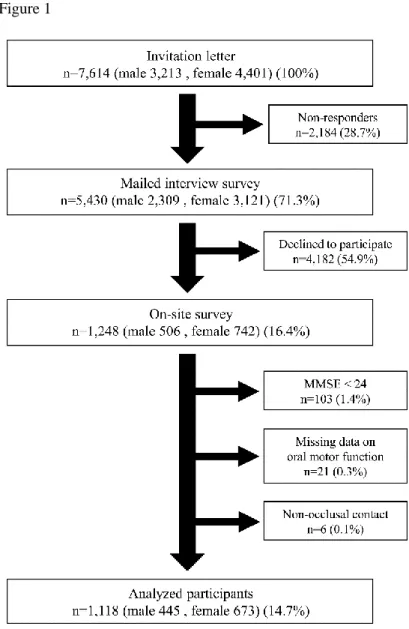
collection was performed in two steps: a mailed interview survey and an on-site survey. The flow of
these assessments is shown in Figure 1.
The initial interview survey was conducted for all older citizens (aged ≥70 years, 7,614 people) living
in Takashimadaira, Itabashi-ku, Tokyo, Japan, wherein all participants were mailed a self-administered
5
questionnaires. For the 5,430 people who completed the mailed questionnaire, an additional on-site,
guided survey was offered. A total of 1,248 people participated in this on-site survey, which examined
cognitive function, oral motor functions, motor function, and blood biochemical markers. Cognitive
function was assessed using the Mini-Mental State Examination (MMSE). In this study, older people
ranging from those with normal cognitive function to those with mild cognitive decline were targeted.
Participants with an MMSE score of 23 or less were considered to have general cognitive impairment.
Therefore, only participants with an MMSE score between 24 and 30 were included in this study. Out
of 1248 participants, there were 1,145 participants with an MMSE score between 24 and 30, and 103
participants with MMSE score of 23 or less. Twenty-one participants who were unable to complete all
parts of the oral motor function assessment and 6 participants without occlusal contact of natural teeth
and without removable dentures were excluded from the analysis.
A total of 1,118 participants (445 men and 673 women; mean age, 77.0 ± 4.7 years) were included in
the analysis. During the on-site survey, participants were informed about the objectives and content of
the survey in writing and verbally, and their written consent to participate in this study was obtained.
This study was approved by the Ethics Committee of the Tokyo Metropolitan Institute of Gerontology
(Approval No. 9 and No. 31 in 2016).
6 2.2.1 Basic characteristics
Age, sex, household status (living alone, as a couple, or living with a family member other than the
spouse), years of education, smoking and alcohol consumption, annual income (no annual income, <1
million yen, <1-3 million yen, <3-7 million yen, <7-10 million yen, and ≥10 million yen) were
recorded.
2.2.2 Mental functioning
The depression status was assessed using the Geriatric Depression Scale-Short Version-Japanese
(GDS-S-J; Sugishita and Asada, 2009).
2.3 On-site survey
The on-site survey included assessments for cognitive function, oral motor functions, and general
motor functions, as well as laboratory tests for biochemical markers. Before conducting the on-site
survey, the evaluators attended lectures and received practical training on the examination methods,
use of examination equipment, and assessment standards, to standardize evaluator performance. The
on-site survey was conducted under the supervision of physicians and dentists.
2.3.1 Basic characteristics
Body mass index, dietary variety, and instrumental activities of daily living (I-ADL) were assessed.
Dietary variety was assessed using a dietary variety score (DVS; Kumagai et al., 2003). I-ADL was
7 2017).
2.3.2 Oral related factors
Four dentists and eight dental hygienists evaluated oral related factors. Oral motor functions assessed
included masticatory ability, occlusal force, maximal tongue pressure, ODK, and swallowing function.
Removable denture users underwent the examinations while wearing their dentures. Masticatory
performance was assessed using gummy jelly (Test gummy jelly for evaluating masticatory
performance; UHA Mikakuto Co., Ltd., Osaka, Japan) (Nokubi et al., 2013; Yasui et al., 2012). The
occlusal force was assessed using pressure-sensitive sheets (Dental Prescale 50 H R type; Fuji Film
Co., Tokyo, Japan) (Hidaka et al., 1999). The maximal tongue pressure was assessed using a tongue
pressure measurement device (JMS tongue pressure device; JMS Co., Ltd., Hiroshima, Japan) (Tsuga
et al., 2011). ODK was evaluated using the articulatory velocity of /ta/ using an oral functions
measurement device (KENKOU-KUN handy; Takei Scientific Instruments Co., Ltd., Niigata, Japan)
(Watanabe et al., 2011). Swallowing function was assessed using a repetitive saliva swallowing test
(RSST; Oguchi et al., 2000). In addition, the number of present teeth and presence of removable
dentures were recorded.
2.3.3 Physical and cognitive function
Cognitive function was assessed using the Japanese version of MMSE (Folstein et al., 1975), which
8
assessed by four specialized researchers. Handgrip strength was measured using a Smedley
dynamometer (Grip-A; Takei Scientific Instruments Co., Ltd., Niigata, Japan). It was measured twice
for the dominant hand, and the highest measured value was used for analysis. Exercise ability was
determined via a single measurement of gait speed over 5 m. Subjective hearing was assessed using
the Questionnaire on Hearing 2002 (Suzuki et al., 2002; Suzuki et al., 2009).
2.3.4 Medical history
Participants were interviewed about any history or current presence of hypertension, stroke, heart
disease, diabetes mellitus, hyperlipidemia, and Parkinson’s disease by nurses.
2.3.5 Blood biochemistry
Samples of blood were collected from participants by registered nurses for a biochemical assessment.
Serum albumin levels, high-density lipoprotein (HDL) cholesterol levels, red blood cell counts,
hemoglobin levels, and Hemoglobin A1c levels, reported to be related to cognitive function were
analyzed (Taniguchi et al., 2014; Zhang et al., 2017). Analyses were carried out in one laboratory
(Health Sciences Research Institute, Inc., Yokohama, Japan).
2.4 Statistical analyses
Statistical analyses were performed in three phases. First, the correlation between all assessed items
9
performed with MMSE score as the objective variable; oral motor functions as the explanatory
variables; and factors associated with cognitive function, including I-ADL, the functional status,
medical history, and biochemical markers, as confounding factors (Baumgart et al., 2015; Li et al.,
2011; Suzuki et al., 2013; Taniguchi et al., 2014). Finally, path analysis was performed to examine the
interrelationship between cognitive function and oral motor functions using factors that were
significantly associated with cognitive function in the multiple linear regression analysis. All analyses
were performed using IBM SPSS version 22 (IBM Corp., Armonk, NY, USA). IBM SPSS AMOS
Version 20 (IBM Corp.) was used for path analysis. The significance level was set at α=0.05.
3. Results
3.1 Subject characteristics
Subject characteristics are shown in Table 1. In total, 79.1% of subjects were educated beyond high
school. The mean number of present teeth was 21.4 for ages 70-74 years, 19.8 for ages 75-79 years,
18.1 for ages 80-84 years, and 13.0 for ages 85 years or older. Of the total participants, 41.2% were
living alone and 37.6% lived with a spouse.
3.2 Pearson’s correlation analysis
10
tongue pressure (r = 0.123), and ODK (r = 0.132) were significantly correlated with MMSE score.
Significant relationships for the other assessed items with MMSE score were as follows: age
(r = −0.186), sex (r = −0.061), education (r = 0.193), JST-IC (r = 0.112), income (r = 0.075), number
of present teeth (r = 0.122), presence of removable dentures (r = 0.147), gait speed (r = 0.116),
subjective hearing (r = –0.072), diabetes mellitus (r = 0.062), HDL cholesterol levels (r = 0.068), and
Hemoglobin A1c levels (r = 0.077).
3.3 Multiple linear regression analysis
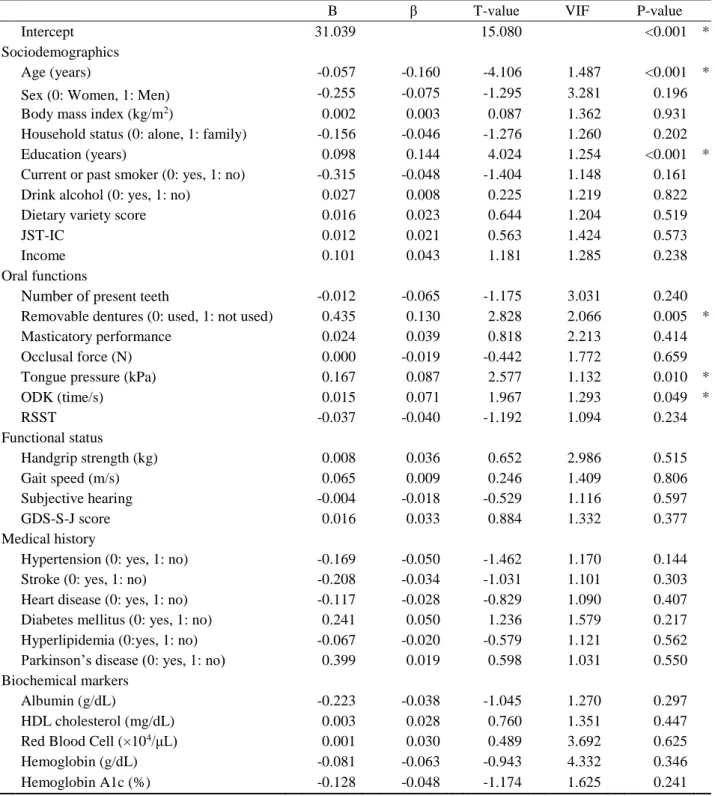
The result of the multiple linear regression analysis is shown in Table 2. The oral motor functions that
were found to be significantly associated with MMSE score, after adjusting for factors reported to be
associated with dementia and cognitive function, were tongue pressure and ODK. The resultant
adjusted R2 was 0.088.
3.4 Path analysis
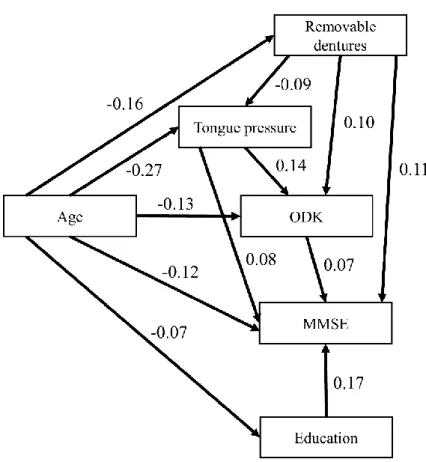
We used the path diagram depicted in Figure 2 to examine our hypothesis that oral motor functions
were associated with cognitive function. The path diagram showed that, among oral motor functions,
decreases in tongue pressure and ODK were directly related to decreases in MMSE score. Decreased
11 decreased MMSE score via decreases in ODK.
4. Discussion
When examining factors associated with cognitive function, the impact of multiple risk factors must
be considered (Baumgart et al., 2015; Li et al., 2011; Suzuki et al., 2013; Taniguchi et al., 2014).
However, only a limited number of studies have examined the association between cognitive function
and oral motor function with risk factors taken into consideration (Ikebe et al., 2018; Watanabe et al.,
2018). As such, this study is the first to examine the association between cognitive function and
multiple oral motor functions in older people with either normal cognitive function or mild cognitive
decline.
The mechanism by which cognitive decline is related to decreased tongue pressure and ODK remains
unclear. In a previous cross-sectional study of community-dwelling people aged >40 years,
participants with higher maximal tongue pressure were reported to be more socially active (Nagayoshi
et al., 2017). In another study of community-dwelling older people, Watanabe et al. considered that
decreased oral motor skills might lead to unclear speech, rendering conversation-making difficult
(Watanabe et al., 2018). It was also found that unclear speech due to dysarthria was also associated
with decreased social participation in stroke patients (Brady et al., 2011). In addition, a review by
12
(Kuiper et al., 2015). These findings suggested that social participation was a factor that linked
decreased tongue pressure to decreased cognitive function, and that decreased ODK and decreased
cognitive function were related through social participation. Cross-sectional studies in Japanese
populations have revealed that tongue pressure and ODK decrease with increasing age (Utanohara et
al., 2008; Watanabe et al., 2017). Age-related decreased in tongue pressure and in ODK might thus be
related to cognitive function through various factors beyond social participation, although these were
not clarified in the present study. In the future, it is necessary to examine the mechanisms that connect
decreased tongue pressure and ODK to cognitive decline.
The negative relationship between removable denture use and MMSE score demonstrated the potential
negative effects on cognitive function of these devices. Various factors might be associated with this
relationship between removable denture use and cognitive decline. However, the present study did not
evaluate potential factors, such as type of prosthesis or condition of missing teeth. Moreover, the cause
of tooth loss and subsequent denture use, as well as the support style, size, and quality of the dentures
might be related to elements of cognitive decline (Cerutti-Kopplin et al., 2015; Yamamoto et al., 2012).
Considering these factors were not assessed, we could not identify any relationship between removable
denture use and cognitive decline. This was a limitation of the present study, and future study of this
relationship is required.
13
relationship with ODK was also revealed in the present study. A potential explanation for this is that
removable dentures that cover the palate with their base might reduce the volume of the oral cavity
and lead to increased tongue pressure. Additionally, narrowing of the tongue range of motion by
wearing impropriety removable dentures might inhibit tongue dexterity and rapid tongue movement,
leading to a negative relationship between removable denture use and ODK.
The present study revealed that tongue pressure and ODK are associated with cognitive function in
older people with either normal cognitive function or mild levels of cognitive decline. The present
study could not, however, clarify any causal relationship between these factors because of the
cross-sectional design. However, because we designed a path model with a high level of fit, we thought that
an interrelationship between cognitive function and oral motor function could be inferred.
Non-users of removable dentures, one of the variables included in the analysis, included study
participants with almost complete dentition and those who required removable denture but did not use
them. Of the 1118 study participants, 1111 (99.4%) maintained their dentition or were using removable
dentures. The remaining 7 (0.6%) participants did not use removable dentures although it was not
assessed whether they required their use or not. In fact, due to the large sample size of the present
study, it was difficult to determine each individual participant’s need for removable dentures.
Therefore, we included all study participants in the analysis, including those who did not use
14
to be a very small number of the large survey conducted, they were not expected to have had a
significant impact on the results. Future studies should focus on including data on patients not using
dentures despite requiring their use.
At present, oral hypofunction has begun to attract attention as a medical condition of increasing
concern in Japan (Minakuchi et al., 2018). In the present study, among the diagnostic items for oral
hypofunction that were assessed, tongue pressure and ODK were associated with cognitive function,
as assessed by MMSE. Given this association, we concluded that oral hypofunction was related to
cognitive function. Based on the results of our path analysis, we speculate that decreased tongue
pressure is not only directly linked to mild cognitive decline, but also indirectly via decreased ODK,
thus providing some insights into clinical utility. For example, tongue pressure might be improved
with training (Oh, 2015). Thus, it might be possible to maintain cognitive function by maintaining and
improving tongue motor function, such as tongue pressure and ODK, through therapeutic efforts.
5. Conclusions
Among the oral motor functions assessed in this study, tongue pressure and ODK were significantly
associated with cognitive function in older Japanese people with either normal cognitive function or
mild cognitive decline. The path analysis result revealed a possibility that decreased tongue pressure
15 movement velocity.
Acknowledgments
We would like to thank Dr. Ikuo Nasu, Dr. Kentaro Igarashi, Dr. Hirohiko Hirano, and other members
of the Takashimadaira Study staff for their cooperation.
Funding
This study was supported by grants from the Tokyo Metropolitan Government, Tokyo Metropolitan
Institute of Gerontology, ARKRAY, Inc., Research Committee of Comprehensive Research on Aging
and Health, Ministry of Health, Labor, Welfare of Japan [Grant Number: H27-Choju-Ippan-005];
Japan Agency for Medical Research and Development [Grant Number: JP16dk0110018]; and
Grants-in-Aid for Scientific Research [Grant Number: 16K11908, JP17K13239].
Declarations of interest
This study received funding from ARKRAY, Inc.
References
Baumgart, M., Snyder, H.M., Carrillo, M.C., Fazio, S., Kim, H., Johns, H. (2015). Summary of the evidence
16
Alzheimer's & Dementia 11, 718–726.
Brady, M.C., Clark, A.M., Dickson, S., Paton, G., Barbour, R.S. (2011). The impact of stroke-related
dysarthria on social participation and implications for rehabilitation. Disability and rehabilitation, 33,
178–186.
Cabinet Office, Governmento of Japan, (2017). Annual Report on the Aging Society: 2016. Cabinet Office,
Tokyo.
Cerutti-Kopplin, D., Emami, E., Hilgert, J.B., Hugo, F.N., Padilha, D.M.P. (2015). Cognitive status of
edentate elders wearing complete denture: Does quality of denture matter? Journal of dentistry, 43,
1071–1075.
Folstein, M.F., Folstein, S.E., McHugh, P.R. (1975). "Mini-mental state". A practical method for grading
the cognitive state of patients for the clinician. Journal of psychiatric research, 12, 189–198.
Hidaka, O., Iwasaki, M., Saito, M., Morimoto, T. (1999). Influence of clenching intensity on bite force
balance, occlusal contact area, and average bite pressure. Journal of dental research, 78, 1336–1344.
Ikebe, K., Gondo, Y., Kamide, K., Masui, Y., Ishizaki, T., Arai, Y., et al. (2018). Occlusal force is correlated
with cognitive function directly as well as indirectly via food intake in community-dwelling older
Japanese: From the SONIC study, PLOS ONE, 2018/01/06 ed, p. e0190741.
Iwasa, H., Masui, Y., Inagaki, H., Yoshida, Y., Shimada, H., Otsuka, R., et al. (2017). Assessing competence
17
of Competence (JST-IC). Aging clinical and experimental research.
Kuiper, J.S., Zuidersma, M., Oude Voshaar, R.C., Zuidema, S.U., van den Heuvel, E.R., Stolk, R.P., et al.
(2015). Social relationships and risk of dementia: A systematic review and meta-analysis of longitudinal
cohort studies. Ageing research reviews, 22, 39–57.
Kumagai, S., Watanabe, S., Shibata, H., Amano, H., Fujiwara, Y., Shinkai, S., et al. (2003). Effects of
dietary variety on declines in high-level functional capacity in elderly people living in a community.
Nihon Koshu Eisei Zasshi, 50, 1117–1124.
Li, J., Wang, Y.J., Zhang, M., Xu, Z.Q., Gao, C.Y., Fang, C.Q., et al. (2011). Vascular risk factors promote
conversion from mild cognitive impairment to Alzheimer disease. Neurology, 76, 1485–1491.
Livingston, G., Sommerlad, A., Orgeta, V., Costafreda, S.G., Huntley, J., Ames, D., et al. (2017). Dementia
prevention, intervention, and care. Lancet, 390, 2673–2734.
Minakuchi, S., Tsuga, K., Ikebe, K., Ueda, T., Tamura, F., Nagao, K., et al. (2018). Oral hypofunction in
the older population: Position paper of the Japanese Society of Gerodontology in 2016. Gerodontology.
[epub ahead of print]
Nagayoshi, M., Higashi, M., Takamura, N., Tamai, M., Koyamatsu, J., Yamanashi, H., et al., (2017). Social
networks, leisure activities and maximum tongue pressure: cross-sectional associations in the Nagasaki
Islands Study. BMJ Open, 7, e014878.
18
of a visual scoring method for masticatory ability using test gummy jelly. Gerodontology, 30, 76–82.
Oguchi, K., Saitoh, E., Baba, M., Kusudo, S., Tanaka, T., Onogi, K. (2000). The Repetitive Saliva
Swallowing Test (RSST) as a Screening Test of Functional Dysphagia (2) Validity of RSST. The
Japanese Journal of Rehabilitation Medicine, 37, 383–388.
Oh, J.C., (2015). Effects of Tongue Strength Training and Detraining on Tongue Pressures in Healthy
Adults. Dysphagia, 30, 315–320.
Prince, M., Wimo, A., Guerchet, M., Ali, G.-C., Wu, Y.-T., Prina, M. (2015). World Alzheimer Report 2015,
The Global Impact of Dementia: An analysis of prevalence, incidence, cost and trends. Alzheimer's
Disease International, London.
Sugishita, M., Asada, T. (2009). The creation of the Geriatric Depression Scale-Short version-Japanese
(GDS-S-J). Japanese Journal of Cognitive Neuroscience, 11, 87–90.
Suzuki, K., Okamoto, M., Hara, Y., Matsuhira, T., Sano, H., Okamoto, A., (2002). Self-Assessment Scale
for Japanese Adults with Hard of Hearing. AUDIOLOGY JAPAN, 45, 89–101.
Suzuki, K., Okamoto, M., Suzuki, M., Sano, H., Hara, Y., Inoue, R., et al. (2009). A study on the application
of “the questionnaire on hearing 2002” as a tool for subjective validation of hearing aid fitting.
AUDIOLOGY JAPAN, 52, 588–595.
Suzuki, T., Shimada, H., Makizako, H., Doi, T., Yoshida, D., Ito, K., et al. (2013). A Randomized Controlled
19
e61483.
Taniguchi, Y., Shinkai, S., Nishi, M., Murayama, H., Nofuji, Y., Yoshida, H., et al. (2014). Nutritional
biomarkers and subsequent cognitive decline among community-dwelling older Japanese: a prospective
study. The journals of gerontology. Series A, Biological sciences and medical sciences, 69, 1276–1283.
Tsuga, K., Maruyama, M., Yoshikawa, M., Yoshida, M., Akagawa, Y. (2011). Manometric evaluation of
oral function with a hand-held balloon probe. Journal of oral rehabilitation, 38, 680–685.
Utanohara, Y., Hayashi, R., Yoshikawa, M., Yoshida, M., Tsuga, K., Akagawa, Y. (2008). Standard values
of maximum tongue pressure taken using newly developed disposable tongue pressure measurement
device. Dysphagia, 23, 286–290.
Watanabe, Y., Arai, H., Hirano, H., Morishita, S., Ohara, Y., Edahiro, A., et al. (2018). Oral function as an
indexing parameter for mild cognitive impairment in older adults. Geriatrics & gerontology
international, 18, 790–798.
Watanabe, Y., Edahiro, A., Ito, K., Iwasa, Y., Watanabe, Y., Hirano, H., et al. (2011). Detection and Analysis
of Assessment Characterizing the Effect of the Compound Program of the Prevention of Long-term
Care-About the Assessment of the Oral Function Improvement Program. Ronen Shika Igaku, 26, 327–
338.
Watanabe, Y., Hirano, H., Arai, H., Morishita, S., Ohara, Y., Edahiro, A., et al. (2017). Relationship
20
Geriatrics Society, 65, 66–76.
Yamamoto, T., Kondo, K., Hirai, H., Nakade, M., Aida, J., Hirata, Y. (2012). Association between
self-reported dental health status and onset of dementia: a 4-year prospective cohort study of older Japanese
adults from the Aichi Gerontological Evaluation Study (AGES) Project. Psychosomatic Medicine, 74,
241–248.
Yasui, S., Nokubi, T., Yoshimuta, Y., Nokubi, F., Kusunoki, C., Koda, M., et al. (2012). Study on Reliability
for Clinical Application of a Masticatory Performance Scoring Method Using Test Gummy Jelly.
Journal of Japanese Society for Masticatory Science and Health Promotion, 22, 11–17.
Zhang, Z., Pereira, S.L., Luo, M., Matheson, E.M. (2017). Evaluation of Blood Biomarkers Associated with
21 Figure 1
22 Figure 2
Figure 2: Path analysis to examine the interrelationship between cognitive function and oral motor
functions using factors significantly associated with cognitive function in multiple linear regression
analysis.
The fit indices were 0.978 per the Bentler-Bonett normed fit index and 0.987 per the comparative fit
23
Table 1: Characteristics of older people living in metropolitan areas in Japan who participated in the study
Characteristic (mean ± SD ) Overall
(n=1118) Men (n=445) Women (n=673) Sociodemographics Age (years) 77.0 ± 4.7 77.0 ± 4.9 77.0 ± 4.5
Body mass index (kg/m2) 23.0 ± 3.2 23.4 ± 2.9 22.7 ± 3.3
Living alone, (n) [%] (452) [41.2] (113) [25.8] (339) [51.4]
Education (years) 12.7 ± 2.5 13.5 ± 2.8 12.2 ± 2.1
Current or past smoker, (n) [%] (74) [6.6] (59) [13.3] (15) [2.2]
Drink alcohol, (n) [%] (478) [42.8] (274) [61.6] (204) [30.3]
Dietary variety score 3.8 ± 2.4 3.3 ± 2.4 4.1 ± 2.4
JST-IC 10.5 ± 2.9 10.5 ± 3.0 10.4 ± 2.9 Income, (n) [%] No income (22) [2.1] (3) [0.7] (19) [3.1] <1 million yen (65) [6.3] (8) [1.9] (57) [9.4] 1-3 million yen (616) [60.0] (225) [53.6] (391) [64.4] 3-7 million yen (300) [29.2] (168) [40.0] (132) [21.7] 7-10 million yen (16) [1.6] (10) [2.4] (6) [1.0] ≥10 million yen (8) [0.8] (6) [1.4] (2) [0.3] Oral functions
Number of present teeth 19.5 ± 9.1 18.0 ± 9.9 20.5 ± 8.3
Removable dentures use, (n) [%] (567) [50.7] (261) [58.7] (306) [45.5]
Masticatory performance 4.5 ± 2.7 4.4 ± 2.9 4.6 ± 2.6
Occlusal force (N) 312.5 ± 225.7 317.5 ± 241 309.3 ± 215.2
Tongue pressure (kPa) 30.2 ± 8.2 30.8 ± 9.0 29.8 ± 7.7
ODK (time/s) 6.0 ± 0.9 6.0 ± 0.9 6.0 ± 0.9 RSST 3.6 ± 1.8 4.1 ± 1.9 3.4 ± 1.6 Functional status Handgrip strength (kg) 25.8 ± 7.5 32.2 ± 6.3 21.5 ± 4.5 Gait speed (m/s) 1.3 ± 0.2 1.2 ± 0.2 1.3 ± 0.2 Subjective hearing 16 ± 6.9 15.8 ± 6.6 16.1 ± 7.0 GDS-S-J score 3.7 ± 3.3 3.7 ± 3.4 3.7 ± 3.2 MMSE score 27.7 ± 1.7 27.6 ± 1.7 27.8 ± 1.7 Medical history Hypertension, (n) [%] (572) [51.3] (238) [53.6] (334) [49.8] Stroke, (n) [%] (94) [8.5] (47) [10.7] (47) [7.0] Heart disease, (n) [%] (233) [21.1] (113) [25.6] (120) [18.1] Diabetes mellitus, (n) [%] (159) [14.3] (93) [21.0] (66) [9.9] Hyperlipidemia, (n) [%] (462) [41.7] (141) [32.1] (321) [47.9] Parkinson’s disease, (n) [%] (9) [0.8] (3) [0.7] (6) [0.9] Biochemical markers Albumin (g/dL) 4.2 ± 0.3 4.2 ± 0.3 4.2 ± 0.3 HDL cholesterol (mg/dL) 64.4 ± 17.4 59.4 ± 15.8 67.7 ± 17.6
Red Blood Cell (×104/μL) 433.4 ± 42.8 446.2 ± 45.6 424.9 ± 38.6
Hemoglobin (g/dL) 13.4 ± 1.3 14.0 ± 1.3 13.0 ± 1.1
Hemoglobin A1c (%) 5.7 ± 0.6 5.8 ± 0.8 4.2 ± 0.5
JST-IC, Japan Science and Technology Agency Index of Competence; ODK, oral diadochokinesis; RSST, Repetitive Saliva Swallowing Test; GDS-S-J, Geriatric Depression Scale-Short Version-Japanese; MMSE, Mini-Mental State Examination; HDL, high-density lipoprotein
24
Table 2: Multiple linear regression analysis for the relationship between MMSE score and oral related
factors
B β T-value VIF P-value
Intercept 31.039 15.080 <0.001 *
Sociodemographics
Age (years) -0.057 -0.160 -4.106 1.487 <0.001 *
Sex (0: Women, 1: Men) -0.255 -0.075 -1.295 3.281 0.196
Body mass index (kg/m2) 0.002 0.003 0.087 1.362 0.931
Household status (0: alone, 1: family) -0.156 -0.046 -1.276 1.260 0.202
Education (years) 0.098 0.144 4.024 1.254 <0.001 *
Current or past smoker (0: yes, 1: no) -0.315 -0.048 -1.404 1.148 0.161 Drink alcohol (0: yes, 1: no) 0.027 0.008 0.225 1.219 0.822
Dietary variety score 0.016 0.023 0.644 1.204 0.519
JST-IC 0.012 0.021 0.563 1.424 0.573
Income 0.101 0.043 1.181 1.285 0.238
Oral functions
Number of present teeth -0.012 -0.065 -1.175 3.031 0.240 Removable dentures (0: used, 1: not used) 0.435 0.130 2.828 2.066 0.005 *
Masticatory performance 0.024 0.039 0.818 2.213 0.414
Occlusal force (N) 0.000 -0.019 -0.442 1.772 0.659
Tongue pressure (kPa) 0.167 0.087 2.577 1.132 0.010 *
ODK (time/s) 0.015 0.071 1.967 1.293 0.049 * RSST -0.037 -0.040 -1.192 1.094 0.234 Functional status Handgrip strength (kg) 0.008 0.036 0.652 2.986 0.515 Gait speed (m/s) 0.065 0.009 0.246 1.409 0.806 Subjective hearing -0.004 -0.018 -0.529 1.116 0.597 GDS-S-J score 0.016 0.033 0.884 1.332 0.377 Medical history
Hypertension (0: yes, 1: no) -0.169 -0.050 -1.462 1.170 0.144
Stroke (0: yes, 1: no) -0.208 -0.034 -1.031 1.101 0.303
Heart disease (0: yes, 1: no) -0.117 -0.028 -0.829 1.090 0.407 Diabetes mellitus (0: yes, 1: no) 0.241 0.050 1.236 1.579 0.217 Hyperlipidemia (0:yes, 1: no) -0.067 -0.020 -0.579 1.121 0.562 Parkinson’s disease (0: yes, 1: no) 0.399 0.019 0.598 1.031 0.550
Biochemical markers
Albumin (g/dL) -0.223 -0.038 -1.045 1.270 0.297
HDL cholesterol (mg/dL) 0.003 0.028 0.760 1.351 0.447
Red Blood Cell (×104/μL) 0.001 0.030 0.489 3.692 0.625
Hemoglobin (g/dL) -0.081 -0.063 -0.943 4.332 0.346
Hemoglobin A1c (%) -0.128 -0.048 -1.174 1.625 0.241
25 *P<0.05