Ec onom
i c Feas i bi l i t y of Coc onut Coi r - Bas ed
H
ydr oponi c s as an Al t er nat i ve Sys t em
f or Cr op
M
anagem
ent i n Thai l and
著者
U
RAYAM
A H
i s as hi , TAKAM
A H
i det os hi , M
ARU
YAM
A
Sac hi o
j our nal or
publ i c at i on t i t l e
J our nal of D
evel opm
ent s i n Sus t ai nabl e
Agr i c ul t ur e
vol um
e
12
num
ber
1
page r ange
45- 51
year
2017- 05- 26
U
RL
ht t p: / / hdl . handl e. net / 2241/ 00150272
Economic Feasibility of Coconut Coir-Based Hydroponics as
an Alternative System for Crop Management in Thailand
Hisashi Urayama
1*, Hidetoshi Takama
2and Sachio Maruyama
31
Overseas Agricultural Development Association, 8-10-32 Akasaka, Minato-ku, Tokyo 107-0052, Japan
2former Japan International Cooperation Agency, Tsukuba International Center,
3-6 Koyadai, Tsukuba, Ibaraki 305-0074, Japan
3
Faculty of Life and Environmental Sciences, University of Tsukuba, 1-1-1 Tennoudai, Tsukuba, Ibaraki 305-8572, Japan.
Coconut coir is an effective growth medium that has been used in hydroponic cultivation of lettuce in Thailand; this material is inexpensive and readily available in tropical regions. Here, we evaluated the financial feasibility of an energy-saving hydroponic system using coconut coir as the growth medium in northeastern Thailand. We first com-pared coconut coir hydroponic cultivation with the conventional open field cultivation to assess the productivity and marketability of cucumbers in the rainy and dry seasons: in the hydroponic system, profit in the rainy season 57% higher and in the dry season, 95% higher. Next, we assessed a simulation of a new cropping pattern based on the hydroponic system. The assessment included a new 4-year investment in a conventional crop of rice and cucumber in the rainy season and tomato in the dry season, versus an investment in the coconut coir-based hydroponic system for a 0.32 ha (2 rai) field. Incremental cost‒benefit values, comparing existing management practices with the new 4-year term, were calculated at a discount rate of 0.0975, which was the lowest concessional loan rate by the Bank of Agri-culture and Agricultural Cooperatives. The cost‒benefit ratio was 1.14. These findings show that investment in hy-droponic cultivation in northeastern Thailand would be cost effective.
Key words: B/C ratio, coconut coir, cropping system, hydroponic media, NPV
───────────────────────
Introduction
Crop production in tropical and subtropical zones can be sustainable if soil fertility can be maintained under continuous farming. The use of hydroponic sys-tems can be beneficial to small-scale farmers by ena-bling them to take advantage of favorable climate conditions to improve productivity. In tropical and subtropical countries, the majority of farmers operate on a small scale, with less than 1 ha of cultivated land. However, medium-scale farmers with more than 2 ha of cultivated land can establish crop rotation systems with cash crop production.
Lowland paddy rice farms are among the most important agricultural systems in tropical Asian
coun-tries. Upland crop farming is not as common as post-paddy rice cropping in most of these countries, where cropping systems should be diversified according to the water supply. In Thailand, paddy rice is generally cultivated during the rainy season (May through No-vember), and upland crops are cultivated in paddies during the dry season (December through June); this practice is typical in tropical Asia. A unique cropping system, called the Chinese system, is used to cultivate Solanaceae, Cucurbitaceae, and Brassicaceae plants in large nurseries on the dry paddy fields in this area (Yamada, 2004).
Salinized soils are common in northeastern Thai-land, and crop growth is severely inhibited in these soils. Continuous cropping also stresses the soils and
Received: January 13, 2016, Accepted: April 28, 2016
further limits yield in this area. To address these problems, the government is considering a project to install irrigation systems in this region (Sato, 2008). In this study, we investigated the economic feasibility of improving crop rotation systems by using coconut coir media in energy-efficient hydroponic systems (Urayamaet al., 2005, 2007).
Materials and Methods
Hydroponic systems (Thippayarugset al., 2002) for fruits and leafy vegetables were used at the Khon Kaen Field Crop Research Center to examine energy and cost savings. Absorbent with the type of fabric (e.g., cotton) sheets were evaluated as an alternative growth medium, and energy-saving hydroponic systems using coconut coir (Urayama et al., 2005, 2007) were used for cucumbers.
The cost and profitability of cucumber production in a 0.1 ha field was estimated with data from a report by the Agriculture & Livestock Industries Corporation (2007). We used data on current conditions for crop rotation in northeastern Thailand as published in Sato (2008) and Agriculture & Livestock Industries Corpo-ration (2006). General information on the production cost of rice and vegetables and on the average field size and yield of paddy rice were obtained from Kabakiet al. (2001), Agriculture & Livestock Industries Corpo-ration (2006, 2007), Sato (2008), and the Food and Agriculture Organization of the United Nations (2008). The data from these reports were used to generate each estimate.
Farm management practices in the four-year cucum-ber cultivation study were compared between the open field and hydroponic system during the rainy and dry seasons. Financial analysis was performed using the ‘Economy Financial Affairs Analysis Method’ (Takama and Tomomatsu, 1999) to examine the economics of the two cropping systems.
Net present values (NPV) and benefit/cost (B/C) ratios were calculated as follows (Upton, 1996):
NPV=∑ ΔB 1+rn−∑
ΔC 1+rn≥0 and
B/C Ratio=∑ ΔB 1+rn/∑
ΔC 1+rn≥1
where ΔB is incremental benefit, ΔC is incremental cost, r is the discount rate, and n is the duration of cropping (number of time periods). A project is feasible if the NPV is positive, and B/C ratios >1
indicate a beneficial or economically feasible result. Cash flow was investigated eight times during the four-year study (in the rainy and dry seasons). A 9.75% discount rate was used with the maximum interest rate from the Bank of Agriculture and Agricultural Coop-eratives. Benefits and costs were computed at a half discount rate for every half year with a half-year cash flow.
Results and Discussion
The Agriculture & Livestock Industries Corporation report (2007) indicates that the average cucumber yield for open fields is approximately 2.0 kg/m2per year. In contrast, cucumber yield in an energy-saving hydro-ponic system with coconut coir as the growth media was 8.5 kg/m2, which is 4.2 times the yield for a 2.5-month farming season.
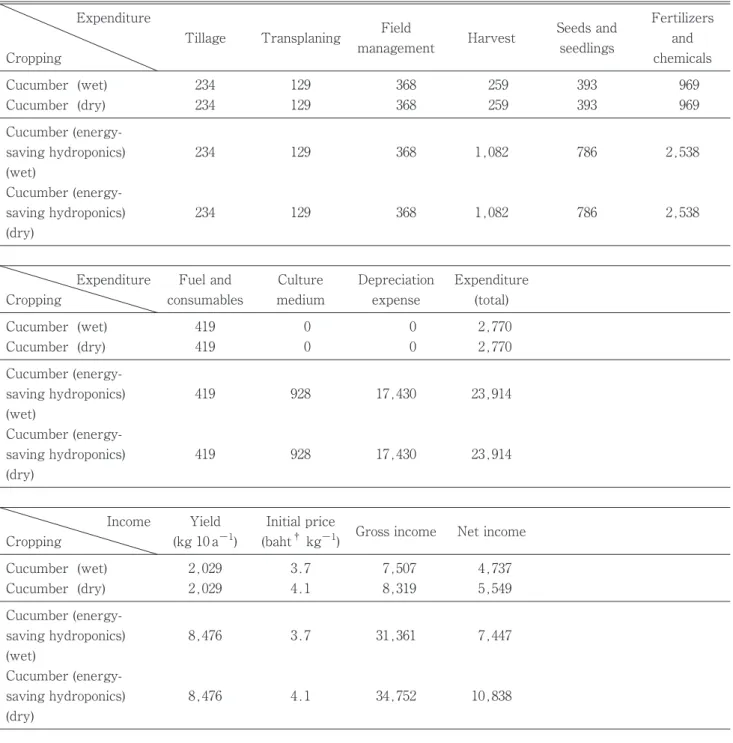
Monthly average shipment prices for the open-field scenario were 3.9 baht/kg (approximately 11.7 yen/kg; 1 baht=3 yen) (Agriculture & Livestock Industries Corporation, 2007). Shipping costs depend on supply and demand during each season. The average monthly wholesale price in Bangkok for cucumbers from 2006 to 2011 was 16.55 baht during the rainy season (Au-gust to November) and 18.11 baht during the dry sea-son (February to May). The total seasea-sonal average price from January 2006 to April 2011 (64 months) was 17.37 baht. The rainy and dry season mean prices were 3.7 baht and 4.1 baht, respectively, which made the average shipment price 3.9 baht for both seasons. The itemized expenditures for cucumber production are as follows: tillage, 234 baht (702 yen); planting, 129 baht (387 yen); field management, 368 baht (1,104 yen); harvest, 259 baht (777 yen); seeds and seedlings, 393 baht (1,179 yen); fertilizer and other chemicals, 969 baht (2,907 yen); fuel and other consumable mate-rials, 419 baht (1,257 yen). In the hydroponic system, harvest expenses were divided proportionally as yield increased or decreased. Fertilizer expenses in the hydroponic system include the price of culture solu-tion; lettuce cultivation required 1.5-times the water and a growing period 4-times that for cucumber (Thippayarugset al., 2002). Expenses for fuel, chemi-cals, and labor in the hydroponic system were esti-mated as half those required for open-field cultivation. Coconut coir is readily available and inexpensive (Thippayarugset al., 2002; the price of coconut coir is approximately 1 rupee (~1 yen) in Sri Lanka and 1 peso (1-2 yen) in the Philippines. Based on this price,
J. Dev. Sus. Agr. 12 (1)
the total expense for media for a 1,000 m2 field (one bed) would be approximately 928 baht (2,784 yen) for 128 kg (23 m×0.6 m), and this could be used for 1 to 2 years. The initial investment required for a hydro-ponic system with 22 beds for 1,000 m2(1 bed=23 m ×0.6 m) is 281,540 baht (844,620 yen) according to Thippayarugs et al. (2002); absorbent sheeting ac-counts for 36% of all expenditures (101,333 baht, 304,000 yen) because of the high costs of importing the sheets from Japan.
Because of this high cost, procurement of absorbent sheeting from Thailand was evaluated, which reduced the cost to 15,484 baht (46,452 yen), equivalent to only 5% of the total expense. After this adjustment, the initial cost of the hydroponic system was estimated as 139,439 baht (104,580 yen) (Table 1), and the total expense for this system was 34,860 baht (189,618 yen) over the four-year period, using a fixed amount with estimated depreciation. Depreciation expenses were then estimated as 17,430 baht (53,290 yen) for a single hydroponic crop of cucumber in the rainy and dry seasons for one year, and total expenditures were 23,914 baht (71,742 yen) (Table 2).
Net rainy season profits for cucumber grown in open fields, assuming a yield of 2.0 kg/m2 (Agriculture & Livestock Industries Corporation, 2007), were esti-mated as 4,737 baht (14,211 yen). Net rainy season profit for the hydroponic system, with a yield of 8.5 kg/m2, was 7,447 baht (22,341 yen), approximately 1.6 times the net income from the open-field scenario
(Table 2).
During the dry season, the net income for the hy-droponic system was 10,838 baht (32,514 yen), ap-proximately double the income for the open field sce-nario (Table 2). However, hydroponic systems could be even more profitable, given supermarket values of 14 baht (42 yen) (Japan International Cooperation Agency, 2006), the durability of these energy-saving systems, and the potential to grow high-value crops such as melons and tomatoes.
The profit margins for energy-saving hydroponic systems are higher than those for open-field cropping, especially when materials are domestically procured. Hydroponic systems also enable fruits and vegetables to be grown without compromising the soil health and timing of planting. However, fluctuations in market prices can reduce the estimated end profits. Because farmers do not commonly use hydroponic systems, it is probable that greater income would not be expected until low-cost absorbent sheeting is procured. Most farmlands in the study area are approximately 2 rai (1 rai=0.16 ha). On most farm fields of approximately 2-3 rai (0.32-0.48 ha), fruits vegetables are cultivated and managed by families (Agriculture & Livestock Industries Corporation, 2006). Crop rotations that al-ternate between rice and vegetables are generally used in the lowlands. In lowland rice-growing areas, most private holdings are divided into 1 rai for paddy fields and 1 rai for vegetables to maintain or improve soil health. Lowland rice planting begins during the rainy
225/ 1.2 m×0.6 m Culture bed
†
1baht=3 yen. Others (piping
stems etc.) Materials
Table 1. Depreciation expense of energy-saving hydroponics systems (materials only, except con-sumables and labor cost) in Thailand.
1,980
550 50,000
Tank
In Thailand
44,000
94,875 1,114,000
Total
In Japan
Absorbing sheet
139,439 3,062,000
50,000 500,000
30/ 1 m×1.2 m 180/
1 m×1.2 m Root barrier sheet
12,100 1,100,000
0 0
15,484 304,000
Cost (baht) Price/unit (baht†)
90 2,000
Floating bulb
Cost (yen) Price/unit (yen)
200/ 1 m×2.0 m 600/
season, and vegetables are used as feed for piglets and as cash crops. Maize and beans are also used in rota-tion with rice. Livestock farmers also plant lowland rice as a cash crop, and cassava and maize are included in the rotation.
Farmers who practice lowland crop rotation have an annual income of approximately 15,000 baht (45,000 yen). In contrast, the average annual income of a
farmer in Thailand is approximately 72,000 baht (216,000 yen) (Sato, 2008).
The profit from an energy-saving hydroponic system that produces two cucumber harvests is clearly greater than that obtained using the open-field method, which produces just one cucumber crop per year. However, hydroponic systems limit the scale or size of the field to 0.6 rai (~0.1 ha) because of the amount of media and
J. Dev. Sus. Agr. 12 (1)
48 Field management Cucumber (dry) 259 Cucumber (wet) 23,914 419 Cucumber (energy-saving hydroponics) (wet) Expenditure Cropping 23,914 419 Expenditure Cropping Cucumber (energy-saving hydroponics) (dry)
Table 2. Expense of cucumber production in unit area (10 a) compared between field and energy-saving hydroponics in different seasons in Thailand (unit: baht).
129 Harvest 368 Seeds and seedlings Fertilizers and chemicals 2,770 419 Cucumber (wet) 2,770 Transplaning 419 Expenditure (total) Tillage Cucumber (energy-saving hydroponics) (wet) 129 368 786 2,538 129 368 1,082 234 Cucumber (energy-saving hydroponics) (dry) 393 969 129 368 393 969 0 Culture medium 259 234 Cucumber (dry) Depreciation expense 786 1,082 234 2,538 928 17,430 928 17,430 0 0 0 10,838 34,752 4.1 8,476 Cucumber (energy-saving hydroponics) (dry) 5,549 8,319 4.1 2,029 Cucumber (dry) 7,447 31,361 3.7 8,476 Cucumber (energy-saving hydroponics) (wet) Net income Gross income Initial price (baht†kg−1) Yield
labor needed. Therefore, a field size of 2 rai would be ideal for farm management when incorporating a hy-droponic system; one rai could be allocated to lowland rice during the rainy season, and one rai should be allocated to vegetable production (Fig. 1). A 0.6 rai field can be used for one harvest, and the remaining 0.4 rai (~600 m2) can be used for vegetables.
The net income for lowland rice farming (one har-vest) is estimated as 1,261 baht (2,364 yen), with an average yield of 2,350 kg (Kabaki et al., 2001) and a
market price of approximately 5.2 baht/kg (15.6 yen/ kg). We estimated the cost of labor and materials (e.g., fertilizer) as 694 baht/rai (2,082 yen/rai) for a family farm business in Thailand (Japan International Coop-eration Agency, 1998). From these values, the net benefit of conventional cropping during the rainy sea-son was estimated as 5,998 baht/260 m2(17,994 yen/ 260 m2), adding a net profit of 4,737 baht/0.1 ha (14,211 yen/0.1 ha) to conventional open-field cucum-ber production (rice + cucumber). If tomato
tion is included after lowland rice farming, gross pro-fits would be approximately 13,838 baht/rai (41,514 yen/rai), with an estimated yield of approximately 4,613 kg/rai (Agriculture & Livestock Industries Cor-poration, 2007) and market price per kg of 3 baht (~9 yen) (Agriculture & Livestock Industries Corporation, 2006). From these values, the net profit for tomato would be approximately 11,638 baht/rai (34,914 yen/ rai) before subtracting material expenses (e.g., fertil-izer) for cucumber production (approximately 2,200 baht/rai). Ultimately, the net profit for conventional farming in the rainy and dry seasons was estimated as 17,636 baht (52,908 yen/rai) (Table 3).
When energy-saving hydroponic systems are intro-duced into farming, the estimated net income increases (Table 2). Our estimated cash flows for conventional and modified (hydroponic) cropping systems reflect four years of depreciation of the energy-saving system (Table 3). Investments in plants and equipment are estimated as 139,439 baht (418,317 yen); the cost of labor are estimated as 8,668 baht during the dry season and 7,162 baht during the rainy season. The incre-mental values of production and expense, the total net present value, and the benefit/cost ratio (1.14 at a discount rate of 9.75% as the annual interest rate) indicate a good return on investment (Table 3).
Coconut coir growth media can be considered a
viable substitute for chemical fertilizers because it ac-cumulates potassium and nitrogen for the life of the media, which is approximately one to two years with continuous farming (Urayamaet al., 2005). After co-conut coir has been used in a hydroponic system, it can be composted or incorporated into the soil (Koyamaet al., 2009). It can also be used as a growth media to improve hydroponic rice production (Urayama and Maruyama, 2009). Compared to conventional (open field) farming, the net income for a hydroponic system is approximately 57% greater in the rainy season and 95% greater in the dry season (Table 2).
In conclusion, this financial analysis shows that modified cropping systems that use coconut coir as a hydroponic growth media can be profitable and farm-ing can enable repayment of loans accumulated through farming practices
References
Agriculture and Livestock Industries Corporation, 2006. Vege-table Information, Vol.22. (in Japanese)
Agriculture and Livestock Industries Corporation, 2007. Report on Collected Information of Imported Vegetables, 20-36. Food and Agriculture Organization of the United Nations, 2008.
FAOSTAT, http://faostat.org/site/.
Japan International Cooperation Agency (JICA), 1998. Report on Management of Modern Irrigation and Drainage System for Sustainable Agriculture Development in the Kingdom
J. Dev. Sus. Agr. 12 (1)
50 Modified cropping Net benefit 28,284 28,284 Incremental net benefit/cash flow Expenses 21,257 25,716
NPV= ΔB 1+rn−
ΔC
1+rn
Table 3. Cash flow between conventional cropping and modified cropping patterns in season wise.
(unit: baht) 34,752 34,752 Incremental value of production Conventional cropping 6,468 6,468 Incremental expenses 39,922 39,922 8,668 year 4 year 2 year 3
48,590 48,590
Gross value of production
─ year 1
Total
NPV
rainy dry dry
dry rainy dry rainy rainy dry rainy
33,316 48,590 33,316 48,590 33,316
9,462 13,838 33,316
7,162 8,668 7,162 3,464 2,200 146,601
23,854 34,752 23,854 34,752 23,854
─ ─ 23,854
39,922 26,154 5,998 11,638 -113,285
3,698 6,468 3,698 6,468 3,698
─ ─ 143,137
7,162 8,668
-113,738
20,156 28,284 20,156 28,284 20,156
-119,283
26,154 39,922 26,154
14,444 19,327 23,748 17,474 23,380 15,887
of Thailand. (in Japanese)
Japan International Cooperation Agency (JICA), 2006. Report on Appropriate Techniques of Agricultural Chemicals in Northern Thailand. (in Japanese)
Kabaki, N., Morita, H., Fujimori, S., Arromratama, U., T. Na Nanagara, 2001. Technologies for rainfed rice production in Northeast Thailand. Research Highlights. Crop, Live-stock and Environment Division Japan International Re-search Center for Agricultural Sciences, 9, 17-18. (in Japa-nese)
Koyama, S., H. Urayama, K.M.P.D. Karunaratne, T. Yamashita, 2009. Effects of Coir Application on Soil Property and Cu-cumber Production as a Reuse model of Organic Medium Used in Soilless Culture. Trop. Agr. Develop. 53, 7-13. Sato Kazunori, 2008. Monthly Report on Vegetables -Overseas
Information- http://www.vegenet.jp/yasaijoho/kaigai/0809/ kaigai.html. (in Japanese)
Takama, H., A. Tomomatsu, 1999. Economic Analysis of Agri-cultural Development Project ‒Prospects and Subjects of International Cooperation-, 92-101. (in Japanese) Thippayarugs, S., K. Suzuki, Y. Katsuta, A. Yoshida, N.
Matsu-moto, N. Kabaki and C. Wongwiwatchai 2002. Vegetable
production using energy-saving hydroponics systems in Khon Kaen. JIRCAS Working Report No. 30, 161-165. (in Japanese with English abstract)
Martin Upton, 1996. The economics of tropical farming sys-tems. CAMBRIDGE UNIVERSITY PRESS, pp. 315-325. Urayama, H., L. J. Matthews, V. J. Coetzee, T. Yamashita, 2005. Cucumber Cultivation in Energy-Saving Hydroponic Sys-tem Using Coconut Coir as Growing Media. Japanese Journal of Tropical Agriculture 49, 154-158. (in Japanese with English abstract)
Urayama, H., A. P M. Irungu, P. K. Chege, D. T. Moabi, T. Yamashita, 2007. Effect of Coconut Coir Media on Bitter Gourd (Momordica charatiaL.) Growth and Yield in an Energy-Saving Hydroponic System. Japanese Journal of Tropical Agriculture 51, 177-182. (in Japanese with Eng-lish abstract)
Urayama, H., S. Maruyama 2009. Raising of Rice Seedlings for Manual Transplanting by Hydroponics Using Coconut Coir as Culture Media. Trop. Agr. Develop. 53, 97-102. Yamada Mitate, 2004. Cropping System, New Agriculture