多層型矩形分割に対する
16
分格子グラフ表現
日本大学 呉羽 彬 (AkiraKureha) Nihon University 東洋大学 土田 賢省 (KenseiTsuchida) Toyo University 日本大学 夜久 竹夫(TakeoYaku)Nihon Univenity
Abstract
Multilayer
rectangular dissections have been
considered such
as
models
ofmulti
page
books in
spreadsheets,
$3D$facility layout
and stratum
maps
in terrain
surfaces.
In
this
paper,
we
deal
with
a
representation
of
the
multilayer
rectangular dissections
that
are
effective
for
ruled line
oriented operations and introduce hexadecimal
gridscorresponding
tomultilayer
rectangular dissections.
And
we
show
an
cell
unification
algorithm
that
runs
in $O(l)$ time,and also
show
a
layer
deletion algorithm.
Then,we
also
propose
a
processing
system.Furthemore,
we propose
$24- a\prime y$Grid Graph corresponding
torectangular
solid
dissection.
1.
Introduction
Multilayerrectangular dissection is
an
effective modelto represent
a
multipagebook in spreadsheets, facility layoutandstratummaps. The uansformation opcrationover
sheets, stratum maps and $3D$ facility layout ofbuildingsoflenpreseIveruled lines. Ourworkisplaced
inrastcrgraph. In$[1, 2]$,itwasshown thatOctgrids for
the heterogeneous rectangular dissections
are
effective for ruledlineorientedffansformations. Another relatedworks
are
quad$\alpha oe$,andrectangul と arrddualsgraphs.Inthis$pap\epsilon r$,
we
extend the Octgrids to3-dimensionin thesenseof multi layers. WeproposeHexadecimal
grid graph representation of the multilayer rectangular
dissections that is effective for ruled line oriented operations[9].And
we
extend Octgridstosolidmodels.InSection2,
we
reviewrectangulardissections andOctgrids
as
preliminaries. Section 3 contains severaldefinitions for Hcxadeci-grids. Wepropose in Section 4 two algorithms cell uniflcation algorithm and laycr deletion algorithm with
a
data structure called H8CODE corresponding Hexadeci-grids. In Section 5,we
explain application system with $H8CODE$.
And Section 6, we propose 24-ary grid graph thatcorrespond a rectangular solid dissection.
Hexadeci-gridscan’t represent
a
solidmodel,so
weconstruct 24-arygrid graph andrepresentsolid terrain surfaces. Finally,we sum
up mainpointsinthispaperand future works.2.
Preliminaries
We provide this Sectiontoexplain octal grid graphs for the rectangulardissections.
2.1 Rectangular Dissection
In thispaper, we deal with tables with heterogeneous
rectangulardissections(compareFig. 3 with4). Hcre,
we
review the definitions of tables and tabular diagrams given by Motohashi-Tsuchida-Yaku$[1, 2]$.
Definition2.1.1
An $(n,m)$ –table is
a
$\{(i_{J})|1\leq j\leq n, 1\leq j\leq m\}$ ofintegerpairs. Atable is
an
$(n, m)$ –tableforsome
$n$and$m$
.
Apartialtable isasubset $S$ofan
$(n, m)$-table, where$S$is inthe formof$\{(i,j)|k\leq i\leq l, s\leq j\leq t\}$forintegers$1\leq k\leq l\leq n,$ $1\leq s\leq t\leq m$
.
Apanition$P$over
a
table$T$isa
pair wise disjoint$collectionS_{1},$$S_{2},$$\ldots$,$S_{N}$
each$S_{\ddagger}$is called
a
cell. Wecall$n$ the
row
number and$m$thecolumnnumber. Defnition2.1.2
Therowraled lineof
an
$(n, m)$-table$T$isamap$l_{\infty w}$:$0,1,$$\ldots narrow R$suchthat$l_{mw}(l)\leq l_{row}(i+1)$for$0\leq t\leq n$
$-i$
.
The column ruled line is a map $l_{\infty 1um\mathfrak{n}}()$ : $0$,1,$\ldots,marrow R$such that$l_{\omega 1m}()\leq l_{colum}(j+1)$ for$0\leq j$
$\leq m-1$
.
Aruledlineispair$’=(l_{ro\iota\nu}, l_{\infty 1umn})$.
Atabulardiagramis
a
triple$D=(T, P, ’)$ofatable$T$,a
partition $P$over
$T$,anda
grid$g$of$T$.
Terminology2.1.3
Let$c$bea cell $c=(i,j)|k\leq i\leq l,$$s\leq j\leq t$
.
The northwallof$c,$$nw(c)$,denote$l_{rm}(k-1)$
.
Thesouthwallof$c$,$\mathcal{M}c)$, denote$l_{row}(l)$
.
The east wall of$c,$ etc), denote$l_{\infty 1\ovalbox{\tt\small REJECT}}(t)$
.
The west wall of$c,$$ww(c)$,denote$l_{\infty 1umn}(s-1)$
.
2.2Octal Grid Grnph
Let us also review the definition ofattribute yaPhs
representing tabular diagrams. Definition2.2.1
Let$D=(T, P, 1)$isA$r\alpha tangular$dissection. AOctgrid
$G=(V_{D}.L, E_{D},\Lambda_{D}, a_{D})$for$D$is
a
multi edgeundirectedgrid graph, where $V_{D}$isidentified byapartition$P$(We denote
a
nodecorresponding toa
cell$c$in$P$by$vc$),$L$$=\{enw, esw, eew, eww\},$$E_{D}E_{D}\subseteq V_{D}xLxV_{D}$
is
a
setofundirectedlabeled edges of $V_{D}$of the form$[vc, l, vd]$,where$vc$and$vd$
are
in$V_{D}$and$l$is in L.$E_{D}$isdefined by the following Rules 1-4,$A_{D}=R^{\ell}$and
$\alpha_{D}$: $V_{D}$
$arrow R^{4}$
are
defined for$vc\subseteq V_{D}$by$a_{D}=(nXc),$ $sw(c)$,$e\tau\downarrow\langle c$),$ww(c))$,where$vc$is only perimeter cells.
Rule1
If$nw(c)=nud)$,thatis, $c$and$d$havethe equalnomh wall,and thereisno cell between$c$ and$d$whichhave the equal nomhwall,then$[vc, enw, vd]$isin$E_{D}$and$\lambda_{D}$
$=em\nu$
.
In thiscase
$[vc, enw, vd]$is calleda
northwalledge. Rule2
If$sWc$) $=md$),that is,$c$ and $d$have the equal south wall, and thereis
no
cellbetween $c$and $d$which havethe equal northwall,then$[vc, esw, vd]$isin$E_{D}$and$\lambda_{D}$
$=esw$
.
In thiscase
$[vc, esw, vd]$ iscalleda
south wall edge.Rule3
If$emc$) $=m\emptyset$, thatis, $c$ and$d$have theequal oest
wall,and there isno cellbetween$c$ and$d$which have the equalnorthwall,then$[vc, eew, vd]$isin$E_{D}$and$\lambda_{D}$
$=enw$
.
Inthisca8e$[ vc, eew, vd]$is calleda
eastwall edge.Rule4
If $ww(c)=wd)$,that is, $c$ and$d$have the equal west
wall,and there is
no
cell betwecn $c$ and $d$which have the equal northwall,then$[vc, eww, vd]$ is in$E_{D}$and$\lambda_{D}=enw$. In this case$[vc, eww, vd]$ is called
a
westwalledge.
The degree of edgesisat mosteightinOctgrid graph. Figure 1 shows an example ofrectangle division and thecorresponding Octgrids. Figure1 shows
an
example of rectangular dissection and the corresponding Octgrids.Figure1. Rectangulardissection$D_{I}$and octgrid$G_{1}$
that
correspondsto$D_{1}$
.
3.
Hexadeci-Grids
In this section,
we
provide Hexadeci-Grids. First,we
explain multilayer rectangular dissection. Multilayerrectangular dissection is an extension of rectangular
dissection. Wegiverectangular dissectionshierarchical
structureand arrange it in multi-layertype. We deflne
multilayerrectangular dissections
as
follows.De 価瞳 d#on3.1.1
An$l- la\mathcal{Y}er\langle n,$ $m$)-tableis
a
set$\{i,j,$$k|1\leqq i\leqq n,$$1$$\leqq j\leqq m,$ $1\leqq k\leqq l$
}
ofinteger trilogy. A multi layertable isan
l-layer$(n, m)$-table forsome
$lm,$ $n$.Ank-th layerPanialtable
of
l-layer$(n. m)$-table is asubset$S$of
an
$(n, m)$-table where$S$is inthefom of$\{(i$,ノ$)|u\leq i\leq v,$$s\leq j\leq t$
}
forintegers $1\leq u\leq v\leq n,$$1\leq s\leq$$t\leq m$
.
A partition$P$over
a
l-layer$(n, m)$-table $T$isa
pairwise disjoint collection$S_{l},$ $S_{2}$
.
$\ldots,$ $S_{N}$of k-th laycr
paItial $T$, where 1 $\leqq i\leq n$, and $S,\cup S_{2}\cup$
...
$\cup S_{N}$$=T$
.
Wecall each$S_{l}$cell.The rowntled lines$(n, m)$-table$T$is
a
map$l_{mw}(\iota)$:
$\{0$,1, $\ldots,$$n$} $arrow R$ suchthat $l_{mw}(\iota)\leqq l_{row}(i+1)$for$0\leqq i$
$\leqq n- l.$
The column raled lines $(n, m)$-table $T$ is
a
map$l_{\infty lm}(’)$
:
$\{0,1, \ldots.m\}arrow R$ such that $l_{c\circ lmn}($ノ$)\leq$
$l_{column}(j+1)$for$0\leq j\leq m- l.$
A ruled lines is
a
pair $l=$ $(l_{aw} i_{\epsilon olunn})$.
Atabulardaigram is
a
tuple$E=$($T$,P.
l) ofa
table $T$,a
partition$T$and
a
ruledline$l$of$T$.
Next,
we
explainhexadecimal Grids.Let$D=(T, P, l)$be
a
k-layeredmultilayer rectangular dissection. A Hexadeci-Grid$G_{D}=$($V_{a}$ L. $E_{D},$ $A_{D}$.
$a_{D}$)for$D$is amulti-edge undirectedgridgraph.Weexplain
deflnitions of
L
$E_{b}44_{D\prime}$ and $a_{D}$.
First,we
define thenodes $V_{D}$
.
We puta
node corre\S ponding to each cell.Next,
we
definelabel$L$.$L=$
{
$enw.esw,$$eew$.
eww$nec,$ $nwc,$ $sec,$ $swc$}
Next,
we
deflne dges$E_{D}$. $E_{D}\sigma V_{D}xLxV_{D}$isaset ofundirected labclededgesof$V_{D}$of the form$[vc$, 1,$vd$],whcre$vc$and$vd$
are
in$V_{D}$and$l$is in$L$.
(i) We define Edges in$E_{D}$betweennearest cells in$D$
that have
comer
horizontally incommon
similarlyOctghds
(ii) We define edges in$E_{D}$between nearest cells in$D$
that have
comers
verticallyincommon.
Rule5It is assumed that Cell $c$ and $d$
are
located in the different layer. If$nec(c)=nec(d)$ and thereisno
cell between$c$and$d$which have the equal x-ycoordinate ofa
norheastcrn, then $[vc, nec, vd]$ is in$E_{D}$.
In thiscasc,$[vc, nec, vd]$is called northeastem
comer
edge.Rule6.
It is assumed that Cell $c$ and $d$
are
located in thedifferentlayer. If$nwc(c)=nwc(d)$andthereis
no
cellbetween$c$ and$d$whichhavethe equalx-ycoordinate
of
a
northwestern, then [$vc$.
$nwc,$ $vd1$ is in$E_{D}$.
In thiscase,$[vc, nwc. vd]$iscallednorthwestern
comer
edge.Rule7
It is assumed that Cell $c$ and $d$
are
located in the different layer. If$sec(c)=sec(d)$and there isno
cel between$c$and$d$whichhave theequal$x$-y coordinateof
a
southeasteIn,then$[vc, sec, vd]$ is in$E_{D}$.
Inthis case,$\mathfrak{l}vc,$$sec,$ $vd$]is called southeastem
comer
edge.Rule8
It is assumed that Cell $c$ and $d$
are
located in the different layer. If$swc(c)=swc(d)$ andthere isno
cell between$c$and$d$whichhavethe equal$x$ -y coordinateof
a
southwestern, then $[vc, swc, vd]$ is in$E_{D}$.
In thiscase,$[vc, s||c, vd]$iscalled southwestemcorneredge.
$A_{D}=R’$ and$a_{D}$ : $V_{D}arrow R^{4}$
are
defined for$vc\in V_{D}$by$a_{D}=(nw\langle c).\mathcal{M}c),$$ew\langle c$)
$,$
$\mathcal{M}c$)).
By these rules,
we
decide two values inan
uppercourse
anda
lowercourse
in eachcomer.
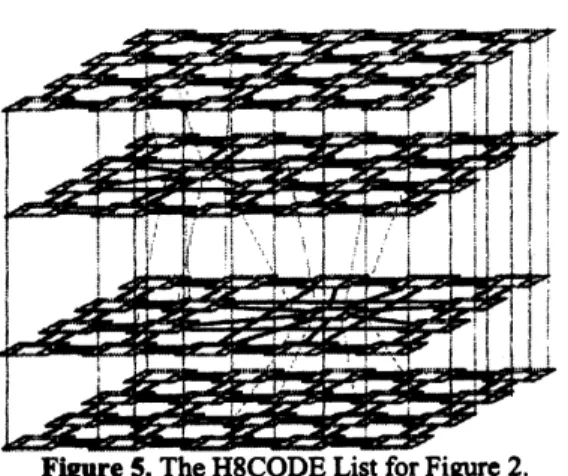
The numberofedgesthatisfrom nodes of Hexadecimal dissection
isat most16. Figure5shows relationsofedgesthatare
from nodes of Hcxadeci-grids and cells of multilayer
rectangulardissections.
Figure3. Link aroundacell forhexadecimal grids.
4.
Algorithms
This Section explains Algorithm with Hcxadeci-grids.
But Hexadeci-grid is
an
undirected grid graph,so
we
extend $H\alpha adeci\cdot yids$ to32-ary grid graph that isa
directedgrid graph. First, wedefine$32ary$-grid graph. Next,we proposealgorithms.
32-mryDirected Grid Graph
$GD$isrepresentedby32-arydirected grid graph. $G_{DD}=$ ($V_{\theta}L$, Direction, $A,$ $E_{DD}$), where Direction $=$
{Forward,
Backward}.
$E_{DD}\subset V_{D^{X}}L_{D^{X}}A_{D^{X}}$ Direction $xV_{D}$is defined
as
follows.
If[$s,$NonhEasternComerEdge,$t$]isin$E_{D}$,then
(1) ($s,$$No\hslash heastemcomerEdge$,Forward, t) is in$E_{DD}$ $\langle sxS\alpha)$
(2) ($s,$ NorthEastemCorneredge, Backward, t) is in $ED_{D}$ $(s_{x}\geqq t_{\pi)}$
CELL$UNmCA\Pi ON$ALGORITHM
In
a
past works, Motohashi, Tsuchida and Yaku introduced algorithm called UnifyCells,whichoPerate$uni\infty g$ two cells $[3, 4]$
.
We improve UnifyCells andmakeCELLUNIFICATIONALGORITHM.
ALGORITHM
CELL UNIFICATION ALGORITHM INPUT
$G_{D}=(V_{D}. E_{n}L, A_{D}, a_{D})$ :
a
Hexadeci-grid formultilayer rectangulardissection$D,$ $v$
.
$,v$ : anode in$G_{D}$ and $ww(x)=ww(\nu),$ $ew(x)=ew(\gamma)$, and $sux$) $=$
$nw\sigma)$
.
OUTPUT
$G_{F}=(V_{F\prime}E_{F}. LA_{F}. a_{F})$ : a Hexadeci-grid for
multilayer rectangular dissection $D$, where $F$ is
obtained fiom$D$ by unify cells$x$and$y$into$x$
.
METHOD
1. Changeedges of thehorizontal direction around $v_{X}$
and$v_{y}$
.
2. Deleteedgesofthehorizontal direction around$v_{v}$
.
3. Change edges of the vertical direction around $v_{x}$
and$v_{y}$
.
4. Delete edges ofthe vertical directionaround$v_{v}$
.
$s$. $Deletenodev_{y}$. ALGORITHM
LAYERDELETIONALGORITHM
$INPI\Pi$
$G_{D}=(V_{\theta}E_{D}. L, A_{D}, a_{D})$ :
a
Hexadeci-grid formultilayerructangulardissection$D,$$v_{x}$;anodein$G_{D}$
.
OUTPUT
$G_{F}=(V_{F}, E_{F}, L, A_{F}, a_{F})$
:
a
Hexadeci-grid formultilayer rectangular dissection $D$, where $F$ is
obtained from$D$by delete k-th layer.
METHOD
1. Delete edges ofthe horizontal direction around
&
$\cdot$2. Delete edges ofthe vertical direction around$v_{X}$
.
3. Delete node$v_{x}$in$G_{D}$
.
4. Repeat$1\sim 3$stepsfor all cells in$G_{D}$
5.
Processing System
In tluis Section, We Propose H8CODE that is
a
data format corresponding Hexadeci-grids. H8CODE is basedH7CODE[3]thatisa
data format corresponding Octgrids.H8CODE expressblocksbucture,andconsistsoffow
blocks.The$\epsilon xplanation$ofach blockis
as
follows.(1)$Ee\bullet der$Block
The header block has basicinfonnationonmultilayer rectangular dissection and consists of four flelds
(expect$spar\epsilon$).
(2)List Block
The list block has information
on
the amibutes ofcells. The numbcr ofcellsequals the number ofrecords. Ithas48fieldsper
a
record.(3)$Content$Block
The content block has information
on
the texture torapping$3D$terrainsurfaces. (4)$T\bullet bular$LayerBlock
The tabular layer block has information to
manage
multi rectangulardissection.Figure 6 shows detail of H8CODE and Figure 7
6.
24-ary
Grid
Graph
Next,
we
Propose 24-ary grid graph. Hexadeci-gridscan’trepresent
a
solid surfaoe. So 24-arygrid graphisan
effectivemodel to representa
solidsurface.And
we
purpose that 24-ary grid graph isa
base ofsystemthatprocesses teIrain surfaces bymetersabove
the
sea
level data. We deflne 24-ary grid graphas
follows.Next,
we
showan
exampleofterrainsurfaces with $H8CODE$.
Figure7isan
examploof multilayerterrain surfaces. TheuPpermapis recognizedvallcyofMt.Fuji, and the lowermaprecognized ridgeofMt.$Fuji[7$,
8].
Definition6.1.1
A rectangularsoliddissection is
a
collection$D=\{S_{1}$,$S_{2},$ $S_{N}$
}
of mutually disjoint rectangular solids ina
rectangularsolid dissection, where$S_{1}\cup S_{2}\cup$ ,.. $\cup$ $S_{N}=D$
.
$Def\bm{o}l0on6.1.2$
Let $D=\{S_{1}, S_{2}, \ldots, S_{N}\}$ be
a
rectangular soliddissection. A $teff\dot{u}cosa- yid$ for $D$ is
a
multi edgelabeled grid graph $G_{D}=(V_{D}, L, E_{D}, A_{D})$, defined
as
follows:
(1) $V_{D}$is definedasfollows:
If
a
rectangularsolid$s$is in$D$,then$v_{*}$isin$V_{D}$.
(2) $L=$ {equivalent upper nonh beam, equivalent
uPper south beam, equivalent upper east beam,
equivalent upper west beam, equivalent north east
comer, equivalent north west comer, equivalentsouth westcomer, equivalent south east comer, equivalent lower nonh beam, equivalent lowel south beam,
equivalent lower east beam; equivalent lower west
beam}
(3) $E_{D}\sigma V_{D}xLxV_{D}$ is
a
set ofundirected
labeled edge, definedas
follows: If$s$and$t$are
nearestsolidsin$D$such that$s$and$t$have uppernorth beamin
common, then[$s$,equivalent upper northbeam,$t$]is in
$E_{D}$
.
Figure 10 shows link around a cell for 24-ary Grid Graph.
48-ary dIrectedgridrepresentation
$G_{D}$ isrepresentedby 48-arydirected grid graph
GDD
$=$($V_{D},$ $L$, Direction, $A_{D}$, EDD), where Direction $=$
{Forward,
Backward}.
$E_{DD}\subset V_{D}xLxA_{D}x$ Direction $xV_{D}$ is
definedasfollows
If$[s, Equival\epsilon ntUpperNorthB\epsilon am, t]$is in$E_{D}$,then
(1) ($s,$ EquivalentUPperNorthBeam, Forward, t) is in
$E_{DD}$ (sx $\leq$ tx)
(2) ($s,$$Equival\epsilon ntUpp\epsilon rNolthBeam$,Backward,t) isin
$E_{DD}$ (sx $\geq\alpha$)
7.
Conclusion
Weproposed hexadeci-grids for Multilaycr dissection
and
a
dataformatcalled$co\pi esponding$tohexadecimnalgrids. And
we
express algorithm Delete layer and algorithm unify cells. Andwe
proposed tetraicosa-grids corresponding to rectangularsolid dissection.As for future works,
we
implement the system ofmultiresolution terrain surfaces for stratum
maps
and chronologically $top_{0}\Psi phica1$ maps. And we will constructinsert layer algorithm.Yaku,andD.Yoshino. GmgraphicalConcePtRecognition Withthe OctgndMethod forLeaming$G\infty graphy$and
$G\infty 10$gy, Proc.IEEEInternati.
Conf
AdvancedLearningTech.(ICALT07), pp.470-471,2007.
8.D.Yoshino,S.Kishira,M.Shimizu,K.Tsuchida,S.
Uehara,and T. Yaku.$G\infty fflphy$Learning Technology Basedon$3D$CGwithGeography DataArchives,$Pmc$. 7th
IEEE Internati.
Conf.
Advanced LeamingTech.$\langle ICALT07$),pp.472476,2007.
9.A. Kurcha,S.Kishira, T. Motohuhi, K.Tsuchida and T.
Yaku,Hexadecimal GridGraphRcpresentationof
MultilayerRectangular Dissections and Its Applications, l0th SIAM
conf
Geometric Design&Comput, Abstract$p32$, 2007,Texas,USA.桶 m
noe
1. T.Motohuhi, K.Tsuchida,and T. Yaku.Attribute graphs for tables andtheiralgorithms,Proc. Foundation
ofSoftware
Engineering2002,$d$.
K.Inoue,pp.183-186,Kindaikagakusya,2002.
2.T.Motohashi,KTsuchida,and T.Yaku. Table$proc\alpha sing$
basdonatmbute graphs Proc.6thhノレ 4STEDIntemati
Conf
Sofware
Engin.&APpti,pl31.136,2002.3. G.Akagi,Y.Miyadera,T.Motohashi,K.Nomaki,K. Tsuchida,andT. Yaku.Octal graphrepresentationfor multi-resolution$3D$landformmap8,2005SIAMGeometricDesign di omputing,Oct.2005.
4.Stcphanie Smullen,ClintonW.Smullen, III,CarlosM.
Santa.Interactive$3D$TerrainExplorationandVisualization, ACM$South\infty st$Regional Conference-Volume2,
pp393-396,2005.
5.XuexianPi,JunqiangSong. Procedural Terrain Detail BasedonPatch-LOD Algorithm.School of Computer, National UniversityOfDefenseTechnology, 410073,
Pp913-920,2006.
6. E.Gobbetti, F.MaIton,P.Cigmni, M. DiBenedetto,and F.Ganovelli,$c- BDAM\cdot c_{0_{\mathfrak{M}}}r\epsilon ss\alpha 1$BatchedDynammic
AdaptiveMeshes forTerrainRendering, Computer Graphics Forum 25,pp.333-342, 2006.