JAIST Repository
https://dspace.jaist.ac.jp/ Title 北陸先端科学技術大学院大学 共有計算サーバ使用成 果報告2018 Author(s) 本郷, 研太; 辻, 誠樹; 宮下, 夏苗; 井口, 寧 CitationTechnical memorandum (School of Information Science, Graduate School of Advanced Science and Technology, Japan Advanced Institute of Science and Technology), IS-TM-2019-001: 1-44
Issue Date 2019-08-07
Type Others
Text version publisher
URL http://hdl.handle.net/10119/16002
Rights
Description テクニカルメモランダム(北陸先端科学技術大学院大
8
I
7M
1
2 39 8 I -0 1 T S2 0 .
0 1 8 0
.
J2
A
J2
I
A new ab initio modeling scheme for ion self-diffusion coefficient applied to
-Cu
3Sn phase of Cu-Sn alloy
Tom Ichibha, Genki Prayogo, Kenta Hongo, Ryo Maezono
Making the most of data: quantum Monte Carlo post-analysis revisited
Tom Ichibha, Kenta Hongo, Ryo Maezono, Alex J.W. Thom
A DMC study on the mechanism of the point defects diffusion in the rutile TiO
2bulk
Tom Ichibha, Anouar Benali, Kenta Hongo, Ryo Maezono
A new candidate structure high pressure solid hydrogen discovered with calypso
algorithm
Tom Ichibha, Anouar Benali, Kenta Hongo, Ryo Maezono
B DFH C
D
:
C: ADC F C
L
C
CH F H DCG HD
F : H :
:D
C
C F
G
HK C AIB
C C: M AD: LHF CG
Tom Ichibha, Ornin Srihakulung, Guo Chao, Adie Tri Hanindriyo,
Luckhana Lawtrakul, Kenta Hongo, Ryo Maezono
Valence band engineering of layered bismuth oxyhalides toward stable visible-light
water splitting
Daichi Kato, Ryo Maezono, Kenta Hongo, Hiroshi Kageyama
v le
Ibi
RT
S l1
kwn
G : 2H
:-2
C K AD A HM G CG H
G C
A DF H B DF
F AA A
FD GG C DC
Nguyen Mau Toan
Electrical contacts to phosphorene - a DFT study
a Y
Inconsistencies in ab initio evaluations of non-additive contributions of DNA
stacking energies
Qin Ken, Ryo Maezono, Kenta Hongo
SVP
b h
t
Oxygen release mechanism of positive electrode active material
Takahiro Toma
64
2
1
3
J2
I
C H D
H FBD:MC B
FD FH G D
FH C DB DIC:G C : GMGH B
:
F
C C:F MD 2DIBM 2F : F ,
F ,IB F
, CH
DC D
MD . NDCD
IG DC .DCH
FAD
AI H DC D : G ADL C
:
F
C C:F MD
ID
D
DB
, CH
DC D
MD . NDCD
Specific heat of BaFe
2S
3and BaFe
2Se
3Adie Tri Hanindriyo, Kenta Hongo, Ryo Maezono
Investigation of twisted bilayers in MoSe
2:
F
C C:F MD
DDC B ,IB F
F M .
:
C MD . NDCD
Diffusion Monte Carlo study of hydrogen adsorption on silicon carbide nanotube
Genki Imam Prayogo, Ryo Maezono
IG DC .DCH
FAD GHI:M D
DFDC C HF : GMGH BG
C
B B F MD D
MD . NDCD
F H
A H B F HIF
A IA H DC D
F 2 HM
GHFI HIF
IG C
: CG HM
IC H DC A H DFM
FD
K CC F 2 C: F CHD 2 C
RT
P
cn f
,
-MDHFD
DF: F C
DF
FDHDC DC:I H HM C GIA DC H :
G B A
H
DAM B : H C ABG
, CG I
IF
I
D
YW
2 C A BDA IA
B
C D
DAMB F C: G BIA H DCG M AA HDB .
C:
pre
a
U TiCl
4MgCl
2mo
Adhesion of the electrodes on black phosphorus device surfaces
D IM
H C
isx
iy a
U
g
du iy
Y
1. JAIST 1.1 JAIST MPC MPC MPC MPC MPC MPC mpc MPC MPC [9] [10] 1.2 8 2018 JAIST MPC MPC ( ) ( ) MPI OpenMP conda .
1. 2018
2018 6 8 Cray XC40/MPI 2018 6 122018 6 20 SGI UV3000 / Parallel Programming
2018 6 25 - PC
2018 10 31 SGI UV3000 / Parallel Programming 2018 11 1 Cray XC40/MPI
1.3 1
2018 2 PC
GPU NVIDIA Tesla K40 NVIDIA Tesla P100
GPU GPU 2018 3 PC Docker PC Dockerhub .
2. JAIST
(2018)
Cray XC 0 548 (1096CPU, 19728Core) : 662.8TFLOPS : 200TB (Lustre)CPU: Intel Xeon E5-2695v4 2.1GHz 18Core x2 Memory: 128GB (16GB DDR4-2133 ECC x8)
(Fortran/C/C++/Python)
GNU/PGI/Cray Complier, Intel Parallel Studio XE, Anaconda Python
SGI UV3000
(ccNUMA )
128 nodes, 1536 CPU cores, 32TB memory ccNUMA
CPU Intel Xeon Processor E5-4655v3 x 2 256GB (DDR4-2134MHz x 8 ) NUMA-link6
51TB
(Fortran/C/C++/Python)
GNU/PGI Complier, Intel Parallel Studio XE, Anaconda Python
PC
Fujitsu Primergy CX2560 M2
48nodes, 64CPU, 1536 CPU cores
CPU: Intel Xeon Gold 6130 2.10GHz (16Core) x2 Memory: 64GB
(Fortran/C/C++/Python)
GNU/PGI Complier, Intel Parallel Studio XE, Anaconda Python
GPU
GPU Tesla P100 :
8 nodes, 16CPU, 256Core, 16GPU
GPU Tesla K40 :
4 nodes, 8CPU, 80Core, 8GPU (Fortran/C/C++/Python)
1.4 0 2
3 Gaussian16/GaussView
Materials Studio Gaussian16 GPU
MATLAB TensorFlow/Caffe/Chainer
3.
(2018)
XC40 UV3000 PC GPU Gaussian 16 Gaussian GaussView Gaussian GaussianMaterials Studio BIOVIA
MATLAB MathWorks
Tensorflow ( ) Google
Caffe ( ) UCB
Chainer ( ) Preferred Networks
1.5
2018 2018 mpc MPC
[1] ( ),”JAIST 1992 -1993 ”, ,IS-TM-94-0001, (1994) [2] ( ),”JAIST 1994 -1996 ”, ,IS-TM-97-3, (1997) [3] ( ),”JAIST (1997 )”, ,IS-TM-98-1, (1998) [4] ( ),”JAIST (1998 -2000 )”, ,IS-TM-2002-003, (2002) [5] ( ),”JAIST (2001 )”, ,IS-TM-2002-004, (2002) [6] ( ),”JAIST (2002 )”, ,IS-TM-2003-001, (2003) [7] ( ),”JAIST (2003 )”, ,IS-TM-2004-002, (2004) [8] ( ),”JAIST (2004 )”, ,IS-TM-2005-001, (2005) [9] ( ) ” 2007” IS-TM-2008-002, (2008) [10] ( ) ” 2008” IS-TM-2009-001, (2009) [11] ( ) ” 2009” IS-TM-2010-001, (2010) [12] ( ) ”
2010” IS-TM-2011-001, (2011) [13] , ( ) ” 2011” IS-TM-2012-001, (2012) [14] ( ) ” 2012” IS-TM-2013-001 (2013) [15] , ( ) ” 2013” IS-TM-2014-001 (2013) [16] , ( ) ” 2014” IS-TM-2015-001 (2014) [17] , ( ) ” 2015-2016” IS-TM-2018-001 (2018) [18] , ( ) ” 2017” IS-TM-2018-002 (2018)
: vpcc XC40 vpcc CASTEP XC40 VASP/Quantum Espresso ( )
1) Asami, K.; Shiraiwa, M.; Ueda, J.; Fujii, K.; Hongo, K.; Maezono, R.; Brik, M.G.; Yashima, M.; Tanabe, S. "Crystal structure analysis and evidence of mixedanion coordination at the Ce3+ site in Y Al (Al,Si) (O,N) oxynitride garnet phosphor", J. Mater. Chem. C, 2019, 7, 1330-1336.
2) Ichibha, T.; Prayogo, G.; Hongo, K.; Maezono, R. "A new ab initio modeling scheme for ion self-diffusion coefficient applied for ε-Cu3Sn phase of Cu-Sn alloy", Phys. Chem. Chem. Phys. 2019, 21, 5158-5164.
3) Matsumoto, Y.; Yamamoto, T.; Nakano, K.; Takatsu, H.; Murakami, T.; Hongo, K.; Maezono, R.; Ogino, H.; Donjgoon, S.; Brown, C.M.; Tassel, C.; Kageyama, H. "High pressure synthesis of A2NiO2Ag2Se2 (A = Sr, Ba) with a high spin Ni2+ in square planar coordination", Angew. Chem. Int. Ed. 2019, 58, 756-759.
4) Wakayama, H.; Utimula, K.; Ichibha, T.; Kuriki, R.; Hongo, K.; Maezono, R.; Oka, K.; Maeda, K. "Light Absorption Properties and Electronic Band Structures of Lead Titanium Oxyfluoride Photocatalysts Pb2Ti4O9F2 and Pb2Ti2O5.4F1.2", J. Phys. Chem. C, 2018, 122, 26506–26511.
5) Asami, K.; Ueda, J.; Yasuda, K.; Hongo, K.; Maezono, R.; Brik, M.G.; Tanabea, S. "Development of persistent phosphor of Eu2+ doped Ba2SiO4 by Er3+ codoping based on vacuum referred binding
energy diagram", Opt. Mater. 2018, 84, 436-441.
6) Kuriki, R.; Ichibha, T.; Hongo, K.; Lu, D.; Maezono, R.; Kageyama, H.; Ishitani, O.; Oka, K.; Maeda, K. "A Stable, Narrow-Gap Oxyfluoride Photocatalyst for Visible-Light Hydrogen Evolution and Carbon Dioxide Reduction", J. Am. Chem. Soc. 2018, 140, 6648 6655.
7) Oshima, T.; Ichibha, T.; Qin, K.S.; Muraoka, K.; Vequizo, J.J.M.; Hibino, K.; Kuriki, R.; Yamashita, S.; Hongo, K.; Uchiyama, T.; Kotaro Fujii, K.; Lu, D.; Maezono, R.; Yamakata, A.; Kato, K.; Kimoto, K.; Yashima, M.; Uchimoto, Y.; Kakihana, M.; Ishitani, O.; Kageyama, H.; Maeda, K. "Undoped Layered Perovskite Oxynitride Li2LaTa2O6N for Photocatalytic CO2
Reduction with Visible Light", Angew. Chem. Int. Ed., 57, 8154–8158.
8) Hongo, K.; Kurata, S.; Jomphoak, A.; Inada, M.; Hayashi, K.; Maezono, R. "Stabilization Mechanism of the Tetragonal Structure in a Hydrothermally Synthesized BaTiO3 Nanocrystal", Inorg. Chem., 2018, 57, 5413–5419.
1) 29 B /17K17762 H30 1,700 H29 4 H31 3 2) 28 / /16H06439 H30 2,700 H28 8 H33 3 3) 27 (B) / /15H02672 H30 200 H27 4 H31 3 4) 28 ( ) / JPMJPR16NA H29 10,500 H28 10 H32 3
A
CTIVITY
R
EPORT OF
FY2018
P
RINCIPALI
NVESTIGATOR:
Tomohiro IchibaA
FFILIATION:
Ryo Maezono Laboratory, JAIST, Nomi, Ishikawa, Japan.A
DDRESS:
8-311 Dormitory, 1-8 Asahidai, Nomi, Ishikawa, 9231211 Japan.P
HONE:
+81-5058065389E
MAIL:
[email protected]W
EBPAGE:
N/AA
NEW AB INITIO MODELING SCHEME FOR ION SELF
-
DIFFUSION COEFFICIENT
APPLIED TO EPSILON
-C
U
3S
N PHASE OF
C
U
-S
N ALLOY
Tom Ichibha, Genki Prayogo, Kenta Hongo, and Ryo Maezono
We present a new scheme for modeling of ion self-diffusion coefficient. Our scheme broadens the applicable scope of ‘ab initio + modeling’ approach, which combines modeling for self-diffusion coefficient with ab initio predictions. Essential concepts in our scheme are ‘domain division’ and ‘coarse-graining’ of the diffusion network, according to calculated barrier energies. With the former concept, the diffusion network is divided into a few types of simple disjunct domains. Their networks are further simplified with the latter idea that groups some ion sites and regards it as just a single site. We applied this scheme to Cu diffusion in ε- Cu3Sn phase of Cu-Sn alloy and succeeded to reproduce experimental
diffusion coefficients in a wide range of temperature.
XC40 is used for density functional theory, and especially for Nudged Elastic Band calculations.
M
AKING THE MOST OF DATA
:
Q
UANTUM
M
ONTE
C
ARLO
P
OST
-A
NALYSIS
R
EVISITED
Tom Ichibha, Kenta Hongo, Ryo Maezono, and Alex J.W. Thom
In quantum Monte Carlo (QMC) methods, energy estimators are calculated as the statistical average of the Markov chain sampling of energy estimator along with an associated statistical error. This error estimation is not straightforward and there are several choices of the error estimation methods. We evaluate the performance of three methods, Straatsma, an autoregressive model, and a blocking analysis based on von Neumann’s ratio test for randomness, for the energy time-series given by Diffusion Monte Carlo, Full Configuration Interaction Quantum Monte Carlo and Coupled Cluster Monte Carlo methods. From these analyses we describe a hybrid analysis method which provides reliable error estimates for series of all lengths. Equally important is the estimation of the appropriate start point of the equilibrated phase, and two heuristic schemes are tested, establishing that MSER minimization gives reasonable and constant estimations independent of the length of time-series.
A
DMC
S
TUDY ON THE
M
ECHANISM OF THE
P
OINT
D
EFECTS
D
IFFUSION
IN THE
R
UTILE
T
I
O2
B
ULK
Tom Ichibha, Anouar Benali, Kenta Hongo, and Ryo Maezono
The mechanism of the point defects (O vacancies, Ti interstitials) diffusion in rutile TiO2 has been
studied using DFT (density functional theory), but this method would not be reliable enough for transition metal oxides. We applied DMC (diffusion Monte Carlo) method to predict the barrier energies of the diffusion routes and re-considered the diffusion mechanism. We mainly discussed these primary issues under controversy: “Which of O vacancy and Ti interstitial diffuses faster perpendicularly to c-direction, when they are positively charged?”, “In which direction parallel or perpendicular to c- direction does Ti interstitial diffuse faster?”. Our DMC predicted utmost ∼2 eV different barrier energies from the DFT values and qualitatively disagreed the DFT conclusion for the first issue. We discussed our DMC results based on Bader charge analysis as well as the saddle state structures obtained by climbing nudged elastic band method.
XC40 is used for DFT and DMC calculations.
A
N
EW
C
ANDIDATE
S
TRUCTURE
H
IGH
P
RESSURE
S
OLID
H
YDROGEN
D
ISCOVERED WITH
CALYPSO
A
LGORITHM
Tom Ichibha, Anouar Benali, Kenta Hongo, and Ryo Maezono
Solid hydrogen phases under high pressures are studied by using CALYPSO/swarm structure searching algorithm, diffusion Monte Carlo methods, and DFT-phonon evaluations. A new phase with Pbam translational symmetry is found to be appeared in the range between 475GPa-490GPa, which is a stacking of the layers that each hydrogen molecule is accommodated within each honeycomb cell sandwiched between neighboring honeycomb layers. The appearance of the phase is consistent with preceding experiments reporting the metal- insulator transition around the pressure region.
Altix is used for DFT, and XC40 is used for DMC, respectively.
I
MPORTANCE OF VD
W
AND LONG
-
RANGE EXCHANGE INTERACTIONS
TO
DFT-
PREDICTED DOCKING ENERGIES BETWEEN PLUMBAGIN
AND CYCLODEXTRINS
Tom Ichibha, Ornin Srihakulung, Guo Chao, Adie Tri Hanindriyo, Luckhana Lawtrakul, Kenta Hongo, and Ryo Maezono
We calculated the docking energies between plumbagin and cyclodextrins, using density functional theory (DFT) with several functionals and some semi-empirical methods. Our DFT results revealed that GD3 dispersion force correction significantly improves the reliability of prediction. Also sufficient amount of long-range exchange is important to make it reliable further, agreeing with the previous work on argon dimer. In the semi-empirical methods, PM6 and PM7 qualitatively reproduce the stabilization by docking, yet under- and over-estimating the docking energies by ∼10 kcal/mol, respectively.
P
UBLICATION LIST(A
RX
IV PAPER IS[
TO BE]
SUBMITTED TO JOURNAL)
1. T. Ichibha, G. Prayogo, K. Hongo, and R. Maezono, "A new ab initio modeling scheme for ion self-diffusion coefficient applied to ε-Cu3Sn phase of Cu-Sn alloy", Phys. Chem. Chem. Phys., Royal Society of Chemistry, vol.21, 5158 (2019). [ /IF=3.906]
2. T. Ichibha, O. Srihakulung, G. Chao, A.T. Hanindriyo, L. Lawtrakul, K. Hongo, and R. Maezono," Importance of vdW and long-range exchange interactions to DFT-predicted docking energies between plumbagin and cyclodextrins", arXiv:1904.02503 (2019). [ ]
3. T. Ichibha, K. Hongo, R. Maezono, A.J.W. Thom, "Making the most of data: Quantum Monte Carlo Post-Analysis Revisited", arXiv(2019). [ ] (Submitted to Phys. Rev. E)
4. R. Kuriki, T. Ichibha, K. Hongo, D. Lu, R. Maezono, H. Kageyama, O. Ishitani, K. Oka, and K. Maeda, "A Stable, Narrow-Gap Oxyfluoride Photocatalyst for Visible-Light Hydrogen Evolution and Carbon Dioxide Reduction", J. Am. Chem. Soc., ACS Publications, vol.140, 6648 (2018). [ /IF=14.357] 5. T. Oshima, T. Ichibha et al., "Undoped Layered Perovskite Oxynitride Li2LaTa2O6N for Photocatalytic
CO2 Reduction with Visible Light", Angew. Chem. Int., ACS Publications, vol.57, 8154 (2018).
[ /IF=11.994]
6. H. Wakayama, K. Utimula, T. Ichibha et al., "Light Absorption Properties and Electronic Band Structures of Lead Titanium Oxyfluoride Photocatalysts Pb2Ti4O9F2 and Pb2Ti2O5.4F1.2", J. Phys. Chem. C,
ACS Publications, vol.122, 26506 (2018). [ /IF=4.484]
7. K. Utimula, T. Ichibha, R. Maezono, and K. Hongo, "Ab initio search of polymer crystals with high thermal conductivity", arXiv:1811.06807,(2018). [ ]
8. Q.S. Ken, T. Ichibha, K. Hongo, and R. Maezono, "Difficulty to capture non-additive enhancement of stacking energy by conventional ab initio methods", arXiv:1807.04168 (2018). [ ]
L
IST OF PLANNED PUBLICATIONS1. Tom Ichibha, Anouar Benali, Kenta Hongo, and Ryo Maezono,, "A DMC Study on the Mechanism of the Point Defects Diffusion in the Rutile TiO2 Bulk".
2. Tom Ichibha, Yunwei Zhang, Kenta Hongo, Ryo Maezono, and Yanming Ma, "A New Candidate Structure High Pressure Solid Hydrogen Discovered with CALYPSO Algorithm".
A
CHIEVEMENTS1. Scholarship: Research Fellowships for Young Scientists (Japan Society for the Promotion of Science), Apr 2018-Apr 2020. [200,000 JPY / month]
2. Grant: Grant-in-Aid for JSPS Research Fellow (18J12653) (Japan Society for the Promotion of Science), Apr 2018-Apr 2020. [1700,000 JPY]
3. Grant: Grant for fundamental research (Japan Advanced Institute of Science and Technology), Apr 2018-Mar 2019.
Valence Band Engineering of Layered Bismuth Oxyhalides
toward Stable Visible-Light Water Splitting
Daichi Kato/Kyoto University, Ryo Maezono/School of Information Science, Kenta Hongo/RCACI, Hiroshi Kageyama/Kyoto University
P
ROJECT DESCRIPTION:
A layered oxychloride Bi4NbO8Cl is a visible-light responsive catalyst for water splitting, with its
remarkable stability ascribed to the highly dispersive O-2p orbitals in the valence band, the origin of which, however, remains unclear. In our previous project, we systematically investigate four series of layered bismuth oxyhalides, BiOX (X = Cl, Br, I), Bi4NbO8X (X = Cl, Br), Bi2GdO4X (X = Cl, Br), and SrBiO2X
(X = Cl, Br, I), and their electronic structures (DOS) is obtained from DFT (Density functional theory). Combined with Madelung potential analysis, we found that Madelung site potentials of anions capture essential features of the valence band structures of these materials and its relationship with their crystal structures.
However, valence band structure is believed to be affected not only by Madelung potential but also 6s lone pair effect. This project attempts to further investigate the contribution of 6s lone pair effect on crystal structures and on band structures in various post-transition metal (i.e. Bi, Pb, etc) oxide and oxyhalides. These effect will be revealed from the analysis of COHP (Crystal Orbital Hamilton Population) and ELF (Electron Localization Function) analysis which are again based on DFT approach.
P
UBLICATION LIST[1] Kato, D.; Hongo, K.; Maezono, R.; Higashi, M.; Kunioku, H.; Yabuuchi, M.; Suzuki, H.; Okajima, H.; Zhong, C.; Nakano, K.; Abe, R.; Kageyama, H.J. Am. Chem. Soc. 2017, 139, 18725-18731.
L
IST OF PLANNED PUBLICATIONS[1] 'Impact of 6s lone pair on valence band structures of post-transition metal oxides and oxyhalides; COHP analysis', [Kenta Hongo, Ryo Maezono], [journal (temporary)].
Na
, :XC40 (SISSA, Italy) , , Na .
(First-Principle Quantum Monte Carlo: QMC) ,
, . QMC , (DFT) , , , . , DFT , QMC . , , , QMC . ,
Na , (Potential Energy Surface: PES)
(Lattice regulated Diffusion Monte Carlo: LRDMC) ( 1(a)). 1(b)
, LRDMC PES , , ,
DMC . DMC Na PES
, .
1 (a) a Na LRDMC (b) Na PES
1) Kousuke Nakano, Ryo Maezono, and Sandro Sorella, submitted to J. Chem. Theory Comput. (2019).
(a) (b) -324.600 -324.575 -324.550 -324.525 -324.500 -324.475 -324.450 -324.425 LRDMC Energy (Hartree / Na 2 ) 0.10 0.08 0.06 0.04 0.02 0.00 a d = 1.8 Å d = 3.5 Å d = 2.0 Å d = 4.0 Å d = 2.5 Å d = 5.0 Å d = 2.9 Å d = 10.0 Å d = 3.1 Å 2 × Na atom 100.0 80.0 60.0 40.0 20.0 0.0 -20.0 -40.0
Total energy (mHartree / Na
2 ) 12 10 8 6 4 2 d Na-Na (Å) UHF UMP2 UCCSD(T) VMC LRDMC Experiment Na2 dimer
1
PC cluster IoT
Training sequence (TS), Cyclic prefix (CP), Guard interval (GI)
Inter-block interference (IBI)
IBI TS TS
Chained turbo channel estimation (CHATES) IBI
IBI / 1
IBI MSE floor
Bit error rate (BER) 1
Figure 1 (AIM-MMSE) BER
[1] Y. Takano, H.-J. Su, M. Juntti and T. Matsumoto, "A Conditional ℓ1 Regularized MMSE Channel Estimation Technique for IBI Channels," IEEE Trans. on Wireless Commun., vol. 17, no. 10, pp. 6720-6734, Oct. 2018.
Wised-StagedLSH: A new locality sensitive hashing algorithm for parallel processing on
GPGPU
School of Information Science, Ino-Lab, Nguyen Mau Toan Machine: pcc
The development of digital content makes the data become bigger and bigger every day. Many high dimensional datasets have constantly updated such as audio fingerprints, photos or text dataset, which needs a suitable dynamic structure to manage. Hash-table of LSH is the mapping table that indexes the value(key) to the list of data/items on the database. People tend to use a static hash-table to increase the speed of searching. However, when the requirements are changed from static dataset to dynamic dataset, we have to use a different structure of LSH hash-table to adapt to the constantly updated dataset.
While StagedLSH of Yang has significant accuracy for structured high dimensional dataset, it still has problems of high memory space requires and incompatible for parallel processing. To tackle these problems, we proposed Wised-StagedLSH to enhance the parallel processing performance and optimize the required memory space.
Firstly, Divergent branch is the critical problem for almost all GPGPU devices, that makes all threads stall when selecting branch to jump. In StagedLSH algorithm, when comparing the distance of corresponding frames of the query and current data item. Which generates stall due to divergent branch after select the similarity frames. We do remove the frames comparison in Wised-StagedLSH for eliminating the divergent
branch and increasing the accuracy of KNN search. However, skipping frames comparing can cause slow down the search processing by taking more vector comparing that need more clock circles than the frame comparison. An additional advantage of removing frame comparison is the search process be simply parallel in frame level. Each flow of each frame can works independently with each other.
With only 10K throughput KNN
queries, our proposed method achieved around 75¥% capacity of P100 GPGPU and having higher speed-up ration than other methods. By the wised selecting the grid size, Wised-StagedLSH can easily full fill the active warps by increasing the number of throughput queries. Follow this result, we recommend to process 10K or more throughput queries for P100 GPGPGU with 1M denseSIFT database. Not only the recall of Wised-StagedLSH is increased, but also the parallel performance is boosted for maximizing the capacity of GPGPU.
A
CTIVITY
R
EPORT OF
FY2018
1. P
ROJECTT
ITLE:
E
LECTRICALC
ONTACTS TOP
HOSPHORENE–
A
DFT
S
TUDYP
RINCIPALI
NVESTIGATOR:
Dr. Nihar Ranjan MohapatraA
FFILIATION:
Associate ProfessorA
DDRESS:
Ab4-321, IIT Gandhinagar, Palaj, 382355, GandhinagarP
HONE:
+91 79 2395 2420E
MAIL:
[email protected]W
EBPAGE:
http://people.iitgn.ac.in/~nihar/M
ACHINE USED:
(XC40/Altix/hster/Linux cluster)2. P
ROJECT DESCRIPTION:
Two-dimensional (2D) van der Waals materials such as Phosphorene possess a wide range of remarkable properties that makes them attractive for a number of applications, including sub-5 nm VLSI. One of the biggest challenges in realizing high performance and energy efficient transistors is the Phosphorene-metal interface. Despite good intrinsic properties of the material, a bad contact can be the limiting factor in achieving a good overall performance. Often metal interfaces experience formation of Schottky barriers which reduces the carrier injection efficiency thus leading to decrease in the device’s performance. Therefore, a proper choice of metal which can form an Ohmic contact is crucial. In addition, a strong adhesion of the metal with the 2D semiconductor parent surface is important. In this project, we are studying the metal to Phosphorene (single to multi-layer) interface using ab-initio calculations. We are also investigating the properties of metal contact on functionalized Phosphorene layer. This going work will help us in finding out a suitable metal which can be used as a contact for Phosphorene based 2D devices.
3. N
AME OFC
O-
AUTHORS INJAIST
3.1 L
IST OF CO-
AUTHORS- Prof. Ryo Maezono/School of Information Science - Dr. Kenta Hongo/ School of Information Science
A/How many co-authored publications with JAIST faculties so far - NIL
B/How many co-authored publications with JAIST faculties planed in future – minimum 2 this year
4. P
UBLICATION LIST DURINGFY2018
USINGJAIST
FACILITIESThere were no publications in FY2018.
5. C
O-
AUTHORINGP
ROJECTS FORFY2019
USINGJAIST
FACILITIES1. Electrical contacts to Phosphorene – A DFT study (This project will be continued in FY2019. We have achieved some results. This project will be finished with some more work.)
2. The electronic properties of Phosphorene/Gallenene heterostructures (Gallenene is found to be a promising 2D Metal. In this work we will study the Phosphorene-Gallenene interface.)
It is planned to have two publications from project 1 and one publication from project 2. Project 1 and 2 are listed above.
PC vpcc ⎧ ⎪ ⎪ ⎨ ⎪ ⎪ ⎩ ∀x. x− 0 = x, ∀x. 0− x = 0, ∀x, y. s(x) − s(y) = x − y ⎫ ⎪ ⎪ ⎬ ⎪ ⎪ ⎭ , ∃x. x − x = s(x). Moc TPTP [1] [2] 3534 1 60 PC Moc CoCo [3] CASC [4]
[1] The TPTP Problem Library for Automated Theorem Proving.
http://www.tptp.org/
[2] T. Sternagel. Reliable Confluence Analysis of Conditional Term Rewrite Systems. PhD thesis, University of Innsbruck, 2017.
[3] Confluence Competition. http://project-coco.uibk.ac.at/
I
NCONSISTENCIES IN AB INITIO EVALUATIONS OF NON
-
ADDITIVE
CONTRIBUTIONS OF
DNA
STACKING ENERGIES
Qin Ken, Prof. Ryo Maezono/School of Information science, Prof. Kenta Hongo/ RCACI.
P
ROJECT DESCRIPTION:
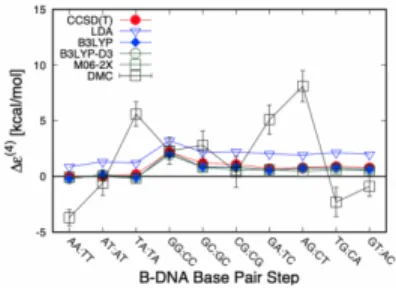
The non-additivity in interactions is obviously expected in intermolecular bindings due to the induced polarizations caused by the quantum fluctuations, such as vdW (van der Waals) forces. We evaluated the non-additive contributions of the intermolecular interactions in B-DNA stacking by using diffusion Monte Carlo methods with fixed node approximations (FNDMC). We found that FNDMC gives qualitatively different estimations of the non-additivity from those obtained using any other ab initio method shown as Figure 2. Given that the estimations of the stacking energies themselves exhibit no obvious differences, the error cancellation of the fixed-node error may not work well when we divide a system into sub-systems that are connected to each other by hydrogen bonds. The target systems are 10 kinds of the Watson-Crick base pairs in B-DNA, the example of geometry for ’AA:TT’ pair is shown as Figure 1. The geometries for all ten pairs are provided by Sˇponer J. et al.'s work, and we take them to be fixed. The specific difference observed only for FNDMC in Figure 2 may be because of the poor cancellation of the quantities including the evaluations of the sub-systems connected to each other by the horizontal hydrogen bonding shown in Figure 1.
Figure 1. The example of geometry for ’AA:TT’ pair. There are two layers in this system and each
layers are composed by one base pair. In ‘AA:TT’ structure, A:T means the adenine-thymine base
pair.
Figure 2. Non-additive contribution, evaluated by various methods. The specific difference observed only for FNDMC results. For CCSD(T), the data is taken from the preceding work.
P
UBLICATION LIST[1] T. Oshima, T. Ichibha, K.S. Qin, K. Muraoka, J.J.M. Vequizo, K. Hibino, R. Kuriki, S. Yamashita, K. Hongo, T. Uchiyama, K. Fujii, D. Lu, R. Maezono, A. Yamakata, H Kato, K. Kimoto, M. Yashima, Y. Uchimoto, M. Kakihana, O. Ishitani, H. Kageyama and K. Maeda, "Undoped Layered Perovskite Oxynitride Li2LaTa2O6N for Photocatalytic CO2 Reduction with Visible-Light" Angew. Chem. Int. Ed. 130(27), 8286-8290, 2018
L
IST OF PLANNED PUBLICATIONS[1] ‘Inconsistencies in ab initio evaluations of non-additive contributions of DNA stacking energies’, K. Qin, K. Hongo, R. Maezono, Int. J. Quantum Chem.
SVP
: SGI UV300 PC (VPCC) Shor RSA DH (SVP)SVP Sampling Reduction SubSieve+
PC (VPCC)
n Sampling Reduction ! ∗ 2$% SubSieve+
! ∗ 2&'( 2)*
(SVP IDEAL LWE) NTRU
SubSieve+ 100 SVP SVP SGI UV3000 (IDEAL) 132 134 138 140 SCIS2019
1) Randomness Assumption SCIS2019 4B1-4 [
/ ]
A
CTIVITY
R
EPORT OF
FY2018
O
XYGEN RELEASE MECHANISM OF POSITIVE ELECTRODE ACTIVE MATERIAL
P
RINCIPALI
NVESTIGATOR:
Takahiro TomaA
FFILIATION:
Hongo Lab., JAIST, Nomi, Ishikawa, JapanE
MAIL:
[email protected]P
ROJECT DESCRIPTION:
LiMe(Me=Ni, Co, Mn)O2 (1) MeO2 Li -( ) LiNiO2 Ni Ni Li Li LiMeO2 Li MeO2 MeO2 O2 Li (Cs-STEM) (R3-m) (C2/m) R3-m C2/m MeO2 C2/m R3-m C2/mL
IST OF PLANNED PUBLICATIONS[1] ' Relationship between crystal structure and oxygen release behavior of LNO', K. Hongo, R. Maezono, J.Power.Sorces
...
Li
1-xMeO
2+ xLi
++xe
-= LiMeO
2A
CTIVITY
R
EPORT OF
FY2018
A
B INITIO THERMODYNAMIC PROPERTIES OF CERTAIN
COMPOUNDS IN
N
D
-F
E
-B
SYSTEM
Adie Tri Hanindriyo/School of Material Science, Soumya Sridar, K.C. Hari Kumar,
Kenta Hongo, Ryo Maezono
P
ROJECT DESCRIPTION:
Calculations have been performed to investigate thermodynamic properties of
intermetallic compounds within the Nd-Fe-B system. Materials within the system possess
intriguing magnetic properties, and one compound (Nd
2Fe
14B) in particular is of great
importance as the basis of a class of powerful permanent magnets. Investigation from ab
initio is performed to supplement existing database of thermodynamic properties in
particular for the application of the CALPHAD method, which calculates the phase diagram
of a system by modelling and optimizing model parameters for the free energy. These
models may utilize ab initio results in order to “fill the gaps” where experimental
measurements do not exist, especially for several lesser known or newly discovered
compounds.
Two key properties are obtained from first-principles calculations, namely the enthalpy
of formation and specific heat (in constant pressure or C
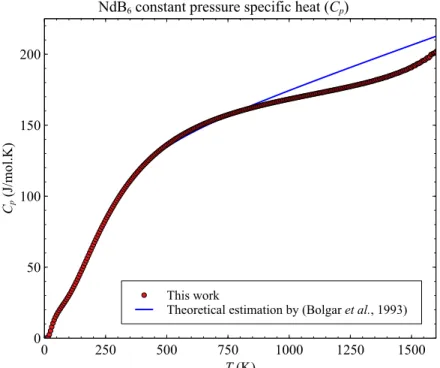
p). Fig 1 shows an example of the
results obtained for the C
pof NdB
6in comparison with theoretical prediction from another
work.
LIST OF PLANNED PUBLICATIONS
[1] 'Ab initio thermodynamic properties of certain compounds in Nd-Fe-B system', [Adie Tri
This work Theoretical estimation by (Bolgar et al., 1993) Cp (J/mol.K) 0 50 100 150 200 T (K) 0 250 500 750 1000 1250 1500 NdB6 constant pressure specific heat (Cp)
Adie Tri Hanindriyo/School of Material Science, Guo Chao, Tom Ichibha, Kenta
Hongo, Ryo Maezono
P
ROJECT DESCRIPTION:
The disiloxane molecule (Si
2H
6O) or disilyl ether is the simplest molecule which contains
the Si-O-Si bond ubiquitous in many important silicate compounds. The description of the
flexible Si-O-Si angle is vital to the properties of silicates and as such is very important to
proper modelling. Past studies regarding this matter have produced wide-ranging results,
either for the magnitude of the angle to the linearization barrier.
Using diffusion Monte Carlo (DMC), which to date is the most reliable ab initio method
(especially with respect to electronic correlation), the nature of the Si-O-Si bond is
investigated in this work. We focus on the result dependence on both the basis set used to
describe the wavefunction and the exchange-correlation functional in density functional
theory (DFT), which is also observed in past works in this area. Trial wavefunction for DMC
is taken from a DFT run using varying basis sets and exchange-correlation functionals and
with results from both DFT and CCSD(T) used as points of comparison.
LIST OF PLANNED PUBLICATIONS
[1] ‘Diffusion monte carlo evaluation of disiloxane’, [Adie Tri Hanindriyo, Guo Chao, Tom
Ichibha, Kenta Hongo, Ryo Maezono], [journal (temporary)].
S
PECIFIC
H
EAT OF
B
A
F
E
2S
3AND
B
A
F
E
2S
E
3Adie Tri Hanindriyo/School of Material Science, Kenta Hongo, Ryo Maezono
P
ROJECT DESCRIPTION:
Compounds BaFe
2S
3and BaFe
2Se
3have recently garnered attention due configurations
present in the crystal structure which is potentially a multiferroic material. BaFe
2Se
3has
been predicted to possess multiferroicity due to the iron ladder structure, while traditionally
interest in the material has been focused on its potential for superconductivity. A view from
this new perspective may extend the search for multiferroicity to beyond this compound,
to other materials possessing similar structures and configurations.
Ab initio methods may play an important part in this endeavor. In this case, the specific
heat of BaFe
2S
3and BaFe
2Se
3is sought after using phonon calculations with DFT as the force
calculator. Multiple, high-cost calculations are required especially considering the doubled
unit cell necessary to reproduce the complex magnetic ordering present within both
structures. Investigation into the thermodynamic properties of both compounds may
present a new perspective on the ongoing endeavor to understand multiferroicity in
BaFe
2Se
3.
LIST OF PLANNED PUBLICATIONS
[1] ‘Specific heat of BaFe
2S
3and BaFe
2Se
3’, [Adie Tri Hanindriyo, Kenta Hongo, Ryo
Maezono], [journal (temporary)].
I
NVESTIGATION OF
T
WISTED
B
ILAYERS IN
M
O
S
E
2Adie Tri Hanindriyo/School of Material Science, Poonam Kumari, Priya Mahadevan,
Ryo Maezono
P
ROJECT DESCRIPTION:
As a collaboration with Poonam Kumari and Prof. Priya Mahadevan, this project is a
continuation of their study into bilayer structures in MoSe
2. It has been discovered that,
contrary to expectations, twisting the xy-plane orientation of one layer with respect to the
other does not change the interlayer distance between the bilayers. Varying the twisting
angle is an important part in the study, and one twisting angle in particular (2.7
o) presents
a challenge due to the large unit cell required to study this phenomenon (1626 atoms,
~10000 electrons). High-performance computing is a necessity in this project for the reason
above.
LIST OF PLANNED PUBLICATIONS
[1] ‘Twisted bilayers of MoSe
2’, [Adie Tri Hanindriyo, Poonam Kumari, Priya Mahadevan,
Ryo Maezono], [journal (temporary)].
D
IFFUSION
M
ONTE
C
ARLO STUDY OF HYDROGEN ADSORPTION ON
S
ILICON
C
ARBIDE
N
ANOTUBE
Genki Imam Prayogo, Ryo Maezono/School of Information Science
P
ROJECT DESCRIPTION:
Silicon carbide nanotube (SiCNT) is a novel type of cylinder-shaped nanostructure that is similar to carbon nanotube (CNT) but with Si atom substituting one position. It has been theoretically and experimentally investigated for use as hydrogen storage material and chemical sensors, among others. Experimental findings suggested that even in pure form, it has better storage capacity by weight than CNT. The mode of adsorption is predicted to consist of mostly physisorption, where most interactions are from dispersion forces. Most of previous theoretical studies were based on conventional Density Functional Theory (DFT), which has known difficulties in describing such interaction. In this study, we use Diffusion Monte Carlo instead of DFT to evaluate the adsorption energetics, comparing optimized geometries derived from multiple exchange-correlation functionals at DFT level. We found that the geometry and binding energy to be highly variable depending on the choice of exchange-correlation functional at DFT level. We also found that the PBE functional was found to give the best (lowest) DMC energy and that predicted adsorption energy is much stronger than DFT predicted.
L
IST OF PLANNED PUBLICATIONS[1] 'Diffusion Monte Carlo study of hydrogen adsorption on Silicon Carbide Nanotube', R. Maezono, K. Hongo, J. Chem. Phys.
D
IFFUSION MONTE CARLO STUDY OF
B
ORON
N
ITRIDE SYSTEMS
Genki Imam Prayogo, Ryo Maezono/School of Information Science
P
ROJECT DESCRIPTION:
Cubic boron nitride (c-BN) is a very hard, chemically inert material that is also stable at high temperature and pressure. It is highly attractive for use as superhard coating materials and abrasives. Its fabrication requires very high temperature and pressure, in the range of 8 GPa at temperature of above 2000 K. A more recent technique adds aluminium nitride into melted phase of BN, which has been found to significantly lower the required temperature for c-BN formation. However, a reliable phase diagram for this system is currently unavailable, with previous experiments arriving at different conclusions. We aim to derive this computationally, starting with the BN polymorphs. There has been an established method for doing this, by combining computational thermodynamics with ab initio derived energetics. Density functional theory (DFT) is the ab initio method of choice for this approach, mainly due to its more accessible computational cost. It is however, unable to accurately describe van der Waals (vdW) interactions, which is unfortunately present in the hexagonal form of boron nitride (h-BN). We found that conventional gradient-corrected functional greatly overestimates interlayer distance in this phase, while supposedly vdW-corrected DFT functionals still failed to reproduce correct energetic ordering between various BN polymorphs. We expect the use of Diffusion Monte Carlo (DMC) instead of DFT will improve this considerably, as it is able to properly treat long-range correlations which give rise to the said vdW interaction.
A
CTIVITY
R
EPORT OF
FY2018
1. P
ROJECTT
ITLE:
Critical Temperature Calculation of ThCr
2Si
2- Type Structure
using Density Functional Theory Approach
P
RINCIPALI
NVESTIGATOR:
Gewinner Senderanto SinagaA
FFILIATION:
Ryo Maezono Laboratory, JAIST, Nomi, Ishikawa, Japan.A
DDRESS:
2-116 JAIST Student Housing, 1-8 Asahidai, Nomi city, IshikawaE
MAIL:
[email protected]2. P
ROJECT DESCRIPTION:
Critical temperature is one of the most interesting phenomena in condensed matter physics for discovering the new materials which has high critical temperature. ThCr2Si2-type structures have
been attracted a lot of attentions both experimental and theoretical studies since it showed a promising superconductivity capability. The general composition of the ThCr2Si2-type structure
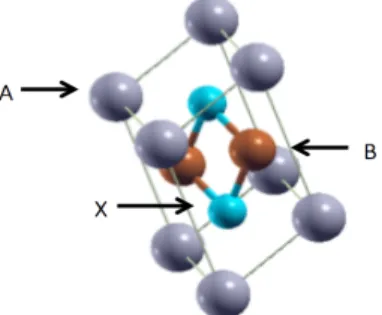
(I4/mmm) can be denoted as AB2X2 where [A = rare-earth or alkaline-earth metal], [B = transition
metal], and [X = p-block element] as shown as figure 1. The structure consists of the stacking ordered of A-[X-B2-X]- A. The [B2X2] layer is considered as a quasi-two-dimensional network. Sometimes X-X bonding are formed in the interlayer of [B2X2] to give a three-dimension network which is called a collapsed tetragonal (’cT’). Critical temperature (Tc) calculation of ThCr2Si2-type structures are done
by performing electron-phonon calculation using Quantum Espresso package. First, we provide the optimized structure using ‘vc-relax’ calculation and then the optimized structure will be applied to self consistent calculation (scf). After doing scf calculation, we perform phonon calculation producing a set of dynamical matrix. From dynamical matrix, we need to calculate the corresponding set of interatomic force constant using q2r. And the last, by performing lambda.x calculation which estimate the critical temperature using via allen-dynes equation (equation 1) which generate critical temperature of the materials.
(equation1)
Where, is the elctron-phonon coupling (EPC) constant, is the effective electron-electron interaction and is the effective phonon frequency.
Tc
= ω
eff
1.2
exp
−1.04(1+
λ)
λ − µ
*(1
+ 0.62λ)
⎛
⎝⎜
⎞
⎠⎟
λ
µ
*ωeff
Figure 1 Unit cell of ThCr2Si2-type structure. The purple ball refer to rare-earth element, brown ball refers to transition metal, and light blue refers to p block elements
: xc40 liquid-ordered phase POPC POPC flip-flop (desorption) POPC 128 8192 POPC
POPC (CHOL) (CER)
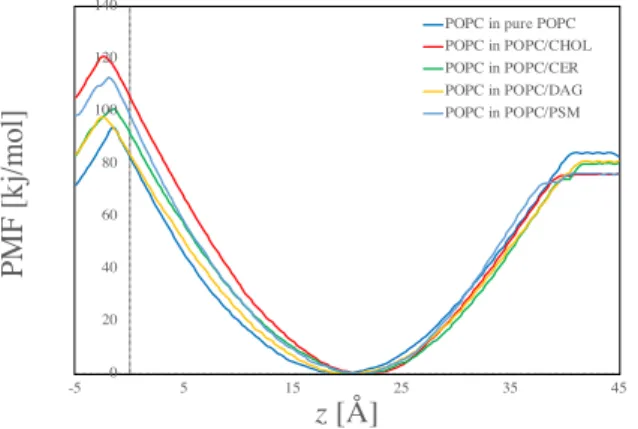
(DAG) (PSM) 20 mol% MD (T=303K, P=1atm) CHARMM36 [2] TIP3 PMF LogMFD [3,4] z POPC P PMF (Flip-flop) PFM POPC (desorption) MD PMF GROACS5.2.1 1 MD POPC
PSM < DAG < CER < CHOL
Table1. Membrane structural parameters for binary POPC bilayers
POPC P z = 20
z = 0 PMF Flip-flop
z = 40 PMF POPC
(desorption) Flip-flop POPC ≈ DAG ≈
CER < PSM < CHOL CHOL
CHOL ≈ PSM < CER ≈
DAG < POPC POPC CHOL PSM
POPC
Fig 1. Free energy profiles for binary POPC mixture bilayers
1. Yousuke Takaoka, Mana Iwahashi, Andrea Chini, Hiroaki Saito, Yasuhiro Ishimaru, Syusuke Egoshi, Nobuki Kato, Maho Tanaka, Khurram Bashir, Motoaki Seki, Roberto Solano, Minoru Ueda, “A rationally designed JAZ subtype-selective agonist of jasmonate perception”, NATURE COMMUNICATIONS, 9(3654), 1-13 (2018).
2. Hiroaki Saito, Tetsuya Morishita, Taku Mizukami, Ken-ichi Nishiyama, Kazutomo Kawaguchi, and Hidemi Nagao, “Molecular dynamics study of binary POPC bilayers: molecular condensing effects on membrane structure and dynamics”, IOP Conf. Series: Journal of Physics: Conf. Series, 1136, 012022, (2018).
3. Hiroaki Saito, Tetsuya Morishita, Taku Mizukami, Ken-ichi Nishiyama, Kazutomo Kawaguchi, and Hidemi Nagao, “Free energy profiles of lipid translocation across pure POPC and
POPC/CHOL bilayer: all-atom molecular dynamics study”, IOP Conf. Series: Journal of Physics: Conf. Series, in press.
0 20 40 60 80 100 120 140 -5 5 15 25 35 45 PMF [kj/mol] z [Å]
POPC in pure POPC POPC in POPC/CHOL POPC in POPC/CER POPC in POPC/DAG POPC in POPC/PSM
7O D
D G
(z
c
z
807 57 A( 2SCX B2) D G( 7O D z a z kt t i z y qt l e fg k o e f i l 1MV SCX 3KT u t ( GA yc t D G( y qt e k 7O D y l i e y qt t i z z p y 7O D D G(z z z az y A0 AKGOOC CD KOKUKP TK VMCUKPO C LCIG p D G(z z
( z d 3 y qt kp 18:30 KO PSDKU PV MKOI kp u k 3SVFG k dqp D G( GA z le y qt z 3 e k e l i e y qt p 3 z d z e iqt ay b e D G(z z z li e tc 7O D z a qp e t b D G(z e y qt l e y qt y ufp z d ( GA ych y qt w nm GA z z e ( GA z z f ikt i e dqp p D G( GA y f r lzy k 7O D z )GA y f qt iz e y z z b c 807 z z y s t kp y l y l
6 COP 9V CJCSC 5 K VUCOK 4KSTU SKO K MGT TUVFX PH UJG GMG USPOK COF P UK CM SP GSUKGT PH SXTUCMMKOG COF MK VKF D G(/ JCTG USCOTKUKPO KOFV GF JCOIGT KO P UK CM
SP GSUKGT 8 O 8 0 M JXT , . . 3 - POMKOG - , ,
1) 2 z y z z
Lyotropic ordering for high proton conductivity
in sulfonated semialiphatic polyimide thin films
School of Materials Science Kensaku Takakura, Yuki Nagao Used MPC : pcc
Influence of the semi-aliphatic backbone on the molecular ordering and proton
conductivity was investigated compared to the rigid aromatic backbone in highly
proton-conductive organized polyimide thin films. We newly synthesized two alkyl
sulfonated semi-aliphatic polyimides (ASSPIs) with different molecular weights and
investigated their molecular organized structure, proton conductivity, water uptake, and
dissociation state of protons from sulfonic acid groups in thin films by in-situ
measurements for grazing incidence small-angle X-ray scattering (GISAXS), quartz
crystal microbalance (QCM), Fourier transform
infrared (FT-IR) spectra, and
impedance spectra. Declining of planarity in the semi-aliphatic backbone reduced the
aggregative character and molecular ordering in the lyotropic liquid crystalline (LC)
structure. However, the higher molecular weight ASSPI exhibited the oriented lamellar
structure in spite of lower planarity of the main chain. The proton conductivity of the
oriented lamellar thin film displayed a more than half order of magnitude higher value
of 1.5 × 10
-1S cm
-1than that of the non-oriented lamellar thin film (3.0 × 10
-2S cm
-1) at
25°C and 95% RH.
Density functional theory (DFT) calculations were performed to obtain polymer unit length of the polymer backbone using the DMol3 package in Materials Studio 2017 (BIOVIA).These results indicate that, in sulfonated polyimide
thin films, the lamellar orientation greatly contributes to the high proton conductivity in
the ASSPI thin films.
Acknowledgment
The authors thank prof. Shusaku Nagano at Nagoya University for determining the organized structure by in situ GISAXS.
Publications (peer-reviewed)
1. K. Takakura, Y. Ono, K. Suetsugu, M. Hara, S. Nagano, T. Abe, Y. Nagao, “Lyotropic ordering for high proton conductivity in sulfonated semialiphatic polyimide thin films “, Polymer Journal, 51, 31 - 39 (2018). (Selected as Cover Picture)
2. 長尾祐樹, “分子配向と組織構造を利用した高プロトン伝導性高分子薄膜の研究 (Review)”, 高分子論文集, 75, 576 - 587 (2018).
自発的な分子集合体の形成とその外場応答
マテリアルサイエンス系 講師 下川 直史 東京大学 物性研究所 物質設計評価施設 助教 樋口 祐次 千葉大学大学院 理学研究院 物理学研究部門 助教 伊藤 弘明 使用計算機:SGI Altix UV3000, Cray XC40 【研究背景】 高分子・液晶・コロイド・両親媒性分子・生体物質などの物質群はソフトマターと呼ばれ、 熱揺らぎ程度での容易な変形、高い内部自由度、実時間で観測可能なほどの遅いダイナミク ス(長い緩和時間)、階層的な秩序構造といった性質を有している。ソフトマターの平衡・ 非平衡での秩序形成の理解は工業的な応用だけに留まらず、生物・医学の発展にも寄与して いる。 ソフトマターの構成単位は巨大なマクロ分子であったり、分子集合体であったりと非常 に大きい。さらに、変形や相分離といった多数の分子が共同的に動く現象がターゲットとな る。計算機シミュレーションによりこれらマクロな現象を記述することは有用であるが、全 原子計算などは計算コストがかかりすぎ現実的ではない。そこで、構成分子を“粗視化”す ることで、計算コストを落とし、長時間で多数の分子が引き起こす現象の記述に取り組んだ。 【研究成果】 1.電場下における荷電脂質膜の相分離と変形挙動 生体膜のモデル系や薬剤送達の器として、人工脂質二重膜小胞(リポソーム)が用いられ ている。本研究では生体膜に荷電脂質が含まれることに注目し、粗視化分子動力学シミュレ ーションを用いて荷電脂質を含むリポソームの静電相互作用と構造の関係を調べている。 相分離ドメインの位置やダイナミクスの制御を目的として、外場として直流電場E = ezE を与えた。荷電脂質を25%含むベシクルにおいて、電場強度Eに応じて荷電相分離ドメイ ン内での細孔形成が観察された。細孔形成確率の電場強度依存性をFig. 1 に示す。また、 荷電脂質を 10%含むベシクルにおいては、相分離が完了しても荷電ドメインが臨界サイズ を超えず細孔形成は生じない。このとき電場の向きを反転させることで、荷電ドメインが移 Fig. 1 細孔形成確率の電場強 度依存性。 Fig. 2 反転した電場(紙面下向き)に対する 荷電脂質ドメイン(赤)の応答。
動し、実験での報告[1]を粗視化シミュレーションで再現することができた(Fig.2)。これら の結果は、外部電場による荷電脂質リポソームの細孔形成の制御やドメインの方向制御の 一例となっている。 2.両親媒性ブロック共重合体の自発的高次構造形成 両親媒性ブロック共重合体の集合構造はナノ材料への応用が期待されている。材料とし て使用するには集合構造を希望の形状にすることが必要である。一つの例として、一軸成長 の制御が課題であり、その生成条件は、疎水部を結晶性の高分子にすること、超分子会合ユ ニットが疎水部と親水部の間にあること、であると実験で示されているがメカニズムは分 かっていない。そこで分子論的理解に基づく集合構造の形状制御を目指し、粗視化分子動力 学法を用いて、両親媒性ブロック共重合体の集合プロセスを検討してきた。 本年度は昨年度モデル化した両親媒性ブロック共重合体を用いて一軸成長プロセスを検 討した。Fig.3a に疎水、超分子会合ユニット、親水の三つのブロックから構成されるモデル を示す。昨年度から親水部と疎水部の粒子数を増やし、疎水部と親水部はそれぞれ40 モノ マーから構成した。超分子会合ユニットは三角形二つをつなげた5 モノマーから構成した。 平面に並べた初期条件から分子動力学計算を行うと、超分子会合ユニットが秩序構造を保 ちながら円筒を形成していく過程を明らかにした (Fig. 3b)。超分子会合ユニットの大きさ や相互作用の強さを変化させて同様の計算を行ったところ、円筒として安定するには、超分 子会合ユニットは強い引力相互作用と、親水部や疎水部よりも大きなモノマーから構成す る必要性が明らかになった。これは曲率を持ち、界面を安定させるために必要であると考え られる。円筒状の構造は実験においても観察されており [2]、実験結果を再現できたと考え られる。本年度は円筒状の構造が安定するために必要な超分子会合ユニットの条件を明ら かにした。今後は疎水部分の物性を変化させた際の円筒の安定性を詳しく調べていく。 3.脂質三成分系における相分離 脂質膜における相分離は、飽和脂質と不飽和脂質の疎水部の秩序の差から生じる同種脂 質間の引力と混合のエントロピーの競合により記述される。そのため、ほとんどの研究では 二成分ないしコレステロールを含めた擬二成分系での二相分離が扱われている。 Fig.3 (a) 両親媒性ブロック共重合体のモデル。 (b) 分子動力学計算の結果(親水部は非表示)。 親水 疎水(結晶性) 超分子会合 ユニット (a) (b) t=0τ t=5000τ
近年、我々は実験により脂質二成分系にもかかわらず三相に相分離する現象を見つけた。 荷電不飽和脂質と中性飽和脂質の二成分系からなる脂質膜において、荷電脂質の電離状態 に依存して三相構造が形成されることがわかった(Fig.4a)。そのため、電離した荷電脂質、 電離していない荷電脂質、中性脂質の三成分系になっているために三相に分かれたと考え た。これら実験で見られた三相を同定するために、荷電不飽和脂質、中性不飽和脂質、中性 飽和脂質の三成分からなる脂質膜での粗視化分子動力学シミュレーションを行った。 その結果、相分離ドメインは中性不飽和脂質が円形のドメインを形成し、その周りに荷電 不飽和脂質が取り囲む構造となっていることがわかった(Fig.4b)。これは荷電脂質間の反発 を押さえるために、荷電脂質と 中性脂質の界面が増えるような 並びになっていると考えら、理 論的な予測とも一致する[3]。 さらに、中性の系においても 三成分系における相分離の計算 を行っている。その結果、実験で は見られていないパッチワーク 状の相分離ドメイン(Fig.3c)など が見られた。 【参考文献】
[1] F. J. Zendejas et al., Chem. Comm., 47, 7320-7322 (2011). [2] S. H. Kim, et al., Angew. Chem. Int. Ed. 48, 4508 –4512 (2009). [3] G. V. Bossa, et al., Int. J. Adv. Eng. Sci. Appl. Math., 8, 101-110 (2016).
【関連業績】 発表論文・著書
1.Coarse-grained molecular dynamics simulation for uptake of nanoparticles into a charged lipid vesicle dominated by electrostatic interactions
Naofumi Shimokawa, Hiroaki Ito, Yuji Higuchi, arXiv:1812.10658
学会発表 1.粗視化分子動力学法による両親媒性ブロックポリマーの構造形成 樋口祐次、伊藤弘明、下川直史、野口博司、日本物理学会2018 年秋季大会、同志社大 学、(平成30 年 9 月 10 日) Fig.4 (a) 荷電不飽和脂質、中性飽和脂質二成分系で の相分離の顕微鏡画像。赤い領域、緑の領域、黒い領 域の三相にわかれている。(b)粗視化分子動力学シミ ュレーション。赤が中性不飽和脂質、緑が荷電不飽和 脂質、灰色が中性飽和脂質を表す。(c)脂質三成分系で のシミュレーション結果。
2.Molecular Simulations on Morphological Change of Charged Vesicles
Yuji Higuchi, Bilateral project between Slovenia and Japan: Interaction between charged particles and lipid membranes, University of Ljubljana, (平成 30 年 9 月 20 日)
3.荷電脂質ベシクルの相分離と形態変化の粗視化分子動力学シミュレーション
伊藤弘明、樋口祐次、下川直史, 第 8 回ソフトマター研究会、首都大学東京、(平成 30 年12 月 7 日)
4.Coarse-grained molecular dynamics simulation of phase separation and morphological dynamics of a charged lipid vesicle
Hiroaki Ito, Yuji Higuchi, Naofumi Shimokawa, Soft Matter Physics: from the perspective of the essential heterogeneity, 九州大学, (平成 30 年 12 月 10 日) 5.DC 電場に誘起される荷電脂質ベシクルの相分離と細孔形成 伊藤弘明、樋口祐次、下川直史、日本物理学会第74 回年次大会、九州大学、(平成 31 年3 月 16 日) 6.荷電脂質膜の張力誘起相分離と脂質電離状態、 郭ジンウ、下川直史、高木昌宏、日本物理学会第74 回年次大会、九州大学、(平成 31 年3 月 17 日) 7.粗視化分子動力学シミュレーションによる荷電脂質膜ベシクルのダイナミクス 下川直史、物性研究所スパコン共同利用・CCMS 合同研究会「計算物質科学の新展開」、 東京大学、(平成31 年 4 月 2 日) 外部資金 1.科学研究費 基盤研究(C) 「荷電脂質膜における多価イオン間静電相互作用と相分離」 (平成29年度~平成32年度) 2.日本学術振興会 二国間交流事業共同研究(スロベニア) 「荷電粒子と脂質膜の相互作用」 (平成30年度~平成31年度)
Single-Molecule Imaging of a Polymer and Simulations by All-atom MD and DFT
Tomoyuki Ikai and Ken-ichi Shinohara( ) ( )
vpcc, uv
BIOVIA Materials Studio (Forcite, Amorphous Cell), Gaussian16
Direct observation of dynamic interaction between a functional group in a single SBR chain and an inorganic matter surface (1):
As a composite of hybrid organic-inorganic materials, blending hydrophilic silica microparticles with oilextended rubber can improve vehicle tire performance but the nanometer scale effects of microparticle inclusion have not been thoroughly studied. Here, we used atomic force
microscopy (AFM) video imaging to closely investigate the behavior of functionalized and unmodified styrene-butadiene rubber (SBR), as models for tire rubber, on mica surfaces. The hydrophilic silica microparticle surface could be simulated by a mica substrate because both have silanol groups on their surface. Using AFM video imaging, we tracked the behavior of individual SBR polymer chains on mica surfaces to reveal how polymer modification affects the interaction of SBR with mica surfaces. We measured the diffusion coefficients and spring constants of single SBR polymer chains for the first time, demonstrating that it is possible to parameterize the relationship between the molecular dynamic structure of a polymer and rubber properties of the vulcanized compound. The SBR structure was also discussed by all-atom MD simulations.
Helicity control of π-conjugated foldamers containing D-glucose-based single enantiomeric units as a chiral source (2):
An optically active bithiophene derivative containing a D-glucose residue and two ethynyl groups ((aR)-7) was synthesized and copolymerized with 2,5-diiodothiophene through Sonogashira–Hagihara crosscoupling. The absorption, circular dichroism, photoluminescence and circularly polarized luminescence properties of the resulting polymer (poly-7) were investigated under various solution conditions. The structure was also discussed by all-atom MD simulations. Poly-7 exhibited a clear solvent dependence of the optical and chiroptical properties as a result of the interconversion between random-coil and right-handed helical backbones. We also demonstrated that poly-7 emitted right-handed circularly polarized light upon ultraviolet irradiation in the helically folded state. Based on the contrasting results for a previously reported polymer (poly-A), which contained biphenyl units instead of bithiophene units in the main chain, it can be concluded that seemingly mirror-imaged chiral materials can be prepared using a single enantiomer of glucose without the need for the unnatural L-isomer.
Triptycene-Based Ladder Polymers with One-Handed Helical Geometry (3):
Here we report an efficient synthesis of optically active ladder-type molecules and polymers through intramolecular cyclization of chiral triptycenes containing
bis[2-(4-alkoxyphenyl)ethynyl]phenylene units. The electrophile-induced cyclization reactions are directed away from the bridgehead carbon atoms of triptycene by steric factors, thereby producing one-handed twisted ladder units without any detectable byproducts. Moreover, the quantitative and regioselective nature of this intramolecular cyclization allowed us to synthesize optically active ladder polymers with a welldefined one-handed helical geometry in which homoconjugated dibenzo[a,h]anthracene units are helically arranged along the main chain. The structure was also discussed by all-atom MD and DFT simulations. This synthesis route enables the construction of a variety of nanoscale helical ladder architectures and provides an entry into new chiroptical materials.
(1) Ken-ichi Shinohara, Yuu Makida, Sci. Rep. 8, 13982 (2018).
(2) Tomoyuki Ikai, Serena Minami, Seiya Awata, Sho Shimizu, Takumu Yoshida, Mitsuhiro Okubo, Ken-ichi Shinohara, Polym. Chem. 9, 5504-5510 (2018).
(3) Tomoyuki Ikai,Takumu Yoshida,Ken-ichi Shinohara,Tsuyoshi Taniguchi,Yuya Wada, Timothy M. Swager, J. Am. Chem. Soc. 141, 4696-4703 (2019).