On Tractable Slices
of
Some
NP-Complete
Functions
$\mathrm{N}\mathrm{P}$完全な
$\text{フ^{}\backslash }-\backslash []\triangleright$関数に対する多項式時間スライス関数について
Sei’ichi
Tani $($谷$\text{聖}-)^{*}$ KoichiYamazaki
(山崎浩–) \dagger Tetsuro Nishino (西野哲朗) \ddaggerAbstract
Inthis paper, we show a number of tractable slices of graph-theoretic$\mathrm{N}\mathrm{P}$-complete functions, such
as MAXIMUM CLIQUE SIZE, INDEPENDENT SET, CHROMATIC NUMBER, HAMILTONIAN
CIRCUIT, and BANDWIDTH. Here,the word tractable means that the slicefunctions can be
com-puted by some polynomial size circuits. In order to show these results, we consider the recognition
problemsof several specific graphs, such asTur\’angraphs.
本論文では、MAXIMUMCLIQUE SIZE, INDEPENDENT SET,CHROMATICNUMBER,
HAMIL-TONIANCIRCUIT,BANDWIDTH などのグラフの性質に関する $\mathrm{N}\mathrm{P}$完全関数のスライス関数で、多
項式サイズ回路で計算できるものをいくつか示す。 これらの結果を得るために、Tur\’an グラフなどの特
定のグラフの認識問題を考察する。
1
Introduction
A combinational circuit is a circuit which consistsof AND, OR, and NOT gates, and a monotone circuit
is a one which consists of AND and OR gates. Despite some considerable effort, it is not known that
some explicitly defined family of Boolean functions has superlinear combinational circuit complexity.
Ontheotherhand, for monotonecircuitmodel, Razborov gave superpolynomiallowerbounds forclique
functions,
[13]. Subsequently, Alon and Boppana improved Razborov’s result to exponential [2]. But,Tardos showed that thereexist exponential gapsbetween monotone and combinational complexity [14].
So, in general, we cannot derive strong lower bounds for the combinational circuit complexity using
those boundsfor the monotone circuit complexity.
Let $X_{n}=\{x_{1}, X_{2}, \ldots,X_{n}\},$ $f(Xn)$ be a Boolean function with $n$ variables, and $k$be any integer such
that $1\leq k\leq n$
.
In [3], Berkowitz introduced the $k$-slicefunction
of$f$, denoted$k_{-}sl(f)$, which is defined
as follows
:
k-sl$(f)(x_{n})=$ ($f(X_{n})$ A$T_{n}^{k}(X_{n})$) $\tau_{n}^{k+1}(X_{n})$
.
Here$T_{n}^{k}(X_{n})$ is the k-th threshold function. Note that $k_{-}sl(f)$ is a monotone Boolean function from the
definition. Also note that $k_{-S}l(f)$is $0$ (resp. 1) for assignments to $X_{n}$ in which fewer (resp. more) than
$k$ variables are set to 1, and is equal to $f$ for assignments to$X_{n}$ in which exactly $k$ variables are set to
1.
Berkowitz also showed that, for any slice function k-sl$(f)$ of $f$, the combinational circuit complexity
$c(k_{-\mathit{8}}l(f))$ and the monotone circuit complexity $c^{m}(k_{-s}l(f))$ are polynomially related. Therefore, if we
’Dept. of Math., Tokai University (東海大・理数学), [email protected]
$\mathrm{f}$
Dept. of Computer Sci. &Inform. Math., The University of Electro-Communications (電気通信大・情報工学),
$\mathrm{t}$
Dept. of Communications & Syst. Eng., The University of Electro-Communications (電気通信大・電子情報), [email protected] jp
can show a superpolynomial lower bound for $C^{m}(k-sl(f))$ for some $\mathrm{N}\mathrm{P}$-complete Boolean function
$f$,
this would imply $\mathrm{P}\neq \mathrm{N}\mathrm{P}$
.
Thus,it is very important to study the circuit complexity of slice functionsof$\mathrm{N}\mathrm{P}$-complete Boolean functions.
In orderto give some insight into this line ofresearch, we show several slices of graph-theoretic
NP-completefunctions that have polynomial circuit complexity. For some monotone$\mathrm{N}\mathrm{P}$-complete Boolean
functions, such as CLIQUE, HAMILTONIAN CIRCUIT, it is known that their canonical slice functions
have polynomial circuit complexity [7]. In this paper, we show a number of slices ofmonotone and
non-monotone$\mathrm{N}\mathrm{P}$-complete Boolean functions, which have polynomial circuit complexity. In other words,
we show several tractable instances of graph-theoretic $\mathrm{N}\mathrm{P}$-complete problems.
In orderto showthese results, we considertherecognition problemsfor somespecificgraphs. We first
show that any Tur\’an graph is recognizable within $O(n^{2})$ time, where $n$ is the numberofvertices in $G$
and $k$ is the number of maximal independent sets in $G$
.
Then, using this fact, we show that the t-thsliceof MAXIMUM CLIQUE SIZE (MAXCLIQUEforshort) has polynomial circuit complexity, where
$t=-r-(k-r)$
is the number of edges included in theTur\’an graph with $n$vertices and$k$classes such that $n=qk+r,0\leq$
$r\leq k-1$
.
We also show that the $(e-t)$-th slice functions of INDEPENDENT SET, and t-th slice functions of
CHROMATICNUMBER have polynomial circuit complexity byusing the above fact on the recognition
ofTur\’an graphs, where $e=n(n-1)/2$
.
Furthermore, we present tractable slices of HAMILTONIANPATH and HAMILTONIAN CIRCUITbasedon someobservationonextremal problems for Hamiltonian
path.
A graph $P_{n}^{k}=(V,E)$ is a one such that $V=\{1,2, \ldots, n\}$ and $E=\{(u, v)|u\in V,$$v\in\{u+1,u+$
$2,\ldots,u+k\}\cap V\}$
.
Itis easy to show that any $P_{n}^{k}$ is linear-time recognizable. Then, using this fact, weshow that the l-th slice of BANDWIDTH has polynomial circuit complexity, where
$l=nk-k(k+1)/2$
is the number of edges included in $P_{n}^{k}$
.
The remainder of this paper is organized as follows. Section 2 gives basic definitions and notations.
Then,we show tractable slices of MAXCLIQUE and other $\mathrm{N}\mathrm{P}$-complete problems in Section 3. We also
give a tractable sliceofHAMILTONIAN CIRCUIT in Section4, and atractable sliceofBANDWIDTH
in Section 5.
2
Preliminaries
Let $X_{n}=\{x_{12,\ldots,n}, Xx\}$, i.e. the set of $n$ Boolean variables. Let $f$ : $\{0,1\}^{n}arrow\{0,1\}$ be a Boolean
function. The circuit complexity of $f$, denoted $C(f)$, is the number of gates in the smallest circuit
computing $f$, which consists of AND, OR, and NOT gates. On the other hand, the monotone circuit
complexity of$f$, denoted $C^{m}(f)$, is the number of gates in the smallest monotone circuit computing $f$,
which consists ofAND and OR gates.
Let $f(X_{n})$ be a Boolean function with $n$ variables and $k$ be any integer such that $1\leq k\leq n$
.
The$k$-slice
function
of$f$, denoted $k_{-\mathit{8}}l(f)$, is themonotone Boolean functionk-sl$(f)(x_{n})=$ ($f(X_{n})$A$T_{n}^{k}(X_{n})$)$\tau_{n}^{k+1}(X_{n})$,
Proposition 2.1 ([3]) Let$f$ bean arbitrary Boolean
function
with$n$variables. Then,for
an arbitraryinteger$k$ such that $1\leq k\leq n,$ $C(k-Sl(f))$ and$C^{m}(k-\mathit{8}l(f))$ arepolynomially related.
Graph-theoretic problems are normally encoded using an adjacency matrix to represent an n-vertex
graph. Let $X_{n}^{U}=\{x_{1j}|1\leq i<j\leq n\}$, where each$x_{1j}$ is a Boolean variable. Then, an assignment to
thevariables in $X_{n}^{U}$ represents an undirected graph $G$in the following way: $G$ contains an edge $\{i,j\}$
iff$x_{1j}$ in $X_{n}^{U}$ is 1. Let $e(n)=|X_{n}^{U}|=n(n-1)/2$
.
On the relationship between thecircuit complexity and the time complexityon Turingmachines, the
following proposition is known.
Proposition 2.2 ([8]) Let $f$ : $\{0,1\}^{n}arrow\{0,1\}$ be a Boolean
function.
If
$f$ is computable within$O(T(n))$ time on a deterministic Turing machine, then$C(f)=O(T(n)\log T(n))$
.
Fordetails of the circuit complexity theory, see [7], and for elementary concepts from graph theory,see
[10].
3
The
Recognition
of
Tur\’an
Graphs and Its
Applications
In this section,we first show an efficient algorithm for the recognition ofTur\’an Graph. Thus by using this result, we show that tractable slices of MAXCLIQUE and other $\mathrm{N}\mathrm{P}$-complete functions.
3.1 The
Recognition
of Tur\’an GraphsBy $T_{k}(n)$, wedenote theTur\’an graph, whichis the complete $k$-partite graph with $n$ vertices such that
each class ofit has exactly $\lfloor n/k\rfloor$ or $\lceil n/k\rceil$ vertices (see Figure 1). Let $t_{k}(n)$ be the number of edges
Figure 1: The Tur\’an Graph $T_{3}(8)$
included in $T_{k}(n)$
.
Note that$t_{k}(n)=-r-(k-r)$
where$n=qk+r,0\leq r\leq k-1$
.
The Tur\’an’stheorem is as in follows:Theorem 3.1 ([4]) Let $G$ be a simple graph with $n$ vertices and$t_{k}(n)$ edges. $G$ hasno $(k+l)$-clique
iff
$G$ is isomorphic to $T_{k}(n)$
.
Using this fact, we show that the recognition problem ofTur\’an graphs can be solved in $O(n^{2})$ time.
Theorem 3.2 Given any graph$G$ with $n$ vertices and$k$ be an integer such that $1\leq k\leq n$
.
Then, $it$Proof.
Let $G=(V, E)$be an input graph. Note that $G$is isomorphic to$T_{k}(n)\mathrm{i}\mathrm{f}\mathrm{f}\overline{c}$ consits of$k$completegraphs with sizes $\lceil n/k\rceil$ or $\lfloor n/k\rfloor$
.
So, we check whether$\sigma$consits of$k$complete graphs with sizes$\lceil n/k\rceil$
or $\lfloor n/k\rfloor$
.
First, construct $\overline{G}$in
$O(n^{2})$ time. Then, $\mathrm{d}\mathrm{e}\mathrm{c}\mathrm{o}\mathrm{m}_{\mathrm{P}}\mathrm{o}\mathrm{s}\mathrm{e}\overline{c}$ into the connected components of it. It is
known that we can find alist of vertices of each connected component of any input graph $H=(V’,E’)$
in $O( \max\{|V’|, |E’|\})[1]$
.
In this case, the number of edges is $O(n^{2})$.
So, we can find a list of verticesofeach connected component $\mathrm{o}f\overline{G}$ in $O(n^{2})$
.
For each component $\mathrm{o}\mathrm{f}\overline{G}$, check whether the cardinalityofit is $\lceil n/k\rceil$ or $\lfloor n/k\rfloor$
.
Ifsome components do not satisfythis condition, $G$is not aTur\’an graph. Thischeck can be solved in $O(kn)$ time. $\square$
Let $TU_{n}^{k}(X_{n}^{U})$ be an $e(n)$-variableBoolean function whose value is 1 iff$X_{n}^{U}$ represents a graph $G$which
is isomorphic to$T_{k}(n)$
.
By Proposition 2.2, we obtain the following corollary.Corollary 3.3 $C(TU_{n}k)=O(n^{2}\log n)$
.
3.2 A Tractable
Slices
of MAXCLIQUEThe well known$\mathrm{N}\mathrm{P}$-completeproblem MAXIMUM CLIQ UESIZE(MAXCLIQUE for
short)isasfollows
[9]:
INSTANCE: A graph $G$ and a positive integer $k$
.
QUESTION: Does the largest complete subgraph in $G$ contain exactly $k$vertices ?
It is known that the central slice (i.e. $e(n)/2$-slice) of the clique function is $\mathrm{N}\mathrm{P}$-complete [7]. Let
$CL_{n}^{n/2}(x^{U})n$ be the $e(n)$-variable Boolean function whose value is 1 iff $X_{n}^{U}$ represents agraph contains
$n/2$-clique. And let $e=e(n)$
.
The followingpropertyis known.Proposition 3.4 ([7]) e/2-sl$(CL^{n/}n)2$ is NP-complete.
We can prove a similar theorem in the case of MAXCLIQUE. Let $MC_{n}^{n/U}2(X_{n})$ be the $e(n)$-variable
Boolean function whose value is 1 iff$X_{n}^{U}$ represents a graph such that the size ofmaximum clique ofit
is exactly $n/2$
.
Theorem 3.5 e/2-sl$(Mc_{n}^{n})/2$ is NP-complete.
Here, we show a tractable slice of MAXCLIQUE using Corollary 3.3.
Theorem 3.6 t-sl$(Mc_{n}^{k})$ has polynomial circuit complexity.
Proof.
Let $G$ be an arbitrary graph with $n$ vertices and $t$ edges. Then the size ofmaximum clique of$G$is $k$ iff$G$ is isomorphic to $T_{k}(n)$
.
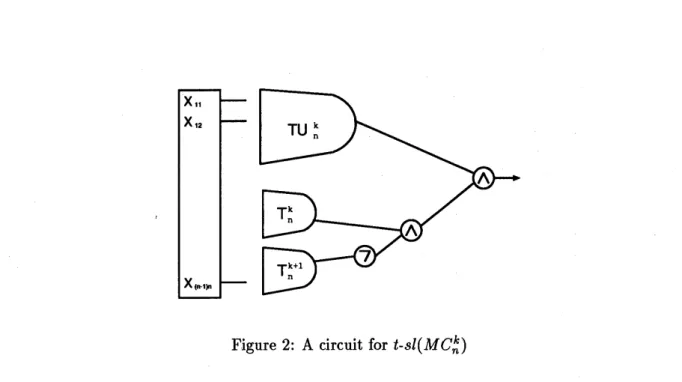
Thus, we can use a circuit $C_{1}$ for $TU_{n}^{k}$ to decide whether the sizeofmaximum clique of $G$ is $k$ by combining the outputs of $C_{1}$ and a circuit $C_{2}$ which checks that the
number of edges in $G$ is exactly $t$ using an AND gate (see Figure 2). Since the function computed by
thecircuit $C_{2}$ is $T_{n}^{k}\wedge\overline{T_{n}^{k+1}}$, we can construct the combinational circuit
$C_{2}$ using $o(n)$ gates and then
thetheorem follows. $\square$
By Proposition 2.1, we obtain the following corollary.
Figure 2: A circuit for t-sl$(Mc_{n}^{k})$
3.3
Tractable Slices
of NP-CompleteFunctions
First,we show a tractable sliceofCHROMA TIC NUMBER. Let $CN_{n}^{k}(X_{n}^{U})$ be the$e(n)$-variable Boolean
function whose value is 1 iff$X_{n}^{U}$ represents a graph whose chromatic number is exactly $k$
.
Theorem 3.8
(i) $C(t- sl(cN^{\lceil}n)n/k\rceil)=C(t- sl(\tau U_{n}t))$
.
(ii) $C^{m}(t- Sl(CN_{n}\lceil n/k\rceil))=C(t- Sl(\tau Ul)n)$
.
Proof.
Let $G$be an arbitrary graph with $n$ vertices and $t$ edges. Then the chromatic number of$G$ is $\lceil n/l\rceil$ iff$G$is isomorphic to $T_{k}(n)$.
$\square$Corollary 3.9
(i) t-sl$(CN^{\lceil n}n)/k1$ has polynomial circuit complexity.
(\"u) t-8l$(CNn)\mathrm{r}n/k1$ has polynomial monotone circuit complexity.
Here we consider a tractable slice of MAXIMUM INDEPENDENT SET. Let $MIS_{n}^{k}(X_{n}^{U})$be the$e(n)-$
variable Boolean function whose value is 1 iff $X_{n}^{U}$ represents a graph such that the size of maximum
independent set of it is exactly $k$
.
Theorem 3.10 Let $k$ be an integer such that $1\leq k\leq n$
.
And let $e=e(n)$ and $t=t_{k}(n)$.
$C((e-$$t)- Sl(MIS_{n}^{\lceil}n/k\rceil))=C(t- Sl(\tau Ul)n)+O(e(n))$
.
Pmof.
Let $G$ be an arbitrary graph with $n$ vertices and $(e-t)$ edges. Then the size of maximumindependent set of$G$ is $\lceil n/k\rceil$ iff$\overline{G}$is isomorphic to
$T_{k}(n)$
.
Thus, we can use the circuit for t-sl$(TU^{k})n_{\square }$
byinverting all the inputs. In order to do this, we need $e(n)$ NOT gates.
Corollary 3.11
(i) $(e-t)- Sl(MIs_{n}^{\mathrm{r}}n/k\rceil)$ has polynomial circuit complexity.
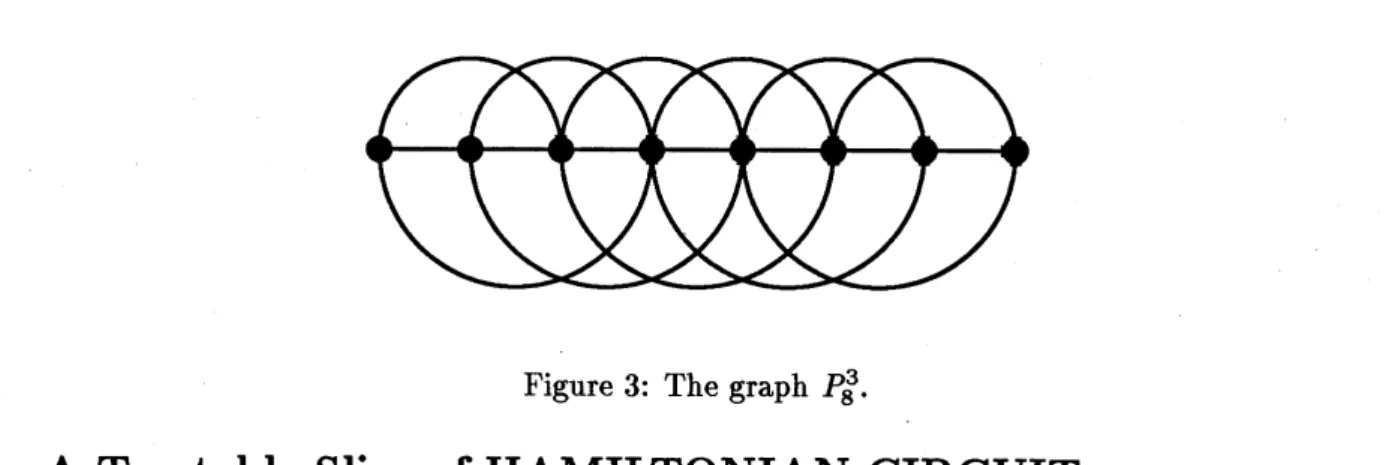
Figure 3: The graph $P_{8}^{3}$
.
4
A
Tractable
Slice
of
HAMILTONIAN
CIRCUIT
In this section, we present tractable slices ofHAMILTONIAN PATH and HAMILTONIAN CIRCUIT
usingtheextremalproblems forHAMILTONIAN PATH and HAMILTONIANCIRCUIT.Let $HP_{n}^{k}(X_{n}^{U})$
($HC_{n}^{k}(x_{n}^{U})$resp.) bethe$e(n)$-variable Boolean function whosevalueis 1 iff$X_{n}^{U}$representsa graph which
hasHamiltoian path (Hamiltonian circuit resp.).
Let $I\mathrm{f}_{n}$ be the complete graph with size $k$ and $E^{1}$ be the empty graph with only one vertex. The
following proposition is known.
Proposition 4.1 ([4]) $(\mathrm{i})LetG$ be a simple graph with $n$ vertices and
$p=e(n)-(n-3)$
.
$G$ has noHamiltonianpath
iff
$G$ is isomorphic to $I\zeta^{n-1}\cup E^{1}$.
$(\mathrm{i}\mathrm{i})LetH$ be a simple graph with $n$ vertices and
$c=e(n)-(n-2)$
.
$H$ has no Hamiltonian cycleiff
$G$isomorphic to a graph which is obtained by adding an edge to $K^{n-1}\cup E^{1}$
.
Theorem 4.2 (i)p-sl$(HP)n$ haspolynomialcircuit complexity, where
$p=e(n)-(n-3)$
.
(ii) c-sl$(HCn)$ has polynomialcircuit complexity, where
$c=e(n)-(n-2)$
.
Proof.
Omitted.5
A
Ractable
Slice of
BANDWIDTH
Thewell known $\mathrm{N}\mathrm{P}$-complete problem BANDWIDTH is as follows [9]:
INSTANCE: A graph $G=(V, E)$ and apositiveinteger $k\leq|V|$
.
QUESTION:Is there a$\mathrm{o}\mathrm{n}\mathrm{e}-\mathrm{t}_{0}$ function $f$ :
$Varrow\{1,2, \ldots, |V|\}$suchthat,for all $\{u, v\}\in$
$E,$ $|f(u)-f(v)|\leq k$ ?
A graph $P_{n}^{k}=(V,E)$ is a one such that $V=\{1,2, \ldots, n\}$ and $E=\{(u, v)|u\in V,$$v\in\{u+1,u+$
$2,\ldots,$$u+k\}\cap V\}$
.
Forexample,the graph $P_{8}^{3}$is shown in Figure3. It is known that an arbitrary graph$G$with $n$ vertices has bandwidth $k$ iff$G$is a subgraph of$P_{n}^{k}[6]$
.
Proposition 5.1 Let $k$ and $n$ be integers such that $1\leq k\leq n$
.
Then, the graph $P_{n}^{k}$ is recognizable in$O(n+e)$ time, where $n$ is the number
of
vertices and $e$ is the numberof
edges.Proof.
It is known that interval graphs can be recognized in $O(n+e)$ time [5] and the isomorphismproblem for interval graphs can be solved in $O(n+e)$ time [12]. Forgiven positiveinteger $n$ and $k$, we
$\mathrm{t}\mathrm{i}\mathrm{m}\mathrm{e}\mathrm{c}\mathrm{a}\mathrm{n}\mathrm{c}.\mathrm{o}\mathrm{n}\mathrm{s}\mathrm{t}\mathrm{r}\mathrm{u}\mathrm{c}\mathrm{t}P_{n}^{k}$in $O(n+e)$ time. Clearly,
$P_{n}^{k}$is $\mathrm{a}$interval graph, thus, $P_{n}^{k}$ is recognizable in
$O(n+e)\square$
Let $PR_{n}^{k}(X^{U})n$ be an $e(n)$-variable Boolean function whose value is 1 iff$X_{n}^{U}$ represents the graph $G$
Proposition 5.2 $C(PR_{n}k)=O((n+e)\log n)$
.
Let
$l=nk-k(k+1)/2$
be the number of edges in $P_{n}^{k}$, and $BW_{n}^{k}(X_{n}^{U})$ be an $e(n)$-variable Booleanfunction whose value is 1 iff$X_{n}^{U}$ represents the graph $G$ has bandwidth $k$
.
We obtain the followingtheorem.
Theorem 5.3
(i) $C(l- \mathit{8}l(BW_{n}k))=C(l- sl(PR_{n}k))$
.
(ii) $C^{m}(l- Sl(BW_{n}k))=C^{m}(l_{-}sl(PR_{n}k))$
.
$Pf\mathfrak{v}of$
.
Let $G$ be an arbitrary graph with $n$ vertices and $l$ edges. Then $G$ has bandwidth $k$ iff $G$ isisomorphic to $P_{n}^{k}$
.
Thus, we can use a circuit for $PR_{n}^{k}$ to decide whether $G$ has bandwidth $k$.
$\square$Corollary 5.4
(i) l-sl$(BW_{n}^{k})$ haspolynomial circuit complexity.
(\"u) l-sl$(BW_{n}k)$ has polynomialmonotone circuit complexity.
References
[1] Aho, A.V., Hopcroft,J.E. and Ullman, J.D., The Design and Analysis
of
Computer Algorithms,Addison-Wesley, 1974.
[2] Alon, N., and Boppana, R. B., “The monotone circuit complexity of Boolean functions”,
Combina-torica, Vol.7, pp.1-22, 1987.
[3] Berkowitz, S., On some relation8hips betweenmonotone andnon-monotone circuit complexity,
Tech-nical Report, Univ. of Toronto (1982).
[4] Bollob\’as, B., Graph Theory, Springer-Verlag, 1979.
[5] Booth, K. S., and Lueker, G. S., “Testing for the Consective Ones Property, Interval Graphs, and
Graph Planarity Using PQ-Tree Algorithms”, JCSS, Vol.13, pp.335-379, 1976.
[6] Chinn,P. Z., Chv\’atalov\’a,J.,Dewdney,A. K., and Gibbs, N. E., “The Bandwidth problem for Graphs
and Matrices-A Survey”, J. Graph Theory, Vol.6 pp.223-254, 1982.
[7] Dunne, P. E., The Complexity
of
Boolean Networks, Academic Press, 1988.[8] Fischer, M., and Pippenger, N. J., “Relations among complexitymeasures”, JACM, Vol.26,
pp.361-381, 1979.
[9] Garey M. R. and Johnson D. S., Computers and Intractability, W. H. Freeman and Company, 1979.
[10] Harary. F., Graph Theory, Addison-Wesley, 1969.
[11] Kloks, T., Treewidth, LNCS, Vol.842, 1994.
[12] G.S. Lueker and K.S. Booth, “A linear time algorithm for deciding interval graph isomorphism”,
JACM,Vol.26 pp.183-195, 1979.
[13] Razborov,A. A., “Lower bounds for the monotone complexity of some Boolean functions”, Soviet
Math. Dokl., Vol.31, pp.354-357, 1985.
[14] Tardos,