
トップページ - 横浜国立大学学術情報リポジトリ
35
0
0
全文
(2) -. Kazutoshi Koshiro. 36-. 2). Michael Maccoby and Neal Q. Herrick, and Yves Delamotte and Kenneth 3). F. Walker. The International Council for the Quality of Working Life confined the concept as the "humaization and democratization of work" rather than including "Security" and "Equity" as Herrick and Maccoby 4). did. Combining these definitions and criteria, we can note three dimensions of the quality of working life: (1) Extension of industrial democracy to the plant and shop floor levels; (2) Measures to deal with increasing worker disstisfaction, ungovernability, and alienation in the work place; and (3) Improvement of wages and other conditions of work. Among these, the first two must be of particular interest. However, the subject of this paper requires. LlS. to cover the third aspect as well.. Therefore, the author will first describe worker satisfaction (or disstisfaction) in ] apanese factories (Section I), then proceed to innovations in work organizations and production techniques (Section II) and the salient features of the whole system of one's work life within the lifetime employment system (Section III). Finally, in conclusion assessments of and the outlook for the quality of working life in Japan will be summarized (Section IV).. I. Indices of Worker Satisfa.ction at the Plant Level Increasing absenteeism and labor turnover, particularlarly an excessive quit rate, can be considered major indices of worker dissatisfaction. Dr. Charles Levinson of ICF, for example, says that a "sickness" rate of 2) Michael Maccoby & Neal Q. Herrick, Humanizing Work: A Priority Goal of the 1970' s, 1972; Quoted in the Japan QWL Committee, oP. cit., pp. 13-15. 3) Yves Delamotte & Kenneth F. Walker, Humanization of Work and the Quality of Working Life-Trends and Issues (Geneva: International Institute for Labour. 4) International Council for the Quality of Working Life, News Tetter, 1973 Quoted in the Japan QWL Committee, op. cit., pp.17-18..
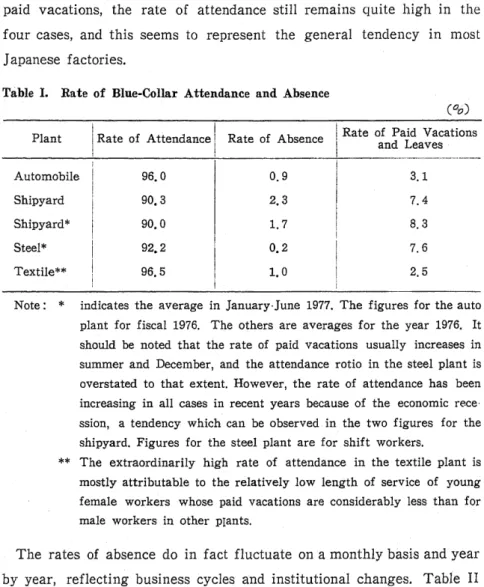
(3) HUMANE ORGANIZATION. WORK IN THE PLANTS. - 37-. workers at Swedish Volvo which reached 10 percent and a worker turnover rate of 25 percent forced the company to maintain a permanent 5). labor surplus and to introduce self-management on assembly lines. Whether similar situations could be found in Japanese factories would be of major interest to German colleagues. The author undertook case studies in four Japanese factories: an automobile (passenger car) assembly plant, a steel plant, a shipbuilding yard, and a textile mill. Figures from these cases will illustrate the situation in Japan better than general statistics. Low Absenteeism. A strikingly low degree of absenteeism is observed in Japan. In the four casee studied, more than 90 percent of the firm's workers attended work in 1976. If we set aside absence because of paid vacations and leaves, the real. rate of absence was only about 1 or 2 percent (Table I). One reason for the low rates of absence lies in traditional Japanese work practices whereby workers tend to take their paid vacations in small segments in connection with sikness or other unexpected events. 6). This does not necessarily mean that workers are not allowed sick leave,. but that they prefer to take fully paid vacations in case of sickness. Otherwise, they have to be satisfied with only sixty percent of "standard 7"\. earnings:" However, even combining the rates of genuine absence and 5) Charles Levinson, Industry's Democratic Revolution (London: George Allen & Unwin, 1974), pA6. Also, the overall absenteeism at a British electric appliances. factory was observed at between 12.6 and 13.6 percent. Ronald Dare, British Factory-Japanese Factory (London: George Allen & Unwin, 1973), p.26. 6) Paid sick leave in addition to paid vacations is not common in Japan, although paid compassionate leaves, paid menstruation leaves for female workers and unpaid maternity leaves are usually granted. Some companies allow special paid sick leave for workers infected in legal epidemics which reguire compalsory quarantine. Income during sickness is guaranteed by the Health Insurance Law of 1922. 7) Article 45 of the Health Insurance Law guarantees 60 percent of the stipulated.
(4) -. Kazutoshi Koshiro. 38-. paid vacations, the rate of attendance still remains quite high in the four cases, and this seems to represent the general tendency in most Japanese factories. Table I.. Rate of Blue-Collar Attendance and Absence. I Rate of Paid Vacations I and Leaves. Plant. IRate of Attendance I. Rate of Absence. Automobile. 96.0. 0.9. 3.1. Shipyard. 90.3. 2.3. 7,4. Shipyard*. 90.0. 1. 7. Steel*. 92.2. 0.2. 7,6. Textile**. 96.5. 1.0. 2.5. Note:. *. I. 8,3. indicates the average in January-June 1977. The figures for the auto plant for fiscal 1976. The others are averages for the year 1976. It should be noted that the rate of paid vacations usually increases in summer and December, and the attendance rotio in the steel plant is overstated to that extent. However, the rate of attendance has been increasing in all cases in recent years because of the economic rece ssion, a tendency which can be observed. in the two figures for the shipyard. Figures for the steel plant are for shift workers.. **. The extraordinarily high rate of attendance in the textile plant is mostly attributable to the relatively low length of service of young female workers whose paid vacations are considerably less than for male workers in other Plants.. The rates of absence do in fact fluctuate on a monthly basis and year by year, reflecting business cycles and institutional changes. Table II illustrates the fluctuations in the shipyard studied. The rates of genuine "standard earnings" to the workers concerned for six months after three days of waiting. In case of serious illness such as TB, designated by the Minister of Health and Welfare, the period shall be extended to one year and six months (Article 47). Most Health Insurance Unions in large companies grant additional benefits. (mostly an. additional 10 percent) and an extended period of security..
(5) HUMANE ORGANIZATION OF WORK IN THE PLANTS. - 39-. absence increased in the early 1970's, but have been decreasing remarkably since the oil crisis of 1973. Introduction of a five-day week every two weeks in this shipyard in January 1972 and of a five-day week every week in April 1973 seem to have also had a considerable effect on reducing absence. Workers who record frequent absence are to be reprimanded or discharged, and it is clear that the realization of the limited number of job opportunities on the part of workers during the recession has noticeably decreased absence in recent years.. Labor Turnover (Quit Rate) Another index of worker satisfaction is the rate of labor turnover or Table II. Monthly Rates of Genuine Absence in the Shipbuilding Yard (%). --.---~~, -'.... ,Y,,ear 1'77. Month. <,. 1'76 1'75. •. 1'74. 1'73. '72 1 '71. 1'70. 1'69. '68. ------=::.:::.-------.-----:---7--.--;-------::+.,---..;.---;----;--Jan. 1.3 1.6 1.7 2.1 2.4 1.8 2.9 2.9 2.2 1,9 Feb.. 1. 4. 1.8. 1. 8. 2.2. 2.6. 2.0. 3.5. 3.3. 2.6. 1.9. Mar.. 1.5. 1.9. 2.1. 2.3. 2.6. 2.4. 3.9. 3,4. 2.8. 2,6. Apr,. 1. 7. 2. 0. 2, 0. 2. 2. 2, g. 2. 7. 3. 5. 3. 3. 2, 8. 2, 8. May.. 1. 9. 1. 8. 2,0. 2.3. 3.2. 3. 1. 3.4. 3, 6. 3, 1. 2.9. June.. 2.1. 2,1. 2.5. 2.5. 3,2. 3.2. 3.9. 4.1. 3.4. 3.0. July,. -. 2,5. 2. 6. 3~. 4.33,9. 4.5. 4. 7. 4.3. 3.7. Aug.. -. 2.9. 2,9. 3.8. 5.3. 4,6. 5.2. 5.2. 4.7. 4.4. Sapt.. -. 2. 7. 2. 8. 3.5. 4. 6. 4. 2. 4. 2. 5. 3. 4. 0. 4.2. Oct.. -. 2, 6. 2. 9. 3.5. 4.4. 4,0. 5.0. 5.2. 4.3. 4.4. Nov.. -. 2.7. 3.3. 3.7. 4,5. 4,1. 4.4. 4.8. 4.5. 4.1. Dec.. -. 2.8. 3.9. 3.9. 5.5. 5,7. 5.5. 5,9. 6.5. 5,0. Average. 2. ~ 2.31 2.51 2.91 3.81 3.sL 4.21 4.31 3.81 3.4. Source: The Personnel Affairs Department of the Shipbuilding Yard surveyed..
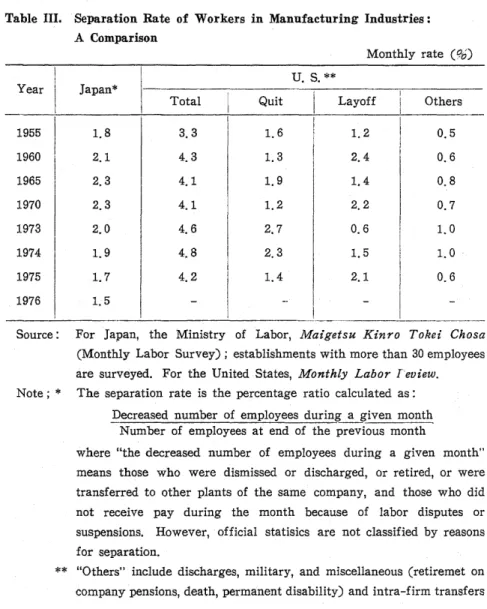
(6) -. Kazutoshi Koshiro. 40-. Separation (especially quit) rate. The average monthly rate of separtion in manufacturing has been about 2 percent in Japan, which is about half the rate in the United States (Table III). This seems to reflect the influence of the "lifetime commitment system" in Japan where workers are believed to have a strong propensity to remain in the Same Table III. Separation Rate of Workers in Manufacturing Industries: A Comparison Monthly rate (96) Year. Japan*. U. S. ** Total. 1. I. Quit. 1955. 1.8. 3,3. 1.6. 1960. 2,1. 4.3. 1965. 2,3. 1970. I I. Layoff. I. I. Others. 1.2. 0.5. 1.3. 2.4. 0.6. 4,1. 1,9. 1.4. 0.8. 2,3. 4.1. 1.2. 2,2. O. 7. 1973. 2.0. 4.6. 2.7. 0,6. 1.0. 1974. 1.9. 4.8. 2.3. 1.5. 1.0. 1975. 1.7. 4,2. 1.4. 2,1. 0.6. 1976. 1.5. -. -. -. -. Source:. Note; *. For Japan, the Ministry of Labor, Maigetsu Kinro T'okei Chosa (Monthly Labor Survey) ; establishments with more than 30 employees are surveyed, For the United States, Monthly Labor review. The separation rate is the percentage ratio calculated as: Decreased number of employees during a given month Number of employees at end of the previous month where "the decreased number of employees during a given month" means those who were dismissed or discharged, or retired, or were transferred to other plants of the same company, and those who did not receive pay during the month because of labor disputes or suspensions. However, official statisics are not classified by reasons for separation.. ** "Others" include discharges, military, and miscellaneous (retiremet on company pensions, death, permanent disability) and intra-firm transfers.
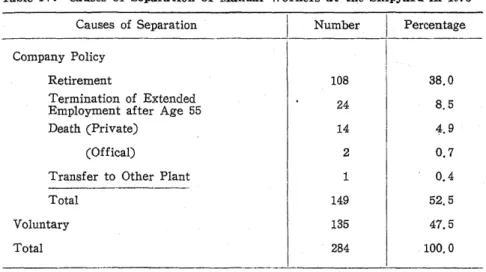
(7) HUMANE ORGANIZATION OF WORK IN THE PLANTS. -. 41-. plant or company until they retire at the age of 55 or 60. The rate of separation in official statistics is not adequate by itself to estimate the state of worker satisfaction or dissatisfaction and the causes of separation. Taking a close look at the shipyard, out of 3,859 blue-collar workers employed in December 1975, 284 or 7.4 percent separated in 1976. This means that the separation rste at this shipyard was less than half the national average (1.5 percent times 12 months gives a national average per year of 18 percent). The larger the firm the lower the separation rate is the general tendency in the Japanese labor market. Table IV shows the 'breakdown for causes of separation. Table IV. Causes of Separation of Manual Workers at the Shipyard in 1976 Causes of Separation. Number. Percentage. Company Policy Retirement Termination of Extended Employment after Age 55 Death (Private). 108. 38.0. 24. 8.5. 14. 4.9. 2. 0.7. 1. 0.4. 149. 52.5. Voluntary. 135. 47.5. Total. 284. 100.0. (Of tical) Transfer to Other Plant Total. We can see here a few salient features of the Japanese employment system: (a) No workers were laid off in this case in spite of increasing redundancy. The shipyard has been reducing the number of employees through attrition and transfer to other plants or related subsidiaries, a portion of which is reflected in this Table; (b) The proportion accounted between plants, (cf. 'Techniques of Preparing Major BLS Statis-. tical Series, New York: Greenwood Pres'), 1954, pp.57-8.).
(8) -. Kazutoshi Koshiro. ·12-. for by retirement and its equivalent (expiration of extended employment after age 55) is significant, although it varies year by year and in different firms or plants; (c) Disciplinary discharges are not explicitly classified because Japanese firms ususally give warning and recornmendations to quit voluntarily to those workers who are absent from work very often or for a long period or who deserve to be discharged for 8). other reasons. In this shipyard, about a third of the voluntary separations can in fact be classifted as "discharges"; and (d ) About a tenth of the voluntary separations may well be classified as quits because of 9). dissatisfaction about payor other conditions of work. Increasing Propensity to Remain in the Same Plant or Company As the relatively low rate of voluntary separation suggests, the propensity to stay in the same plant or company has been strong among Japanese blue- collar workers as well as white-collar workers. This propensity has intensified in the past few years. Table V shows the change in separation rates before and after the 1973 oil crisis in the steel plant surveyed. Table V. Change in Separation Rates in the Steel Plant by Reasons of Separation*** Reason:!SCal Y:r_11970 [1971 [1972. Retirement at the Age 55 Involuntary* Voluntary**. 1.3 0.3 2.4. Total. 4. a. 1,8 0.2 2,0. 1,5 0,3 1. 7. I. 3, 5. I 1973. I. 4,0. [1974 11975. 1.3 0,4 2.0. I. 3. 7. 1.7 0.3 1.1. I. 3, 1. 1.8 0.3 0,8. I. 2, 9. 1. 1976. 1.8 0,3 0.6. l~~. 8) For a discussion of such practices, see Robert E. Cole, Japanese Blue Collar (University of California Press, 1971), p.119. 9) It is very difficult to generalize on this point. In the automobile plant, the ratio of "quits because of dissatisfaction" is estimated as about a fourth of total separations..
(9) HUMANE ORGANIZATION OF WORK IN THE PLANTS. Note:. * ** ***. - 43 -. Expiration of extended sick leave, death, marriage, etc. Quit for various reasons and hidden discharges. The rates are figured as follows: (Number of Separatian in the Fiscal Year) divided by (Number of Blue-Collar Workers at the Beginning of Each Fiscal Year).. The same picture might better be painted in another way.. Despite. the fact that the rate of separation as a whole is currently low, it had tended to increase during the boom period of the late 1960's and the 10). early 1970's. Before the oil crisis, less than 20 percent of textile workers, a little less than 40 percent of automobile workers and a little more than 50 percent of shipbuilding workers remained employed in the same plant after five years of service. Even in the steel plant, whose workers have had the strongest propensity to remain in one location, about a fourth of the blue-collar workers had quit by their fifth year of service. Table VI shows the rising rates of settled employment in the textile, auto and steel plants after one year of employment. Table VI. Percentage of Blue-Collar Workers Remaining in the Same Plant After One Year of Service, 1968·1976. (%). Year. Textile. ,. 81. 2. I. -------:---.,.-----------r---1968 1969 1970 1971 1972 1973 1974 1975 1976. i. 85.9. Auto. ---. 66 68 75 81 90 91 82. 86.9. 81. Steel. 90.4 92.8 98.0 83.8 90.9 91. 9 98.2. -------_--.:.._------'-'-.....:..-'--------,-----'---It would be impossible to eliminate all causes of worker dissatisfac-. tion, part of which is resolved through voluntary separations or labor 10) Robert E. Cole. op.vci t.; pp.122-127..
(10) -. 44-. Kazutoshi Koshlro. disputes, or is temporarily mitigated by absenteeism under a free industrial relations system. However, one ideal of personnel management in a free market economy is to minimize absenteeism, the quit rate and labor disputes through various means involving both labor and management such as joint consultation, worker participation in management at the plant and shopfloor levels, and collective bargaining. The statistics cited above seem to tell that management in these factories have succeeded in achieving these goals to a considerable extent. Whether such achievements have really improved the quality of work life at the plant level will be examined in the following sections.. II. Innovations in Work Organizations and Production Techniques In order to meet the worsening labor shortage in the 1960's and early 1970's mechanization and automation were introduced to replace dirty or hazardous work with machines. Increased criticism against industrial pollution since around 1970 has compelled manufacturing companies to reduce dust, odors, smoke, and noise with a resultant improvement in work environments. Mesures to deal with monotonous work resulting from mechanization, such as quality control CQC), zero defects CZD), and other group activities to enhance worker autonomy and self-deve lopment, have prevailed since around 1965.. Replacement of Hard and Dirty Work by Machinery. Pressures from the labor shortage and from market competition prior to the liberalization of international trade in the late 1960's, and from the need later to cope with increased prices of oil and other resources, caused rationalization and modernization of plants and equipment to proceed rapidly. The general manager of the auto assembly plant told the author that.
(11) HUMANE OF·,_·,,·,'..WORK IN THE .._ .. ORGANIZATION ..__...,_,.. ._._... ..__.,'__,__ '_., .,_PLANTS _,,__..__..._.... _. _______.. ._'_~._.'. ~_~. '_·T~_._~~. ~. .~.. ~. - 45-. the company invested in machines and equipments to avoid being unable to increase output because of the labor shortage. If they can save one man with a machine costing 10 million yen, then they will prefer to invest in machines. The two-shift system makes the breakeven point for capital investment 20 million yen. The same is true in the steel plant where the three-shift system with four crew units increases the breakeven point to 40 million yen. In the auto assembly plant, multi-spot welders, machine bags, and robot welders have been introduced to process automatically 87 to 90 percent of the approximately three thousand welding spots on a passenger car. Tin plating facilities, which are characterized by unpleasant working conditions, have been reduced to a third of the previous number. The only workplaces which still contain physically difficult tasks requiring endurance might be ones performing soldering processes. However, this job is considered essential for workers if, they want to become skilled sheet-metal workers. Soldering workers are rotated every four or five years. On the assembly lines, major production processes are centrally controlled by computers at a rate of one and a half minutes per car. Interesting enough, various models (such as four door sedans, hardtops, station wagons) and colors are mixed in the same line to help relieve worker monotony in repeating the same tasks, although this may tend to require additional attention from workers. In the shipbuilding yard, computers are utilized in all stages, from designing to process controL NC drafting machines make blueprints, which are marked by RPM (electro print marking) systems on steel plates, which in turn are cut by automatic machines and by gas cutters. The pieces are press-fabricated and carried to the assembly shop, where they are assembled into large blocks with the use of automatic welders and two-stage roller conveyors on sliding floors and under sliding roofs..
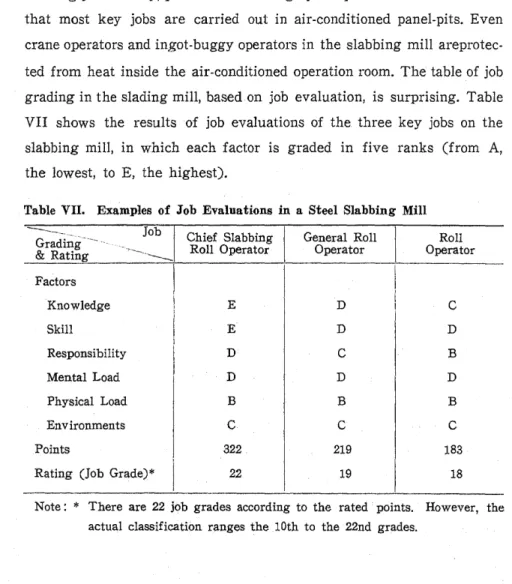
(12) -. Kazutoshi Koshiro. 46-. Hull blocks are fitted with pipes, valves, etc. (early outfitting) and the units are assembled in a large building berth. The block assembly method, early outfitting, and automatic welding techniques helped to build high-quality vessels fast and economically.. At the same time,. these new techniques replaced noisy riveting, and relieved many workers from dangerous tasks in high places. Steel-making used to be one of the hardest, hottest, and physically wearing jobs. Today, processes are so highly computerized and automated that most key jobs are carried out in air-conditioned panel-pits. Even crane operators and ingot-buggy operators in the slabbing mill areprotected from heat inside the air-conditioned operation room. The table of job grading in the sladlng mill, based on job evaluation, is surprising. Table VII shows the results of job evaluations of the three key jobs on the slabbing mill, in which each factor is graded in five ranks (from A, the lowest, to E, the highest). Table VII. Examples of Job Evaluations in a Steel Slabbing Mill ---- -"_ " Grading" "--- & Rating. Job -___. Chief Slabbing Roll Operator. General Roll Operator. Roll Operator. Knowledge. E. D. C. Skill. E. D. D. Responsibility. D. C. B. Mental Load. D. D. D. Physical Load. B. B. B. Environments. C. C. C. 322. 219. 183. 22. 19. 18. _. -e-. _. I. Factors. Points Rating (Job Grade)* Note:. *. There are 22 job grades according to the rated points. However, the actual classification ranges the 10th to the 22nd grades..
(13) HUMANE ORGANIZATION OF WORK IN THE PLANTS. - 47 -. While "knowledge," "skill" and "mental Ioad" are graded highly in these jobs, "physical load" is given a "B" in all three. Considering all the jobs in this plant, a plant personnel officer says that only 10 percent of the total employees are classified in jobs where the gradings for "knowledge" and "skill" are "B and B" or "B and Co" These jobs may well be classified as "monotonous," although they are closely linked with the lines of progression to more highly skilled jobs. In this respect, work in steel mills requires more knowledge and judgment than work on belt-conveyer lines. In the textile plant, the spinning and weaving processes are highly mechanized and standardized. Work at the automatic winders, located at the end .of the spinning process, and at the automatic spoolers at the beginning of the weaving process, are recognized as simple and monotonous, although the work environment has improved significantly so that it is difficult to imagine the conditions before World War II when many young female workers were infected and died from tuberculosis. Work at the spinning frames and automatic looms, however, requires the skill and experience to judge what is wrong with the machine, materials, or operation in order to minimize scratches and defects. The work environment for looming is the most unpleasant in the plant because of the high humidity and ear-splitting noise. Therefore, work at looms tends to be disliked at first glance, but once workers understand the challenging nature of the work, they tend to continue working with greater satisfaction than for other jobs. In short, modern production techniques have reduced hard and dirty work to a considerable extent and created semi-intellectual jobs on the one hand, but increased monotony and potential dangers of accidents in quite a few job:; on the other hand. However, this does not mean that blue-collar work has become enjoyable at any place,nor does it mean.
(14) -. 48-. Kazutoshi Koshiro. that monotony or the threat of accidents will paralyze the system of production. The truth seems to exist in between. Thus, management took the initiative to introduce innovations into the work life of the plant through such means as improvements in working conditions, job enrichment, recurring education, QC (quality control), ZD (zero defects), ZA (zero accidents), VT (vital team) and so forth. Work environments have also improved remarkably with increased investment to prevent and reduce industrial pollution. In the case of the steel plant, it is said that it cost the company more than 10,000 yen per ton of final steel products to combat pollution. Steel plants used to be extremely dusty because of iron ore and coal dust. Odors were terrible because of fumes and smoke laden with NOx, SOx and CO. Nowadays, dust and malodorous fumes are minimal. Water is recycled completely with none discharged into the ocean. Strong public regulations as well as self-regulation against industrial pollution have benefitted workers in many industries. Trade unions have also been urging stricter control of industrial pollution for better sanitation and safety. For example, the union at the steel plant revised its target for reducing dust from 5 mg/rn" to 3 mg /rn'' in 1976. The union also sets several targets in combating occupational diseases including lumbago, hearing difficulties, silicosis, chrome poisoning, and other gas poisoning.. Industrial Safety. The number of industrial accidents has been decreasing in terme of both frequency and severity. The tendency is similar in all industries as well as in manufacturing industries. However, more than four thousand workers still die every year in industrial accidents. Among manufacturing industries, the trend is similar, but the situation.
(15) HUMANE ORGANIZATION OF WORK IN THE PLANTS. -. 49 -. differs. The frequency rate is highest in the lumber industry, followed by furniture, ceramic, stone and clay products, machinesy.viron and steel, and transportation equipment (auto, aircraft. shipbuilding, etc.). This also holds for the severity rate. Among the plants surveyed, the shipbuilding yard had had no recorded Table VIII. Trends in Industrial Injuries ---Indus. '. . t...r_i.e_s__ Fiscal Year .'--. I. .. All Industries. Frequency Rate* 1955 1960 1965 1970 1975. 24.49 17.43 12.38 11. 32 6. 75. Severity Rate** 1955 1960 1965 1970 1975 Number of Death 1955 1960 1965 1970 1975. I Construction*** I Manufacturing 47.28 27.88 16.24 15.44 8.22. 15. 78 9. 70 7.34 8.75 6.21. 2.59 1. 83 1. 30 0.92 0.57. 3.56 1. 80. 1. 18 0.81 0.68 O. 73 0.49. 4495 5058 5880 5647 4550. 1397 1879 2185 2332 2040. 963 1034 1145 1361 1073. ---------------------'---------'--------. Source: The Ministry of Labor, F odo S~igai Doko Chosa (Survey of the Trends of Industrial Injuries) Note: * Frequency rate is (Number of casualties) divided by (All actual hours worked) multiplied by 1,000,000. ** Severity rate is (Working days lost) divided by (All actual hours worked) multiplied by 1,000. *** Large scale only.. fatal accidents since 1968, until one in 1974 and two in both 1975 and 1976. The severity rate has fluctuated each year and once dropped to 0.09 in 1967, but climbed again to 1.21 in 1975 and 1.44 in 1976. The frequency rate, however, has decreased consecutively and remarkably from the high of 76.34 in 1967 down to 14.19 in 1976..
(16) -. Kazutoshi Koshiro. 50-. In the shipbuilding industry as a whole, both frequency and severity rates have been halved in the past decade. It should be mentioned, however, that subcontract workers have suffered a rate of accidents 11). double that of "regular" workers. In the steel plant surveyed, one "regular" worker and three sudcontract workers were killed in 1975. From January to August 1976, only one subcontract worker was killed in an accident. The frequency rate for regular workers was 0.53, whereas for subcontract workers it was 0.69 in 1975. The rates dropped to 0.25 and 0.64 respectively in the first 12). eight months of 1976. In order to reduce industrial accidents, particularly of subcontract workers, a law was enacted in 1964 to require parent companies to take the responsibility for the industrial safety of subcontract workers.. In. 11) Shin'ichi Takazawa & Shigeo Asazawa, ed., "Trends in the Quality of Working Life in the Shipbuilding Industry" (mimeo, the Japan Institute of Labour, June 1977), p.2l. 12) The Proceedigs of the 49th Annual Assembly of the Trade Union at the Steel Plant (October 10, 1976), pp.122-3. The following statistics give a general picture of differentials in accident rates between the two groups of companies in the iron and steel industry.. Fatal Injuries in the Iron and Steel Industry Year 1965 1966 1967 1968 1969 1970. Parent Firms 48 48 65 47 57 68. Subcontracting Firms 88 88 102 178 125 191. Total 136 128 167 225 182 259. Source: The Japan Iron and Steel Federation, Summary of Safety Administration in the Iron and Steel Industry (Quoted from Tsunemi Tanaka, "On the Three Shifts by Four Crews System in the Iron and Steel Industry," the Japan Institute of Labour, Nihon Rodo Kyokai Zasshi No. 150, September 1971, p.47)..
(17) HUMANE ORGANIZATION OF WORK IN THE PLANTS. -. 51-. 1972, a new comprehensive law, the Labor Safety and Hygiene Law was enacted, stipulating the same responsibility for parent companies (Articles 29 to 32). Employers have sought to improve working conditions and to reduce industrial accidents through such means as improved methods of performing work, more safety clothes and shoes, safety organizations among rank and file work groups, intensified safety education, and encouraging voluntary activities to prevent accidents by workers. Trade unions have tackled this problem not only at the national level, but also at the industry and plant levels. Joint consultation conferences between labor and management in shipbuilding, iron and steel, automobile and other major industries have set up expert committee for industrial safety and sanitation. Safety patrol teams have been organized to visit plants periodically. The enterprise union at the steel plant launched a "zero accidents" movement in 1972. It organized .union safety organizations at plant levels (union headquarters and branch levels), and in small groups at the shop floor level.. The ZA patrols visit every facility two or three. times a year to equalize safety standards among the facilities. Setting particular targets for safety improvement in each plant is encouraged by the union.. The tenth of each month is set as "safety day" when. joint union-management meetings are held to examine the results. Similar activities are undertaken in each of the plants surveyed. One of the greatest contributions by the trade unions in the field of industrial safety is supplementary compensation for work accidents over and above the legal requirement. The Workmen's Accident Compensation Insurance Law of 1947, as amended in 1971, stipulates that employers should compensate an injured worker for 60 percent of average normal 13). wages until he recovers with full medical benefits.. If a worker dies. 13) The maximum period for non-duty compensation is three years, after which.
(18) Kazutoshi Koshiro. - 52-. because of an industrial accident, his (her) survivors receive pensions. If a worker suffers a permanent disability, he (her) also receives pen-. sion. The amounts of disability and survivors' pensions are stipulated according to the gravity of the injury (disability), or the number of survivors. Beginning from around 1967, trade unions began to demand supplementary benefits beyond the legal accident compensation. Unions are particularly eager to obtain an additional lump-sum payment for the survivors. According to a survey by Domei (Japan Confederation of Labor) in 1973, 57.4 percent of affiliated enterprise unions had obtained provisions for lump-sum benefits of more than 5 million yen a death, 14). of which 7.4 percent had acquired benefits of more than 10 million yen. Now, the amount exceeds 13 million yen ($ 48,507. ((j) ¥268/dollar). in. 15). most large enterprises.. Job Enrichment Job enlargement or enrichment can be a means to enhance workers' morale, relieving them from the monotony of repeating a simple, stereotyped task. Among the cases studied by the author, the steel plant is far ahead of the others. It has also been reported that in another 16). shipbuilding yard 98 jobs were integrated into 36 enlarged jobs. However, it seems that management in Japan is not necessarily very interestd in job enlargement for several reasons, the most important of which is that the traditional system of progression within job clusters coupled with the lifetime employment system has made it a customary the injured party can receive "a long term injury compensaton benefit." 14) Domei (Japan Confederation of Labor), R6d6J6ken To Chosa H6koku Tokushii (Special Issue on Working Conditions), Domei Sbiry o Series, (No. 22, February 1974), p, 50. 15) Takezawa & Asazawa, op. cit., p.21. 16) Ibid., p. 26..
(19) HUMANE ORGANIZATION OF WORK IN THE PLANTS. -. 53 .:-. practice for workers to be trained on the job. During the OJT process, workers are required to undertake various tasks within a job cluster or shop. In this sense, jobs in Japanese tactories have already been enlarged to a considerable extent, there being no urgent need to implant the western idea of job enlargement, which emerged out of thetraditional craft system coupled with strict job demarcations. Second, worker morale has not yet deteriorated in Japan in terms of the low rate of absence and the once again decreasing quit rate as we have seen.. In fact, ,people from Volvo visited Japan to talk with. management in the Japanese auto industry. Stimulated by the talk, some of one auto manufacturer's subsidiary parts producers experimented with the "island" method, which had a considerable effect.. However,. the parent company is still suspicious about the Volvo system because of its impact upon productivity and increasing initial inventory of 17). parts. Quite a few employers now realize, however, that there are growing reasons to try job enlargement, including: (a) changing demand for products requires the flexibility to rearrange the work force, particularly given the restricted freedom to fire employees, (b) attrition policies to reduce manpower tend to increase the size of the middle-aged work force.. Efforts would be necessary to maintain their morale, and (c). young workers with 12 years' education would be dissatisfied with simple monotonous work. In the steel plant, an experiment to integrate three jobs at blast furnaces into a single job, "blast furnacemen," has been underway since February 1977.. Formerly, "romae-k8" (furnace dischargers), "saro-bo". (furnace operators), and "romae-seibi" (furnace maintenance men) were 17) Interview with the general manager of the auto assembly plant on July 18, 1977..
(20) - 54-. Kazutoshi Koshiro. separate positions. However, in order to improve the quality of furnace operation (such as reducing fuel consumption, stabilizing the quality and quantity of raw materials, increasing heat stability and gas circulation within furnaces, increasing the temperature of the blast, etc.) the reorganization and integration of three jobs were required; manpower savings were also desired. Twenty-six out of 44 "blast furnacemen' did not have any prior experience in operationg blast furnaces, which requires understanding the operation of a computerized panel. Learning FORTRAN as well as deciphering figures and pictures on the T"; screen showing conditions regarding heat. gas circulation, and melted materials inside the furnace through operation of keys on the panel board, and giving appropriate instructions from time to time are required of "blast furnacemen," and therefore, intensive off-the-job-training was undertaken. About a third of tha candidates did not finish the retraining. Prior to implementing the reorganization, the plan was proposed to the union, the details were negotiated. The superintendent of the blast furnaces stressed the need to motivate educated young workers. It was considered unfair that some workers who happened to be assigned as furnace dischargers or furnace maintenance men at the time of hiring had to remain in the same job without being given any opportunity to learn operation. Working conditions for those jobs are worse than for operators who are protected in the air-conditioned panel room, while the former have to work in front of heat. However, the mental tensions involved in dealing with furnaces by remote control may be greater for the operators.. Recurring Education and Training Recurring education is an integral part of the' Japanese employment 18). system. Workers employed in large firms are expected to work in the 18) Since the lifetime employment system does not allow the benefits of "cross-.
(21) HUMANE ORGANIZATION OF WORK IN THE PLANTS. -. 55 -. same company until they retire, and employers expect to receive a return on their investment in human capital. They seldom dare to layoff "regular workers" in whom they have invested a great amount for 19). training. In the steel plant, 574 courses for worker development are listed in 1977, compared to 478 last year. Table IX and X show the content of the courses. Table IX. Worker Development Training Courses at a Steel Plant in 1977. ~traineesll Middle . Foremen & . Blue-Collar Ordinary Sho ' ", . p as a 'I Total Whole I Content' ""'''--. Management Sub-foremen. Workers ". _Gen~~~I I' .., 61 ' . 59 -~-. 207 Training I (l0.6) (10. 3) (12.2) ( 3.0) ( 36.1) Technical i 115 38 136 78 367. I. I. I. '----70'- ---. _~,~~ng,L_~20. ~.~ Total. I (3~7~). ~~:_~. I. ~16~~) I. ?). (23 ... (3;?g). _(_13_._6)_-+-'- ( 63.9) _. I (l6~~). 574 (100.0). Table X.. Subjects Engineering and Technical Subjects IE, QC Techniques Computers and Related. Subjects Rationalization of Tasks Shop Management Problem Resolution Safety Work Environment Other. Ratio (percent) of the Sections (Mills) Which Selected the Subject to the Total Nu~ber of Sections (Mills) 82.5 49.2 12.7 20.6. 25.4 14.3 12.7 31. 8 20.6. fertilization" through hiring skilled workforce from outside, it becomes. essential for Japanese firms to continually retain their workers, and "using slack time to carry out training" is a common practice. See., OECD, The Deuelopment of. Industrial Felations Systems-Some Implications of Japanese Experience (Paris: GECD, 1977), pp. 16-7. 19) Walter Oi, "Labor as a Quasi-,Fixed Factor," Journal of Political Economy, Vol. LXX, No.6, December 1962; Gary S. 'Becker, Human CapUal (New York: Columbia University Press, 1975)..
(22) -. 56-. Kazutoshi Koshiro. About a fifth of the courses are conducted during working hours, while 40 percent of them are taken as overtime work. Sometimes workers reside together for training. Most striking are the courses for candidates for foremen.. The courses are divided into several specific subjects. (such as blast furnaces, steel making, slabbing, sheet rolling, cold strip) and candidates from all of the company's plants reside together in a particular training institute for four months. During this period, schooling on basic metallurgy, chemistry, and other subjects continues from 8:00 AM to 4:30 PM. At least once a week, exams are given. The candidates are mostly in their thirties or forties.. The high quality of the text. books, which amount to a stack more than a feet high,is surprising. Education during work life is not limited to skilled male workers. In the textile plant, girls with the nine years of compulsory education have access to study in the evening senior high school for four years if they so choose; most prefer to quit the job at the completion of four years' schooling to get married or to go to other jobs. One of the most notable develpments in the past decade in worker education involves voluntary activities on the part of workers to participate in quality control classes. The classrooms of the steel plant's training institute were fully occupied by participants who were studying in their off-time, between shifts. Qz,eality Control, Zero Defects, and Other Small Group Activities. Quality control (QC) groups were introduced in Japan around 1960 and zero defects (ZD) movements in 1965, modeled after American ideas. The recession in 1965 and the impact of liberalization of international trade and direct foreign investment in Japan in the late 1960's to early 1970's generated a "crisis consciousness" among employers and workers. Among the cases studied, for example, the shipbuilding yard introduced QC groups in 1966, the same year the steel plant began a ZD movement..
(23) HUMANE ORGANIZATION OF WORK IN THE PLANTS. -. 57-. The basic idea behind "QC movements" is explained by the company as "activities to improve managerial efficiency, the quality of products, and working conditions as well as methods of performing work, with 20). the participation of all employees of the shipyard." In promoting the activities, the participants were encouraged to have clear-cut objectives, to improve communication and cooperation among employees, and to utilize the techniques of scientific management. Through such activities, it is expected that the quality of products will be improved, that a more. human and interesting atmosphere in each workshop will be created, and that self-development and mutual education among workers will be enhanced. At first, more than 1,400 groups were organized in the shipyard; these were integrated into 994 groups by 1977. A great many proposals for improvemnt were made, amounting in the second half of fiscal 1967 to 37,040 proposals, or 6.4 proposals per employee; these figures decreased to 8,092 or 1.4 proposals per employee, by the first half of fiscal 1976. For example, the production norms for plate cutting by gas cutters have been raised from 16 m/h to 19.5 m/h, and the target is now set as 20 m/h. In setting such norms, foremen take a leading role. Foremen have dual status; they head the blue-collar workers in each workshop and supervise workers; at the same time they belong to the same union as their subordinates. Therefore, they in fact act as chief negotiators for the work groups under their supervision when new work norms are set by the superintendent of the workshop. They can judge from their experience whether the required norms will be accepted by their subordinates.. Before making any substantial changes in the norms or. methods of work, they undertake to sound out the opinions and feelings of workers. Communication and understanding among the people involved 20) Document No. 16 of the Shipbuilding Yard..
(24) -. 58-. KazutoshiKoshiro. have become all the more important because of the QC groups. At the steel plant, 2D movements were inaugurated first as a device to improve the product yield rate and to reduce industrial accidents. Meanwhile, there were also significant effects in terms of worker spontaneity and group cohesiveness. For example, in the slabbing mill, there are 28 groups among the regular workers. Each sets its goals for aspeific period (mostly three months, and sometimes one year). Subcontract workers are sometimes involved in groups. The results of achievements are reported to the foreman, the superintendent of each workshop, and finally to the chairman of the ZD headquarters (Deputy General Manager of the plant, in charge of technology). The reports are screened by a committee on the basis of scheduled point ratings, and graded into three classes; a special award (1,200 yen per person involved), an excellent award (800 yen per person), and a good award (500 yen per person). During the most recent quarter, the slabbing mill had 28 awards (one special, 12 excellent, and 15 good) with a total prize of 871,000 yen. The money is spent for recreational activities twice a year for all employees in the mill. Recently, a group of 20 roll hands in the slabbing mill contrived an instrument to prevent water for roll-cooling form falling on the slabs while they were rolled. The device contributed to improving the yield rate of rolled products. A young worker was elected as the leader of the team receiving the honor of reporting the achievement to the general manager and other top executives of the plant. The process leading to their achievement was recorded in slides for demonstration before the public. Similar small group activitiesrare promoted under various names in various factories. Such groupism might bean indigenous component.
(25) HUMANE ORGANIZATION OF WORK IN THE PLANTS. -. 59-. 20. of "Welfare Corporatism" which flourishes in the lifetime commitment system.. III.. Work Life in the Factory. In discussing "Humane Organization of Work in the Plants," it would certainly be inappropriate not to make mention of the total structure 22). of work life in a Japanese factory based on the "lifetime commitment" 23). or "career employment" system. The whole system of employment in large enterprises might well be characterized as "humane organization," although it cannot benefit those outside the system. Several books written in English on Japanese industrial relations have described this system. Furthermore, space limitation does not allow the author to describe the system in details. However, it. seems desirable to mention the topic briefly to the extent it is closely connected with the theme of this paper. The Structure of Job Clusters. The smallest formal work group on the shopfloor is called a kumi or han and is headed by a sub-foreman (kumz"cho, gocho, h anchii, or kocho).. The group usually consists of ten to twenty workers, and. coinsides with a job cluster in which workers are expected to rise from the bottom (unskilled) to supervisory positions. In that sense, this is a 21) Ronald Dore, Britith Factory-Tapanese Factory (London: George Allen & Unwin Ltd., 1973) defines the idea as follows: "factory and company based trade union and bargaining structure, enterprise welfare and security, greater stability of employment and integration of manual workers as 'full members' of the enterprise, greater bureaucratization and a cooperative or corporate ideology" (p. 370); The DECD Study Group also paid a serious attention to the strong group orientation of the Japanese workers and "social norms within the enterprise." OECD, OPt cit., pp.27-30. 22) James C. Abegglen, The Iapanese Factory (New York: Free Press, 1958). 23) DECD, op. cit., p, 15..
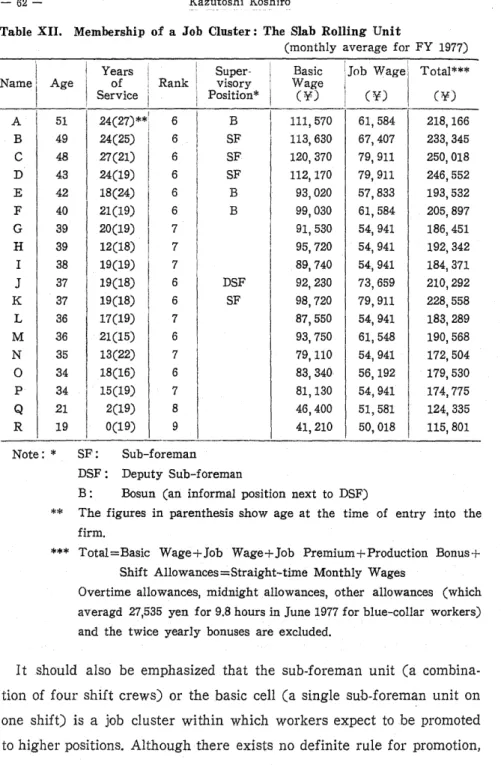
(26) -. Kazutoshi Koshiro. 60-. micro-cosmos in which workers have to spend their day-to-day work lives, one which is cohesive and which has the power to decide a worker's future. For example, in the steel slabbing mill there are three sections, the head of which is called a kakarich8 and who is usually a university graduate engineer. Within each section, there are foremen who are normally at the upper ranks available to manual workers. In this plant, they are not eligible for union membership. In the Second Slabbing Section, there are foremen, one for each shift crew (three shifts by four crews) and one for the day-only shift. There are six k8ch8-tan'i (subFigure I. Organization of the Slabbing Mill Superintendent. I. II. First Slabbing Section (Mill) Chief. Second Slabbing Section (Mill) Chief. 87 emr~~. rO;;;~~;~~;5Y). ··-·.··---.·--------------.-·--··----···-------.r.·.-·-.--.-. 702 employees. I. Slab Finishing Section (Mill) Chief. ~:~r~:;~~;~~l:~~r -..-. Sub-foreman (SISCO** center) (Day-only) x 1 (SISCO** center) (Shift) x4 (Heating kiln) X 4 (Charging Machine) x 4 (Roll) x4 (Cutting) x 4. . Union Members below this Line. I. Workers (including sub-foremen) 104 (SISCO** center) 1 +5 x 4 (Heating) 5 x4 (Charging Machine) 6 x 4 (Roll) 4x4 1+1x2 (Cutting) 5 X 4 Total regular employees 286 Subcontract workers (6 companies) 416 702.
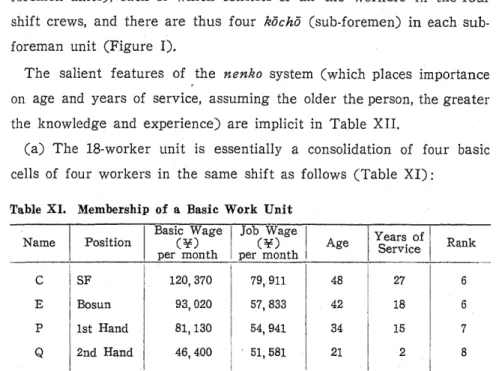
(27) HUMANE ORGANIZATION OF WORK IN THE PLANTS .... -----~~.~.~----_._------------~-~-~---~,.,'---,----,~ ~ -'"-'-'-~""-' ,. Note:. *. **. ....;.. 61 ---. Includes the superintendent and three workers on the safety staff. These figures represent the negotiated manning in the mill and differ from the actual working members at a particular date which are listed in Table XII below. Steel Ingot and Slab Control Center.. foremen units), each of which consists of all the workers in the four shift crews, and there are thus four kOcho (sub-foremen) in each subforeman unit (Figure I), The salient features of the nenko system (which places importance on age and years of service, assuming the older the person, the greater the knowledge and experience) are implicit in Table XII. (a) The 18-worker unit is essentially a consolidation of four basic cells of four workers in the same shift as follows (Table XI): Table XI. Membership of a Basic Work Unit Basic Wage Name. I. Position I. C. SF. E. Bosun. P Q. (¥). I Job(¥) Wage I. per month. per month.. Age. Years of I Service 27. 6. 18. 6. Rank. -. 120,370. 79,911. 48. 93,020. 57,833. 42. 1st Hand. 81,130. 54,941. 34. 15. 7. 2nd Hand. 46,400. 51,581. 21. 2. 8. I. I. Here, the basic wages are determined by (1) the hiring wage rate set by education level and age at time of entry, are specified by the collective bargaining agreement with the enterprise union, (2) the annual increment by merit rating, the range of which is determined by the collective bargining agreement, and (3) the negotiated wage increase every April. Thus, the order of basic wages generally reflects the order of age and years of service. As the years pass, however, an able and industrious person can be promoted faster than older fellow workers: for example, compare K with G and H in Table XII..
(28) -. Kazutoshi Koshiro. 62-. Table XII. Membership of a Job Cluster: The Slab Rolling Unit (monthly average for FY 1977) Name A B. II. \. Age. 51 49. C. 48. D. 43 42 40 39 39 38 37 37 36 36 35 34 34 21 19. E F. G H I. J K L M. N 0 P Q R Note:. *. **. ***. III,. ~~rs. I I. Y Service. Rank I. 24(27)**1 24(25) 27(21) 24(19) 18(24) 21(19) 20(19) 12(18) 19(19) 19(18) 19(18) 17(19) 21(15) 13(22) 18(16) 15(19) 2(19) 0(19). i. 6 6. 6 6 6 6 7 7 7 6 6 7 6 7 6. 7 8 9. Ii. I I. I I. ,. Supervisory Position* B SF SF SF B B. DSF SF. Basic Wage. Job Wage. (¥). (¥). C¥). 61,584 67,407 79,911 79,911 57,833 61,584 54,941 54,941 54,941 73,659 79,911 54,941 61,548 54,941 56, 192 54,941 51,581 50,018. 218,166 233,345 250,018 246,552 193,532 205,897 186,451 192,342 184,371 210,292 228,558 183,289 190,568 172,504 179,530 174,775 124,335 115,801. 111,570 113,630 120,370 112,170 93,020 99,030 91,530 95,720 89, 740 92,230 98,720 87,550 93,750 79,110 83,340 81,130 46,400 41,210. 'I'. Total***. SF: DSF:. Sub-foreman Deputy Sub-foreman B: Bosun (an informal position next to DSF) The figures in parenthesis show age at the time of entry into the firm. Tctal e Baslc Wage+Job Wage+Job Premium-t-Productlon Bonus-jShift Allowanceseextraight-tlme Monthly Wages Overtime allowances, midnight allowances, other allowances (which averagd 27,535 yen for 9.8 hours in June 1977 for blue-collar workers) and the twice yearly bonuses are excluded.. It should also be emphasized that the sub-foreman unit (a combina-. tion of four shift crews) or the basic cell (a single sub-foreman unit on one shift) is a job cluster within which workers expect to be promoted to higher positions. Although there exists no definite rule for promotion,.
(29) - 63-. the superintendent of the slabbing mi1l noted that only 15 percent of the workers had been promoted to higher positions outside of the sub-foreman unit in the past seven years. All other promotions had taken place within the sub-foreman unit. (b) From the figures in the parentheses in Table XII, it is obvious that most of the workers, except for five (A, B, C, E, and N),entered the firm right after leaving high school (M and 0 entered after leaving junior high school, ancI the others after senior high school), Generally, "halfway" workers, that is, workers recruited in mid-career, are at a disadvantage in terms of the besic wage rate: e.g., E (halfway) vs. F, or N (halfway) vs. O. However, it was not necessarily unusual before and during the War for workers to be hired as regular employees after finishing military service. Moreover, as the years pass, the pay diff'erentials at time of hiring tend to diminish, reflecting merit and induriousness. (c) Despite the principle of placing importanc on age and years of service, the principle of merit also receives importance. The art of adjusting the two principles is essential in maintaining the nenko system. (d) Egalitarianism is also an important element in dealing with workers. The job wage rate is determined strictly by job evaluation. Thus, six workers (G, H, I, L, N, and P) have job wage ratings of 54,941 yen although theirbasic wages differ. Furthermore, among the older workers, three of four sub-foremen receive a job wage rate of 79,911 yen and are in the 6th rank (the 1st rank is for department managers, the 2nd for deputy managers, the3rd for senior section chiefs or workshop superintendents, the fourth for section chiefs, the 5th for foremen, and down to the 9th for new entrants). At the same time, a deputy subforeman and three bosun are also in the 6th rank which means that although they are still bosun, an unofficial title, they are qualified in.
(30) -. 64-. Kazutoshi Koshiro. terms ofability and potential to be promoted to sub-foreman when there is a vacancy. To be promoted from the 7th rank to the 6th, a written test as well as a merit rating and interviews are required. To advance to the 5th rank, candidates are required to present a paper. As Fred Emery and Einar Thorsrud suggest, one measure to enhance the quality of working life is modifying strict job wages or payment by results to "qualification wages" which provide pay not for the. ~obs. per-. formed by workers but to the potential abilities that they possess. Periodic increments of wage rates by years of service are also recom24). mended by Emery and Thorsrud. These reforms have long been practicedby Japanese firms, as illustrated above. However, one defect in the nenko system is the dual structure of employment. In the slabbing mill, there are 416 subcontract workers, aparf from the regular workers, who work at supplementary positions in the mill, such as scraping cracks on the surface of rolled slabs. Generally speaking, the proportion of subcontract workers to the total number of employees in the iron and steel industry is about 45 percent, 25). and sometimes in. modern plants, this figure exceeds 60 percent. These workers are employed by subcontractors, and are usually organized into different enterprise unions of their own although sometimes they are not organized. The cleavage between regular workers and subcontract workers seems unfair, but nevertheless, it should not be ignored. that quite a few workers who retired from parent companies at age 55 are 24) Fred Emery & Einar Thorsrud ; Quoted in the Japan QWL Committee, QWL Problems in the United States and European Countries (Tokyo: The Japan QWL Committee, 1974, a pamphlet), p.26. 25) Takashi Niinuma, "Employment Policies of Trade Unions" in the Study Committee on Employment,. Tei-Seicho-ka. no Koy o Mandai. (Employment. Problems under Low Economic Growth), (Tokyo: The Employment Study Committee, March 1977), p. 5..
(31) HUMANE ORGANIZATION OF WORK IN THE PLANTS. -. 65 -. 26). employed in .these "related" or "cooperating" companies. In this sense, the dual structure is an indispensable supplement to the "lifetime commitment" system. Subcontract workers are also employed extensively in the shipbuilding industry. In 1970, there were 76,348 subcontract workers, accounting for 32.6 percent of total employees. In 1975, there were 73,508 subcontract 27). workers, or 28.7 percent of the total. Construction and chemical industries are others which employ many subcontract workers. In other industries, the system of subcontract workers does not prevail, although there are many subsidiary parts suppliers. Instead, seasonal temporary workers in the automobile industry or female part-time workers in the electric appliances industry are employed mainly as a buffer against business fluctuations.. Frz"nge Benef'it s Last but not least, fringe benefits are contributing a great deal to the quality of working life in Japan. Monthly wages and salaries constitute only about 60 percent of total labor costs in the surveyed shipyard (Table XIII). Similar situations could likely be found in other plants. Among the legally required fringe benefits, the employer's contribution to the Health Insurance accounts for the greatest part. The premium is 80 per mill of the monthly standard earnings in this firm, of which employers uaually pay 60 percent in large enterprises. Increasing contributions to the Welfare (old age) Pension Fund are required, constituting about a third of legal fringe benefits. The premium has now been raised 26) These are standard euphemisms for subcontractors. See Niinuma, op. cit.; p. 29. For a case of an eiectric appliance company (Hitachi), see Dare, op. cit., p.202. 27) The Ministry of International Trade and Industry (Quoted from the Nihon Keizai Shinbun November 2, 1976, "Shinkoku na ]ukyu Gap ni Nay amu Zosen Gy okai' (The shipbuilding industry worrying about a serious demand-supply gap)..
(32) -. Kazutoshi Koshiro. 66.-. to 91 per mill of standard monthly earnings. In some large companies, the employer assumes the burden for seventy percent of the premium. The Employment (Unemployment) Insurance premium is 13 per mill of the total payroll, including bonuses and allowances, of which employers contribute 8 per mill. The costs for Workmen's Accident Compensation are also considerable, particularly in hazardous industries, because the merit rates are applied Teble XIII.. Total Labor Costs, Wages and Salaries, and Fringe Benefits at a Shipyard (Monthly average per employee) Items. October 1, 1975 to March 31, 1976. I September April 1, 1976 to 31, 1976. -Monthly Wa~~ & S~~~ie;------------- ¥18~~104----~8-.5~6i----¥212, 727 Bonus Compassionate Payments Commuter Fees Lump-sum Retirement Payments Non-legal Fringe Benefits Legal Fringe Benefits ___. i. I. 73,606 969 4, 125 20,335 11,917 20,351. 77,861 708 4,879 23,990 16,346 23,307. I. I. 21. 6 0.2 1.4 6.7 4.5 6.5. ~__ Total __~~=_-~~=~_···I~~~~~l~,!~7.~~:::~~~~~:~[:~ :~~i, ~~~_:-100. 0. Table XIV.. Legal Fringe Benefits at the Steel Plant and Shipyard (Monthly average per employee) Items. Steel Plant FY 1976 ___ __ ~. Health Insurance Welfare Pension Employment Insurance Workmen's Accident Compensation Children's Allowance* Others**. * **. ~. I.. ShiPy.ard .-First Half of FY 1976 _ _"__·_. r_·~~_·,··,·~_···,··. (43.096) i ¥9,872 (38.2) 7, 462 (10.3) 2,352 3, 321 ( 7.5) 222 ( 1. 0 ) 1 ( ) 78. ¥9,201 8, 172 2,199 1,609 229. 21,411 Note:. 23.3 0.3 1.3 6.4 3.8 6.4. 59.1C!6. (l00.0). 23,307. ~.. •.. ,.~. --......._. (42.4%) (32. 0 ) (10.1 ) (14. 2 ) ( 1.0 ) ( 0.3 ) (100.0. ). For fiscal 1976, the premium set by Order of the Minister of Health and Welfare wa$1.2 per mill of the standard earnings stipulated by the Health Insurance Law. Off-duty compensation stipulated by the Labor Standards Law..
(33) HUMANE ORGANIZATION OF WORK IN THE PLANTS. - 67-. on the basis of the standard premium. In the steel plant, the premium was 5.9 per mill of the total payroll. This item accounted for 14.2 percent of the legal fringe benefits at the shipyard, and 7.5 percent at the steel plant (Table XIV). Among the non-legal fringe benefits, which are mostly negotiated with each enterprise union, major costs are for dormitories and company houses, housing loans, meals and cafeterias, hospitals and clinics, sports and recreation facilities.. At the same time, the cost of the lump-sum. retirement payment has been increasing, Workers with 35 years of service at the steel plant were entitled to receive 10,308,000 yen ($ 38,463. @. ¥. 28). 268/dollar) by the 1976 agreement.. IV.. Conclusion. Japanese manual workers are still well disciplined. There has been little sign of their becoming unmanageable both in terms of the rate of absence and the quit rate.. None the less, Japanese employers have. been eager to forestall problems related to the quality of working life 29). since around 1965. A strong consciousness of the scarcity of wall-paying 28) The Enterprise Union of the Steel Plant, Kikan Y'akuin Handbook (Hadbook for Union Officials), (September 1976), p.123. 29) A Series of epoch-making experiments to humanize work organizations was first inaugurated at Sony's Atsugi Plant in the early 1960's. It stat-ted from making lunchrooms free from checking by cashers in the belief that workers would pay honestly the prices for foods without casher counters. Bellevlng workers' honesty and enthusiasm for self-development was the starting point for the continuing innovations in work organizations at the plant. Checking of attending and leaving work was also made voluntarily, abolishing time recorders and substituting by self-control by each work group which was called a "cell." The general manager of the plant, Mr. Shigeru Kobayashi, hashacl a unique philosophy by which he highly respects worker initiative to work with satisfaction. He is strongly critical to Taylorism and Fordism, but highly appraises the personnel policies of Texas Instruments. For more derails, see Shigeru Kobayashi,Sony wa Hit o wo Ikasu (Sony.
(34) -. 68-. Kazutoshi Koshiro. jobs under the dualistic system of employment has been reinforced among workers since the industrial reorganization in the late 1960's and the continuing depression after the 1973 oil crisis. Most measures proposed to deal with QWL have been practiced or have been experimented with by many major firms. It seems that the traditional system of "lifetime commitment" per se has an inclination to respect human relations among employees, to enhance the cohesiveness of work groups, and thus to integrate workers into the value system of a particular enterprise.. On the other side of the coin are the voluntary. elimination of highly individualistic personalities from the communal 30). society, and the segregation of "strangers" or the unqualified. The mechanization of production processes and the modernization of work organizations under the continued pressure of a labor shortage over the past two decades, and the increased pressure regarding industrial pollution, have improved work environments tremendously. At the same time, intensified capital investments require increasing efficiency through various measures such as QC and ZD movements. Vitalizes Its Employees), (Tokyo: Nipoon Keiei Shuppan Kai, 1966). The success of Sony's Atsugi experiments received a wide publicity and similar innovations were introduced by many companies in the latter half of 1960·s. 30) Someacademics and journalists who have sympathy with the new left ideology are strongly critical to the personnel and labor policies of gigantic firms such as Toyota and Shin Nittetsu (Japan Steel Corp.), They even criticize the new approach by Sony mentioned above as sophisticated alternatives to exploit workers. See Tetsuro Nakaoka, Kojo no Tetsgaku (A Philosophy of Factories), (Tokyo: Heibonsha, 1971), pp. 210-212, 228-234, & 259; T. Nakaoka, Gijutsu no Lonr i-Ningen no T'achlba (The Logic of Technology-A Standpoint of Human Beings), (Tokyo: Chikuma Shobe, 1971), pp. 213-4; Satoshi Kamata, [idosha Zetsudo Kojo (A Desperairing Auto Works), (Tokyo: Gendaishi Shuppan Kai, 1973) which is a diary of a seasonal worker at a Toyota Plant; Shunsuke Fukada, Shiu Nittetsu. no Teihen Kara (From the Bottom of Japan Steel Corp.), (Tokyo: San'ichi Shob I, 1971), which criticizes the company policies :and the attitudes of the enterprise. union from the standpoint of a subcontract worker..
(35) HUMANE ORGANIZATION OF WORK IN THE PLANTS. -. 69-. Trade unions have played an indispensable role, participating in increasing economic growth. Unions do not demand strict control over job demarcation, but rather, have concentrated their activities in improving safety, wages and other conditions of work, and fringe benefits. The influence of intensive communication, negotiation, and joint consultation at the shopfloor level cannot be overlooked. One of the most desirable reforms affecting the quality of working life in Japan would be the extension of "welfare corporatism" to those workers who have been denied the privileges en.oyed by the "elitist half." Several unions have tried reforms in this respect through extending membership in the Health Insurance unions to retired employees, or extending trade union membership to those who are transferred to subsidiary or "related" companies. Hasty criticism against the dualistic employment system would not serve to stimulate positive reforms. There can be no free enterprise that has no buffer against business fluctuations.. At the same time,. the system of dual employment itself, supported by "related" subsidiaries, is an integral part of the "lifetime employment" system. Further innovations in this respect would be most welcome in the future development of the quality of working life in Japan. It would be impossible, however, to resolve this problem for individual enterprises without more positive financial, monetary, and other public policies at the macroeconomic level..
(36)
図

+7



関連したドキュメント
[7] , On initial boundary value problem with Dirichlet integral conditions for a hyperbolic equation with the Bessel operator, J.. Bouziani
The newly developed phase-fitted and amplification-fitted Runge-Kutta methods FRK adopt functions of the product ν ωh of the fitting frequency ω and the step size h as
Wro ´nski’s construction replaced by phase semantic completion. ASubL3, Crakow 06/11/06
Here we shall supply proofs for the estimates of some relevant arithmetic functions that are well-known in the number field case but not necessarily so in our function field case..
小林 英恒 (Hidetsune Kobayashi) 計算論理研究所 (Inst. Computational Logic) 小野 陽子 (Yoko Ono) 横浜市立大学 (Yokohama City.. Structures and Their
Touchdown Total may be applied as a spot spray in peppermint and spearmint. Apply spray-to-wet with hand-held equipment, such as backpack and knapsack sprayers, pump-up
Apply in water as necessary for insect control using a minimum of 15 gallons of finished spray per acre with ground equipment and 5 gallons per acre by air.. Use lower
静岡大学 静岡キャンパス 静岡大学 浜松キャンパス 静岡県立大学 静岡県立大学短期大学部 東海大学 清水キャンパス
