Review Rapid publication
The Neuroscientific Basis of Stress-related Psychiatric Diseases
Fumihiko KoyamaJapan Labour Health and Welfare Organization, Clinical Research Center for Worker s Mental Health, Tokyo Rosai Hospital (Received: December 9, 2015)
Abstract
This article summarizes brain symptoms, related diseases, social adjustment, and features of behavior that are associated with chronic fatigue and insomnia and may be important for disease prevention, based on recent findings on stress and brain function and morphology. These results, modulation of mental function oc-curs, it is known that to develop mood disorders or schizophrenia, stress and anxiety disorders. Our research results presented here, it is part of the dissemination projects related to 13 the field of disease research and de-velopment and work-related accidents and Japan Labor Health and Welfare Organization.
(JJOMT, 64: 138―143, 2016)
―Key words―
hypothalamic-pituitary-adrenal axis (HPA axis), hypofrontality, neuroethics
1.Introduction
Endocrine function of the hypothalamic-pituitary-adrenal axis (HPA axis) plays a pivotal role as the mechanism against stress in the brain. With prolonged stress, excess corticotropin releasing factor (CRF) is re-leased in the HPA axis and cortisol increases in the body. This may affect cerebral neural plasticity, weaken the mechanism against stress, and lower the threshold for onset of psychiatric disorders such as depression. Continuous elevation of serum cortisol inhibits neurogenesis in CA1, CA3 and the granule cell layer of the hip-pocampus. This affects the HPA axis, and persistent hyperactivity of the HPA axis may affect the emotional state.
Morphological analyses have shown a significant decrease in hippocampal volume in patients with depres-sion or posttraumatic stress disorder (PTSD), and have indicated that stress strongly affects brain-derived neu-rotrophic factor (BDNF), which plays a significant role in neurogenesis and neurodevelopment. BDNF in blood decreases in patients with depression and there is a significant negative correlation between the levels in blood and the severity of depression1)
. BDNF in blood is also lower in healthy individuals with greater stress2) . Excessive release of CRF also influencesγ-aminobutyric acid (GABA), a monoamine inhibitory neurotrans-mitter in the brain, and inhibits the serotonin nervous system extending from the dorsal raphe nucleus to the prefrontal cortex (PFC), which is associated with hypofrontality in patients with depression. CRF itself also has an arousal effect, and thus HPA axis hyperactivity may be induced by sleep deficit and may be associated with depression3)
.
These biological findings in psychological and social studies of stress reinforce the theory concerning the mechanism relating chronic insomnia and stress to fatigue and onset of depression. We have shown negative correlations between severe overwork and cortisol levels and the cortisol/DHEA ratio in females4)
. Therefore, it is clear that an appropriate work environment is important from the perspective of mental health in indus-try.
2.Fatigue and Depression
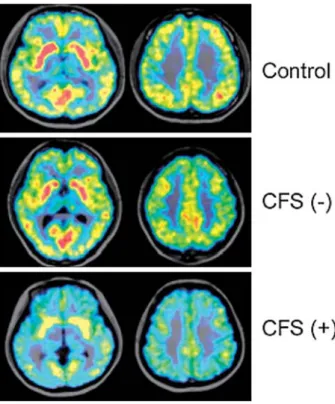
Fig. 1 Differences in mAChR expression on PET images in
pa-tients with chronic fatigue syndrome (CFS) with or without
mAChR autoantibody9). mAChR expression in CFS patients
without mAChR autoantibody (middle panel) was similar to that in healthy individuals (upper panel), whereas mAChR ex-pression decreased in CFS patients with mAChR autoantibody (lower panel).
tigue and sleep deficit6) .
Management of insomnia and fatigue is an impor-tant measure against stress in the field of industrial health and preventive medicine, since these conditions may cause psychological fatigue associated with hy-pofrontality during the depressive phase7)
. Measurement of brain function using fMRI during neuropsychological tasks also indicates that hypofrontality is correlated with psychomotor inhibition and poor concentration8)
. PET analysis in patients with chronic fatigue syndrome (CFS) showed that severe fatigue and malaise are corre-lated with ACC hypoactivity9)
. A recent study suggested that neurotransmission is decreased in CFS patients with autoantibodies to muscarinic acetylcholine receptor (mAChR)10)
(Fig. 1). These findings explain chronic psychological fatigue caused by prolonged insomnia, overtime, and stress, as a sign of motor and cognitive dys-function resulting from decreased metabolism and blood flow in the PFC and ACC11)
.
3.Psychiatric Diseases (1) Depression
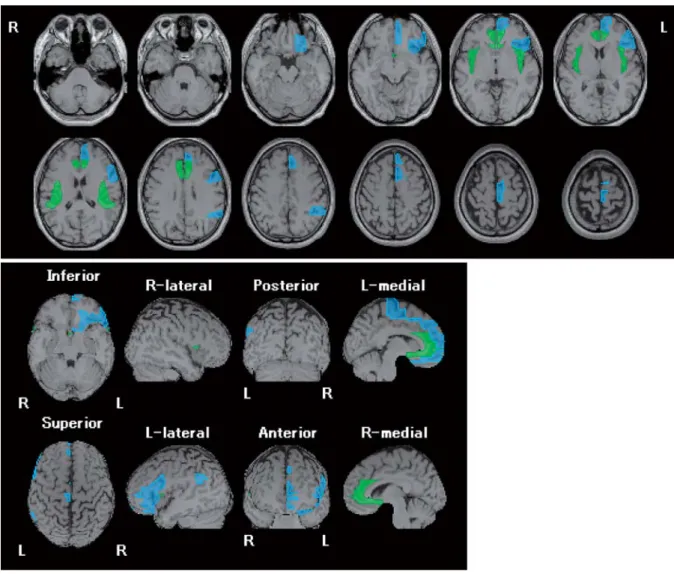
The monoamine hypothesis suggests that depression is caused by a lack of monoamines (noradrenaline (NA), serotonin (5-HT), dopamine (DA)), which are closely associated with emotion. However, there is no evi-dence showing a lack of monoamine metabolites during the depressive phase or an increase in monoamine lev-els in the brain at a few hours after treatment with antidepressants, although this effect may be delayed. Other neurotransmitters, G proteins, the cAMP-responsive element binding protein (CREB) transcription factor, and BDNF may also have roles in depression. Clinical studies, including those using PET/SPECT at rest and fMRI for measurement of activation during performance of tasks, have shown hypofrontality in the ACC, dorso-lateral PFC, and subgenual cortex (Fig. 2). Noninvasive and convenient-to-handle near-infrared spectroscopy (NIRS) has been approved by the Ministry of Health, Labour and Welfare in Japan in April 2009 as medical technology for differential diagnosis of depression using optical topography12)
. As mentioned above, the hip-pocampal volume is decreases by HPA axis hyperactivity during the depressive phase, but is inversely propor-tional to the frequency of the phases and disease duration. Thus, the number of studies on BDNF, which is closely related to neurogenesis, has increased, and improved understanding of methylation of the BDNF gene may promote more objective diagnosis of depression13)
.
(2) Schizophrenia
Abnormal dopamine function is the most common pathology of schizophrenia. Thus, correlations between dopamine D2receptor inhibition and drug dosage have been examined, along with PET analyses of dopamine
Fig. 2 Regions with decreased CBF in patients with depression. The greatest decrease in CBF occurred in the ACC, based on
voxel based stereotactic extraction estimation (vbSEE) analysis. Upper panel: horizontal section; lower panel: brain surface. (Koyama et al. 2010)
neurotransmission in the brain. PET/SPECT at rest shows that blood flow and metabolism in the temporal lobe and basal ganglion increase, in addition to relative hypofrontality, which might be related to the symp-toms and treatment of auditory hallucination14)
. Regarding morphology, the volume of the left superior tempo-ral gyrus and medial tempotempo-ral lobe are reduced. A study on at risk mental state (ARMS)15)
found partial and gradual volume reduction in the left superior temporal gyrus. Negative symptoms and cognitive impairment have also been associated with PFC abnormalities, and may explain working memory disorders.
(3) Panic disorder
Previous studies on neurotransmission in anxiety and fear have suggested that the amygdala is an impor-tant site in panic disorder (PD). Hyperactivity in this site might cause abnormal excitation in the hypothala-mus, locus ceruleus, periaqueductal gray matter, and other regions, and induce symptoms such as panic at-tack, avoidance response and sensory defensiveness. There are abundant serotonergic terminals in the lateral and basal nucleus of the amygdala. The serotonergic terminals enable selective serotonin reuptake inhibitors (SSRIs) to act on these regions and have an effect on PD. Hyperactivity of the amygdala, hippocampus, and brainstem causes panic attack, which suggests that this might be associated with hypoactivity in the orbi-tofrontal area, ACC, and dorsomedial PFC. Regarding morphology, Asami et al.16)
showed that the volumes of the right amygdala, PFC, and insular cortex were significantly decreased in patients with PD, using MRI and voxel-based morphometry.
(presence or absence of a traumatic experience) and genetic factors.
4.Prospect
As described above, prolonged exposure to stress activates CRF nerves, inhibits the serotonin nervous system from the dorsal raphe nucleus, and damages ventrolateral PFC function. Arita et al.19)
proposed an asso-ciation of socially deviant behavior such as loss of temper and suicidal impulse with the PFC, based on lost con-trol of impulsivity and violence due to damage to the vencon-trolateral PFC. In general, serotonin release de-creases in patients with depression, and such a decrease in the ventrolateral PFC may particularly lead to un-controllable depressive and impulsive actions and may be linked to suicide.
fMRI studies of brain function while lying (lying and truth-telling, go/no-go tasks) indicate activation of the ventrolateral and medial PFC, and activation of the ventrolateral PFC may inhibit impulsivity (no honesty (go response), but other actions (no-go response) and guilt). In a fMRI study on changes in brain function in healthy volunteers, Takahashi et al.20)
found that the medial PFC and posterior superior temporal sulcus were activated during feelings of guilt and embarrassment. Thus, these brain regions may be related to the ability to under-stand the intention of others and to self-examination21)
. These findings suggest that neuroscience can reflect general morals, guilt and embarrassment, and encourage appropriate thought and self-examination for promo-tion of social adjustment.
Advances in neuroscience have clarified brain functions that are related to impulsivity and suicidal intent, and permit screening for development of diseases and life-threatening conditions. However, if brain regions linked to emotion can be identified systematically, individual social adjustment and behavior can be appropri-ately classified and modifications based on this classification may be possible. These features of brain function may be very useful for providing appropriate approaches for disease prevention and strengthening resilience against stress. This also indicates the need for a greater focus on neuroethics, in order to protect people from inappropriate use of this science for manipulation of intentions and beliefs.
References
1) Yoshimura R, Sugita A, Hori H, et al: Verification of the brain-derived neurotrophic factor (BDNF) hypothesis. Psychiatria et Neurologia Japonica 112: 982―985, 2010.
2) Mitoma M, Yoshimura R, Sugita A, et al: Stress at work alters brain-derived neurotrophic factor (BDNF) levels and plasma 3-methoxy-4-hydroxyphenylglycol (MHPG) levels in healthy volunteers: BDNF and MHPG as possible biological markers of men-tal stress? Progress in Neuro-Psychopharmacology and Biological Psychiatry 32: 679―685, 2008.
3) Buckley TM, Schatzberg AF: On the interactions of the hypothalamic-pituitary-adrenal (HPA) axis and sleep, normal HPA axis activity and circadian rhythm, exemplary sleep disorders. The Journal of Clinical Endocrinology and Metabolism 90: 3106―3114, 2005.
4) Koyama F, Honma S, Ashihara M, et al: Relationships of depressive state, fatigue, and sleep with HPA-related endocrine ki-netics in workers. Japanese Journal of Occupational Medicine and Traumatology 62: 143―148, 2014.
6) Koyama F, Hojo K, Otsuki K: Objective assessment of depression using cerebral blood flow99mTc-ECD SPECT. Journal of the Japanese Society of Occupational Medicine and Traumatology 56: 122―127, 2008.
7) Koyama F, Kubuki Y, Uragami I: For early detection of potential patients with depression; Correlation of sleep disorder with frontal lobe dysfunction and depression symptoms. Journal of the Japanese Society of Occupational Medicine and Traumatol-ogy 59: 32―39, 2011.
8) Okamoto Y, Yamawaki S: Depression and the prefrontal cortex. Clinical Neuroscience 23: 679―681, 2006.
9) Kuratsune H, Watanabe Y: Clinical aspects of chronic fatigue syndrome and the cingulate gyrus. Clinical Neuroscience 23: 1286―1291, 2005.
10) Yamamoto S, Ouchi Y, Nakatsuka D, et al: Reduction of [11C](+) 3-MPB binding in brain of chronic fatigue syndrome with se-rum autoantibody against muscarinic cholinergic receptor. PLoS One 7 (12): e51515, 2012.
11) Cook DB, O Connor PJ, Lange G, et al: Functional neuroimaging correlates of mental fatigue induced by cognition among chronic fatigue syndrome patients and controls. Neuroimage 36: 108―122, 2007.
12) Takizawa R, Fukuda M: Near-infrared spectroscopy (NIRS) as clinical testing for psychiatric disorders; Advanced medical care and differential diagnosis for depression. Medix 53: 30―35, 2010.
13) Fuchikami M, Morinobu S, Segawa M, et al: DNA methylation profiles of the brain-derived neurotrophic factor (BDNF) gene as a potent diagnostic biomarker in major depression. PLoS One 6 (8): e23881, 2011.
14) McGuire P, Howes OD, Stone J, Fusar-Poli P: Functional neuroimaging in schizophrenia: Diagnosis and drug discovery. Trends in Pharmacological Sciences 29: 91―98, 2008.
15) Takahashi T, Wood SJ, Yung AR, et al: Progressive gray matter reduction of the superior temporal gyrus during transition to psychosis. Archives of General Psychiatry 66: 366―376, 2009.
16) Asami T, Yamasue H, Hayano F, et al: Sexually dimorphic gray matter volume reduction in patients with panic disorder. Psychiatry Research 173: 128―134, 2009.
17) Gilbertson MW, Shenton ME, Ciszewski A, et al: Smaller hippocampal volume predicts pathologic vulnerability to psycho-logical trauma. Nature Neuroscience 5: 1242―1247, 2002.
18) Kasai K, Yamasue H, Gilbertson MW, et al: Evidence for acquired pregenual anterior cingulate gray matter loss from a twin study of combat-related posttraumatic stress disorder. Biological Psychiatry 63: 550―556, 2008.
19) Arita H, Fukuda M, Kashima H, editors: Overview of frontal lobe function, Clinical psychiatry for specialists Vol. 21. Clinical findings in the frontal lobe in psychiatric disorders. Tokyo, Nakayama Shoten, 2010, pp 4―11.
20) Takahashi H, Yahata N, Koeda M, et al: Brain activation associated with evaluative processes of guilt and embarrassment: an fMRI study. Neuroimage 23: 967―974, 2004.
21) Amodio DM, Frith CD: Meeting of minds; the medial frontal cortex and social cognition. Nature Reviews Neuroscience 7: 268―277, 2006.
Reprint request:
Fumihiko Koyama
Clinical Research Center for Worker s Mental Health, Tokyo Rosai Hospital, 4-13-21, Omori-minami, Ota-ku, Tokyo, 143-0013, Japan.
別刷請求先 〒143―0013 東京都大田区大森南 4―13―21
東京労災病院勤労者メンタルヘルス研究セン ター
不安障害等の発症閾値を低下させることが知られている.これらの生物学的知見を産業現場などの心理・社会的領域に 展開すれば,不眠・ストレス・過労から疲労蓄積を伴い,場合によってはうつ病化に至るといった,ストレス曝露から 経時的に疾病性が生じる論理が強化される.これまで脳形態学的には,うつ病や PTSD 患者における海馬容積の低下を 認める報告が多く,これには神経細胞新生や神経発達に重要な脳由来神経栄養因子(brain-derived neurotrophic fac-tor:BDNF)がストレスの影響を受けることが強く関連しているなど,従来の内分泌や神経伝達物質,脳内モノアミン 類以外にも病態解明につながる新知見が蓄積されている. また,脳機能的検討では,強い疲労と前帯状回との関連や, うつという状態依存性にみられる前頭葉機能低下が示されてきたが,さらには社会適応性(衝動性とその自制など)と 前頭前野との関連についても研究が進み,性格傾向や行動パターンと関連した脳機能的検討も多く行われている.その 成果として,疾病予防やストレス耐性の強化等につながる対策が打ち出されることは当然有用であるが,仮に偏向的な 応用により性格や行動特性の分類が容易になされ,人の個性や自由意思,アイデンティティなどへの侵害が起こらない ために,neuro-ethics(脳神経倫理)が今後一層重視されるべきであろう. 利益相反:利益相反基準に該当無し (日職災医誌,64:138─143,2016)