Factors promoting sense of coherence among university students in urban areas of Japan : individual‑level social capital,
self‑efficacy, and mental health
著者 間戸 美恵
著者別表示 Mato Mie journal or
publication title
博士論文本文Full 学位授与番号 13301甲第4613号
学位名 博士(保健学)
学位授与年月日 2017‑09‑26
URL http://hdl.handle.net/2297/00049696
doi: 10.1177/1757975917691925
Creative Commons : 表示 ‑ 非営利 ‑ 改変禁止 http://creativecommons.org/licenses/by‑nc‑nd/3.0/deed.ja
Global Health Promotion
Original Article
Factors promoting sense of coherence among university students in urban areas of Japan: individual-level social
capital, self-efficacy, and mental health
Mie Mato 1 , Keiko Tsukasaki 2
1. Division of Health Sciences, Graduate School of Medical Sciences, Kanazawa University, Japan.
2. Faculty of Health Sciences, Institute of Medical, Pharmaceutical and Health Sciences, Kanazawa University, Japan.
Correspondence to: Mie Mato, Division of Health Sciences, Graduate School of Medical Sciences, Kanazawa University, 5-11-80, Kodatsuno, Kanazawa, Ishikawa 920-0942, Japan.
Email: [email protected]
2 Abstract:
Objective: Sense of Coherence (SOC) is a concept that helps to explain the relation between personal intentionality as psychosocial factors and health-related behaviors.
Thus, it is essential to enhance SOC when encouraging a healthy lifestyle. However, the factors that promote SOC have not been fully investigated among university students.
The objective of this study was to clarify the general resistance resources (GRRs) that may promote the development of the SOC among university students. Therefore, we examined the relationship between SOC and social capital (SC), self-efficacy, and mental health.
Methods: Participants included 443 students from nine academic departments at eight universities in the Kanto or Kinki metropolitan areas of Japan. Participants completed an anonymous questionnaire. Individual-level cognitive and structural SC, generalized self- efficacy, mental health inventory (from SF-36v2), and SOC were measured.
Confirmatory factor analysis using structural equation modeling was conducted to verify the factor structure of the SOC-13 scale. Stepwise multiple regression analysis and two- way layout analysis of variance were performed with SOC as the dependent variable.
Results: The factor structure of SOC indicated the optimal model fit in the second-order three-factor model of the 12 items. SOC was predicted by five variables: age, cognitive SC, structural SC, mental health, and self-efficacy. For students from urban areas, SOC was predicted by the interaction between cognitive and structural SC.
Conclusion: SOC was significantly related to cognitive SC, structural SC, and self-
efficacy as well as mental health in university students from urban areas. Furthermore,
the combination of higher-level cognitive SC and higher-level structural SC exerted an
3
inhibitory influence on SOC among students who previously and currently live in urban areas. Therefore, the findings indicated that both cognitive and structural SC as well as self-efficacy may act as GRRs that promote the development of SOC, and similarly, good mental health may promote a strong SOC.
Keywords: sense of coherence, general resistance resources, social capital, psychosocial
factors, university students, urban areas
4 Introduction
Since the 20th century, non-communicable diseases (NCDs) such as malignant neoplasms, heart disease, diabetes, and hypertensive disease have become predominant causes of death in Japan. Thus, the prevention of NCDs is now a high priority (1).
Globally, approximately 38 million people (approximately 68% of the total number of deaths) die from NCDs each year (2). In particular, the number of middle-aged and elderly NCD patients is rapidly increasing, and is expected to continue to rise until 2030 (3). One strategy to reduce the onset of NCDs later in life involves encouraging
individuals to adopt healthy lifestyle behaviors from an early age. Such support may be especially effective if it is promoted during late adolescence, particularly during years spent as university students.
Antonovsky (4) postulated that people with a strong SOC successfully and consistently utilize the various general resistance resources (GRRs) that are accessible. In short, they are prepared to face challenges in a realistic manner, and more maintain in daily healthy lifestyle behaviors (4). Among university students, perceived social support have been proposed as GRRs that influence SOC (5). However, the specific factors promoting the function of SOC, including GRRs, have yet to be fully investigated.
By taking advantage of various resources and options, people with strong SOC may be
more likely to deal with problems in a flexible and realistic manner, and may be better at
coping with stress and receiving support from others (4). In other words, in their usual
environment, these people appear to have an abundance of „human relationship‟ capital,
which can function as a GRR. Human relationship capital is a type of social capital (SC)
that represents the ability to establish human networks and maintain a basic sense of trust
5
in interpersonal relationships. SOC may be promoted by good mental health. However, the relationship between these 3 factors at a individual-level among university students has not been clarified.
Furthermore, self-efficacy is considered to be a personal resource that is distinct from the concept of SOC, which refers to one‟s outlook on and views about life. Previous studies have indicated that there is a relationship between SOC and self-efficacy among elderly people, teenagers, and patients with specific diseases (6-8). However, no studies have investigated this relationship among university students.
SOC is reported to develop throughout life (9), and in university students during late adolescence, SOC is still in the formation process (4). From the viewpoint of
developmental stages, individuals generally re-develop their relationships with other people and with society during adolescence (10). In other words, university students are in the process of social development, and susceptible to their social environment. As SOC greatly depends on external resources, such as interactions with individuals and with general society (4), psychosocial perspectives are useful when discussing SOC development and the influence of GRRs among university students.
Against this background, and on the basis of salutogenesis, we aimed to clarify GRRs that promote the development of SOC among university students. Specifically, we
analyzed the relationships between SC, self-efficacy, and mental health (SOC promoters).
Methods
Participants and Procedures
We contacted faculty at universities included in the 2013 Listing of Universities
Across Japan (Association of Education), with the aim of securing more than 600 study
6
participants from universities in the Kanto and Kinki Metropolitan areas. Specifically, we contacted a representative of faculty at each university and requested their cooperation in the study. The study participants comprised 614 third- or fourth-year students (including postgraduate students who had recently finished their undergraduate program) from nine faculties at the eight universities which agreed to participate in the study. Ultimately, 517 responses were received (response rate: 84.2%), among which, 443 were considered valid (effective response rate: 85.7%). Participants were permitted to withdraw from the study at any time and were assured of their anonymity. We provided the university contact persons with consent forms and questionnaires, and asked them to distribute the forms to the participants. We then collected the self-completed anonymous questionnaires from the contact person by post after a set length of time. This study was conducted between May and October 2014.
Measurements
Cognitive social capital
We employed the same SC scale used by Hanibuchi et al. (11) to assess “generalized trust” and “norms of reciprocity”, which are components of cognitive SC (12,13).
The “generalized trust” item included the following statement: “Generally speaking, would you say that most people can be trusted?” The “norms of reciprocity” item included the statement: “Would you say that most of the time people try to be helpful?”
Participants responded on a 5-point scale ranging from “Strongly agree” to “Strongly disagree”. The scores for these 2 items are summed (2 to 10 points), with higher scores indicating higher levels of cognitive SC.
Structural social capital
7
On the basis of the scaling of structural SC, the reliability and validity of which have been verified (14,15), a pre-survey was conducted with 10 university students and 10 activity fields (networks) were reconstituted to align the content with the actual connections university students in Japan have with groups and organizations. The contents, including union meeting and private party, were excluded, and university activities, event activities in the community, were included.
Participants were asked about groups with which they were connected, and chose the fields of activity in which they had been involved during the previous year. Each positive response equaled 1 point, and the total score (1 to 10 points) was calculated, with higher scores indicating higher levels of structural SC.
Self-efficacy
We used the generalized self-efficacy scale, which was developed by Sherer et al. (16) and translated into Japanese by Narita et al. (17). The scale comprises 23 items, each of which has 5 possible responses ranging from “Strongly agree” to ”Strongly disagree”.
The total score (23 to 115 points) is calculated, with higher scores indicating higher levels of self-efficacy. The reliability and validity of the scale have been sufficiently verified (17). Cronbach‟s alpha in this sample was α = 0.86.
Mental health
Among the subscales of the SF-36v2 Japanese version of the health-related quality of
life scale, we used the subscale “Mental Health Inventory (MHI)”, which has verified
reliability and validity (18,19). The subscale, which comprises 5 items, measures an
individual‟s mental state during the previous month. Each question has 5 possible
8
responses ranging from “Always” to “Not at all”, and the total score is converted into a subscale score ranging from 0 to 100 points. A higher subscale score indicates a more favorable state of mental health. Cronbach‟s alpha in this sample was α = 0.82.
Sense of coherence
We used the short version of the SOC scale, which was developed by Antonovsky (4) and translated into Japanese by Yamazaki (20). The scale comprises 13 items, each of which has 7 possible responses ranging from “Very frequent” to “Not at all”, and the total score ranges from 13 to 91 points. Although various previous studies have examined the reliability, validity, and factor structure of the 13-item seven-point version of the SOC scale (SOC-13 scale), consensus regarding the factor model of this scale has not been reached, and some relevant issues have been identified (21-23). Therefore, in the present study, we conducted confirmatory factor analysis. To investigate between-factor
relationships, we calculated the total score using the factor model, which resulted in the optimal evaluation index.
Demographic variables
We considered the age, gender, major, family constitution, siblings, number of years lived at current location, living situation, and home region of the participants.
Statistical analysis
We performed a descriptive analysis of participant attributes, cognitive and structural
SC, self-efficacy, mental health, and SOC. To consider the number of years in college as
well as personal history of moving addresses, we divided the participants into three
9
groups based on the number of years of residence at their current location: ≤4 years, 5–19 years, or ≥20 years. Participants were divided into two groups based on home region:
within the two metropolitan areas in which the participating universities were located or other regions of Japan.
We used Cronbach‟s α values and structural equation modeling to conduct a confirmatory factor analysis of the factor structure of the SOC-13 scale.
We analyzed the relationships between participant demographics and cognitive SC, structural SC, self-efficacy, mental health, and SOC via Student‟s t-test, one-way layout analysis of variance, Welch‟s test, the Tukey–Kramer multiple comparison test, and Games–Howell multiple comparison test, respectively. In addition, we used Pearson‟s correlation coefficient to analyze the relationships between individual SOC scores and cognitive and structural SC, self-efficacy, and mental health. We also performed stepwise (forward-backward stepwise selection) multiple regression analysis with SOC as the dependent variable.
Because environment may influence the SC and SOC scores obtained by university
students, we investigated the relationships between SOC and cognitive/structural SC
scores according to home region. We divided the participants into two groups according
to their cognitive and structural SC scores. The low score group included people who
obtained the average or lower than average score, and the high score group consisted of
people who obtained a higher than average score. We used a two-way layout analysis of
variance to analyze the relationships between participant SOC and cognitive/structural
SC scores according to home region.
10
We used SPSS ver. 22.0 for Windows (Amos ver. 22.0) for all analyses. The level of significance was set at 0.05.
Ethics approval
This study was conducted with the approval of the Kanazawa University Medical Ethics Committee (April 28, 2014; No. 511).
Results
Participant characteristics
The mean age of the participants was 21.06 years (SD = 1.18, range: 20–27). The average SOC scores for males and females were 50.51 (SD = 10.07) and 50.42 (SD = 8.90) points, respectively, and we found no significant difference between the genders.
Table 1 shows additional results.
Factor structure of SOC
As per previous studies (21-23), we performed confirmatory factor analysis using the one-factor and second-order three-factor models of SOC (Table 2). We obtained the optimal model fit, with Cronbach‟s α, CMIN/DF, GFI, AGFI, CFI, RMSEA, and AIC values of 0.76, 2.532, 0.953, 0.931, 0.910, 0.059, 184.186, respectively, in the second- order three-factor model. This model comprised 12 items after excluding one item (Q2) that showed a markedly low item-total correlation coefficient in a non-modified model.
Factors related to SOC
Relationships between participant demographics and cognitive SC, structural SC, self-
efficacy, mental health, and SOC
11
When assessing the relationships between participant demographics and cognitive SC, we found that average cognitive SC scores were significantly higher for those not living with their families (M = 7.19, SD = 1.36) compared with those living with their families (M = 6.76, SD = 1.52, p = 0.002). We also found a significant difference in cognitive SC scores when we divided the participants into 3 groups according to the number of years they had lived at their current location (p = 0.015). Multiple comparisons revealed a significantly higher score for those with ≤4 years (M = 7.18, SD = 1.38) compared with those with ≥20 years (M = 6.72, SD = 1.57, p = 0.015). Regarding the home region of the participants, cognitive SC scores were significantly lower for those whose home region was either of the 2 metropolitan areas in which the participating universities were located (M = 6.88, SD = 1.51), compared with those whose home region was in another area (M = 7.27, SD = 1.25, p = 0.016).
When assessing the relationships between participant demographics and structural SC, we found significant differences in structural SC scores when we divided the participants into 3 groups according to their major (p = 0.004). Multiple comparisons revealed that humanities students obtained significantly higher scores (M = 4.38, SD = 2.02) than science (M = 3.86, SD = 1.74) and medical (M = 3.60, SD = 1.67) students (p = 0.020, p = 0.009).
Participant demographics were not associated with self-efficacy, mental health, or SOC.
Relationships between SOC and cognitive SC, structural SC, self-efficacy, and mental health
We found mild, moderate, and moderate significant correlations between individual
levels of SOC and cognitive SC (r = 0.40, p < 0.001), self-efficacy (r = 0.54, p < 0.001),
12
and mental health (r = 0.51, p < 0.001), respectively. We also found a mildly significant positive correlation between self-efficacy and structural SC (r = 0.24, p < 0.001).
Analysis of SOC-related factors
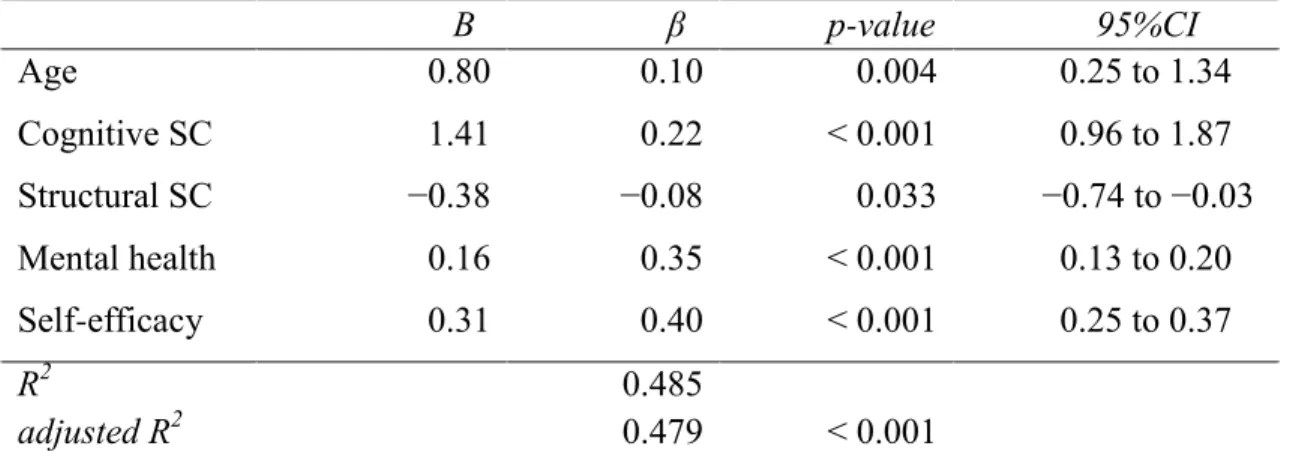
We conducted multiple regression analysis using a stepwise method (forward-
backward stepwise selection) with SOC as the dependent variable (Table 3). Independent variables included age, gender, and factors that were significantly correlated with SOC or cognitive SC, structural SC, self-efficacy and mental health based on univariate analysis.
We found that participant SOC could be explained by age (β = 0.10, p = 0.004), cognitive SC (β = 0.22, p < 0.001), structural SC (β = −0.08, p = 0.033), mental health (β = 0.35, p
< 0.001), and self-efficacy (β = 0.40, p < 0.001) (p < 0.001, R
2= 0.485, adjusted R
2= 0.479).
Relationship between participant SOC and SC according to home region
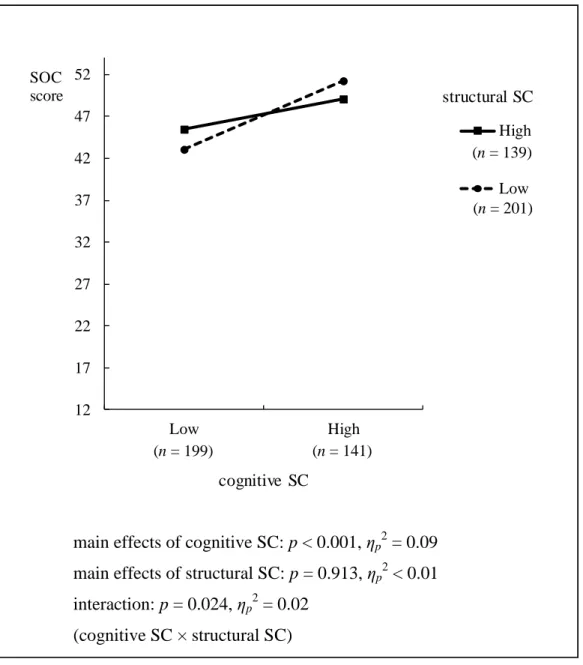
We conducted a two-way layout analysis of variance to assess the relationship between SOC and cognitive/structural SC (Figures 1) among 340 participants whose home region was either of the two metropolitan areas in which the participating universities were located, as well as 103 participants whose home region was in another area. As the average cognitive SC score was 6.97 points, we divided the participants into two groups based on whether they had scores of ≤7 points (low group) or ≥8 points (high group).
Similarly, as the average structural SC score was 4.04 points, we divided the participants into two groups depending on whether they obtained scores of ≤4 points (low group) or
≥5 points (high group). Our analyses revealed an interaction between SOC and SC among participants whose home region was in either of the two metropolitan areas in which the participating universities were located (p = 0.024, η
p2= 0.02).
13 Discussion
SOC among university students
In the present study population, the mean overall SOC score was 50.5 points. In previous studies of university students in urban areas of Japan, mean SOC scores were reported to be 48.7 points (23) and 50.3 points (24). Our results are therefore similar to those reported in the abovementioned studies.
Furthermore, previous studies in the United States (22) and Turkey (5) reported mean SOC scores of 44.0 and 56.9 points, respectively. These results suggest that SOC among university students varies according to country. However, more data are necessary to allow a comparison of SOC values between countries.
SOC-related factors among university students
Cognitive and structural SC
Our findings indicate that individual-level cognitive and structural SC are factors related to SOC. Previous studies have reported that the strength of social support
networks, which is a factor similar to structural SC, was related to SOC (5). However, no
previous studies have investigated the relationship between structural SC and SOC in
university students. In the present study, we identified a relationship between SOC and
structural SC, which represents an individual‟s broad group networks, including
supportive connections. The results of this study indicate that trust and mutual benefits
(cooperative relationships) resulting from human-to-human connections positively
influence an individual‟s orientation and views regarding their life. People with strong
SOC are thought to cope with stressful stimuli by occasionally depending on various
14
physical and human resources around them. As these individuals are largely thought to be trustworthy, this coping is generally achieved in a balanced manner, consistent with the idea of “salutogenesis” proposed by Antonovsky (4). Thus, improving an individual‟s SC may be one approach to developing their SOC.
To the best of our knowledge, the present study is the first to investigate the
relationship between SOC and cognitive and structural SC in university students grouped according to their home region. The present study found that among students for whom both their home region and current location were in an urban area, those with higher cognitive and structural SC scores had a tendency towards lower SOC scores compared with those with a higher cognitive SC score and a lower structural SC score. A previous study demonstrated that people living in an urban area were more susceptible to social stress than those living in a non-urban area, and that this tendency was stronger among people living in a larger area as well as those who had lived in an urban area for a longer period in infancy (25). In urban areas, which often feature a large amount of information and numerous resources, people are more likely to be subjected to stress due to broad networks. Therefore, it is possible that the participants with higher cognitive and structural SC in the present study had relatively low SOC scores because these two factors were more stressful for them. These results are consistent with those obtained by Lederbogen et al. (25). Based on this tendency, there is a need to discuss individualized measures for developing SOC according to living environment and social background.
Self-efficacy
The present study found self-efficacy to be the strongest factor influencing SOC in
university students. A previous study uncovered a relationship between self-efficacy and
15
SOC among elderly people (7). In another previous study, which reported a relationship between self-efficacy and SOC among children aged 16 and 19 years, these two factors were investigated as an equivalent of resilience to daily challenges associated with mental health problems (6). However, SOC and self-efficacy have different relationships with respect to adolescent substance use (e.g., tobacco, alcohol) (26). In other words, self- efficacy is a concept that should be considered as separate from SOC. Based on the present study, self-efficacy in university students seems to be as strongly associated with SOC as GRRs are associated with SOC. The successful experiences form self-efficacy (27). Therefore, it is likely that successful experiences and supportive relationships leading to higher self-efficacy contribute to increased SOC in university students.
Mental health
The present study found a relationship between mental health and SOC among university students. Indeed, a number of domestic and foreign studies have reported a relationship between SOC and mental health (28,29). In many of these studies, researchers considered the SOC of an individual to be a contributing factor to mental health. Conversely, emotional health, which is conceptually similar to mental health, may influence SOC among university students in the United States (30). Only a small
percentage of studies aimed to clarify the factors influencing SOC in a relationship
between mental health and SOC. In the present study, we hypothesized that a greater
feeling of wellbeing, which is generally expressed as a positive aspect of mental health,
would be one of the factors promoting SOC, and analyzed our data accordingly. The
findings suggested a mutual relationship between SOC and mental health. Based on this
thought, to consider stability of mental health of university students may leads to good
16
circulation to SOC. However, hypothesis of present study should be confirmed according to future longitudinal studies.
Proposal regarding health promotion in university students, and study limitations In the present study, we hypothesized that cognitive/structural SC and self-efficacy act as GRRs to promote SOC, and that mental health promotes SOC. The findings indicated that SOC was related to cognitive SC, structural SC, self-efficacy, and mental health. On this basis, it will be useful for the promotion of their healthy lifestyle that psychosocial factors are considered to enhance SOC of university students. In other words, it is
important to adjust the overall student environment as well as examine individual support while considering psychosocial factors, such as trust and cooperative relationships
resulting from human-to-human connections, broad networks, self-efficacy as a personal characteristic, and mental health. These concepts may become the basis for a broad range of health-promotion measures, including student health management policies and
guidelines.
The present study was conducted with the participation of partial universities in two
metropolitan areas; hence, the results of this study have a limit to be generalized due to
possible sampling bias. As the study was implemented in a cross-sectional manner, the
causal relationships between SOC and the investigated factors were not clarified. There is
a need to conduct longitudinal studies to determine the causal associations between SOC
and the related factors. In addition, it is necessary to compare the results with those of
studies investigating students from other areas.
17 Acknowledgements
We would like to express our deep gratitude to the staff members and students at the participating universities for their cooperation.
References
1. Ministry of Health, Labour and Welfare (MHLW). Health Japan 21 (the second term): Analysis and Assessment Project. Tokyo: MHLW, 2015.
http://www.mhlw.go.jp/seisakunitsuite/bunya/kenkou_iryou/kenkou/kenkounippon2 1/en/kenkounippon21/mokuhyou.html (accessed 22 October 2015).
2. World Health Organization (WHO). World Health Statistics 2014. Geneva: WHO, 2014. http://www.who.int/gho/publications/world_health_statistics/2014/en/
(accessed 8 June 2015).
3. World Health Organization (WHO). World Health Statistics 2012. Geneva: WHO, 2012. http://www.who.int/gho/publications/world_health_statistics/2012/en/
(accessed 8 June 2015).
4. Antonovsky A. Unraveling the Mystery of Health: How People Manage Stress and Stay Well. San Francisco: Jossey-Bass Publishers, 1987.
5. Kadriye P, Gulgin B, Omer U. Factors Related to Sense of Coherence Among Dental Studenrs at Istanbul University. J Dent Educ 2012; 76: 774 – 782.
6. Kröninger-Jungaberle H, Grevenstein D. Development of salutogenetic factors in mental health – Antonovsky‟ s sense of coherence and Bandura‟ s self-efficacy related to Derogatis‟ symptom check list (SCL-90-R). Health Qual Life Outcomes 2013; 11:80.
7. Wiesmann U, Dezutter J, Hannich HJ. Sense of coherence and pain experience in
18
older age. Int Psychogeriatr 2014; 26(1): 123–133.
8. Opheim R, Fagermoen MS, Jelsness-Jørgensen LP, et al. Sense of Coherence in Patients with Inflammatory Bowel Disease. Gastroenterol Res Pract 2014;
2014: 989038.
9. Nilsson K, Leppert J, Simonsson B, et al. Sense of coherence (SOC) and
psychological well-being (GHQ): Improvement with age. J Epidemiol Community Health 2010; 64(4): 347–352.
10. Erikson EH. Identity and The Life Cycle (T. Nishihira & Y. Nakajima, Trans.).
Tokyo: Seishin Shobo, 1980, pp.123–126.
11. Hanibuchi T, Murata Y, Ichida Y, et al. Place-specific constructs of social capital and their possible associations to health: A Japanese case study. Soc Sci Med 2012;
75(1): 225–232.
12. Putnam RD. Making democracy work: Civic traditions in modern Italy. Princeton:
Princeton University Press, 1993, pp.163–171.
13. Islam MK, Merlo J, Kawachi I, et al. Social capital and health: does egalitarianism matter? A literature review. Int J Equity Health 2006; 5(3).
14. Lindstrӧm M. Social capital and the miniaturization of community among daily and intermittent smokers: a population-based study. Prev Med 2003; 36: 177–184.
15. Lindström M, Merlo J, Östergren PO. Social capital and sense of insecurity in the neighbourhood: a population-based multilevel analysis in Malmö, Sweden. Soc Sci Med 2003; 56: 1111–1120.
16. Sherer M, Maddux JE, Mercandante B, et al. The self-efficacy scale: Construction
and validation. Psychol Rep 1982; 51: 663–671.
19
17. Narita K, Shimonaka Y, Nakazato K, et al. A Japanese Version of The Generalized Self-Efficacy Scale: Scale utility from the life-span perspective. Jpn J Educ Psychol 1995; 43: 306–314. (in Japanese with English abstract).
18. Fukuhara S, Bito S, Green J, at al. Translation, adaptation, and validation of the SF- 36 Health Survey for use in Japan. J Clin Epidemiol 1998; 51(11): 1037–1044.
19. Fukuhara S, Ware JE, Kosinski M, et al. Psychometric and clinical tests of validity of the Japanese SF-36 Health Survey. J Clin Epidemiol 1998; 51(11): 1045–1053.
20. Yamazaki Y. Salutogenesis as new perspectives on health and sense of coherence.
Qual Nurs 1999; 5(10): 825–832. (in Japanese).
21. Feldt T, Leskinen E, Kinnunen U, et al. Longitudinal factor analysis models in the assessment of the stability of sense of coherence. Pers Individ Dif 2000; 28(2): 239–
257.
22. Hittner JB. Factorial Invariance of the 13-item Sense of Coherence Scale across Gender. J Health Psychol 2007; 12(2): 273–280.
23. Togari T, Yamazaki Y, Nakayama K, et al. Construct validity of Antonovsky‟ s sense of coherence scale: Stability of factor structure and predictive validity with regard to the well-being of Japanese undergraduate students from two-year follow- up date. Jpn J Health Hum Ecol 2008; 74(2): 71–86.
24. Kase T, Oishi K. The effects of the type A behavior pattern and sense of coherence on depressive tendencies in Japanese college students. Jpn J Personality 2015; 24(1):
38–48. (in Japanese with English abstract).
25. Lederbogen F, Kirsch P, Haddad L, et al. City living and urban upbringing affect
neural social stress processing in humans. Nat 2011; 474: 498–501.
20
26. Grevenstein D, Bluemke M, Kroeninger-Jungaberle H. Incremental validity of sense of coherence, neuroticism, extraversion, and general self-efficacy: longitudinal prediction of substance use frequency and mental health. Health Qual Life
Outcomes 2016; 14: 9.
27. Bandura A. Self-efficacy: Toward a unifying theory of behavioral change. Psychol Rev 1977; 84: 191–215.
28. Eriksson M, Lindstrӧm B. Antonovsky‟s sense of coherence scale and the relation with health: a systematic review. J Epidemiol Community Health 2006; 60: 376–381.
29. Urakawa K. Trend of research on sense of coherence (SOC) and health behavior in Japan: A review. Mie Nurs J 2012; 14(1): 1–9. (in Japanese with English Abstract).
30. Darling CA, McWey LM, Howard SN, et al. College student stress: the influence of
interpersonal relationships on sense of coherence. Stress Health 2007; 23: 215–229.
21
Table 1. Demographic characteristics of the sample population.
n (%) Mean (SD)
Age
Gender n = 443 Male
Female Major n=443
Science Humanities Medical
Family constitution n=434 Two-generation
Three-generation Others
Number of siblings n = 443 None
One Two
Three or more
Living with family members n = 442 Yes
No
Number of years lived at current location n=443
4 years or less 5–19 years 20 years or more Home region n = 443
Two metropolitan areas Other areas
SOC (13–91)
Comprehensibility Manageability Meaningfuiness Cognitive SC (2–10) Structural SC
a(0–10) Self-efficacy (23–115) Mental health (0–100)
259 184 196 184 63 327 88 19 56 229 125 33 233 209
205 110 128 340 103
(58.5) (41.5) (44.2) (41.5) (14.2) (75.3) (20.3) (4.4) (12.6) (51.7) (28.2) (7.4) (52.7) (47.3)
(46.3) (24.8) (28.9) (76.7) (23.3)
21.06
50.48 18.59 15.52 16.37 6.97 4.04 68.63 61.09
(1.18)
(9.59) (4.29) (3.69) (4.04) (1.46) (1.87) (12.03) (19.88)
a
Ten areas of activity (network) in structural SC: 1) club/group activities within the university; 2) the operations and support for school festivals; 3) participation in self-governing activities within
the university; 4) support for community events; 5) activities of sports clubs and groups outside the university; 6) social activities such as volunteer work; 7) participation in family gatherings;
8) socializing with neighbors; 9) doing part-time work; and 10) interaction via social networking services (SNS), through which users show their profiles to one another.
SD: standard deviation.
22
Table 2. Goodness-of-fit statistics for comparative models of the SOC-13 scale (n =443).
CMIN/DF GFI AGFI CFI PMSEA AIC α one-factor model
non-modified (13-item) included the covariance
aexcluded one item
b(12-item) second-order three-factor model
non-modified (13-item) included the covariance
aexcluded one item
b(12-item)
4.656 3.970 4.413
3.109 2.383 2.532
0.897 0.911 0.909
0.936 0.952 0.953
0.856 0.873 0.868
0.909 0.930 0.931
0.750 0.800 0.795
0.858 0.908 0.910
0.091 0.082 0.088
0.069 0.056 0.059
351.986 308.076 286.314
252.974 206.116 184.186
0.747 0.747 0.761
0.747 0.747 0.761
a
included the covariance between the residual variance of the observed variables Q2 (comprehensibility item) and Q3 (manageability item).
b