
Developments of Early Old English through Language Contacts
journal or
publication title
聖学院大学総合研究所紀要
number 65
page range 27‑56
year 2019‑03‑31
URL http://doi.org/10.15052/00003623
Developments of Early Old English through Language Contacts
Shigeyuki Kobayashi
〔抄録〕
言語接触による初期古英語の発達
古英語方言が起源を発する最初期の古英語は紀元後449年のアングロ・サ クソンの侵入後にすぐに形成されたという通説は,反対意見があるものの一 般に受け容れられている。
他の有力な仮説は,ケルト語の消滅はアングロ・サクソンの侵入の結果で あるというものである。しかしながら,この説の問題は,Oppenheimer(2006) が反証した「全滅説」の言語学版であるということである。
古英語のいくつかの特徴は,ラテン語から古英語への翻訳を通した影響,
またはブリトン人が話したケルト語の影響によって発達したと主に考えられ てきた。
当論文は,初期古英語主節の動詞末尾語順に関する最近の分析とOppen-
heimerの理論を検討し,アングロ・サクソン侵入以前のサクソン人とブリ
トン人との言語接触について論じる。
0 Introduction
The conventional theory that the earliest ancestor of English, from which all dialects of Old English (OE) branched off, was formed immediately after the Anglo-Saxon invasion in 449 AD, has been generally accepted despite many objections.
According to another prominent theory, the Anglo-Saxon invasion resulted in the extinction of the Celtic languages. However, this linguistic perspective on the theory is based on the wipeout theory, which Oppenheimer (2006) refuted, and therefore it requires reconsideration.
OE’s peculiar syntactic characteristics are considered to have been influ- enced by Latin, from which it was translated, or by the Celtic language of the Britons.
This paper reviews some recent analysis of verb-final (V-final) word order in early OE main clause and Oppenheimer’s theory, and reveals language contacts between the Saxons and Britons before the Anglo-Saxon invasion.
1 Word Order Variations in Old English
1.1 Verb-second Word Order and Its Variations in Old English
We begin with an analysis of verb-second word order in OE because it is the most typical word order in main clauses. The following examples are quoted from Roberts (2007):
(1) a. Se Hæland wearæð þa gelomlice ætiwed his leornung-cnihitum.
the Lord was then frequently shown his disciples.
‘The Lord then frequently appeared to his disciples’.
(ÆCHom I, 15.220.21; Fischer et al. 2000: 106; Roberts 2007: 58) b. On twam þingum hæfde God þæs mannes sawles gegodod.
in two things had God this man’s soul endowed ‘With two things had God this man’s soul endowed’.
(ÆCHom I, 15.20.1; Fischer et al. 2000: 107; Roberts 2007: 58) c. Þa astah se Hælend up on ane dune.
then rose the Lord up on a mountain ‘Then rose the Lord up on a mountain’.
(ÆCHom I, 15.20.1; Fischer et al. 2000: 107; Roberts 2007: 58) Notice that the subject precedes the finite auxiliary in (1a), which precedes
an adverb; a PP precedes the auxiliary in (1b), which precedes the subject;
and the adverb þa (‘then’) precedes the finite verb in (1c), which precedes the subject. These finite auxiliaries and verbs are not in T as in present-day English.
The configuration of V2 construction is illustrated as follows:
(2) [CP[C Vf [IP . . . ……… V]]]
(Fischer et al. 2000: 107)
The first constituent is in spec-CP, the finite verb in C in (2). This analysis has been generally accepted, where a finite verb moves to the head position of CP structure.
OE is not a rigid V2 language like modern German, because in cases where the first constituent is a non-subject, pronominal subjects precede the verb, as in (4)̶(5); verb-subject order is dominant only when the subject is a full noun, as in (3).
(3) On twam þingum hæfde God þæs mannes sawle gegodod in two things had God the man’s soul endowed
‘With two things God had endowed man’s soul’.
(ÆCHom I, 1.20.1; Fischer et al. 2000: 107)
(4) Forðon we sceolan mid ealle mod & mægene to Gode gecrrran therefore we must with all mind and power to God turn
‘Therefore we must turn to God with all our mind and power’.
(HomU19 (BlHom 8) 26; Fischer et al. 2000: 107)
(5) Be ðæm we magon suiðe swuytule oncnawan ðæt … by that we may very clearly perceive that …
‘By that, we may perceive very clearly that …’
(CP 26.181.16; Fischer et al. 2000: 107) The word order pattern seen in (4) and (5) is often referred to as a kind of V3 word order specific to OE. However, it is actually a variant of V2 word order in
OE because the pronominal subjects in (4) and (5) are regarded as subject clitics (see van Kemenade [1987]). Both V2 and V3 as a variant of V2 word order are non-Latinate elements in OE word order.
1.2 The View of Development of CP Structure in Germanic Languages for Verb-final Word Orders in Old English
We review the view of Development of CP Structure in Germanic Languages in Kiparsky (1995) in this section. While V 2 word order in the main clause is obligatory in modern German, it is not a necessary condition in OE. Instead of assuming that V-to-C0 movement is optional in Old English, Kiparsky (1995) argues that ‘the category C itself is optional, where no principle of grammar requires its presence’. As Kiparsky argues that ‘[W]here C0 is not required for these or other reasons, its presence or absence is fixed on a language-specific basis’, the differences in word order among Germanic languages ought to reflect the parametric variations of CP structures.
Kiparsky illustrates the three word-order variations, as follows:
(6) a. CP[ XP C”[ C[V] S[ … ] ] ] b. CP[ C”[ C[V] S[ … ] ] ] c. S[ …V… ]
(Kiparsky 1995, (4))
Verb-second clauses like (6a) are the standard main clause type in OE and other Germanic languages, which is discussed in 3.1. Verb-first clauses, which are obligatory in yes-no questions, also occur in declarative clauses in Old English, Old High German, and Old Icelandic.
(7) a. Hæfde se cyning his fierd on tu tonumen
(Anglo-Saxon Chronicle, A.D. 893) ‘The king had divided his army in two’.
b. Uuârun thô hirtâ in thero lantskeffi (Tatian 6) ‘At that time there were shepherds in the area’.
c. ferr þá Vagn heim suðr til Danmerkr (Heimskringla 160.29)
‘Then Vagn went home southwards to Denmark’.
(Kiparsky 1995, (5))
According to Kiparsky’s analysis, the verb-final main clause illustrated in (6b) displays bare S structure, which does not accompany CP. Some examples are as follows:
(8) He þa his here on tu todælde (Orosius 116.16)
‘He then divided his army in two’.
Her hæþne men ærest on Sceapige ofer winter sætun
(Anglo-Saxon Chronicle, A.D. 855)
‘Here (in this year) heathen men first encamped in S. over the winter’.
(Kiparsky 1995, (6))
Such examples are observed almost only in Old English. Kiparsky supposes that C0 is a syntactically obligatory element even in main clauses in Old High German and Old Icelandic. This means that CP structure was not developed to be obligatory in main clauses in OE, and V2 was abandoned in Middle English and became residual in Early Modern English. The cause of verb-final word order in Early Old English can be traced back to a Germanic language which was brought to Wessex by Saxons before Old English was established in Britain.
1.3 Objective Views to the Development Hypothesis of CP in Germanic Languages
Taylor (2014) argues against the Development Hypothesis of CP in Germanic Languages described above as follows:
It has been claimed that Germanic inherited the PIE situation as far as clausal syntax goes; i.e. the verb does not move to a left-peripheral position as it does in many of the modern Germanic languages (Kiparsky 1995).
The V-to-C movement, which results in verb-second (V2) order in these languages under this account, is thus a language-specific innovation following the breakup of Proto-Germanic. However, closer examination of
the early Germanic languages (Eythórsson 1995, 1996, 2001,Ferraresi 2005, Axel 2007, Walkden 2009) has provided strong empirical evidence for verb movement to C (possibly alongside a lack of such movement) in all the early Germanic languages, and thus the status of V-to-C as a Proto- Germanic innovation now seems far more secure.
(Ringe and Taylor 2014: 396)
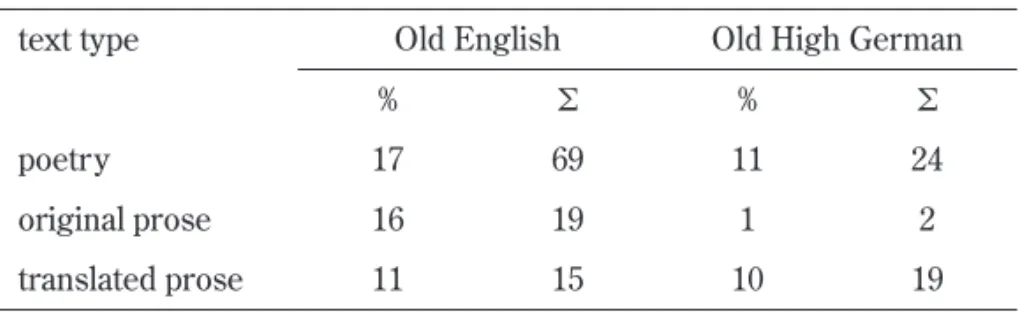
Cichosz (2010) shows the result of her investigation of verb-final word order in Old English and Old High German as follows:
text type Old English Old High German
% Σ % Σ
poetry 17 69 11 24
original prose 16 19 1 2
translated prose 11 15 10 19
Table 1. V-Final non-conjoined declarative clauses
(Cichosz 2010: 88, Table 19)
She analyses it as follows:
Another word order pattern that reveals discrepancies between the analysed languages is V-final. This structure seems more prominent in Old English, but the differences between text types are visible only in the case of poetry and original prose:
V-final is the most popular Latin word order, which would explain the perfectly similar behaviour of OE and OHG translations. Here, the equal frequency of V-final clauses can be safely attributed to a similar foreign influence.
The only sample where V-final structures are clearly avoided is OHG original prose. It is present in OHG poetry, though its frequency is visibly lower than in OE verse. This may be due to the fact that the V-final order
was already so characteristic of OHG subordinate clauses that it would sound unnatural in independent clauses …
(Cichosz 2010: 88)
Cichoz remarks the similar portion of V-final in translated prose in both Old English and Old High German, and suggests that the cause of this would be the influence of Latin.
But Walkden (2014) argues against this view of Cichoz as follows:
A variant of this hypothesis is to argue that verb-late order is due to foreign influence, specifically the influence of Latin. This is the line taken by Cichosz (2010: 88̶9). However, Cichosz’s own data, given above, does not support this hypothesis: verb-late clauses are found more frequently in OE and OHG poetry and in OE original prose than in translated prose of either language, which is the opposite of what we would expect if the influence of Latin were the sole explanation.
(Walkden 2014: 98)
He also argues against the similar view of Axel (2007) for Old High German, citing the example as follows:
(9) min tohter ubilo fon themo tiuuale giuuegit ist my daughter severely by the devil shaken is
‘My daughter is severely possessed by a demon’
(Tatian 273,10, Walkden 2014: 96 (54))
Similarly, Axel (2007: 72) argues that verb-late order in [(9)] is due to literal translation of the Latin original. Even if this is the case, it does not render the example unproblematic: can we really assume that literal translation from the source language can result in an order that is absolutely ungram- matical in the target language? For the same reason, though metre may have influenced the distribution of verb-late clauses in verse texts …, a metrical explanation is unlikely to be fully satisfactory alone.
Walkden also points out his assumption that speaker-oriented adverbs occur in V4 clauses and verifies it as follows:
To investigate the distribution of speaker-oriented adverbs I compared V2 clauses and V4+ clauses in the YCOE, on the assumption that these types would be likely to represent verb movement to the left periphery and the absence of such movement respectively. I considered only clauses containing three or more constituents (other than the verb), in order to avoid giving more opportunities for the adverbs to occur in V4+ clauses. The dividing line between early and late OE is 950 …
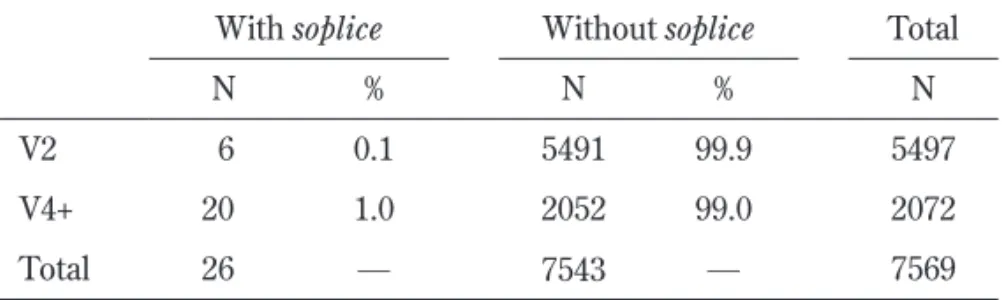
(Walkden 2014: 101) Some parts of his investigation is shown in Table 2 and 3 as follows:
Table 3. Frequency and percentage of V2 vs. V4+ declarative main clauses with and without witodlice in early OE
With soþlice Without soþlice Total
N % N % N
V2 6 0.1 5491 99.9 5497
V4+ 20 1.0 2052 99.0 2072
Total 26 ̶ 7543 ̶ 7569
(Walkden 2014: 102; Table 3.3 and Table 3.4) Table 2. Frequency and percentage of V2 vs. V4+ declarative main
clauses with and without soþlice/soðlice in early OE
With soþlice Without soþlice Total
N % N % N
V2 8 0.1 5489 99.9 5497
V4+ 24 1.2 2048 98.8 2072
Total 32 ̶ 7537 ̶ 7569
Table 3. Frequency and percentage of V2 vs. V4+ declarative main clauses with and without witodlice in early OE
With soþlice Without soþlice Total
N % N % N
V2 6 0.1 5491 99.9 5497
V4+ 20 1.0 2052 99.0 2072
Total 26 7543 ̶ 7569
(Walkden 2014: 102; Table 3.3 and Table 3.4)
The examples of verb-late clauses including soþlice and witodlice from early OE are as follows:
(10) He þa soþlice oðre þara flascena he then truly other.ACC the.GEN bottles.GEN þam halgan were brohte
the.dat holy.dat man.dat brought
‘He then truly brought one of the bottles to the holy man’
(cogregdC, GD_2_[C]:18.141.28.1696)
(11) Þa witodlice æfter þæs lichaman æriste be then certainly after the.GEN body.GEN awakening.DAT of Lazares wundrum & mægnum wæs ætswiged L.gen wonders.dat and virtues.dat was kept-silent
‘Then, certainly, we hear nothing of Lazarus’s wonders and virtues after his bod’s resurrection’
(cogregdC, GDPref_and_3_[C]:17.2.17.17.2929) Walkden argues for the result of his investigation as follows:
Speaker-oriented adverbs occur in verb-late clauses with a frequency that is very clearly not due to chance, then. This is not a property of all adverbs, since the manner adverb swiðe/swiþe ‘severely, terribly’ does not pattern this way: the difference between V2 and V4+ clauses with regard to the frequency of occurrence of this adverb is not close to significance …
(Walkden 2014: 103) Walkden also shows the frequency of first and non-first pronouns in V2 and V4+ (verb-late) main clauses in early Old English as in Table 4.
Walkden explains the data both semantically and syntactically as follows:
[This data] clearly indicates that for OE at least there was an interpretative distinction between at least some verb-late clauses and clauses in which the verb moved to the left periphery. Furthermore, it is not inconsistent with the hypothesis that verb-movement to the left periphery in declaratives was linked to the assertion of the main proposition of the clause, whereas in clauses in which the main proposition was presupposed, such as expres- sives/evaluatives, verb-movement did not take place. Speaker-oriented adverbs, which presuppose the main proposition, and first person pronouns, which are naturally likely to occur in evaluatives, occur with greater-than- chance frequency in clauses with unmoved finite verbs.
In syntactic terms we can state this in terms of Fin0 lacking a [uV]
feature in these clauses. Since the features of the verb are then no longer a subset of the features of Fin0, head-movement fails to take place. We can think of this non-verbal exponent of Fin0 as a null complementizer, which, following Roberts (1996), raises to Force0 for reasons to do with its clause- typing role.
(Walkden 2014: 105̶6)
In sum, though Fin0 itself exists in the sentence structure, the analysis of which is opposed to Kiparsky (1995), it moves not accompanying any verb to F0
Table 4. Frequency and percentage of V2 vs. V4+ declarative main clauses with first and non-first person subject pronouns in early OE
1st 2nd/3rd Total
N % N % N
V2 305 14.0 1874 86.0 2179
V4+ 223 22.5 767 77.5 990
Total 528 ̶ 2641 ̶ 3169
(Walkden 2014: 105; Table 3.9)
position in verb-late or verb-final sentences in Old English. The problem to be left is how this word order historically developed, which should be explained in historical sociolinguistics.
2 No direct evidence of the Influence on Old English from Celtic Languages in Britain
Bede and his predecessor Gildas provided us with the history of the early ages of Britain, which many linguists have assumed to be the basis on which English developed. However, we should reconsider such views, which Oppen- heimer (2006) criticises as follows:
This is where one of the most deeply embedded of British roots myths comes in: namely, that the English story starts late in the day with Angles, Saxons and Jutes, as inferred from the illuminated writings of the Dark Age clerical historians Gildas (sixth century ad) and the Venerable Bede (seventh century).
(Oppenheimer 2006: 9)
The Anglo-Saxons arrived in Britain in 449 AD, bringing the English language with them. Bede recorded this event in his Ecclesiastical History of the English People as follows:
It was 449 years after our Lord’s incarnation, when the emperor Martianus succeeded to the throne, which he occupied for seven years. He was the forty-sixth from the emperor Augustus. At that time the Angles and Saxons were called in by the aforesaid king, and arrived in Britain with three great ships. They received settlements on the east side of the island by order of the same king, who had invited them here, to fight as for their country.
They at once took the field against the foe, who had often before overrun the land from the north; and the Saxons won the victory. Then they sent home messengers, whom they bade to report the fertility of this land, and
the cowardice of the Britons. Immediately a larger fleet was despatched here, with a stronger force of warriors; and the host when united overpowered resistance. The Britons gave and assigned to them settlements among themselves, on condition of fighting for the peace and safety of their country and resisting their enemies, while the Britons also provided them with a maintenance and estates in return for their labours.
(Miller (trans.) 1890: 51, 53) Bede also described the Germanic tribes that landed in Britain as follows:
The new-comers were of the three strongest races of Germany, namely, Saxons, Angles and Jutes. Of Jutish origin are the men of Kent, and the Wihtsætan; that is the tribe dwelling in the Isle of Wight. From the Saxons, that is from the people called Old Saxons, came the East Saxons, the South Saxons, and the West Saxons; and from Angle came the East Angles and the Middle Angles, Mercians, and the whole race of the Northumbrians.
(Miller (trans.) 1890: 51)
The Anglo-Saxons took control of Britain in a non-peaceful way. Bede recorded the destruction of cities and the slaughter of Britons by the Anglo- Saxons as follows:
So then here almost every city and district was wasted by this impious people, though it was by the just judgment of God. Buildings both public and private collapsed and fell; by every altar priests and clergy were slain and murdered. Bishops and people, without regard for mercy, were destroyed together by fire and sword; nor was there anyone who bestowed the rites of burial on those so cruelly slaughtered. Many of the miserable survivors were captured in waste places, and stabbed in heaps.
(Miller (trans.) 1890: 53, 55) Based on Bede’s articles, it has been generally believed that after some resistance, the Anglo-Saxons wiped out the Britons who had been native dwellers
in Britain.
However, recently, an argument against the extinction of the Britons has been made on the basis of anthropological research. Oppenheimer (2006) calls this traditional view the ‘wipeout theory’, against which he argues as follows:(1)
There is a reasonable linguistic evidence for the presumption that there were ‘Celts’ living in England before and during the Roman occupation. But then, in the absence of any other linguistic evidence, this firms up to the modern linguistic view that before the Roman invasion all rather than some Ancient Britons were ‘Celts’ and Celtic-speaking.
… [T]he Celts were totally eradicated̶culturally, linguistically and geneti- cally̶by invading Angles and Saxons. This sort of logic derives partly from the idea of a previously uniformly ‘Celtic’ English landscape …
(Oppenheimer 2006: 10, 11)
We will further discuss the Celtic influence on Old English in the next section.
3 Linguistic Evidence in Non-Literature
There is little linguistic evidence that shows the traces of Celtic languages in Britain, because no literature written in Celtic languages was left in Britain before the Anglo-Saxon Invasion. This matches well with the legend of the ancestors of the Anglo-Saxons, as narrated in The Battle of Brunamburh in The Anglo-Saxon Chronicle Manuscript A (AD 937). This is a typical case that shows that the wipeout theory was well established among the English people in the period of Late Old English. This is shown in the following excerpt:
… Never yet in this island was there a greater slaughter of people felled by the sword’s edges,
before this, as books tell us,
old authorities, since Angles and Saxons
came here from the east,
sought out Britain over the broad ocean.
Warriors eager for fame, proud war-smiths, overcame the Welsh, seized the country.
(Swanton (Trans.) 2000: 106, 109̶10)
The wipeout theory seems to be correct from the linguistic point of view, which is stated as follows:
… [A]t least in parts of England, contact between the two peoples (the Anglo-Saxons and the Celts) must have been fairly intimate and must have persisted over several generations. Nevertheless, the traces Celtic has left on the emerging Anglo-Saxon dialects are minimal … And as to loans, the number of those that have been identified with certainty is so low that we can afford to give a complete list. It is only in the domain of place-names that the influence is substantial …
(Kastovsky 1992)
Oppenheimer (2006: 328) illustrates the distribution of place names influ- enced by Celtic (British) and other languages, which is shown in Figure 1.
According to his explanation, this map shows a comparatively low rate of Celtic (British) attribution in southern England. There are only six definitely British (i.e. Celtic) names in the south, excluding the West Country.
Oppenheimer gives another theory for the lack of linguistic evidence of Celtic in Britain from an archaeological point of view, based on coinage and stone inscriptions. The distribution of coinage is illustrated in Figure 2.
Figure 1: The Distribution of Place Names in England (Oppenheimer 2006: 328, Figure 7.2)
According to Oppenheimer’s description (2006: 333), the map illustrates the distribution of Gallo-Belgic type E coins that appeared in southern England in 55 BC as payment for English support against Caesar’s Belgic campaign.
This provides archaeological evidence that the native Britons had strong connections with the Belgae on the Continent before the Anglo-Saxon invasion.
Oppenheimer argues as follows:
Figure 2: Map of Gallo-Belgic type E coins (Oppenheimer 2006: 333, Figure 7.3b)
The geographical distribution of the time-focused Gallo- Belgic E coins (and, to a lesser extent, of C coins) is nonetheless broad and matches the overall British distribution of Gallo-Belgic coinage during the Roman period (Figure [2])… If both the Belgae and the British south-east were Celtic-speaking, that closeness might be expected, but if the Belgae were not Celtic-speaking or, as Caesar suggests, were largely descended from Germans, then it would make less sense̶unless some tribes of south- eastern England also spoke Germanic
(Oppenheimer 2006: 331, 332)
The language of inscriptions in stone in the time of Roman Britain and later was Latin, not Celtic, in southern, central, and northern England, which is shown in Figure 3.
Oppenheimer recognises the almost non-existence of Celtic inscriptions as evidence that Celtic languages were not spoken in England during that time (AD 400̶1100), which he describes as follows:
During the Roman period, all inscriptions in south-east Britain were in Latin, none in Celtic. By the time they started up again in England after the Roman exit, they were in Medieval Latin or Anglo-Saxon. This leaves a near-total absence of Celtic inscriptions in England and also large parts of Scotland, at any time.
(Oppenheimer 2006: 336̶7)
If there are plenty of Latin and Celtic inscriptions from after the Roman collapse in all other Romanized regions of the British Isles, why are there no post-Roman inscriptions, Latin or Celtic, to speak of in England until the first runic (i.e. non-Celtic) stones, which appear later? Surely the Anglo- Saxon invasions were not a complete and instantaneous blitzkrieg. Even the most avid supporters of the Anglo-Saxon wipeout theory accept that it could have been possible only over several hundred years. If Celtic languages
Figure 3: Distribution of over 1,200 Celtic inscriptions on stone in the British Isles and Brittany (AD 400̶1100) (Oppenheimer 2006: 336, Figure 7.4)
were spoken universally in England throughout the Roman occupation, surely they would have initially persisted, as in Cornwall and Wales, for several hundred years before succumbing to Anglo-Saxon? … Given that neither Latin nor Celtic words intruded much into Old English, there is the possibility that a third, pre-existing and more closely related (i.e. Germanic) language survived in England during Roman times, one which could hybridize more easily with the incoming Germanic influences from the Continent.
(Oppenheimer 2006: 337, 339)
As we have seen in the linguistic evidence presented by Oppenheimer, there is almost no evidence that the native Britons had used Celtic languages during the Roman period and after the retreat of the Roman Empire before the Anglo- Saxon invasion. Therefore, another theory is needed to explain the few traces of Celtic languages in England, instead of the wipeout theory of the Britons. If the theory deduced by Oppenheimer is correct, the Saxons’ settlement in Britain did not begin with the invasion in the way that Gildas and Bede recorded. The new theory leads to a change in the conventional explanation of the beginning of Old English, which will be discussed in the next section.
4 Reconsideration of the Age of Introduction of the English Language
As seen in the previous section, there is no clear evidence of the great slaughter of the Britons by the Anglo-Saxons. The age of introducing English in Britain should be reconsidered because the articles in Bede cannot be inter- preted directly to describe the age of introducing English. Oppenheimer, quoting Foster, Polzin, and Röhl (2006), explains why there is no clear evidence of Celtic languages in England before AD 449.
This study is a very interesting contrast to the widespread theory that English was made in AD 449, which is recorded as the year of the Anglo-Saxon invasion of Britain. Their theory is based on the distances between German languages, including Old English, by measuring the degree of similarity in the
basic vocabulary. The result of their study is illustrated in Figure 4.
Icelandic
Network of Germanic languages based on differeces in vocabulary
> AD 900
< AD 1250
> AD 516
< AD 1000 AD 890
AD 350 AD 825
Old Norse
Faroese
Nynorsk Bokmal
Danish
Swedish English
ALFRED
Heliand
BEOWULF
Gothic
West Frisian Dutch
Saterfrisian
Low German High German
Swiss Bavarian
Figure 4: Germanic Vocabulary Network(2) (Oppenheimer 2006: 342, Figure 8.1b)
Figure 4 illustrates that the language of Ælfred’s circle, which has been recognised as the standard of Early Old English, is distant not only from that of Beowulf but also Late Old English, from which English developed into Middle and Modern English through many processes. Oppenheimer reviewed their study as follows:
Germanic vocabulary network suggests English as a fourth Germanic branch. Based on vocabulary similarity, Forster’s network groups all Conti- nental West Germanic languages close to each other and relatively near to Old German (Heliand poem). However, Old English (Beowulf /Æ[l]fred) was already diverse, and as Far from Old German as the latter is from Frisian̶even beyond the Gothic branch. English appears to form a fourth branch splitting off closer to Scandinavian languages than the others.
(Oppenheimer 2006: 342)
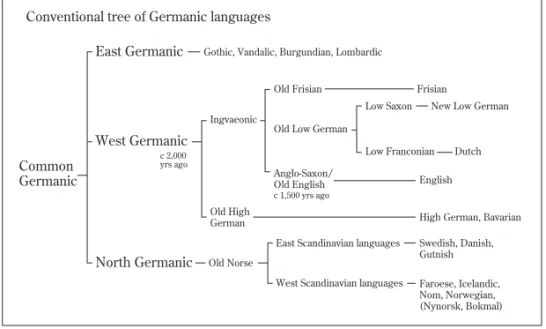
Oppenheimer proposes modifying the conventional tree of Germanic languages as shown in Figure 5, and proposes Figure 6 as an alternative.
Conventional tree of Germanic languages East Germanic
West Germanic Common
Germanic
North Germanic
Gothic, Vandalic, Burgundian, Lombardic
Ingvaeonic
Old High German
Old Norse c 2,000
yrs ago
c 1,500 yrs ago
High German, Bavarian East Scandinavian languages Swedish, Danish,
Gutnish Faroese, Icelandic, Nom, Norwegian, (Nynorsk, Bokmal) West Scandinavian languages
Old Frisian
Old Low German
Low Saxon
Low Franconian Dutch New Low German
Anglo-Saxon/
Old English English
Frisian
Figure 5: Conventional Germanic language tree (Oppenheimer 2006: 341, Figure 8.1a)
The date of the earliest English is assumed to be around the arrival of the Anglo-Saxons in AD 449. In contrast to Figure 5, Figure 6 shows that pre-Old English is assumed to have branched off from Common Germanic as well as the ancestors of Other Germanic.
Figure 6: Germanic tree four-branch reconstruction based on Figure [4](3) (Oppenheimer 2006: 343, Figure 8.1c)
Tree of Germanic languages based on network in Fig 8.1b
Pre-English/
Island Germanic Gothic AD 350
Old German
Common Norse AD 825
East Anglian > AD 516 (BEOWULF) Wessex AD 890 (ALFRED)
Old Icelandic
> AD 900 German (modern)
High German Swiss Bavarian Sater Frisian Dutch West Frisian
English Iceland Nynorsk Faroese
Swedish, Danish, Bokmal Common
Germanic
< 5,600 years
> 1,650 years ago
Oppenheimer explains Figure 6 as follows:
When the Germanic network is viewed as a tree, there are four branches rather than the conventional three, with a new pre-English ‘Island Germanic’. Forster argues that the break-up of these four can be no younger than the Gothic Bible (ad 350), and thus older than the ‘Anglo-Saxon invasion’, and possibly as much as 4,000 years old.
The discussion by Oppenheimer and others makes clear the distinctive character of Early Old English literature by the Ælfredian circle, which has been treated as the chronological ancestor of Late Old English. If their analysis
is correct, Ælfredian literature should be assumed to reflect the Wessex dialect, which can be traced back to before the Anglo-Saxon invasion in 449 AD.
Oppenheimer claims that Old English is not descended from Old Saxon, which was brought to Britain through the Anglo-Saxon invasion as follows:
This might mean that the connection between Old English and the ancestral Common Germanic root predated the arrival of the Angles and Saxons.
English would then be neither directly descended from Old Saxon nor from Scandinavian (i.e. Old Norse).
(Oppenheimer 2006: 354)
Oppenheimer does not discuss the scenario about the language contact between the language which the Britons spoke and a Germanic language which the Saxons spoke in Wessex, which will make clear the connection between pre-Old English and the language of the Wessex dialect, on the basis of which Ælfredian literature was mainly made. This problem will be discussed from a historical sociolinguistic point of view in the next section.
5 Language Contact between the Britons and the Saxons
The theory of the immediate introduction of English after the invasion as suggested by the wipeout theory should be reconsidered from a dialectological point of view. Though the Wessex dialect has been recognised as the canonical language in Early Old English, there is some possibility that the Wessex dialect was established in another way. This possibility should be inferenced from the history of the settlement of the Saxons in Britain in the Latin version of Bede. A translation of this is shown as follows:
The 449th year of the incarnation of our Lord, Marcian having with Valen- tinian obtained the kingdom, the 46th in succession from Augustus, held it seven years. In whose time the nation of the English or Saxons,(4) being sent for of the said king into Britain, landed there in three long ships, and
by the same king’s commandment is appointed to abide in the east part of the island, as to defend the country like friends, but indeed, as it proved afterward, as minded to conquer it as enemies. Encountering therefore with the enemy who had come to battle from the north, the Saxons had the better. Whereof they sending word home, as also of the batfulness of the island and the cowardice of the Britons, the Saxons forthwith sent thither a larger navy with a stronger band of men-at-arms, which being now joined with the former company, drew to a stronger army than the Britons were able to overcome. They then who came were allowed by the Britons a place to dwell among them, with that condition that the one should war for the peace and safety of the country against the enemy, the other should pay them due wages for their warfare. Now the strangers had come from three of the more mighty nations in Germany, that is, the Saxons, the Angles and the Jutes. Of the Jutes came the people of Kent and the settlers in Wight, that is the folk that hold the Isle of Wight, and they which in the province of the West Saxons are called unto this day the nation of the Jutes, right over against the Isle of Wight. Of the Saxons,(5) that is, of that region which now is called of the Old Saxons, descended the East Saxons, the South Saxons and the West Saxons. Further, of the Angles, that is, of that country which is called Angeln(6) and from that time to this is said to stand deserted between the provinces of the Jutes and the Saxons, descendeth the East Angles, the Uplandish Angles, the Mercians and all the progeny of the Northumbrians, that is, of that people that inhabiteth the north side of the flood Humber, and the other nations of the Angles.
(Translation by King 1979: 69̶70; emphasis added)
The first underlined part, ‘the nation of the English or Saxons’, is translated from Anglorum sive Saxonum in the Latin version, which is slightly, but crucially, different from the Old English version ‘the Angles and Saxons’ in Miller’s translation in Section 1. The expression in the original Latin version implies that Saxons were the only settlers from the Continent to Britain in the early stages of the settlement, along with the note by King for this part.
The second underlined part of the Latin says that the Angles came to Britain
with the Saxons, and the Jutes, coming to Britain for the first time after the Saxons, sent word to their country on the Continent. The Angles did not take part in the first expedition. They joined the second expedition for invasion.
It is generally believed that the Saxons had already settled before the Anglo- Saxon invasion in 449 AD. It is unthinkable that there was language contact between the Saxons and the native Britons in the area called the Saxon shore.
It is difficult to know which language the Saxons spoke in their settlement area. It is quite plausible that their language was influenced by language contact with the Britons’ language, which would cause the differences in the Wessex and Anglian dialects.
One of the differences in phonology is illustrated as follows:
Proto-Germanic æ- (so-called æ-) is reflected in WS as dæ-d ‘deed’ stræ-t ‘road, street’, Old Anglian de-d, stre-t.(7)
It is remarkable that the WS word stræ-t apparently comes from the Latin strata, where the vowel pronunciation resembles WS stra-t more than the Old Anglian stre-t. The contrast that WS scyppend ‘creator’ vs non-WS scepen(d), which was derived from the former by rounding, may represent the influence of the language contact.(8)
Trudgill (2016) discusses the language the Britons spoke as follows:
British Latin, Schrijver [(2009)] suggests, was extremely widely used by Celts, especially the upper classes, as a native language or second-language lingua franca. …[T]he arguments for a certain amount of Latin-Old English contact is a strong one. …[I]t has been argued that British Vulgar Latin continued to be spoken by Romanized Celts well after the beginning of the fifth century, and even for long after that.
(Trudgill 2016: 324̶5)
It is natural that the Wessex dialect in Old English reflects the result of the language contact if the Saxons began to settle and communicate with the Britons before the Anglo-Saxon invasion. But the problem should be what language
influenced the pre-OE, which the Saxons spoke.
6 Conclusion
I investigated the word orders in the Old English Orosius, which was one of early Old English prose literature and rendered from the Latin original by Ælfredian circle with mainly the Wessex dialect. The results of the investigation of the Old English Orosius Book 1 are illustrated in Table 5.
V1 V2 Non_V2 V-final
expletive Impers0 0
pronoun And... Others SV Wh V And... Ac... Others SV 0
pronoun And... Ac... Others And... Ac...
12 − − 1 − − 2 − − − − 2 1 − 1 − 2 − −
13 − − − − − 2 − − − 2 − − − − − − − −
14 − − − − − − − 1 − − − − − − − 1 1 −
15 1 − − 1 1 1 − 2 3 5 − − − − − − 1 −
16 2 − − − 1 1 − − − 1 − − − − 1 − − −
17 1 − − − 1 9 − 1 − 5 2 − − − 1 1 − 1
18 − − − − 2 3 3 1 − 3 3 − − − 2 1 2 −
19 1 − − − 1 − − − − 1 − − − − − − − −
110 − − 1 − 1 3 − − − 7 7 − 1 − 2 3 − −
111 1 − 1 − 1 − 1 − − 1 − − − − 1 2 1 −
112 − − − − 1 4 1 1 1 4 4 − 1 2 − 2 1 1
113 1 − − − − − − − − 1 − − − − − − − −
114 − − 1 − − 2 − − − 2 − − − − 1 − − −
SUM 7 0 4 1 9 27 5 6 4 32 18 1 2 3 8 12 7 2
Table 5. Word Orders in Main Clauses in the Old English translation of Orosius
Book 1. 1 was excluded from the investigation displayed in Table 1 because it includes some parts that were originally written in Old English, and Book 1.
1 consists of geographical articles, which were modified from the original Latin version.
Each type of word order classified in Table 1 was not examined in detail because this study focused on the question of the influence of Latin word order in an Old English translation. While verb-first and verb-final word orders
generally are not typical of Old English literature, they are frequently found in the Old English translation of Orosius. Verb-final word order in Old English is generally found in subordinate clauses rather than main clauses.
As the comparisons between the Old English and the original Latin version were examined, the direct influence on word orders in Old English from Latin cannot be recognised. If the language of early Old English literature such as Orosius reflects the Wessex dialect to a considerable degree, we can make the assumption that the language that the Saxons used in Wessex had already diverged from that which the Angles used.
There is no direct evidence which is available for us to investigate the earliest stage of pre-OE when the language contacts between the native Britons and the Saxons, who started to settle in Britain. But some peculiar linguistic phenomena, such as verb-final word order in main clauses in early Old English prose, can be thought a consequence of the language contact between them if the language which the Britons spoke was British Latin or highly influenced Celtic by Latin.
I have argued for the assumption in Kobayashi (2017) as follows:
The Saxons had started to settle on the Saxon shore before the Anglo-Saxon invasion in 499 A.C. recorded by Bede, according to the historical theory on which Oppenheimer (2006) depends.(9) The Wessex dialect can be assumed to have been formed through linguistic contacts with the Britons and the Romans, who inhabited the area when the Saxons started to settle in the region. It is assumed that this process influenced the characteristics of the language in early Old English literature.
Such scenario of the language contacts seems quite plausible. As Kiparsky’s original analysis has been challenged, though the verb-final word order in early Old English cannot reflect the syntactic development of pre-Germanic language, from which Germanic languages including OE diverged, the origin of the Wessex dialect is assumed to be established through the language contacts between the Britons and the Saxons before the Anglo-Saxon invasion in 449 AD.
Notes
(1) Sykes (2006: 337) also argues from an anthropological point of view as follows:
I estimate that approximately 10 per cent of men now living in the south of England are the patrilineal descendants of Saxons or Danes, while above the Danelaw line the proportion increases to 15 per cent overall, reaching 20 per cent in East Anglia. … The roughly twofold excess of Saxon/Danish Y-chromosomes compared to their maternal counterparts hints at a partially male-driven settlement with some elimination or displacement of the indigenous males. But the slaughter, if slaughter there was, was not total and still there are far more people with Celtic ancestry in England, even in the far east, than can claim to be of Saxon or Danish descent.
(2) This figure was simplified from Foster, Polzin, and Röhl (2006), Figure 11.3.
(3) This figure was made by Oppenheimer based on research by Gray and Atkinson (2003) and others.
(4) Footnote 2 in King (1930: 68̶9) notes the following: The coast from Hampshire to the Wash was known in Roman times as the Saxon Shore, and there may well have been Saxon settlements in Britain before 450.
(5) King (1930: 70) notes Holstein on Old Saxon.
(6) King (1930: 70) notes Slesswick on Angeln.
(7) See Smith (2009: 67).
(8) Filppula, Klemola and Paulasto (2008: 28) comment that Schrijver (1999), who examines the contact background of front rounded vowels in different dialects of Old English as features that might be due to early substratal influences.
(9) There are two theories about the Saxon shore. According to the first theory, the Saxon shore was named after the Saxons because the region had been invaded by them. On the other hand, the second theory proposes that the Saxon shore was named after them because they had settled in the region.
References
Axel, K. (2007). Studies on Old high German Syntax: Left Sentence Periphery, Verb Placement and Verb-Second. Amsterdam: Benjamins.
Cichosz, A. (2010). The Influence of Text Type on Word Order of Old Germanic Languages: A
Corpus-based Contrastive Study of Old English and Old High German. Frankfurt: Peter Lang.
Dyen, I., Kruskal, J. B. and Black, P. (1992). ‘An Indoeuropean Classification: A Lexicostatis- tical Experiment,’ Transactions of the American Philosophical Society, 82: Part 5.
Eythórsson, T. (1995). Verbal Syntax in the Early Germanic Languages. Ph. D. dissertation, Cornel University.
Eythórsson, T. (1996). ‘Functional Categories, Cliticization, and Verb Movement in the Early Germanic Languages’, in Thráinsson, Peters, and Epstein (eds.) (1996). Studies in Comparative Germanic Syntax, Vol. II. Dordrecht: Kluwer.
Eythórsson, T. (2001). ‘TheSyntax of Verbs in Early Runic’, Working Papers in Scandinavian Syntax 67: 1̶55.
Ferraresi, G. (2005). Word Order and Phrase Structure in Gothic. Leuven: Peeters.
Filppula M., Klemola, J., and Paulasto, H. (2008). English and Celtic in Contact. New York:
Routledge.
Fischer, O., A. van Kemenade, W. Koopman, and W. van der Wurff (2000). The Syntax of Early English. Cambridge: Cambridge University Press.
Forster, P., Polzin, T. and Röhl, A. (2006). ‘Evolution of English basic vocabulary within the network of Germanic languages’, in Forster, P. and Renfrew, C. (eds.). Phylogenetic Method and the Prehistory of Languages, 131̶7. McDonald Institute Monograph Series.
Cambridge: McDonald Institute for Archaeological Research.
Gray, R. and Atkinson, Q. (2003). ‘Language-Tree Divergence Times Support the Anatolian Theory of Indo-European Origin,’ Nature, 426; 435̶9.
Hogg, R. M. (ed.) (1992). The Cambridge History of the English Language. Volume 1.
Cambridge: Cambridge University Press.
Kastovsky, D. (1992). ‘Semantics and vocabulary,’ in Hogg, R. M. (ed.), The Cambridge History of the English Language. Volume 1, 290̶408. Cambridge: Cambridge University Press.
Kemenade, A. van (1987). Syntactic Case and Morphological Case in the History of English.
Dordrecht: Foris.
King, J. E. (ed. and trans.) (1930, Repr. 1979). Baedae Opera Historica I, Cambridge, Massa- chusetts: Harvard University Press; London: William Heinemann Ltd.
Kiparsky, P. (1995). ‘Indo-European Origins of Germanic Syntax,’ in Batteye, A. and Roberts, I. (eds.) Clause Structure and Language Change, 140̶69. New York: Oxford University Press.
Kobayashi, S. (2017). ‘Syntactic Development and Verb-Final Word Order in Early Old English Main Clauses,’ Seigakuin Ronso (The Journal of Seigakuin University), 30̶1:
101̶12.
Marsden, R. (2004). The Cambridge Old English Reader. New York: Cambridge University
Press.
McMahon, A. and McMahon, R. (2003). ‘Finding Families: Quantitative Methods in Language Classification,’ Transactions of the American Philosophical Society, 101: 7̶55.
Miller, T. (ed. and trans.) (1890, Repr. 1990). The Old English Version of Bede’s Ecclesiastical History of the English People Part I. The Early English Society. London, New York, Toronto: Oxford University Press.
Mitchell, B. (1985). Old English Syntax Vol II. Oxford: Clarendon Press.
Oppenheimer, S. (2006). The Origins of the British. London: Robinson.
Ringe, D. and Taylor, A. (2014). The Development of Old English: A Linguistic History of English, Vol. II. New York: Oxford University Press.
Roberts. I. (1996). ‘Remarks on the Old English C-system and the Diachrony of V2’, in Brandner E. and Ferraresi, G. (eds.), Language Change and Generative Grammar.
Linguisticche Berichte, Sonderheft 7. Opladen: Westdeutscher Verlag, 154̶64.
Roberts, I. (2007). Diachronic Syntax. Oxford: Oxford University Press.
Schrijver, P. (1999). ‘The Celtic Contribution to the Development of the North Sea Germanic Vowel system, with Special Reference to Coastal Dutch,’ Nowele, 35: 3̶47.
Schrijver, P. (2009). ‘Celtic Influence on Old English: Phonological and Phonetic Evidence,’
in Fippula, M. and Klemola, J. (eds.), Re-evaluating the Celtic Hypothesis, Special Issue of English Language and Linguistics, 13(2): 193̶211.
Smith, J. (2009). Old English: A Linguistic Introduction. New York: Cambridge University Press.
Swanton, M. (trans. and ed.) (2000). The Anglo-Saxon Chronicles, Revised Edition. London:
Phoenix Press.
Sykes, B. (2006). Blood of the Isles: Exploring the Genetic Roots of Our Tribal History.
London: Transworld Publishers.
Traugott, C. E. (1992). ‘Syntax,’ in Hogg, R. M. (ed.), The Cambridge History of the English Language. Volume 1, 168̶289. Cambridge: Cambridge University Press.
Trudgill, P (2016). ‘Contact-Related Processes of Change in the Early History of English,’ in Kytö, M. and Pahta, P. (eds.) The Cambridge Handbook of English Historical Linguistics, 318̶34. Cambridge: Cambridge University Press.
Walkden, G. (2009). The Comparative Method in Syntactic Reconstruction. M.Phil.
dissertion. University of Cambridge.
Walkden, G. (2014). Syntactic Reconstruction and Proto-Germanic. New York: Oxford University Press.


![Figure 6: Germanic tree four-branch reconstruction based on Figure [4] (3) (Oppenheimer 2006: 343, Figure 8.1c)](https://thumb-ap.123doks.com/thumbv2/123deta/6487728.2154393/23.739.97.641.254.574/figure-germanic-branch-reconstruction-based-figure-oppenheimer-figure.webp)

