
• 検索結果がありません。

Distribution of Tintinnids (Loricate Ciliates) inEast Asian Waters in Summer

N/A
N/A
Protected

Academic year: 2021

シェア "Distribution of Tintinnids (Loricate Ciliates) inEast Asian Waters in Summer"

Copied!
8
0
0

読み込み中.... (全文を見る)

全文

(1)

173 Eds., A. Ishimatsu and H.-J. Lie, pp. 173–180.

© by TERRAPUB and Nagasaki University, 2010.

Distribution of Tintinnids (Loricate Ciliates) in East Asian Waters in Summer

Joon-Baek L EE and Yo-Hae K IM

Department of Earth and Marine Sciences, College of Ocean Sciences, Jeju National University, Jeju, 690-756 Korea

Abstract—The distribution of planktonic ciliates, tintinnids, was studied in the East China Sea, the southern Korean waters and the East Sea (the Sea of Japan) in summer. A total of 20 species of tintinnids occurred: 9 species were identified in the East China Sea, 9 species in the southern Korean waters, and 13 species in the East Sea, respectively. Quantitative and qualitative analyses by the QPS (Quantitative Protargol Stain) method revealed that the standing stocks of tintinnids ranged from 0 to 240 cells·L

–1

and showed a reverse relation with the distribution of chlorophyll a. Dominant species were Dadayiella ganymedes and Eutintinnus tubulosus in the East China Sea, Amphorides quadrilineata in the southern Korean waters, and Amphorellopsis acuta, Amphorides quadrilineata, and Salpingella sp. in the East Sea. Most species occurred during this investigation were warm-water species.

Oceanic tintinnids were mainly found in the southern and eastern Korean waters while neritic species in the East China Sea.

Keywords: tintinnids, planktonic ciliates, plankton distribution, the East China Sea, Korean waters, the East Sea, Sea of Japan

1. INTRODUCTION

Phytoplankton biomass and productivity are dominated by nanoplankton (Malone, 1980) and picoplankton (Stockner and Antia, 1986; Stockner, 1988). Planktonic ciliates are recognized to be major consumers of nano- and picoplankton (Fenchel, 1987). Namely, they are efficient transfers from the primary production to higher trophic levels. The ciliates are divided into two groups, tintinnids (loricate ciliates) and oligotrichs (naked ciliates). Tintinnids are the best known group of marine ciliates and recognized as indicator species of different water masses due to their hard loricae (Kato and Taniguchi, 1993). Several studies have shown the food of tintinnids to include bacteria (Hollibaugh et al., 1980), diatoms and dinoflagellates (Heinbokel and Beers, 1979; Stoecker et al., 1981, 1983, 1984), and other smaller protozoans.

Strong positive correlations between phytoplankton and tintinnid abundances have

been found (Kimor and Golandsky, 1977; Sorokin, 1977). Some tintinnids, especially

genus Favella, are specialized predators on small, bloom-forming dinoflagellates

(Stoecker et al., 1984). These tintinnids are important in the population dynamics of

some dinoflagellates, including some red-tide-forming species in Korean waters

(Yoo and Lee, 1987).

(2)

waters of the East China Sea. And it sometimes causes the lower salinity phenomenon around Jeju Island (formerly Cheju Island) especially in summer. The flow is known to affect the southern and even the eastern Korean waters. A study on tintinnid distribution is considered as a best approach which can indicate the flow of water mass in the open ocean like the East China Sea and the neighboring waters of Korea. In Korea, taxonomical studies on tintinnids have been done in Jinhae Bay (formerly Chinhae Bay; Yoo et al., 1988) and Youngil Bay (Yoo and Kim, 1990). There, however, are a few ecological studies (Kim et al., 2007; Kim and Jang, 2008) focused on distribution and dynamics in Korean waters. This study has been carried out to clarify the effect of the flow route from the mouth of Chang Jiang River to the East Sea (the Sea of Japan) in terms of planktonic ciliates' distribution.

2. MATERIAL AND METHODS

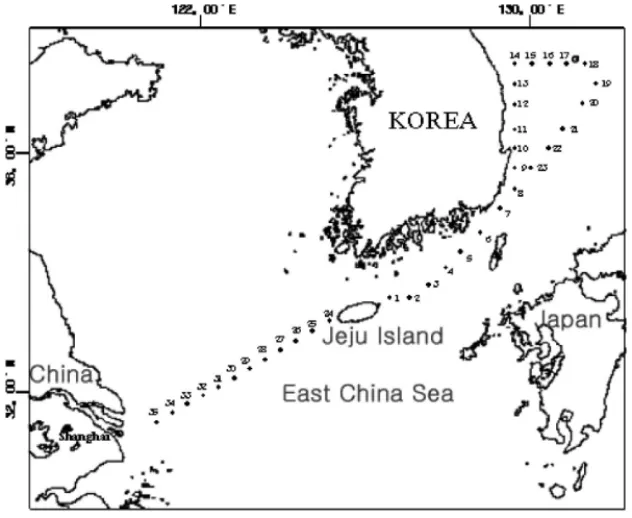
Sampling was done in the East China Sea (St. 24–35) on 28 to 30 June 1998, and in the southern Korean waters (St. 1–7) and in the East Sea (St. 8–23) from 26 August to 5 September 1998 on a cruise aboard using the R/V Ara-ho of Jeju National University (Fig. 1). Water samples were collected using Niskin water bottle at 0, 10, 30, and 50 m and then fixed immediately in 7% (v:v) Bouin’s fixative. For high reliability of species identification and counting, the fixed samples were stained by QPS (Quantitative Protargol Stain) method (Montagnes and Lynn, 1987). Tintinnids were identified and counted using a light microscope under a difference interference contrast (DIC). Identification and systematics of tintinnids were done based on Kofoid and Campbell (1929, 1939), Campbell (1942), Hada (1932a, b, c, 1935, 1937, 1938) and Sano (1975). For phytoplankton biomass, chlorophyll a were measured by the standard method of APHA et al. (1994) and calculated with µ g chl-a·L

–1

.

3. RESULTS AND DISCUSSION Species composition

A total of 20 species of tintinnids occurred during the sampling period. Nine species in the East China Sea, 9 species in the southern Korean waters, and 13 species in the East Sea were recorded, respectively (Table 1). Tintinnids from Korean waters were first described 27 species in Jinhae Bay (Yoo et al., 1988) and then serially reported 52 species in Youngil Bay (Yoo and Kim, 1990). As these prior investigations were accomplished over one or more years, the larger number of species was observed comparing with the samples for this study collected only during the summer from June to August.

Tintinnids occurred in the study area can be divided as neritic or oceanic species

according to ecological distribution type (Kim, 1986). Three oceanic species were

included in the East China Sea, whereas 9 oceanic species existed in the southern

Korean waters, and 10 in the East Sea (Table 1). In particular, the smallest number

of oceanic species was recorded in the East China Sea. The genera Tintinnopsis,

Stenosemella, Helicostomella, and Favella which have been found to be neritic or

(3)

restricted to relatively shallow waters (Pierce and Turner, 1992) were detected only in the study area. This result reveals that neritic tintinnids are largely distributed in the East China Sea, where Chang Jiang River and coastal waters from inland China affect this sea. Tintinnids, however, actually comprise a larger number of oceanic species than neritic species. Yoo and Kim (1990) also suggested that the larger number of oceanic species was distributed in Youngil Bay located in the East Sea rather than in Jinhae Bay in the southern Korean waters.

Based on the distribution to water temperature, tintinnids can be also grouped as cold- or warm-water species. From this study, cold- and warm-water species included 2 and 18 species, respectively (Table 1). There were one cold- and 8 warm-water species in the East China Sea, one cold- and 8 warm water species in the southern Korean waters, and one cold- and 12 warm-water species in the East Sea. Tintinnid species distributed in tropical and temperate waters display higher species composition.

Namely, the warm-water species is more diverse than cold-water one. Furthermore, because the sampling of this study was limited to the warm season and to 50 m depth above the thermocline, the higher composition of warm-water species might be easily understood. In general, the cold-water species are mainly found below 20 ° C (Hada 1960). Two cold-water species, Helicostomella subulata and Acanthostomella norvegica, revealed the different distribution in comparison with other reports.

Helicostomella subulata was detected in the East China Seas. This species was

Fig. 1. A map showing the sampling stations in the study area.

(4)

frequently observed in neritic area and cold season (Yoo et al., 1988; Yoo and Kim, 1990). Acanthostomella norvegica was detected in the southern Korean waters and the East Sea. This species is described as the most reliable indicator species of cold current from the Oyashio water (Kato and Taniguchi, 1993) and as the only tintinnid showing a bipolar distribution (Pierce and Turner, 1993).

Standing stocks

The maximum standing stocks showed 240 cells·L

–1

at 30 m depth in the East China Sea. The range of standing stocks from the southern Korean waters was 0 to 120 cells·L

–1

with the average of 37 cells·L

–1

. The maximum was recorded at the surface and the 10 m depth of St. 1 and 2. The standing stocks between sampling stations in the East Sea were quite different. The standing stocks varied from 0 to 240 cells·L

–1

, showing the maximum at the 30 m depth of St. 20.

Dominant species were selected on the basis of abundance with more than 60 cells·L

–1

from all the stations as follows; Amphorellopsis acuta, Amphorides

a

Yoo et al. (1988) reported a total of 27 species from Jinhae Bay

b
Yoo and Kim (1990) reported a total of 52 species from Youngil Bay

N/O: Neritic species/Oceanic species; C/W: Cold water species/Warm water species.

Species Name ECS South East Jinha

a

Youngil

b

N/O C/W

(St. 24–35) (St. 1–7) (St. 8–23) Bay Bay

Acanthostomella norvegica * * * O C

Amphorellopsis acuta * * * O W

Amphorides amphora * * * * O W

Amphorides minor * * * O W

Amphorides quadrilineata * * * O W

Amphorides sp. * * * * O W

Ascampbelliella urceolata * * * O W

Condonellopsis morchella * * N W

Dadayiella ganymedes * * * O W

Epiplocyloides reticulata * * O W

Eutintinnus tubulosus * * * * N W

Eutintinnus sp. * * * * N W

Favella sp. * * * N W

Helicostomella subulata * * * N C

Rhabdonella poculum * * O W

Salpingella subconica * * * O W

Salpingella sp. * * * * * O W

Stenosemella sp. * * * N W

Tintinnopsis beroidea * * * N W

Tintinnopsis parvula * * * N W

Number of species 9 9 13 12/(27)

a

20/(52)

b

(5)

quadrilineata, Dadayiella ganymedes, Eutintinnus tubulosus, and Salpingella sp.

(Table 2). Distribution patterns are quite different in each sea. Warm-neritic species dominated in the East China Sea, whereas warm-oceanic species were predominant in both the southern Korean waters and the East Sea.

Relationship with phytoplankton abundance

Figure 2 shows the fluctuation of chlorophyll a and tintinnid abundance in the southern and eastern Korean waters. Chlorophyll a means phytoplankton biomass in these stations. The chlorophyll a represented the range of 0.10–0.90 µ g·L

–1

(mean 0.38 µ g·L

–1

) and 0.00–0.70 µ g·L

–1

(mean 0.19 µ g·L

–1

) in the southern Korean waters and the East Sea, respectively. The fluctuation of phytoplankton and tintinnids is likely to be related, which means they show a reverse distribution in both waters based

Table 2. Distribution of dominant tintinnids at each sea during the study period.

Species Name ESC South East N/O C/W

(St. 24–35) (St. 1–7) (St. 8–23)

Amphorellopsis acuta * O W

Amphorides quadrilineata * * O W

Dadayiella ganymedes * O W

Eutintinnus tubulosus * N W

Salpingella sp. * O W

N/O: Neritic species/Oceanic species; C/W: Cold water species/Warm water species.

Fig. 2. Distribution of chlorophyll a and standing stocks of tintinnids on the surface layer in the southern

Korean waters and the East Sea in summer.

(6)

PLATE I

1. Tintinnopsis beroidea (length 60 µ m); 2. Tintinnopsis parvula (length 135 µ m); 3. Codonellopsis morchella (length 85 µ m); 4. Helicostomella subulata (length 70 µ m); 5. Acanthostomella norvegica (length 26 µ m); 6. Rhabdonella poculum (length 85 µ m); 7. Epiplocyloides reticulata (length 75 µ m);

8. Ascampbelliella urceolata (length 35 µ m).

on cell abundance. Stations having high phytoplankton abundance show relatively lower tintinnid abundance and vice versa. This suggests that the tintinnid might affect phytoplantkon abundance with respect to the relationship of prey-predator. There are only a few studies on the feeding relationships between these taxa in the culture system (Heinbokel and Beers, 1979; Stoecker et al., 1981, 1983, 1984), but rare in nature. Thus, some in situ observation data concerning the food chain between various taxa should be collected continuously to understand the microbial loop and the energy transfer in marine ecosystems.

Acknowledgement—This manuscript was written based on the paper published in the bulletin volume 23 of Jeju National University’s Marine Research Institute in 1999. We thank Dr. Kim Young-Ok for reading this paper and helping with identification of tintinnids.

REFERENCES

APHA, AWWA, APEC. 1994. Standard Methods for Examination of Water and Wastewater. 18th ed.

American Public Health Association, Washington, D.C., 1288 pp.

(7)

PLATE II

1. Amphorides amphora (length 160 µ m); 2. Amphorides minor (length 90 µ m); 3. Amphorides quadrilineata (length 135 µ m); 4. Amphorellopsis acuta (length 110 µ m); 5. Dadayiella ganymedes (length 103 µ m); 6. Eutintinnus sp. (length 100 µ m); 7. Salpingella subconica (length 140 µ m);

8. Salpingella sp. (length 100 µ m).

Campbell, A.S. 1942. The Oceanic Tintinnoina of the Plankton Gathered during the Last Cruise of the Carnegie. Carnegie Institution of Washington, Washington, D.C., 537( i–v), 163 pp.

Fenchel, T. 1987. Ecology of Protozoa. The Biology of Free-Living Phagotrophic Protists. Springer- Verlag, Berlin, 197 pp.

Hada, Y. 1932a. Descriptions of two new neritic Tintinnoinea, Tintinnopsis japonica and Tintinnopsis kofoidi with a brief note on a unicellular organism parasitic on the latter. Proceedings of The Imperial Academy 8: 209–212, 3 figs, in text.

Hada, Y. 1932b. The Tintinnoinea from Sea of Okhotsk and its neighbourhood. Journal of Faculty of Science, Hokkaido Imperial University, Ser. 4, 2(1): 37–59.

Hada, Y. 1932c. Report of biological survey of Mutsu Bay. 26. The pelagic Ciliata suborder Tintinnoinea.

Science Report, Tohoku Imperial University, 4th Ser., Biology, 7(4): 553–573.

Hada, Y. 1935. On the pelagic Ciliata, Tintinnoinea, from the East Indies with consideration on the character of the plankton in the seas. Bulletin of Japan Society of Scientific Fisheries 4(4): 242–252.

Hada, Y. 1937. The fauna of Akkeshi Bay. 4. The pelagic Ciliata. Journal of Faculty of Science, Hokkaido Imperial University, Ser. 4, Zoology, 5: 143–216.

Hada, Y. 1938. Studies on the Tintinnoinea from the western tropical Pacific. Journal of Faculty of Science, Hokkaido Imperial University, Ser. 6, Zoology, 6(2): 82–190.

Hada, Y. 1960. The pelagic ciliate from Antarctic waters. Antarctic Rec. 11: 141–145.

(8)

Hollibaugh, J.T., J.A. Fuhrman and F. Azam. 1980. Radioactively labeling of natural bacterioplankton for use in trophic studies. Limnology and Oceanography 25: 172–181.

Kato, S. and A. Taniguchi. 1993. Tintinnid ciliates as indicator species of different water masses in the western North Pacific Polar Front. Fisheries Oceanography 2: 166–174.

Kim, Y.O. 1986. Taxonomical Study on the Suborder Tintinnina (Ciliated Protozoa) in Korean Coastal Waters. Master Thesis, Hanyang University, Korea, 122 pp. (In Korean).

Kim, Y.O. and M.C. Jang. 2008. Temporal distribution of planktonic ciliates in Jangmok Bay, south coast of Korea. Ocean and Polar Research 30(4); 419–426.

Kim, Y.O., J. Chae, J.S. Hong and P.G. Jang. 2007. Comparing the distribution of ciliate plankton in inner and outer areas of a harbor divided by an artificial breakwater. Marine Environmental Research 64;

38–53.

Kimor, B. and B. Golandsky. 1977. Microplankton of the Gulf of Elat: aspects of seasonal and bathymetric distribution. Marine Biology 42: 55–67.

Kofoid, C.A. and A.S. Campbell. 1929. A Conspectus of the Marine and Freshwater Cilata Belonging to the Suborder Tintinnoinea, with Descriptions of New Species Principally from the Agassiz Expedition to the Eastern Tropical Pacific 1904–1905. University of California Publication in Zoology, 34, 403 pp.

Kofoid, C.A. and A.S. Campbell. 1939. Reports on the Scientific Results of the Expedtion to the Eastern Tropical Pacific in Charge of Alexander Agassiz, by the U.S. Fish Commission Steamer “Albatross”, from October 1904 to March 1905, Lieut.—Commander L.N. Garrett, U.S.N., Commanding.

XXXVII. The Ciliata: The Tintinnoinea. Bulletin of Museum of Comparative Zoology, 84: 473 pp.

+ 36 pls.

Malone, T.C. 1980. Size-fractionated primary productivity of marine phytoplankton. In: Primary Productivity in the Sea, P.G. Falkowski (Ed.). Plenum, New York, pp. 301–319.

Montagnes, D.J.S. and D.H. Lynn. 1987. A quantitative protargol stain (QPS) for ciliates: method description and test of its quantitative nature. Marine Microbial Food Webs 2: 83–93.

Pierce, R.W. and J.T. Turner. 1992. Ecology of planktonic ciliates in marine food webs. Reviews in Aquatic Sciences 6: 139–181.

Pierce, R.W. and J.T. Turner. 1993. Global biogeography of marine tintinnids. Marine Ecology Progress Series 94: 11–26.

Sano, A. 1975. Taxonomy of Tintinnida. Marine Science 7: 170–177.

Sorokin, Y.I. 1977. The heterotrophic phase of plankton succession in the Japan Sea. Marine Biology 41:

107–117.

Stockner, J.G. 1988. Phototrophic picoplankton: an overview from marine and freshwater systems.

Limnology and Oceanography 33: 765–775.

Stockner, J.G. and N.J. Antia. 1986. Algal picoplankton from marine and freshwater ecosystems: a multidisciplinary perspective. Canadian Journal of Fisheries and Aquatic Sciences 43: 2472–2503.

Stoecker, D., R.R.L. Guillard and R.M. Kavee. 1981. Selective predation by Favella ehrenbergii (Tintinnia) on and among dinoflagellates. The Biological Bulletin 160: 136–145.

Stoecker, D., L.H. Davis and A. Provan. 1983. Growth of Favella sp. (Ciliata: Tintinnina) and other microzooplankters in cages incubated in situ and comparison to growth in vitro. Marine Biology 75:

293–302.

Stoecker, D., L.H. Davis and D.M. Anderson. 1984. Fine scale of spatial correlations between planktonic ciliates and dinoflagellates. Journal of Plankton Research 6(5): 829–842.

Yoo, K.I. and Y.O. Kim. 1990. Taxonomical studies on tintinnids (Protozoa: Ciliata) in Korean coastal waters 2. Yongil Bay. Korean J.ournal of Systematic Zoology 6(1): 87–122.

Yoo, K.I. and J.B. Lee. 1987. On the trophic correlation between tintinnids and dinoflagellates in Masan Bay, Korea. Bulletin of Korean Fisheries Society 20(3): 230–236.

Yoo, K.I., D.Y. Kim and Y.O. Kim. 1988. Taxonomical studies on tintinnids (Protozoa: Ciliata) in Korean coastal waters. 1. Chinhae Bay. Korean J.ournal of Systematic Zoology 4(1): 67–90.

Joon-Baek Lee (e-mail: [email protected]) and Yo-Hae Kim

Fig. 1.  A map showing the sampling stations in the study area.
Table 2.  Distribution of dominant tintinnids at each sea during the study period.

参照

関連したドキュメント

The bacteria on the hexagonal plates O,1um in dtameter CC, arrows) and unicellular bacteria aiter 90 days

[r]

Key words: acorn worms, reproductive season, the Sea of Japan, synchronized spawning, tidal

Keywords: homology representation, permutation module, Andre permutations, simsun permutation, tangent and Genocchi

Standard domino tableaux have already been considered by many authors [33], [6], [34], [8], [1], but, to the best of our knowledge, the expression of the

The only thing left to observe that (−) ∨ is a functor from the ordinary category of cartesian (respectively, cocartesian) fibrations to the ordinary category of cocartesian

[56] , Block generalized locally Toeplitz sequences: topological construction, spectral distribution results, and star-algebra structure, in Structured Matrices in Numerical

Having this product and a product integral in a Fr´ echet space (see [6]), we obtain the exact formula (11) for the solution of problem (1), being an extension of a similar formula