Shadowing Approaches Inside and Outside of the Classroom
Devon Arthurson
Abstract: Shadowing is a technique which can aid ESL and EFL instructors and learners as it potentially assists in developing speaking, reading and listening skills simultaneously, in addition to being highly adaptable based on learners and instructors’ needs. This paper discusses the benefits and challenges of using shadowing inside and outside of the language-learning classroom. My personal experience using shadowing as a Japanese-language learner in self-study and as an EFL instructor at a university are described. Data regarding students’ opinions about shadowing is explored. Methods to implement shadowing are presented. In addition, possible applications of shadowing based on the number of students and their levels are also discussed; in addition to how the technique can be used for a class as a whole, small groups, pairs, individual or self-study. Also data gathered from Vietnamese participants in 2 shadowing presentations in March 2018 were compared with the JALT November 2018 workshop’s participants’ data about shadowing.
Keywords: shadowing, speaking, listening
1. Introduction
This paper will explore the ways foreign- or second-language instructors can incorporate the technique of shadowing into their lessons as well as their own and their students’
language self-study. Referencing Tami (1997), Zakeri (2014) defines shadowing as “an active and highly cognitive activity in which learners track the heard speech and vocalize it as clearly as possible at the same time that they hear it” (p.21). Shadowing’s benefits and challenges, my own experiences with shadowing as a Japanese-language learner and then as an EFL instructor are explored. Data about shadowing from Japanese learners, Vietnamese English language instructors and English language instructors teaching in Japan will also be presented. Furthermore, this paper will focus on discussing potential ways that ELF or ESL instructors and learners can use shadowing both inside and outside of the classroom based on an adaptable method along with various approaches.
2. Benefits
Shadowing has numerous benefits for language learning as a technique advantageous to both the learner and the instructor.
For the Learners
The technique has many advantages for the learner. Shadowing develops multiple skills to aid learners in language learning in addition to positive psychological effects. A major benefit is that it “contributes to the improvement of reading and speaking skills as well, because listening skills share its mechanism with these two skills, such as phonological coding and representation, and subvocal rehearsal” Kadota & Tamai (2004) (as cited in Hamada, 2009). With improved listening skills, learners can also develop their phoneme perceptions enabling them to increase the amount of language learned (Hamada, 2009;
2016; Kadota, 2007). With a better ability to hear the language, the learner can potentially improve their pronunciation and intonation (Omar & Umehara, 2010). Shadowing can also result in more successful communication with another individual whose proficiency is higher than that of the learner’s (Omar & Umehara, 2010). As students are practicing speaking the language aloud in front of others when shadowing, it can aid in lessening their anxiety when they use the language in other settings and situations (Sumiyoshi &
Seventant, 2017). Moreover, shadowing could improve the learners’ self-confidence in foreign or second-language usage potentially leading to more motivation in their studies which in turn could lead to improvement in the four skills of listening, speaking, reading and writing.
For the Instructors
The instructors’ benefits of using shadowing are the range and adaptability. It can be adapted for learners ranging from low-proficiency to high-proficiency, as well as for classes, small groups, pairs, individuals and self-study (Hamada, 2016; Shiota, 2012;
Zarei & Jahanbakhsh, 2016). Instructors can use any text appropriate for their learners’
proficiency. Possible applications of shadowing will be more deeply discussed in the Method for Exploration section. The steps outlined there can allow the instructor to use the text and focus on developing the learners’ listening, speaking and/or reading skills simultaneously. In addition, instructors can use shadowing at a high or low-frequency depending on the lesson’s goals and the learners’ needs. Moreover, depending on the number of learners, shadowing can be used both inside and outside the language- learning classroom. By using recorded texts learners can shadow alone or for teachers who do not feel confident in their pronunciation, they can use a recorded text with the corresponding script when shadowing. Teachers can also encourage their students to adopt a similar practice of using a recorded text to shadowing in their own self-study during lessons or in their own private studies. Shadowing’s flexibility makes it a beneficial technique in language learning regardless of the numbers or language level of the learners.
3. Challenges
The challenges of shadowing are connected to its complexity of practice and the confusion of what constitutes its definition. One challenge of shadowing is that it is difficult as according to Omar and Umehara (2010): “A person must remember speech input and reproduce it in real time” (p.205). The learner needs to be able to hear, comprehend and then say the language almost instantaneously. However, to remedy the difficulty of shadowing it is important to use easy materials so that learners will be able to accomplish the task, then to gradually increase the materials’ difficulty while getting feedback from students about the technique (Nakanishi & Ueda, 2011). Limited research exists about shadowing perhaps because it is difficult to concretely show its effectiveness (Kojima & Ota, 2012; Nakanishi & Ueda, 2011). This may be because shadowing has many variations and styles. As a result language teachers, and in turn their students, may be confused to what shadowing actually is. For example, they may perceive oral or chorus reading as shadowing. In conclusion, the difficulty of and uncertainty about shadowing are possible barriers.
4. Personal Connection
Language Learning
Prompted by a suggestion about shadowing received from a colleague regarding my Japanese studies, I began to use this technique in my own self-studies in July 2017. My colleague advised me that if I can say the words, when I then hear them, I will be able to understand them. I have used shadowing with a textbook that has a CD, YouTube videos with subtitles and now use an application on my phone. Basically I listen to the text and read along with it multiple times paying close attention to the pronunciation, pacing and intonation of the recording as I attempt to duplicate it in real time. This variation of shadowing is referred to as synchronized or parallel reading (Omar & Umehara, 2010).
Soon after using shadowing, I became aware of the problems I had with Japanese pronunciation, accenting and pacing when I read aloud. Also I was able to more quickly and accurately understand Japanese when it was spoken. Based on my positive experience with shadowing as a Japanese learner, I was eager to implement the technique into my EFL practice.
Classroom Practice
As a result of my success with shadowing as a Japanese language learner, I began to incorporate shadowing into my teaching practice. Beginning in September 2017 with university English discussion classes, I started to use synchronized reading or reading together as a class with all texts, asking students to focus on their speaking skills, such as pronunciation, as they read. For the lesson’s target language, first the students read together with me or use synchronized reading before I ask them to pay attention to the words’ meaning. Then I use prosody shadowing which uses no text but simply relies on
the learners’ listening skills to reproduce the text as soon as they hear it (Omar &
Umehara, 2010). Before prosody shadowing is used, the students focus on their pronunciation when they are saying the language. Then they are asked to close their eyes because they should not read the target language but must instead focus only on their listening skills, repeating what they hear me say. The practice of the technique uses steps from a method originally from Hayakawa (2004) cited in a study by Omar &
Umehara (2010).
In other classes such as reading and writing skills-based lessons as well as elective classes with a greater emphasis on incorporating multiple language skills, I continue to use shadowing for all texts with learners ranging from first to fourth-year students with varying English proficiencies. The texts vary from textbook readings to activity’s instructions to vocabulary. Students seem to be able to read English at a faster pace and appear to better understand when instructions are given which is reflective of the cited references (Hamada, 2009; 2016; Kadota, 2007; Omar & Umehara, 2010). Also using shadowing allows all the students to be more active and take ownership of the texts instead of passively listening to the instructor read or to another student selected by the instructor read aloud to the class. After incorporating shadowing into the discussion classes, I was interested in learning more about students’ perceptions of shadowing.
Furthermore, it seemed advantageous to learn more about other language instructors’
opinions about and experiences with shadowing as to gain a better understanding of other ways that the technique may be implemented. The results of informal surveys from EFL and ESL instructors in Vietnam and Japan will be discussed in a subsequent section.
5. Student Surveys
Based on shadowing’s benefits highlighted in the research as a way to develop multiple skills and its difficulty, three classes of students were surveyed to learn more about their experiences with shadowing. Nineteen 1st-year university students from an English discussion class participated by completing an in-class survey which is in the Appendix.
Their TOEIC scores ranged from 280 to 680. Over a fourteen-week period in 2018 during a 90-minute lesson, 10% of the time was comprised of shadowing in English discussion classes. This article further explores the data that was published in Shadowing: A Technique for Language Learning and a Tool for Critical Reflection Arthurson (2019). However the following analysis is more strongly focused on exploring the quantitative data based on the four statements asking the students to choose whether they strongly agree, agree, disagree or strongly disagree with shadowing in regards to the skills of speaking, listening and reading as well as level of difficulty. An optional prompt of “Because” was provided if the students wanted to write a reason for the choice in either Japanese or English. Figures of the survey data and a selection of student responses to the prompts are presented.
Figure 1. Shadowing and Speaking.
The data shows positive results as the majority of students viewed shadowing as beneficial to improving their English speaking skills with a total of 95% agreeing or strongly agreeing. Only 5% disagreed with the statement “Shadowing was helpful for my speaking.” In comparison with listening and reading skills, shadowing was viewed as being most beneficial to these learners’ speaking skills. The first two responses below demonstrate the psychological effects shadowing can have on a language learner’s motivation and confidence, in addition to developing their speaking skills.
Student Responses
Strongly agree because it makes me want to speak.
Strongly agree because shadowing is good for pronunciation. Before I didn’t have confidence about pronunciation.
Disagree because shadowing is to get your ears used to linking and speed, so I don’t think it’s related to speaking.
Figure 2. Shadowing and Listening.
The data shows that the majority of students agreed that shadowing was beneficial to their English listening skills with a total of 89% agreeing and strongly agreeing with the statement “Shadowing was helpful for my listening.” However, 11% disagreed with the statement perhaps feeling that other activities were better to develop listening skills
than shadowing. As shadowing was done as a communal activity performed by all members of the class, students may have had difficulty hearing the instructor’s output of the text. As a consequence, they may have decided to abandon listening and simply focus on producing their own oral output as they read the target language.
Student Responses
Agree because I can now pick up on the vocabulary words that I have known and the sounds that I have been able to produce.
Agree because you only focus on information through listening.
Disagree because I think if you want to improve your listening skills, you should do something else because it’s not like you’re trying to listen and comprehend something.
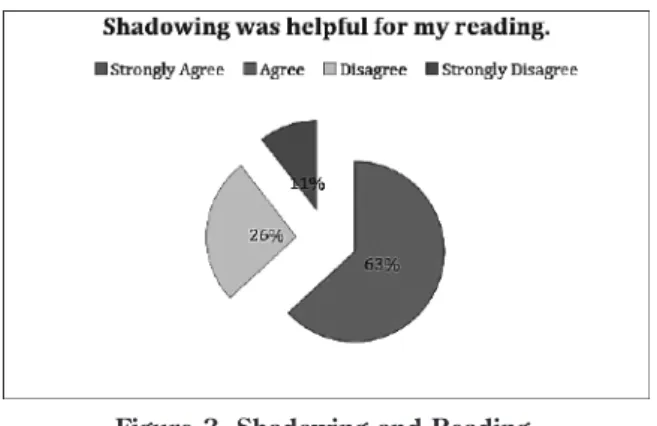
Figure 3. Shadowing and Reading.
The data shows that regarding English reading skills, fewer students agreed that shadowing was beneficial in comparison with speaking and listening skills as only a total of 74% agreed. The percentage of students who disagreed or strongly disagreed with the statement “Shadowing was helpful for my reading” was 26%. There were no students that strongly agreed with this statement. A possible reason for this could be that learners were told to focus on listening to the instructor’s output and focus on replicating their own similar output thus causing students to feel that reading the text was viewed as less important. Furthermore, as shadowing progressed in the lessons, the final challenge was replicating the target language without reading the text but by simply listening to reproduce the language.
Student Responses
Agree because I think by reading aloud the target language I will be able to more quickly use it (in class).
Agree because I can now understand the meaning of words.
Strongly disagree because I felt that it was not related.
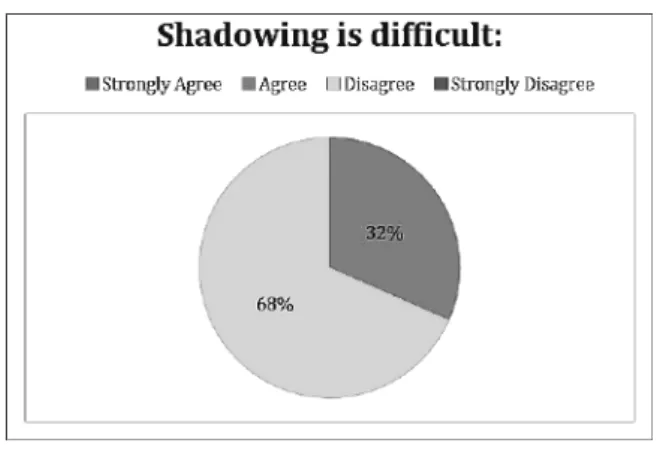
Figure 4. Shadowing’s Difficulty.
In response to the statement “Shadowing is difficult” 68% of students agreed and 32%
disagreed. No students either strongly agreed or strongly disagreed that shadowing is difficult. This reflects the literature about shadowing as one of its biggest challenges is its level of difficulty. Personally as a Japanese language learner who utilizes shadowing in self-study, I felt that I could more easily empathize with many of my students’
comments about shadowing’s challenges. As a result, I focused the majority of the shadowing activities on allowing learners access to a text by reading it as they shadowed.
This lessened the difficulty of relying simply on their listening skills to replicate the language.
Student Responses
Somewhat difficult because it is difficult to pronounce the words accurately.
Somewhat difficult because if I don’t know the words or the pronunciation, I’ll fall behind (from the group).
Somewhat easy because my skills have somewhat improved.
6. Method for Exploration
As shadowing can potentially be confusing and complex, a systematic method for exploration was necessary. The method for exploration is based on a study by Omar &
Umehara (2010) originally from Hayakawa (2004). This method provides steps which can be implemented based on the learners’ needs and the focus of the lessons. Also certain steps can be used or omitted according to time limitations. The method is as follows:
Step 1: Listening without text.
Step 2: Listening with the text while marking pronunciation, stressed or unstressed points.
Step 3: Mumbling with the text.
Step 4: Synchronized/Parallel reading (reading together with the text) and focusing on the difficult points.
Step 5: Comprehension check of the text, for example vocabulary, grammar, etc.
Step 6: Prosody shadowing (reading together without the text).
Step 7: Shadowing smoothly and trying to understand the contents without using the text.
Step 8: Recording the shadowing activity on a device.
Step 9: Listening to compare the listener’s recording with the text. Recoding to identify any points to improve.
Step 10: Reflecting about the experience of shadowing, for example, in a discussion, journal or questionnaire.
7. Possible Approaches
The flexibility of this method will be presented. Depending on the class’ focus, numbers or in a self-study setting, there are possible approaches for implementation. Firstly, the steps focus on developing various skills so one or multiple steps may be used in a lesson or throughout various lessons. In Step 1 listening skills are the focus. For Step 2 the focus is on developing listening and reading skills, while Step 3 and 4 focus on developing listening, speaking and reading skills. Step 5 focuses on reading. Steps 6 through 8 again focus on speaking and listening skills with Step 9 focusing on listening and reading skills. Secondly, for all steps in the classroom the instructor can choose to read the text or use a recording of the text when shadowing with the whole class, in small groups, for pair work or individual students. It seems that if the instructor is not reading the text, using a recording for smaller numbers is advisable so that the learners will be able to focus on duplicating correct pronunciation, intonation and accenting. In self-study or individual study a recording of the text either by CD, with a cell phone or even using videos with subtitles options allow for the implementation of these steps. Lastly, the instructor can use whichever steps are suitable for their learners either alone or in combination and at various times in the lesson. This also applies to those students doing individual or self-study. Steps can be omitted due to time restraints or the required focus of the lessons. For example, Steps 8 to 10 may not be appropriate due to technological and time restraints in a classroom setting. However, for individual or self-study Steps 8 and 9 may be beneficial to the learner as they can concretely evaluate their own output with that of the instructor’ or the recording allowing the learner to identify both their strong and weak points. The adaptability of this method allows for approaches that better meet the needs of the students and teachers.
8. Instructor Surveys
At two presentations and one workshop given about shadowing in 2018, instructors in
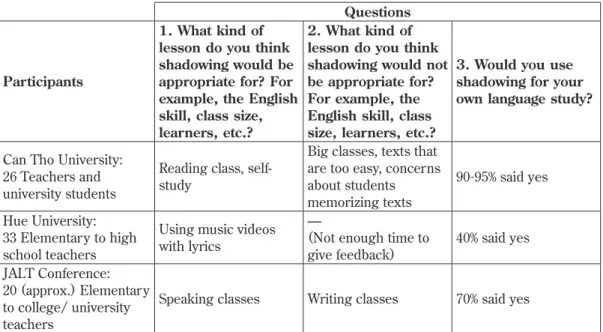
attendance were also informally surveyed to get their feedback about shadowing. The data was gathered from participants who attended either Can Tho University, Vietnam March 19’s presentation; Hue University, Vietnam March 22-23’s presentation or the Japan Association for Language Teaching National Conference, Shizuoka, Japan November 25’s workshop. The participants received information about the shadowing method by Omar & Umehara (2010). There was also an opportunity for them to practice Steps 1 to 7 as a group so that they could experience ways that shadowing may be implemented in lessons and to minimize the possible confusion about the definition of shadowing. Participants were also told about the above possible approaches to shadowing. Approximately 80 participants who were language instructors ranging from elementary school to university levels and university students studying to be English teachers were surveyed. The data is assembled in the following table.
Table 1: Participants’ Feedback about Shadowing Questions
Participants
1. What kind of lesson do you think shadowing would be appropriate for? For example, the English skill, class size, learners, etc.?
2. What kind of lesson do you think shadowing would not be appropriate for?
For example, the English skill, class size, learners, etc.?
3. Would you use shadowing for your own language study?
Can Tho University:
26 Teachers and university students
Reading class, self- study
Big classes, texts that are too easy, concerns about students memorizing texts
90-95% said yes
Hue University:
33 Elementary to high school teachers
Using music videos with lyrics
—(Not enough time to
give feedback) 40% said yes JALT Conference:
20 (approx.) Elementary to college/ university teachers
Speaking classes Writing classes 70% said yes
All the participants shared that they felt shadowing would aid in developing their learners’ speaking, listening or reading skills. They also felt that utilizing shadowing was not appropriate for developing foreign or second-language writing skills. Some also said that if students simply tried to memorize the target language when shadowing, it was not effective. If more time for feedback was permitted, it would have been interesting to learn more from participants to the reasons that they would or would not use shadowing in their own language study as one area that would be useful to discover more about is how these language teachers viewed the importance of using shadowing not only in their teaching but in relation to their role as language learners. Furthermore, another question I would have liked to ask these participants is if they first encountered shadowing in the role of a teacher or student as this could affect how they implement shadowing in their teaching practice. This is because if teachers have also been language
learners who used this technique they may better understand its advantages and challenges.
9. Conclusion
Shadowing has numerous benefits for language learning teachers and students as it can aid in developing multiple skills. Incorporating this technique into segments of foreign language or second language lessons can provide learners with more exposure to the language as well as potentially give them more confidence in using the language.
Instructors can experiment with various styles and methods of shadowing to meet their students’ needs. Furthermore, instructors who are studying a second or foreign language and use shadowing in their own studies could potentially understand some of the challenges that their learners may be experiencing. Areas for future exploration could be incorporating students and instructors’ opinions about shadowing to develop a more collaborative practice of the technique in ELF or ESL language lessons and self- study.
References
Arthurson, D. (2019). “Shadowing: A technique for language learning and a tool for critical reflection” In New Directions in Teaching and Learning English Discussion, 7, 209-215. Retrieved from https://rikkyo.repo.nii.ac.jp/?action=pages_view_
main&active_action=repository_view_main_item_detail&item_id=17631&item_
no=1&page_id=13&block_id=49
Hamada, Y. (2009). The effect of shadowing with different text levels on listening proficiency. Retrieved from https://www.kairyudo.co.jp/general/data/contents/
06-information/07-nakamuraeigo/57/57-03.pdf
Hamada, Y. (2016). Shadowing: Who benefits and how? Uncovering a booming EFL teaching technique for listening comprehension, Language Teaching Research 20(1), 35-52. Retrieved from http://journals.sagepub.com/doi/pdf/10.1177/13621 68815597504
Kojima, S. & Ota, S. (2012). Shadowing, dictation and reading aloud: Which is effective?
Tohoku TEFL: The Japan Association of College English Teachers (JACET) (4), 29-40. Retrieved from https://ci.nii.ac.jp/els/contentscinii_20180306124444.pdf?
id=ART0009913736
Nakanishi, T. & Ueda, A. (2011). Extensive reading and the effect of shadowing. Reading in a Foreign Language, 23(1), 1-16. Retrieved from Google Scholar.
Omar, H. M. & Umehara, M. (2010). Using ‘a shadowing’ technique’ to improve English pronunciation deficient adult Japanese learners: An action research on expatriate Japanese adult learners. The Journal of Asia TEFL, 7(2), 199-230.
Shiota, K. (2012). The effectiveness of shadowing on students’ psychology in language
learning. Accents Asia, 5(1), 71-83.
Sumiyoshi, H. & Svetanant, C. (2017). Motivation and attitude towards shadowing:
Learners perspectives in Japanese as a foreign language. Asia-Pacific Journal of Second and Foreign Language Education, 2(16), 1-21.
Zakeri, E. (2014). The effect of shadowing on EFL learners’ oral performance in terms of fluency. International Journal of English Language Teaching, 2(1), 21-26.
Zarei, A. A. & Jahanbakhsh, F. (2016). The effect of multimedia instruction and shadowing on EFL learners’ reading comprehension. Teaching English Language, 10(2), 73-93.
Appendix - Student Survey
Shadowing Survey|シャドーイングのアンケート
1 Shadowing was helpful for my speaking.|スピーキングの向上にシャドーイングは役に立った。
A Strongly Agree B Agree C Disagree D Strongly Disagree
Optional Because… (Comment|コメント):
2 Shadowing was helpful for my listening.|リスニングの向上にシャドーイングは役に立った。
A Strongly Agree B Agree C Disagree D Strongly Disagree
Optional Because… (Comment|コメント):
3 Shadowing was helpful for my reading.|リーデイングの向上にシャドーイングは役に立った。
A Strongly Agree B Agree C Disagree D Strongly Disagree
Optional Because… (Comment|コメント):
4 Shadowing is:|シャドーイングは:
A Easy 簡単 B. Somewhat easy やや簡単 C. Somewhat difficult やや難しい D. Difficult 難しい Optional Because… (Comment|コメント):
5 Would you like to do shadowing again?|またシャドーイングをしたいですか?
A Yesはい B Maybe 多分 C. No いいえ
Optional Because… (Comment|コメント):